Karl Delossantos

  • ‘Blinded by the Light’ review — Saved by Springsteen

    ‘Blinded by the Light’ review — Saved by Springsteen

    Blinded by the Light follows a teen growing up in 1980s Britain as he discovers who he is through the music of Bruce Springstein

    30-second review: Blinded by the Light has a lot on its mind — for better and worse. Thanks to some inventive musical staging of Bruce Springsteen’s greatest hits like “Dancing in the Dark” and “Born to Run,” director Gurinder Chadha delivers a crowd-pleasing and uplifting musical romp. However, that’s just half the movie. The other half is a raw and heartbreaking look at 1980s Britain under Margaret Thatcher complete with high unemployment and the rise of white supremacy. Sound familiar?

    It’s clear Chadha wanted to explore more than what’s on the surface of the story, and it’s refreshing that a mainstream crowd-pleaser has deeper themes. However, it also feels like there are two movies — the lighthearted and terminally delightful comedy and realistic present-day allegory — battling for the spotlight, which ends up being detrimental to both parts.

    Where to watch Blinded by the Light: Now playing in theaters.

    Full review below ?

    There’s a lot to admire about Blinded by the Light — its ambition chief among them. Just like Javed (Viveik Kalra), the British-Pakistani teen with dreams outside of his small English town, the movie has a lot on its mind.

    It’s 1987 Britain. Thatcher is Prime Minister, the white supremacist group National Front marches in the streets, and the number of jobs is dwindling by the day. Sound familiar? Like many of the feel-good, crowd-pleasing movies before it, Blinded by the Light tackles issues facing our society today through the lens of its character’s lives. To its credit, it avoids being terminally delightful and isn’t afraid to face them head-on.

    And while all these terrible things are happening around him, all Javed can think about is how to get out of his small town and out from under the thumb of his strict, traditional Pakistani father Malik (Kulvinder Ghir). Javed has dreams of becoming a writer. His nose is constantly buried in his journal writing about his day or poems or lyrics for his friend Matt’s (Dean-Charles Chapman) band.

    However, it isn’t until a chance encounter with Roops (Aaron Phagura), the only other South Asian student at the school, that all his musings click. That’s because Roops introduces him to “The Boss” himself — Bruce Springsteen. All the frustrations, thoughts and dreams that Javed has been confused by are encapsulated in Springsteen’s lyrics — and it’s freeing.

    One night when he’s feeling particularly down and throws away all his writing, he pops in a cassette and listens to “Dancing in the Dark.” The lyrics literally swirl around his head and are projected on walls as he twirls around finally feeling seen for the first time in his life. It’s that kind of innovative and impressionistic filmmaking by director Gurinder Chadha (Bend it Like Beckham) that make Blinded by the Light a joy to watch.
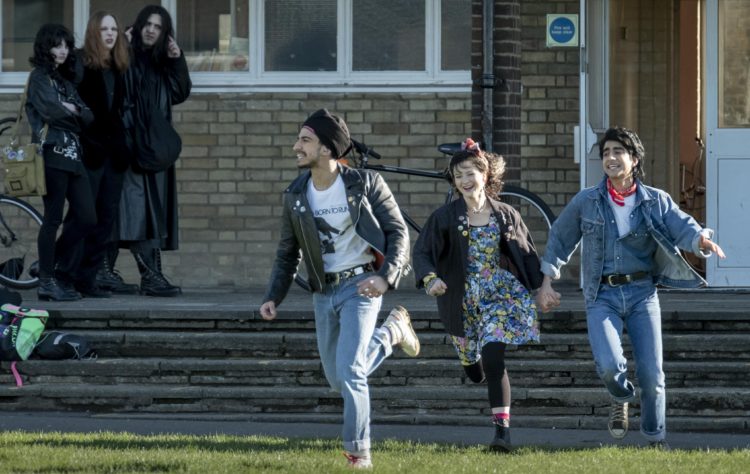
    Kulvinder Ghir, Nell Williams, and Viveik Kalra in Blinded by the Light. Credit: Nick Wall/Warner Bros. Entertainment Inc.

    Inspired and motivated, the usually shy and introverted Javed begins to do things he never thought he’d be able to like demanding to have his work considered for the school paper, showing his writing to his English teacher (Hayley Atwell), and asking out his crush Eliza (Nell Williams). Just as you’d expect, things start going his way as he continues to dive further into Springsteen’s work and evokes him in any way he can — the clothes, the hair, the attitude.

    But the movie doesn’t stop there.

    Javed’s journey is anything but smooth. He’s antagonized daily by white supremacists telling him to leave the country. His father discounts his desire to be a writer and regularly admonishes his love of Springsteen and both British and American culture. All the while, his sister is arranged to be married and his mother Noor (Meera Ganatra doing great work) is working day and night to support the family when Malik is laid off from his factory job.

    Both halves — the lighthearted musical crowdpleaser and the dramatic present-day allegory — are successful in their own right. It’s when the two parts are combined that the movie loses some of its sheen. That’s because it tries to put together two tones that don’t work. There’s an inherent corniness to Javed’s journey. You’ve seen it all before — and that’s fine. But the very real conflicts brought about by the world they’re living in make it all seem trite. Maybe that’s being cynical. I really admire what the movie is trying to do, but it isn’t entirely successful.

    Though, there’s still a lot to enjoy about it. Kalra’s performance as Javed is filled with charisma and charm. It’s impossible to turn away from the screen when he’s on it. And the musical numbers are hard to resist. Then again, most of Springsteen’s songs are hard to resist. And the story of the son of immigrants caught between two cultures is so rich — and explored extremely well in this year’s The Farewell. It’s just a matter of the movie being less than the sum of its parts.


    ADVERTISEMENT


    More movies, less problems


    Hey! I’m Karl. You can find me on Twitter and Letterboxd. I’m also a Tomatometer-approved critic.

    💌 Sign up for our weekly email newsletter with movie recommendations available to stream.


    ADVERTISEMENT


  • ‘Gwen (2019)’ mini-review — Bad times in the Welsh hills

    ‘Gwen (2019)’ mini-review — Bad times in the Welsh hills

    Gwen follows a young girl must keep her family from falling apart as her community turns against them for mysterious reasons.

    60-second review: Dark storm clouds seem to be rolling into the small Welsh village where Gwen takes place constantly — both literally and figuratively. The film is relentlessly dark as the family of women at the center — consisting of mother Elen (Maxine Peake), teenager Gwen (Eleanor Worthington Cox), and youngest Mari (Jodie Innes) — struggles through plight after plight including losing their father to the war, their farm falling apart, and the owners of the nearby mine threatening their land. The movie is appropriately tense, atmospheric, and filled with a sense of dread.

    However, it struggles to do anything with all that tension. Director William McGregor, in his film debut, proves he’s adept at creating a mood of terror and satisfyingly mixes in elements of gothic and folk horror. But the story never takes off. The journey to its conclusion is so well-crafted, engrossing, and seemingly intentional, but it never says more than what’s on the surface. And unfortunately, the conclusion doesn’t do anything but add another layer of darkness on the already grim narrative.

    It’s easy to compare Gwen to Robert Eggers’ 2015 folk horror The Witch as both deal with a young woman coming of age in a complicated family situation and set against the backdrop of a dreary time. However, The Witch has tangible themes and takes a full dive toward horror whereas Gwen stays in the real world, making it less compelling. It’s unfortunate considering there’s so much strong craft on the screen. I want to see more from McGregor. He has the directoral talent, he just needs a good story to tell.

    Where to watch Gwen: Streaming exclusively on Shudder on August 16th.


    ADVERTISEMENT


    More movies, less problems


    Hey! I’m Karl. You can find me on Twitter and Letterboxd. I’m also a Tomatometer-approved critic.

    💌 Sign up for our weekly email newsletter with movie recommendations available to stream.


    ADVERTISEMENT
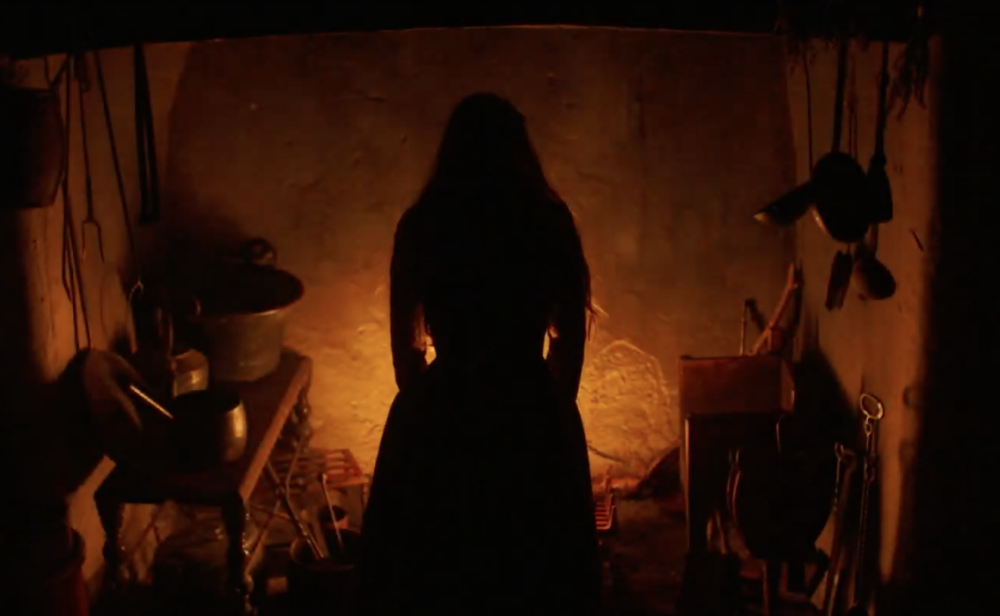

    gwen
    Eleanor Worthington Cox in GWEN. Credit: AMC Networks.
  • ‘The Farewell’ review — One wedding and maybe a funeral

    ‘The Farewell’ review — One wedding and maybe a funeral

    The Farewell follows a New Yorker as she travels to China to say goodbye to her sick grandmother — who doesn’t know she’s dying.

    30-second review: The Farewell is a movie of dichotomies — Chinese culture and American culture, parents and children, mourning and celebrating, youth and old age — that appropriately straddles the line between drama and comedy. Even during dramatic moments, it seems that there’s always something lighter going on in the background to remind us that everything in the movie is based in love.

    It’s so difficult to make the exploration of emotions and family strife entertaining, but director Lulu Wang was able to pull it off by avoiding the melodramatics and instead focusing on the characters, their experiences, and their relationships to each other. It also helps that her Awkwafina is an incredible lead with enough charm to pull you in and the dramatic chops to keep you invested.

    Where to watch The Farewell: Now playing in theaters.

    Full review below ?

    One night when I was 14 or 15, my dad — who immigrated to the United States in the 80s from the Philippines — walked into my room, sat down on my bed and started to cry. I never saw my dad cry, not even when both of my grandparents died. It was out of nowhere. And he started talking about how he felt like he was a bad son because he didn’t take care of his parents enough or let them live in our house as they got older. “We have so much space, they could have just stayed here,” he said.

    I later learned that despite the pleading of most of my aunts and uncles, my grandparents never wanted to move in with any of them, afraid they’d be a burden.

    That’s one of the many conundrums of Asian and Asian-American culture that Lulu Wang‘s film The Farewell explores. The fact that showing your emotions is like burdening other people with it. The worst thing that you can do is worry others. It leads to a lot of emotional repression.

    We learn as we grow up that Eastern and Western cultures are like night and day. So for first-generation Americans like myself or people who immigrated to America as a child like the movie’s protagonist Billie (Awkwafina), the clash is hard to navigate. And she’s thrown into a situation where she needs to face it head on.

    A New Yorker to the bone, Billie steadfastly pursues her dreams while watching her bank account suffer as a result. However, when she finds out from her parents — after a lot of prying — that her grandmother who she calls “Nai Nai” (Zhao Shuzhen) has stage four lung cancer she doesn’t hesitate to fly back to her hometown in China, which she left at the age of six with her parents.

    The Farewell
    Awkwafina and Zhao Shuzhen in THE FAREWELL. Credit: A24.

    The complication is that her entire family including her dad (Tzi Ma), mom (Diana Lin), and uncle Haibin (Jiang Yongbo) have hidden Nai Nai’s true diagnosis from her and instead are visiting under the guise of a wedding for her grandson Hao Hao (Chen Han). In reality, they’re there to say goodbye to her and be with her one last time.

    This leads to plenty of disagreements between Billie and her family based on the differences in cultures, which is explored in more ways than one. However, it also sets the stage for plenty of hilarity as a very real wedding is being put on by Nai Nai even though Hao Hao and his girlfriend Aiko (Aoi Mizuhara) have only been together for three months.

    Even when serious discussions are happening, it always seems like there’s some lightness in the background to remind us that despite the deception it’s all being done out of love. It’s both hilarious and heartbreaking. Awkwafina has proven with roles in Crazy Rich Asians and Ocean’s Eight that she can do the former, The Farewell proves she can also be an emotional powerhouse.

    The movie is made up of these moments where the characters are litigating their decision to not tell Nai Nai the truth. In one scene, Haibin tells Billie that they have to do it so they can bear the emotional burden for her. It makes it all the more tragic because Nai Nai is so full of life and Zhao Shuzhen — who is fully deserving of an Oscar nomination — gives her the richness and sass the character deserves.

    There’s a scene when Billie’s mother asks Little Nai Nai (Lu Hong), Nai Nai’s younger sister, whether she’ll be okay when Nai Nai passes away. She gives a hopeful answer mentioning she wants to travel and maybe visit them in America. She then turns towards her and tells her not to worry about her.

    All any of us want to do — Asian, Asian-American, and otherwise — is to not burden our loved ones with our own problems. That’s the main crux of all the moments that make up The Farewell. It’s all just character’s trying to find ways to make life easier on each other whether it’s sending their kid to America for college or giving their granddaughter money to spend on something special or lying to a grandmother about their health.

    But what Wang brilliantly explores is the consequences of those actions. That kid could never come back or forget their home, the granddaughter would be no better off than they were before, the grandmother could die without properly saying goodbye. She litigates all those decisions without coming down on either side. Instead, she’s on the side of the characters and what they need to go on. Most of them don’t know what that is. But then again, do any of us?


    ADVERTISEMENT


    More movies, less problems


    Hey! I’m Karl. You can find me on Twitter and Letterboxd. I’m also a Tomatometer-approved critic.

    💌 Sign up for our weekly email newsletter with movie recommendations available to stream.


    ADVERTISEMENT


  • ‘Under the Silver Lake’ mini-review — To live and trip in L.A.

    ‘Under the Silver Lake’ mini-review — To live and trip in L.A.

    Under the Silver Lake follows an aimless slacker as he unravels a mystery following the disappearance of his neighbor.

    90-second review: Under the Silver Lake alternates between being incredibly compelling and frustratingly confused. It misses the assuredness of director David Robert Mitchell‘s masterpiece film debut It Follows, because he has to spend so much time navigating the tricky world he created. Sometimes he’s successful — particularly when he explores the series of elite Hollywood parties surrounding indie-pop band “Jesus and the Brides of Dracula” — and sometimes he gets distracted by the weirdness of it all.

    The tone reminds me a lot of Boots Riley’s political satire Sorry to Bother You, but unlike that film Under the Silver Lake lacks the point-of-view and narrative clarity to pull it off. In other words, it’s underdeveloped. Mitchell has so many ideas — both thematic and cinematic — that he wants to explore, which explains the bloated 2 1/2 hour running time. When he focuses in on the central mystery of aimless conspiracy theorist and professional slacker Sam’s (Andrew Garfield) missing neighbor Sarah (Riley Keough), the movie and his vision take shape. But then the potential of the neo-noir fantasy world comes into play and muddies the waters.

    It’s not all bad though. He makes some genuinely interesting choices that prove he was never interested in making another It Follows. And so much of it is bold and funny with a dry wit that keeps it entertaining. A lot of that is thanks to Garfield’s immersive performance that is an almost too-accurate portrayal of a scum bum LA conspiracy theorist. Truthfully, I was never bored with it until it began wrapping up.

    Under the Silver Lake is incredibly frustrating because it feels like you can piece together a good movie from what’s on-screen. Even then, it’s not completely clear what Mitchell is trying to say with it. Is he criticizing Hollywood’s misogynistic culture? Or is he more broadly exploring the LA lifestyle? And then there’s the more straightforward read of a man coping with a difficult time by wrapping himself up in a conspiracy and mystery that isn’t his to solve. Whatever the intention of the movie is, it’s unclear. And that’ll work for some. You’ll either love it or hate it. I’m the rare person in the middle ground.

    Where to watch Under the Silver Lake: Streaming for free on Prime Video.


    ADVERTISEMENT


    More movies, less problems


    Hey! I’m Karl. You can find me on Twitter and Letterboxd. I’m also a Tomatometer-approved critic.

    💌 Sign up for our weekly email newsletter with movie recommendations available to stream.


    ADVERTISEMENT


    Under the Silver Lake
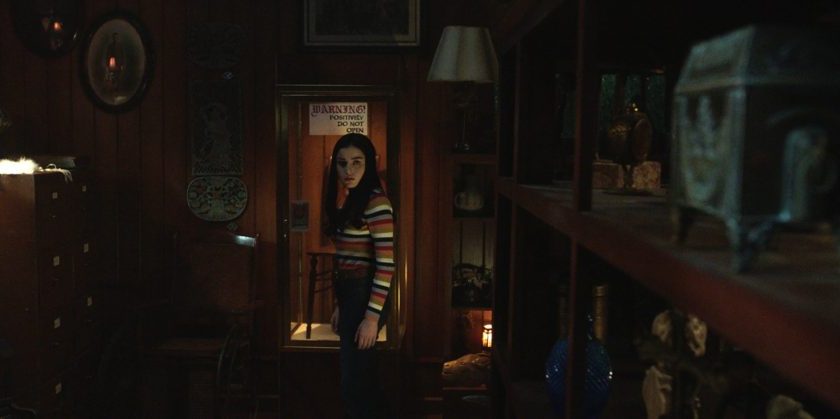
    Grace Van Patten in UNDER THE SILVER LAKE. Credit: A24.
  • ‘The Lion King’ mini-review — Richard Attenborough is shook

    ‘The Lion King’ mini-review — Richard Attenborough is shook

    The Lion King reimagines the 1994 classic animated film of the same name in “live-action” with Donald Glover, Beyoncé, and James Earl Jones.

    90-second review: For a remake to be successful it has to have a reason for existing. And having the technology to make photorealistic animals and environments is almost reason enough for a remake of The Lion King to exist. However, instead of using the technology to tell a story, director Jon Favreau lets the technology dictate what he did. The result is less than inspiring.

    Because the movie is essentially a shot for shot remake, making it “live-action” had to add something to it, which it doesn’t. The times that it works is when the movement of the characters feel cartoonish — particularly the scenes with Timon (Billy Eichner) and Pumba (Seth Rogen), which are the highlight of the film. It also helps that those scenes divert from the source material. Something that needed to happen way more. The actors recorded together, which allowed the dialogue to feel fresh and natural.

    On the other hand, many of the scenes involving adult Simba (Donald Glover) and adult Nala (Beyoncé) fall completely fat without that same chemistry and dynamic style. Instead, they feel manufactured. Just look at “Can You Feel the Love Tonight?” which ironically takes place in the daytime. It plays more like the background of a karaoke video than a pivotal emotional moment in the film.

    The movie is nowhere the disaster that some have made it out to be. The photorealism largely doesn’t work and at times — like the stampede scene — is a hinderence. That still doesn’t stop it from having its moments. “Hakuna Matata” and “The Circle of Life” have as much impact as the original, but is that a reason for existing? The answer is a resounding no.

    Where to watch The Lion King: In theaters now.


    ADVERTISEMENT


    More movies, less problems


    Hey! I’m Karl. You can find me on Twitter and Letterboxd. I’m also a Tomatometer-approved critic.

    💌 Sign up for our weekly email newsletter with movie recommendations available to stream.


    ADVERTISEMENT


    JD McCrary as Young Simba, Billy Eichner as Timon, and Seth Rogan as Pumba in THE LION KING. Credit: Disney Studios
  • ‘Once Upon a Time in Hollywood’ movie review — Tarantino’s Summer of ’69

    ‘Once Upon a Time in Hollywood’ movie review — Tarantino’s Summer of ’69

    Once Upon a Time in Hollywood, Quentin Tarantino’s ninth film, is a romp through the Golden Age of Hollywood.

    30-second review: Once Upon a Time in Hollywood is as well-made, deliciously unhinged, and entertaining as any of Quentin Tarantino’s films. However, the impeccable recreation of 1969 Hollywood — from the sun-drenched cinematography to the lived-in costumes — is impeded by the thin story.

    The characters, both fictional and real, played by Brad PittLeonardo DiCaprio, and Margot Robbie are perfectly constructed — the performances are impeccable — but the narrative they’re thrown into feels shapeless and meandering for much of the runtime. Even when the ending tries to stitch it all together. Though, every scene sticks with you in some way. It’s that impact that has made Tarantino’s work endure. 

    Where to watch Once Upon a Time in Hollywood: In theaters now.

    Full review below ?


    If Quentin Tarantino knows how to do one thing it’s how to name characters. I mean, when you hear the name Rick Dalton you almost picture the washed-up TV cowboy that Leonardo DiCaprio plays. Though Dalton was a star burning bright for much of his career on the fictional show Bounty Law, Hollywood is a town that’s always on the move and it’s leaving him behind. 

    Like many TV stars of the era, he tried to make the pivot to movies to lesser success. In one hilarious scene, he tells the story of how he once almost played Steve McQueen’s part in The Great Escape — complete with DiCaprio superimposed into clips of the film. He laments his career to his best friend, driver, and frequent stunt double Cliff Booth (played by a better than ever Brad Pitt) who has a dark reputation in town as the man who killed his wife and got away with it — which is seen in yet another vignette. 

    Much of the movie is spent hanging out with the duo both together and separately as Dalton films a guest role on another TV western and Booth has a friendly sparring match with Bruce Lee (Mike Moh) and encounters with a curious group of hippies (mainly Pussycat played by Margaret Qualley).

    All the while, we follow young upstart Sharon Tate (Margot Robbie), her husband Roman Polanski (Rafał Zawierucha), and ex Jay Sebring (Emile Hirsch). Yes, we follow Sharon Tate during the Summer of ’69 — a.k.a. the summer of the Manson murders. More on that later. 

    Every scene — all vignettes really — are infused with Tarantino’s trademark style and sharp writing. But as one of the few of his films that isn’t told in chapters, the narrative desperately needed a structure. I can’t quibble with any of the scenes. They’re all entertaining and some hilarious. DiCaprio is better than ever as a semi-high functioning alcoholic trying to prove to himself he can still act. But because his journey doesn’t clearly fit into the larger narrative, so much of it feels pointless. 

    Once upon a time in hollywood
    Brad Pitt and Leonardo DiCaprio star in ONCE UPON TIME IN HOLLYWOOD. Credit: Sony Pictures

    Despite the highly publicized spat between Tarantino and a reporter over the number of lines Robbie has in the film — apparently, more were added in later — Tate looms large in the film. If Dalton is a star fading, she is a star on the rise. She knows it and can’t believe it. Robbie is transfixing on the screen and any fan of Tarantino’s movies knows that following her for no discernible reason is going to pay off in some way — and it truly does. 

    The film’s ending is going to be a make or break moment for audiences. It’s classic Tarantino and theoretically ties the movie together. Whether or not it does is going to be subjective. Honestly, I’m not totally sure how I feel about it just yet. But ultimately, I land more positively on Once Upon a Time in Hollywood than I did his last film, The Hateful Eight, which I had a similar issue with. 

    Most of that is due to the fact that Tarantino is without a doubt a singular filmmaker. No one does what he does and those that try often fail — with the exception of Bad Times at the El Royale, which I loved. Each scene taken on its own is impeccably crafted and stick with you.

    In one scene, Sharon Tate sits in a theater and watches her own performance in The Wrecking Crew smiling as the audience react. In another, Dalton has a conversation with a precocious 8-year-old about his career and the wringer of the film industry. And in perhaps the best sequence of the movie, Dalton attempts to make it through a scene only to flub his lines after which he gives himself an alcohol-induced pep talk which reminds us why DiCaprio is a star. Each described sound uninteresting, but the reason Tarantino has endured is his ability to give each moment impact. Even without a solid story, Once Upon a Time in Hollywood certainly sticks with you.


    ADVERTISEMENT


    More movies, less problems


    Hey! I’m Karl. You can find me on Twitter and Letterboxd. I’m also a Tomatometer-approved critic.

    💌 Sign up for our weekly email newsletter with movie recommendations available to stream.


    ADVERTISEMENT


  • ‘Apollo 11’ documents history like never before | movie review

    ‘Apollo 11’ documents history like never before | movie review

    Apollo 11 assembles incredible unseen footage — from Earth and into space — of the mission to put man on the moon.

    30-second review: It’s almost unbelievable that Apollo 11 is made solely of archive footage. Every shot and camera move feels so intentional. It’s been 25 years since Hoop Dreams became the first and only documentary to be nominated for Best Film Editing at the Oscars. It looks like it’s time for another to join its ranks.

    Apollo 11 has the ability to give you a sense of wonder about real life. It’s one of the best documentaries of the year (decade?) because it doesn’t feel like a documentary at all — it’s a bold and breathtaking exercise in storytelling.

    If you thought the moon landing sequence in First Man was thrilling, then Apollo 11‘s very real footage is going to be sensational for you. In the completely uncut 4-minute shot, you can’t see more than the lunar surface getting closer and closer as a small line of text in the corner tells you how much fuel the Apollo Lunar Module called the Eagle has left and how far they are from the surface.

    Matt Morton’s score, fit for a Hollywood thriller, pulses underneath while you hear Commander Neil Armstrong and Lunar Module Pilot Buzz Aldrin converse with Houston in technical jargon. You know how it ends up. The craft lands and Armstrong becomes the first man to set foot on our moon. It’s the masterful and daring filmmaking that makes it a breathtaking moment in cinema. 

    Apollo 11 is made of those moments. Even the simple ones where we’re sweeping a crowd of onlookers excited to watch the Apollo 11 rocket blast off into space are almost hard to comprehend. Documentary filmmaking like this relies on masterful curation and an understanding of the story you’re trying to tell. The fact that director and editor Todd Douglas Miller was able to find clips that gave off the exact emotion he was looking for is astonishing. 

    Apollo 11 Documentary
    Photo by NASA/REX/Shutterstock (3683583c) (Real lunar mission image) Buzz Aldrin stands beside Lunar Module strut and probe Apollo 11 Moon landing mission – 1969

    It’s so hard to make a clear narrative solely from archive footage. Usually, documentarians need to rely on interviews or voiceovers to fill in the gaps. In Apollo 11, there is none of that. Yet you’re never at a loss for what is happening — even when the jargon becomes too technical — and you’re always in tune to what the overwhelming emotion behind a scene is. 

    Even though it’s a subject we all know about — or at least think we do — the piece that we’re always missing is the emotion — it’s why First Man is so successful. Apollo 11 is brimming with empathy for everyone involved — the astronauts, mission control, and the public.

    Sensational feels like the right word to use when explaining the feeling of watching this movie. Apollo 11 is as thrilling as any sci-fi and emotional as a sweeping drama. It’s an astonishing watch and one of the best movies of the year. 


    ADVERTISEMENT


    More movies, less problems


    Hey! I’m Karl. You can find me on Twitter and Letterboxd. I’m also a Tomatometer-approved critic.

    💌 Sign up for our weekly email newsletter with movie recommendations available to stream.


    ADVERTISEMENT


  • 2020 Oscars — Predictions in every category

    2020 Oscars — Predictions in every category

    Who will be nominated at the 2020 Oscars? Here are our predictions for Best Picture and every category.

    The 2020 Oscars are certain to be one of the most unpredictable yet after an off year. In addition to the most diverse voting body ever, the 2020 Oscars will be held on February 9th, which makes it the earliest Academy Awards ceremony in history.

    Below are my predictions in all 24 categories — as I get to them ?. Come back to this page for updates. I’m going to try to update it once a month until December. Then, I’ll start updating weekly.

    More categories coming soon!


    ADVERTISEMENT


    More movies, less problems


    Hey! I’m Karl. You can find me on Twitter and Letterboxd. I’m also a Tomatometer-approved critic.

    💌 Sign up for our weekly email newsletter with movie recommendations available to stream.


    ADVERTISEMENT

  • ‘Crawl’ movie review — Lesson: Evacuate during hurricanes

    ‘Crawl’ movie review — Lesson: Evacuate during hurricanes

    Crawl follows a college student as she attempts to rescue her father from a pack of aggressive alligators during a Category Five hurricane.

    30-second review: Picture a movie where a father and daughter are trapped in a cramp Florida basement in the middle of a Category Five hurricane by alligators — and you have Crawl. It is exactly the brainless, thrilling, and often ridiculous B-movie that you’d expect — even if it is a bit overly serious.

    It doesn’t do anything to differentiate itself from any other of the countless films with a similar premise — and that’s fine. It makes up for it with anxiety-inducing action scenes and a committed lead performance by Kaya Scodelario.

    Where to watch Crawl: In theaters now. 

    Alligators. Are. Aggressive. Full review below ?


    Take 2016’s The Shallows and replace a secluded Mexican beach with a flooded Florida basement in the middle of a category 5 hurricane, the shark with a congregation of alligators — that’s the right term — and the seagull with an adorable dog named Sugar and you basically have Crawl.

    It has one of the most recognizable movie premises, yet Crawl (mostly) succeeds because of the moments when it takes that premise — and all the familiar beats — and tackles them in an intelligent way.

    The set up is swift and breezy. Haley Keller (played by a spirited Kaya Scodelario) is about to leave town as a category five hurricane is about to bear down on the Florida coast. However, after her sister voices concern that she hasn’t heard from their father (Barry Pepper), she redirects course to go find him. 

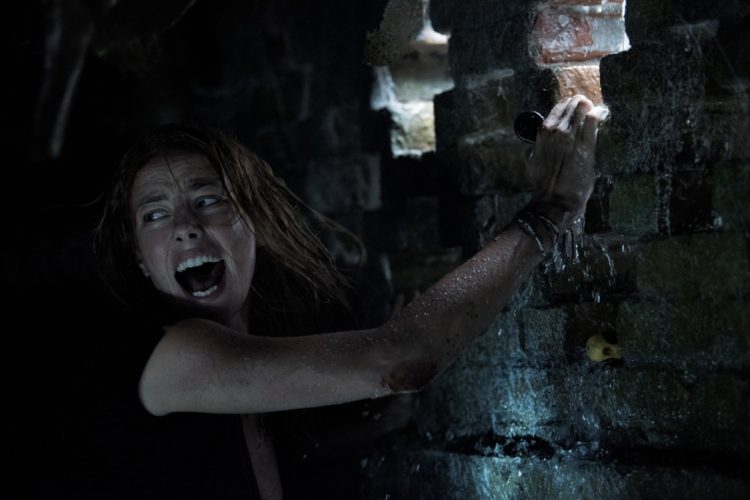
    In her childhood home — under escrow after her parents’ divorce, she follows a set of clues to the cramp, damp, and dark basement — a crawl space really — where her father unconscious and badly injured with a nasty bit on his shoulder and broken leg with an exposed bone. It’s during this scene that I realized Crawl was going to be different. It wasn’t afraid to slowly ratchet up the tension until it was nearly unbearable, instead of going for an easy scare.

    Kaya Scodelario in Crawl. Credit: Paramount Pictures.

    The crafty Haley smartly rolls her father onto a tarp to drag her father to safety, but just as she’s about to climb up the basement steps a massive — and particularly tenacious — alligator attacks the pair. Realizing she’s trapped, Haley and her father come up with different ways to escape from the slowly flooding basement with the lives — and limbs.

    What makes Crawl particularly work is its setting and bleak atmosphere set by director Alexandre Aja (Piranha 3D). Instead of a bright and open beach or an open lake or the Amazon river, Crawl puts so much of its horror in its claustrophobic setting. There’s little room to move, little light, and its filling with water — what’s worse than that? Oh yeah, the alligators. And Aja puts that setting to work with ingenious ways to test the pair as they fight for survival. 

    The second part of the equation comes from Kaya Scodelario’s performance. Just like Blake Lively in The Shallows, she doesn’t phone it in or act like she’s in a B-movie. She goes at it with all she’s got physically, emotionally, and all the badassery of any great final girl. Plus, there’s just enough character development and relationship building between the two leads to make the movie compelling, but not too heavy. 

    Though the movie certainly comes close to overstaying its welcome over its 87 minutes, it’s hard not to be entertained and completely terrified by it. It’s not the most original movie, but in a summer where every blockbuster is a remake or sequel, it’s refreshing to have a (nearly) brainless but well put together one to entertain audiences. I wish it took itself a little less seriously — and had more lines like “Apex predator all day” — but with Crawl what you see is what you get, and that’s perfect.


    ADVERTISEMENT


    More movies, less problems


    Hey! I’m Karl. You can find me on Twitter and Letterboxd. I’m also a Tomatometer-approved critic.

    💌 Sign up for our weekly email newsletter with movie recommendations available to stream.


    ADVERTISEMENT


  • ‘Luce’ movie review — An American (dream) crime story

    ‘Luce’ movie review — An American (dream) crime story

    Luce follows a mystery surrounding a small town’s golden child and him and his parents’ run-in with a teacher bent on his demise. 

    30-second review: Luce is so successful because its story has a clear message and point-of-view it wants to communicate, but director Julius Onah presents it in a completely fresh and original way. Though at its core it’s an emotional family drama, it plays more like a psychological thriller — and sometimes horror. 

    Its twisting plot sometimes gets in the way of its social commentary, but overall Luce is an unpredictable and extremely entertaining exploration of the morals that we built our country on. Plus, Kelvin Harrison Jr. gives an Oscar-worthy performance — he’s a star on the rise.

    Where to watch Luce: Now playing in theaters. 

    Full review below ?

    You’re going to need to suspend disbelief a bit when watching Luce. Not because the world it takes place is any different than ours — it is our world and country — and not because the story is that ludicrous. It’s just clear that the story and characters are designed to deliver a message. An extremely timely message in our polarized political moment. And while many movies have dealt with the strained race relations in our country, Luce is more complex.

    Luce (Kelvin Harrison Jr. following up his breakout in It Comes at Night) is the perfect American success story at his high school in the picturesque suburbs of Arlington, Virginia. Not only is he the captain of the track team, the valedictorian of his class, and star of the debate team, it seems that almost everyone in the school adores him — administrators, teachers, and students alike.

    However, it wasn’t always easy for Luce. We learn that he was adopted from war-torn country Eritrea by white parents Amy (Naomi Watts) and Peter (Tim Roth) Edgar who had the tough rehabilitating the former child soldier. And though they often refer to how rough his childhood and upbringing was, they look at him with pride over his accomplishments.

    There is one person that doesn’t completely buy Luce’s charisma and agreeable demeanor — and trust me when I say Harrison makes you fall for Luce. His American History teacher Harriet Wilson (Octavia Spencer doing her best work in years) is wary of him, especially after reading an essay where he defends African writer Frantz Fanon and his call to combat colonization with violence. To make matters worse, Ms. Wilson searches Luce’s locker and finds a brown bag filled with powerful fireworks. 

    She takes them to Amy who has to decide whether to confront her son or hide that she knows about their existence in the first place. She decides to hide them in a cabinet in their kitchen and hold a confrontation for another time — or never. However, in the twisting narrative of the film, the fireworks are quickly discovered by Luce, which sets off a chain of confrontations and deceptions and moral quandaries ranging in themes from tokenism, race, class, sexuality, nature versus nurture, and even more.   

    Luce movie
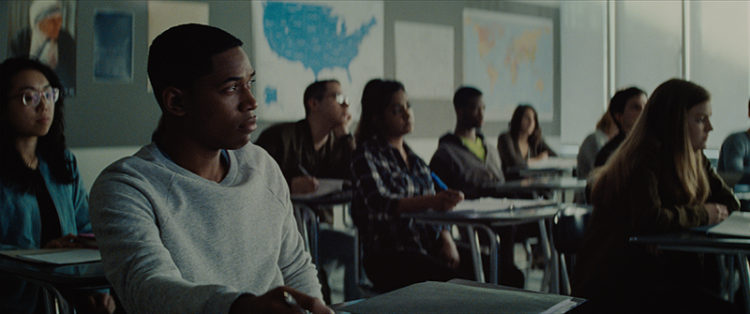
    Kelvin Harrison Jr. in Luce. Credit: NEON.

    Luce operates on multiple levels at once. At the center, there is this central mystery around Luce. How genuine and harmless is he? Is he predisposed to violence because of his background? Did he know about the fireworks? But the discourse runs so much deeper than that. Every character is dealing with some struggle that tests the very fabric of our society. If it sounds dramatic, it is. But it’s never overwrought or sentimental. 

    Though it may seem a bit heavy-handed with its themes and message, that’s the point. The movie is designed to make you question the characters and your loyalty to them. In one magnificent scene, Luce indirectly confronts Ms. Wilson with his knowledge of the fireworks and their discovery. Harrison — who is truly brilliant and Oscar-worthy — makes you question Luce’s motivations by making his delivery both sincere, but with a sinister tinge that is genuinely terrifying. With a few changes in the plot, Luce could easily have been a horror movie. 

    That’s the brilliance of Julius Onah’s direction. He doesn’t allow the movie to be constrained by any one genre as he switches perspectives between Amy, Luce, and Ms. Wilson. Even more, he gives Watts, Harrison, and Spencer room to dive into each of their characters to the point that each feels so lived in, even when the plot gets more convoluted and staged — it is based on a play after all.

    I can’t understate how thrilling it is to watch Luce. You’re kept guessing at every moment. In one scene late in the movie, a character for one second breaks their usual demeanor for a split second in a way that is both endearing and completely terrifying. There are more of those moments throughout. Moments where you don’t know whether to laugh or cringe. If I was watching this on stage, I would applaud. Luce is made of those brilliant moments. Be ready for a ride. 


    ADVERTISEMENT


    More movies, less problems


    Hey! I’m Karl. You can find me on Twitter and Letterboxd. I’m also a Tomatometer-approved critic.

    💌 Sign up for our weekly email newsletter with movie recommendations available to stream.


    ADVERTISEMENT


  • ‘Midsommar’ movie review — Break up with your boyfriend, I’m scared

    ‘Midsommar’ movie review — Break up with your boyfriend, I’m scared

    Midsommar is a Swedish folk nightmare for a couple and their group of friends caught in the middle of a sinister summer ritual

    30-second review: All the tools that Ari Aster used in his directorial debut Hereditary — a film I adore — are on display in Midsommar. It’s impeccably shot and directed with the same unflinching intensity and confidence. However, his sophomore effort lacks two things that prevent it from taking off: a compelling plot and an understanding of its core themes. Still, the movie has all the creeps and disturbing imagery you’d expect — plus an incredible sense of humor.

    Where to watch Midsommar: Playing now in wide release. You can watch Hereditary on Amazon Prime.

    Drink the Kool-Aid. Full review below ?


    I hope Ari Aster is okay. Based on the movies he’s put out so far, he has some things he’s working through. No offense to him, but all the better for us. His directorial debut Hereditary is a modern horror masterpiece that both perfected and upended everything we know about the horror genre. The brilliance of that film comes from its central plot and themes. Strip away the absolutely disturbing and terrifying horror elements and you’re left with a kitchen sink family drama.

    That expectation colors a lot my experience with Midsommar, his sun-drenched and beautifully saturated follow-up that is every bit as disturbing as his first film. And in the opening act, it’s clear that Aster had a perspective. We meet Dani (star on the rise Florence Pugh) mid-crisis. She’s received cryptic emails from her sister — who has a bipolar disorder — that make her think she might harm herself. She calls her boyfriend Christian (Sing Street and Detroit’s Jack Reynor) for support, however, he seems more occupied with his friends.

    Aster wrote the film after a bad breakup, which is clear considering the central couple in the film is struggling with co-dependency issues. And while Christian is ready to pull the plug on the relationship, the revelation that Dani’s sister indeed committed suicide and took her parents along with her — in a stunningly captured but disturbing sequence — keeps the couple together. 

    Midsommar
    William Jackson Harper, Vilhelm Blomgren, Florence Pugh, Will Poulter, and Jack Reynor in Ari Aster’s Midsommar. Credit: A24.

    Sometime later, Christian’s Swedish friend Pelle (Vilhelm Blomgren) invites him and their two other graduate school classmates Josh (William Jackson Harper) and Mark (Will Poulter) to attend a midsummer celebration at Pelle’s home village in northern Sweden. Dani is upset that Christian kept the trip from her, so, out of guilt, he invites her along. 

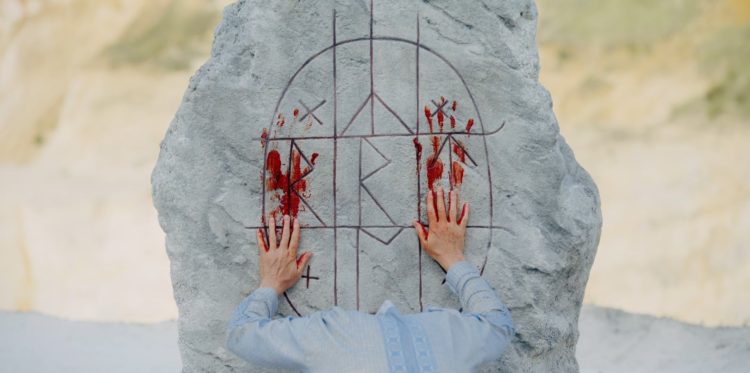
    I don’t need to tell you that things aren’t quite as they seem. Though the villagers are welcoming, they all don cultish garb embroidered with flowers and the commune is just a group of disparate buildings that all seem to serve some ritualistic purpose. The film focuses mostly on the different odd and increasingly upsetting rituals involved in the nine-day celebration that continue to hint to the group that things are not right. 

    And Aster’s so assured in the way he captures these horrific moments. 

    He’s patient with his atmosphere-building and isn’t afraid to sacrifice a big scare for the sake of a slow, unsettling one. In particular, the imagery remains the most off-putting. Without moving the camera he can create dread. However, the film lacks a narrative structure like Hereditary to make those moments add up to anything really. Even the development of the central couple and their troubles are set aside for the pageantry of the rituals — a beautiful as they are, they become repetitive. 

    Midsommar
    Ari Aster’s Midsommar. Credit: A24

    That’s not to say the movie drags. Even at 147 minutes, the movie moves surprisingly fast. That’s thanks to the unexpected humor, much of it delivered by Poulter, that will make you laugh along with the queasiness the horror elements will bring you. Still, though I didn’t regret the time, the movie ends a bit abruptly and without much satisfaction. 

    There’s not much to add because not much happens. There’s a build up and then the ending. There is a shocking moment in the middle of the film — and plenty more later — but as disturbing as it is, nothing really surprises you like Hereditary. That film keeps you guessing until the final moments. Midsommar lets you know what it is pretty early and tries to use that to its advantage to not much avail. 

    The movie comes close to finding the path to success, which involves a refocusing on the central couple instead of the well-constructed, but pointless moments of horror. Either way, it still proves Aster is a masterful horror director that has so much potential in him, he just didn’t access it this time.


    ADVERTISEMENT


    More movies, less problems


    Hey! I’m Karl. You can find me on Twitter and Letterboxd. I’m also a Tomatometer-approved critic.

    💌 Sign up for our weekly email newsletter with movie recommendations available to stream.


    ADVERTISEMENT


  • ‘Spider-Man: Far From Home’ movie review

    ‘Spider-Man: Far From Home’ movie review

    Spider-Man: Far From Home finds Peter Parker at a crossroads following the fallout of Avengers: Endgame

    30-second review: Spider-Man: Far From Home has the same quirkiness that made Homecoming so successful, but a predictable plot and poor pacing keep it from reaching its predecessor’s heights. However, it also gives us the best interpretation of the “with great power comes great responsibility” theme.

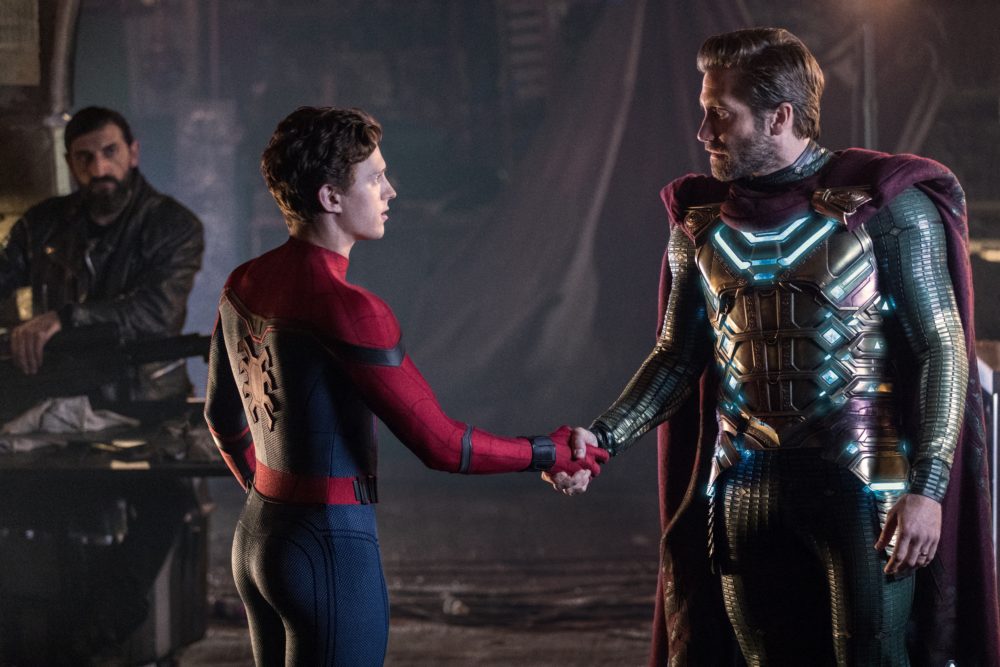
    Tom Holland cements his place as the best actor to portray Spider-Man in Far From Home. But, as a whole, the movie has trouble balancing Peter’s character development with its quirky tone and less than exciting plot. Although, it is still a delight to watch and Jake Gyllenhaal gives a wonderfully bizarre performance.

    Where to watch Spider-Man: Far From Home: Now playing in wide release.

    Don’t forget to pack your suit. Full review below ?


    Spider-Man: Far From Home mostly succeeds in its near-impossible task of following up Avengers: Endgame one of the best entries in the Marvel Cinematic Universe and a quasi-series finale for the “Infinity Saga.” However, it’s clear that the impact of the events of Endgame are going to weigh heavily on the franchise as it moves forward — for better or worse.

    Picking up almost immediately after The Avengers defeat Thanos — losing a few beloved characters on the way — Far From Home does quick work of establishing us in a new reality. Thanos’ snap, known as the blip, has certainly had a massive effect on the planet, but to the happy-go-lucky teen ensemble, all is the same. Other than the fact that half of their classmates have aged five years while they remained the same age. 

    Peter Parker (Tom Holland) is looking forward to a class trip across Europe to take some time away from being Spider-Man and, more importantly, finally profess his true feelings for MJ (Zendaya). Of course, not everything goes quite to plan.

    Nick Fury (Samuel L. Jackson) seeks Peter our to help a new superhero named Quentin Beck (Jake Gyllenhaal) battle monsters made of the four elements — earth, fire, water, and air. However, he’s hesitant to help. Partially because he’s on vacation, but also because the image of a memorialized Tony Stark haunts him everywhere he goes. 

    Spider-Man: Far From Home
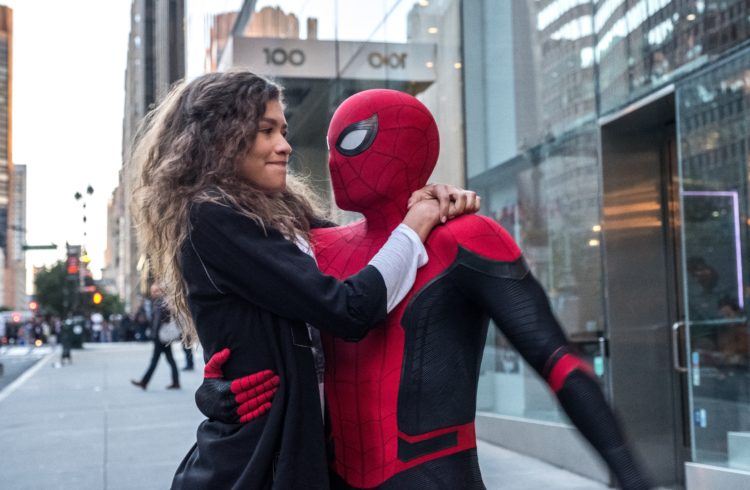
    Michelle (Zendaya) catches a ride from Spider-Man in Columbia Pictures’ SPIDER-MAN: ™ FAR FROM HOME.

    Homecoming succeeded when it didn’t try to be a Spider-Man movie and was instead a high school coming-of-age. Far From Home, on the other hand, works so well as a Spider-Man movie — one where Peter directly deals with the “with great power comes great responsibility” adage — but is bogged down by the same quirkiness that made Homecoming so great — Jacob Batalon does great work as Peter’s geeky best friend Ned, but isn’t given enough to do to make the same impact he did in the last film.

    It doesn’t help either that the first half of the film is jarringly paced as it races towards one of the least surprising twists in an MCU film. However, once that’s out of the way, the second half has tons of fun moments, including an Inception-like action scene that is as impressive as it is terrifying and perfectly weird Gyllenhaal performance that just leaves you wanting more.

    And though the movie doesn’t completely work, it solidifies Tom Holland as the best incarnation of Spider-Man. Holland’s ability to translate emotion on screen — and more importantly the emotion of a 16-year-old — carries the movie past the finish line. Where the movie fails in development, he makes up for in performance. Without a doubt, he’s a movie star.

    Far From Home isn’t everything I hoped it would be. It’s a middle tier entry in the franchise at best, but it does serve as a bridge between the past and the future of the MCU. Trust me, you’re gonna want to stick around for the mid and post-credits scenes. Those scenes alone tell us what the MCU needs to do to continue working — it needs to break its own mold and start taking risks. 


    ADVERTISEMENT


    More movies, less problems


    Hey! I’m Karl. You can find me on Twitter and Letterboxd. I’m also a Tomatometer-approved critic.

    💌 Sign up for our weekly email newsletter with movie recommendations available to stream.


    ADVERTISEMENT


  • ‘Annabelle Comes Home’ movie review — Ghost adventures in babysitting

    ‘Annabelle Comes Home’ movie review — Ghost adventures in babysitting

    Annabelle Comes Home is Adventures in Babysitting by way of an evil possessed doll that wants to steal your soul. Groovy.

    One sentence review: Annabelle Comes Home uses all the tricks in The Conjuring playbook to be one of the scariest and most entertaining movies in the franchise. The movie succeeds by going back to basics. Like the original film, it’s slow, deliberate, atmospheric, and most importantly, terrifying. It also carries on the tradition of inventive scares using some classic tactics — but it also isn’t afraid to subvert expectations. It’s the best film since the original.

    Yet, it’s still a step-down and a great example of why we need to move away from franchises. By being part of a cinematic universe, Annabelle Comes Home allows itself to be formulaic. That formula works but requires additional unique elements to keep it afloat. This movie comes close to having those elements but doesn’t quite get there.

    Where to watch Annabelle Comes Home: Now playing in wide release.

    Grab a crucifix and some holy water. Full review below ?


    You would think that Annabelle Comes Home, the seventh film in The Conjuring universe and the third Annabelle film, is doomed to fail. The franchise has been losing steam as of late, especially after two of the worse entries in the unlikely horror franchise — The Nun and The Curse of La Llorona, which is already a film that doesn’t exist. However, with The Conjuring stars Patrick Wilson and Vera Farmiga reprising their roles as demonologists Ed and Lorraine, Annabelle Comes Home finds itself by leaning on what made the original film so good in the first place. 

    The movie starts where The Conjuring starts. Ed and Lorraine help two young women who are being terrorized by a doll named Annabelle, which is possessed by a demonic entity intent on possessing a human. As they are taking the doll to their home to be blessed and put somewhere it can’t do harm — although that clearly doesn’t work out — they are blocked by a car accident that requires them to take a detour leading to an atmosphere-setting cold open that lets you know you’re in for a ride. 

    The Warrens lock Annabelle in a room that is filled with haunted and cursed items ranging from a suit of Samurai armor to a wedding dress to a pile of gold coins. Then, we meet the real protagonists of the film. While the Warrens are away, their daughter Judy (Mckenna Grace) is put in the care of high schooler Mary Ellen (Madison Iseman), who, unlike most babysitters in movies, is actually pretty great. Her friend Daniela (Katie Sarife) is the real trouble maker. 

    When she learns what the Warrens do for a living, she weasels her way into the house under the guise of helping Judy celebrate her birthday, but she has other plans. She makes her way into the locked room and, as the trailer emphasizes, touches everything — including Annabelle. From there, the movie is a twisted and terrifying haunted house horror as each of the girls in the house — and Mary Ellen’s suitor Bob (Michael Cimino) — are harrassed by the unleashed entities. 

    While The Conjuring is certainly a more artful horror film, Annabelle Comes Home is a pure mainstream crowdpleaser — but it still does a lot of what made the original film in the franchise work. Mainly, it doesn’t always go for the easy scare. It lays in weight. It builds tensions. And then it snaps. While Annabelle Comes Home does quite have the same patience, it makes up for it in pure moments of terror. This movie is terrifying from beginning to end and has little reprieve. 

    It also pulls the wrong lessons from The Conjuring 2 and The Nun and features a bit too many CGI-based scares, but they’re not enough to derail the film. Overall, a mix of good old fashioned scares, interesting characters, and an ever-expanding universe of creatures keep this franchise alive and well. 


    ADVERTISEMENT


    More movies, less problems


    Hey! I’m Karl. You can find me on Twitter and Letterboxd. I’m also a Tomatometer-approved critic.

    💌 Sign up for our weekly email newsletter with movie recommendations available to stream.


    ADVERTISEMENT
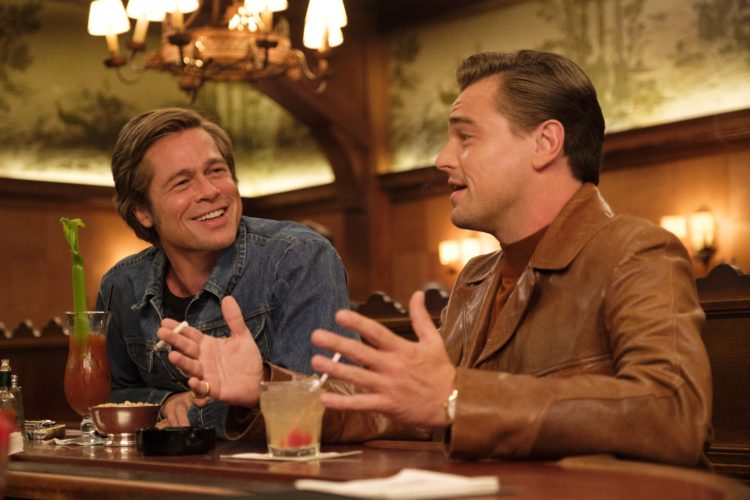

  • ‘Dark Phoenix’ movie review — The X-Men civil war

    ‘Dark Phoenix’ movie review — The X-Men civil war

    Dark Phoenix finds the X-Men fighting each other as they try to save Jean Grey — and the world — from herself

    30-second review: There’s something off about nearly every element of Dark Phoenix. The dialogue is overly-written to the point that you can predict a line before it’s said, the performances are unmotivated, the story is too familiar, and the action scenes lack stakes. However, they’re also not off enough to be interesting. The biggest problem with the film is that it’s bland.

    It’s unfortunate considering the “Dark Phoenix” storyline is a staple of the X-Men canon. Sophie Turner and James McAvoy try to do something interesting with the material, but they’re hindered by the movie’s inability to bring anything new to the table. We’ve seen it all before. For the superhero genre to stay alive it needs innovative. Dark Phoenix is stuck in the past.

    Where to watch Dark Phoenix: Available to buy or rent on Amazon.

    Full review below ?


    Full disclosure: I haven’t read and am not familiar with the X-Men comics. What I do know is that the Dark Phoenix saga — also explored in X-Men: The Last Stand — is one of the series’ biggest storylines. The main crux of it finds Jean Grey (Sophie Turner) turned into a conduit for a powerful alien energy force that corrupts her and turns her into an unstoppable and uncontrollable force.

    In Dark Phoenix, written and directed by Simon Kinberg — who wrote three previous X-Men movies — Jean and the other X-Men are tasked with rescuing a shuttle full of astronauts after their spacecraft is disabled by a mysterious floating solar flare. They’re successful in their mission, but Jean is nearly killed when the energy reaches the shuttle with her still in it. However, instead of killing her, she absorbs the energy and returns back to Earth with the other X-Men.

    The film, which takes place ten years after the events of X-Men: Apocolypse, sees the X-Men living in a world where mutants and humans now live in harmony — mostly thanks to the work Dr. Charles Xavier (James McAvoy) has done to bridge the divide by using the X-Men to protect humanity. At one point, he even references the term “superhero.”

    The movie tries to create a Civil War-esque divide between Xavier and Mystique/Raven (Jennifer Lawrence), who thinks that the work they’re doing to be heroes in the eyes of the humans is demeaning as they risk their lives to save theirs. And it’s an interesting theme, but the movie explores it with no passion — and the performances, in turn, have no passion either.

    The main storyline, though, follows Jean as she struggles to control her newfound powers that push her to destructive ends, especially as she learns the truth about her past. Early on — and spoiled in the trailers — one of her destructive spells leads to the death of Mystique, which creates a fissure between the X-Men. On one side, there’s Charles, Scott/Cyclops (Tye Sheridan), Ororo/Storm (Alexandra Shipp), and Kurt/Nightcrawler (Kodi Smit-McPhee). On the other, there’s Erik/Magneto (Michael Fassbender) and Hank/Beast (Nicholas Hoult) — they both seek revenge on Jean for the death of Raven — along with Erik’s minions.

    However, like everything else in the movie, the team turning on each other is half-hearted and doesn’t feel rooted in anything tangible. The movies up to this point haven’t laid the groundwork for us to care about Jean’s fate — or the fate of anyone on the team.

    A more interesting storyline involves a shape-shifting alien race that has come to earth to harness the energy in Jean and, in turn, claiming the Earth as their own. Jessica Chastain, who plays the human form of the lead alien, does her best to make her character a compelling villain. But the storyline feels secondary and means to the final battle that, while entertaining, lacks stakes.

    Dark Phoenix is likely the last X-Men movie in this form as the property is absorbed by Disney and the Marvel Cinematic Universe. Maybe that’s why it lacks passion. It certainly doesn’t help that it comes on the heels of Avengers: EndgameTruly, the movie isn’t a disaster. But even that would be more interesting than what we got.


    ADVERTISEMENT


    More movies, less problems


    Hey! I’m Karl. You can find me on Twitter and Letterboxd. I’m also a Tomatometer-approved critic.

    💌 Sign up for our weekly email newsletter with movie recommendations available to stream.


    ADVERTISEMENT


  • ‘Rocketman’ mini-review — The bitch is back

    ‘Rocketman’ mini-review — The bitch is back

    Rocketman follows the meteoric launch and the explosive fall of one of music’s most iconic artists, Elton John.

    90-second review: Let’s get the Bohemian Rhapsody comparison out of the way early. Rocketman is the better film. Not only is it competently made, it’s not just a paint-by-the-numbers biopic that plugs in the right plot points in at the right time — for the most part.

    Director Dexter Fletcher, who was brought in to save Rhapsody after he who should not be named was fired, had a clear creative vision for Rocketman that was worthy of its theatrical subject. Much of the movie plays like a musical with fully choreographed numbers, duets, and 11 o’clock soliloquies — the “Crocodile Rock” and “Rocket Man” sequences are standouts. Making this choice differentiates the movie from the typical biopic about a musician.

    Taron Egerton evokes Elton John without feeling like he’s doing an impression. His performance and voice are remarkable. Jamie Bell also does great work as Bernie Taupin, John’s longtime friend and musical collaborator. But the character also uncovers one of the biggest problems in Rocketman.

    While the movie goes to great lengths to not just hit plot point after plot point in Elton John’s life, it also spends too much time on his long struggle with drug and alcohol addiction rather than looking at how it affected the people around him. There are moments when we dig a little deeper into his relationship with Taupin, which are some of the strongest scenes in the movie, but they’re few and far between.

    Overall, Rocketman is a worthy portrayal of the life of one of our greatest living musical artists and gives Egerton an incredible spotlight role in his career. Pay attention, he’s going to win an Oscar one day.

    Where to watch Rocketman: Available to buy or rent on Prime Video.


    ADVERTISEMENT


    More movies, less problems


    Hey! I’m Karl. You can find me on Twitter and Letterboxd. I’m also a Tomatometer-approved critic.

    💌 Sign up for our weekly email newsletter with movie recommendations available to stream.


    ADVERTISEMENT

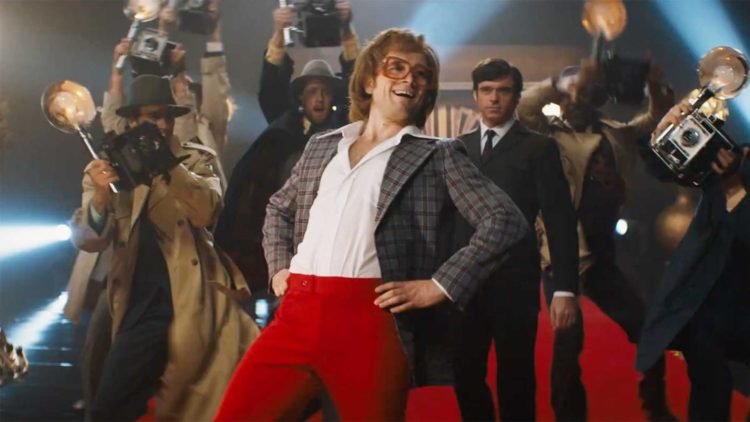
    Taron Egerton and Richard Madden in ROCKETMAN. Credit: Paramount Pictures