Karl Delossantos

  • ‘Falling For Christmas’ review: Lindsay Lohan is back

    ‘Falling For Christmas’ review: Lindsay Lohan is back

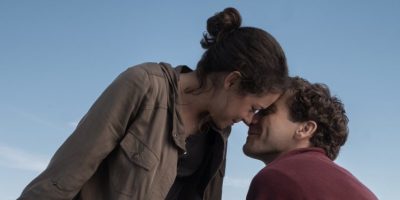
    A spoiled ski resort heiress finds herself in the care of a well-to-do lodge owner after losing her memory in an accident in Falling For Christmas

    Falling For Christmas is in many ways a classic corny holiday-themed romantic-comedy complete with over-the-top camp characters, ridiculous physical comedy, corny but sweet romantic gestures, and a gay awakening with a mountain man named Ralph. Wait a second. Okay, maybe it’s not your classic holiday rom-com. Instead, the Netflix original is a tongue-in-cheek send-up of the genre, something its star Lindsay Lohan is completely dialed into. No one is taking the material too seriously, and that, ladies and gentlemen, is camp.

    A little bit Overboard and a little bit It’s A Wonderful Life, Falling for Christmas is an easy holiday watch for the girls, gays, and theys.

    Sign up for our newsletter to get notified when we publish our full review.


    ADVERTISEMENT


    More movies, less problems


    Hey! I’m Karl. You can find me on Twitter and Letterboxd. I’m also a Tomatometer-approved critic.

    💌 Sign up for our weekly email newsletter with movie recommendations available to stream.


    ADVERTISEMENT


  • ‘Black Panther: Wakanda Forever’ helps us grieve together | review

    ‘Black Panther: Wakanda Forever’ helps us grieve together | review

    Black Panther: Wakanda Forever follows the nation as it navigates grief, politics, and new enemies after the death of King T’Challa.

    • Black Panther: Wakanda Forever is closer to a drama meditating on loss and grief than it is a comic book movie. Even when those elements come in, they’re tied into the plot.
    • The tone of the movie is notably more somber than other Marvel Cinematic Universe movies. Although there are flashes of humor, director Ryan Coogler never strays far from the movie’s darker undertones.
    • The first and last scenes are the most dramatically satisfying and moving in any MCU movie. Letitia Wright, Danai Gurrira and Angela Bassett’s performances become the movie’s heart in Boseman’s stead. Not by replacing him, but by continually reminding us of his impact.
    • Tenoch Huerta is a revelation. A goddamn STAR. His Namor constantly feels dangerous, but finds complexities in his motivations and very existence. Like any good villain (anti-hero?), he very nearly convinces you that he is right. He also very nearly runs away with the movie.
    • The first half has a perfect rhythm. It kept my heart pounding and eyes on the verge of tears. The second loses momentum as it expands its worldly themes. Still, Coogler knows how to keep you in. Along with Chloe Zhao and Sam Raimi, he’s the MCU’s future.

    By the time the Marvel logo came up at the start of Black Panther: Wakanda Forever, this time with a purple background rather than its usual trademark red, I was already on the verge of tears. There’s a melancholy in those opening minutes that we haven’t yet seen in a Marvel Cinematic Universe movie. The real raw human emotion that has mostly gone untapped in the franchise hits you like a gut punch — and we all know why. While director-writer Ryan Coogler was still in the middle of writing the script, star Chadwick Boseman died from colon cancer. Something unknown to Coogler and producer Kevin Feige. There wasn’t a world that they, or we, imagined without Boseman as T’Challa, the Black Panther and King of Wakanda. Now faced with his absence, they had to go back to the drawing board. What they came up with was exactly that: his absence.


    ADVERTISEMENT


    Instead of shying away from his death or recasting the character, Coogler unflinchingly faces grief and loss head-on dealing with each surviving character’s struggles and how they deal with his absence. The details of T’Challa’s death aren’t specific. A mystery illness with no cure that quickly and quietly led to the King’s demise despite his sister Shuri’s (Letitia Wright) attempts to recreate the heart-shaped herb in a last-ditch effort to save him. It’s her grieving process — and guilt — that propels us for the first half of the movie as we learn of the geopolitical implications of T’Challa’s death including the rise of his mother Queen Ramonda (Angela Bassett) as the head of the nation. Seeing an opening, other nations are seeking to share in Wakanda’s supply of vibranium going as far as raiding outposts with the substance. Queen Ramonda gives an impassioned speech in front of the United Nations — one of many stellar moments of Bassett’s performance in typical Waiting to Exhale mic drop car-burning fashion — accusing them of taking advantage of their supposed weakness.

    And she’s right. Shortly after we see an American ship using a machine designed to find vibranium deposits encounter a potential supply at the ocean’s floor. However, before they can even get so much as a glance at it, they are ambushed by a group of blue amphibious humanoids that easily dispatch with the crew before one cloaked in shadow (with wings on his feet) single handedly takes down a helicopter. We come to learn that this is Namor (newcomer Tenoch Huerta). Or as he says with perfect supervillain delivery: “my people call me K’uk’ulkan, the feathered serpent god. My enemies call me Namor.”

    Like the first movie, Wakanda Forever moves rhythmically for the first half. Composer Ludwig Göransson — he won the Oscar for the first movie — expands the score’s musical language to work with Coogler’s melancholy tone and the political intigue of the plot. In some ways, the movie feels like a noir — albeit a brightly lit and action-oriented one. The mystery of Namor and his people, the Talokan, fuel much of the setup. Namor’s introduction — easily breezing into the (nearly) impenetrable Wakanda for a conversation with Queen Ramonda and Princess Shuri — is a showcase for Huerta. He explains to them that Wakanda’s cooperation with the outside world puts his own underwater kingdom at risk, so he tasks them with bringing the scientist responsible for creating the vibranium-detecting machine to him to kill.


    ADVERTISEMENT


    This sets off a series of moral, political, and personal dilemmas as Queen Ramonda looks to protect her nation and Princess Shuri discovers that there’s more in common between her people and her supposed enemy. Throughout the movie, but especially in the first half, Coogler is in the pocket — completely in rhythm with the story he’s telling. Nearly every single element that made the first movie the first (and still only) comic book movie to be nominated for Best Picture at the Oscars is even further elevated, especially the costumes by Ruth E. Carter and production design by Hannah Bechler. Coogler himself is more visually daring, presenting action setpieces and fights that feel dangerous.

    However, Black Panther: Wakanda Forever begins to come apart when it has to consummate its very sensitive exploration of grief with the demands of a comic book movie. And often in the second half, those two elements are in direct opposition to each other. Coogler does his best to use Shuri’s emotional journey to hold the two together, but in the end there are a few jumps the audience needs to make to believe in where the story ends up. The element that is successful at briging those two ideas together is Huerta’s Namor.


    ADVERTISEMENT


    The backstory of the Tatoklan almost begs for its own movie and gives the themes of grief, loss, and trauma structure. Much of this is in thanks to Tenoch Huerta’s revelatory performance. He is a goddamn star. His Namor constantly feels dangerous, even just with his words — especially important as comic book movies become increasingly predictable. However, he finds complexities in his motivations. Like any good villain he very nearly convinces you that he is right. In a way, he’s not even a villain, but an anti-hero in his own story. 

    Black Panther: Wakanda Forever is for better and worse emblematic of the fourth phase of the Marvel Cinematic Universe. Rather than returning to the same formula that made the franchise a success, Coogler pushes the narrative and artistic boundaries to create a flawed but ultimately satisfying chapter.


    ADVERTISEMENT


    More movies, less problems


    Hey! I’m Karl. You can find me on Twitter and Letterboxd. I’m also a Tomatometer-approved critic.

    💌 Sign up for our weekly email newsletter with movie recommendations available to stream.


    ADVERTISEMENT


  • ‘Till’ breathes life into American history | movie review

    ‘Till’ breathes life into American history | movie review

    Bringing a piece of American history to life, Till is the story of a mother’s love as a woman fights for justice after her young son is murdered in the 1950s

    The name “Emmett Till” is one that is often thrown around. He is one of a handful of Civil Rights figures (along with Rosa Parks, Martin Luther King Jr., and Malcolm X) that have permeated the culture to the extent that they are mentioned on the half page allocated to the “Civil Rights Movement” in American History textbooks. (He even made his way briefly into my conservative Christian education in rural Michigan). Perhaps you know that he was a 14-year-old Black boy who was lynched in Mississippi. Perhaps you have seen the photos of his body that were used to showcase the horror of racism. But for many, Emmett Till remains a distant historical figure rather than a real human, even though his murder only took place 67 years ago (for context, he’d be the same age as Bernie Sanders and Martha Stewart if he was still alive). Till, Chinonye Chukwu’s film which premiered at the New York Film Festival on October 1, seeks to make Emmett Till a human once again.


    ADVERTISEMENT


    In a Q&A after the press and industry screening of the film Chukwu outlined three non-negotiables she stipulated when she was approached to direct Till. First, she did not want to show violence against Black bodies directly. Second, she wanted the film to begin and end with moments of joy. And third, she wanted to center the story of Emmett Till around his mother Mamie Till-Mobley. All three of these choices contribute to breathing life into a story that has become more myth than real-life, especially for non-POC Americans.

    In recent years we’ve seen an increasing number of films that could be labeled “trauma porn” whether those be brutal depictions of violence against Black people (like in Antebellum), against women (as with Blonde), against queer people (see the recent “Bury Your Gays” trope), or against those with mental health issues (The Son’s manipulative plotting comes to mind). It could have been easy to steer into the horrific, graphic violence committed against Till here with long, grizzly lynching scenes, but Chukwu deftly steers away from that while still presenting a powerful, unflinching portrait of what happened to Till. 


    ADVERTISEMENT


    The casting of the cherubic, exuberant Jalyn Hall as Emmett (who goes by “Bobo”) instantly gives the film a lightness in its early sections, although those are obviously complicated with the dread we as the audience feel knowing what is coming. Hall plays Till as a goofy, sometimes lazy, always sweet, smiley little boy, the type of child we’ve all met, and the type we know can accidentally wander into trouble. Just how quickly things escalate, however, clearly illustrates the dangers that even innocent Black children were subjected to then (and unfortunately still today far too often).

    The centerpiece of the film, of Chukwu’s directing, and of Till’s emotion is Danielle Deadwyler’s portrayal of Emmett’s mother. Deadwyler (who you may know from last year’s The Harder They Fall or Station Eleven, both of which show her dizzying range as an actor), gives one of the most tremendous, full-bodied performances of the year. As Emmett’s loving protective mother early on, as the heartbroken, grief-stricken mourner in the film’s center, and as the persistent, determined fighter in the third act, she builds a mountain of Oscar-worthy moments. Especially in several long takes, Deadwyler proves herself as an actor Hollywood should be watching. The strength and subtlety of her performance is the best thing about the film (and one of the best performances of 2022). The film succeeds largely because of Deadwyler’s performance, and its ability to deliver to the audience the full emotional weight of the lynchings without the graphic violence mostly falls on the shoulders of her portrayal. Some credit for this performance must be given to Chukwu, who captured an equally powerful performance from Alfre Woodard in her 2019 drama Clemency.


    ADVERTISEMENT


    While the true story is one that needs to be told, and the performances are tremendous, they are slightly undercut by the technical elements of the film. Up against a slew of big-budget, artistically nuanced period pieces (Noah Baumbach’s White Noise premiered the day before at NYFF, and The Fabelmans, Empire of Light, and The Women King are all swirling through this year’s awards conversations), Till feels a bit chintzy at times. Some scenes are obviously green screen, the production design is underwhelming, and the sets often feel more like walking into a Cracker Barrell than the 1950s. The film, which was produced by Whoopie Goldberg and documentarian Keith Beauchamp, among others, was not a project to get greenlit do the uncomfortable subject matter, and I would imagine the financing was not on the level of recent productions from behemoths like Netflix or Amazon. One wonders whether the film’s weak spots in the technical areas are a result of filmmaking choices or the movie’s small budget given Hollywood’s longstanding reluctance to financially support projects with Black voices at the center (especially ones that focus on racism). I tend to think the latter, and hope that someday soon we’ll get to see Chukwu work with the budgets given to her white, male counterparts.

    Certainly not a flawless film, but one that triumphs repeatedly in many ways, Till accomplishes much of what it sets out to do. It gives new life to Emmett Till. It showcases the work of his mother as a Civil Rights activist. It delivers a tremendous Oscar-worthy central performance. And it manages to tell a terrible, terrible story without being overly graphic or shying away from the horrors, all while being approachable to a larger audience (a nearly impossible tightrope walk that Chukwu should be commended for walking). Till makes the (too near) past present and full of life, and hopefully reminds viewers that Emmett Till is more than just a name and a series of black and white photographs.


    Hey! I’m Matt. You can find me on Twitter here. I’m also a staff writer at Buzzfeed.


    ADVERTISEMENT


  • ‘Halloween Ends’ is not a Halloween movie (and that’s a good thing) | movie review

    ‘Halloween Ends’ is not a Halloween movie (and that’s a good thing) | movie review

    Forty-four years after Laurie Strode survived Michael Myers’ massacre, she goes up against a familiar enemy in Halloween Ends.

    Halloween Ends shouldn’t work—and almost doesn’t. It’s an absurd and deeply weird interpolation of the Halloween lore that feels less like another installment and more like a story within its world—like Halloween III: Season of the Witch. However, the audacity to take a risk with its story—and to go so far as making it closer to a drama than a horror—is both admirable and surprisingly entertaining. “Fanboys” looking for the movie to up the gore and kills will be disappointed—and perhaps those looking for a satisfying conclusion to Laurie Strode’s saga will too. However, some, like me, will tune into its off-the-wall wavelength and find the good in it. Halloween Ends will divide audiences. However, it will also get people talking—for better or worse.

    Halloween Ends is so absurd and deeply weird that it’s impossible not to at least appreciate its audacity—something that so-called “fanboys” of the original are going to detest. However, as a critic that lists the original 1978 Halloween as one of my favorite movies of all time, I can say that I’m kinda obsessed with how Halloween Ends feels nothing like the rest of the series—like an interpolation of the story rather than a continuation. That’s no more apparent than the movie’s bold 10-minute cold open that begins a year after the events of Halloween Kills as we follow Corey (Rohan Campbell), a directionless young man babysitting the son of a wealthy family in Haddonfield, Illinois. After a few callbacks to the original—including a late-night TV showing of John Carpenter’s The Thing, dark closets, and a wide shot of Corey investigating outside the house—something happens. Something even more shocking than all the unnecessary gratuitous killings in the previous installment.

    Spoiler Alert in 3… 2… 1…


    ADVERTISEMENT


    When the child he is babysitting locks him in the attic, a panicked Corey attempts to kick down the door. What he doesn’t realize is the kid is just on the other side. When the door finally gives it flings the child over the banister crashing down three stories below just as his parents walk in. Cue the title sequence.

    Spoilers over.

    It was always a fool’s errand to continue Laurie Strode and Michael Myers’ saga in a way that respected John Carpenter’s vision for the original.

    That was no more apparent than with 2018’s “just fine” Halloween and 2021’s actively terrible Halloween Kills (evil died that night and so did all my hope). That’s because it’s a movie that was always successful in a vacuum and as an allegory. It was never meant to be a story that continued on—and it famously didn’t with the third installment Season of the Witch, which didn’t even feature Myers. It’s only appropriate that Halloween Ends use the same font for the title card as the third film since, although this does feature Myers, it feels more like its own self-contained story in the same world.

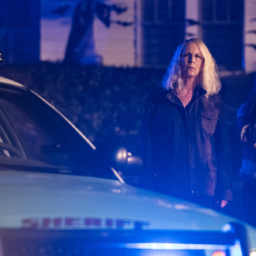
    Another couple years after the events of Corey’s babysitting mishap we catch up with Laurie Strode (Jamie Lee Curtis) sitting at a desk typing what sounds like a soliloquy about her life fighting Michael Myers—I couldn’t help but think of Diane Keaton crying at her laptop as she wrote her newest play in Something’s Gotta Give. She’s settled down in a house with her granddaughter Allyson (Andi Matichak) and attempts to live a normal life. But a city won’t quickly forget the murderous rampage of a supernatural-like serial killer. They also won’t forgive the woman that brought him into their town. Laurie, now labeled as the town “freakshow,” can’t go anywhere without somebody bringing Michael up in the same sentence. The same goes for Corey, who was acquitted of any wrongdoing, yet is still labeled a “psycho” by the town folk. Especially a group of cartoonishly unpleasant teens—who knew band geeks could be so vicious. However, Laurie sees more in him and after an altercation involving Corey, she orchestrates a meet-cute between him and Allyson.


    ADVERTISEMENT


    For nearly half of the runtime, other than the cold open, Halloween Ends plays like a family drama—and even a quirky romantic comedy—about misunderstood people navigating their trauma.

    We watch Corey and Allyson get closer as they bond over the feeling of being unwanted in the town but unable to leave—like Terrence Malick’s Badlands or Arthur Penn’s Bonnie and Clyde. However, at the same time, we also see a change in Corey as a series of incidents—another altercation with the group of teens, a Halloween party gone wrong, a run-in with Allyson’s ex—start to drive him to resent the town and its people. As Norman Bates infamously said, “we all go a little mad sometimes.” In a way, Halloween Ends is a villain origin story.

    You’ll notice I haven’t mentioned two things: Michael Myers and murders. That’s because the movie is more tactful in its approach to both—almost the polar opposite to Halloween Kills and more reminiscent of the original where the body count remained in the single digits. The marketing hasn’t hidden that Myers makes his return and faces off against Laurie, however, he isn’t the main focus of the movie. Instead, his influence (or shape), is the real villain of the movie. Or perhaps, what happens when you call someone a monster enough? Eventually, they become one. 


    ADVERTISEMENT


    Halloween Ends shouldn’t work—and in some ways doesn’t. As a conclusion to the 40-year Halloween saga it leaves a lot to be desired, even if Laurie does get her moment to face Michael.

    However, I’d rather a huge swing and miss than more of the same. Clearly that didn’t work in the last movie. At the very least, I was never less than entertained—whether intentionally or unintentionally—by the lunacy of it all. Did I ever expect there to be a Hallmark-channel version of a Halloween movie about shared trauma with a central romance plot? Definitely not. 


    ADVERTISEMENT


    More movies, less problems


    Hey! I’m Karl. You can find me on Twitter and Letterboxd. I’m also a Tomatometer-approved critic.

    💌 Sign up for our weekly email newsletter with movie recommendations available to stream.


    ADVERTISEMENT


  • ‘TÁR’ wants you to kill your heroes | review and analysis

    ‘TÁR’ wants you to kill your heroes | review and analysis

    TÁR follows world-renowned conductor-composer Lydia Tár as she prepares for a career-defining concert as the objectionable actions of her past come back to haunt her.

    In one of the opening scenes of TÁR, director Todd Field’s first feature film in nearly two decades, which is playing at the 60th New York Film Festival, world-renowned composer-conductor Lydia Tár (Cate Blanchett) chides a BIPOC gender non-conforming Julliard student who suggests he can’t appreciate Bach as he was a racist white man. Tár—a self-proclaimed “Uhaul lesbian” draped in harshly structured suits pulled out of a Muji catalog—retorts, “you must stand in front of your audience and God and obliterate yourself.” She’s saying you need to compromise your humanity—your values, identity, and beliefs—for your craft. And the way Blanchett delivers the stunning monologue, which is presented as an unbroken ten-plus minute take, convinces you that she’s right. 

    She’s not, of course. And over the course of two-and-a-half hours, we’ll learn exactly why.


    Ironically, Lydia is unapologetically her human self in every moment of TÁR—something we as the audience can’t help but find admirable and maybe even charming (she’s funny!)… until it’s not.

    Refreshingly, Field presents her as an anti-hero, a title often reserved for male characters. Like it’s impossible for a woman to be both “difficult” and a human at the same time. The concept is broken down in Brett Martin’s book Difficult Men, which explores the television revolution of the 2000s through the villainous men we rooted for until the end—Don Draper in Mad Men, Tony Soprano in The Sopranos, Walter White in Breaking Bad. However, often times the women in those stories are simply seen as the villain—Skylar White in Breaking Bad being the prime example.

    TÁR, on the other hand, is on Lydia’s side. Or perhaps, we the audience are on her side and the movie challenges us to stay on her side similarly to her partner (in both life and the orchestra) Sharon Goodnow (Nina Hoss). However, she makes it difficult at every turn. We learn that Lydia, the first female conductor of the Berliner Philharmoniker in Germany, is set to conduct a recording of the fifth symphony of legend Gustav Mahler. An accomplishment that will cement her greatness status even more than the EGOT she already achieved—Mel Brooks, eat your heart out. 

    Though she’s more than devoted to the work as we see through prep for the concert and rehearsals, Lydia is human after all despite the android-like demeanor she maintains. It comes in handy when she bullies her young adopted daughter Petra’s (Mila Bogojevic) bully into leaving her alone. She hilariously approaches and says, “I am Petra’s father” before assuring her if she doesn’t leave her daughter alone that she will get her. I’d be terrified too. However, it also prevents her from seeing her true nature like when she’s auditioning new members for the orchestra and cheats the blind audition system to admit young Russian cellist Olga Metkina (Sophie Kauer) to whom she takes a liking.


    ADVERTISEMENT


    But like any good anti-hero story, Lydia’s past eventually catches up to her and exposes her truest human nature—and forces us to reckon with how we treat, forgive, and don’t forgive genius. A past protégé that she tries to sweep under the rug, political intrigue around the orchestra (who knew philharmonics were so dramatic!), and her interest in Olga all eventually start to crush the perfect world she’s built around her. It leads to the movie exploring the power dynamics of fame (and grooming), cancel culture, and the narcissism of greatness.

    That’s not to say the movie is preachy or precious about those themes. TÁR is a surprisingly fun movie that moves swiftly through its two-and-a-half-hour runtime.

    Lydia herself is a few degrees removed from full-blown satire—not quite Julia Louis-Dreyfus screaming about croissants and dildos in Veep but close. And at first, that’s part of her charm until you see that Lydia’s emotional crassness goes beyond words and into action. But when the world puts you on a sky-high pedestal, you’re bound to get too close to the sun. Is Lydia a self-imposed victim of circumstance or is she a sociopathic narcissist? The movie’s ending—completely unexpected—doesn’t give us the answer. Yet, it’s still boldly satisfying like everything else about TÁR. Like a perfectly composed symphony, every note has a purpose—even the ones that don’t seem to.


    ADVERTISEMENT


    However what really pushes TÁR into greatness is that Lydia isn’t actually our point-of-view character.

    However, what really pushes TÁR into greatness is that Lydia isn’t actually our point-of-view character. Sure, we see the events of the movie from her perspective, but it’s actually Sharon who represents us in the movie. When Tár makes the rash decision to hold auditions for a cello solo rather than giving it to the first chair as is tradition—in an effort to give the solo to Olga—Sharon’s confused, disturbed, then angry face says it all. When things finally come crumbling down, Sharon delivers the final blow. Hoss, with far less screen time and internal exploration, makes Sharon into the movie’s most complex character. 

    Still, it’s Blanchett’s performance that feels like a magnum opus—in a career that seems to hit a peak but then continues to climb. I can’t fathom that Tár is fictional because she makes her so real. Like I could open Wikipedia and go on a bender through her early life, personal life (“Tár is openly gay”), and controversies section. It’s what makes TÁR one of the year’s greatest. So rarely does a movie feel so imminently relevant while also having no agenda, no references, and no preconceived notions. TÁR is a movie to chew over. To analyze like a historian. If only those dead old white guys were this interesting.


    ADVERTISEMENT


    More movies, less problems


    Hey! I’m Karl. You can find me on Twitter and Letterboxd. I’m also a Tomatometer-approved critic.

    💌 Sign up for our weekly email newsletter with movie recommendations available to stream.


    ADVERTISEMENT


  • ‘Hocus Pocus 2’ is 90s nostalgia done right | movie review

    ‘Hocus Pocus 2’ is 90s nostalgia done right | movie review

    Our three favorite witches are back in Hocus Pocus 2 as they try once again to beat the sunrise (and a group of meddling teens) to attain immortality.

    Like every other 90s kid, I grew up watching Kenny Ortega’s 1993 fantasy comedy Hocus Pocus every Halloween season. My sister and I would buy the Pillsbury precut spooky-themed sugar cookies, light up a fire, and settle in on the couch every year well into adulthood. I’d hazard a guess that we’ve seen the Sanderson Sisters resurrected in modern-day Salem more than I’ve seen any other movie. There’s real magic (pun intended) captured in the movie. It’s like capturing lightning in a bottle. A perfect spooky-not-scary tone, both intentionally and unintentionally hilarious lines, outlandish running gags, and three iconic performances from Bette Midler, Kathy Najimy, and Sarah Jessica Parker came together to make the perfect Halloween classic. To say Hocus Pocus 2 had a lot to live up to is an understatement. However, director Anne Fletcher and screenwriter Jen D’Angelo not only delivered a worthy sequel to the original. They also perfected the 90s nostalgia sequel.


    ADVERTISEMENT


    More often than not, sequels to 90s IP that we have nostalgia for fail—Space Jam: A New Legacy, Ghostbusters: Afterlife, Independence Day: Resurgence (they just love a subtitle).

    There are two reasons. First, because they try to mimic the original—whether out of reverence or an unsubtle attempt at leveraging our nostalgia for money—yet often misunderstand what we loved about it. Second, they try to one-up the original, again resulting in a misinterpretation of what made it good in the first place. Hocus Pocus 2, on the other hand, doesn’t ape the original. It doesn’t try to outdo it either. It completely understands the tongue-in-cheek tone and weaponized it in an updated way without feeling like a grab for relevancy.

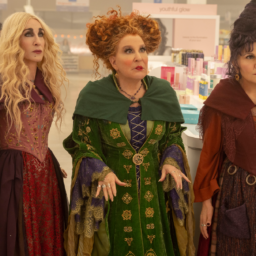
    At the same time, it expands the lore of the first movie as it opens with more backstory for our three favorite witches—Winnie (Midler), Mary (Najimy), and Sarah (Parker). We learn that from their youth they have been outcasts, albeit aimless. That is until Mother Witch (Hannah Waddington) gives them the famous booooOOOOOk that gives them their powers—while also warning them against using a magica maxima spell to become all-powerful. In the present day, we meet our own rambunctious group of outcasts, Becca (Whitney Peak), Izzy (Belissa Escobedo), and their recently estranged friend Cassie (Lilia Buckingham). However, unlike Max in the original film, Becca and Izzy are ostracized for being into the occult.

    Well, maybe the other students—including Cassie’s boyfriend Mike (Froy Guttierez)—are onto something.


    ADVERTISEMENT


    That’s because while performing a ritual for Becca’s birthday on sacred ground with a candle they’re gifted from Gilbert, owner of the Olde Salem Magic Shoppe in the Sandersons’ home, they accidentally resurrect the sisters… again. This time, though, they enter with a musical number. Like “I Put A Spell on You” from the original, they sing a version of Elton John’s “The Bitch Is Back” reworked as “The Witch is Back.” As Becca and Izzy are hiding watching the witches sing their song they wonder, “who are they performing for?” That question is answered when Mary suddenly appears beside them and says, “you!” In an attempt to save themselves from the sisters, the girls convince them they are actually 40, witches, and can help them get the souls of children.

    Of course, hijinks ensue. In what is easily my favorite scene of the movie and an instant classic, the Sanderson sisters take on all of our nemesis: a Walgreens.

    Just like the “black river” in the original, Winnie hilariously takes on the automatic door—”the gates parted for her,” she snarls in amazement when Becca walks through—before our young heroines convince the sisters that the beauty products have the souls of children in them to keep them youthful. As they start to eat the product, Sarah delivers my favorite line of the entire movie, “retinol, what a charming name for a child.” And while a lesser movie would try to hit the original’s jokes beat for beat, Hocus Pocus 2 creates its own gags and jokes—including lines I’m going to quote forever.

    However, what this also did is immediately signal to us that this isn’t going to just be a retread of the original’s plot. There’s added complexity including a revenge storyline involving the town’s mayor (Tony Hale), a coming-of-witch plot with Becca, and a reintroduction to our old friend Billy (Doug Jones). While the plot of the original was relatively simple, Hocus Pocus 2 expands the parameter of the world in new ways while maintaining its campy tone.


    ADVERTISEMENT


    ADVERTISEMENT


    That’s not to say there aren’t references back to the original like an onstage performance by the trio—complete with drag queen versions of them played by Kahmora Hall, Ginger Minj, and Kornbred—a trap set up by our teenage heroines, and the sisters’ unconventional broom choices (did Roomba have a sponsorship?). However, the movie doesn’t rely on them to keep the movie interesting. It forges its own way while allowing Bette Midler, Kathy Najimy, and Sarah Jessica Parker to have fun and live in these roles that have been so iconic in their careers.

    Hocus Pocus 2 is nostalgia done right because it doesn’t rely on our nostalgia to keep it afloat.

    Instead, it casts its own set of spells to bewitch us in the same way it did 30 years ago. Watching this movie with my sister decades older in her home in New York City (but still with the cookies) just felt right. Like it fits in with the same routine we’ve been doing for years. I already can’t imagine a Halloween without it. Call me a sap, but this was the sequel my inner child didn’t know it needed—but maybe it’s just really just a bunch of hocus pocus.


    ADVERTISEMENT


    More movies, less problems


    Hey! I’m Karl. You can find me on Twitter and Letterboxd. I’m also a Tomatometer-approved critic.

    💌 Sign up for our weekly email newsletter with movie recommendations available to stream.


    ADVERTISEMENT


  • In ‘All Quiet on the Western Front’ war has never looked worse and never looked better | TIFF review

    In ‘All Quiet on the Western Front’ war has never looked worse and never looked better | TIFF review

    All Quiet on the Western Front, the second adaptation of the novel of the same name, follows a group of young soldiers that learn the hard way that war is hell

    All Quiet on the Western Front will be released on Netflix on October 28th.

    For whatever reason (schadenfreude? To stare the harshest reality straight in the eye? A fascination with large machines?), for as long as humans have been making movies, they have been making them about war. The first ever Best Picture winner at the Oscars was Wings, a 1928 silent war film about a pair of fighter pilots. The highest-grossing film ever (adjusted for inflation) is Gone with the Wind, set against the backdrop of the Civil War. And Oscar history is littered with wartime films from classics like World War II-set Casablanca and The Bridge on the River Kwai (focused on a British POW camp) to more recent entries like Holocaust tragedy Schindler’s List and Iraq War-set The Hurt Locker. But one story has been a staple in the war film canon since the very beginning: the 1930 Best Picture winner All Quiet on the Western Front


    ADVERTISEMENT


    The film is based on the German novel by Erich Maria Remarque, which follows a young, naive soldier named Paul through events of the First World War. Remarque’s novel, inspired by his experience fighting in the trenches, paints a horrifying, monotonous, and ultimately pointless picture of war. Paul is dispatched to complete various futile tasks on the front, watching his comrades die agonizing deaths with little rhyme or reason. As opposed to the prevalent view of war at the time—honorable, glorifying, heroic—the novel took a definitive anti-war stance. It enraged many readers (especially in Germany where the book was banned during the Nazi era) while delivering harsh truths to a population fueled by propaganda, and with relatively few ways to understand what war actually looked like.

    Now post-Vietnam War, post-Cold War, and post-Iraq War, the anti-war sentiments of All Quiet seem commonplace and even quaint.

    The fact that you were probably assigned the book in a high school English class and that the original film is in black-and-white contribute to the misconception that this is a run-of-the-mill war epic. At the time of the film’s release, however, merely two year’s after the book’s publication in German, and one-year post-English translation (nearly a decade before World War II), All Quiet was revolutionary. 

    Nearly a century after the American film, a German remake, which debuted at the Toronto International Film Festival, feels as timely as ever. In a period of growing nationalism and increased violence, the message of war’s futility and human toll feels like a necessary reminder. Like the novel and the 1930 film, this new adaptation from German director Edward Berger, isn’t terribly concerned with a streamlined plot (because war itself rarely has one). Rather it’s more of a mish-mash of grizzly, muddy, bloody moments covered in rats, in piss, in shrapnel, in severed limbs, and in the ever-present toxic masculinity. 


    ADVERTISEMENT


    While the new film strays from the book in many regards (especially in its eleventh-hour battle sequence), it does stay true to the novel in premise and theme.

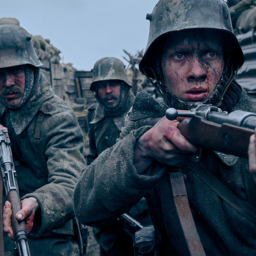
    A group of impetuous young German schoolboys, led by Paul (newcomer Felix Kammerer) enlist in giddy excitement, trotting off to certain death while singing upbeat tunes and daydreaming about the glory, wealth, and women who will await their return. A masterful opening sequence that follows the garments of previous German casualties, their uniforms stripped from mangled bodies, stitched up, scrubbed, and handed to the euphoric new recruits, shalacks the film with ominous foreboding from its first scene. The crew is then whittled away one by one in a series of battles, wartime mishaps, and body horrors, cementing for viewers that there is no glory in war. 

    While there may be no glory in war, there is most certainly glory in war movies. Berger’s vision, expertly shot by cinematographer James Friend, is as breathtakingly gorgeous as it is brutal. The haunting, misty vistas (set against an eerie piano score from Volker Bertelmann) are Nat Geo in spooky season. Even as the runtime approaches the 2.5-hour mark, Berger is concocting new ways to artfully depict how goddamn horrible war is. Scenes of tank warfare, of hand-to-hand combat in a bomb crater, and of flamethrower deaths will be branded into my mind for eternity. The film, distributed by Netflix, looks EXPENSIVE, and the practical effects go a long way, much as they did with almost Best Picture winner 1917. However, unlike Sam Mendes’s one-shot masterpiece or Mel Gibson’s Hacksaw Ridge, which presents war as at least somewhat heroic, All Quiet’s beauty is 100% in service of showing how disgusting war is. 


    ADVERTISEMENT


    The 2022 German submission for the Academy Awards, All Quiet is almost guaranteed an Oscar nomination in the Best International Feature category. And as we’ve seen with Drive My Car, Flee, Another Round, Cold War, Roma, and of course Parasite, the increasingly international Academy is not afraid to nominate non-US films in other categories. Cinematography, Score, Sound, Film Editing, Makeup (those yellow teeth!), and even Picture seem within reach, especially since this year seems without an international juggernaut frontrunner to this point. It should be mentioned that Daniel Brühl appears here in a supporting role (as he seems contractually obligated to appear in any movie involving Nazis) relegated to a series of non-battle scenes that add more bleakness to the story. 

    Despite premiering late in the TIFF lineup and being over two hours long, I was engrossed the entire time in this beautiful horror.

    With a Netflix debut at the end of October, All Quiet on the Western Front has the potential for plenty of eyeballs as awards season heats up. It’s one of the most artfully rendered and least “oorah”-shouting war films in recent history—I’m looking at you, Top Gun: Maverick. And while the Germans may have suffered a painful loss in World War I, they have a cinematic triumph here.


    Hey! I’m Matt. You can find me on Twitter here. I’m also a staff writer at Buzzfeed.


    ADVERTISEMENT


  • ‘Don’t Worry Darling’ works (just barely) | movie review

    ‘Don’t Worry Darling’ works (just barely) | movie review

    Don’t Worry Darling follows a 50s housewife begins to suspect that the desert oasis that she and her husband call home may not be as idealistic as it appears

    I’m not going to talk specifically about all the well-documented drama around Don’t Worry Darling in this review (if you just emerged from an underground bunker, here’s a refresher). What I will say is I choose to believe Harry Styles spit on Chris Pine. However, the intrigue around the movie’s production and press tour do color my feelings about the movie. They don’t directly affect them, however, it does supply an explanation. That’s because I don’t think Don’t Worry Darling is a bad movie, as is often the case with projects with feuding creatives. There is a strong vision, and, at least half of the runtime, the movie delivers on that vision. But hearing that director Olivia Wilde was absent for part of the production explains why the vision was never completed. 


    ADVERTISEMENT


    Don’t Worry Darling isn’t exactly a fresh story—it very much feels like an amalgamation of The Stepford Wives, The Village, and an episode of Black Mirror. Refreshingly, though, the movie knows that. Instead of wasting some of its running time trying to trick you into thinking things are normal for the sake of its own magic trick, immediately you know something is off in its world. While Alice (Florence Pugh) and Jack Chambers (Harry Styles) seem like a young, happy couple living in an idyllic dessert company town in the 1950s, Wilde makes it clear with John Powell’s sinister score and quick cuts to a mysterious black-and-white film of synchronized swimmers that things aren’t as they seem. 

    Throughout the first half, tension is slowly ratcheted up as we learn more about the town of Victory, California. Wives wait at home as their husbands leave each day to work on some unspecified project, they’re not allowed to drive or leave town limits, and the town’s creator Frank (Chris Pine) is an omnipresent force in their lives. Of course, they’re also discouraged from asking questions. There’s a satirical quality to the perfect pastel-colored world that Wilde creates, which is punctuated by strong supporting performance from Kate Berlant and Gemma Chan. But it’s Margaret (a wildly underused Kiki Layne, who was last seen in The Old Guard and If Beale Street Could Talk) who starts to break down the illusion for Alice. 


    ADVERTISEMENT


    However, as impressive as that world-building is, what counts is what you do with it—and that’s where Don’t Worry Darling falters. In the second half of the film, after Alice for the first time acknowledges that something is amiss, the movie struggles to be compelling while leaving its sterling world-building patina behind. It’s partially a function of the twist, which you could honestly call during Frank’s first speech to the community about control and order. However, there are a few fun campy reveals (whether intentional or unintentional) that helped bolster the movie from complete boredom. 

    Much of my problem with the second half stems from the movie’s lack of direction (or a director). It felt as if each scene went a little too long yet never furthered the plot or added color to the characters. If the screenplay doesn’t fill in the gaps, it’s up to the director to—and if rumors are to be believed there might not have been one. It’s a shame because Pugh—who has never been less than magnificent in movies like Midsommar and Little Woman—does some of her best work in those scenes. A climactic dinner scene where things finally come out into the open is a particularly impressive acting showcase—and tests the limits of Styles’ acting ability.


    ADVERTISEMENT


    Florence Pugh famously said, “the nature of hiring the most famous pop star in the world, you’re going to have conversations like that.” Those conversations involved the explicit sex scenes scattered throughout the movie. And while Harry Styles’ most-famous-man-in-the-world persona works for some of the movie, when he plays outside of that type his skills as an actor are stretched to their absolute limits. Even my audience filled with Styles’ couldn’t help but laugh out loud at his more emotional moments. 


    ADVERTISEMENT


    More movies, less problems


    Hey! I’m Karl. You can find me on Twitter and Letterboxd. I’m also a Tomatometer-approved critic.

    💌 Sign up for our weekly email newsletter with movie recommendations available to stream.


    ADVERTISEMENT


  • ‘The Woman King’ redefines the historical epic | TIFF review

    ‘The Woman King’ redefines the historical epic | TIFF review

    Set in 1820s West Africa, The Woman King follows an all-female group of warriors as they prepare to face the rising threat from a rival kingdom.

    In some ways, The Woman King is a quintessential historical action epic—think Ben-Hur or Glory. It’s immersive with its impeccable sets and costumes recreating 1820s Africa, engrossing with its storytelling, and captivating with its action. It’s the kind of big studio blockbuster we don’t often see anymore. But in other ways, it’s unlike anything else in the genre—and a watershed moment for action movies—because of how its story centers on the experience and plights of black women without focusing on their relation to whiteness and men—Top Gun: Maverick, eat your heart out. Of course, those elements are there. But director Gina Prince-Bythewood moves them to the periphery. Instead, her heroines, led by General Nanisca (Viola Davis who disappears into the role), are front and center. 

    At the same time, Prince-Bythewood directs The Woman King as a full-throated historical action epic that is simply weightier because her protagonists aren’t the typical ones you’d see in a studio blockbuster.

    However, she doesn’t treat them any differently in the same way she didn’t treat the queer characters in her underrated fantasy action The Old Guard any differently than straight heroes—#JoeandNicky4Ever. There’s no better example than the movie’s sensational opening scene. In the dead of night, a group of male soldiers is relaxing around a campfire when the Agojie, a group of sword-wielding female warriors from the West African kingdom of Dahomey, rise from the brush—and oiled for the gods—with Nanisca at the center. It’s the kind of cheer-worthy entrance that heroes of their caliber deserve and Prince-Bythewood knows it. 

    What follows is one of the most impressive action setpieces of the year as the Agojie tear through the group of men viciously but gracefully. And just like the warriors, it is captured on camera with the same grace—there’s a sense of space and geography that makes the scene almost feel like a choreographed dance. The women are there to save women taken from their kingdom by the Oyo Empire, who intends to sell their captives to white colonialists. General Nanisca, along with her two closest comrades Izogie (Lashana Lynch) and Amenza (Shelia Atim), returns to the kingdom as revered as warriors should be. While their enemies chide King Ghezo (John Boyega) for using women as his main line of defense, he knows what they are capable of. 

    The movie then transforms into a classic hero’s journey as we’re introduced to Nawi (Thuso Mbedu), an orphan whose adoptive parents gift her to the king after her disobedience becomes too much to handle. But instead of being forced into grueling training with the Agojie, she willingly accepts the opportunity to become a warrior—igniting a running theme of finding one’s agency. The movie spends much of its second act as a Shakespearean drama as tensions continue to rise between Dahomey and the Oyo, Nawi struggles through training, and Nanisca faces a trauma from her past as the king prepares to make her his successor. However, the movie doesn’t become any less thrilling. The stakes are never lessened, if anything the introduction of each character’s arc raises them. 

    Prince-Bythewood knows the key to good action is good character development. Each member of the Agojie is etched in such beautiful detail that you can clearly see how their past—and the world they live in—informs their present.

    Take for example Amenza’s careful counseling of Nansica as various threads from her past come back to haunt her. Her measured response—and consultation with mystical nuts—never feels false because the relationship between the pair is well-defined. You can easily understand why they’ve been confidants for so long. The same goes for the way they fight—it feels in control. Like they’re listening to each other’s bodies only in the way that sisters forged in battle can. 

    Multiple story threads involving slavery, colonialization, and sexual assault weave themselves together into an ignition wire that is ignited into a stellar third act that works because of all the groundwork set in place—and in one case, literally. The brutal action feels dangerous because we are made to care deeply for these women. Every single one of them. Even those whose names we don’t get to learn. That is The Woman King’s most impressive achievement among its many technical and social achievements. 

    Don’t get me wrong, though. The Woman King is exactly what moviegoers are expecting of it.

    Nail-biting action, engrossing political intrigue, awe-inspiring heroics, even a muscled-in romantic subplot—the folly of many of its predecessors. But because of the simple fact that it takes place in a location, time, and with faces we don’t often get to see as heroes, it feels completely fresh. The same way it felt when Black Panther broke the glass ceiling for superhero movies or Crazy Rich Asians for romantic comedies. The beats we know and love are there. But Prince-Bythewood gives them a new rhythm. The Agojie deserve to have their stories told as epically as Maximus Gladiator or Achilles in Troy. And Viola Davis, Lashana Lynch, Sheila Atim, and Thuso Mbedu are up to the task—and then some.


    ADVERTISEMENT


    More movies, less problems


    Hey! I’m Karl. You can find me on Twitter and Letterboxd. I’m also a Tomatometer-approved critic.

    💌 Sign up for our weekly email newsletter with movie recommendations available to stream.


    ADVERTISEMENT


  • ‘Aristotle and Dante Discover the Secrets of the Universe’ is YA movie goals | TIFF review

    ‘Aristotle and Dante Discover the Secrets of the Universe’ is YA movie goals | TIFF review

    Aristotle and Dante Discover the Secrets of the Universe follows two teen boys growing up in Texas in the 1980s as they uncover their identities through their friendship

    Aristotle and Dante Discover the Secrets of the Universe is what a young adult coming out story should be. Instead of creating a false idealistic world, director Aitch Alberto plants the movie firmly in something realistic, which makes the very personal journey each of the character’s makes all the more poignant. Max Pelayo and Reese Gonzales have perfect chemistry as Aristotle and Dante and make them feel lived in. Effortlessly charming and emotionally satisfying, Aristotle and Dante makes a grab for the heart and doesn’t let go. I also didn’t want it to.

    Notably, the 2012 young adult novel Aristotle and Dante Discover the Secrets of the Universe by Benjamin Alire Sáenz was written and released before the United States Supreme Court legalized same-sex marriage. It’s important to point out because queer media released before comes from a different perspective. A scrappier perspective. One where queer people had a mindset to to protect—and fight. For that reason, watching the movie of the same (very long) title feels like a breath of fresh air among the Love, Simon’s and Heartstoppers of the world. 


    ADVERTISEMENT


    Not that there is anything specifically wrong with either of those projects. They just live in an idealistic version of the queer experience. One where the glass ceiling has been shattered. Aristotle and Dante, on the other hand, takes steps to ground you in a time and place. That time and place: 1987 in El Paso, Texas. Specifically, summer. The hazy, warm cinematography by Akis Konstantakopoulos draws you into a sleepy daze as we meet Aristotle “Ari” Mendoza (Max Pelayo), a Mexican-American high schooler facing down the summer before his junior year the way he usually spends it: alone. That is until he meets Dante Quintana (Reese Gonzales), a fellow teen whose effervescent personality nearly makes him glow in the sun. At least that’s how Ari sees him when he first sees Dante at the pool.

    After Dante offers Ari swimming lessons, the pair become fast friends. It’s largely because Dante is in many ways a foil to Ari. He’s aggressively himself—flamboyant, open, excitable. On the other hand, Ari is trapped in his own silence—something that he chides his father (Eugenio Derbez) about. Dante comes from a wealthier family while Ari poorer. Dante’s parents Sam (Kevin Alejandro) and Soledad (Eva Longoria) are very open and expressive while Ari’s parents Jamie and Liliana (Verónica Falcón) are more subdued—reminiscent of the repression of feelings that many immigrant families display. However, Dante helps bring the real Ari out of himself. He helps him become interested in himself. 

    After a summer of days by the pool, camping trips, and more than one Dante rant about some book or painting, fates separate the two. Something that helps further separate Aristotle and Dante from other young adult stories. It allows the pair time to discover themselves on their own. Ari begins to find his place in his high school and solve the mystery of his parents—this generational trauma storyline is a bit underbaked and I would have loved to spend more time on it. We also see him gaining confidence in himself without Dante by his side. Many people observe that he’s beginning to look like a man. Something that further interrogates why that is a statement to be had.


    ADVERTISEMENT


    As the movie quickly moves through a year, we hear through letters Dante’s journey to understanding his sexuality. He tells Ari how he came to the conclusion after dating a girl and realizing that he was fantasizing about a boy instead. Gonzales is able to communicate his struggle and trepidation about coming out with his voiceover, which Pelayo reacts to with silent emotion. It’s what makes Aristotle and Dante such a successful book-to-movie adaptation. Director Aitch Alberto is okay to live in those introspective silences—something particularly important for a repressed character like Aristotle. 

    Coming out stories are difficult to pull off because they’re such singular experiences that differ from person to person. They’re largely an internal dialogue that we have to have (or not have) with ourselves. Yet, at this point, it feels like we’ve seen so many of the same versions. In that way, Aristotle and Dante Discover the Secrets of the Universe feels like a breath of fresh air—or a clear sky full of stars (with no light pollution). Most obviously because of the focus on two Latino characters—groundbreaking for a genre that is very white-washed. But more importantly because it doesn’t try to pretend that it’s a perfect experience. What it does say is that there is magic to be had—and that you can hold the universe in the palm of your hand. 


    ADVERTISEMENT


    More movies, less problems


    Hey! I’m Karl. You can find me on Twitter and Letterboxd. I’m also a Tomatometer-approved critic.

    💌 Sign up for our weekly email newsletter with movie recommendations available to stream.


    ADVERTISEMENT


  • Queer military drama ‘The Inspection’ asks and tells | TIFF review

    Queer military drama ‘The Inspection’ asks and tells | TIFF review

    A homeless young gay man enlists in the Marines as a way out of his struggle in The Inspection. As he goes through boot camp, he grapples with his masculinity and queerness.

    The Inspection is a deeply personal look into a queer Black man’s experience in Marine boot camp and how his struggles lead him to a deeper understanding of his identity. Writer-director Elegance Bratton never lingers on his characters’ misery. Instead, he focuses on their hope and strength. The result is a deeply felt and emotional but ultimately uplifting and entertaining character study of masculinity, queerness, and love. Anchored by an electrifying Oscar-worthy performance from Jeremy Pope, The Inspection is an electrifying introduction to a new voice.

    Among the many emotional scenes in The Inspection, a standout shows Ellis French (Jeremy Pope) comforting Ismail (Eman Esfandi), a fellow Marine recruit, when he breaks down in the bathroom in the midst of boot camp. Ismail, a practicing Muslim, sinks into the embrace of French, who is gay. As Ismail cries about wanting to be home, French stares out into the distance with tears slowly filling his eyes. Two people from two different worlds bonding over their shared trauma as outsiders in a world that is not built for them.


    ADVERTISEMENT


    When we first meet French, he’s staying in a homeless shelter in Trenton, New Jersey. And even then, we can see how writer-director Elegance Bratton is setting this story apart from others of its ilk. Throughout the movie, he never lingers on French’s misery. Rather, he focuses on his hope and strength. As he journeys into New York City to see his estranged mother (Gabrielle Union), we see him say goodbye to his group of friends—an split second insight into how queer friendship gets us through adveristy. We see it again as an elder gay man in the homeless shelter gives him advice “from an old queen to a young one.”

    That energy continues even when we learn that French’s mother strongly disapproves of his sexuality. We see this in actions instead of words—she covers her couch in newspaper before he sits, crucifixes hang on the walls of her small apartment. However, he’s not here to make amends. He’s here to tell her he’s made the decision to become a marine. There’s an odd glimmer of hope in his voice—but as we learn later, it wasn’t exactly a choice. “I’ve been taking care of myself since I was 16,” he tells Laurence Harvey (Raúl Castillo), a sergeant sympathetic to French’s struggles.

    When he arrives at boot camp in South Carolina, he’s greeted with a barrage of questions from the commander of the unit Leland Law (a towering Bokeem Woodbine) including whether or not they are or have been gay—as if it’s something that can just go away. From there, the movie turns into a Full Metal Jacket retelling set in the “don’t ask, don’t tell” era as the members of the unit are subjected to intense physical, mental, and emotional training—or is it abuse?


    ADVERTISEMENT


    While much of it is difficult to watch—Woodbine’s domineering performance easily strikes fear into your heart—the story never makes the pain a focus.

    Rather it’s meant to move the plot forward and characters along in their journey. When French’s queerness is exposed while in the group shower in a gorgeously directed neon-splashed sequence that perfectly captures the sensation of suppressed queer desire, the result is a beating from Harvey (McCaul Lombardi) and a group of recruits at the behest of Commander Law. But even in that brutal moment, Bratton somehow finds the humanity in the sequence—the conflict in Castro’s (Aaron Dominguez) face is a focus of the sequence.

    The movie continues to alternate between those trying moments and moments of victory. While Law—and the actual law of the land—dictate that French can’t be open with his sexuality, he also proves to his fellow recruits that not only is he more than his queerness but that he is more because of it. In a cheer inducing moment, French in preparation for his final evaluation paints the war paint on his face to look more like makeup on a drag queen than that of a soldier, to which Law chides, “French, only you could manage to f*g up war paint.” The audience went wild.


    ADVERTISEMENT


    Bratton, making his feature film directorial debut, based the story on his own life as a gay Marine recruit. And that personal angle to the story is apparent throughout.

    Through the breezy 104-minute runtime, he focuses on specific moments of his journey. The ones that when put together as a tapestry become a fully formed view of the man he becomes at the end of the movie. A man defiant in his queerness, even when it all seems against him. At times, that makes The Inspection seem formulaic. However, I see it as complete. It’s a movie from the perspective of a person that has figured it out. That has inspected his own life to find how his traumas have formed him. 

    In that way, The Inspection is a love letter to Bratton’s experience. That’s why despite his mother’s journey throughout the movie, which finds her at a very similar place to the start, the movie is dedicated to her. That’s the action of a person that is healing.


    ADVERTISEMENT


    More movies, less problems


    Hey! I’m Karl. You can find me on Twitter and Letterboxd. I’m also a Tomatometer-approved critic.

    💌 Sign up for our weekly email newsletter with movie recommendations available to stream.


    ADVERTISEMENT


  • ‘Barbarian’ is for the camp horror girlies | review

    ‘Barbarian’ is for the camp horror girlies | review

    Barbarian follows a woman staying in an Airbnb in a rough neighborhood of Detroit who gets more than she bargains for when she finds a man already staying there.

    Barbarian is B-movie camp. It feels like it’s from the same grotesque weird wicked world that Sam Raimi is operating in. The twists are surprising, scares genuinely frightening, and comedy sharp. See it in a theater with a crowd.

    Don’t read this review. Barbarian is a movie that is best enjoyed unspoiled. And when I say unspoiled, I really mean it. That’s not to say it can’t be enjoyed entirely knowing what it’s about. But where’s the fun in that? It’s like a magic trick. The same way magicians use misdirection, distractions, and spectacles to hide how a trick is done, director Zach Cregger tricks you into thinking the movie is one thing. But while he’s showing you his left hand is empty, his right is getting ready to shock you. And unless you’re a boring cynic, you want to be tricked.

    It’s the same way I felt about James Wan’s Malignant, which feels like a spiritual sister to Barbarian. Both movies mine the tropes and imagery of Giallo flicks—a genre of movies popularized in Italy that combine elements of suspense, horror, and psychological erotic thrillers. The result is a maximalist horror that never fails to shock you with its devilishly fun twists and keep you entertained with delicious camp. At any given moment you’re not sure whether to laugh, cry, or just lose your damn mind. I, and the rest of my audience, seemed to be doing all three. Grab a bowl of popcorn, your closest horror-loving friend, and go for a ride. 

    For those who aren’t going to heed my warning, I’ll try to keep the rest of this review relatively spoiler-free.


    ADVERTISEMENT


    The first act of Barbarian will feel familiar to horror fans, whether it’s the camera movements reminiscent of Leigh Whannel or John Carpenter-esque score.

    It’s almost as if Cregger wanted to prove that he’s done his horror homework before completely flipping the genre on its head. There’s an almost cozy feeling when Tess (Georgina Campbell) drives up to the front of an unassuming single-family home at night… in the middle of a rainstorm. Yeah horror fans, your alarm should be going off. If it wasn’t already, it should be blaring when Tess finds the key in the lockbox already gone. Even worse, when she calls the phone number on the faux-Airbnb listing, it goes to the voicemail of a home management company. However, her luck sees a turn—for the worse or better we’re not sure—when a man answers the door.

    Keith is tall and handsome, but has a bit of a creepy edge to him. Bill Skarsgard, best known for his terrific turn as Pennywise the Clown in It, is perfectly cast. His look alone perfectly exudes a charmingly endearing energy that is alluring, but creepy at the same time—it would confuse any sensible person’s stranger danger senses. His apologetic and kind tone gets Tess to accept his invite to share the space while she sorts out her housing situation. Skarsgard’s performance continues to toe the line between genuinely charming and creepily rehearsed—but whether there is more to him is unclear.


    ADVERTISEMENT


    The movie actively ratchets up the tension even as Tess’ fears are assuaged in a perfectly calculated slow burn that keeps you searching for the twist—trust me, you won’t find it.

    When Tess steps out of the house the next morning to go to the job interview she’s in town for, she sees the state of the neighborhood. The house she’s staying in is lovingly renovated, but the rest of the neighborhood is a dilapidated ghost town. All this setup eventually leads to Tess returning to the home and finding a hidden corridor in the basement out of the house.

    From there, the movie takes pivots to the grotesque, absurd, and downright batshit. But what I love is that it doesn’t feel the need to explain itself or its lore further than needed. Some would call those plot holes—I’d call it strategic information withholding. Barbarian almost makes itself immune to story criticism because it only gives you enough to piece your own background story together. The same goes for its potential social commentary. It could follow It Follows and Don’t Breathe in the Detroit-horror subgenre that touches on race and class. However, it never fully forms those ideas—but it doesn’t spend valuable time on them either.

    There is a #MeToo subplot that takes the movie to a new place from the first half—Justin Long makes an appearance that I wish was hidden in the marketing. And while the message may be obvious, it helps tie the absurdity into a satisfying character journey. Barbarian isn’t going to be for everyone. It’s like Sam Raimi movies or Giallo films. If you know you know. Like Evil Dead 2 or Malignant, Barbarian feels like it’s from the same grotesque weird wicked world where twists are surprising, scares genuinely frightening, and comedy sharp. See it in a theater with a crowd.


    ADVERTISEMENT


    More movies, less problems


    Hey! I’m Karl. You can find me on Twitter and Letterboxd. I’m also a Tomatometer-approved critic.

    💌 Sign up for our weekly email newsletter with movie recommendations available to stream.


    ADVERTISEMENT


  • ‘Aftersun’ is a masterpiece of memory | review and analysis

    ‘Aftersun’ is a masterpiece of memory | review and analysis

    Aftersun follows the childhood memory of a girl on vacation with her father to the Turkish coast. But where there’s sun there is also shadow.

    Aftersun is one of the greatest depictions of depression and grief captured on film as it meditates on childhood, parenthood, and memory. Beautifully wrought with cinematography and score that play like a memory on loop. As the movie comes to its stunningly satisfying and emotional conclusion—perhaps one of the greatest final moments of a movie I’ve seen in some time—we’re taught that opening that box might be a means to an end. A means to heal the burn that memories can leave.

    You might also like: Past Lives, The Worst Person in the World

    Do you know that lethargic feeling after sitting in the sun on a hot summer day? Or the melancholic daze that follows you home after a perfect vacation? Do you get blotches in your vision after looking into a bright light or staring up at the sun? All those sensations perfectly described Charlotte Wells’ debut feature Aftersun, which feels like the perfect term to encapsulate each of those feelings. And that is what the whole movie is: a feeling. For its largely plotless 96-minute runtime nothing really happens in front of you. But rest assured, there’s plenty happening in the shadows of the sunny father-daughter beach holiday at the center of the movie.


    💌 Get weekly streaming movie
    recommendations in your inbox

    Wells presents Aftersun as a childhood memory flashing into the mind of a girl 20 years later—when she’s the same age as her father at the time. But as with any memory, things look different in retrospect.

    In the early 90s, young father Calum (Normal People’s Paul Mescal) brings his 11-year-old daughter Sophie (played as a child by Francesca Corio, a real festival breakout) on a sleepy summer vacation on the Turkish coast. Gregory Oke’s dreamy cinematography simultaneously underlines the sunny haziness of a beachy summer and the soft edges of memory. In between days lounging at the pool, trips to the resort’s restaurant, and interactions with the other guests, we see interstitial clips from home video of the trip filmed by either Sophie or Calum. It’s in those clips—and interruptions often taking place at night while Sophie is asleep—that we sense there’s more meaning and heaviness in this vacation for Calum.

    Those feelings only come in waves though. We never see Calum being less than a devoted (and goofy) father to Sophie, almost a complete juxtaposition to the view we have of the usual young parent—sometimes he’s even mistaken for her brother. Sophie, as a child, sees him as nothing less than an invincible infallible hero—how many of us see our parents. Her childlike wonder extends to the world around her as she becomes enamored with a group of older kids—a bit of a nod to the typical coming-of-age story, of which Aftersun is decidedly not. However, that wonder also leads to conflict when Sophie’s frank questions lead to revealing that not all is great and perfect in the background of Calum’s life. At the moment, she thinks nothing of them. However, when adult Sophie looks back at the same clips we’re watching, they play very differently. Like videos taken before a coming disaster.


    ADVERTISEMENT


    Memories always have their blind spots. You remember the bright moments while blocking out the darker ones. It’s not until you look back and unpack them as an adult that you see their profundity.

    31-year-old Sophie (Celia Rowlson-Hall), who we cut to for short moments throughout the movie, is the same age as her father when they went on that vacation. As she remembers the bright spots—the late night karaoke, her first kiss, her dad clumsily juggling bread rolls at dinner—the darker ones slip in as well. Or, at the very least, she fills them in—her dad crying in the middle of the night, his quiet swaying while smoking a cigarette on the balcony, his muffled contentious phone calls back home. However, the movie never lingers on those moments—like adult Sophie is trying to keep them out of her perfect vision of that summer vacation. The same way that we exclude the awkward pauses at an otherwise lovely dinner or the arguments heard through walls late at night after you went to bed in our memories. You keep the good and avoid the bad until you can no longer stand the weight of the past.

    It’s difficult to describe Aftersun because nothing and everything is happening at the same time. Though what’s happening on screen may seem mundane, it’s drenched in subtext. For those that aren’t looking in the right places, the movie might be tedious to get through.


    ADVERTISEMENT


    Aftersun is about many things, but at its core it’s about the blindspots of our memories and traumas—and how we fill them in to make them whole again.

    Our parents try to create the best childhood for us. Short of that, they at least try to create the best version of those memories for you, whether intentionally or unintentionally. It’s why nostalgia exists and why some memories float to the surface while others burrow themselves deep into our psyches. Charlotte Wells uses Aftersun to show us what it’s like to unlock that box that we all keep away in a hidden dark corner of our minds. What it’s like to admit that our perfect childhood memories are just afterimages of the brightest moments. As the movie comes to its stunningly satisfying and emotional conclusion fittingly underscored by Queen’s “Under Pressure”—perhaps one of the greatest final moments of a movie I’ve seen in some time—we’re taught that opening that box might be a means to an end. A means to heal the burn that memories can leave.


    ADVERTISEMENT


    More movies, less problems


    Hey! I’m Karl. You can find me on Twitter and Letterboxd. I’m also a Tomatometer-approved critic.

    💌 Sign up for our weekly email newsletter with movie recommendations available to stream.


    ADVERTISEMENT


  • ‘Orphan: First Kill’ is the campy sequel we didn’t know we needed | movie review

    ‘Orphan: First Kill’ is the campy sequel we didn’t know we needed | movie review

    Esther, the titular Orphan from 2009’s cult classic, makes her triumphant return in Orphan: First Kill, an origin story prequel that you didn’t know you needed.

    Orphan: First Kill doubles down on the original’s wacky premise to deliver a deliciously campy prequel that will please fans of the first movie and convert a few new ones. With each passing twist, and a pair of perfectly tuned-in performances from Isabelle Fuhrman and Julia Stiles, the movie delights, terrifies, and entertains from beginning to end. A camp cult classic in the making.

    One of my favorite memories growing up is watching silly B-horror movies with my older sister—I Know What You Did Last Summer, Fear Island, the Final Destination series. But one of our favorites was 2009’s Orphan. It was kind of silly in a self-serious way but legitimately creepy and scary. The exact type of horror movie that we could come back to whenever we needed a comfort watch. Of course, we were excited when we heard that a sequel was forthcoming, with the original Esther.

    From the opening moments, we were giddily soaking in the creepy atmosphere. But then, our excitement waned. For the first half of Orphan: First Kill, what we loved about the first movie was dialed too high—the dramatics, Esther’s creepiness, the gore. It wasn’t the movie we loved. But then the twist happened—that glorious twist that completely changed the way we were watching the movie and turned it into a campy classic that I could see us enjoying for years to come.


    ADVERTISEMENT


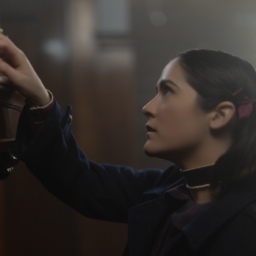
    The first half was also campy fun, but the game of expectations made it feel like a betrayal of the original. In retrospect, it only made sense for the movie to open that way. We remeet Leena (played again by Isabelle Fuhrman who is made to look 10 years old with the help of movie magic) in a mental institution in Estonia before the events of the first movie. As her doctor explains, she suffers from proportional dwarfism, a disease that causes her to look the same age even as her mind grows and develops. You could imagine how that would make a person go mad—and mad she does go. After escaping the institution with manipulation and hilariously brutal kills for a “ten-year-old,” Leena hatches a plan to get to America.

    Finding a missing girl to whom she holds a passing resemblance, Leena assumes her identity and poses as Esther Albright, the daughter of wealthy artist Allen (Rossif Sutherland) and his philanthropist wife Tricia (Julia Stiles). She concocts a kidnapping backstory, which would explain how she found herself in Estonia… with an accent. Over the coming weeks, “Esther” tries to assimilate into the family by piecing together fragments of the actual Esther’s life.


    ADVERTISEMENT


    What made Fuhrman’s performance in the original so iconic and terrifying—part of the reason why a sequel would only work with her—was her ability to make Esther just odd enough to put you on edge but not enough to convince you she isn’t anything but a creepy, but normal, child. In First Kill, her performance is dialed up to 11, which doesn’t work—until it does. Remember that twist I mentioned a bit ago? Without spoiling, it doubles down on the wackiness of the premise to deliver some of the highest gay shriek-inducing camp that includes a deliciously devilish performance from Julia Stiles.


    ADVERTISEMENT


    More movies, less problems


    Hey! I’m Karl. You can find me on Twitter and Letterboxd. I’m also a Tomatometer-approved critic.

    💌 Sign up for our weekly email newsletter with movie recommendations available to stream.


    ADVERTISEMENT


  • ‘Beast’ roars for your attention | movie review

    ‘Beast’ roars for your attention | movie review

    In Beast, a doctor and his two young daughters find themselves at the wrong end of a lion’s taste for vengeance as they become trapped in the South African bush

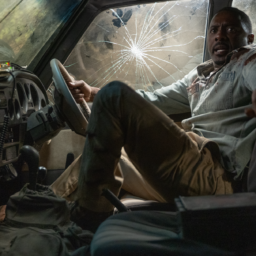
    Over the running time of Beast, wildlife biologist and animal sanctuary protector Martin (Sharlto Copley) remarks a few times that what is happening isn’t normal. That being a lion on a path of vengeance through the South African grasslands after his pride is killed by a group of poachers. Most lions will kill to eat and generally avoid humans. This one is doing the exact opposite, leaving bodies behind in his wake. Why? The movie doesn’t exactly tell us. Rather than wrapping some wild exposition about the lion being infected by radioactive waste dumped by a nearby nuclear plant, Beast spares us from the unnecessary details and delivers what we want: Man vs animal. In that way, at its core, it’s a perfect B-movie.

    However, it’s more than that largely thanks to director Baltasar Kormákur and actor Idris Elba who elevate the schlocky script into a surprisingly effective survival thriller. The details we do get are that Elba’s Dr. Nate Samuels recently lost his wife who he had separated shortly before. In the wake of her death, he brings his young daughters, teenager Meredith (Iyana Halley) and preteen Norah (Leah Sava Jeffries), to her home village in South Africa where Martin still works. After a magical encounter with a pride of lions that Martin has worked with since their youth, they come upon an abandoned village that looks to be on the wrong end of a vicious lion attack. From there, the movie roars to life.


    ADVERTISEMENT


    Thanks to Kormákur’s sense for suspense, Beast rarely gives you a minute to breathe. Through a series of single-shot long takes, the movie builds suspense until inevitably the antagonistic lion roars onto the screen. And despite it being done in complete CGI, the titular beast feels dangerous. In the movie’s first long shot, the camera follows the group as they arrive at a nearby village. As we sweep around following different characters, the discovery of multiple dead bodies sets our senses ablaze. When Norah temporarily goes missing, we follow Nate through a labyrinth of branches that further disorients our senses. The shot finally cuts when we find Norah who has discovered another body. And the games begin.

    Each ensuing encounter with the lion feels as impactful as the last. Elba’s bonafide movie star glow holds every frame and makes you believe the stakes—even when the beast isn’t on screen. The movie is careful not to overuse its villain, but there’s always a sense that it’s lurking within reach. That’s what makes Beast worth its lean 93 minute runtime. Even if the material isn’t Oscar-worthy, every actor and filmmaker is performing like it is.


    ADVERTISEMENT


    More movies, less problems


    Hey! I’m Karl. You can find me on Twitter and Letterboxd. I’m also a Tomatometer-approved critic.

    💌 Sign up for our weekly email newsletter with movie recommendations available to stream.


    ADVERTISEMENT