Michael Wampler

  • American Horror Story: Freak Show Review – “Magical Thinking” (4×11)

    American Horror Story: Freak Show Review – “Magical Thinking” (4×11)

    ahs freak show magical thinking
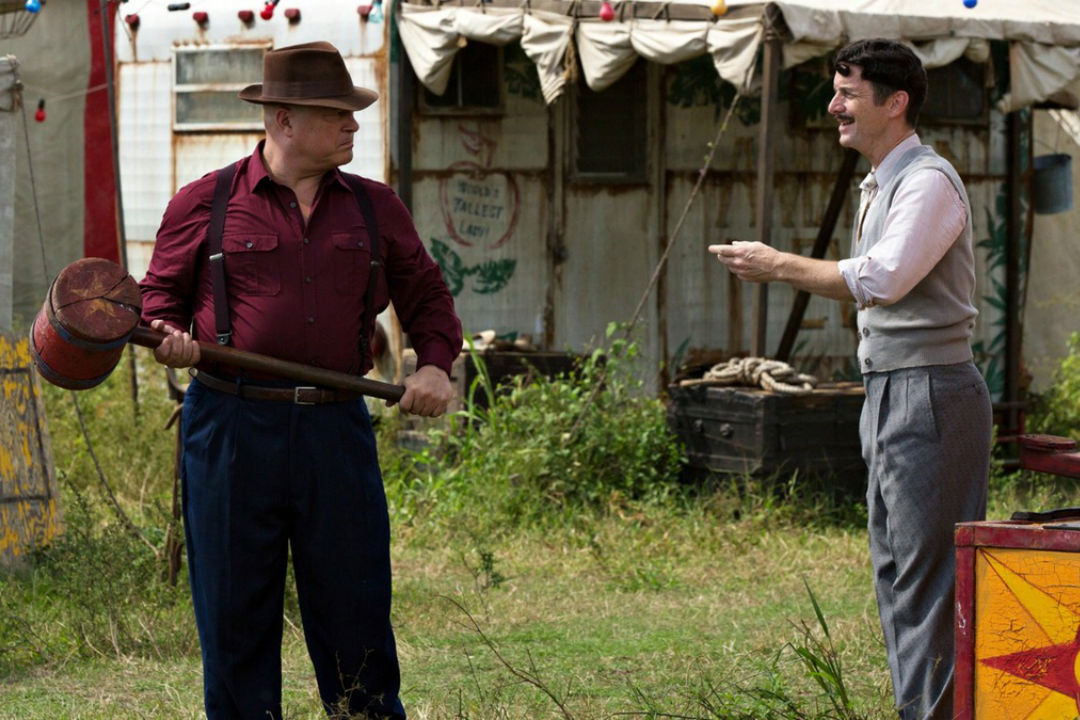
    And we’re back! I barely remember where we left off, so thankfully the episode begins on a narrative curlicue to “two days ago”, when Stanley convinced Jimmy to give him his left hand by way of an ipecac-fueled fake emergency. (He takes both hands because duh.) I’ve already expressed my annoyance at Freak Show’s continued insistence on double- and triple-tracing its narrative steps, and that holds true here, not just on the level of the opening scene here, but also on a macro-level, with “Magical Thinking” bringing the freaks back into conflict with the Jupiter police again-slash-still.

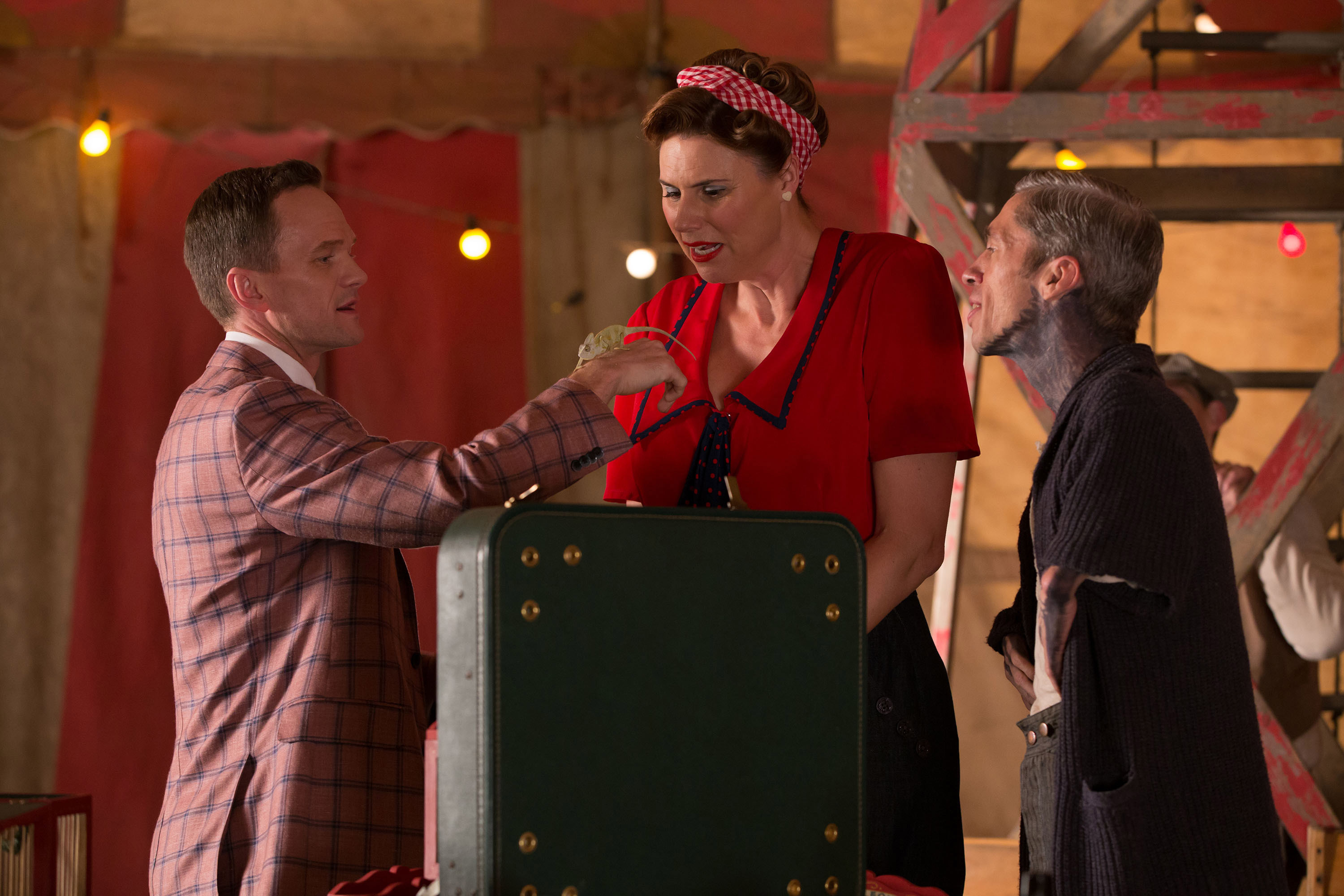
    Fortunately there is new material in the episode as well, with Neil Patrick Harris showing up as traveling salesman/magician/general crazy person Chester. He’s carting along a ventriloquist’s dummy named Marjorie—it should come as no surprise that he talks to her like a real person, and that, by episode’s end, she appears to him as an outright human, played pretty awesomely by Jamie Brewer. “Magical Thinking” is straight up weird, and given the title, “weird” is a place Freak Show hasn’t gone to as often as you might expect. Harris jumps into the role with verve, and fits comfortably among the ensemble.

    But the episode can be as weird as it wants—it doesn’t change the fact that it meanders like crazy. The pacing of “Magical Thinking” is mind-boggling. Characters flit in and out in large chunks of story; large swaths of the episode are dedicated to Chester’s backstory, which is doled out so slowly, in fits and starts, as to lose what little interest it held in the first place. So often, Freak Show is convinced of its own coolness, that it can just tell whatever story and its audience will eat it up (this also proves to be frustratingly true. We’re trapped in a feedback loop of shit.). But it just keeps telling and telling, piling non-sequiturs miles high, loading on new characters and complications, but entirely forgetting to use these complications to add depth, dimension, or even simple narrative value to the season arc or any of its characters.

    To be fair, “Magical Thinking” does resolve (or at least it hints at resolving) the relative lack of direction that has so far plagued Freak Show. The confrontation between the Jupiter police and the freaks toward the episodes end, while a retread of a retread of a plot point, does at least escalate said plot point. Now, will any of this have consequence come next Wednesday? It’s basically a fifty-fifty proposition. But in the moment, it works.

    In keeping with the abundant weirdness, Chester finds himself a pawn in Bette and Dot’s suddenly very urgent quest to lose their virginity to, well, anyone who is willing. It’s a super bizarre story, with plenty of (unintentionally) hilarious exchanges, such as this brilliant gem: “I said kiss me, not lick me!” “But I am French!” Raucously funny as shit like this is, you’ll be forgiven for finding the whole enterprise pretty gross. The idea of the twins as moon-eyed romantics is one that’s been with us since the premiere, but “Magical Thinking” puts a pretty icky spin on it that feels pretty unnecessary to me.

    And yet, this week’s episode does the one thing that American Horror Story consistently excels at: having a batshit crazy awesome final five minutes that means, damn it, I can’t wait to tune in next week. First of all: the final scenes of “Magical Thinking” confirm my theory that Dandy’s presence correlates with awesomeness, as when the episode drops the twins’ nonsense and has Dandy take an interest in Chester, it’s a much needed jolt of excitement. Desiree’s confrontation of Dell is one of the more emotionally charged episode’s of the season, and hot damn, that final shot (pun intended) is great. Kudos to Jessica Lange—she brings Elsa to life this week in a way that I don’t know she or the writers have managed so far. In terms of emotional consequences, Ma Petite’s death has paid dividends, and that’s a pattern that seems likely to continue.

    There isn’t really much more to say at this point. You know exactly what you’re getting with Freak Show, and “Magical Thinking” has the same strengths and the same weaknesses the season has displayed all along. So, you know, in other words it’s business as usual: glimmers of excitement, the occasional genuine moment of pathos, and a lot of unnecessary shit to slog through in between. Welcome back!


    Stray Observations:

    • Tight close ups of Evan Peters’s face all day long, please and thank you.
    • “My friend Myrna was at that Tupperware party.” Only on American Horror Story, folks.
    • Denis O’Hare is fantastic in the opening scene, chewing scenery and shouting with crazy, elongated-vowel-fueled manic glee. I wish Stanley was more firmly planted in the villain role, but that would require more narrative discipline than Freak Show is capable of deploying at this point.
    • This episode was so close to 6.5ish territory, but I let myself be swayed by the last ten or so minutes, even if I know I’m just gonna be burned down the line.
  • AHS: Freak Show Review – “Orphans” (4×10)

    AHS: Freak Show Review – “Orphans” (4×10)

    ahs freak show orphans

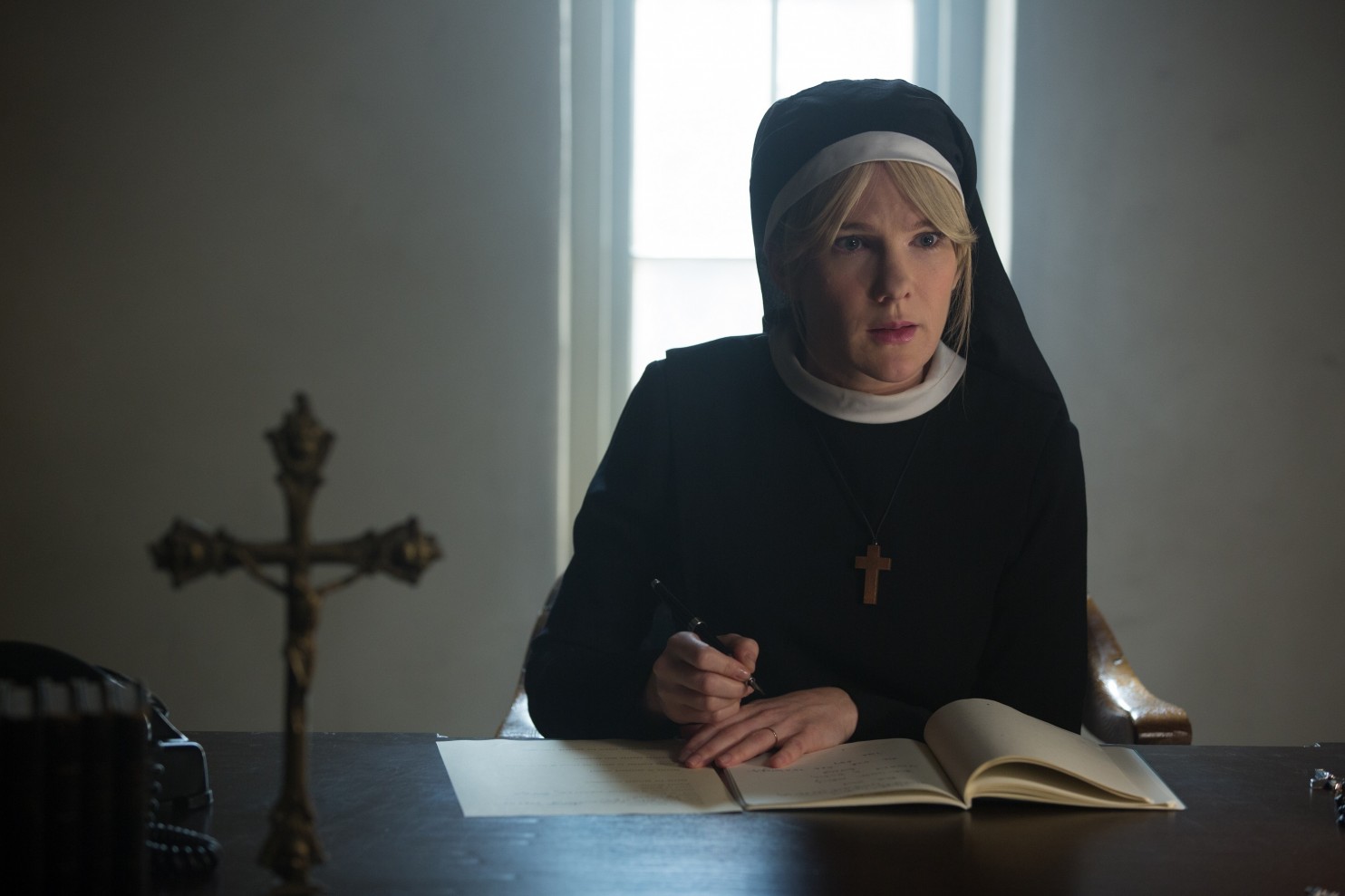
    I am, as always, of two minds regarding Freak Show. On the one hand “Orphans” is a simple, touching episode, one that uses a familiar but minor character to highlight the emotional journey the season, and the series, has taken on us on so far. On the other hand it plays as an overlong, lost episode of Asylum more than it does an episode of Freak Show. How you feel about the episode, ultimately, depends on your tolerance for Ryan Murphy’s attention deficit when it comes to blocking out a season of television. In the spirit of the holiday season (which is sadly not an excuse for a return visit by Murder Santa), I want to be as generous as possible to “Orphans,” which really is lovely for a bit. Pepper’s story is told in broad strokes, but the minimalist approach has maximum impact, in no small part owing to Naomi Grossman’s skilled, beautiful performance. There is no question that Pepper is a sketch of a character, here as fan service more than anything else, but that relative simplicity gives the episode’s final sequence an almost charming, storybook quality. That’s true of Mare Winningham as Pepper’s older sister, too; she fills in the barest of characters with an over the top personality that suits rather than overwhelms the story.

    The episode looks great, too. As Elsa tells the story of how she first came to rescue Pepper from the orphanage, the scenes take on a blueish-white tinge, still bright, but a completely different palette than the series has used to date. The Briarcliff scenes, by contrast, slowly drain of color until everything is the washed out grey that Asylum so favored. The score, too, is wonderful, a fantastical, whimsical bit of music that is also rather unlike the season to date, and yet works more or less perfectly here. As a short story about this strange little character named Pepper, then, I would call “Orphans” mostly a success. As an episode of a serialized television drama, well, I can’t be so generous on that note. The voiceover early in the episode goes on FOREVER. The final third of the episode veers away from every ongoing plot, only to veer back in a last-second “shocking reveal”. What could happen over a decade that results in Elsa Mars getting onto the cover of Life magazine in 1962? I suppose we’ll spend the next three episodes finding out. It’s another frustrating instance of American Horror Story telling stories from moment to moment, with no regard for how these moments connect to each other. There’s a real sense of “what a twist!” storytelling here, with the magazine cover certainly, but also with the “reveal” that the various seasons are interconnected (which has by the way been so thoroughly reported by the entertainment news sites that enable this kind of lazy, shock-a-minute storytelling as to lose any element of surprise). Yes, the everything-but-the-kitchen-sink-and-even-then approach has been with the series, and with Ryan Murphy, since time immemorial. But it very quickly shifts gears from original and vibrant to hackneyed and cynical. Also in this episode Stanley chops off Jimmy’s hands and sells them to the freak museum, and Maggie and Desiree go to said museum. The show treats these developments as just such an afterthought, choosing to spend much, much more time on Pepper’s ordeal and the return of Sister Mary Eunice. In fact we do not even see Jimmy lose his hands, but just the aftermath. (The previews suggest we will double back next time, because of course we will.) These scenes are functional, pushing the season to the point it needs to be when we return in January. But they lack the artistic interest of the rest of the episode, and it makes you wish that the same amount of energy that goes into the strangest, most divergent ideas of this season (Twisty the Clown, anything regarding Dandy, and now Pepper’s trip to Briarcliff) would also go into the main characters and storylines.

    Speaking of Dandy, he is absent again this week, and I’m beginning to suspect that the success of any given episode is directly proportional to Finn Wittrock’s screen time. Anyway, it’s the Christmas season and I don’t want to be the Scrooge to Ryan Murphy’s Tiny Tim. (Ryan Murphy would of course most identify with Tiny Tim.) This is a fun little Easter egg to those of us who are ardent fans of Asylum’s particular approach to the American Horror Story tropes, and indeed, the bulk of “Orphans” feels like a lost episode of Asylum. For that reason if none other I’ll count the episode a success—but it would really be nice for the producers to get a more even keel on the story they’re trying to tell.   Stray Observations:

    • Elsa purchased Ma Petite for the low, low price of three cases of Dr. Pepper. There’s a great underlying current here of Elsa treating her “children” as commodities, same as Stanley, same as her audience. The bookend of the last scene begs the question: how many more of her freaks will Elsa cast aside in her (apparently successful) scrabble for fame?
    • Maggie’s fortune for Desiree and Malcolm Jamal Warner takes a dark turn very quickly, and Emma Roberts does a nice job of playing the woman scorned; she’s wickedly comedic and dry in her line deliveries.
    • I almost wonder if we will return to Briarcliff again before the season is up. I can’t necessarily think of any justification for it, but I also know that won’t stop Ryan Murphy.
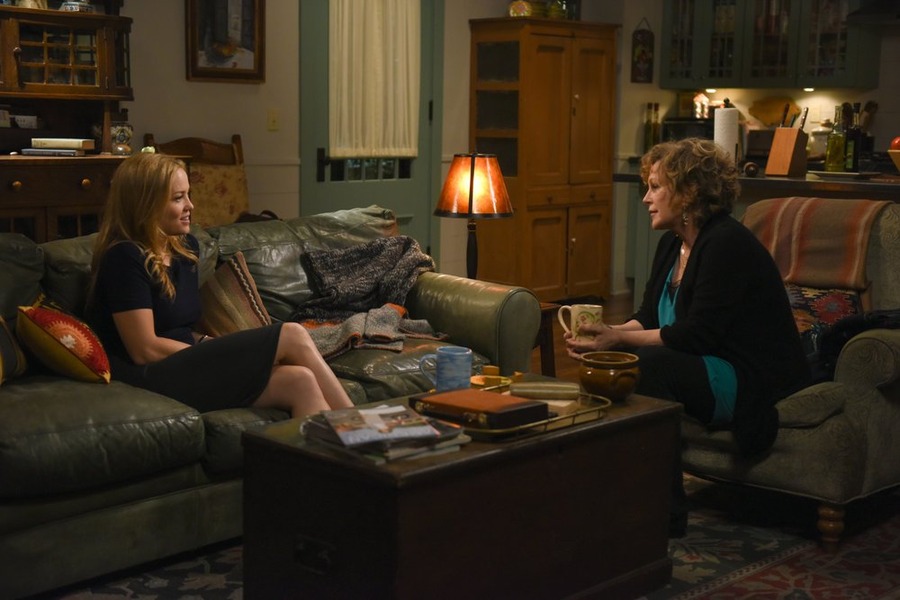
  • AHS: Freak Show Review – “Tupperware Party Massacre” (4×09)

    AHS: Freak Show Review – “Tupperware Party Massacre” (4×09)


    tupperware party massacrePerhaps I’ve just been worn down. Perhaps we’ve passed through the quality looking glass and everything has gone topsy-turvy. Who knows. But “Tupperware Party Massacre” is a dementedly fun, twisted episode of Freak Show. It’s a sign of vitality at a relatively late stage of the season, and thank goodness for it. The episode has laser focus, not just in terms of its plot (which continues to foreground the significance of the freak museum Stanley is working with), but in terms of its themes. Here is an episode that, finally, feels consistently and, more importantly, successfully about things.

    There’s been a collection of themes and motifs floating in and out of Freak Show all season long, but this week’s episode is the first that draws a line through all of its various plots and still keeps them orbiting around these themes. It’s no coincidence that the episode makes by far the season’s best use of the massive ensemble cast—and that’s including some dead characters!

    Everyone in “Tupperware Party Massacre” is worried about normalcy, about feeling like a proper member of society. They all have the same goal, which is to be not something: to be not gay, to be not ordinary, to be not a freak. The characters have been born into situations, into bodies, that they can’t help, and that they can’t change (not for lack of trying). The sick joke is that for every one of them, their fantasy of normalcy is someone else’s freakshow reality. So you get the frankly brilliant parallel between Bette and Dot, who want normal, separate lives, and are cruelly prevented from that by their deformity; and Dandy Mott, whose “perfect” life and perfect body are shot through with insanity.

    But don’t take this all to mean that “Tupperware Party Massacre” is too serious or ponderous. The title suggests, correctly, that we’re a little off center. One of the very first images is of Dandy playing around with Gloria’s corpse, held up on strings. “Now you’re my puppet mother!” is creepy, unsettling, and absolutely hilarious. I can go all in on this show if “demented circus” is the tone we can keep up.

    Most of the episode’s set pieces bring a return to the off-kilter, Flannery O’Connor-esque Southern Gothic tone that the show’s earliest episode’s hinted at, none more so than the titular massacre. But even smaller, character moments embrace the horror of the grotesque. Take Jimmy Darling’s fling with Ima. He’s wasted drunk (and must have been for several days now) and is feeding her, or else has his pants around his ankles fucking her. The episode treats him as something of a punch line, but the sad desperation with which he gleans attention from Ima, and the wonderfully bizarre drunken sequence with Ether, paint a sympathetic portrait of the character for pretty much the first time this season. The writing, as well as Evan Peters’ plaintive performance, give a new depth to Jimmy Darling, and make it much easier to genuinely feel for the kid.

    Dell also gets a much-needed boost of empathy, as his guilt over Ethel and Ma Petite’s deaths drive him to suicide. The sequence of his near hanging is beautiful, brilliantly filmed, with alternating flashes of black and blurry bursts of color as Dell’s vision leaves him. Desiree’s last minute rescue comes as a genuine relief, and you realize you’ve been holding your breath as Dell loses his.

    Bette and Dot finally get some proper attention after a weeks-long lull this week. It’s unfortunate that Sarah Paulson is still getting the same notes to play over and over, but it’s still something to see how she has managed to craft two distinct, vibrant characters in the twins. Elsa and Stanley have tried to convince them that the surgery to split them is a good idea; they’ve made up some cockamamie story about how they each have their own heart and sets of lungs, so it’ll all be fine! Sweet Dot is naïve enough to believe it, and while Bette’s not, she still longs enough for a normal existence to consider the option anyway. The twins’ awkward romantic encounter with Jimmy is another in a line of appropriately weird scenes; it’s about time for the show to take more consistent storytelling advantage of the menagerie of curiosities it has on display.

    The overall season arc gets a kick in the ass this week as well, as Dandy becomes an outright, outsized villain, convincing the town cop with surprising ease to shoot Regina in the head, and slaughtering a party full of housewives. He converges with the freaks once more, as Jimmy’s drunken escapade ends up getting him nailed for the murder. The comparison here, of the freak with a good heart and the normal kid who’s a secret axe murderer, might be obvious, but at least now it’s once again explicit, providing an easy justification for the plot, so that the story can make other, more interesting observations about its characters.

    “Tupperware Party Massacre” is a really strong installment of Freak Show, exemplifying the season’s best strengths and addressing many of its weaknesses. Most importantly, it hits exactly the right mark of weirdness, while still balancing it with both horror and thoughtful drama. At its best, Freak Show can keep all of these balls in the air, and become wildly entertaining as a result. At its worst, those balls wind up scattered across the floor. Luckily, for now at least, Freak Show is at its best.

  • Sons of Anarchy Series Finale Review: “Papa’s Goods” (7×13)

    Sons of Anarchy Series Finale Review: “Papa’s Goods” (7×13)


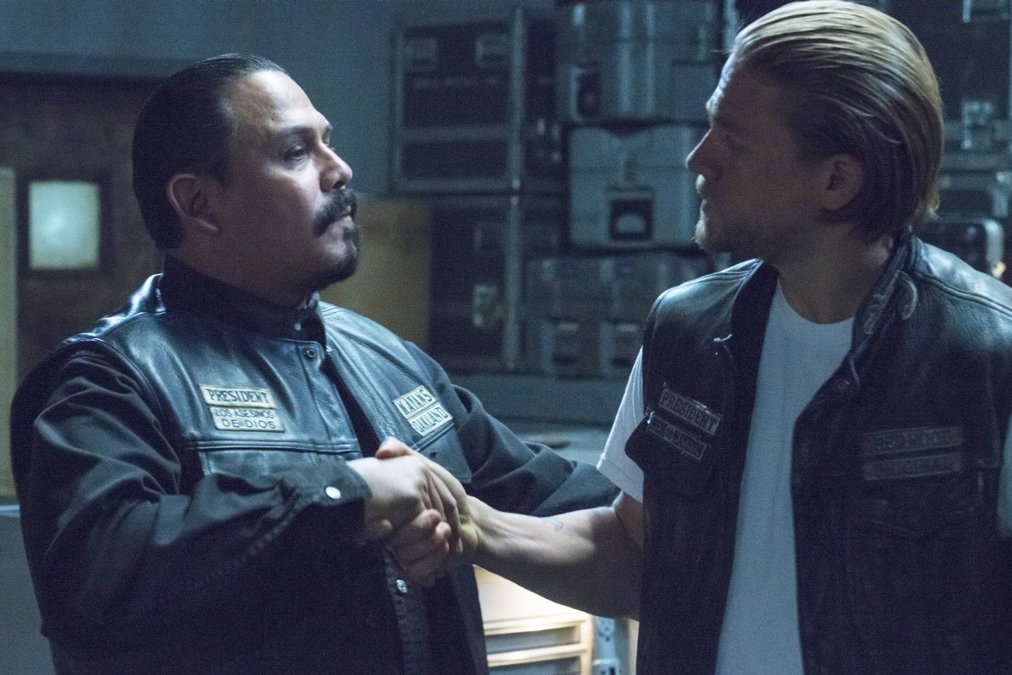
    sons of anarchy papa's goodsDepending on how you look at it, Sons of Anarchy leaves on one of two notes. The primary note, the one that I ultimately think the series intends, is one of tragic regret, the weight of the characters’ history coming down to bear upon those left alive. But there is a secondary note here, one borne of the tonal miscalculations that have plagued the show’s final arc for some time now. For the bulk of its running time (which, yes, is still too long), “Papa’s Goods” treads carefully enough, but when it does make missteps, they’re enough to make you apoplectic.

    After seven seasons, amounting to about five years of the characters’ lives, Jax Teller is finally made to answer for his many sins. But he does it on his own terms, and he dies regarded a hero by basically everyone else on the show (again, those who are actually left alive). This is a tricky spot, to say the least, though I don’t doubt that the show’s nigh-religious final moments ended up connecting with the bulk of the audience. I’m not nearly so convinced that that final shot works, with Jax meeting Michael Chiklis’s semi truck head-on, arms outstretched, a literal Christ figure, dying for the sins of SAMCRO.

    The finale itself is concerned mainly with tying up loose ends. After all, the major emotional beats have by now been resolved, an all that’s left is Jax’s final fate. There is absolutely no question that we did not require two hours to get to it. “Papa’s Goods” suffers from the same overwritten, undercooked plottiness that has been such an issue throughout the past several seasons. One would think, for instance, that the writers would have remembered the show’s ill-advised sojourn to Ireland and decided the finale should not spend so much time with the IRA once more. On a significant stretch of the episode, Jax is off on a murder spree, clearing the way for the gangster’s paradise he plans to leave behind.

    Now on the one hand, there’s something to the idea of Jax running around, his mind focused solely on club business, while Nero loses his mind and is left alone to deal with the fallout of every terrible decision the Teller family has made. But the finale is too concerned with sending the club, and Jax, on what amounts more or less to a victory lap. If I have one complaint about this finale, it’s the way it underserves the remaining members of the ensemble; and not just Drea de Matteo, whose Wendy is left to stand around, mostly silent, but also Kim Coates, whose Tig I think has gotten less attention this season than even Rat.

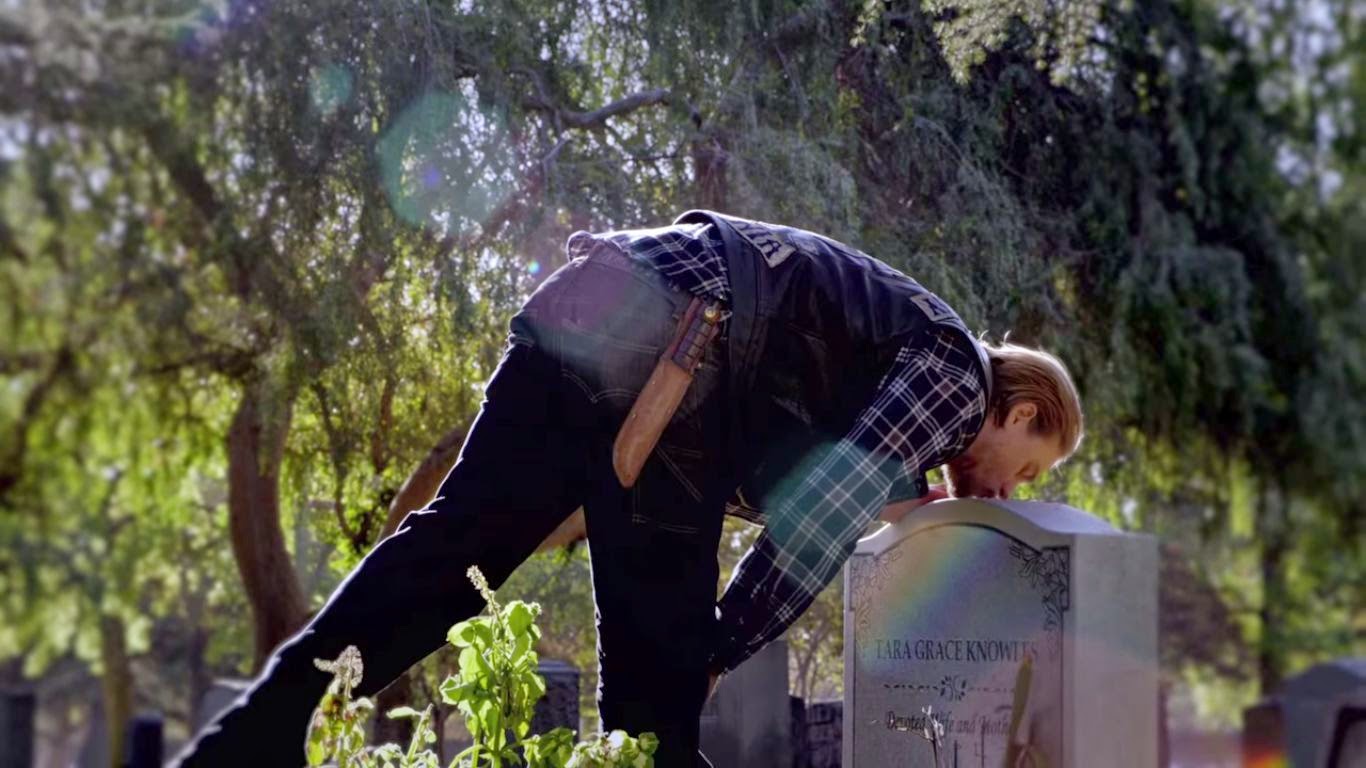
    At times it seems the show is trying to have things both ways. After all, the episode opens with Jax burning all of John’s papers and photos. He visits the graves of our dearly departed Opie (where he leaves his SONS rings) and Tara (where he leaves his wedding ring). This is a man who has embraced the fact that he is a criminal. As he says to Nero, “The lies caught up to all of us. This is who I am. I can’t change.” In watching this episode and considering Jax’s arc to this point, something occurred to me that I hadn’t considered until now: in my frustration with the show, with the idea that Jax should have just left with Tara, should have gotten out of the club, is inherent the notion that Jax could be redeemed at all. In other words, in wanting Jax to wise up and leave Charming, the audience is giving him more credit as a moral human than the show or the character himself is willing to give. “Papa’s Goods” may make Jax a martyr, but it’s not to justify his actions. The finale is a condemnation of Jax Teller, of John Teller’s legacy, of the whole shebang, really.

    Or rather it would be, were it not for that troublesome final sequence. Jax is finally brought to account for his sins, yes, but what has changed? SAMCRO goes on, still slinging guns, still trafficking drugs; Chibs’s veiled threat to Jarry before the Mayhem vote might be for show (so much of this episode, after all, is smoke and mirrors), but it also might be a final restatement of these men’s dangerous attitude toward women. Jax tells Patterson that at the end of the day, “the bad guys lose,” but Jax dies in communion with his father and with a smile on his face. I don’t see any bad guys losing here. Hamlet ends in blood, in the total ruin of an entire family; there’s blood to spare in Sons of Anarchy, but it pulls that final tragic punch, to the show’s detriment.

    In the end Sons died as it lived, in a patchwork of cool action sequences, occasionally affecting drama, long-winded plots, and portentous symbolism, shot through with some of the best dramatic acting you’ll find on television. That is an insanely frustrating legacy for a series, and I imagine that I will shake my fists at the sky for years to come, imagining what a four or five season run of the show might have looked like. But ultimately when we look back on “Papa’s Goods” we will look back on the tremendous pas de deux between Charlie Hunnam and CCH Pounder. We’ll look back on two great car chases, and some really great camera work during the last bike chase. We’ll look back on a Mayhem vote that, though it turned out (like so many climactic moments on Sons of Anarchy) to be a ruse, did manage to put a lump in my throat after all.

    And when we look back on Sons of Anarchy, we can remember a great second season, with a heart-stopping finale that is still one of the best in recent memory. We’ll remember episodes like “Hands”. (We’ll forget all about Romeo and the CIA, hopefully.) We can remember the miracle of an acting performance that Katey Sagal turned in, remember the moments that shocked but that didn’t make us roll our eyes. There was plenty to like about Sons of Anarchy, even here at the end—and with it all behind us, it’ll be that much easier to remember it fondly.

    Episode Grade: 7.5/10


    Stray Observations:

    • In a moment that comes more or less out of nowhere, the club patches in T.O. I understand the impulse to address the club’s stance on race one last time, but considering that 1) I barely know who T.O. is, and 2) he vanishes from the episode after getting patched in, the impact is perhaps not as great as the show thinks. Plus considering that Juice’s long journey to a gruesome death began with his own race anxiety concerning the club, it’s also a pretty sad moment.
    • How many tremendous guest actors has Kurt Sutter attracted to this show over the years? I can’t think of one off the top of my head that I disliked (I know that Ally Walker’s June Stahl was not so popular, but even she brought a demented psychosis to her role that was fantastic to behold). This season alone has highlighted CCH Pounder and Jimmy Smits, but even actors with smaller roles, like Annabeth Gish and, astonishingly, Marilyn Manson of all people, have done some good work with what they’ve been given.
    • Much has been made of Abel’s fondling of Gemma’s ring in the car. I met the shot with a shrug; file it away under “portentous symbolism”. If the idea is to indicate that the kid is permanently fucked up from all this, well, that point’s been made sufficiently by now. Making it again with such a trite shot, in a scene where the kid is being (somewhat unbelievably) carted away to safety, is gilding the lily a bit.
    • Seriously, what an up and down journey watching this show has been. I wouldn’t recommend anyone watch it straight through again, but it sure has one hell of a highlight reel.
  • American Horror Story: Freak Show Review – “Blood Bath” (4×08)

    American Horror Story: Freak Show Review – “Blood Bath” (4×08)

    ahs freak show blood bathI think that we’re far enough into American Horror Story as a television series now that we can diagnose the show’s chief problem, especially because it’s a problem that plagues Ryan Murphy’s entire oeuvre, more or less. It’s a problem best presented as a question: what is American Horror Story meant to be about? With Murder House you have an answer: fucked up family finally spends quality time with each other after their haunted house kills them. (Can you believe that Murder House is in retrospect the most focused and consistent, if not the best, installment of this series?) Ditto Asylum, which was about a ragtag band of outcasts who, in their struggle to escape imprisonment, become their own kind of family.

    Coven and Freak Show gesture at similar themes, have similar trappings of families both born and made, and how these units compete with each other for prominence in the various characters’ lives. But where the first two installments managed to keep these themes central enough to make the show cohesive (despite narrative loop-de-loopsdeadends and detours like the Rubber Man and Murder Santa), the latter installments feel composed entirely of such detours. It makes one grateful for scenes such as the ones that open and close “Blood Bath”. At the beginning, Gloria recounts the History of Dandy Mott, which while thoroughly unsurprising is also plenty creepy. Also ramping up the creep factor: the episode’s final scene, in which Dandy bathes in his murdered mother’s blood.

    I’m sad to see Frances Conroy go, though I do wonder if it’s truly the last we’ll see of her, not just because she’s been so delightfully batty as Gloria Mott, but also because the Motts have been by far Freak Show’s most consistently engaging and entertaining component. Dandy’s murder of Gloria fits both the “crazy shit happens” and the “be about something” criteria for a good episode of American Horror Story, and it’s just so very rare that that happens anymore.

    The rest of the episode is concerned with the other half of the season’s ongoing plot. Dell somehow manages to trick everyone into believing that “some animal” killed Ma Petite. The little gal sticks around in flashbacks, however; and Ethel is burned enough to think that Elsa may have done the deed. What’s this? Character-based conflict? We’ve gotten to this point in fits and starts but I’ll take it. The confrontation between Elsa and Ethel has to drop more than a little exposition, but two great actors, a pretty awesome reveal, and some neat direction more than make up for it. Jessica Lange seems more engaged than she has over the past couple episodes. I don’t necessarily think she was phoning it in previously, but it’s certainly dialed up a bit now.

    And like that Ethel is gone! Elsa frames an elaborate suicide with Stanley’s assistance. (The only thing more elaborately staged is Elsa’s grief.) That’s two “main” characters that “Blood Bath” dispatches, but it says something that Gloria’s feels much more significant than Ethel’s, when one imagines the writing intends the reverse. But the fact is that none of these characters has been well drawn enough to warrant scenes like Ethel’s funeral, which ask of the audience emotion that has not been earned. Take for example the sudden Girl Power speech that Desiree (remember Desiree?) gives Evey and Grace Gummer the Fork-tongued Tattoo Monster. “You’re family?” OK, sure. The tarring and feathering of Grace Gummer’s father hits on the “us vs. them” mentality that drives the season, the idea that “Freaks are family”, but it does so in that clunking, Murphyesque way. Sometimes it feels like the production team skips directly from pre-production notes to finished product, without ever whittling everything into a coherent narrative. Freak Show is “about something” in only the most technical sense; it demonstrates a fifth grader’s understanding and execution of theme.

    On the one hand, if our standard for American Horror Story is for crazy things to happen, like for instance the literal tarring and feathering of a man who previously turned his daughter into a fork-tongued tattoo monster, or a serial killer bathing in his dead mother’s blood, then “Blood Bath” was a very good episode. And I read the Internet—I am well aware that this is the only standard by which many people view the show. The bar has been set so tremendously low by Coven that, as long as Freak Show can avoid being outright offensive or moronically plotted, which it so far has, then it remains a pleasant, occasionally freaky diversion. What frustrates is that the show is capable of more, has achieved more in the past, and shows glimmers of that potential still.


    Stray Observations

    • Danny Huston returns, thankfully NOT as the Axe Man. The long diversion into just how, exactly, Elsa got her fancy legs is perhaps unnecessary, style over substance, but I suppose this is the show we’re watching after all.
    • Gabourey Sidibe returns as Regina, Dora’s daughter, and I’m so sorry you guys, but she just isn’t a very good actress. Her line readings are so flat, and since she’s taking part in the show’s most exaggerated, surreal story, she really can’t get away with it. Finn Wittrock and Frances Conroy know exactly what they need to do in these scenes, but Sidibe just seems lost, like she’s shown up to read cue cards and collect a paycheck.
    • “You’re no better than the Roosevelts.” “How dare you say that name in this house?”
    • Evan Peters should play drunk for the rest of the season; even an indignant and mourning Jimmy Darling is still adorably red-faced and slurry.
  • Sons of Anarchy Review: “Red Rose” (7×12)

    Sons of Anarchy Review: “Red Rose” (7×12)

    sons of anarchy red rosePerhaps unavoidably, “Red Rose” is a step down from the preceding episode. Not only is there still one more episode through which to stretch the series’ denouement, but it’s also just plain impossible to maintain the emotional highs that we’ve just reached for what would amount to nearly three hours of television. Season arcs come in peaks and valleys, and for the bulk of its running time, “Red Rose” has to function as a valley. But even if last episode was any kind of equivalent to Breaking Bad’s “Ozymandias,” “Red Rose” is no “Granite State,” no matter how very hard it’s trying to be.

    The problem is that Sons of Anarchy’s valleys are very rarely interesting, and so, when we’re asked to spend multiple scenes pondering the re-mapping of gang territories throughout the improbably massive town of Charming, it’s pretty hard to actually care a whit about it. Peaks and valleys is one thing, but after the total wreckage of “Suits of Woe”, going back to business as fucking usual is a bigger letdown than usual.

    At least there appears to be a purpose beyond simply explicating the mechanics of gang politics. As I see it there is a two-fold question here. First, why are all of these men still listening to Jax Teller, when they are all perfectly aware that his latest string of decision making has blown up all of their lives into all-out war? Because, this time, he promises everything will be great? That’s all the reasoning he has to offer, and they all still buy it. Jax has convinced everyone (and, more importantly, has convinced himself) that he is bringing some sort of beautiful revolution to organized crime, which is more than a little insane.

    Now at this point I might throw my hands up in despair. (My notes from about halfway through the episode read, verbatim: OH MY GOD THEY’RE MARTYRING JAX.) Fortunately, though, the episode is prescient enough to pose a second question: How on earth does Jax Teller still have it in him to live this toxic life? “Red Rose” doesn’t get so far as to offer an answer, but it lays enough groundwork to leave me confident that an answer is coming.

    It’s this second question that much of the second half of the episode concerns itself with, and it’s no coincidence that the second half picks up speed considerably. Once Jax finally levels with Unser, the episode returns to that well of Shakespearean inevitability that has been the sole driving force behind this season. Jax’s redemption tour, such as it is, is shaping up to be more of a suicide mission, and while that looks a whole lot like martyring at the end of the day, it still leaves room for the idea that Jax himself is irredeemable; that the only thing left is for him to die.

    Of course I get to say this because, this week, Jax murders Wayne Unser in cold blood. Unser has since the beginning been the show’s moral arbiter, a narrative conscience, lingering around through losing his badge, through cancer, through complete and utter superfluity, if only to remind us that, yes, Jax isn’t the great guy he thinks he is. The character has gone astray (to put it mildly) over the course of the series, and even in this last season, he didn’t have as much to do as one might have liked—why, for instance, was he not permitted to discover the truth about Tara on his own? Would that not have had more dramatic weight? But regardless, the final standoff tonight between him and Jax is a suitable, appropriate end for the character.

    I absolutely love the long sequence at Gemma’s childhood home. Unser’s arrival is pitch perfect, a would-be heroic moment, starring a sad sack old man and the violent psychopath he’s hopelessly in love with. For her part, Gemma creeps around the edges of the episode as a ghost, and even when Unser and Jax converge on her, she’s already gone; this, too, is her design, and she sees exactly how this must end. After Unser’s death, Jax and Gemma talk, but there are no histrionics. A moment that could easily have been overplayed, been melodramatic or even operatic, is instead chillingly, depressingly normal. Gemma and Jax may as well be discussing groceries.

    Obviously, though, the big event of this episode is Jax putting a bullet through his mother’s head. The framing of this scene in the garden is perfect, Gemma facing away from her son, and therefore from all of the damage she has done. Her insistence that it was all for his benefit, all to save the family, rings hollow, because it is addressed to the void before her. “This is who we are,” she says as she basically instructs her son to kill her. Charlie Hunnam gives a season-best performance as Jax gears up over and over again to kill Gemma, each time leveling the gun at her only to drop it again. When he finally convinces himself to pull the trigger, it’s an act of violence that still manages to be sudden, and Sons’ unflinching approach to violence means we hold on Gemma’s face as the bullet flies out from her forehead. It is not as dramatic, not as gruesome, a death as Gemma likely deserved by this point—but it is fittingly tragic, the death we knew must come all along.

    But no matter how good this scene is—and it’s really, truly great, seven seasons in the making, and carrying all that weight of expectation without once buckling under it—great scenes like this can’t exist in a vacuum, yet that’s what I feel like Sons constantly expects. The pacing of this season has been an absolute mess, and, “Suits of Woe” mostly excepted, every single episode has suffered for it, no matter how many great scenes or performances or shots they contain. That’s not to say there was room in last week’s episode for any or all of the events of this week’s. In fact it feels perfect to me to have Jax’s killing of Gemma as a separate beat. But knowing that something needs to happen at the end of episode 12 does not absolve one from writing the rest of episode 12, and that’s pretty much exactly what has happened here, and what happens on this show constantly.

    So we face the finale with nothing left but to learn what Jax’s endgame is. We are basically guaranteed more politicking, more red herrings and fakeouts and needlessly extensive plotting, because Kurt Sutter and company are operating under the mistaken assumption that these plots are interesting in and of themselves. And we go into the finale with most of the remaining interesting characters already killed (more on that in the Strays). What possibly is left to cover? Who knows? But even if it’s only in fits and starts, from “Red Rose” it is already clear that Sons of Anarchy will ultimately be known as an epic tragedy, occasionally moving, frequently frustrating, sometimes human. If you’ve come this far, then those moments will still satisfy.

    Stray Observations

    • Another week, another scene of Juice getting raped. I had hoped that at the end of all this he might get his revenge on Jax, and perhaps the fact that I hoped that at all speak to some success on the storytelling’s part. That he dies, essentially sacrificing himself to protect the MC one more time, is tragic in its own right, but is so removed from the character-based conflicts that would make that tragedy really hit home that the overall effect is diminished. Juice has been on borrowed time since failing to hang himself, way back in season four, and his series arc ultimately took him to the exact same point. That’s a whole lot of middle for such a delayed payoff.
    • Guest star palooza! Michael Chiklis popping up in a surprise guest role is pretty fantastic, and he and Katey Sagal get along brilliantly. Ditto Charisma Carpenter, who while perhaps not as recognizable of a name, does an equally good job of bringing weight to an otherwise minor role. Both characters are there for Gemma to bounce off more than anything else, but if you’re going to do this sort of story with the character, then it’s absolutely a smart move to fill these one-off roles with character actors who will make them mean something.
    • Notice how Gemma and Jax use the same logic to justify Jury and Tara’s murders, respectively.
    • Now presenting the Sons of Anarchy in The Return of the Terrible Irish Accents and the Interminable Montage
    • Did Theo Rossi Show His Ass? Charlie Hunnam will be handling all man-ass duties forthwith. RIP Juice.
    • We don’t speak of Anarchy Afterword in these parts, but if anyone did happen to catch it, please tell me someone uttered the phrase, “It was the right time for Gemma to go,” so that I can cackle wildly.
  • Parenthood Review: “Lean In” (7×09)

    Parenthood Review: “Lean In” (7×09)

    Parenthood - Season 6

    Parenthood really could have gone out for the year on a better note. “Lean In” is a middling episode at best, with stories that are repetitive, grating, and frustrating. As much as I love Sarah and Hank, it’s a rough week indeed when their portion of the show is the sole highlight of the episode.

    “Frustrating” really is the best word for how I felt after finishing this episode. It’s not bad, per se, but it simply fails to deliver on any of the promise of Parenthood—fails to deliver on the promise of the season, of the series, of the characters, of it all. “Lean In” is at turns lazy, manipulative, and clichéd, but worst of all is the complete lack of awareness on the part of its characters. The various Bravermans act like real assholes this week, but we’re meant to root for them all the same. This is always true of Adam and Kristina, but here the problem is especially egregious where they are concerned, and it bleeds over into most of the other stories, as well.

    It’s an occasionally problematic fact of the series that Parenthood’s characters occupy a bubble of white, upper-middle class SoCal privilege. But “Lean In” is written from within that same bubble, and it makes for some truly unsatisfying storytelling. Take for example Adam and Kristina’s story this week, which has them confronting Dylan’s parents over their decision to pull Dylan out of Chambers. Last time I wrote about Parenthood I defended the narrative decision to place Max’s parents in the school environment with him, but this week it becomes an awful mess. It’s a terrible idea for parents to supervise their children at school, but that doesn’t mean it can’t generate interesting conflict. The script for “Lean In,” though, just makes Adam and Kristina out to be schmucks. Well, more so than usual, at any rate. Kristina’s speech to Max last week was heartfelt and touching; this week, her insistence that Max was not harassing Dylan is wrongheaded and, frankly, insane.

    What’s worst is that the whole thing is resolved by a family meeting, in which Max apologizes to Dylan for making her feel uncomfortable, and everyone more or less hugs it out. The whole thing takes a complex issue (actually, several complex issues) and reduces them to a pat, trite conclusion that lifts up the Bravermans without them having to actually address the flaws in either their administration or their parenting. Max learns a lesson and that’s great, but after some great, nuanced handling of this situation, the show really biffs the landing here.

    As bad as all that is, the bits with Julia and Joel are even worse. If Kristina and Adam’s parenting this week is misjudged, then Joel’s romantic overtures are flat out insane. Joel is a creep this week, period, but the show plays up this latest development with maximum melodrama, an excruciating point that the overbearing score during their lunch scene drives home. It’s basically the second act climax of a Lifetime movie up in here. Which isn’t to say that Sam Jaeger isn’t great as Joel, but neither he nor Erika Christensen can make this dreck romantic.

    It is as always a problem of perspective. The show has never been particularly interested in Joel as a character, which means that the divorce story has been pretty heavily weighted toward Julia. As a study of divorce and its many different phases, and the effect it has on not just the couple, but their families as well, the story has until now worked just fine. It was about Julia, and Joel was an object in it (the same way that Chris, Sydney, Victor and even Zeek have been). But now, this turnaround of Joel’s is thoroughly unbelievable, and so is Julia’s conflicted nature as a result. As for the story’s totally shocking and not at all stupid cliffhanger conclusion, the less said the better. How lazy and reverse engineered can a plot really be? Like with Adam and Kristina, the writing takes something interesting and new and takes it to the most unsurprising, uninteresting place possible.

    But the show tops itself even in this regard! After a story with Zeek and Drew that is literally a repeat of the previous one, the episode closes on Zeek having another incident in bed, begging Camille to call an ambulance. Now of course this scene was spoiled by the crack team at NBC’s promotional department, so any potential impact it might have had is entirely out the window. By the time the episode ends you are basically rolling your eyes. I understand the logic behind ending the season here, especially since we began here as well, with Zeek’s health problems, and it’s a fine way to go about things, but it’s hard to be too surprised or affected by a “twist” we literally saw coming a week ago.

    It’s a disappointing conclusion to the fall season, sadly. There are still bizarre pacing decisions, with Mae Whitman and Dax Shepard once again taking the week off; there are stories that are repeated wholesale from previous episodes; and there is just lazy, rote, cliché storytelling for too much of the time. The usual charm of the actors, even, is mostly lost, whether amid Zeek’s unnecessary gruffness with Drew, or Joel’s inappropriate declarations of love, or Kristina and Adam’s unbridled asshattery. Here’s to hoping for a stronger back half.

    Stray Observations

    • Sarah and Mark’s brief reunion here is nice, even if Jason Ritter is being trotted out as a “road not taken” for Sarah and not much else. That’s much better than him serving as the third point of a triangle, which is why I’d feared. It’s a nice enough story on that level, then, further solidifying that Sarah and Hank are for real, Betsy Brandt notwithstanding.
    • Did Drew Holt get a haircut? No. He has been very busy studying.
    • Well, you have Thanksgiving and suddenly it’s been two weeks since Parenthood aired! Sorry for the delay in getting this up—you’ll understand my reluctance to think about this episode any further, surely.
  • Scandal Review: “Where the Sun Don’t Shine” (4×09)

    Scandal Review: “Where the Sun Don’t Shine” (4×09)

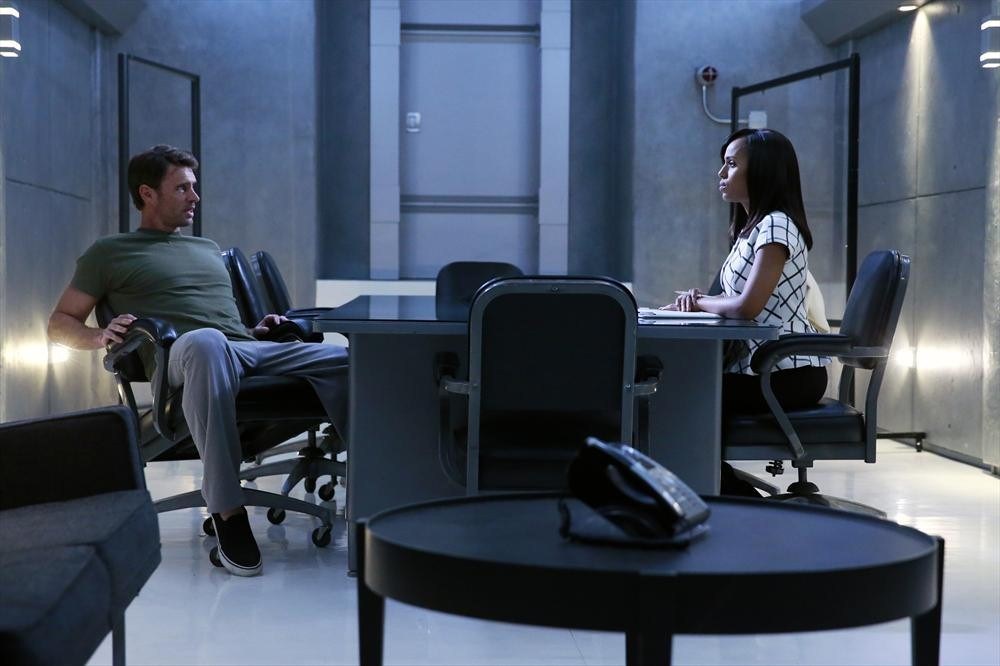
    where the sun don't shine scandalAs “Where the Sun Don’t Shine” begins, Rowan has gone off the grid following Olivia and company’s failed attempt on his life. Our intrepid heroes spare no effort in their attempts to find him; as Olivia so marvelously puts it, “As for my father, hunt him, find him and kill him.” But then Olivia is distracted, by my favorite case of the week of the season by far, and so it’s down to Jake to go on a solo quest to find and kill Rowan Pope.

    There is an impressive, creeping sense of menace throughout this episode. Kudos to Shonda Rhimes and team, who create multiple instances of legitimate danger. There aren’t actually any casualties this episode, but that comes as a surprise, rather than a foregone conclusion. That kind of tension is difficult to achieve on television series, even ones as twist-prone as Scandal can be. So often characters are safe simply because they are the protagonists; we can always rest easy in the knowledge that nothing bad will happen. And if you do manage to achieve that tension, the quickest way to deflate it is to have everyone get away safely after all. “Where the Sun Don’t Shine” avoids both pitfalls, to its extreme credit.

    But unlike the previous episode, this winter finale carries weight. These are not false climaxes, nor do they feel manufactured to create talking points. In fact, in focusing the episode on the intensely personal, rather than on spy games or sudden deaths, Scandal engenders a poignant, cathartic finale that, only in its final moments, becomes about the overarching conspiracies that make the series tick.

    The episode’s biggest strength is in its focus on Olivia, as a woman on her own terms, but also as a reflection of the men she loves, and as a product of her parents. Now, common wisdom is that Maya Pope was a big drag on the final episodes of season three, but it’s easy to see why the writers would run away with the character in the first place. Khandi Alexander is really fantastic; not only is she impeccably cast as Kerry Washington’s mother, but she effortlessly provides a gravitas that puts Maya on par with Rowan.

    Olivia has conversations with both of her parents tonight, and they are, at their core, conversations between a broken girl and the parents that broke her. She is a child of a broken home, a child without a mother and with a father she hates yet has more in common with than she can ever imagine. That’s why it’s so smart to bring Maya back into the picture at this juncture; she is a reminder to Olivia both of what her father could do to her, and of what she is becoming. His admonition to her as she points a gun at him is the most chilling, scariest thing he’s said to date: a simple warning, “Olivia. Watch yourself,” as though he is scolding an unruly child. Of course he is testing her, and of course he sees Olivia just so, as an unruly child who must be reined in.

    This all is important because it firmly reframes (or, more accurately, it finally properly frames) these nine episodes as an inquiry into Olivia Pope’s character. It sheds most, if not all, concern for her love life. As she so triumphantly tells Jake, she’s not choosing him or Fitz; she’s choosing herself. This inquiry is why I’m so jazzed on the case of the week. The client is Cyrus Beene, and he needs Olivia’s help because Elizabeth North has leaked photos of him and Michael in flagrante.

    Now on the one hand, this case is a way to bring Cyrus to rock bottom, only to reinvent himself, colder and more calculating than ever. But on the other hand, it’s a way to shed further light on Olivia, and her frequent inability to understand things in terms of romance—or, put another way, it highlights the considerable gap between her understanding of her romantic life and the reality of it. When Rowan accuses her of knowing nothing about love, that hits home. She’s caught between two men, and claims to love them both; she loves both of her parents, but they’re monsters. Olivia tries to be so many things with so many people, and along the way has lost herself entirely.

    The best scene of the night does not feature Olivia, but it does set up an important character beat for her later in the episode. Cyrus’s resignation is touching, a really well-written, beautifully acted scene, some of the best work Jeff Perry has done on the show to date. He reacts with appropriate disgust at Olivia’s suggestion he fake a marriage to Michael (Olivia sees no problem with faking such a thing), and he’s willing to fall on his sword for the sake of Fitz’s presidency. It’s not until Olivia knocks some sense into him that he goes through with her plan. He values being Cyrus Beene, the man who tells the president of the United States what to do, over the condition of his soul.

    But as Olivia is yelling at him she’s really shouting at herself, too, and we get the marvelous closing scene between her and Jake, dancing to Stevie Wonder. “I choose me,” is the perfect place to leave Olivia this season, a statement that not only wrests her from the control of either Fitz or Jake, but also frees her from the overbearing paternalism of her father. The montage toward the episode’s end, where Cyrus resumes his post, is bizarrely triumphant, with such upbeat music. Everyone is laughing, hard at work, having just the best time, and then Olivia looks in on Abby, Cyrus and Fitz in the Oval and sees a world that has gone on spinning without her. She’s lost herself over the past season or so, and tonight begins the process of finding herself again, not in relation to a job, nor to a man, nor to a family.

    And so that cliffhanger ending is perfect. When Olivia untethers herself from everything in her life, she literally disappears. The plot question of where Olivia Pope is will mirror the character question of who Olivia Pope is. That’s brilliant, and it’s a wonderful note to end this half season on, adding context to what’s come before, and providing fertile ground for everything that is to come. I’m not sure that the specific plot machinations completely work—for instance I am not remotely convinced that the Winslow conspiracy leads to Olivia’s abduction here in any way that makes sense—but thematically “Where the Sun Don’t Shine” is as good as Scandal gets, and does the best work with Olivia specifically that the show has done all season.

    Stray Observations

    • Mellie’s putdown of Lizzie this episode is a thing of beauty, but overall she spends this episode on the sidelines, and that’s a shame. I really hope for Bellamy Young to get more to do in the back half.
    • Huck gives his ex-wife the B-613 document (a gift from Charlie of all people) to help prove that he’s not a raving lunatic. This story has been stop and go all season, and even here it feels like an appendage to the episode, and the cliffhanger is not as effective here as it is with the episode’s main plot.
    • Charlie and Quinn are gross.
  • American Horror Story: Freak Show Review – “Test of Strength” (4×07)

    American Horror Story: Freak Show Review – “Test of Strength” (4×07)


    freak show test of strengthLo, my friends: John Landgraf giveth, and John Landgraf taketh away. In the very same week where Sons of Anarchy reinvigorates a flagging season with a stunning, emotional episode, American Horror Story comes completely off the rails, on the heels of a pretty good outing. After all my ballyhooing about how “Bullseye” brought focus to a show that desperately lacked it, “Test of Strength” is a scattered mess.

    Much of the problem is that the show is all sprawl, without any real protagonist or core story for us to latch on to. When an episode (or even just a scene) features a more engaging character, whether it’s Elsa or one of the Motts, then Freak Show is consistently entertaining and occasionally even good. But outside of those characters there really isn’t anything to grab on to here. Too many of the other characters, even Bette and Dot, are too thinly drawn for the audience to actually care about them. Maggie is an utter non-presence. Jimmy Darling, despite Even Peters’s best efforts, is a bland hero-type, a sketch more than anything else. And these are the characters who have gotten significant screen time! As for Desiree or Ethel (whose name I just had to Google), they are summed up by their “freak” traits and not much else.

    It’s one thing for these characters to be support, to be less well developed than the “important” characters. But then you get an episode like “Test of Strength” that abandons those characters entirely. Worse, it introduces yet another entirely new aspect, as Grace Gummer’s dad forks her tongue and tattoos her skin and, you know what, whatever. I can’t even get that worked up about it. Freak Show is a show where stuff happens and sometimes it is interesting but most of the time it is not.

    Really, that is the worst sin of the season to date: it is so very boring. It does not even have the courtesy to be hilariously, mind-bogglingly bad. A big chunk of this episode is devoted to Dell and Jimmy having a “man to man” talk, and while I appreciate the time spent attempting to develop this relationship, and I appreciate the actors’ best efforts in this regard, I’m just not invested in it, and I’m not convinced that the show is, either. Their conflict is introduced and resolved in the span of one scene, to be tossed aside for the next outrageous thing. At least Dell’s murder of Ma Petite has the trappings of a horror story, and is a genuine shock in a real sleeper of an episode. But even that falls flat, because Ma Petite is here only to be a victim, and Dell is only here to be a villain; there has been zero attempt to complicate the former, and only failed attempts to complicate the latter.

    The biggest disappointment is that the show thinks it has interesting things to say, but as always with Ryan Murphy joints, it falls well short of actually saying them. Between Stanley’s crusade to present all the freaks in jars, Dandy’s creepy obsession with Bette and Dot, and now Grace Gummer’s crazy fucking dad, there’s a really great thematic element here of commoditization and objectification, of how we view the Other in American culture, and simultaneously are repulsed by it and yet want to have control over it. But, as with Coven’s similar trappings of body horror and gender trouble, we never get quite so far as actually exploring these ideas. Ryan Murphy is content to skim the surface.

    At the end of the day, “Test of Strength” is a formless mess, giving too much attention to dull, underdeveloped characters at the expense of the too few good ones it has. It gives way to the series’ worst tendencies, while failing to maintain the previous episode’s focus, nor to deliver on the potential of the various underlying themes at play. Things happen haphazardly: Suddenly Maggie is totally into Jimmy and wants to run away together. Suddenly Stanley is blackmailing Dell. Suddenly Grace Gummer is a fork-tongued tattoo monster. Or else the same damn things happen over and over again: did you know that Elsa feels threatened by Bette and Dot?

    I hate to begrudge Freak Show its good qualities. I still admire the show’s willingness to work outside of the box formally, even if it’s in little ways, like the split-screen shot of Elsa reading her note to Dot. Even though she’s far too underused, Kathy Bates still gives a great performance, and her speech about Dell is moving even within the relative void of characterization that has been given Ethel. But there is just no core to this season, no spine to speak of. There’s no sense of the story moving anywhere, even though just last week, there seemed to be a way forward emerging. “Test of Strength” feels like a rug being pulled from beneath our feet, and now, with half the season already behind us, I wonder if there’s any way we get our bearings again.

    Stray Observations:

    • What exactly is the justification for a freak show where everyone singing all the time? Evan Peters’ rendition of Nirvana’s “Come As You Are” is autotuned beyond recognition, as Freak Show becomes even more like Glee. It’s an unnecessary, illogical performance—and it’s almost certainly meant to fill out a Songs from American Horror Story: Freak Show album.
    • The horrible squeaking sound that Ma Petite makes as Dell crushes her really is horrifying.
    • “I wanna keep my balls.” In case you hadn’t surmised this already, Jimmy’s one of those dumb drunks.
  • Sons of Anarchy Review: “Suits of Woe” (7×11)

    Sons of Anarchy Review: “Suits of Woe” (7×11)

    suits of woe sons of anarchyLet’s get this out of the way up front: this should be the antepenultimate episode of a seven or eight episode season, tops. For all the plot that this season has had to this point, every new twist and knot in Jax’s elaborate vengeance scheme, there really has not been enough story to justify the more than ten hours that the season has lasted so far. So regardless of how good or bad this episode is, the overlong path that brought us here results in unavoidable diminishing returns. Think, for instance, how much more impactful this episode’s opening scene would have been were it only the first or second time that we saw Gemma talk to Tara. This episode finally begins allowing the various conflicts that have been bubbling since the premiere to boil over, but the pot’s been threatening to boil over for weeks now.

    But let’s forget that. Let’s pretend that this is indeed the antepenultimate episode of a season of more appropriate length, because “Suits of Woe” is for most of its runtime undeniably great. In fact it is pretty much the best episode of the season to date. Everything comes to a head, and more importantly, everything is laid out on the table. Color me impressed: the writers charge headlong into the fallout and aftermath of Abel’s revelation, rather than maneuver the plot into yet another contortion. The result is that the characters finally evolve in their current conflicts, rather than playing the same ones out over and over in varying configurations. “Suits of Woe” is essentially the Sons equivalent of “Ozymandias”, in the way it so totally changes the status quo for these characters. The entire episode is a protracted, inevitable reckoning, summative of the show’s emotional journey to this point.

    These are the same qualities that made the season’s early episodes successful, and they are qualities that are nigh impossible to maintain over a larger number of episodes. But in bursts, in the small dramatic units they’re intended to compose, they can really work. As the extremely dour end of the second act, “Suits of Woe” works super well: the writing no longer has to stop just short of tragedy, and the actors give the material their usual best efforts. Gemma’s soliloquy that opens the episode is a final draw of the curtain, an ominous epigraph that precedes the (albeit overdue) fall of the hammer. Katey Sagal plays Gemma throughout the episode as a ghost, never more reminiscent of Lady Macbeth than she is here.

    Really, every character is by this point a shade of their former selves, if not by the beginning of this episode, then certainly by its harrowing conclusion. Take Unser, whose bitterness to Jax is something to behold. Dayton Callie has played the role of long-suffering knight so well, even when the show has given him little and less to work with, so it’s great to see him get some real room to play around here. “If you gave a shit about Tara maybe you’d spend a little less time being a thug and a little more time being a dad,” is a sentence I’d nearly given up on hearing on this show, and it’s fitting that Unser is the first to damn Jax.

    Even more fitting is that Juice serves the role of soothsayer, and watch how great Theo Rossi throughout this episode. First, when Juice murders Lin, he is nearly gleeful, and yet detached in a sociopathic way. Then as he details the night of Tara’s murder for Jax, he has a barely restrained grin that cracks his face, almost as though he relishes being the one to bring Jax crashing down, before he realizes finally that he has truly lost everything. Juice and Jax are so similar in this regard—both have idealized SAMCRO, made it the center of their lives, and the club has returned the favor to both of them in blood and tears.

    Jax breaks down twice in this episode. First it is in listening to Juice. Charlie Hunnam is pitch perfect, allowing Jax to just completely fall apart, but then something clicks within him one last time, and suddenly Jax is more reserved than ever. He thinks for just a few hours longer that Gemma is just another problem to be solved, that he can keep everything held together and move forward with the club and his life even still. It’s only at the end of the episode, when he breaks down for good in Nero’s arms, that we see the full scope of the wreckage Gemma leaves in her wake.

    If I weren’t so convinced that the next episodes will destroy SAMCRO that way that this episode destroys its president, I would be concerned that the episode is structured around the reveal of Gemma’s deeds, and her final decision to skip town and leave her damaged past behind. Everything might have spun from her lie, but that doesn’t, or at least shouldn’t, absolve Jax from his sins. For a while it seems as though Jax will be let off the hook, but that last scene with him suggests otherwise. It’s not so much that Gemma is taking the fall for everything; it’s just as Juice said: “Gemma knows every truth, behind every lie, inside every secret. She’s the gatekeeper.” Jax may be a monster, but he’s a monster Gemma created. There’s no doubt at this point that Sons is aiming for a scorched earth finale and nothing less, but it all begins and ends with Gemma Teller.

    This is an awesome episode, in the truest sense of the word. It deftly employs the show’s significant, weighty history, and as such the episode’s events have import. They matter. That’s been a rare quality too this season, and for a few seasons now. It’s pretty frustrating that it’s taken so long to get here, and that the road has been so inconsistent But this is the ending that Kurt Sutter began to hint at all the way back in season four, it’s been a long time coming, and now, after a lengthy final pause, it’s finally here. This episode is a powerhouse, and well worth the wait, even for lapsed fans, even for those who may have lost patience over this last season.

    Stray Observations:

    • Jimmy Smits’s Nero is yet another casualty of Gemma’s, and the scene where Jax fills him in is expertly shot and acted. We don’t hear Jax give the details, as they’ve already been repeated multiple times. Instead we just watch Nero, over Gemma’s shoulder, as he falls out of love with this woman.
    • Let’s talk about tone: the jazz music scoring Jax’s flight from the police is completely absurd, some ridiculous, Dukes of Hazzard cool outlaw bullshit that has no business on the show at this point, let alone with Jax. The man is a violent criminal who is, finally, going to have to face down his actions. He is a tragic hero, yes, but that’s the only type of hero he is anymore. “Suits of Woe” doesn’t make many missteps, but this is a pretty big one.
    • Annabeth Gish hasn’t really gotten much of a chance to do a lot with Jarry, but the character is kind of redundant, huh? When she and Unser go to meet Juice, she delivers a couple of prison rape jokes and some platitudes about needing Juice’s cooperation, but she’s filling a plot role only at this point. It’s Unser’s emotional involvement that matters now.
    • Did Theo Rossi Show His Ass? He did not, but after he killed Lin and started unbuttoning his shirt, I thought for sure we’d get a gratuitous butt shot. There’s always next week!
  • Scandal Review: “The Last Supper” (4×08)

    Scandal Review: “The Last Supper” (4×08)

    scandal the last supperThe worst thing about the current structure of television dramas, which emphasize winter finales that require series plots to simultaneously escalate to a climax, while also forestalling any real progress until that climax happens. Such is “The Last Supper”, which makes much ado about the Winslow conspiracy, further complicates it by adding both Elizabeth North and the Vice President into the mix, all the while backburnering it in favor of Olivia’s war against her father. Everything ends in a last minute reversal that is meant to be a shocking twist, but really is a reversion to status quo, so that the real climax can come in an episode that normally would just be episode nine, but now carries the extra weight of being a “finale” that has to manufacture the type of urgency that normally would build naturally over thirteen (or fifteen, or eighteen, or twenty-two) episodes.

    Is this preferable to the mid-season doldrums of a traditional (read: antiquated) twenty-two episode season? Probably. But this method of storytelling has an unfortunate tendency to reduce episodes to a series of OMG moments, scenes that are practically reverse engineered from an E! listicle. (Go ahead: Google “Scandal + shocking” and maybe throw “moments” in for good measure.) And so much of “The Last Supper” is composed of these moments. There’s great stuff in this episode, but there’s also too much that goes beyond the show’s normal heightened tone into purely ridiculous territory.

    When the show remembers to treat these characters like people, and to ground everything with at least a toe in reality, it can be really good. Olivia and Rowan have a handful of exchanges this week that are mesmerizing. I love that the biggest piece of evidence is not the deceit or the murder—which are about on par with doing the laundry grocery shopping on this show—but the abusive, paternalistic way that he views Olivia, as not a woman with any agency, but as an extension of himself, as a possession he controls. Everything he accuses Fitz and Jake of is true, but he’s so much worse himself. This is a smart way to keep Rowan out of mustache-twirling territory, because at its core, the story is of a girl fighting for independence from her father. Everything else is just trappings.

    There is another really great scene this week, this one between Cyrus and Olivia. Jeff Perry has been playing a broken man since James’s death in season three, but for the past several episodes Cyrus has fooled himself into happiness again. Now that the illusion is gone, he’s even more damaged than he was before. There are some particularly great shots here, through Olivia’s office door, that cause the image to literally fracture and duplicate. This isn’t the first time the show has employed this visual device on this set, but it’s a particularly nice one here.

    I even liked Huck’s story this week! After a few weeks of random scenes that played almost as afterthoughts, Olivia finally learns that Huck has been catfishing his son, which brings the story into the rest of the show’s orbit a little more, as well as underscores the growing divide between the two characters. Ultimately the show is using Havi to question the morality of OPA’s work—after all, Huck kills a guy in pretty gruesome fashion while on Olivia Pope’s dime—and while this isn’t exactly new territory for the show, it’s still a question worth raising.

    But then so much of this episode is a slog. The team-up between Jake, Fitz and Olivia takes all of three minutes to come back around, once again, forever and always, to Jake and Fitz measuring their dicks. When Olivia finally does take some initiative and comes up with a plan to entrap Rowan, the plan is so obvious that playing it as a fake out is a pointless waste of time. Ditto the closing double cross, which, while emotional affecting, is equally unsurprising. It’s another OMG! moment.

    The client of the week is Elizabeth North, and while at first blush the idea of using the case of the week to draw the show’s many disparate threads together, in this case the disparate threads are Cyrus’s spy whore boyfriend, something about West Angola, and the Winslow conspiracy. Bringing all these things together to be about the same thing, and roping the Vice President into it as well, is just complication for its own sake, and worse, it’s complication without any clarification. I don’t know anything more about these stories. There is no additional mystery, no pressing need to know what happens. It is just a mashing together of a bunch of questions that I was lukewarm to the answers to in the first place.

    So, I mean, whatever. Is it exciting on a soapy level? Maybe. But Scandal at its best can achieve those soapy heights, the verve of melodrama, without evincing such a tin ear for quality as is on display tonight. Scandal should never feel like a formula—in fact it can’t, if it wants to be the type of show it thinks it is—but this is Scandal by numbers.


    Stray Observations:

    • Help me with the twist that all of the B-613 files (which are actual files, because of course) are all blank pages. David Rosen has viewed the files, so somehow Rowan swapped them out without anyone catching on? Okay.
    • Now I’m probably way too attuned to this, but this week, Cyrus gets vengeance on Michael by, you know, fucking him. Because something something bottoms. I’ll direct you once more to Bryan Lowder, who criticizes this nonsense way better than I can. (Also it’s pretty strongly implied that maybe Cyrus just killed the guy, so there’s that too.)
    • Quinn whines all episode about how boring watching Kobiak is, which is perhaps not the best choice on the script’s part.
    • Mellie sleeps with Andrew and does basically nothing else this week. That sucks.
  • Parenthood Review: “Adam Brownstein Must Be Stopped” (6×08)

    Parenthood Review: “Adam Brownstein Must Be Stopped” (6×08)

    Adam Brownstein Must Be Stopped parenthood“Aaron Brownstein Must Be Stopped” is just a great episode title, and happily, it accompanies a pretty great episode. Any time spent on Max is generally time worth spent, and this week is no exception. But the episode also achieves the remarkable feat of taking Crosby’s story, which has oscillated of late between boring and incessantly petulant, and invigorating it by allowing it to dovetail with Amber’s story, and to a lesser extent Drew’s as well. The result is an episode that deals with character absences in a much more successful way, as well as one that takes advantage of the show’s shared settings to increase interaction between the characters who do appear.

    The action at Chambers Academy is the best use of the school setting yet. The school’s very existence may strain credulity, but when we realize that really, it’s only there to allow Kristina to take part in school stories with Max, it’s a forgivable lapse in logic. Scenes like those at the school this week are reason enough send the Bravermans on ludicrous business endeavors: so that they can all work together, learn together. This is simple character economy, sure, but it also plays to the show’s greatest strength, which is its ensemble of crazy talented actors and their chemistry with each other. Chambers is a device that allows Kristina to play both principal and mom, and to take an active role in Max’s school trials, rather than merely react to them once he returns home.

    It helps that Monica Potter is a rock star. It can’t be said enough. She can do literally anything—her range as Kristina is astounding. She’s funny in the opening scene with Nora; she goes from confused to flustered to devastated in breaking up Max’s fight at school; in her last conversation with Max, she is tearfully resigned to the unique difficulties that Max will face, yet her priority is never anything less than Max’s safety and emotional well-being. Especially with Peter Krause out this week as well (Adam is “away on business”), Potter is left to do the heavy lifting here, and she knocks it out of the park. Max Burkholder is great as well, taking the histrionics of Max’s freakout and giving a very tragic, human edge to them. As always, the writing is careful to remain sympathetic to all characters involved, and to give deference to Max’s Asperger’s without becoming treacly. What he does is creepy. But he doesn’t know any better, and the way Kristina helps him through these emotions is inspired. It’s a scene that will surely make the Emmy reel for both actors.

    The bulk of the rest of the episode revolves around the Luncheonette, another shared setting that can incorporate multiple characters. Crosby’s work woes are infinitely more interesting this week, and that’s because Jasmine’s voice is finally in the mix, as well. Jasmine even gets her own scenes, for the first time in what feels like forever. (Call it a hidden blessing of the cast scheduling gymnastics this season is having to perform.) The idea of career fulfillment, and of how to balance the need to make money with the need to enjoy one’s work, runs throughout Crosby’s story, and is paralleled by Amber and Drew. I think the show strikes a pretty successful balance here, but I wonder if Crosby isn’t let off the hook a little too, considering how immature he is with Jasmine and her mother. Then again, perhaps I, like Drew, am a total wet blanket about this issue—though even if that’s the case, Crosby’s need to bring pot to the concert is an absurdly poor decision that is swept under the rug, before it’s played for laughs.

    It’s great to see Amber woven into this story, and to see a story that deals with her professional issues as well as her personal ones. Mae Whitman has great chemistry with Dax Shepard, and as their characters tend to be rather similar in temperament, there’s plenty of entertainment value in watching them try to score one for the Luncheonette, with Adam lurking over the episode as this horrible off-screen presence, raining awful singing cat ladies down upon them.

    And then there is the Hank and Sandy show, which, while good, feels this week like an entirely different show. That sense is exacerbated by Sarah’s absence. Don’t get me wrong, I love Ray Romano and Betsy Brandt both, and they are so good that I almost don’t even care that these secondary characters are swallowing up so much of the show. But no matter how good the scenes are, they’re a constant reminder of stories we’re not seeing, characters we’re not spending time with, and that weighs everything down just a bit. The conclusion of the story is pure Parenthood though. Even though Ruby manipulates Hank in the worst possible way, and betrays both Hank and Sandy’s trust, the mean words, the fights and the lies, they’re just blips along the way, and no more. Other shows like this would turn this party into a big teachable moment, full of tearful apologies. On Parenthood there is just a game of poker. Life goes on.

    The stop-start nature of the season’s arcs is too frustrating to look past: Zeek is absent again, Joel and Julia are nowhere to be found after last week’s cliffhanger, Camille pops in for a second to babysit and vanishes (but hey at least she’s alive!). But the individual components are all lovely, and the closer we get to the end of the season, the more I suspect we’ll start to get everyone in the same room once more. If we’ve a little longer to wait before that happens, at least it’s an altogether pleasant wait.

    Stray Observations:

    • I wonder if we are meant to compare Ruby’s behavior toward Hank with Dylan’s behavior toward Max? They’re each taking advantage of the Asperger’s, though in different ways.
    • Last week I completely biffed on Sandy’s name and called her Linda, for some reason. Sorry about that.
    • We need to talk about the cat song that Adam schedules for the Luncheonette, because it is just amazing. Drew: “It’s really bad, Amber, thank you, for your inviting me to hear this.”
    • Seriously, it becomes hilarious how specific the show is about explaining these absences. Amber, mid-pregnancy episode, on whether Crosby should call Sarah: “She’s in Napa anyway, she can’t do anything.”
    • Did Drew Holt Get a Haircut? Nope. It’s getting all tangly back there again.
  • American Horror Story: Freak Show Review: “Bullseye” (4×06)

    American Horror Story: Freak Show Review: “Bullseye” (4×06)

    ahs freak show bullseyeIt’s amazing what one good episode can do.

    Freak Show is as insane as ever, but “Bullseye” continues on from “Pink Cupcakes” and gives most, if not all, of its insanity some context. Finally the characters begin to feel like they inhabit the same space, and the show overall is more of a piece with itself, rather than cobbled together from bits of various stories.

    Specifically, it’s Dot and Bette’s disappearance that serves as the lynchpin that draws the rest of the show into focus. It’s a central plot event that touches all of the other characters on the show; it draws suspicion onto Elsa, sheds further light on Dandy’s dementedness, sparks Maggie into action with Jimmy. The more that these elements all achieve at least some sense of interconnectedness, the better off the show will be.

    Everything is connected not just by plot, but also by an emerging central theme, which, generally, is love. Love is what Murder House and Asylum previously boiled down to, as well (Coven did not boil down to anything at all), but while the first dealt with familial love and the second with a kind of compassionate love, Freak Show deals directly with romantic love, and treats it as a passive act, something that is received from someone else more readily than it is given.

    And so you have Elsa, who on the occasion of her birthday demands the love and attention of her sideshow family. She’s becoming thoroughly unhinged, in a way that gives the character a little more definition, if not necessarily more dimension. This is still very much the mode that all of Jessica Lange’s American Horror Story characters have been played in, but there’s no denying that it’s a mode that plays to her strengths. She goes from shrill desperation, to manipulative violence, to quiet longing, in the span of an hour. This is by far the best showcase Freak Show has given Elsa to date, and I’m looking forward to seeing where Lange takes the character.

    Perhaps surprisingly, this is also a standout episode for Paul, who, as played by Mat Fraser, is the episode’s moral center. It’s Paul who is most concerned about the twins’ disappearance, and who begins to suspect foul play on Elsa’s behalf. He’s also sleeping with the candy striper from the premiere, played by Grace Gummer (I believe—I can never tell which Gummer is which), so he certainly doesn’t let his condition keep him from getting around. I like the idea of fleshing out some of the other freaks, and Paul is as good a place as any to start, especially with such a talented actor in the role.

    Even in Dandy’s case, all he really wants is love. He’s decided he’s in love with the twins, though even this seems to be more because it is a requirement of the identity he’s constructing for himself than because it’s an emotion he’s feeling. (In fact I wonder at this point whether Dandy feels anything at all.) When he reads Dot’s diary and learns that she’s planning to fleece him for the money necessary to have Bette surgically removed, he reacts characteristically, which is to say that he flips a shit. I can’t heap enough praise upon Finn Wittrock, who has taken an utter cartoon of a character and made him the most compelling presence on the show. The scenes with the Mott’s are mesmerizing, candy colored fantasias that are more freakish than anything going on in Elsa’s camp.

    We also spend some more time with Stanley and Maggie, and I’m less convinced by the show’s treatment of these characters. They’re very isolated from the rest of the show, sharing scenes only with each other for the most part. Maggie at least branches out a bit. Her romance with Jimmy, if one can call it that, falls flat, unfolding more because it is expected than because there is anything inherently interesting about it. What does work is her abandoned attempt to capture and kill Ma Petite, which stealthily becomes the episode’s scariest, most unsettling thread. This episode once more utilizes the flashes to murders that don’t happen, but does a better job of demarcating this than “Pink Cupcakes” did. They work, as another way of objectifying and dehumanizing the freaks. (It’s worth noting that Dot gets in on this action, too, imagining a future where she is no longer attached to her unwanted sister.)

    After a slow start, Freak Show has really taken off. It’s nice to once again approach these episodes with more anticipation than trepidation, and as the season starts to pull into sharper focus (as opposed to Coven, which by this point had gone completely off the rails) the story promises to only become more enticing. If Ryan Murphy and company can keep delivering episodes like these, then Freak Show looks poised to become the series’ redemption.

    Stray Observations

    • I’m seriously with the Gummers, though. How does anyone keep the Streep-spawn straight?
    • “I’m going to take my business to Woolworth’s. They’ve got ice cream.”
    • Dell and Desiree both take the week off, and while I wouldn’t say that they aren’t missed, there was obviously no room for them this week. I’m more concerned with the continued underuse of Evan Peters, who seems to be getting the shaft again this season. (Although nothing will be so bad as his nearly completely mute turn in Coven.)
  • Sons of Anarchy Review: “Faith and Despondency” (7×10)

    Sons of Anarchy Review: “Faith and Despondency” (7×10)

    sons of anarchy faith and despondencyWell, it’s about time.

    In the last moments of “Faith and Despondency” the truth about Tara’s murder is finally revealed. Of course this is done in a way that isn’t totally incontrovertible; I can already envision the seventy-minute fetch quest to find Gemma that will culminate in a dramatic cliffhanger.

    The thing about this episode is that it is long. Like, more than ninety minutes long, including commercials. Multiple set pieces are repeated wholesale from previous episodes this season. Characters whose names I don’t even know run back and forth in circles, shooting at each other. The episode is too long by half, and the pacing is miserable to boot.

    Look, Sons isn’t without its strengths. We all know this. But its focus is so often on process, on plots that are complicated not for any dramatic reason but simply for the sake of being so. Major pieces of this episode are entirely occupied by ciphers rather than characters, by henchmen and soldiers. The only problem is, the plot is not inherently interesting to begin with, and by this point it has been stretched beyond thin. “Faith and Despondency” is the final contortion, the last unnecessary twist before endgame.

    And so you have an episode where Abel gouge into his skin with a fork at school, and then blames Gemma for it. You have Juice being raped by Tully. You have Moses (Marks’s lieutenant) first beating the shit out of Rat, and then having his own eye ripped out by Jax. You have Chibs and Jarry beating the shit out of each other, and then fucking. You have literally every single typical Sons move in the book. A lot of times with this show (and with other popular shows like The Following), “dark and gritty” gets conflated with “serious and dramatic.” The climactic moment of this episode is not the serious and dramatic portion of the story. It’s an inevitable revelation that is so overdue it hardly causes any shock. And as for the material that leads up to it, any effect it does have on the audience is solely because it is so graphic, so twisted, so disturbing, and so obviously calculated to be so. The bodies are piled high—adding any more just doesn’t have an impact at this point.

    It’s a shame, because there’s some great stuff this episode. Unser gets a nice little arc this week, and his assistance with the White Power guy that tries to kill the wounded cop gets him back into SAMCRO’s good graces, just in time, I imagine, for him to corroborate Abel’s story through some good old-fashioned detective work. There is a fantastic scene with Tig and Venus that feels like it belongs on another show entirely. Kim Coates and Walton Goggins are each so great, they make me long for a version of Sons that is composed entirely of scenes like this. When they’re lost amid the unending misery porn, it’s much harder for them to have much of an impact.

    And the actual scene at the end, where first Jax tells Abel that Wendy is his biological mother, and then where Abel tells Jax about Gemma, is actually tense, and makes good use of the expanded run time (for once!). Jax’s decision to tell Abel on the spot like that is presumptuous, and Drea De Matteo runs through too many emotions to name as Wendy watches the conversation. But ultimately she is overjoyed, and despite the history of these two characters (and perhaps even because of it), there is something truly heartwarming about this scene as a conclusion.

    Which, of course, is why it isn’t the conclusion. Just as Jax’s family gets itself back together, the final tear brings it irreparably apart. There’s a simple reason why the show has delayed this moment so long: there is no turning back from it. And so the final, drawn out push toward just gets more and more tense with each second. There is a tragic logic to the whole sequence, especially in the idea that murder is to Abel just another solution to a problem. Knowing that Wendy is his mother is all he needs to be understand why Gemma would kill Tara. By staging the reveal this way, the writers are able to make it not just about Tara’s murder, but also directly about the effect that SAMCRO life as a whole has had on Abel. That’s a great position to be in for the final act.

    So, hey: I’ve been kvetching waiting for us to get to this point, and we’re finally here. The landing was perhaps a little bumpy, but we’re here. I’d be lying if I said I’m not looking forward to it.

    Stray Observations

    • The girl Jax sleeps with (the very same girl he rescued from fucking Greensleeves) looks eerily like Tara. She also cracks wise, all, “you know, before we all get gunned down by Chinese gangsters” which, uh, is not the kind of joke I’d make if I were her. She follows this up by calling Jax a good guy, even though “I don’t know much about you, or your club.” Sweetheart, you more or less covered it with the Chinese gangsters bit.
    • You know what is totally not sexy? Whatever the hell is going on with Chibs and Jarry. I don’t care if Jarry swings first, because I don’t know anything about Jarry at all. It’s another notch on the “gritty” belt, but it’s nonsensical, and its problematically violent to boot.
    • Did Theo Rossi Show His Ass? Everyone showed their ass.
  • Parenthood Review: “These Are the Times We Live In” (6×07)

    Parenthood Review: “These Are the Times We Live In” (6×07)

    these are the times we live in parenthoodBy this point in Parenthood’s final season, your enjoyment of any given episode depends in large part on which characters you favor, and whether they appear in said episode.

    For instance, I enjoyed “These Are The Times We Live In” much more than last week’s episode, because I happen to like Julia and Drew best, and I don’t really care for Crosby at all. On the one hand, I hesitate to let this level of favoritism affect my thoughts on each episode, since even though reviewing is ultimately subjective, it really shouldn’t be on that superficial of a level. But really, the balance of characters is integral to Parenthood’s success, and so there is a valid criticism to be made that, by isolating the characters to such a degree (and by going weeks at a time without featuring some of them) (seriously I think Camille might be dead, you guys), the show has lost some of the spark that makes it work.

    Don’t get me wrong: many, many of the small vignettes that Parenthood has done so far have been good, and a handful of them have even been excellent. But they are vignettes, short stories about various members of the Braverman clan, that seem to have very little to do with one another most of the time. This has always been something of an issue with the show, but the problem is much more pronounced when we are not checking in with all of the siblings, every week. Even though Parenthood can excel by finding character combinations that work, putting the actors in a room, and just letting them do their thing, it is most successful when it can bring all of those characters together, as well. This is a show about the family unit, as well as units within the family, but much of this season feels only to be serving the latter purprose.

    Take this week’s Amber story, which folds in Max as well, while Kristina and Adam both continue to be absent, for the second week in a row. That absence is pronounced, especially as this week’s story also more or less ignores Dylan, all while reiterating character beats that by now are firmly established. Amber is still unprepared for motherhood. Max still has trouble empathizing with others. Putting these two characters together does not shed any new light on either of them—or at least, the writers do not take advantage of the opportunity to do so. Mae Whitman has gotten much better material earlier in the season, and it’s somewhat frustrating to see what little Amber gets to do here. Ditto Max Burkholder, who is typically great in this episode, but who doesn’t get to stretch the way he has when Max shares scenes with Dylan. That storyline was new ground; this episode is the same old.

    An exception to all of this is Hank, who this week both intersects with Max’s story, as well continues to demonstrate change in both his behavior and in his situation. Since the show is concerned primarily with navigating the intricacies and subtleties of familial relationships, it makes a tremendous amount of dramatic sense to feature characters that are unable to do this themselves. It allows for closer examination of the relationships, the how’s and why’s of why the characters behave how they do, without requiring them to explain these reasons to each other the way a lesser drama might. This only works if the Asperger’s characters are as fully drawn as Hank and Max are, of course, and when the actors are as talented as Ray Romano is. Hank’s conversation with Linda about his Asperger’s, the first time he’s confided in her about it, is another in a series of showcases for Romano, who, even as a latecomer to the cast, has become its most valuable player.


    If balancing the ensemble is Parenthood’s chief difficulty this year, toeing the line of sentiment is a very close second. The other two major stories of the evening illustrate both sides of this double-edged sword. The first, and the successful one, is the trio of road trips taken by Drew and Zeek. While Zeek pairs well with pretty much any other character on the show, he pairs especially well with Drew, and the two have always had an understated but powerful relationship. Zeek tries to spend time with Drew, perhaps with some anxiety that he has few such opportunities remaining, but he miscalculates, the way grandparents often can, taking Drew to shoot at cans of cream corn, while Drew needs to be studying. Natalie’s reprimand of him after Drew ruins the outing is a spot on treatment of the complicated relationships between grandparents and grandchildren. “You could have humored him, at least,” she says, rightly, but that’s the last thing grandkids want to do. The time we spend with grandparents is valuable though, for those of us lucky to still have them with us, and so when Drew realizes that, more than humoring Zeek, he should savor the time they get to spend together, it’s a powerful, emotional moment.

    But there’s heartwarming, and then there’s cloying, and what the show is trying to do with Joel falls squarely on the wrong side of that line. Julia is my favorite Braverman, and so I’m happy enough to see so much time spent on her this week, as her divorce settlement comes to a close. The show’s treatment of divorce, at least initially, is unflinching. There is nothing cut and dry about this process; divorce is complicated, messy, with a tangle of emotions that are not always clear or easy to parse out. There’s a great early shot of the two of them in the elevator, with their tearful embrace obscured by the doors, which open again to them standing the way they were before the embrace; as though an elevator door opening can erase the history between them.

    But then, of course, Joel goes to say goodbye to Zeek, taken as he is with playing the victim of late, and, of course, Zeek turns this into a “fight for the girl thing,” which is both a problematic direction for the story, and also far from the most interesting one. A last minute, motion picture reunion would be boring, especially when the show has so effectively and realistically handled the divorce thing up to this point. The ending is cringe-worthy, and reads as though it was cobbled together from network notes (perhaps by the same executives responsible for the dreadful previews and promos). I want to have enough faith in Parenthood to believe a reunion is not in the cards, or at least, will not be as saccharine as the ending of tonight’s episode would suggest—but even so, this ending would then be the worst kind of false cliffhanger. It’s a no-win situation, and a misstep in what has otherwise been the season’s strongest arc. (A caveat: if the very next scene this season is Julia telling Joel to step the fuck off, I will rescind this entire paragraph.)

    I’ve probably come across as pretty negative thus far, and I really don’t want to be too hard on the show. There are many, many things about this episode that work, even amidst the stories that have issues. Drew and Zeek’s story especially was simple, and lovely. Ray Romano deserves an Emmy. I can’t think of a television series that has handled divorce more sensitively than this one. I just wish the various elements of the show would click together into a more cohesive whole, even if the realities of production make that a more difficult prospect this season than it has been in the past. This is nothing less than solid, but man, it’d be nice for it to be spectacular.


    Stray Observations:

    • “Don’t interrupt me, Nora.” Max Burkholder delivers on the comedy this week.
    • “It’s my fault, I let you watch Fast Times at Ridgemont High too early.” Lauren Graham gets a pretty great week this week, too, as Sarah begins to feel marginalized within Hank’s family unit. And of course she feels that way—there is a complete family there, and she is on the outside of it, no mater how well she gets along with Ruby.
    • The oppressive reign of on-the-nose song choices continues this week as Joel drives to Julia’s house. “Would you give it up?” goes the singer, over and over again. Shut up, band.
    • Did Drew Holt get a haircut? I’m beginning to wonder if they’re shooting these things out of order or something, because boy’s hair is all over the place every week. It looks considerably neater this week, though.
    • Seriously, though, Zeek calls out to Camille before leaving with Drew, but I think she is dead and stuffed in a closet somewhere. At least the last time she vanished, it was to Italy!