Michael Wampler

  • Scandal Review: “Baby Made a Mess” (4×07)

    Scandal Review: “Baby Made a Mess” (4×07)

    baby made a mess scandalLet’s get the record straight immediately: I am all about this episode of Scandal.
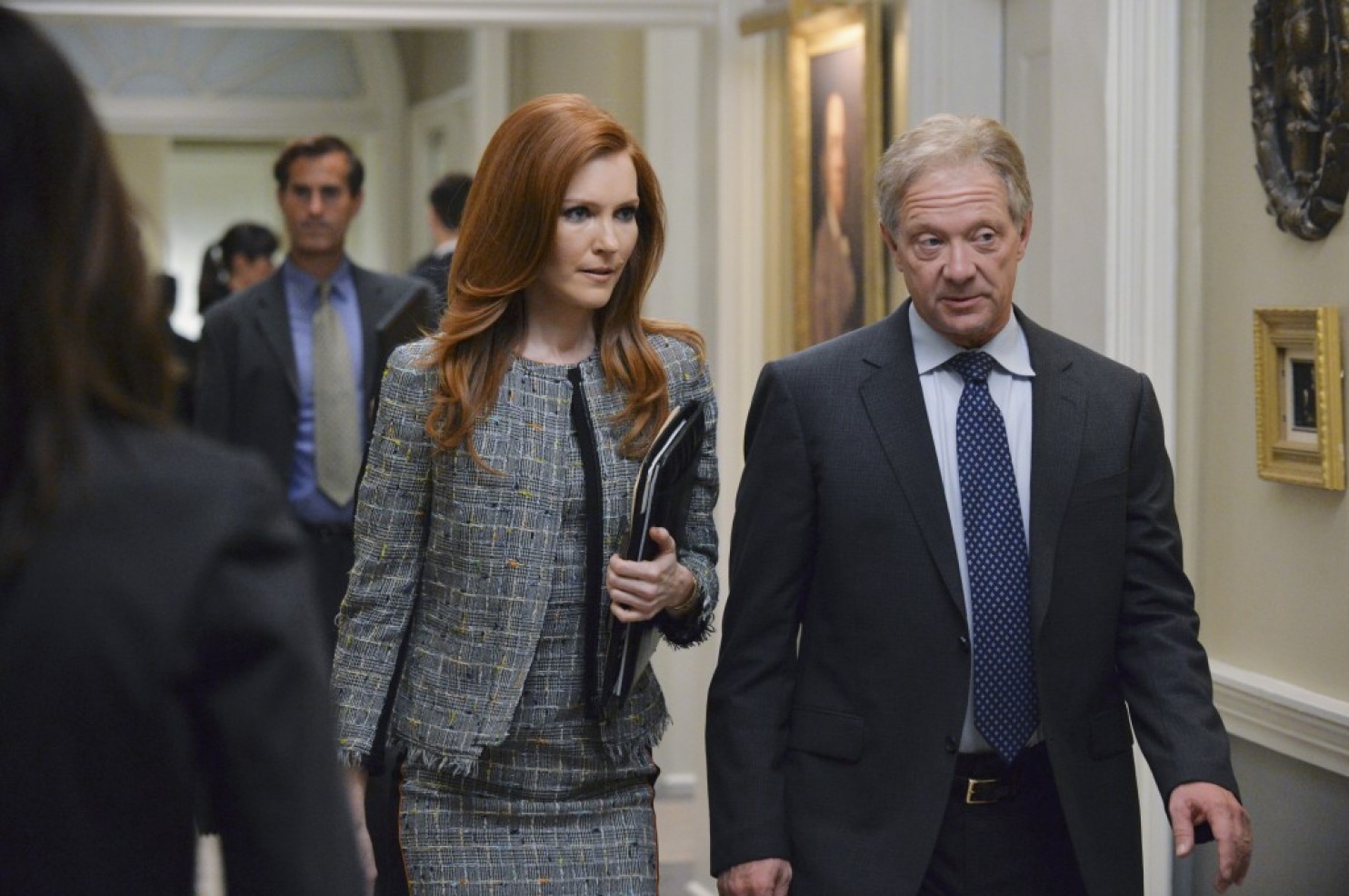
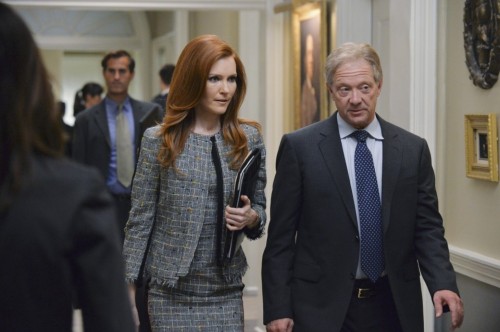
    “Baby Made a Mess” feels like a direct response to my biggest criticism of the season (and the series) to date, which is that the show has leaned too heavily on Olivia’s romantic life at the expense of her professional life. Well, in short order this episode takes that criticism, ingests it, and throws it right back at the audience.

    Most obviously, the episode does this by pitting Olivia directly against her father, allowing her (or anyone, really) to for once outsmart Rowan. That the narrative reaches this point through Olivia’s own agency, through her co-opting of her father’s tactics, and through her successful attempt at bringing the two dumb men in her life into the same room, is really tremendous. Olivia Pope is on point this week, and the result is by far the best, most exciting episode of Scandal so far this season. This is an episode that demonstrates in turn each of the show’s best qualities, one after the other. The “case of the week” is Susan Ross’s campaign for Virginia’s Senate seat, which Olivia quite literally marches into and takes over. Everything to do with Ross is funny and witty, but not at the expense of showcasing Olivia’s skills as a political operative, often spoken about but not of late seen. The campaign ad she devises featuring Ross’s daughter is brilliant, a simple, elegant, and effective solution to the problem of Ross’s ill-suitedness for the camera. In other words it is quintessential Olivia Pope.

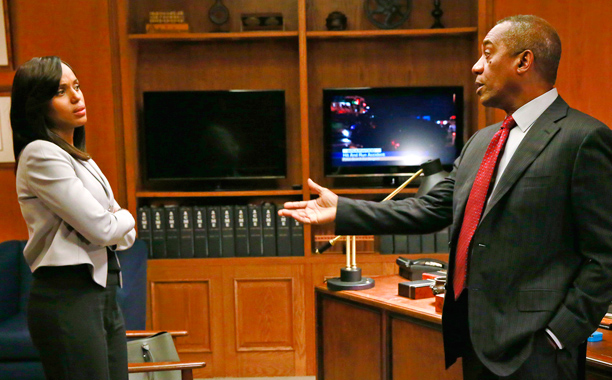
    And of course there is the scene that Kerry Washington shares this week with Joe Morton, which is easily their best dramatic encounter to date. Morton’s monologues are fantastic regardless of their context, but here, the speech serves doubly as a much-needed wake-up call for Olivia. In fact, that wake-up call may come even earlier, in her conversation with Tom, who by this point is little more than Rowan’s proxy. Upon first watch, my reaction to Olivia’s interrogation with Tom was not kind—it instantly becomes about Fitz and Jake, about positioning Olivia as an object of desire between them. It’s not until the episode ends that we realize the show isn’t positioning Olivia as an object at all; it’s allowing her to break free. He remarks on her beauty. He calls her “Helen of Troy, the face that launched a thousand ships,” and while it’s super overwrought (even if in an appropriately Scandalesque way), it also succeeds in turning what until now has been a shortcoming of the season into a strength. Tearing a page out of Rowan’s playbook, she forces Tom to confess, and uses the truth as a weapon to finally get Fitz and Jake into the same room, and onto the same page as she is. No more who-will-she-choose? No more Team Fitz and Team Jake. Just Olivia Pope, kicking ass and taking names. Finally.

    The rest of the episode supports this newly rediscovered feminist streak, as well. There’s a meaty B-plot for Abby, as her ex-husband Chip Putney turns up in the Virginia race as well, as Fitz’s favored candidate. Putney himself is a bit of a cartoon—the scene in the parking garage is extremely over the top, like a Lifetime movie rendition of domestic abuse—but Darby Stanchfield turns in a hell of a performance, ranging from physical comedy to outright drama, even embracing the melodrama of that parking garage bit as she levels a gun at Putney. While it would be justifiable to take issue with the notion that, at the end of the day, the problem is solved not through Abby’s own action but by Leo, there’s still plenty of agency in Abby’s decision to tell Leo the truth. Further, Olivia takes on the Ross campaign solely as a way to defeat Putney for Abby’s sake. I’m not sure if the show got enough mileage out of Olivia and Abby being at odds, and in fact they used it mainly as an excuse for the characters to snipe at each other in full-on Mean Girls fashion, and so in this episode especially, it’s great to see them friends again, supporting each other not just romantically but professionally, even if the two are still pretty deeply entwined.

    And then there is Mellie Grant. Her long mourning has ended, and it’s astonishing and revealing to see just how quickly Fitz changes his tune as a result. What, exactly, did he think he was asking for when he bemoaned Drunk Mellie and Smelly Mellie and all the other forms that Mellie’s grief took on, and asked for the “real” Mellie to come back? Because the real Mellie is back now, in full force, and that Mellie is a woman who is not content to curate china patterns and play housewife to the most powerful man in the world. Real Mellie wants that power, too, and, emboldened by Bitsy Cooper as well as by Lizzie Thompson, she’s going to grab at it posthaste. Bellamy Young is never anything short of amazing, and in just a few scenes here, she completely turns around the character, selling the audience fully on this transformation, and the reasons for it. When she answers Fitz’s phone and lets him know that it’s Olivia calling for him, there’s a spark in her eyes and an edge to her voice, not the shrill jealousy of a few episodes ago, but the knowledge that her husband is weak, and she is strong. That’s the kind of development I want to see more of on this show.

    So, then, what “Baby Made a Mess” is more than anything else is a re-statement of this show’s feminist objective, one that in the wake of the past several episodes was sorely needed, and is extremely welcome. The episode is not without its flaws: Huck’s story, for instance, is still too isolated to carry much weight, and yet, if more time was spent on it, it would only draw more attention to how very creepy it is for Huck to be catfishing his son. The melodrama is amped up just slightly too much at times, as well. That “Helen of Troy” metaphor loses its luster after being repeated seventeen times, and the episode’s closing sequence, with the pounding music and the montage full of smash cuts (hey, that’s the name of the site!) is a bit much. I haven’t mentioned the Winslow conspiracy, either, mainly because it’s still bubbling, not very interestingly, in the background, and like Huck’s plotline, it feels appended on, rather than an integral part of the show. But these are small concerns—what is integral to the show is its central women, and this episode both reaffirms Olivia and Mellie’s feminism in that regard, and fully adds Abby to their ranks as well. That it does this while also running on high-octane excitement is an achievement, and a promising sign of things to come. More of this, please.


    Stray Observations:

    • Despite whatever problems the resolution to Abby’s story may carry, I like the idea of her and Leo, and their scene in the pressroom is a nice contrast to the horrors of Abby’s previous romantic engagement with Putney. The actors have good chemistry, and, on Scandal especially, a non-toxic romance is a breath of fresh air.
    • Speaking of toxic romances, Cyrus plants a trap for Michael, and at first he seems to confirm that Michael is not the leak, before, at the worst possible moment, confirming that he in fact is. The other shoe, I can see it dropping even now.
    • The notable event of the Winslow conspiracy this week is that Winslow shoots himself in the head in front of Quinn. It’s nice to see she can still be rattled by something. Quinn and Huck also finally bring Olivia in the loop on the photos of her that Winslow was keeping, but nothing more amounts from that yet.
    • “The woman could sell a dual ticket of Hitler and Bin Laden.” Pretty much, yeah.
    • Susan Ross is played by Artemis Pebdani of It’s Always Sunny in Philadelphia, in case you, like me, were going crazy trying to figure out where you knew her from. It’s more than a little odd to see her playing such a “normal” role, given how batshit insane the character of Artemis is.
  • American Horror Story: Freak Show Review: “Pink Cupcakes” (4×05)

    American Horror Story: Freak Show Review: “Pink Cupcakes” (4×05)

    ahs freakshow pink cupcakes

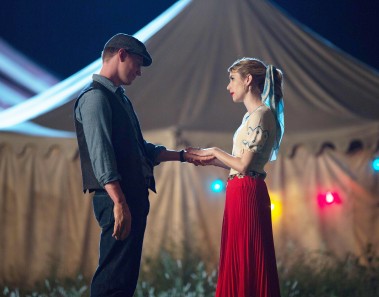
    While there are still some issues with American Horror Story: Freak Show, there’s no doubt in my mind that “Pink Cupcakes” is the first truly great episode of the season.

    It has immediately proven true that, with the introductions and lengthy preamble out of the way, the show can now launch headfirst into the stories and issues that it’s wanted to explore all along. Ryan Murphy had stated several times this week while promoting the episode that it was one that would amp up the horror quotient. Now, I’ve long since trained myself to believe nothing that Ryan Murphy says, but this once at least, he’s telling the truth. “Pink Cupcakes” returns to the psychological body horror well that it’s enjoyed for a while now, but it’s also violent, and at times downright scary, and frankly, it’s been too long since American Horror Story has delivered a good jump scare.

    Of the major stories this week, the strongest by far belongs to Dandy Mott. Finn Wittrock is quickly revealing himself to be the season’s standout performer, delivering a gleefully unhinged performance that turns on a dime from camp to terrifying. Dandy more or less plays out American Psycho this week, hitting the gym (if by “gym” we mean his freakish, candy-colored bedroom that is strangely devoid of furniture), soliloquizing about the sweet language of murder, then hitting the town looking for his next victim. Why he picks a gay strip joint to start could fill many thousands of words, but I don’t think Dandy’s psychosis is quite so easily explained away by closeted gayness. Murder and sexuality are definitely tied together for him, and with the suggestion that his father suffered similarly, I expect we’ll delve much further into this in weeks to come.

    At any rate, his trip to the gay bar leads him to cross paths with Dell, who turns out to be a closet case himself. Dell’s been enjoying the company of Matt Bomer, who guest stars this week as the escort/prostitute. Bomer is essentially playing the stereotypical horror movie vixen here, and while the gay spin is interesting enough, it’s not like he’s really asked to do a whole lot. Dandy’s murder of him is a prime example of the fine tonal line the show walks, and it has done so successfully so far this season. When the first several stabs fail to kill Bomer, Dandy’s petulant cry of, “You’re making me feel bad!” is a deeply uncomfortable laugh-out-loud moment, one that highlights the way that audiences are complicit in violence toward and subjugation of the people we might deem “freaks”.

    Though the show is occupied by the idea of spectacle, and how observation and the “normal gaze” can be their own kind of violence, its exploration of that this week, through Stanley’s attempts to procure freaks for the museum of oddities, leaves something to be desired. His scenes this week are a tough nut to crack, as the show portrays what might be flash forwards, but what might just be fantasies, with no narrative signaling at all to indicate what exactly we’re meant to take from them. The notion of what “really” happened is thrown entirely into question, but not in a way that encourages any deeper consideration. Obfuscation is fine as a narrative device, as is disorientation, but if it serves only to confuse the audience and muddle the storytelling, then what’s the point? The fake-out with the twins’ deaths seems so far to have been only a waste of time.

    Fortunately the remainder of the episode is clearer in its storytelling and more grounded in its conflicts. Out of Dell’s encounter with Bomer springs a confrontation with Desiree, who, after a brief encounter with Jimmy, suffers a miscarriage. Here’s an inversion of a trope for you: the miscarriage, far from a moment of body horror, is instead an affirmation of Desiree’s femininity. Her trip to the doctor confirms that she is biologically a woman (at least, it does so by 1950s scientific standards), and she arranges surgery to reduce or remove her extraneous parts; it also confirms, courtesy of Ethel, that Dell is Jimmy’s father. The real horror comes later, when Desiree confronts Dell with this knowledge, attacking his masculinity in the process, doing enough damage that Dell pays her doctor a visit and breaks all of his fingers. Angela Bassett gets her first great scene of the season here, in a darkly lit confrontation with Michael Chiklis that emphasizes the many physical differences between them in order to highlight her own femaleness.

    Despite some missteps in the narrative’s construction, as well as a story that still can’t find room for all its many characters, “Pink Cupcakes” is still a solid episode, and the first great episode of Freak Show. It reaches at times the lunatic heights of Murder House and Asylum, while still finding room for the pathos of the later series, as well—and suggesting that there is more where that came from, too.


    Stray Observations:

    • The singing returns, but only briefly, and it’s another rendition of “Life on Mars” anyway. (In fact it’s possibly the same rendition?) “Fame” also pops up on the soundtrack this week, and I’m definitely down for more Bowie on this show. Let’s get a “Five Years” ensemble number started, shall we?
    • Twenty dollars to take Matt Bomer home? Sign me up.
    • Gabourey Sidibe makes her first appearance this week, as Dora’s daughter, who is off at secretary school. While it doesn’t help that the conversation is half exposition anyway, and is trapped visually in the artifice of a telephone split-screen, Sidibe really is not the greatest actress, and her appearance here falls flat.
  • Sons of Anarchy Review: “What a Piece of Work Is Man” (7×09)

    Sons of Anarchy Review: “What a Piece of Work Is Man” (7×09)

    what a piece of work is man sons of anarchy“What a Piece of Work Is Man,” indeed.

    This week’s episode is still over-stuffed, and the pacing is drawn out at times, but it at least features periodic jolts of excitement in most of the ongoing stories. It at least raises stakes, and at least bothers to feign forward momentum on the season’s major arc.

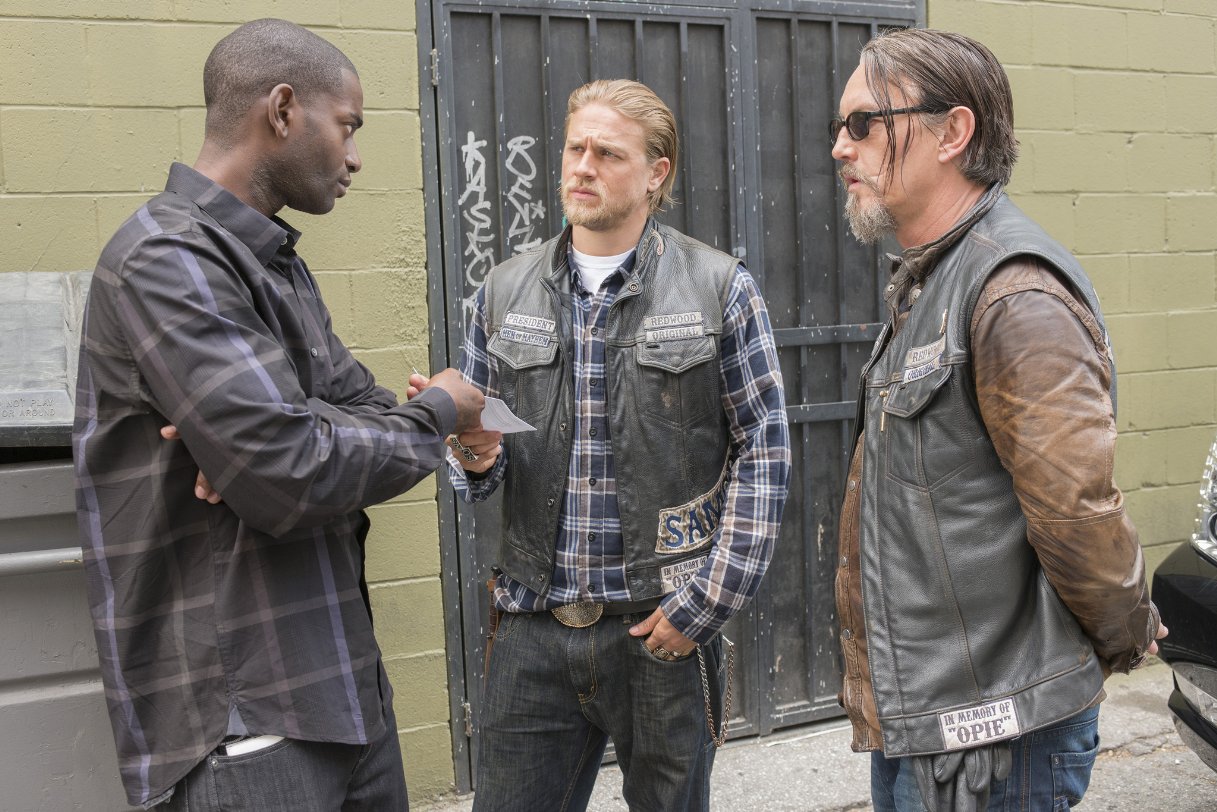
    The current tango with Marks comes to a bloody end, as he executes Bobby in front of Jax as repayment for Jax’s war on the Chinese. The fact that it took three episodes and several beatings sort of deflates the moment’s tension, as Bobby’s death is as predictable as it is inevitable. But that doesn’t mean that the last few episodes haven’t been a nice final showcase for Mark Boone, Jr., and it doesn’t make the loss of Bobby any less significant. Along with Chibs, Bobby has been the most frequent voice of reason at the table, and so that he should be a casualty of the club’s descent into darkness is appropriately tragic.

    What’s even more promising is that Marks remains the “big bad” of the season at episode’s end—at least, to the extent that Jax doesn’t fill that role himself. Jax doubles down on his war following Bobby’s death, seemingly learning nothing from the actions he’s taken so far, but the show is no longer making any bones about this. The pastor’s wife claims to see that Jax is “fundamentally decent,” but even Jax isn’t claiming that anymore. Instead the show goes to great lengths to isolate Jax and SAMCRO from the world around them.

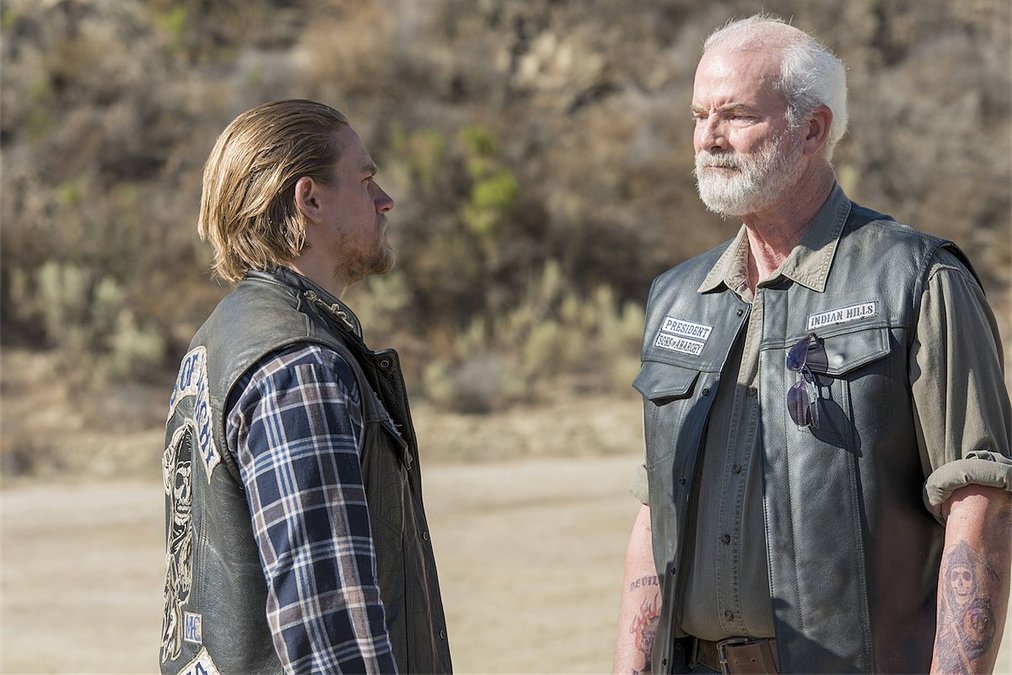
    The Indian Hills charter is summoning a forum of all Sons charters, with the implicit threat that they wish to disband SAMCRO. More even than last week, they function as audience surrogates, which at this stage is hugely important to the show’s narrative. Even Marks brings Jax to task, placing all the spilt blood at his feet. “Is this what you wanted?” he asks as they negotiate. “Piles of bodies?” And when he actually does murder Bobby, he puts a gun to Jax’s head as well: “This is on you, Jackson.” That’s a powerful statement to have the show’s ostensible villain make, especially since it’s a true one. Of course it’s no big revelation that Jax and the club have long lost any hope at redemption or forgiveness, but by bringing in the other charters’ viewpoints as well, the show at least has the means to challenge and vilify the club’s actions.

    Unser’s investigation into Tara’s murder turns up new developments, as well, as Jarry learns that the Chinese man Gemma pinned the murder on was in jail in a different state the night of Tara’s murder. They’re playing dumb for now, but while this is only a baby step, it is at least some progress in this story. Plus, Abel spies on Gemma as she confesses to yet another inanimate object, this time Bobby’s boy. This is hardly necessary, and in fact just feels silly, especially since it’s not like Abel’s gonna piece together this whole complicated conspiracy. He already knows the one important detail; anything else until he tells someone else (my money’s on Wendy) is just redundant filler. It’s also another lazy (and unnecessary) way to emphasize the dangers of the SAMCRO life. Everyone is pretty much straight up ignoring what is clearly a severely damaged child, which is perhaps the most egregious example yet of just how much these people have normalized and rationalized their destructive lives. Neither they nor the show treat Abel like a real person, and if there’s going to be no commitment on that level, well, then who cares?

    Let’s be honest: the episode doesn’t really shake anything up. It’s a workman-like installment of Sons, advancing the pieces it needs to, and while some of the moves are more interesting than they’ve been at times, they’re the expected moves. Where the show succeeds as always is in its acting, and if nothing else, “What a Piece of Work Is Man” gives its actors the material to deliver some good performances. There’s still too much filler, and not enough genuinely gripping material to justify the bloated run-times. But if you treat like a primetime soap and approach it with a generous fast-forward button trigger finger, you can do worse.


    Stray Observations:

    • What a beautiful shot of Gemma smoking in the cabin kitchen, with everything behind her swallowed in pitch darkness. Major kudos to Peter Weller for that one alone, but really, there are a lot of beautiful compositions this week. Even Chibs fucking Jarry in a parking garage is almost well-shot enough to excuse how stupid the scene itself is.
    • Juice’s story is on a mega-slow burn this week, as he enacts Jax’s plan to have Lin killed, only to have Jarry toss him back into solitary at the last minute. If that’s not a perfect microcosm of bullshit Sons plotting, I don’t know what is.
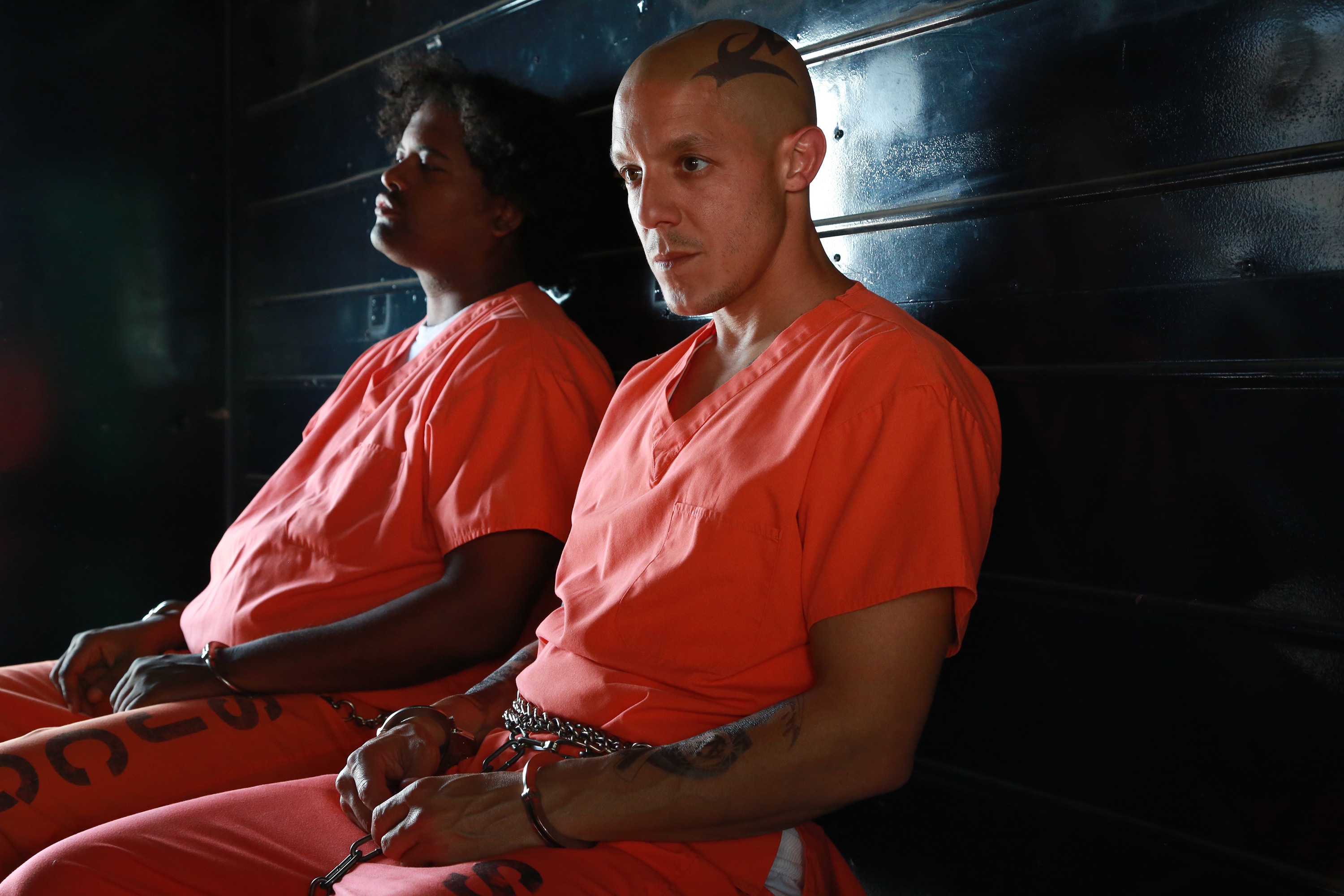
    • Did Theo Rossi show his ass? Did he ever.
  • Parenthood Review: “Too Big to Fail” (6×06)

    Parenthood Review: “Too Big to Fail” (6×06)

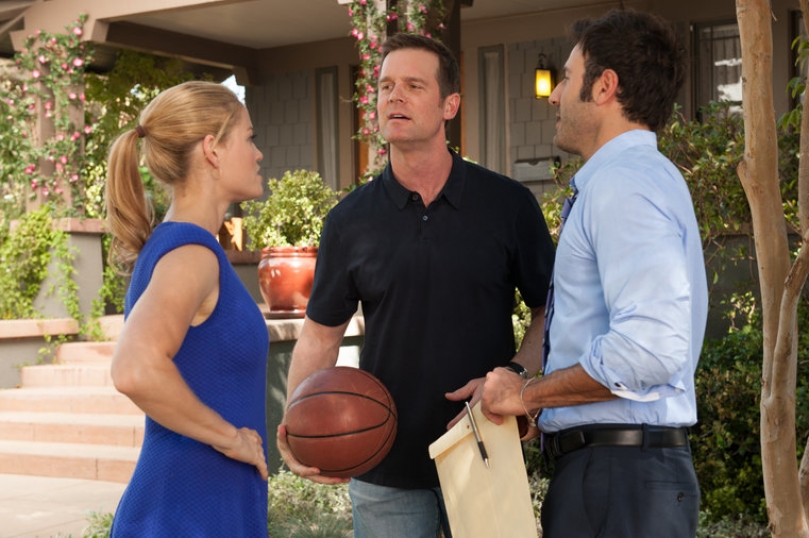
    parenthood too big to failI’m not going to lie, that “three months later” title card pretty much blew my mind the first time I watched this episode.

    Not because anything particularly shocking happens as a result of it, but because it’s the sort of thing that Parenthood wouldn’t typically do in previous seasons. Between seasons, maybe you would see something like this, but here, this is a purposeful attempt to accelerate the storylines to cover the necessary narrative ground before the series ends. It’s audacious, and it can be very useful; in fact, most of the storylines this season could benefit hugely from such a time jump. The only one that it wouldn’t and doesn’t really have an effect on is Adam, Kristina and Max, and it’s no coincidence that, in their scenes, it’s not even altogether clear that three months has passed.

    But then scheduling and budgetary issues rear their heads in the worst way possible: Joel and Julia, as well as Zeek and Camille, the two segments of the show apart from Amber who would benefit most from a time jump, are completely absent from this episode. Considering where we left these stories, a lot could have changed in this time, and it’s frustrating at best to have the two strongest stories of the season hit a wall so forcefully.

    Rather that lament what we’re missing, though, let’s try to enjoy what we have. “Too Big to Fail” is a functional, frequently solid episode of Parenthood, even if it’s a bit of a structural mess. Plus, though I’d still rather have seen what’s up with Julia or Zeek, their absence does allow for more time spent with characters there would otherwise not be room for, like Drew and the long-suffering Jasmine.

    The impact of the three-month time jump is most obvious on Amber, who is suddenly much more pregnant than she was when last we saw her. Her growing realization of the difficulties of raising an infant (as well as the fact that it costs a lot of money) leads her to ask Adam and Crosby for a raise at the Luncheonette. The only problem is, the Luncheonette isn’t making any money. Money woes are at the root of many of the stories this week, as Amber worries about how she’ll provide for her baby, Crosby worries about how he can provide for his own family, Adam worries about his own income (which is also gutted by Chambers Academy, another shockingly unprofitable Braverman business venture), and even Drew gets in on the worrying action, fretting about which major he should choose to be able to provide for a hypothetical family that is years from existing.

    Frankly, the idea of any of the Bravermans having financial trouble is a tough pill to swallow, given the way that Parenthood treats money as no object most of the time. It makes at least some sense with Amber, at least, and even as far as Crosby goes I’ll buy it. But Adam and Kristina have never been portrayed as anything less than comfortable, and usually much more than that. Parenthood is an upper middle class fantasy most of the time, and given that approach, it feels somewhat disingenuous to suddenly decide now that money is a serious issue, and even more so to do so after a three month time jump that skips over any of the events that led to this point.

    On the bright side, at least the focus on finance gives some focus to Crosby’s story, which until this point has been a sort of aimless malaise; now, at least, we have some sense of his dissatisfaction that goes beyond the show’s desire to portray him as a mirror to Zeek. And as the youngest, most reckless Braverman sibling (well, perhaps not as reckless as Sarah), it’s not completely out of the realm of possibility that he’d find himself in dire financial straits.

    While I usually appreciate when Parenthood episodes revolve around a theme, this week the most successful stories are the ones that abandon the ideas of money and responsibility. Unfortunately, these are also the stories that make the least use of the time jump; in fact, they basically ignore it. For Max’s part, his continued courtship of Dylan is sweetly touching—it certainly got dusty in my living room when he tells Adam, “She said I nice eyes.” I also love how the show has inverted the initial dynamic of Kristina and Dylan’s relationship—it’s clear Kristina is warming up to the girl, even if it’s in her own, awkward, almost disbelieving way. It’s easy to see even now how Dylan’s presence will lead Kristina and Adam to see Max in a new light, as a person and growing young man rather than a problem to be solved or a victim in need of protection. In their own quirky way, Dylan and Max are more normal than many of us can manage most days.

    Hank’s story with Sarah and Ruby is also touching, and even manages to draw Amber in for the game night Sarah plans. The story doesn’t cover much new ground—Ruby and Hank have tension, the combination of Sarah and Amber begins to soften her cruel, hard teenage heart—but it does introduce the idea that Hank’s difficulty with her owes just as much to his Asperger’s as it does to her pubescent brattiness. In that sense, the episode gives some dimension both to Ruby’s character and her relationship with Hank, and as we spend even more time with them, that’s a great thing.

    It won’t go down as one of the all-time great Parenthood episodes, and it wastes a lot of the opportunity that that “three months later” card suggests, but “Too Big to Fail” is by no means bad, and its component parts range from good to great, even if they never come together into a very cohesive whole. Ultimately, though, even the individual parts aren’t great enough to forgive what the episode squanders.


    Stray Observations

    • “We’ll go to Target or something.” Drew goes baby furniture shopping exactly the way
    • Caring for drunken teenagers is in fact exactly like caring for an infant. Good call, show.
    • Max is dating Dylan now. And of course Adam and Kristina walk by the room constantly.
    • “We’ve been on two dates now. Would you like to stay the night?” It’s cool, Dylan still only likes Max at a two and a half.
    • The Lowe’s commercial with Parenthood’s set designer is the sort of advertising I wouldn’t mind seeing more of.
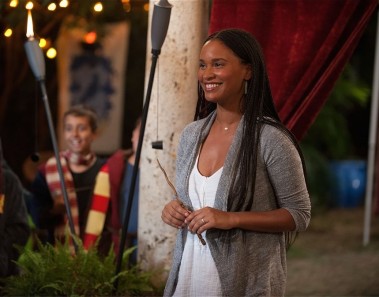
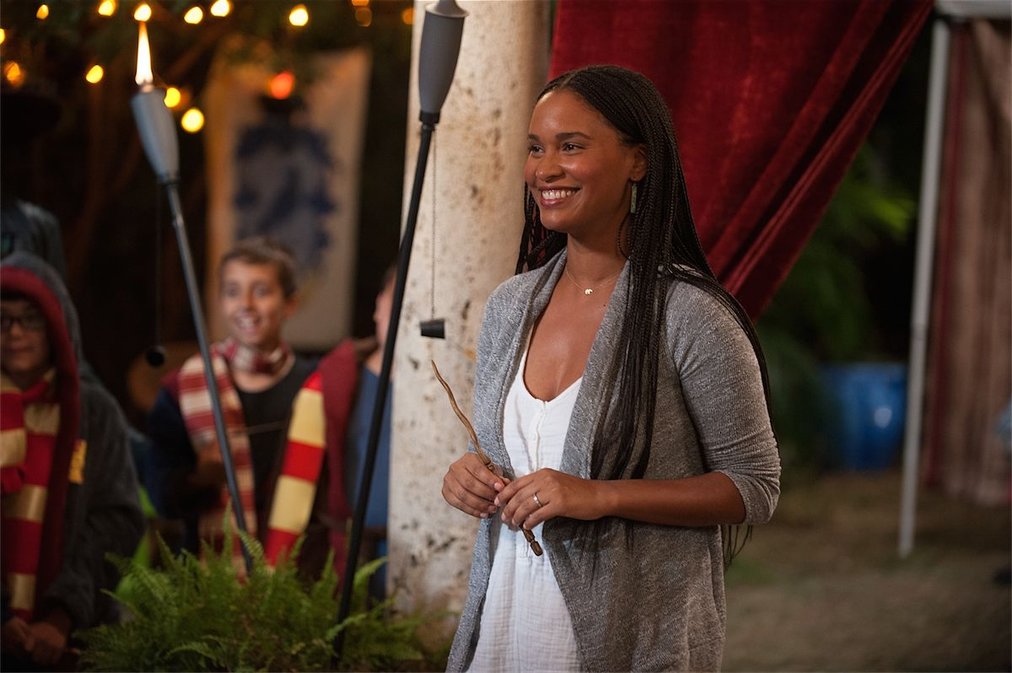
    • Oh hey Jasmine, how ya been? Nice to see she hasn’t completely vanished, and her Harry Potter party for Jabbar hits that perfectly Parenthood level of schmaltz, even if the song choice, with its repeated refrain “I’m trying the best that I can,” is too on the nose.
    • Did Drew Holt get a haircut? Three months have not been kind, let’s put it that way.
  • Scandal Review: “An Innocent Man” (4×06)

    Scandal Review: “An Innocent Man” (4×06)

    BELLAMY YOUNG, CAROL LOCATELLThis week, Olivia Pope devotes her energy to proving the innocence of a man who stands accused of attempting to assassinate President Cooper, who is the Scandal universe’s analogue to Ronald Reagan. The notion of innocence is an elusive one in Olivia Pope’s Washington, and so it’s fitting that the case of the week here is paralleled so effectively by Jake’s continued detention. The innocence of various characters is called into serious question frequently throughout the series, but this episode takes a special interest in the idea, examining the way we define it, and the way we can will ourselves to believe it against all evidence to the contrary.

    “You don’t know him the way you know me,” Fitz says of Jake to Olivia. He sees himself as her protector, sees Olivia as an innocent little girl, and himself as the chivalrous man who loves her. And sure, Fitz may know things that Olivia doesn’t. But Fitz is a murderer, and a liar. He’s possessive, manipulative, emotionally abusive. He loves her, but he is as bad for Olivia as Jake is, and they both, on some deeper level, know it. As much as I begin to tire of this love triangle, Tony Goldwyn and Kerry Washington are selling the hell out of Olivia and Fitz’s romance this season. Their conversation here is heated, passionate, with Fitz’s repeated, escalating shouts of “Are you saying there’s hope?” punctuating their argument, and then Olivia’s quiet confirmation and sudden departure abruptly corking the emotional outburst for another time. It’s impossible not to be captivated by performances like these.

    But even when I find this romance is magnetic, and it really is here, it’s also now directly tied to the show’s other central conflict, Rowan’s manipulation of the president, of his daughter, of basically anyone and everyone around him. Pitting Olivia against her father promises to be a strong source of conflict, but that that conflict is equally about with whom Olivia is sleeping as it is about the misdeeds of Rowan Pope makes for some complicated gender politics. The episode opens with a nightmare Olivia has, seeing her father’s face intermingled with those of Fitz and Jake while she’s doing laps in the pool. I’m not sure to what degree the nightmare is meant to be funny, but it feels very off to me, especially as a way to set the stage for the episode. Luckily, everything that comes after redeems this awkward start, but the scene is stupid. I just want Olivia to stop worrying about boys for once.

    Even her conversation with Jake, though it does spur her to action against Rowan, eventually boils down to “Olivia will pick Fitz over Jake,” when that should be the least important deciding factor she considers. Jake killed Cyrus’s husband, works for an organization that represents everything Olivia claims to detest and to work against. That’s more than enough justification for her to reject Jake, but she lets her love for him override her knowledge of this. Further the show treats this as zero-sum, either-or, Jake or Fitz, neither is not an option. This mentality pervades the show; Abby reunites with Olivia, and steps up for her in a major way with Fitz, but it’s still about boy trouble, and this show can and should be above that.

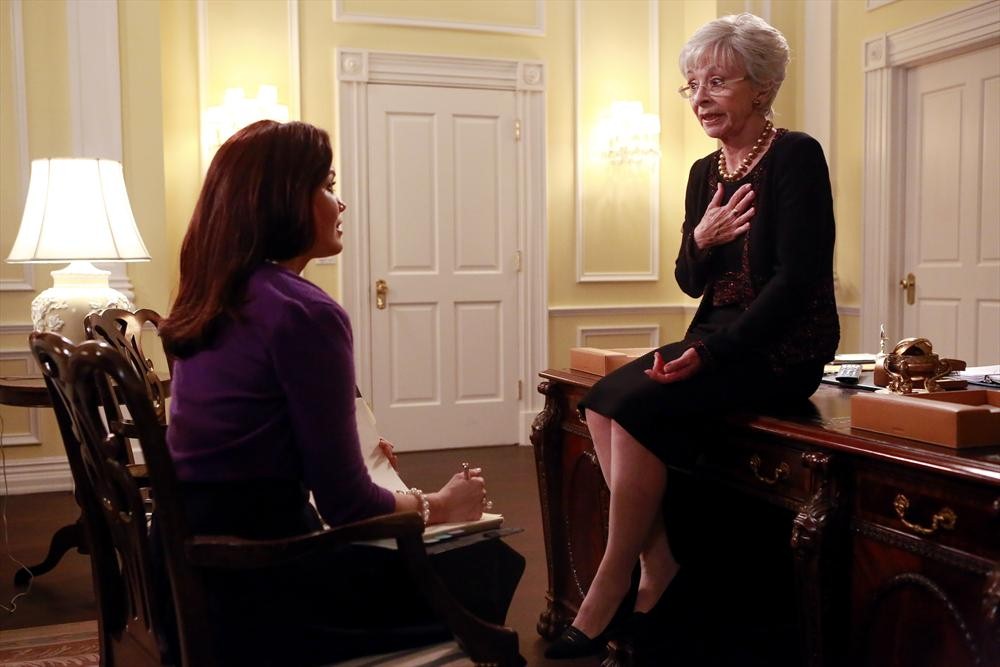
    I suspect the writers are to an extent aware of these troublesome politics, however, since while all this is going on, Mellie Grant is getting her groove back in magnificent fashion. Former First Lady Bitsy Cooper is a reminder of what Mellie is capable, as well of a warning of what she might become. She lives in her husband’s shadow, with none of the credit for the major works of governance she achieved in the White House. Above all else that “An Innocent Man” achieves, I really love its examination of the role of First Lady, and how women are expected to perform in politics and government. It’s especially effective in contrast with Fitz, who at the beginning of this episode more resembles the Mellie of the past few weeks. She got him elected to office; he thinks with his dick ninety percent of the time. But it will be President Grant that goes down in history, the great man of great works. Bitsy herself is a delight, a Betty White-esque cantankerous old lady, just shy of a caricature of what Mellie might be like in her golden years, but on the right side of that comedic line.

    In the end, Olivia’s client turns out to be guilty of President Cooper’s murder, despite her best efforts; so it goes with the men in her life, as well. Innocence eludes us all. Even Huck’s bonding with his son is done in secret, and would have ruinous consequence if discovered. Vermont is a myth. They’re familiar themes, but they’re handled well here, and advanced where they are in interesting fashion. All told “An Innocent Man” is a great episode of Scandal, and a promising sign of things to come. The dissolution of OPA had left the show somewhat formless, but now, with Abby back in Olivia’s corner, and with Olivia now poised to take Rowan head on, the various disparate threads are starting to come together. “Rebuilding seasons,” as they’re called, can be tedious, especially if there’s no clear sense of the structure you’re meant to be rebuilding. Scandal’s writers are definitely still figuring it out, but they’re closer than ever to doing that if this week is any indication.


    Stray Observations:

    • My memory’s not so great on how much of Scandal’s alternate history we’ve gotten before, but the death of President Cooper sheds a lot of light on the Cold War era in this world. The West Wing fans worked out a very detailed alternate history; I wonder if something similar exists for this show?
    • Abby gets in a sick Cyrus burn, having discovered the source of the White House leak, but her “back door” comment immediately made me think of Slate’s recent article on bottom shaming, and, well, Bryan Lowder has a point.
    • Joe Morton has another great, great monologue, this one about how “true power hides in plain sight.” Rowan himself is ultimately a dead end character, considering his association with B-613, but it’ll still suck to see him go.
  • AHS: Freak Show Review – “Edward Mordrake, Part Two”

    AHS: Freak Show Review – “Edward Mordrake, Part Two”

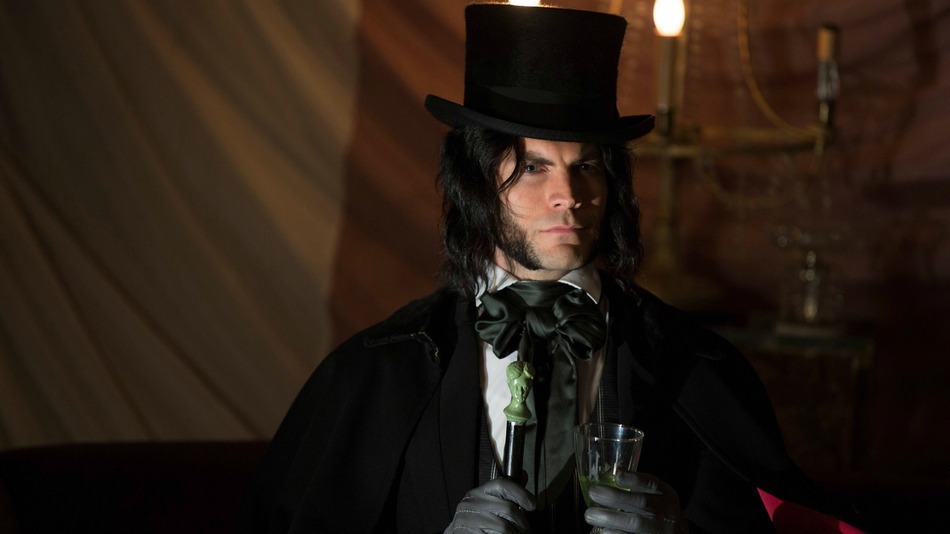
    edward mordrakeWith the second half of its Halloween two-parter, American Horror Story: Freak Show continues its exploration of its characters backstories, before arriving at a conclusion that seems to signal, at last, the “real” beginning of this season.

    The major flashbacks this episode focus on Elsa and on Twisty the Clown. While these feel serve to add color and depth to the characters, much like Ethel’s conversation with Mordrake last week, the scenes bring the season’s overall narrative to a halt. It’s a shame that the season so far has been so stop and start in the story department, because the small vignettes that have thus far composed these episodes have been consistently entertaining, and occasionally fascinating. Elsa’s story is deeply unsettling, playing on the psychosexual body horror that is American Horror Story’s bread and butter. The big reveal: she worked as a dominatrix for hire back in the Thirties, until she lost her legs in the making of a snuff film. The images that accompany her narration are nothing short of insane—the scenes of her at work are a visual assault, and that toilet is still making me wince. This is great, twisted stuff, and it’s exactly the sort of story a show called Freak Show should be telling.

    As for Twisty, the way the Mordrake business ultimately intersects with his arc is the first sign of the show telling an overarching story, and is a great way for these episodes to avoid superfluity. As we learn in his conversation with Mordrake, Twisty has some sort of mental disability. He either has molested children, or he’s been falsely accused of it, but either way Twisty isn’t handling this well. He tries to kill himself and fails, instead blowing the bottom half of his face off. For a character that had been sold thus far as the season’s major villain, it’s a surprisingly touching sequence, injecting the character and his story with a pathos that I wouldn’t have expected. It’s reminiscent of nothing so much as Asylum’s better moments, where even the heinous Dr. Arden had at least a shred of humanity.

    What’s more, Twisty’s acceptance by Mordrake opens the door for the season’s real villain, the once annoying, and now suddenly scary, Dandy Mott. His interaction with Nora this week, after he dons Twisty’s mask (and surely along with it multiple infections), is an example of the show making good use of the two-part structure, creating a scene in parallel that underlines the transformation Dandy undergoes. Finn Wittrock has been a real standout this season, fitting right in among the rest of the cast and fully embracing a pretty challenging role. Dandy and his mother are super-stylized in their weirdness, and it would be easy for their scenes to seem forced or inauthentic, but not so with Wittrock (and of course Frances Conroy, but she sits this episode out). With Twisty out of the way, I’m actually intrigued to see where Dandy’s total commitment to the clown thing takes us.

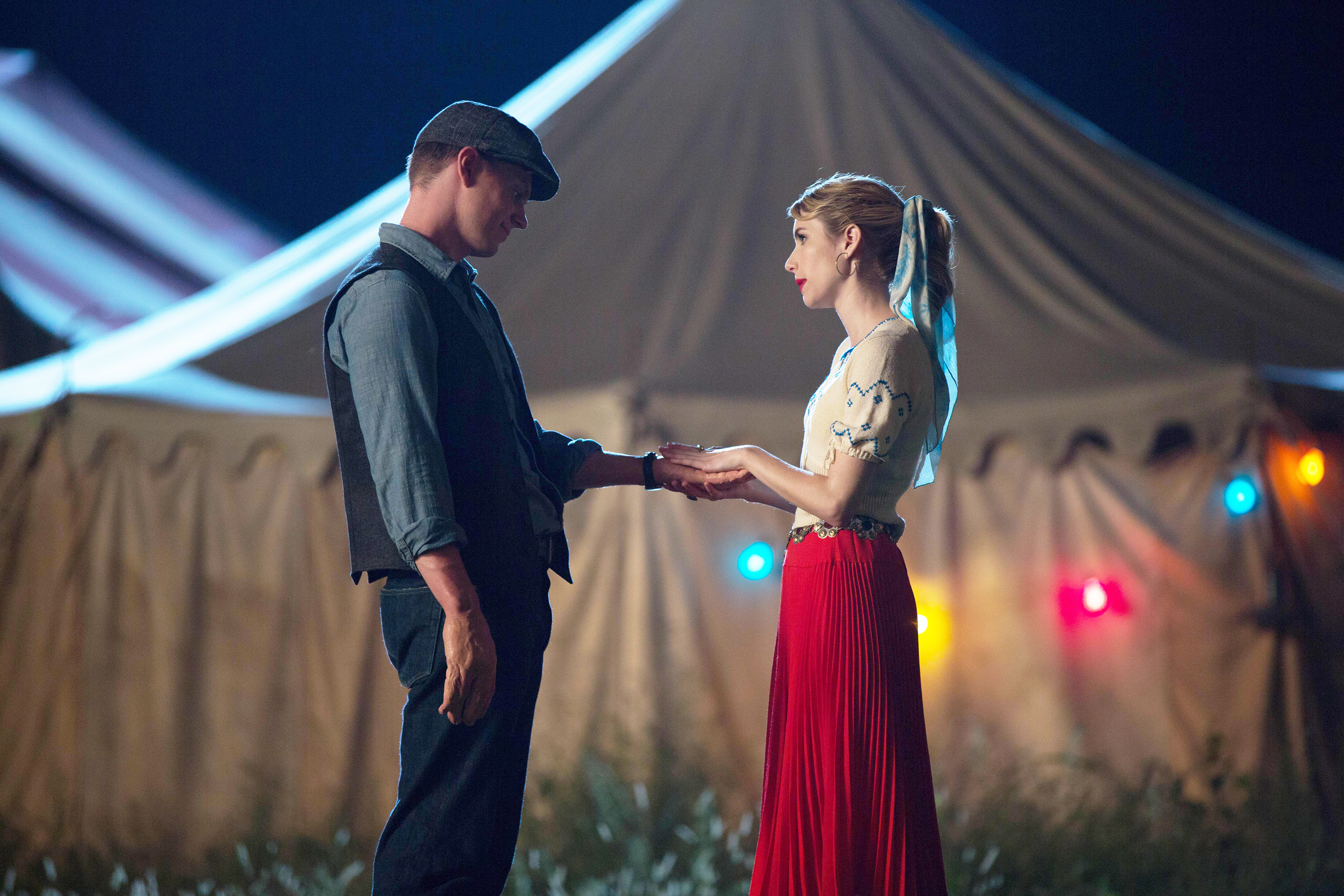
    Of course, the end of Twisty also means the freedom of those kids he kidnapped, and therefore the end of the town’s curfew and, somewhat unbelievably, their animosity toward Elsa’s freaks. They’re freed by Jimmy Darling, with an assist of Maggie Esmeralda, after they’re picked up by Twisty. Evan Peters and Emma Roberts have an easy, classic horror flick chemistry, and they make for exciting heroes in the mini-horror movie they star in this week. I’m much less convinced by the too-easy way that the town is so eager to adopt Jimmy as a kind of hero. We reach this conclusion out of plot necessity, rather than any logic on the part of the writing. It’s a resolution like you’d see on Glee, banal and cloying. While it’s a setup that could bear interesting fruit down the line, the means by which we’ve arrived at it are drawn out and overly sentimental.

    Even though it shares the same flaws as “Part One”, “Edwark Mordrake, Part Two” is flawed to a much lesser degree, and it displays some of the series’ best strengths. Though the pace is still rather slow, there really is a lot that happens in this episode, and by the end the status quo is very different than how Freak Show began. Given the size of the cast, there might actually be some value in this extended prologue, which relieves later episodes of some character- and world-building burden. I’d like to see some more things happening in it, but the world of Freak Show is remarkably well illustrated, and there’s something to be said for that.

    When watching the episode with my roommate, he commented that it started to feel like a season finale, and, well, he’s right. Twisty shuffles off this mortal coil and joins Edward Mordrake. Jimmy gets a hero’s welcome from what feels like the entire town of Jupiter. Elsa gets a big audience out of it, the curfew is lifted, all is well. The more I think about it, though, the more I think this is a beginning rather than an ending. Is it absurd that it’s taken four episodes to get here? Yes, absolutely. But now the introductions are made, the stage set. Certainly this episode amps up the weird horror quotient sufficiently. So I, for now, approach the remainder of Freak Show with cautious optimism.


    Stray Observations:

    – Patti LaBelle leaves without singing even one song. That’s some kind of crime.

    – In fact there are no songs this week at all, for the first time, though technically this is the second half of one episode. I don’t want them to do songs for their own sake, but I’m also curious to see if the conceit has any life left in it.

    – For an episode that’s named after him, Edward Mordrake himself doesn’t make much of an impression. The script treats him as a sounding board for the other characters and not much else, and Wes Bentley doesn’t really do a whole lot with what he’s given, either.

    – I just want to remind everyone that probably the most glorious episode of this ridiculous series was Asylum’s two-part “I Am Anne Frank,” and you would do well to catch it on Netflix this Hallo-weekend. (Though you’re probably definitely reading this after Halloween.)


  • Sons of Anarchy Review: “The Separation of Crows” (7×08)

    Sons of Anarchy Review: “The Separation of Crows” (7×08)

    sons of anarchy the separation of crows“Do you understand what an accident is?”

    Technically speaking, ‘The Separation of Crows’ is better than last week’s “Greensleeves.” There is one genuinely great, tense dramatic centerpiece, and many of the scenes surrounding that are also good, creating mood, developing character—in other words, doing a lot of the work that, on occasion, Sons can forget to do.

    But one centerpiece, even a genuinely great one, doesn’t speak for an entire episode of television, and the rest of “The Separation of Crows” is a solemn retread through beats we have covered tirelessly multiple times this season. The episode even ends in literally the exact same place that “Greensleeves” did, as the Sons receive Bobby’s hand in a box. I am dumbfounded. I cannot even begin to imagine the writer’s room conversation in which the episodes are blocked, and either 1) no one notices that these two episodes follow the same dramatic beats, or 2) someone does notice, and everyone decides it’s no big deal.

    The episode is not totally devoid of development, at least. I especially enjoyed the emotional journey that Chibs and Jax go on in a set of scenes throughout the episode. Chibs is so usually the voice of reason, yet early this week he encourages Jax to continue on this vengeance quest. He talks about the dream of SAMRCO, its mission—but what is it? I’ve no doubt that these men care deeply for each other, but at what point does this escalation stop? It’s refreshing to see Jax finally expressing some doubt, but annoying to see otherwise reasonable men convince him nothing is amiss.

    The show wants to sell the point that this is out of blind deference to their leader, and likely, deference to John Teller as well. I can buy that—the performances among even the tertiary members of the club certainly suggest this sort camaraderie, the fraternal mindset that would inspire devotion to a man and an ideal, even if that ideal is tarnished beyond all recognition. And so we get the big centerpiece of the episode, as Jax confronts Jury, the Indian Hills charter’s president, whom Jax has determined ratted SAMCRO out to the Chinese. Every word Jury says cuts deep, and while it’s not imparting any new information about Jax—Jury has after all come to a conclusion that any reasonable viewer arrived at episodes, if not seasons, ago—but it means something that these words are coming from a fellow Son.

    “You had the chance to be something good for this club,” Jury says to Jax. “And you turned into everything he hated. You became the poison.” He earns a bullet to the head for his trouble, one Jax sells as self-defense even as the lone other Indian Hills crow loses his shit (“Your boy is out of control,” indeed). Finally, though, this scene gives us a turning point; in the later scene between Jax and Chibs, Chibs is no longer encouraging his president to continue down this path. Finally, a wake up call. “There’s gonna be questions about the rights and wrongs of the whole thing,” is perhaps a sterile way to put it, but it’s a valid point. No matter what the club’s mission is, no matter what ideal Jax thinks he’s upholding, what righteous vengeance he believes he’s carrying out, there is still right, and there’s still wrong. Murdering a club president, at least, falls on the wrong side of that line.

    But while that scene and the ones surrounding it may be gripping, there’s no excusing the fact that it’s taken entirely too long for the story to reach this point, and that moreover there is entirely too long to go before the story reaches its next point. The rest of the episode bounces back and forth on the balls of its figurative feet, remaining firmly in place until finale time, when Jax will finally be permitted to learn the truth. (Right now, my money says that Unser finds out first, then somehow dies before sharing with anyone important, probably in the eleventh episode).

    Outside of the scene with Jury, this episode features an incredibly silly, on-the-nose scene between Gemma and the pastor’s wife, which earns the distinction of being even more clunky than the frequent soliloquizing; another indication that Abel’s acting out is getting worse (and the actor’s acting is just plain bad); and Juice way too obviously playing out Jax’s plan to get him in proximity to Lin. All these machinations of the plot are here for the sake of it, here because there are episodes that need filling; but as always, they run circles around each other, giving just the illusion of progress, before we arrive at a final scene that we’ve already seen. The episode makes a decent thematic statement on the idea of accidents—neither Gemma’s murder of Tara nor Jax’s descent into darkness qualifies as one, even if they’ll both try to argue otherwise—but thematic statements also do not make for a complete episode of television, let alone a good one. The story that Sons’ seventh season wants to tell is not big enough to fill thirteen normal-sized episodes, let alone thirteen FX-style jumbo episodes, and the longer this goes on, the more frustrating that fact becomes.
    Stray Observations:

    – Finally, a good song choice! “All Along the Watchtower” on a fiddle fits well, and reprising the song at the end at least gives the sense that the contents of the episode are purposely meant to reframe the situation with Marks, and to paint him as an opponent much more serious than Jax gave him credit for. Then again, Bobby’s eye in a box might have hinted at that, too.

    – Scenes like the very long silence between Chibs and Jax are what remind me that FX’s disregard for running times can be a very, very positive thing. That long, excruciating pan out would be the first thing cut on another network, but it is absolutely necessary to the scene.

    – How funny would it be if Unser’s scrabble letters had spelled out “Gemma did it”?

  • Boardwalk Empire Review: “Eldorado” (Series Finale)

    Boardwalk Empire Review: “Eldorado” (Series Finale)

    eldorado (boardwalk empire)Television is a tricky medium, especially in its current form. A series evolves over time, takes detours, scenic routes, tantalizing tangents, flights of fancy with supporting characters that, for even a moment, hold more interest and more promise than the stars of the show. Things change in a television series. But in the era of the prestige drama, audiences have come to expect more thematic consistency, more resolution, more of a sense that a series is a complete story, a long novel or film, rather than a collection of loosely related short stories. (We can perhaps blame Lost for this, and we can certainly blame Breaking Bad.) For much of its run, Boardwalk Empire was the latter type of show. Its many disparate elements were unified by a vague association with criminality, and, at least at first, with Atlantic City, but the characters and stories grew further apart with each season.

    This final season, and especially this last episode, attempts to rewrite that history of the series, turning it into a long story of one man’s descent into evil, and the destruction he wreaks on all those around him. With its final season, Boardwalk Empire states emphatically that its central character and primary concern is, always was, Nucky Thompson. You’ll have to forgive me the lateness of this review, as well as its length—I’m happy to say that, whatever else it may have done, Boardwalk has proved a thought-provoking and challenging show, delivers the kind of finale that one needs to sit with for a time. It’s a series that merits consideration.

    “Eldorado” is an episode of endings, of reckonings. It moves slowly and with purpose, in no rush to reach any particular conclusion. We know already that the end has arrived, and so there is no need to move toward it any more quickly. The episode eschews the opening credits, but the scene that begins the episode evokes them anyway, as a stripped-down Nucky wades ever further into the tide that, for five seasons now, we’ve watched him stare down and turn his back on. It’s eerie and moody, and casts an appropriate sense of foreboding over the remainder of “Eldorado”, a feeling that is exacerbated by Nucky’s absence from much of the episode.

    But the absence of Nucky is not a rare thing. We began the series with his story, yes, but it was equally the story of Jimmy Darmody, and became more his story with each episode. When “To the Lost” (also directed by Tim Van Patten) dispatched him, the story did not re-focus on Nucky, but instead exploded outward, encompassing Chicago, New York, Washington, Florida, and Cuba over the next two seasons. Nucky has been at the center of all this, but as many critics have noted, chief among them HitFix’s Alan Sepinwall, he’s been a void at the center, an unreadable blank slate, something off which the other characters can react.

    To state, then, here at the end, that Boardwalk has been all along the story of Nucky and the Darmody family is revisionist at best. It feels somewhat like the finale to a show that Terence Winter has not been creating all along. The languorous pace of this episode, with its staccato bursts of emotion or of violence, seems to support this. The show concludes the stories of Luciano and Capone more out of a sense of narrative obligation than any particular interest—it’s the tying of historical loose ends, underscoring themes that are tangential at best to Nucky’s story. Certainly, both Capone and Luciano leave behind more of a legacy than Nucky manages to, but does that justify all the time spent with them on this show, to have their conclusions here feel more like addenda or afterthoughts than actual, vital parts of the story?

    Perhaps it’s that Boardwalk expanded so rapidly that it bit off more than it could chew. Nowhere does this feel more the case than with Valentin Narcisse, who is unceremoniously murdered this episode in a brief scene, literally unfinished business for Luciano to take care of. Is the character a victim of the truncated season? After such a prominent introduction in season four, Narcisse is an asterisk, underused even in Chalky’s storyline earlier this season.

    “Eldorado” is an interesting inversion of the show’s history, in that the scenes featuring Nucky are for once the most interesting things about the episode, and the most emotionally affecting. His first appearance (save the opening scene) is roughly halfway through the episode, in a gorgeous apartment in the titular Eldorado building. He meets with Margaret, and they continue to settle the score between each other. The symbolism of this couple slow dancing in an apartment they will never own, and being interrupted by a younger, happier couple, might be on the nose, but Tim Van Patten shoots the scene with such a keen eye, the nighttime color palette painting everything in mournful hues, that it’s hard to give the script too much grief. For a moment it even seems that Margaret would consider reuniting with her estranged husband after all; she notes it’s thirteen stops closer to downtown, and when Nucky asks what she means, her response is perfect: “I’m not sure. But I said it.” They have reached a frank honesty with each other now, a level of comfort that only years of separation could bring them.

    Theirs is a relationship that was not always well served by the show, especially as Kelly Macdonald’s screen time has dwindled in the last two seasons, but her acting has never faltered, and where Margaret was once a drag on the show, she’s now a complete delight. Her scenes with Joe Kennedy are playful, and deliver on the hinted promise of feminist progress that the show has teased with the character, on and off, for years now.

    In fact, if the first half of the episode is a series of scenes wrapping up various loose ends, the second half is a tour with Nucky, as he makes peace with what little family is left to him. Nucky and Eli have said goodbye many times, but this last goodbye is no less powerful for that. Nucky hands him a sack of cash and a razor, and it’s the nicest thing he’s ever done for him, one feels. There is both quite a bit of resolution, and none at all, with both Margaret and Eli; we do not know exactly what becomes of either of them, except that Nucky has in some small way absolved them of their association with him. He sets them free, acknowledges his own role in their misery, and plans to leave.

    It seems almost altruistic of him, but then he visits Gillian, and he finds, somehow, a way to abandon her once more. She is another problem to solve, nothing some money won’t fix. “The past is past,” he says, as though the weight of his guilt is now too much to bear. “What do you expect of me?” He knows that he cannot undo the damage he has done to Gillian and her family, and when he offers her her own room, and a trust fund, he can’t even look her in the eye. The biggest success of this final season is the way the pulls the entire series into a not-too-tight knot. Intellectually, it may seem strange, off-balance, to reframe the series to hinge upon Nucky’s betrayal of Gillian Darmody. But in the moment, and especially in the final moments of “Eldorado,” it makes perfect emotional sense.

    The show may have expanded outward and outward, to the point where Gillian’s continue presence was more confusing than rewarding, but season five represents a concerted effort to resituate the show’s emotional center, and, ultimately, I would argue that it works. This is owing in no small part to the flashbacks, which in “Eldorado” add up at last to two things: first, the fervent desperation with which Nucky tried to remake himself, to “get ahead”; and second, the horrible act of evil that forever doomed him, and that in fact, through the miracle of Tim Van Patten’s direction, Terence Winter and Howard Korder’s script, and Tim Streeto and Perri Frank’s editing, dooms him simultaneously in both his past and his present.

    Let’s make no bones about it—the final scenes of Boardwalk Empire are a tour de force, beautifully shot, expertly written, drawing upon the show’s history with an inevitable sadness (or perhaps a sad inevitability). The moment the flashbacks arrive at the Neptune’s Bounty parade, we as the audience know what is to come, feel the pressing, impending dread. The cross-cutting between this scene and Nucky’s retrieval of Joe Harper is a masterful choice, beginning to connect these scenes temporally and emotionally well before the big reveal. It’s when this cross-cutting began that I finally admitted to myself that Joe Harper is, in fact, Tommy Darmody, and I’ve been wrong this whole time. That this fact was so obvious in retrospect deflates the reveal slightly, and I wonder if the show might have been more straightforward about Tommy’s identity to begin with.

    But when I dismissed the idea that Tommy and Joe were one in the same, I did it on the grounds that it’s not the sort of thing this show typically does. And while the show does not normally present these things as big twists, the show does trade in questions of identity and pseudonyms and assumed disguises. Nelson Van Alden spent more time as George Mueller than he did as himself. Just this season, Nucky offers a false name, in the very same episode where Tommy offers us his. The reveal of Tommy Darmody isn’t a shocking twist; it’s a narrative inevitability. Same goes for the bullet he puts under Nucky’s eye.

    In several interviews since the finale aired, Winter has stated the importance of presenting the Neptune’s Bounty parade, even though all of the facts of it are already known to the audience. As creator, he’s well aware of the dramatic import he’s placing on this particular moment in the characters’ histories. The cross-cutting continues throughout the remainder of the episode. At the exact moment that the Commodore dresses down Deputy Sheriff Johnson, Nucky walks down the boardwalk in his old age, eyeing strange men in dark suits, wondering which will kill him. As he promises a young Gillian, “I’ll always look after you,” her grandson pulls a gun on the man who murdered her son. As Nucky lays dead on the boardwalk, he grabs a nickel in the ocean. It all happens simultaneously, is the complete story of Nucky’s life. The sequence is stunning, beautiful and poetic. Tim Van Patten is a treasure, and the momentum of these final scenes as they push forward is arresting.

    In the end, Boardwalk Empire ended the way that it always lived: something of a sprawling mess, but a beautiful, complex, worthwhile mess. I don’t know that the show ever really became more than the sum of its parts, but it had a great many parts over its five years, and though they sometimes digressed, and sometimes never went anywhere at all, they were consistently engaging in the moment. Boardwalk achieved a level of detail, of mise en scene, of authenticity, that is not often found. For an hour each Sunday, we were in the 1920s, no questions asked. The historical characters came to life in the way that only characters in stories can, and the fictional characters became living, breathing people. It was a peculiar show, not ever as popular as it might have been, but it was complex, rewarding television, with an impressively, impossibly deep bench of masterful actors, and production design and direction unrivaled by almost anything else on television. That’s not a bad legacy at all.


    Stray Observations:

    – A note on the score: This episode gets a 9 out of 10. Below I’ve broken down my scores for the season into the usual categories.

    – Capone’s conversation with his son is expectedly heartbreaking, even without the callback to “Blue Bell Boy”. Stephen Graham plays this character loud and boisterous, sure, but he never loses sight of the fact that there is a human being here.

    – Nucky has a “vision of the future” in one of the oddest scenes this series has ever presented. The girl singing on the primitive television is certainly another symbol of the impending future, but man, is it weird, especially with the over-saturated, bright lighting of the boardwalk set.

    – “The old way of doing things, it’s over.” Lucky’s proclamation to the newly formed Commission is summative not just of his journey, but of the series’ arc in general. In Nucky’s flashbacks, the Commodore makes his own proclamation: “Through me and from me, that’s all there is.” That’s all over by 1931.

    Boardwalk Empire is actually a pilot that I didn’t care for—I found it boring and drawn out, clichéd Scorcese without any of the verve that made his films pop. It wasn’t until the second season that I returned and fell in love, and obviously, by “To the Lost” I was hooked. This was such a smart, cerebral show—the equivalent, to me, of picking up a Fitzgerald novel, with the costumes and the direction playing the role of that writer’s lyrical prose. “Lyricism” is, to me, the best way to sum up Boardwalk’s artistic style and intent. There have been on this show so many indelible images, ones that will stick with me for a long time, and Boardwalk delivered on that promise right up until the very end. I’m going to miss it. Thanks for taking the time to watch this last season along with me.

  • Parenthood Review: “The Scale of Attraction is Fluid” (6×05)

    Parenthood Review: “The Scale of Attraction is Fluid” (6×05)

    The Scale of Attraction is Fluid (Parenthood)On a weekly basis, Parenthood has to juggle so many characters and stories that individual episodes can feel less like cohesive story units and more like a selection of scenes required to advance each storyline, without regard to how well the scenes fit together. There are so many characters to serve that, even when some are benched for the week (as Sarah and Hank are this week), episodes are juggling four or five storylines simultaneously. It’s nice, then, when an episode like “The Scale of Affection is Fluid” comes along where all of the disparate stories fall under the same thematic umbrella.

    The centerpiece of the episode is Max’s story—fitting, as it also provides the episode’s perfect title. What’s really great about this particular story is the way it uses Max’s Asperger’s not just to highlight Max’s own difficulties with typical teenage tribulations, but also to shed some light on more normative expressions of romance and desire. Adam and Kristina try to teach him that attraction must be mutual, that Max can’t force Dylan to like him the way he likes her. That’s a great lesson, but Adam blows it by allowing for the caveat that, hey, Kristina didn’t like him that much at first, either. Monica Potter is always great, but she’s amazing in this scene, as Kristina becomes more and more frustrated with Adam, until her annoyance gives way to exasperation. Max, of course, runs with Adam’s made-up scale, happy for a way to quantify attraction in a way that makes sense to him.

    What Max stories also do almost always on this show is challenge the ways in which we raise kids with disabilities. Adam and Kristina both care for Max and do an excellent job as parents, but they also both tend to jump overboard in their desire to protect him. That Kristina is so certain Dylan will not reciprocate Max’s feelings says far more about Kristina than it does about Max, but this is a complicated issue, and the show treats it as such. Consistently, Parenthood presents Max as just like any of the other Bravermans, with his own unique quirks that just happen to be related to his condition. (This also means we get some really excellent Max-isms tonight, including: “This picture of a horse tells me that she likes picture and she also likes horses.”)

    Max’s story is the most explicit rumination this week on the mutability of attraction, but all of this week’s stories suggest that theme to some extent. Julia has officially and completely moved on from Joel, as her relationship with Chris gets more serious by the week. I still wonder how balanced the show’s presentation of this separation is, as Joel has done such a 180 turn this season, but I continue to dig the way that Parenthood, unlike other shows (ahem, Scandal) makes Julia the most interesting thing about this love triangle. There is no sense of Joel and Chris competing for her affection; instead, Julia has her own agency, and reserves the right to do whatever she pleases and make her own decision, in her own time. She also reserves the right to plain not know what she’ll do next.

    Chris ends up spending time with the kids, and while it truly is an accident, it’s also obviously good for them. Julia does apologize to Joel for the way it happens, but she doesn’t apologize for the thing itself, and that’s good for her. The separation story is quickly becoming my favorite Julia story of the series, and it continues to build outward in complicated ways that don’t create unnecessary or unrealistic drama. Is it perhaps a little too convenient that Joel just happens to arrive at the barbecue to see Chris still there? Probably, especially since you wonder why he’d go to things like this at all at this point in the separation. But Parenthood is a crowded show; you more or less have to forgive them the occasional narrative expedient.

    Amber returns this week, where she meets cute with a bland tech start-up dude who we’ll simply call Captain Exposition. He is boring and tells complete strangers entirely too much about his boring life. But he’s cute and seems safe and Amber decides to go out on a date with him anyway. Drew (rightly) tells her that she’ll need to tell Captain Exposition about the pregnancy sooner rather than later, but of course, he changes his tune the moment she does. (You could say Amber goes from a 5 to a 1 in a split-second.) “I’ll call you,” is a pretty empty promise, although I do half wonder if he’ll be back in an attempt to subvert expectations here. I’m all for whatever gets Amber and Drew on screen together, as their sibling relationship is one of the best to watch on the show, but this story feels more like going through the motions than anything else, owing at least in part to how bland Captain Exposition is.

    Crosby gives me trouble this week, too, as his mid-life crisis continues to resemble nothing more than a temper-tantrum. His minivan joyride with Zeek is a sweet moment between the two, as is their conversation after physical therapy in the bar. Crosby’s admission that he’s feeling overwhelmed by and perhaps even resentful toward married life and parenthood is darker and more direct than I’d expect from this show and especially from this character, but it certainly starts to flesh out his behavior this season beyond “typical Crosby man-child shenanigans.” Jasmine continues to get the shrew treatment with this story, though, as does Camille, and even Zeek’s admonition to Crosby about marriage, “You gotta try to enjoy it, son,” isn’t enough to erase that fact.

    Still, this is a well-constructed episode, and even the weaker storylines have some impact due to the thematic consonance throughout. I’m hopeful that as the stories begin to approach resolution, we’ll see more episodes where the content is this unified. That this show is even still around is a small miracle; that it’s still holding at this consistent level of quality is nothing short of amazing.


    Stray Observations:

    • Of course Crosby and Zeek feel compelled to override Adam’s advice to Max to “pursue common interests” with Dylan. “What base are you on?” “She doesn’t like sports, I don’t understand.” Exchanges like this are why we like Max episodes, guys.
    • While I love Crosby and Zeek’s relationship, I have to chuckle at the way the show equates Crosby not riding his motorcycle anymore to Zeek getting open heart surgery. That’s something Crosby would do.
    • Did Drew Holt get a haircut? He did! There’s still a mop on top there but at least he went in for a trim around the sides.
    • Chris is so perfect that I feel like he is secretly Patrick Bateman or something.
    • When Sydney and Victor go on about awesome Chris is (they’re not wrong), Joel goes off about “the subtle beauty that is baseball” and how “with the exception of your mother most lawyers have questionable morals.” Be more passive aggressive, Joel.
  • Scandal Review: "The Key" (4×05)

    Scandal Review: "The Key" (4×05)

    The Key (Scandal)While this episode is ultimately a step down from last week, by the final scenes, I can confidently say that the Scandal I know and love is finally back for a while. “The Key” is by no means a perfect episode, but whatever missteps it takes, there’s no denying just how exciting its final third is. There’s been a lot bubbling just beneath the surface this season, plot-wise, and “The Key” starts to let everything boil over.

    Specifically there are two big narrative explosions this week, both spun out of Rowan’s framing of Jake. Until he confesses, Jake is a prisoner of the United States government, and his imprisonment has the dual effect of leaving Olivia completely clueless as to whereabouts, as well as keeping Mellie clueless as to Fitz’s. These two absences at the center of the episode are what finally pull the trigger on what to this point has been only dramatic potential.

    When Scandal is really on point, it paints its characters as god-like, extreme both in their most deeply felt emotions and in their most petty trivialities. The show is set in Washington not because of any particular political reasoning, unlike say The West Wing, but because it gives the characters control over larger-than-life situations, placing the lives and deaths of everyone around them directly in their hands. (The very existence of B-613 is proof positive of this decision by the writers.)

    Mellie Grant gets this about her own life, and so she is the character that most embodies this aspect of the show. It’s no surprise, then, that she is frequently the most compelling and interesting character on the show. Mellie has so far been a pitiable thing this season, almost difficult to watch, and certainly only a pale shadow of the character we’d gotten to know prior to her son’s death. But the knowledge that Jerry was murdered, that his death was not a freak accident but was just another part of the game she thinks she’s playing, has a peculiar effect on Mellie. The chance to ascribe meaning to Jerry’s death pulls her out of her grief, and on the one hand, it’s a triumphant moment for the character, as she emerges from the muck of despair and depression. It’s also a completely insane reaction for anyone to have, and Fitz is duly horrified and repulsed by her. This is the appropriate level of craziness for Scandal to operate at, one that acknowledges the unique and destructive lives these characters lead.

    Scandal needs to operate at that level, because it’s the only foundation that will support a character like Rowan, or a story like the intricate manipulation he’s currently perpetrating. It would be oh so easy for Rowan to be a caricature, and when the rest of the show is trying to emphasize quiet character moments and reflections on morality, he does. When the rest of the show gets on that same level, though—when Mellie becomes grateful for her son’s murder, when Quinn slices a dead teenager’s corpse open to retrieve the key she swallowed, when the President of the United States kicks the living shit out of a prisoner in a secret detention room, et cetera—then Rowan just fits right in, doesn’t he? It helps that Joe Morton plays his relationship with Olivia so well. Their father/daughter chemistry has a lived-in ease to it, but both Morton and Kerry Washington physically remind us of the complicated history of this family. They’re never too close to each other, their body language is always a little stilted, their speech slower and with more pauses for thought (or, in Rowan’s case, for choosing the best lie). His lies are eerily convincing, and as he “explains” Jake’s guilt to Olivia, he hits an emotional nerve that he knows will seal the deal.

    But when stories of the gods aren’t about life and death and power, they are about the passions of the gods, and good lord, are passions of the gods on full display this week. This is one department where the show maybe could use some restraint, or at least a different angle. I know this is just how the show works, but Olivia Pope is a strong, independent woman (or so we are frequently told), and the President’s son has been killed—can this not be about which of her boyfriends loves her more? Because, as Jake points out to twist the knife, Fitz is so eager to accept Jake’s guilt precisely because Olivia loves him. I don’t need or want a show about these two stupid men fighting over a helpless Olivia Pope. But Olivia is helpless this episode, wondering where her boyfriend is for much of the episode, and breaking down crying at the end of it. To her credit, she does immediately and correctly accuse Rowan of setting him up, but then she’s all too happy to accept his explanation (however convincing) and back into her corner. While reuniting Abby and Olivia is probably a good move for the ensemble, it emphasizes the love triangle in that “Pick me choose me love me” way that devalues Olivia’s agency and participation in the story. I’ve written about this before, and I haven’t changed my mind—I really wish Scandal could be a little more feminist in the way it plays out these romances. I would say that the romance between Fitz and Olivia is less toxic now than it was toward the end of season three, but given the way this week’s episode ends, I’m not sure for how long that will be the case.

    For better or worse, though, this privilege of godliness belongs to only some of the show’s cast, and what’s been the most entertaining aspect of the season so far is the way we’ve seen the various supporting characters envy or covet this power, and act out these emotions in interesting ways that manage to complicate the overall story. David Rosen’s story is annoying, and caught up in the most excess B-613 baggage this show has left, but it’s central conceit is a good one, and the question “Why are we all trying to be Olivia Pope?” is one that the show should be asking at this stage. It goes hand in hand with Cyrus’s dressing down of Olivia at the White House, with catty references to her “other boyfriend” and an impassioned reminder that Jake is a murderer, however much she’s managed to ignore that fact. These people are in service of nothing and no one besides themselves, and they have committed unimaginable sins and atrocities with increasing casual coolness. It’s the common idea of Scandal as House of Cards’ pulpier cousin, but that idea is common for a reason—when it comes to Scandal, the pulpier the better.


    Stray Observations:

    – The investigation into Kaitlin Winslow’s death continues, as Quinn helps Olivia investigate her murderer. Aside from the wild key retrieval, this is a by-the-numbers case of the week, and the continued one-note characterization of Quinn makes it hard to be super invested in this one. The most interesting aspect of this story is Olivia’s relationship to Katherine Winslow, but Olivia is not involved with this investigation for most of the episode.

    – Huck returns to his family as well, and while the shape of the story is heartbreaking, Huck is another one-note character, who is sympathetic in a supporting role and in the context of his friendship with Olivia, but he can’t really support his own stories so well. Guillermo Diaz’s acting in the role is still overly affected, distracting from whatever emotion there is in the writing.

    – “The B-613 files” are on track to become this season’s “Publius,” a dumb phrase uttered so frequently as to lose any semblance of meaning.

  • Sons of Anarchy Review: "Greensleeves" (7×07)

    Sons of Anarchy Review: "Greensleeves" (7×07)

    Greensleeves (Sons of Anarchy)As we get started this week, I’d like to offer Verizon’s summary of this episode: “SAMCRO makes an unlikely partnership in order to undermine a powerful club enemy.” I am not inspired with confidence.

    And sure enough, “Greensleeves” suffers from the same issues as earlier episodes this season, the same issues that have plagued the show for years now. It’s bloated, overly complicated for the sake of being so, and reluctant to change its status quo, preferring instead to cycle through endless iterations of the same conflicts, over and over. That the show can’t figure out how to streamline this mess of plot is a shame, because many of the individual components are quite good this week. But the show is spinning its wheels, and it’s doing so in the laziest possible way, to boot.

    First, that cop who got shot, and who was waking up at the end of last week? She’s just not going to ID the club because Charming. ¯\_(ツ)_/¯. It’s lazy, and it’s the same narrative bullshit this show pulls on a regular basis. A threat is built up, pushed to the precipice of an actual payoff, and then just vanishes, just in time for a new, even bigger and badder threat, to emerge. This happens literally every season, sometimes multiple times a season. We’re halfway through and we have already gone from Lin to maybe-Jarry-but-not-really-lol-jk to Marks within a few episodes. It’s frustrating.

    This episode features two great monologues, one from Jax and one from Gemma. Jax’s very long speech to the club is more or less his St. Crispin’s speech, and sure enough, it presages what will certainly be the club’s final trudge into war (barring another last minute reversal before Gemma’s secret is revealed). It’s weakened by the fact that, to paraphrase Nero, we’ve heard this before, but that doesn’t mean Charlie Hunnam doesn’t give a good speech regardless. In some ways, it is finally an at least partly honest acknowledgment by Jax of of how far down this path SAMCRO has gone, and it’s a reminder to the audience that his vengeance is in pursuit of a lie. With the information we have, it’s easy to become frustrated and lose sight of the fact that the club is completely unaware; it’s very smart on the writers’ part, then, to give such a potent reminder of that fact. Dramatic irony is no substitute for a compelling narrative, but at least the performances are worthwhile.

    The same is true of Gemma’s monologue, which this week is addressed to Thomas, rather than Tara’s ghost, and which is overheard by Abel. If nothing else, the show deserves credit for creating some tension in this sequence; I was convinced that Wendy would overhear it, and Gemma would shoot her. The episode attempts to build tension throughout this storyline, as Gemma becomes convinced that Jax plans to hurt her for her part in helping Juice. But the setup for this tension is pure sitcom, a misunderstanding caused because Rat and Happy needlessly withhold information from Gemma. From a characterization standpoint, it’s about time Gemma starts feeling some guilt for her actions, but the tension itself is manufactured, and toothless, the moment you give it any thought.

    Very little else happens throughout the episode. Between episodes, Jax has apparently hatched a plan to plant Juice in prison and have him work with Tully, but by episode’s end, that’s still all the information we have. Similarly, Abel knowing about Gemma is a tragic development, but it doesn’t move the needle on the season arc at all; the revelation is still a ticking bomb and no more. Unser might be ever closer to unraveling the truth, but he’s still just approaching the truth, and every episode seems to suggest he’s only one move away, before moving the goalpost on the story’s resolution. The longer the narrative time bomb ticks, the more of what tension remains deflates. Inevitability can create a sense of dread, sure, but before long anticipation becomes annoyance. You’d think Sons might have realized this by now, but every season still has the same problems.

    To stall the eventual and necessary payoffs of their stories, the writers instead construct missions-of-the-week to occupy the club, which is fine as a structure for a series, but exhausting when we have to sit through the same emotional beats, over and over again. Gemma is guilty and insane. Jax is heroic but misguided. Unser is finally turning a critical eye to the club to which he’s given so much and from which he’s received so little in return. Nero wants out of the game. We know. But even though the show takes place within an extremely decompressed timeline, it doesn’t make that pacing work the way a show like Breaking Bad manages to. The tension on that show is genuine, and grows naturally from the story consequences of its characters decisions. The tension on Sons is fake, reverse-engineered to arrive at an ending that just needs to get here already.

    I’m not going to fault the show for its strengths. Like most episodes, the acting is on point, and there some lovely shots in this episode too. The composition Gemma and Nero standing beneath the Teller-Morrow sign is beautiful and almost even poetic, at least by Sons’ standards. Jimmy Smits is, and always has been, a reliable, valuable addition to the cast, and Nero’s scene with Gemma at T-M is poignant. Their exchange, Nero tearfully insisting “We deserve something better, Gemma,” and Gemma’s plaintive reply of “Do we?”, is powerful. But as I wrote at the outset of this season, its success rises and falls on its ability to maintain momentum. That momentum has fully stalled. Given the ending of tonight’s episode, it’s likely to pick up again, but if Marks is just another episode in this crazy rollercoaster ride, another obstacle so that Katey Sagal can stick around until the finale and nothing more, then we’ll be back here again in three episodes’ time. ¯\_(ツ)_/¯.


    Stray Observations:

    – Another unnecessary diversion this episode is with the titular Greensleeves, a gross pimp who exists only so that Jax’s Diosa operation can appear noble by comparison. While Diosa might be better than working for fucking Greensleeves, their last crew was violently gunned down, so let’s cool it on how great of an employer we are, Jackson.

    – Holy shit Jax is going to get this woman killed. If it weren’t for the previous speech I would believe he didn’t give a shit. But that’s the thing with Jax; he can be as nice and caring as he wants, but at the end of the day he does not care if these people die.

    – Maybe Gemma is nervous about going to the cabin given that it is routinely the place we take people to in order to murder them? RIP Piney.

    – Bobby Elvis is down an eye, as Marks announces that he means business. My gut says the show is cheating by letting him survive, especially since Bobby is basically a redshirt at this point anyway, but I might be letting the show’s terrible history with this sway my opinion.

    – Obviously the title was an excuse to close with Katey Sagal singing “Greensleeves.”

    -Tig casually grabbing at Unser while on the phone is hilarious.

    – Poll: is the child actor playing Abel really bad, or are the dead creepy eyes a secretly brilliant performance?

  • American Horror Story: Freak Show Review: "Edward Mordrake (Part 1)"

    American Horror Story: Freak Show Review: "Edward Mordrake (Part 1)"

    edward mordrake (part 1)

    In what’s become something of a tradition for American Horror Story, Halloween marks a two-part episode delving into the supernatural or superstitious (Coven broke with this tradition, but then, Coven also broke with the tradition of being a good television show). This time it’s Edward Mordrake, a deceased carny with two faces, a la Harry Potter’s Professor Quirrel/Voldemort combo. If any of the freaks performs on Halloween, so the legend goes, they will summon Mordrake’s murderous spirit. Ethel, Jimmy and the rest are appropriately cowed, but not Elsa Mars, who gets up on stage and performs Lana Del Rey’s “Gods and Monsters,” even if only for herself and the twins, whom she now more than ever fears will usurp, thanks to the meddling of faux-psychic con artist Maggie Esmeralda (yes, really).

    If you’re getting the sense that things are getting over-stuffed in here, well, you’re not wrong. “Edward Mordrake (Part 1)” incrementally furthers the plots already in motion, while introducing both Stanley and Maggie, while also injecting the show with its first supernatural element in Mordrake himself. That’s a lot of balls in the air, and with not a lot of plot to catch them all. Freak Show’s biggest sin so far is the one that has plagued American Horror Story all along—it’s a collection of characters and events, some scary, some funny, some moving, but a collection that never comes together under any overarching theme or purpose. The show is scattered, and there’s no clear indication of what unites any of these things, beyond the fact that they’re occurring in the same general space and time.

    For the first two episodes it appeared that the murder investigation would be a driving plot force, but that’s all but forgotten in this episode. Twisty the Clown continues his kidnapping rampage in the background, but that remains unknown to anyone else on the show. Ditto Dandy, who has briefly crossed paths with the Cabinet of Curiosities, but is now off in his own corner of the show with his mother and a wonderfully sassy Patti LaBelle. This week finally lets us get to know Ethel a little better, but even that exposition is saddled with the appearance of Edward Mordrake’s ghost.

    It’s obvious that Freak Show wants to be more concerned with the characters than with the plot, and while that’s a nice thought, the characterizations themselves are too broad and obvious for that approach to work. Dot’s deference to Meep is a barely-concealed attempt to further ingratiate herself with Jimmy. Her “All About Eve” triangle with Bette and Elsa is a tale older than that film, with only the presence of a conjoined twin to mark it distinct. Even the cinematography this week belies the derivative nature of the story so far, with several shots lifted directly from the film Halloween; yes, they’re homage rather than theft, but all the same.

    Mostly, “Edward Mordrake, Part 1” has me wondering why on earth this is a two-part story. The episode runs more than ten minutes long, but there doesn’t seem to be a particular reason for that. Perhaps the writers would like to keep the Mordrake material contained, but 1) I’ll believe that when I see it, and 2) most of the material this episode has nothing at all to do with Mordrake. And come to think of it, 3) the non-Mordrake material is the best the show has to offer this week.

    Specifically, I’m thinking of quieter scenes, like the one that Ethel and Dell share outside Ethel’s tent, over a glass of hooch that neither of them should be drinking. The writing and, especially, their great performances, strips away the freak-like nature of their appearances and leaves just two people, damaged by their pasts, just like any of us. It’s not just the quiet moments, though; more bombastic elements are working as well. I won’t go so far as to call Twisty the Clown scary, but certainly his appearance is unsettling, and Dandy Mott’s apprenticeship under him neatly walks the line between over-the-top and cloying and legitimately unnerving behavior.

    These are characters and stories that, for now at least, I’m invested in, and I’m curious to see how they play out. I’m less interested in Elsa’s mostly-imagined rivalry with Dot and Bette, but at least that too is rooted in the pilot and the premise of the series. But with its supernatural elements, “Edward Mordrake, Part 1” also introduces a bevy of other elements into the mix, and it’s that ribald willingness to throw anything and everything at the wall, without even a care as to what sticks, that has threatened to undo this show in the past, and that completely undid Coven. Worse, this season commits a sin that even Coven did not—for large stretches, it is boring. It’s like Ryan Murphy and company have taken half a lesson from criticisms of last season, toning down the campiness and insanity, but leaving the same number of cooks in the kitchen. This episode marks the third straight week of teasing and set-up; we’re still introducing regular characters and setting up conflicts and backstory; and yet we’ve time to take a detour into freak show urban legends. Basically, we’ve been down this road before, and it’s a bumpy one. Freak Show needs to pick up the pace, but without throwing the show into total disarray, and right now, I’m more curious to see if it can do that at all than I am to see what lies on the other side of “To Be Continued…”.


    Stray Observations:

    – This week also marks the third straight week of musical numbers. At this point it’s safe to assume these will be a regular occurrence. I think so far they’ve done a good enough job of remaining relevant to plot and/or character, but they could easily become unnecessary distractions, too. But if they’re here to stay, are there any songs you’re hoping to see pop up?

    – Dennis O’Hare arrives in this episode as well, as Maggie’s partner Stanley. Other than that he’s gay (or at least, enjoys sex with men dressed like Thor, which, who doesn’t?) and that he’s a con man, we learn little about him. They’re in town to collect a specimen that they can sell to a museum of oddities.

    – Mordrake appears to Ethel and it turns into an impromptu therapy session. The backstory is welcome, and the scene where she gives birth to Jimmy in front of a throng of paying customers is horrifying in the cultural sense, the way that, say, Lana’s “therapy” in Asylum was. As she points out too literally, Jimmy Darling has been exploited since the very moment he was born.

  • Parenthood Review: "A Potpourri of Freaks" (6×04)

    Parenthood Review: "A Potpourri of Freaks" (6×04)

    A Potpourri of Freaks (Parenthood)When I was writing about Parenthood last season, I came rather quickly to the realization that it’s a very difficult show to write about weekly. Owing to its realistic, slice-of-life approach to family drama, there are often episodes where very little happens, at least externally. Many of the stories contain such subtle moments, and are spread across so many episodes, that it’s not always so simple to find new or interesting things to say about each character, every episode. The writers must face this conundrum as well, as they rotate cast members in and out of episodes, and, occasionally, do a story that is so forced and goofy, you can just picture Jason Katims staring at an empty square on the season grid and scratching his head.

    “A Potpourri of Freaks” is symptomatic of all these Parenthood quirks. Kristina returns after taking a week off, but Amber is now missing (rather conspicuously, given her big episode last week). The problem of Sydney’s bullying continues into this episode, and Joel and Julia continue to vacillate between “definitely over” and “tentatively over,” to the consternation of said bully. Oh, and Crosby joins Oliver Rome at some odd spiritual retreat, of which the less said, the better. It’s a scattershot episode, in other words. The stories range from fantastic, to occasionally great, to mildly interesting, to horrifyingly grating.

    This week’s episode focuses heavily on Zeek as he recovers at home from his surgery. “Recovers” is perhaps too generous a term; really, he sulks on the couch watching John Wayne movies, while Camille looks on helplessly. Craig T. Nelson and Bonnie Bedelia have always had a lived-in quality to their chemistry, and that continues to be evident here. It’s extremely difficult to watch Zeek like this, but Nelson gamely walks the line between keeping him sympathetic, while still allowing him to be a bit of a dick to Camille. It’s always totally understandable why he acts the way he does, and both the script and the acting avoid making him seem petulant or mean. He’s just frustrated, and sometimes we take frustration out on our family members in ways we might not mean to.

    We also spend a considerable amount of time with Hank and his family. Betsy Brandt is back as Sandy, and both she and Ray Romano are their usually excellent selves. Romano will never cease to amaze me with his ability as a dramatic actor, and this episode he portrays such an internalized conflict with care and precision that is unrivaled by any other actor on the show. His meeting with Sandy at the diner is shot beautifully, and makes a small victory—after all, all Hank really does is let Sandy know exactly what Sarah means to him—feel momentous.

    Hank’s story continues to parallel Max’s, which always yields interesting results. This week, it turns out Max is smitten with new student Dylan, a girl with ADHD and a bit of an attitude on her. She calls him “Asperger’s” and vexes Kristina to no end; their smug-off in Kristina’s office is a great bit of comedy. But when Adam goes to ensure that Dylan is not bullying Max or making him feel uncomfortable, he instead is floored when Max asks for advice on girls. Again, it’s a small victory—perhaps Adam’s first typical teenage interaction with his son—but it plays as tremendous.

    Interestingly enough, Hank’s story also parallels Julia’s, as the show provides two perspectives of divorce, and how they affect both the former couple and their children. Sydney is acting out against the uncertainty of her parents’ situation, and it’s only causing a further wedge between Joel and Julia. I could do without the slow pan up to Sydney watching her parents through her bedroom window, though, which is like something from some awful, mawkish after school special. I’m still not convinced (and probably never will be) that the show has ever given us enough of Joel’s perspective on anything, let alone this divorce, and for him to suddenly be the one pining for Julia is always going to seem just a little off. When Julia notes that he was the one who moved out, he was the one who called things off, it’s entirely too easy to side with her, when the script clearly wants us to be conflicted between the two of them. That said, Erika Christensen continues to shine, and Julia’s scene with Zeek this week is another in a line of scenes examining the various kids’ relationships to their father. It’s heartwarming to see him validate her parenting, and her ability as a mother, and, perhaps implicitly, her decision to move on from Joel.

    At the end of the episode, though, it’s Kristina of all people who finally gets Zeek off the couch and outside. That rings true to me in a lot of ways. Kristina can often feel like the outsider in the Braverman clan (which could be said about Jasmine, too, but Jasmine is barely a character on this show anymore), and so it’s fitting that it’s she who can reach Zeek at this time, when he also is feeling unlike himself, feeling on the outside of his own life. It’s a difficult time for many of the Bravermans, and only about to get harder, but it’s moments like these, moments when the simple fact of being Bravermans bonds them together, that form the glue of the show. It’s hard to fault any episode for that—Oliver Rome notwithstanding.


    Stray Observations:

    – About Oliver Rome: I don’t want to drag down a review of an episode I mostly like with discussion of this asinine plot, so I’m relegating it to the stray observations down here. How stupid is Crosby’s story this week? It commits multiple cardinal Parenthood sins, by 1) playing up over-the-top, sitcom-esque “jokes”; 2) drawing Crosby away from the rest of the family to engage in said sitcom bullshit; and 3) heavily featuring a supporting character in a storyline that is extremely unbelievable once you give it even the remotest examination. It’s dumb, plain and simple, and it really makes this episode a chore to get through.

    – With appearances by both Chambers Academy and the Luncheonette, this really is the week of improbable Braverman business ventures.

    – After taking the week off, both Kristina and Chambers Academy are back. Dylan vexes Kristina.

    – And a Luncheonette story too! It’s a week of improbable Braverman business ventures.

    – I know Sydney is being really cruel, but man, Melody’s mom could be less of a bitch to Julia, right?

    – “The last grandkid gift was a Pontiac, so I hope you have something good up your sleeve for this one.” Jasmine might barely exist on this show anymore, but she at least gets a good moment in every so often.

  • Boardwalk Empire Review: \"Friendless Child\" (5×07)

    Boardwalk Empire Review: \"Friendless Child\" (5×07)

    Friendless Child (Boardwalk Empire)Boardwalk Empire is exceedingly good at doing finale episodes, and its track record with penultimate episodes is equally great. Season two’s one-two punch of “Under God’s Power She Flourishes” and “To the Lost” is looking primed to go down as the best pair of episodes in the series’ history, and in fact, with its focus on Gillian as its emotional center, this week’s episode is most reminiscent of the former.

    As with all of Boardwalk’s season ending installments, “Friendless Child” continues and accelerates the season’s story, giving context to earlier events. Here, that means imbuing the flashbacks with narrative urgency and emotional relevance. Last week’s introduction of a young Gillian Darmody, the titular friendless child of this episode, suggested a major role for the character in the show’s endgame, which this week’s episode certainly confirms.

    The script, from Riccardo DiLoreto, Cristine Chambers, Howard Korder (the last of whom has been putting a lion’s share of work in the writer’s room this season), cleverly plays with our knowledge of how young Gillian will eventually end up, and what events will bring her there. That makes the revelation that Nucky had initially strived to help Gillian, at the behest of his wife Mabel, all the more of a gut punch. The direction, as well, by Allen Coulter, makes the most of this dramatic irony. The way that Nucky is shot head on during his conversation with Gillian makes us complicit in what he’s doing, even if he doesn’t yet realize how bad it’s going to get.

    The same is true of the episode’s gorgeous, stunning closing sequence. After a particularly difficult evening (more on that in a moment), Nucky sits down to read the letter that Gillian sent him, as Gretchen Mol reads it in voiceover, while a harrowing, haunting montage of her time in the mental institution plays out in Nucky’s mind. Gillian’s words repeat and loop back on themselves, over and over, until they are basically unintelligible, a helpless cacophony ringing between Nucky’s ears.

    After all, Nucky and Gillian are more similar than we might have first suspected. Nucky, too, was that friendless child, and in fact still is to this day. (“Tell me a guy you ain’t screwed over,” Luciano taunts Nucky.) They were both helpless street urchins, though Nucky by choice, and both crossed paths with the Commodore and lost their souls in the process. Tonight’s episode clearly demonstrates a vicious cycle, one that’s gone on for longer than anyone would care to admit: from Leander to the Commodore, from Lindsay to Nucky, from Nucky to Gillian, Gillian to Jimmy, on and on. Boardwalk Empire reveals here, at the last, a concern for lost children, and the ways in which parental figures and authority figures can destroy them.

    As such, Nucky’s sudden concern for Joe Harper, whom he refuses to allow at the meet with Luciano, and whom afterward he gives a thousand dollars, to go do anything else, is simultaneously a recognition of his own need for absolution, and almost comical in how it is too little, and too late. It’s not so long ago he put a bullet in Jimmy Darmody’s head, and not long before that he sold a defenseless girl into sex slavery. Nucky has failed so many people, and himself, too.

    This week, Will Thompson almost becomes another of Nucky’s failures, and, fittingly, Nucky must surrender all he has in order to save his nephew. Will Thompson began (in this current incarnation, anyway) as a grating character, but both he and actor Ben Rosenfield have grown on me, and Will is well deployed here at the eleventh hour. With him as Luciano’s hostage, Nucky and Eli are once again brought together by circumstances, both friendless, with only the other, his hated brother, in his corner. When the intended hostage exchange goes belly-up, the “embrace” between the two, as Nucky insists “I’ll fix it,” is brilliant writing and directing. The entire exchange, a scene the likes of which we’ve seen so often on this show, feels fresh and original still, and the sudden burst into chaos is frenetic, expertly shot and blocked.

    By the end of it, Nucky is on his knees, and has given his entire empire over to Luciano without so much as a fight. Micky Doyle and Archie are dead, and Will is still a hostage, pending the assassination of Maranzano. Nucky is a lapdog once more, this time for his junior, and a man that he once had a hand in building up to what he is today. The cycle continues.

    “Friendless Child” is great television. It appropriately raises the narrative stakes, as well as the emotional stakes, and sets up a finale that will be concerned less with resolving any questions of plot than it is with resolving questions of character. In the show’s middle seasons, the idea that this is Nucky’s story wavered slightly, as other members of the ensemble took precedence. Here at the end, there can be no question that everything will come down to Nucky Thompson. So much business is settled this week that I’m genuinely curious as to where this journey is taking us, and given the show’s dependence on historical reality, that’s a tremendous feat. That everything boils down to Nucky and Gillian is a somewhat unexpected, yet perfect, flourish—it’s all too appropriate that the show plays with that sense of history now, and it does so to great, great effect.


    Stray Observations:

    – There are a few other things addressed in this episode, but they all feel like distractions, which is why I’m addressing them down here. The opening sequence, for instance, is super cheesy. We’ve been watching the show for four years. We don’t need to be sold on the severity of mob violence. Especially not when the scene where Benny Siegel gets kidnapped by Nucky so effectively makes the same point—he goes from signing autographs to staring down the business end of a gun barrel in seconds flat. That’s the entire relationship of gangsters to popular culture in one scene, no dumb newsreel voiceover necessary.

    – Hat tip to Alan Sepinwall at HitFix: apparently, Benny Siegel’s rousing number “My Girl’s Pussy” is an actual hit of the period. Go figure.

    – Capone is almost definitely going down next week, or else why include the brief scene with the feds getting their warrant? That scene exists only to serve as connective tissue between last week’s episode and next week’s, and therefore can’t help but feel extraneous, even as it’s paired in montage with Maranzano’s assassination. Margaret’s sudden intrusion into the episode feels much the same—she has not been (re)integrated into the season as well as Gillian has.

    – RIP Mickey Doyle, who, appropriately enough, is shot in the throat.

    – Lots of great, thematically summative quotes this week: “Everyone has a reason. Murderers have reasons.”

    – “You said you wanted to help. Here is opportunity. I’m done.”

    – “All the booze, out.” I especially loved this one.

  • Scandal Review: "Like Father Like Daughter" (4×04)

    Scandal Review: "Like Father Like Daughter" (4×04)

    Like Father Like Daughter (Scandal)

    Scandal’s fourth season may have gotten off to a bumpy start, but this week’s episode is proof positive that delaying certain story developments can have rewards down the line. Fitz and Olivia’s almost-reunion is by far the strongest scene of the episode, and of the season to date, owing almost entirely to the amount of distance they’ve kept from each other. The encounter has real weight to it, especially Olivia’s confession that she did not go away alone. While Fitz mourned his son, he mourned Olivia as well and nearly killed himself. Olivia went and gallivanted on an island with her boy toy. That’s a decision with crushing implications, and now that the cards are all on the table, we get the chance to fully explore the fallout from Jerry’s death, rather than simply show the aftermath and tiptoe around the emotional damage.

    “Like Father Like Daughter” takes a fairly traditional story—child of a broken marriage has issues, stepmom intervenes, mom gets angry—and puts a Scandal-style twist on it. The broken marriage is between the President and the First Lady, and the stepmom is the mistress instead. Oh, and the “issue” is a drunken sex tape starring the President’s daughter. Karen Grant’s decision to slip her Secret Service detail, get wasted at a party, and have a threesome on tape has repercussions that ripple throughout the episode. The least of these is the first, which is that it ruins Jake and Olivia’s date night. But it affects the story in two very significant ways: Karen calls Olivia for help, and that brings Olivia directly back into the White House, where Mellie catches a glimpse of her; and the night’s events cause Fitz to order an internal investigation of the Secret Service, which unearths some peculiarities with agent Tom’s schedule.

    In other words, Karen’s wild romp has a direct impact on both character and plot. In “Like Father Like Daughter,” it’s the character scenes that hold the most interest. Mellie is still a wreck when we first see her, but as soon as she sees Olivia, some of her old fire returns, and she basically tackles her in a White House hallway to figure out why she’s there. When Olivia won’t say, Mellie crashes into the Oval Office hurling accusations. Of course she immediately assumes that Fitz is having an affair. Fitz takes the opportunity to dress down Mellie (whom he labels “Smelly Mellie” in the episode’s best line of dialogue by a huge margin), and it’s a cathartic scene for him and for the audience. Mellie has been so subsumed by grief that it has excluded every other aspect of her life, including Fitz. But Mellie’s hatred of Olivia is so powerful, though, that it manages to overtake her grief; her response to the news of the sex tape is to comment that Karen takes after her father, and to leave without a further comment.

    It’s only natural, then, that Fitz turns to Olivia in this moment, only to learn that Olivia is perhaps not as committed to him as he is to her. Both Tony Goldwyn and Kerry Washington do amazing work this week; I didn’t realize how much I’d missed them together on screen, especially given how infuriating this pairing can be. That’s even more amazing considering that “The Bleep” focuses on the love triangle between these two and Jake, but at least the love triangle is focused more on Olivia’s decision, and less on Jake and Fitz wagging their dicks at each other. There’s no denying the chemistry the actors have, and their big scene this week is more than worth the price of admission.

    The plottier aspects of Karen’s shenanigans are slightly less satisfying. I’m not saying that a teen girl having sex needs to be all seriousness, all the time, but I also wonder how tasteful a perky montage to “I’m Coming Out” is, given the context of this teenage girl getting wasted and having a threesome with two strangers who are also not of age. Eiffel Tower jokes seem somehow out of place. This weird tonal problem persists throughout the episode—Quinn shakes down a teenager outside the Gettysburger in a scene that might as well be ripped from a cartoon. The same is true of the boy’s parents, who are so cartoonishly evil that they decide they’d like to extort money from the president in order to keep the video recording of aforementioned Eiffel Tower-ing a secret. The parents exist as an excuse for Olivia to blow up in her own fit of rage, as a mirror to Fitz’s eventual rage with Jake, and her tirade against them is so satisfying that one wonders why the script feels the need to oversell the parents so much.

    The other big movement of the week concerns the death of Jerry Grant, as internal investigation of the Secret Service casts suspicion upon agent Tom. That means we spend some more quality time with B-613, and, you guys, I just can’t anymore with B-613. I don’t care. I don’t care about Jake and Rowan’s feud, I don’t care about Tom the hapless Secret Service agent, I do not care about David Rosen’s guilt trip, and I certainly do not care about these preposterous B-613 “files” that will somehow dismantle an entire government. The story twists and turns some more this episode, until finally, Rowan coerces Tom into framing Jake for Jerry’s death. It’s so convoluted that, even after watching again, I have no idea how it actually works—somehow, Fitz contacts Rowan for his assistance—or how on earth Rowan plans to get away with it. But man, the final moments of this episode are incredibly tense and satisfying anyway, and for just a moment, we’re permitted to forget how interminably dumb B-613 is. There’s something to be said for powerful acting and a pulsating score.

    “Like Father Like Daughter” is more notable for what it sets up than for what actually happens within it. We finally have a clear focus for at least the next several episodes, as the various plot threads dangling from last season finally converge and give the season some forward momentum. Between the killer ending, the return of the Mellie we know and love, and the surprisingly welcome return of Fitz and Olivia’s on-again, off-again flirtations, we’re slowly getting back into the groove.


    Stray Observations:

    -Cyrus goes on a rant at Abby about how secretly she’s just jealous of Olivia, and it must be hard being Olivia anyway, so give her a break, why don’t you? It’s really gross, and isn’t followed up on again. I am 100% Team Abby here—Olivia is great at her job and whatever, but she’s also a masochistic narcissist, like, a lot of the time.

    -Speaking of, Cyrus is still sleeping with Michael the sex worker, but there’s no further trajectory on that plot—all decks are cleared for Karen’s crisis.

    -I just want to praise SMELLY MELLIE again, especially the off-the-cuff way that Tony Goldwyn delivers the insult mid-rant, as though Fitz thinks it up on the spot. Just a fantastic bit of character-based comedy.

    -This episode was definitely called “The Bleep” when I watched it on Thursday night, but apparently it is actually called “Like Father Like Daughter,” which admittedly is a much better title.