Michael Wampler

  • Boardwalk Empire Review: “What Jesus Said” (5×03)

    Boardwalk Empire Review: “What Jesus Said” (5×03)

    boardwalk empire what jesus said

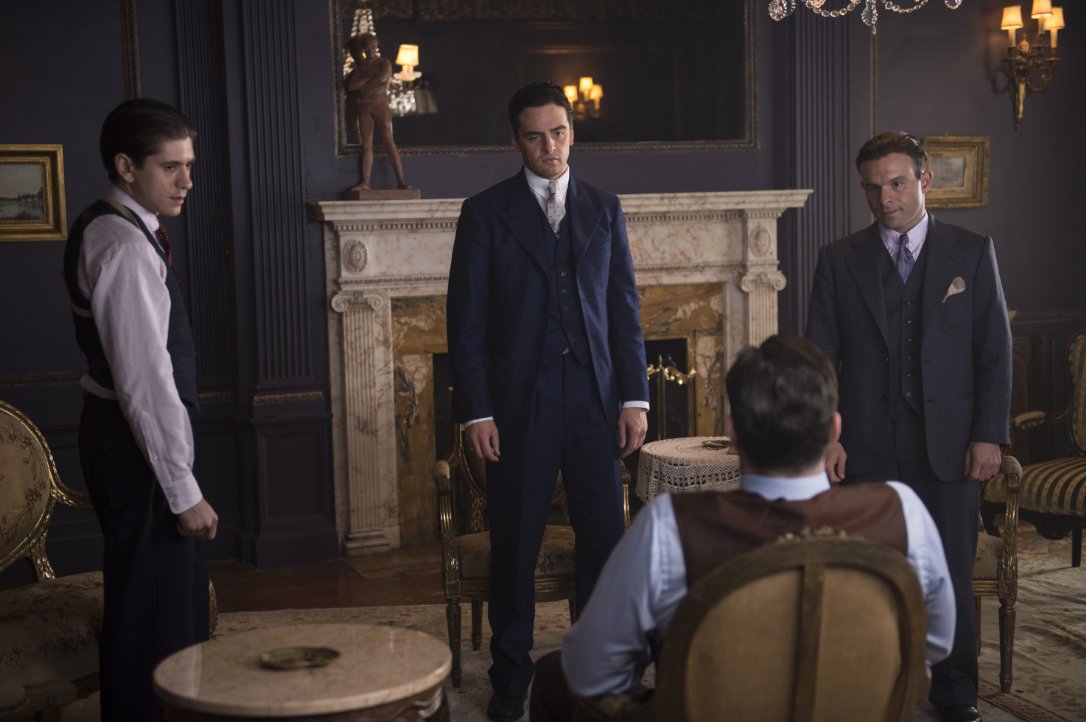
    More than it does anything else, this week’s episode of Boardwalk Empire confirms the show’s storytelling method, remaining entrenched in the series slow (we might instead say “steady”), novelistic approach to telling its story through the accumulation of character-driven scenes, rather than necessarily through developments of the plot. There are plot developments as well, of course—Luciano and Siegel’s murder of several of Doctor Narcisse’s girls this week guarantees a reckoning in the episodes to come, for starters. But, as is always the case with early season episodes, much of what goes on here is place-setting, standing up dominoes that we’ll later have much more fun knocking down.

    You know this already about Boardwalk Empire, and either you’ve bought in or, if you haven’t, you’ve likely stopped watching altogether. So while I wish the show could be a little faster paced, a little lighter on its feet, writing to that effect is fruitless. Instead, the show from week to week rises and falls on the strength of the scenes it chooses to focus on. This week, the focus is on a few key scenes, with some additional characters scattered about for the sake of moving the season along.

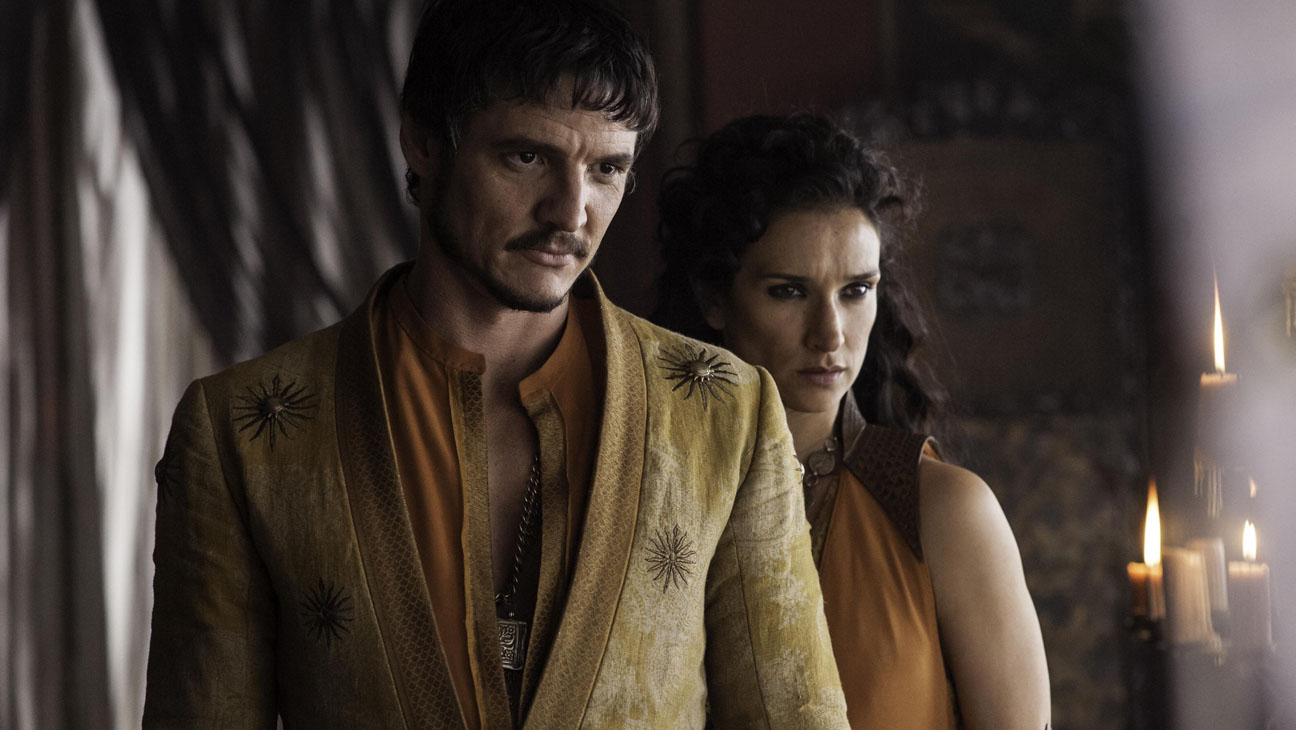
    This week, the focus is on Chalky White, and this is good news indeed for the viewer. Chalky and his newfound companion, Milton, break into a house and take the widow and daughter who live there hostage. Milton spied a safe in the home before, and is determined now for its contents. The girl, Fern, and her mother prove pluckier than expected, however, and they stall Milton all day long with lies about where the safe is located, when the man of the house will arrive home, and so forth. The scene is an extended vignette, a sort of pseudo-bottle episode tucked away inside “What Jesus Said,” and it is magnificent, unsettling and exquisitely tense, feeling for all the world like a lost Flannery O’Connor story.

    It’s no great shakes at this point to state how astoundingly talented Michael Kenneth Williams is, but it bears repeating here anyway. Chalky is a silent observer for much of this episode, answering very few questions, and even those cryptically—does his daughter know who he is, Fern asks. Chalky says, “She knew what I was.” But neither Chalky nor Williams needs say anything to be effective. The actor imbues even silent stares, of which this episode has several, with great import. The tension builds and builds, and of course we know, instinctively perhaps, that Chalky will kill Milton. He will act to save this family from being murdered—that will be the bridge too far for him. But when it happens he receives as thanks only a gun leveled at him, and orders to leave the house. Chalky’s experience has been such that he believes himself deserving of little more.

    This is a brilliant scene, and a great breakdown of Chalky’s character at this point, filling in many of the blanks of the premiere, as well as of the gap between seasons. He is still reeling from Maybelle’s death, and it is the event that has led him to lose everything else, as well. He and Nucky are mirrors of each other as ever, but, as we’ve learned time and again, Nucky will always have one advantage Chalky can never have.

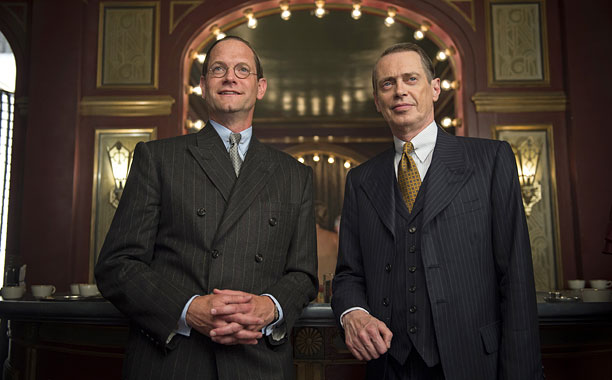
    It’s that advantage that allows Nucky to spend the episode gallivanting with Joe Kennedy, despite having committed as many crimes as Chalky and then some. Kennedy is a cracked mirror held up against Nucky (or, more truthfully, Nucky is the one with the cracks). He has a large, happy family; he claims never to have committed a crime in his life; he does not drink. He is exactly the sort of man Nucky pictures himself as, and in seeing him, he is the sort of man who makes Nucky realize that he himself, is not that sort of man. Kennedy prods and pokes, asking Nucky “What are you?” when Nucky attempts to distinguish himself from gangsters. He can’t. He tells white lies about his family, his relationships with wife and brother and nephew and children. And Kennedy sees through them, rejects Nucky’s deal, and pours him a single glass of booze.

    When pressed, Nucky says that the reason for all this, for everything he’s done, is this: “I want to leave something behind.” Which, YAWN. This trite sentiment has become such a cliché of the prestige TV drama as to be annoying and practically comedic. Here it is stripped even of any nuance or additional detail. Kennedy is equally unimpressed, and perhaps the emptiness of such a platitude is an intentional commentary on Nucky’s own emptiness? But if this is the case, the show had better make with another, better reason, and soon.

    As for the flashbacks to young Nucky, they depict his introduction to the seedier side of the Commodore’s business, witnessing first a man who claims to be in love with one of the Commodore’s girls, and then, later, the aftermath of that same man’s murder of that same girl. It’s a hard lesson for a ten-year old. He’s also enamored with a young girl named Mabel Jeffries. The flashbacks continue to become more interesting, especially in the ways the intercut with the present day story (the connection between the Commodore’s girls and the dancer in Nucky’s club is not lost on the camera or the editor).

    The rest of the developments I’ll deal with below in some stray observations. What we have here in this episode chiefly is direction, even if that direction could use some additional nuance. The justification for setting the season in 1931 become ever more obvious as time goes on, and the show begins to move pieces into interesting places, and to set up viable, vital conflicts and character combinations. It could be faster paced, and I especially wish that the balance of characters per episode was a little more even. We’re still very much in the part of the season that will seem more valuable in retrospect—but when even the slow build toward chaos is this beautiful, and this riveting, it’s hard not to be swept away just one more time.


    Stray Observations:

    – Margaret greets Nucky from the darkness in the corner of his living room, which is an extremely cartoonish moment that detracts from the lovely acting that both Kelly Macdonald and Steve Buscemi do in this reunion. There is such a sense of history, grudging respect, and yes, lingering love, between the two, and these are all conveyed nearly entirely wordlessly. If only Margaret weren’t lit like a comic book supervillain.

    – The world surely joins me in demanding a Mickey Doyle spinoff series.

    – Narcisse’s return is almost entirely expository, just as Luciano and Siegel’s massacre on his house at the end is simply a trigger for future stories. There’s the promise of more interesting developments as a result, of course, but it rather bugs to still be doing this kind of seed planting in the third episode of eight.
  • Sons of Anarchy Review: “Toil and Till” (7×02)

    Sons of Anarchy Review: “Toil and Till” (7×02)

    sons of anarchy toil and till

    With this week’s episode, “Toil and Till,” Sons of Anarchy makes the first compelling case for its unending, unrelenting depiction of misery of the season. In fact, I can’t remember the time I was as invested in or even interested by an episode of this show. Considering where I stood last week, we’ll consider this high praise. I genuinely tried to be more positive about the show this week, and am very happy that those efforts dovetailed with an episode that is worth them.

    Last week’s premiere got a lot of necessary, but not inherently compelling, exposition out of the way, which means we get to spend this episode settling into this new status quo, before the revealed truth of Tara’s death inevitable blows everything to smithereens. And “Toil and Till” does truly go a long way toward bringing some human dimension back to these characters. Consider Gemma’s conversation with Abel: Are you okay, Grandma? he asks her, and what is her perfect response? “Always.” This is such a quiet, well-acted and -directed moment, the sort that justifies running over time (this week, it’s by a perfectly reasonable sixteen minutes), a character-developing scene that is both given sufficient room to breathe and which allows the audience to refocus our empathy toward that character. Gemma is an awful woman, the worst person on this show by almost any measure, but we know enough about her to begin to understand her, and this one scene reinforces so much about the character.

    Similar successes are had this week with Juice and Unser, whose early scene in the episode, while committing the perennial Sons sin of immediately undoing a cliffhanger, is another instance of the show using its history effectively, and allowing small, talky scenes that might otherwise have been cut from the episode, to instead do very important character work. Theo Rossi has gotten me this week to question my judgment of his acting in the premiere. Then, I found him listless and affected; this week I wonder if it’s intentional. Juice as a character is in so far over his head—he’s “basically a child,” according to Unser—and he is posturing at being as ruthless as Jax or Gemma, as being the kind of guy who could kill Unser just to keep a secret. But he’s not that ruthless, and Unser knows it.

    Speaking of Wayne Unser, this is a big week for him! The character feels dramatically relevant for the first time in ages, and to have him back in the mix in some official capacity with the law promises a minefield of conflict in the coming weeks. Dayton Callie is great even when the writing is fumbling, so this week, with several great scenes to play, is a real treat just for his performance.

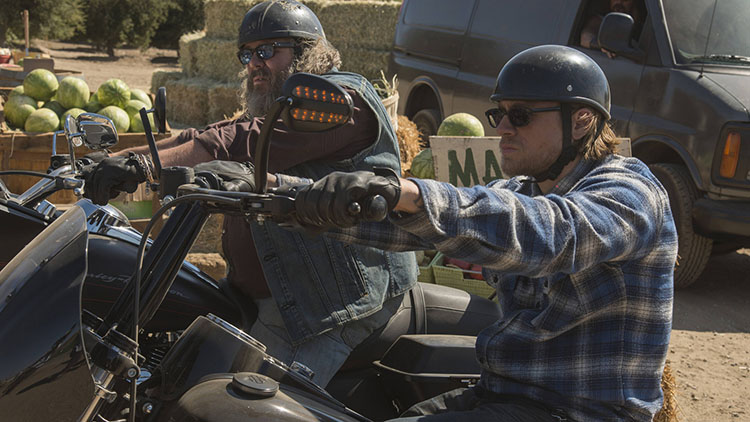
    That said, the show still has a massive problem, and that’s the way it depicts Jax and the Sons. It is impossible at this point for the show to have its cake and eat it, too: either the Sons are badass, super cool biker badasses, or they are a group of wrongheaded, violent men who doom themselves and everyone around them. You have to pick one. Walking a strange tightrope between these two depictions of the characters and of the world itself causes too many moments where the whole thing is flat—for instance, any moment in which we are subjected to a reading of Jax’s journal entries. Perhaps the way those two stoners so plainly idolize Jax, up until he murders them, too, is a comment on this very issue. But when every episode still features a motorcycle chase set to a rock song, it seems we’re asked to forget just who, exactly, we are watching, if only until the commercial break.

    So when the episode ends on a shot of Jax cradling Abel, a single perfect tear falling down his cheek, while across town, who is Jax’s brother by Jax’s own definition of the word, cradles the dead body of someone he clearly knew and loved more than he suggested to Jax; when the episode ends asking me to appreciate how much of his soul he has lost, well, that falls flat, because Jax is a murderer now, several times over. Any sympathy or desire for redemption that might have once existed for this character is completely gone, but the writing seems completely unaware of this fact. We’re asked to view this violent behavior as a lashing out in the wake of Tara’s death, a single-minded quest for vengeance, but that’s not really a valid request. Jax has been this violent for a very long time now, and he had been knowingly placing Tara’s life in danger since the middle of season four, when his own father-in-law tried to have her killed. That he doesn’t know that his own mother is the most dangerous of all his associates is the only oversight of which Jax can be forgiven at this point. But Tara’s safety? He had already demonstrated a complete lack of concern for that.

    Does this make sense for Jax’s arc? Yes, absolutely. His final story arc taking the shape of a willing dive into the darkness is thematically fitting for the show. But this all needed to follow directly from the season four premiere. Instead, Sutter and team crafted two artificial seasons, that treaded water until the characters could reach this point, but which continued upping the ante on the violence and crime anyway. Jax has been on this level for some time, but only now are we asked to take it seriously and take concern. Taken on its own, it works well, and has the potential for much more, but you’re basically required to jettison most of the past two seasons in order to do so.

    Then again, maybe disregarding the business with Romeo and for some reason Dave Navarro isn’t the worst that could happen.

    Regardless, this is a solid episode of Sons, and hopefully it’s indicative of things to come. The show still needs tighter editing; even though this episode actually doesn’t run that long, I think it could comfortable have been cut to a cable hour. The show would be more exciting if it were more concise in its storytelling, and that’s true on the micro-level of episode structure as well as on the macro-level of: this should have been a five season show. But the episode does strong character work, and more importantly, positions characters interestingly for maximum conflict and fallout at the end of the season. In that sense, at least, the show is still honoring its Shakespearean inspiration. If the series can more effectively grapple with the issues of Jax’s history, and I think that even this will become less of an issue as the conclusion nears, then we are in for some potent drama, and a hopefully fitting finale to the series.


    Stray Observations:

    – The montage at the beginning, which is mercifully silent, actually features some stellar directing and editing, as well as a knowing wink at the show’s unbreakable musical montage addiction. Jax, Gemma and Juice, along with Unser, are positioned as the major players going forward, and that’s a great combination of relationships, so it’s very cool to see them linked visually here, as well as throughout the episode.

    – Annabeth Gish is the new commissioner in town, but it remains to be seen exactly how Althea Jarry will figure in at this stage. I’m much more interested in Unser’s new role as consulting investigator.

    – This is a show where “the porn warehouse” is a real thing that exists, and also is a suitable alibi.

  • Boardwalk Empire Review: “The Good Listener” (5×02)

    Boardwalk Empire Review: “The Good Listener” (5×02)

    boardwalk empire the good listener

    That’s much more like it. “The Good Listener” may be the second episode of the season, but it feels like the first. Certainly it’s the first real indication this season that Terence Winter does, in fact, have some kind of endgame in mind that he’s working toward. This week also provides significantly more, and better, justification for jumping ahead all the way to 1931. What seemed last week to be an arbitrary decision to bookend the series’ treatment of prohibition, this week is revealed to be something entirely different.

    In 1931 we have arrived at a flashpoint, and it’s that flashpoint that gives this episode its newfound verve and urgency. Al Capone is a bona fide celebrity now, giving interviews to Variety and generally trouncing about with the same manic energy that Stephen Graham has gotten so excellent at embodying. He’s also still employing Van Alden and Eli, neither of whom are very well off after these seven years. Luciano, Lansky and Siegel are up to no good together, and one gets the sense that they are in way over their heads. Eli’s son Will is desperate to join the U.S. Attorney’s office—whether this is to take down Nucky, or to get information for him, is left up in the air for now. We even check in on Gillian Darmody, who has been committed to an insane asylum that feels like something out of a retro-Orange is the New Black.

    Gillian’s story this week feels the most out of place, like it’s there for the sake of keeping Gretchen Mol on the payroll, but Mol is excellent, and there is a lingering cloud of uncertainty that hangs over both her performance and the staging of her scenes. Especially in a season that seems determined to expound further on the nature of both the Commodore and Nucky’s youth, I expect we will be exploring much further the specific reasons for Gillian’s institutionalization, as well.

    Where this episode succeeds, and where the premiere more or less failed, is that everything is interesting in its own right, but also is sufficiently related to the central story of Nucky’s return to the alcohol business. We are here, at this moment in time, because this is where the story ends. Already we can see those threads coming together, if slowly. This feels very much like a premiere episode, and one wonders why we didn’t just cut to the chase sooner; but then, if the rest of the season keeps up at this clip, then the plodding-by-comparison premiere might feel like a more natural deep inhale.

    The flashbacks continue, and while they still feel a little gimmicky to me, especially when I’d rather be spending time with the absent members of the ensemble (Narcisse has yet to show up this season, and we don’t follow up with Chalky or Margaret either this week, though I’m only really upset about one of those things), but they do feel more confident this week, and so I feel much more confident about them. As they persist, they accumulate meaning, and begin to develop their own sense of narrative. I’m reminded of nothing more than the flashbacks on Lost, which similarly developed narratives of the characters’ pasts that were meant to reflect their struggles in the present. It might not be the most original way to highlight Nucky as we wind down, but it at least is now showing signs of effectiveness.

    Overall this is a much more entertaining and effective episode, and I’m glad to see the season pick up the pace so early on, considering the shorter episode order. I hope very much that we spend more time with Van Alden and Eli as the weeks go on. Both stories are tinged with tragedy, yet the pairing of characters feels like its own sort of buddy cop movie, with the witty repartee and physical comedy that comes with that territory, and it all works tremendously well. Shea Wigham and Michael Shannon have excellent chemistry, and on a show that very rarely finds justification to pair off many of its central characters, this particular pairing is a real treat.

    As always, the show is much more interesting when all the other characters orbit around Nucky, while Nucky himself rests in stasis at the center of the whole thing. There is very much that sense here, and thanks to the flashbacks, there is a specific request from the show for us to consider Nucky the way we would the Commodore—as a toxic, manipulative, corrosive villain, in too many lives to count. We’ll see if the narrative plays out. The episode leaves us with a shot of Tonino’s open earhole, the first shot in what will likely be a much bloodier war. Nucky’s attempts at outright gangster-ism have landed him in trouble before, and this one is likely to do so again. Thankfully, on the strength of this episode, we have reason to look forward to the playing out.

    Stray Observations:

    – Just a note on the scoring this week: In the Emmy Spotlight series it was useful to highlight acting, directing, and writing as separate categories. Reviewing weekly, though, a lot of these things are consistent from week to week, purposefully so. I’ll call out specific notes of interest in the review, but I’m not breaking the score down into categories, as it requires way too many mathematical gymnastics to get to an appropriate overall score. I’ll still grade the episode out of ten, but it’s going to be much more holistic. I’ll break down a full season score at the end, and that’ll be where we go from here.

  • Sons of Anarchy Review: “Black Widower” (7×01)

    Sons of Anarchy Review: “Black Widower” (7×01)

    sons of anarchy review black widower

    Welcome to season seven (!) of Sons of Anarchy! I hope you are ready to have some fun, because I sure as hell am. If you’ll remember, last season ended with Gemma bashing Tara’s head in with a kitchen fork, followed shortly by Juice shooting the woefully underdeveloped Officer Roosevelt in cold blood to protect Gemma from prosecution. Last season was otherwise pretty uneventful, to be honest—lots of tangents, talking circles, continued poor decisions, and awful scenes of murder and violence, including Clay’s long overdue demise, all culminating with Jax cradling his dead wife’s body in his arms.

    You know, in case you’d forgotten what kind of show this is.

    “Black Widower” opens and closes with a musical montage, because of course it does, and in between are about seventeen hours of scheming, violence, and boredom. Juice does naked pushups, and ends up in hiding from SAMCRO along with Drea Di Matteo. Jax is in prison, mutilating someone, for some reason, by carving a swastika into his torso. Unser, who is somehow still on this show, visits Tara’s grave, and hopefully feels at least some responsibility for her murder, but probably doesn’t. No words are spoken for a solid five minutes and holy shit this is going to be two and a half hours of this nonsense, isn’t it?

    In what is probably the strongest scene of the episode—which comes in the first half hour, so, you know, cause for concern—an impassioned Patterson (played by the absolutely fantastic CCH Pounder) lets loose on Jax, insisting to him that the violence he carries on will destroy what little is left of his family. Then Patterson lets him out of jail, unable to find any evidence to pin Tara’s murder on him. And what is the Verizon blurb summarizing this episode? “Jax makes vengeance a priority for the club following Tara’s murder.” Their shoot first, ask questions later approach leads to the club teaming up with the Grim Bastards, when they accidentally murder a handful of debauched bastards. Upon realizing the mistake, Jax shrugs and murders the last one.

    Jesus Christ.

    This is an empty, disgusting, soulless show. Kurt Sutter and his team constantly posture at having deeper, more meaningful things to say about violence, and its corrosive impact on the lives of the Teller family. But nihilism is not a moral stance. Saying “violence begets more violence,” and using that as an excuse to show a paraplegic man being dragged violently across the street whilst chained to the back of a motorcycle; or to show your show’s hero carving a swastika into a man and slicing out his teeth, just to make an introduction; or to have one of your female leads brutally murder the other, only to never admit, and in fact to baldly lie to her son about it; none of this is justified. None of it has even the remotest artistic value, not anymore, and frankly not since probably season four.

    The last episode of this show I can recall having even the slightest emotional impact on me as a viewer was “Hands,” in which Clay brutally beat Gemma following her attempt to escape the marriage by way of shooting him in the face. The scene is harrowing, fraught with tension that has been earned through several years of careful character work and an intense chemistry between Ron Perlman and Katey Sagal. Everything, literally everything, since that episode has been a steep downhill slide of diminishing returns. Violence for its own sake no longer shocks. Betrayals are now routine. The increasingly convoluted club politics and machinations were never especially interesting, but now are so obtuse and complicated as to be incomprehensible. And at the center of it all is a cast of characters that feel entirely like strangers.

    Are there even any real characters left on this show? Or is everything a set piece for Gemma’s latest manipulation, or else the latest “shocking,” graphic burst of violence that Sutter and company can dream up? Outside of Jax and occasionally Juice, the club is full of ciphers and two-dimensional characters. When is the last time we spent any meaningful time with Chibs, or Tig, or Bobby Elvis? You might even have a hard time just naming all the members anymore. And despite several major character deaths, the cast has gotten larger, adding Di Matteo, Jimmy Smits’ Nero, Pounder, and a cavalcade of guest stars that the show will almost certainly fail to serve.

    But the biggest sin of this show is the ridiculous, faux-weight that it forces upon a plot that is paper-thin, sensational, and lacking any depth. Jax gives a lengthy speech at some point in the interminable middle of this episode, pontificating about his reluctance to “sit in this chair,” lamenting the “direction he tried to take this club in”, and you know, it’s a fucking motorcycle club. Stop fucking shooting people. Leave the damn club. The lesson has been learned, time and again, and every horrible thing that has happened has been brought upon the club by its own actions. Instead Jax gives a speech that affirms the club’s actions. He demands that each man at the table be prepared to “kill and die” for the man next to him. The entire scene is framed as an affirmation of the brotherhood on display, the fraternal connection that is so important to the club and ostensibly to the show.

    In a scene that seems meant to directly mirror it, Gemma tells Juice that she is “the only thread holding this family together,” when every single event of the past several seasons has demonstrated nothing of the sort. She is the titular black widow, a cancer upon everything she touches, and yet you get the sense that the show thinks her a protagonist, especially with Unser and Nero both fawning all over her. Or at least, the narrative gives no opposing figure, no modicum of heroism or even just basic decency to counteract the manipulation and deceit. Everyone is equally awful, and only the rationalizations vary. If the show does eventually give Gemma her comeuppance, and I suspect it will, even that will be robbed of any significance or catharsis, coming as it will several seasons too late.

    When the episode ends, Jax tortures and murders a random Chinese gangster, innocent of Tara’s murder if not of anything else, and the background music intones that “nothing really matters” as Jax literally rubs salt in the man’s wounds. Have truer words been spoken? Everything in the show, it amounts to nothing and less. There is no heart here, just unending violence and gratuitous spectacle, more of the same, over and over, and bloated beyond any reasonable length of narrative. There are no further depths to which the show or its characters can sink. Its continued insistence on reveling in pulp operatic violence does nothing to further its cause, nothing to deepen its thematic value. It does nothing at all. The show is loosely based on Hamlet, which of course deals with similar themes. But Shakespeare does it in about three hours, and with a lot more style and substance than Sons could ever hope to achieve at this point in its long, stupid run.

    Stray Observations:

    – For all its many, many failings, the show does feature some great acting on a consistent basis. CCH Pounder is fantastic as DA Patterson, and one hopes she continues to have an increased presence, as she’s perhaps the only decent character around anymore. Jimmy Smits gives Nero far more gravitas than is present on the page. Gemma is horrid, but Katey Sagal is a captivating screen presence, and she manages somehow to sell the magnetic quality that keeps all of these idiot men in Gemma’s toxic orbit. And Charlie Hunnam does his best with a character that has become increasingly hard to sympathize with or even understand, but even if he does play a good noble leading man, the performance of nobility will only become more grating as Jax’s behavior becomes more deplorable.

    – That said, some of the acting leaves a lot to be desired, especially from Theo Rossi and Drea Di Matteo, who both are very flat throughout this episode–though, given the story Rossi is saddled with, and the almost complete lack of material for Di Matteo, you can hardly blame them.

    – In calculating the acting score below, I’m also accounting for the criminal mismanagement of the show’s ensemble cast in this episode.

    – The episode is also handsomely directed, especially the closing scene in Gemma’s kitchen, where Jax commits a murder that mirrors Gemma’s murder of Tara. But even handsomely directed nihilistic violence is still pretty gross to me.

    – I should also note that I really did like this show, once upon a time, and I took on these reviews in part because I hope to see a return to form before the final scene. So as much fun as it is to write scathing reviews, I’m also pretty disappointed that this is the start we’re off to.

    – One of these days, I hope FX realizes that the way it gives its drama showrunners, and especially Sutter, carte blanche when it comes to running times hurts the shows more than it helps them. The 42-minute hour (closer to 50 for cable) has existed as a format for a very long time for good reason: it works. This premiere is so bloated, taking several scenes to explain and set up scenarios that need little to no explanation or set-up. Indulging the every whim of the show’s writers (any show’s writers, really) is an epically bad idea. I doubt there is a strong story nestled within this episode, but it would at least be a tighter story, and there is so much extraneous material that I have absolutely no doubt that it could be cut to 42 minutes without losing a single essential frame.

    – The closing montage is set to a cover of “Bohemian Rhapsody” that I will never be able to unhear, and which is the episode’s greatest offense.

    – We will not be discussing Anarchy Afterword in these review, unless it is to hope fervently that the fad of post-show discussion shows ends, and soon.

  • Boardwalk Empire Review: \"Golden Days for Boys and Girls\" (Season Premiere)

    Boardwalk Empire Review: \"Golden Days for Boys and Girls\" (Season Premiere)

    boardwalk empire

    Boardwalk Empire opens its fifth and final season with a flashback to 1884, wherein a young Nucky is shown swimming, poorly, in an attempt to earn some of the coins that the Commodore tosses into the ocean. He competes, poorly, with several of his peers. It’s a case of the show going back before it goes forward, and I fear it’s also a case of the show thinking itself deeper and cleverer than it actually is.

    When the heavy-handed flashback has ended, the scene flashes forward to Havana, Cuba (as opposed to the other Havana, most likely; see also Coney Island, Brooklyn, and Bronx, New York), and the year is now 1931. We have missed a rather lot in the intervening years since season four ended—not least being, Nucky is now holed up in Cuba with Patricia Arquette. Chalky is now in prison for reasons unknown, part of a black chain gang.

    Last season’s finale felt very much like the end of something, certainly owing to the death of Richard Harrow, but it also felt like a gentle reset on the show. Eli was sent to Chicago with Van Alden; Margaret fell into Arnold Rothstein’s orbit; Chalky withdrew to Havre de Grace, and seemingly out of the mob game entirely; Gillian went to jail. By jumping ahead to after the Depression, you can’t help but feel a little robbed of witnessing the direct fallout of these developments. The premiere leans heavily on Nucky, who is by far the show’s least interesting character, someone around whom the things we actually care about happens, but who himself seems to have very little impact on those events.

    The worst offense of the time jump is that it results in a whole lot of place setting and piece moving, directly after a finale that was in large part place setting and piece moving. Abandoning a perfectly good premise in order to set up another one is fine, but man, it can be a drag. We spend much of this premiere playing catch-up, or else struggling to figure just what the hell, exactly, is going on. With only so many episodes remaining, there really is an unjustifiable amount of time spent on unnecessary flashbacks to Nucky’s youth. We learn nothing about him we didn’t already know, or couldn’t have guessed, and the rest plays as a ham-handed attempt to generate empathy for a character that, frankly, deserves none.

    In the present it’s more of the same, as Nucky wheels and deals in Cuba. Patricia Arquette continues to delight as Sally Wheat, and Steve Buscemi is typically droll as Nucky, but the various characters introduced in Cuba don’t make much of an impression, at least not in this first episode. Again, you can’t help but miss the characters we already know. There’s an admirable bit of symmetry here, as Nucky endeavors to be ahead of the curve once more, this time setting up a legal alcohol distribution operation, just in time for the end of Prohibition. The series will end as it began, and that’s very nice. But toward the end of the fourth season, the series was reinventing itself—doesn’t that seem like a better deal?

    As for the other characters, we spend the most time with Margaret, who finds herself embroiled in…well, in something or other, after her boss shoots himself in the head in front of the entire office, after giving a peculiar speech about Mickey Mouse. Chalky silently plots his escape from the chain gang, either masterminding a rebellion, or simply taking advantage of a fortuitous uprising; which is not clear, though the implication is strongly toward the latter. We even drop in on Lucky Luciano, who conspires with Bugsy Siegel to assassinate Joe Masseria before initiating himself by blood into what appears to be the mafia proper—Lucky, like a young Nucky before him, will do a favor to get ahead. It’s the most intriguing of the episode’s developments, both because of our previous investment in Lucky, and because of the near-certainty that whatever path he’s on right now, it’s due to collide with Nucky’s before long.

    Mostly, the premiere raises more questions than answers, and the questions are rarely good ones. What is the point of the flashbacks? Why is Margaret still on this show? Why is Chalky the only person who seems to have aged since 1923? But there are interesting questions as well. And it may be that worrying too much about an uneventful premiere is a moot point—after all, the previous seasons have uniformly gotten off to slow and often strange starts, only to have everything come together by season’s end. There is no reason not to keep giving the show the benefit of the doubt. But there’s no question that the season we’ve gotten here is very different from the season that was suggested in the previous episode, and there’s definitely a disappointment of expectations as a result.

    This is very much an average, run-of-the-mill episode of Boardwalk Empire, in other words. The production is top-notch as always, and in fact, Cuba in the 1930s allows for a different visual palette than the show normally goes for, and it’s frequently a striking one. But narratively, there’s too much time spent on flashbacks that are notably mainly for a particularly bad Dabney Coleman impression, and too little time spent on characters like Chalky, Lucky, and Margaret, the latter two of whom feel shoe-horned into this episode. That’s to say nothing of the characters who are entirely absent—as with previous seasons, it seems we’ll be dropping in and out of plotlines in alternate weeks, if not entirely at random. Maybe it will all come together in the end. History suggests that it will. But taken on its own terms, this premiere episode is too scattered to be of substance, and suggests more of its own missed opportunities than it does any particular promise of the future.

  • Emmy Spotlight: Orange is the New Black

    Emmy Spotlight: Orange is the New Black

    o-ORANGE-IS-THE-NEW-BLACK-facebook1

    Did you know that it’s the first season of Orange is the New Black that is in contention at this year’s Emmy ceremony? I sure didn’t. So go ahead and check out my absurdly belated review of season two that I totally didn’t write by accident after you finish up here. And now, let’s all reach back in our minds, to that desolate wasteland in our collective memory known as “summer 2013,” which is when the first season of Orange is the New Black aired before it was then summarily ignored by that year’s Emmys because eligibility windows.

    The first season of Orange is the New Black is a solid dramedy. It’s pretty hard at this point not to look at it comparison to the second (and I think superior) season, but I’ll try my best. What I love most about it, which I briefly touched on in my piece on season two, is that the show is a total Trojan horse. On its face it appears to be yet another show about a privileged white lady, in over her head, even more so considering it’s from Jenji Kohan, who gave us Weeds. But like that show (which I’ll argue forever is great), Orange has a much different, better, and more interesting agenda. For while Piper is certainly our entry point into the crazy world of Litchfield, it becomes evident very quickly that Kohan and company are much more interested in the characters that inhabit the prison, and in the ways that they cope with life behind bars. It’s a wonderful bait and switch, and the result is a television show that features one of the most diverse, inclusive casts in the history of the medium.

    It’s not all bait and switch, of course. The premiere episode especially is heavily focused on Piper, as it slowly transitions the audience from her comfortable upper-class existence into the harsh realities of prison life. Appropriately titled “I Wasn’t Ready,” the episode also firmly establishes the flashback structure, most reminiscent of a show like Lost, that enables the series to explore its characters in such impressive depth. While at first this exploration is reserved for Piper, it quickly extends outward. At first the characters appear to Piper, and therefore to us, as clichés. But slowly, as Piper gets to know both them and the prison better, we see that each is a complex, well-rounded individual.

    It says something about how well the rest of the season does its job that, in re-watching “I Wasn’t Ready,” Piper comes across as, frankly, grating. Similarly, the other characters come across as flat and one-note, especially as they’re introduced with their specific roles within the prison. One of the biggest benefits of the Netflix model is that we don’t need to wait thirteen or more weeks for the shading to be filled in, as we would with a typical television show. Instead, the rough sketches presented here are fleshed out as quickly as our eyes will allow.

    The show grows exponentially throughout the season, and the retrospective strangeness of the premiere suddenly seems all of a piece with the story the show is trying to tell. Insofar as the season is about Piper’s journey, then, it’s quite successful. But it’s most successful in telling the stories of the other inmates. Kate Mulgrew is a standout as Red, who runs the kitchen and makes Piper’s life hell before becoming a valuable ally. On the outside Red was herself an outsider, starved for the attention of the wives of the Russian mobsters, until she falls in with the crowd herself. Laverne Cox is excellent in a small role as Sophia, a transgender woman who committed credit card fraud to finance her surgery. And Taryn Manning gives a frequently genuinely frightening turn as Pennsatucky, an under-educated meth head in for the murder of a worker at an abortion clinic. But even the background roles, tertiary characters who might not have much bearing on the plot, but who add depth and color to the setting of the show, are memorable and even moving. Morello, Jones, Big Boo, Taystee, Poussey, and on and on—slowly but surely, nearly every single inmate becomes a living, breathing character.

    It’s somewhat disappointing, then, how heavily the season leans on Piper and Alex. It’s not that Laura Prepon is bad in the role—in fact, she’s the better of the season’s several antagonists, since her preexisting connection with Piper raises the stakes for both Piper and the audience. But with so much else going on at the prison, it can sometimes be a drag to spend so much time with arguably one of the least interesting characters, or at least, the most familiar. There isn’t very much left to learn about Piper, whereas we as an audience are seeing someone like Red, or Sophia, or Miss Claudette, for the first time. What we do learn about Piper is how she is changed by these women, and by her new circumstances; everything we learn, we learn through contrast to these other elements.

    I think part of my discomfort with the focus on Piper is also the relative lack of an overarching story, one that connects the many, many disparate threads of the season. (I’m cheating slightly by noting that season two goes a long way to fixing this, by way of introducing Vee, but hey—it does.) Pablo Schreiber’s Mendez rounds out the villains of season one, and his dealings with Daya and Tricia do bring in many of the other supporting characters, but Piper and Pennsatucky’s ultimate showdown feels very separate from much of the show, just as the rest of the show at times can feel very separate from Piper. Curiously, even though Piper is one of the few characters in season two who doesn’t interact directly with Vee, that sense of her as just another inmate actually makes the character feel more integrated into the show.

    It’s important to remember, though, that these episodes can be watched straight through in a handful of sittings (if not just one), and in many ways they are meant to be taken more as a whole than they are as a series of thirteen separate stories. Taken as such, the season becomes an examination of morality, in a sense, of the way that decisions long forgotten, or tiny indiscretions thought unnoticed, can suddenly dominate our lives. Laura Prepon plays Alex as a toxic presence throughout Piper’s life, one that simply won’t go away, while scenes with Larry and his parents create an ever larger gap between what Piper was and what she is now. Running through all of that is Pennsatucky, with her brand of pure, unbridled chaos. As for everyone else, they fall somewhere along the spectrum, each their own special shade of grey, whether we’re talking Bennett, the well-intentioned fool, or Fig, who emerges by the end of the season as a devious administrator, or Piper herself, a spoiled white girl who maybe is learning to be less so. (As an aside, Alysia Reiner is absolutely fabulous as Natalie Figueroa, always striking the perfect balance of no-nonsense and heinous bitch.)

    When we get to the end of the season, Piper is pummeling the life out of Pennsatucky, and it’s a moment that is appropriately horrifying, and yet in a way also liberating. It’s Piper embracing prison life for all that it entails, her sign to herself that yes, she is ready. And we have Healy, who leaves Piper to die. And we have Red, down a peg, having lost her kitchen and with it her status in the prison. Perhaps it is most fitting, then, to view this first season as a collection of different stories, united by their common themes, and by their common setting. Funnily enough, the comparisons to Lost don’t seem to end with the structural similarities; there’s something to be said for the idea that Litchfield, as a closed system, is a space for the inmates, and the COs as well, to confront their own worst demons, whether they reside in their pasts or in their present.

    In closing, then, I want to especially call out the Christmas pageant that closes out the season in “Can’t Fix Crazy”. The entire sequence is wonderfully incongruous, breathtaking in its simplicity and in its beauty. When Norma breaks the silence caused by Suzanne’s forgotten lines, with her surprisingly gorgeous voice, the moment catches you off guard in the best possible way, precisely because it is so unexpected to see anything even remotely resembling unbridled joy up on that stage.

    The incongruity carries into Piper and Pennsatucky’s shiv duel out back, and I think it’s worth noting that when Piper does finally snap, it’s at Pennsatucky’s insistence that she is unworthy of God’s love, of anyone’s love at all. That exact fear has nagged at the back of Piper’s mind all season, but really, it’s the same fear that plagues every single character on the show, whether inmate or guard or administrator. For whatever reasons—the reasons don’t ultimately matter—the various residents of Litchfield are afraid that they are unworthy of love. And so the best thing about Orange is the New Black is not only its expanding scope, but its insistence on revealing these people for the human beings that they are. It’s highly entertaining and often funny, but it’s also piercing commentary on our prison system, on the way that we as a country systematically and institutionally devalue inmates who, really, have the same problems any of us has. Orange is the New Black is about finding commonality where one least expects it—commonality between inmates and free folk, between black and white, rich and poor, and any other divisive binary you can dream up. The characters and setting might be new to television, but themes aren’t, and it’s that universality that makes the show so very effective, and which has so quickly cemented it in the cultural zeitgeist. And the best thing about considering this first season on such a delay? We already know the show only gets better from here.

  • Emmy Spotlight: Veep

    Emmy Spotlight: Veep

    Selina signs her book

    If at any point this essay devolves into just a running list of one-liners, I apologize. But with a show as consistently, uproariously funny as Veep, it’s nigh impossible to resist the urge to simply revel in the wonderful blue humor of Armando Ianucci’s vulgarity-ridden zingers. In the hands of the talented ensemble that fills out the cast, swearing is elevated to an art form, even if no one quite measures up to the imitable Malcom Tucker, played by Peter Capaldi on Ianucci’s The Thick of It, the BBC satire that is Veep’s precursor.

    Now in its third season, Veep has thoroughly demonstrated that it only gets better with age. With its focus on Selina Meyer’s cover presidential aspirations, this season has a stronger narrative thrust than the previous two, as it displays greater comfort with the characters and setting, and more confidence in its audience, allowing stories to unfold serially over multiple episodes. There are still elements of the series’ trademark problem-of-the-week model, but even on these outings (including a trip to Silicon Valley and a stop at a gun show in Detroit), the hijinks that the Veep’s staffers get up to have repercussions beyond the individual situations.

    Don’t get me wrong, it’s not like this is 24 or something. Beyond “Selina campaigns for president” the plot is as secondary as it ever was. But even this minor shift in the season’s structure is extremely rewarding. Now that they’ve an actual goal to work toward (as opposed to continued languishing in the uselessness of Selina’s office), we see new aspects of these by-now familiar characters.

    As ever, and even more so now, it is the characters that are Veep’s greatest strength. This is an incredibly strong ensemble, gifted in their delivery of some wickedly funny dialogue, and endlessly compatible. The characters can be paired off in basically any combination, and hilarity is guaranteed to ensue, and in fact this season sees some fruitful experimentation in this regard, especially with the running gag of Sue and Kent’s maybe-flirtation, maybe-mutual hatred. Even established character traits, such as Dan and Amy’s rivalry, come into clearer focus when they have something concrete, like the campaign manager position, to compete over.

    Of course, all of that means nothing without the performances to back it up, and it’s not overstating things to say that Veep has one of the best comedy ensembles to ever appear on television. Leading the cast as Vice President Selina Meyer, Julia Louis-Dreyfus has won two Emmys for the role and is now nominated a third time for Best Actress, and she continues to earn it a hundred times over. She is amazing with all her material, but she is best at conveying Selina’s pure, seething hatred for everything and everyone around her. Pretending to care about her staff, her constituents, even her family, is so obviously the most difficult aspect of Selina’s job, and of her personal life. Not that she pretends very often—some of the season’s biggest laughs come from Selina’s barely veiled, and sometimes not-at-all veiled, disdain for the people she is forced to interact with. (My personal favorite: Selina’s every interaction with Minna Hakkinen, whom she insists on referring to as the “ex-Prime Minister of Finland,” every time, no matter what: “In your country, people fuck snow.”)

    The rest of the cast is fantastic as well. Tony Hale is perfectly cast as Selina’s simpering personal aide, Gary, who this season suffers a shoulder injury that makes him unsuited even for his ridiculously unnecessary job as, essentially, a place for Selina to hang her purse. He’s eminently pitiable, but just annoying enough that you don’t feel bad for laughing at him. Of course, Hale has experience with this type of character, having spent four years as veritable punching bag Buster Bluth, and in many ways Gary is a toned-down variation on that same attention-starved, slightly slow-on-the-uptake, tertiary team member. Dan Reid and Anna Chlumsky are reliably funny, trading off the Everyman role while the other indulges in some neurosis or other. Scott is especially effective during Dan’s epically chaotic tenure as Selina’s campaign manager. Matt Walsh’s Matt McClintock is as endearingly bumbling as ever, but he also meet his wife (played by Kathy Najimy) and see a home life that suggests he’s not quite as pathetically useless as he appears to be at work.

    The ensemble continues to grow, as well, as Sufe Bradshaw’s Sue has an increasingly larger role, Kevin Dunn joins the regular cast as Ben, and Timothy Simons continues to steal the show as perennial punching bag Jonah. And there is also a strong cavalcade of guest stars: beside the aforementioned Najimy and Gary Cole’s Kent, Chris Meloni also gives a hilarious turn as Ray, Selina’s physical trainer/fuckbuddy, Zach Woods as Amy’s milquetoast boyfriend Ed, and Diedrich Bader as a shit-stirring campaign manager who manages to (further) turn Selina against her staff. Frankly, there isn’t a weak link in the bunch here—every single character, including the minor one-off characters who drop by for just a line or two, can be counted on to generate laughs.

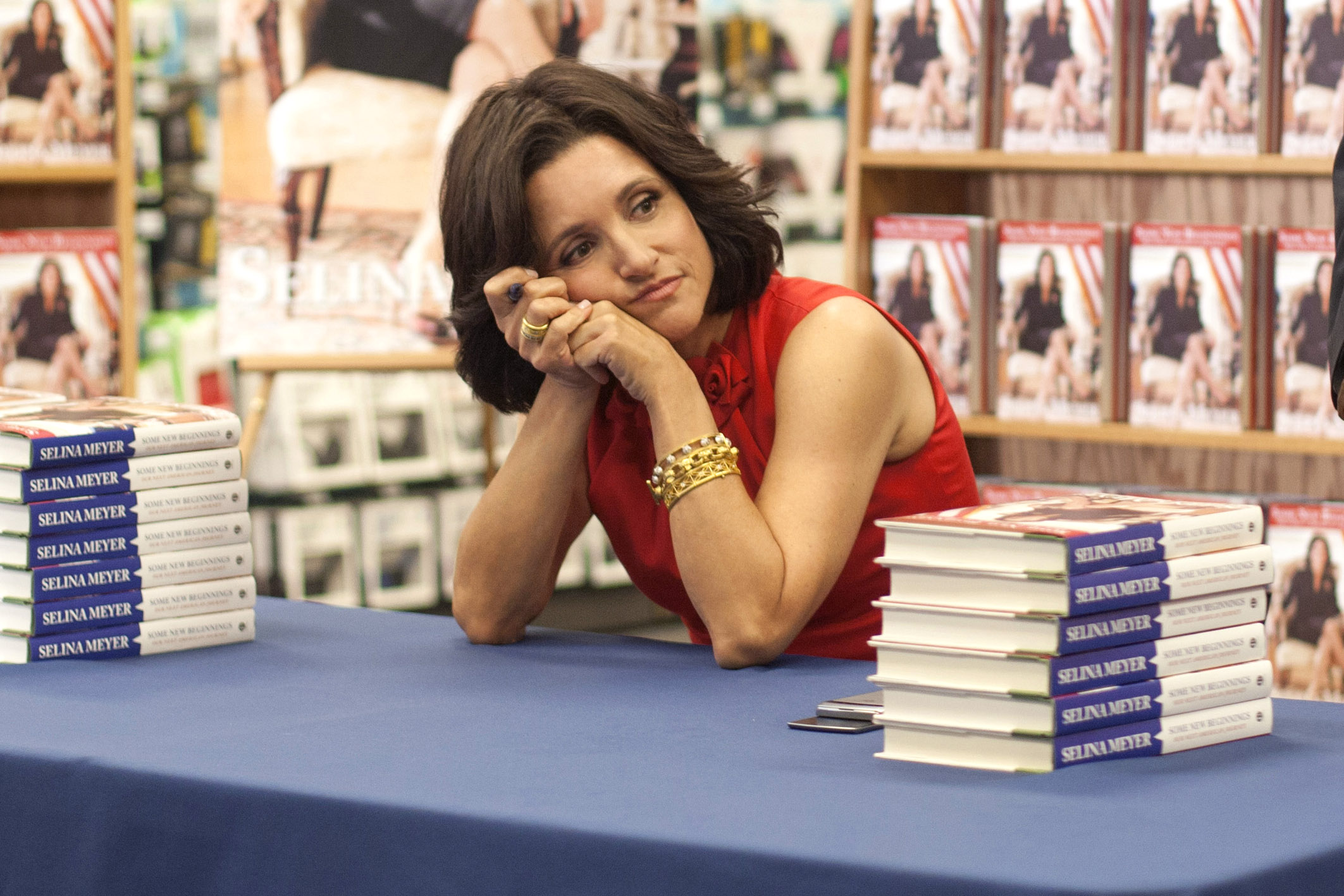
    For that, credit belongs chiefly to the twisted, vulgar genius of Armando Ianucci, who truly is a poet of swear words and insults. The epithets that fly in every episode are endlessly inventive, bringing new meaning to the phrase “colorful language,” but more than that, they are backed by a witty, acerbic sense of humor (a running joke late in the season involves the First Lady’s attempted suicide), often crass (never forget: “That would be like using a croissant as a dildo”), but with such a pitch perfect ear for the bullshit nonsense of politico-speak that it always feels like smart satire, rather than cheap laughs. In fact, “feels like” is the wrong phrase. This is straight-up satire, through and through. Veep thoroughly understands the emptiness of so much of the political cycle, of the meaningless campaign slogans and press appearances. Nowhere is this better represented than in the premier episode, where the Vice President signs copies of her book, a fake smile plastered on her face. The book is called “Some New Beginnings: Our Next American Journey,” which makes no sense; it was, naturally, ghostwritten; and when Selina finally bothers to open up a page, she finds that it doesn’t make a lick of sense.

    Like all great comedy, the secret of Veep’s success is that at its core, it speaks the truth. The reality might be heightened, but Washington really is this dysfunctional, and the system really is up to its eyes in bullshit. That’s what makes the characters unrepentant awfulness so entertaining. We’ll gladly watch them bumble around because they deserve every damn bad thing that happens to them. Unfailingly, Selina and company’s plans fall to utter shit (I would call them best-laid plans, but they so rarely are), and the show not only unfailingly mines humor from it, but it pays increasing dividends too. They can’t do anything right because they are incompetent idiots, but they’re also terrible people, instinctively mean and socially illiterate. Their messes are frequently, perhaps even exclusively, of their own making, and there is never any doubt that they deserve their fate.

    And yet, Armando Ianucci and his team never fall from the tightrope they walk every episode—Selina and her team remain loveable underdogs, even (and perhaps especially) in their most insensitive, idiotic, blundering moments. Nothing encapsulates this idea better than the finale, where we see Selina’s staff briefly excel in their new roles, before failing spectacularly and expectedly. “Crate,” the first part of the season finale, ends with POTUS stepping down, and Selina becomes president through basically no effort of her own—and to boot she basically cheers on FLOTUS’s dubious mental health and welcomes her latest suicide attempt—and the moment somehow actually comes off as triumphant, with her Gary manically celebrating in the ladies’ room (nosebleed notwithstanding). That she’s supposed to be having a meaningful, serious conversation with two immigrants could not be less important to her, and after getting the news of her impending promotion, she has a shit-eating grin plastered to her face the entire time. That’s politics, and that’s Veep, and I wouldn’t have it any other way.


  • Emmy Spotlight: True Detective

    Emmy Spotlight: True Detective

    Matthew-McConaughey

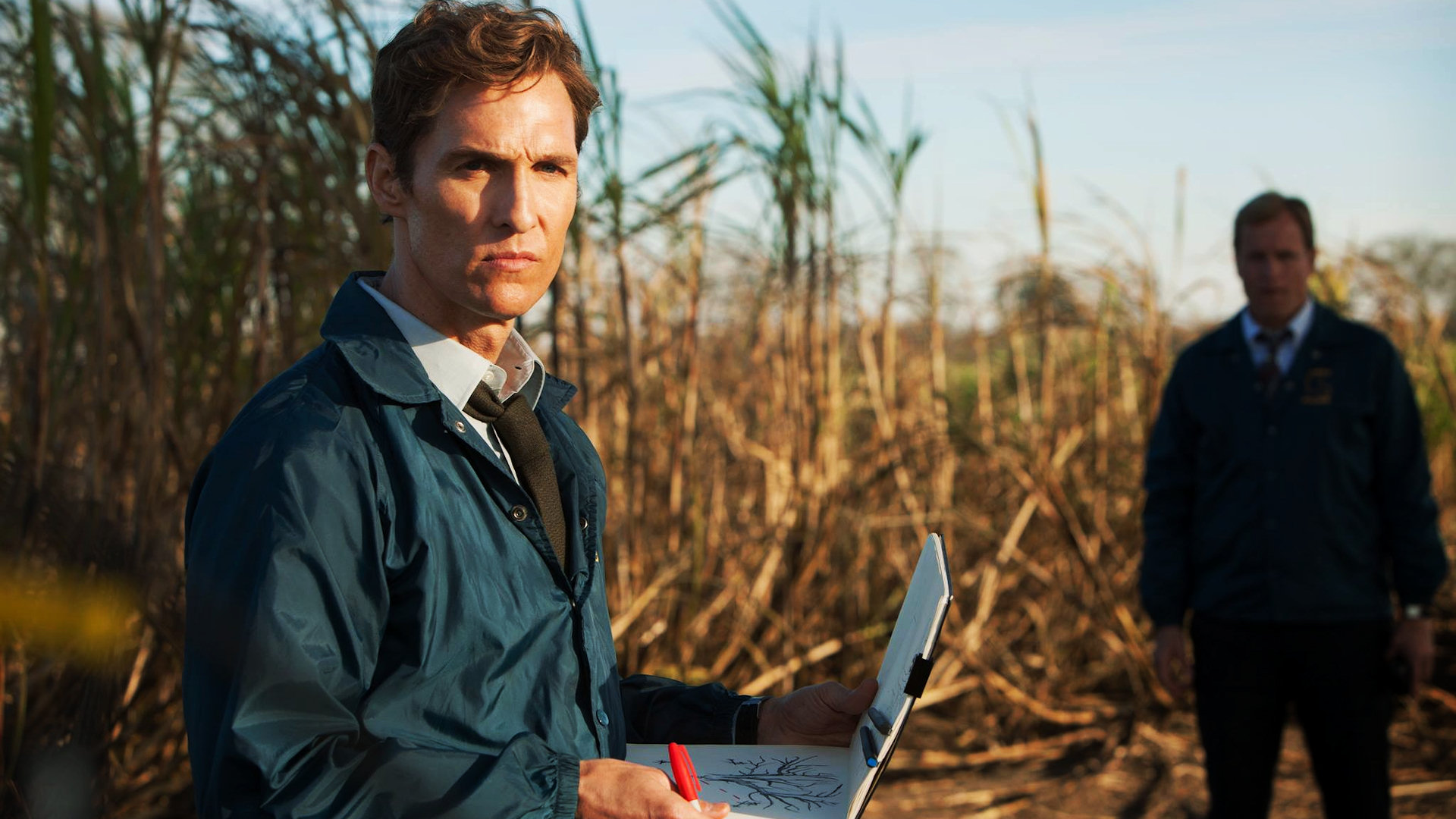
    Can you believe that we’re far enough past True Detective’s finale to have already arrived at the True Detective backlash? Neither can I, but here we are nonetheless. In the words of the ever-quotable Gawker Media, Nic Pizzolatto is a schmuck, and he probably also hates women? Pizzolatto mostly disregards that criticism, and mostly he does this for good reason. True Detective tells a story of violence against women—systemic, socially engrained, physical, sexual, and emotional violence against women. From beginning to end, the implication is that it the capacity for this violence is basically in the soil of the godforsaken Louisiana that the show depicts.

    The crime that sets this whole chain of events in motion, in 1995, is like something out of Hannibal, and is unlike any case Marty Hart or Rust Cohle have worked on before. Their investigation leads them down a dark, twisting path, until they appear to catch their man, and Hart shoots him dead in anger. But in 2002 it becomes clear that this is not the case, and Cohle spends the next decade trying to unravel the mystery. Like the audience he becomes bogged down in mythology, in ideas of the Yellow King and Carcosa, and it drives him half-mad. And in the intervening time, we watch each man in fits and glimpses, always comparing them to each other, watching as the case, or else their inherent natures, chips away bit by bit at their souls.

    It goes without saying, then, that True Detective is relentlessly dark, and not just in terms of the violent crimes that Hart and Cohle investigate. These men have dark lives, as well. Rust Cohle is divorced, and has recently lost his young daughter, and has turned to a Nietzschean, nihilist philosophy, refusing to recognize any meaning to life or the world around him. Marty Hart is a womanizing bastard, a perennial philanderer, and a misogynist hypocrite. Through some awful twist of fate, it is these men who are charged with the investigation of a serial murderer who abducts and horribly maims children. But True Detective is less interested in being a mystery about this killer’s identity than it is in being a portrait of these two men across the nearly two decades that their investigation spans. This doesn’t become immediately obvious to us until the end of the seventh episode, “After You’ve Gone,” when Errol Childress, he of the scarred neck and spaghetti monster ears, is more or less dropped into our laps. Much of the finale, “Form and Void,” is then devoted to Hart and Cohle retracing their steps, explaining how the clues they’ve been presented with do, indeed, lead to the Childress clan. I highly doubt that anyone could have arrived at this conclusion on his own, through careful study of the show, not least because the most essential clues are not given until after the killer’s identity is confirmed.

    If you are watching True Detective expecting the thrill of clues coming together and solving a mystery, then “Form and Void” is your Lost moment, a crushing disappointment at the realization that your expectations not only have not been met, but were in fact way off base to begin with. If you were watching with more interest to form and style, to the performances being given, and to the character studies being carried out, then you perhaps are more pleased with the final product than you would have expected at the beginning. By and large I fall into the second camp, and that is owing to several key components.

    First and foremost is Cary Joji Fukunaga’s wonderful direction. True Detective is a formal rarity in television, with all eight installments by the same writer and director. The result is a consistency of tone and vision that is almost completely unparalleled—the only other example I can think of is Breaking Bad, which is all the more impressive considering it achieves that consistency over many more episodes, with many more writers and directors in the room. There is hardly a shot in these eight episodes that is not utterly breathtaking. More than anything else, Fukunaga achieves the perfect atmosphere for this story, a hard-boiled Southern Gothic detective yarn, with the requisite strong imagery that goes with those vastly different territories. His instinct for framing is unmatched, and there are countless images throughout that will stay with you for a very long time. There are many wide shots, industrialized landscapes with billowing plumes of smog that never seem too symbolic. The lighting, as well, is excellent, leaving everything in murky shadow or else this bitter orange light—and all this is contrasted with the bright, lush green landscapes of the Louisiana swamplands, including the fields where eventually we arrive at Carcosa itself.

    Another component, briefly mentioned before we get to the meat and potatoes here, is T-Bone Burnett’s excellent music curation, along with the opening tune and credit sequence, all of which capture the Creole vibe of the show’s setting, as well as the more haunting aspects of the narrative. Particularly with the songs that close out each episode, Burnett picks some killer cues that keep us thoroughly, emotionally engaged.

    And finally we have the lead actors, Woody Harrelson and Matthew McConaughey, each in his own way thoroughly unlikely to be found in this sort of project, and yet each perfectly suited to his role. McConaughey especially is a revelation here, at the beginning of his so-called “McConnaissance,” imbuing this difficult character with a vital spark of humanity that is necessary to make the constant dorm-room philosophizing remotely bearable, let alone believable. In McConaughey’s hands, Rust Cohle becomes a real man, irreparably damaged by grief, whereas he easily could have become a noir cliché. The same is true of Harrelson, whose Marty Hart is as clichéd a hard-boiled detective as they come, and yet remains relatable to the audience even in his most horrible moments. Both actors commit fully to the idea that they are not portraying good men, and that level of understanding is crucial to the performances they give. This is their show, and they steal it, both rightly nominated for Lead Actor this year.

    As for the rest of the “main cast,” they don’t get much to do. Michael Potts and Tory Kittles play the detectives who have taken over the Carcosa case in 2012, and while they are named, you’ll be hard-pressed to remember the names. Michelle Monaghan has the next-largest role, as Margaret Hart. Credit where it’s due: Maggie is a stronger character than many critics would have you believe, but the fact remains that there simply isn’t enough here to make much of a judgment on her one way or the other, especially toward the end of the season, where she serves only to drive conflict between the two men. The argument here is that this is a closed-perspective show, telling the story from Cohle and Hart’s points of view, to the exclusion of other perspectives. That’s a fine argument, but there are multiple scenes throughout the season that are from Maggie’s point of view, and they sort of torpedo that argument.

    In a story about wanton violence toward women, whether physical or emotional, it’s completely legitimate for female characters to function as objects, or as reference points for the male characters. This is something that happens fairly often in literature—I’m reminded most strongly of James Salter’s short story “American Express”—and it only really becomes problematic here when Pizzolatto opens his mouth about it. (I guess maybe he is a little bit of a schmuck after all.) But I don’t find it to be a fundamental problem with the show the way that other critics, chief among them Emily Nussbaum of The New Yorker, have. When toward the end of the season, Maggie seduces Rust, for the sole purpose of hurting Marty, it’s easy to read Rust’s angered reaction as misogynist, as the narrative reducing Maggie to a sex object. And yes, she is being used to create conflict between the two men. But it’s much more rewarding to read the scene as a damnation of both men, as a way of equating Cohle with Hart, even though Cohle sees himself as better than Hart is. Assuming that Maggie’s portrayal here is negative or misogynist or anti-feminist is, frankly, lazy. Yes, it’s a problem that the character eventually exists only to drive a wedge between Hart and Cohle, but the script, and more so Monaghan’s performance, ensure that it’s the men who are at fault.

    Really, the plot is the weakest part of the whole affair here. It’s overly complicated, especially considering that the human elements of the story are foregrounded in the climax, and it’s all too easy to tune in and out of the (rather convoluted) specifics of Hart and Cohle’s investigation. That Cohle more or less cracks the case off-screen is a big red flag. Each episode has hugely interesting set pieces, especially those concerned with Hart’s home life. His relationship to his wife and daughters is consistently contrasted with the dead girls he investigates, and ideas of virginity and patriarchy are fully explored through Marty’s various experiences and, yes, his bad decisions with regard to women. No one should walk away thinking that True Detective endorses his behavior—but yes, it would be nice if Monaghan had a bit more to work with.

    Basically, the show is at its best when it’s not concerned directly with the detective work, whether that’s when we’re exploring the characters’ lives outside of work, in the fantastically directed chase sequence that closes out “Who Goes There,” a long, unbroken carnage that is certainly the highlight of the season, or in the rip-roaring climax that briefly becomes a supernatural showdown of epic proportions. It’s impossible to overstate how magnificently tense the final confrontation with Childress, there in Carcosa. It’s no stretch to accuse the show of teasing occult or supernatural elements that it never quite delivers on, but in this sequence, those elements are out in full force nonetheless. The set design of Carcosa is staggering, and the way that Hart and Cohle make their way into this literal heart of darkness is a perfect ending to the long, strange journey that has led them there.

    That said, I have a quibble—neither of them dies, despite grievous injuries that probably should have killed one or both of them. That instead both Hart and Cohle survive this long ordeal is somewhat beyond belief, but is nevertheless in line with the story that Pizzolatto ultimately tells. They survive precisely so that they can realize the folly of their actions, of their belief systems. Yes, this is a story in which our heroes, such as they are, are made to learn something. It’s a weirdly warm and fuzzy ending, and while it doesn’t come out of left field—in fact it’s well supported from the very beginning—it does subvert audience expectations, and that can often feel like the same thing. Mostly this is a case of Pizzolatto being a Writer with a capital-W, used to writing a complete work and letting it stand for itself. Television is a different animal, and while we can now in retrospect view it as a creative whole, we’ll always have those six weeks of rabid speculation that was, at best, misguided. At worst, it was an utter waste of time.

    So the show is not perfect. I think at times its reach exceeds its grasp, especially in the later episodes. Moreover, the show ends up telling a simpler story—in which it tracks the progress of two very damaged men over nearly twenty years—than it purports to at first; you can look to the degree of disappointment in the show’s finale as proof positive of this. It certainly would have been helpful if Pizzolatto had tipped his hand earlier with regard to this. Instead, as with The Killing over on AMC, a series of clues turn out to be red herrings, and the mystery itself turns out to be almost beside the point. There’s nothing wrong with that—but when your show is called True Detective and you’re laying out clues like crazy anyway, it might be helpful to give your viewers a heads up.

    But by and large this is a very good series. It starkly portrays the very worst aspects of human nature, and does so unflinchingly, but it also makes a strong argument against nihilism, against the resigned acceptance of this world as a cruel, random place. It leaves us with our notion of good and evil intact, and perhaps even reinforced. You could watch it on mute and it would still be gorgeous, if nothing else. The narrative is long and winding, too much so, with occasionally too inflated a sense of self-importance, but the script is nonetheless effective in its smaller moments, and each episode has several sequences that are truly great television. For the atmospherics and direction alone, True Detective is a stellar achievement; that the other elements all occasionally align as well is even better, and more than enough to forgive its few failures.

  • Movie Review: The Giver

    Movie Review: The Giver

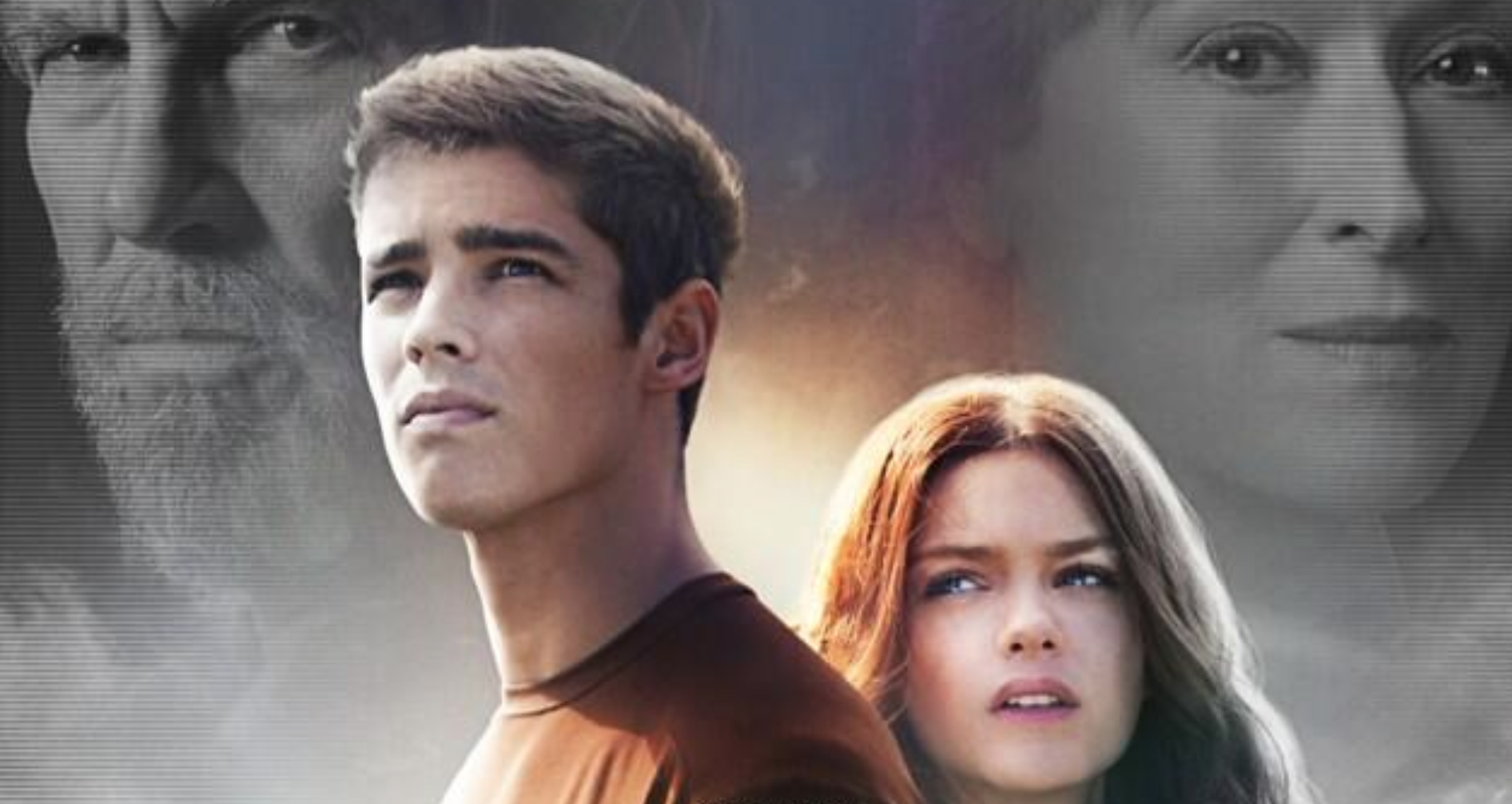
    Screen-Shot-2014-06-25-at-1.30.21-PM

    I first read Lois Lowry’s The Giver in eighth grade, at which time the YA classic was already ten years old. I have not read it since, and I purposely did not re-read it in advance of watching Philip Noyce’s film adaptation for this review. That said, the book had on me, like it did on so many, a very strong impact. In many ways The Giver is the progenitor of the modern YA novel, and indeed it shares many of the characteristics of later works such as The Hunger Games.

    My goal in not re-reading it, then, was to go in to this film with as little expectation as possible. I have a strong emotional memory of the book, but many of the specifics have long been lost on me. I therefore suspect that I enjoyed the film more than most, because despite my limited memory of the source material, I also suspect that the adaptation here is by and large one giant missed opportunity.

    For whatever reason, one specific moment from the novel stands out in my memory: Jonas uses the word “starving” to indicate the degree of his hunger, and is scolded by an authority figure (precisely whom, I don’t remember)—after all, in this world no one is starving, and the Elders have worked very hard to ensure that. For Jonas to say that he is starving is therefore flippant, and totally disregards the effort that attained this utopia. While in the film, Katie Holmes’s Mother admonishes Jonas multiple times for his “precision of language,” this specific scene is entirely absent, along with almost any world-building that I certainly remember being in the book.

    We are told constantly how perfect and idealized the world of The Giver is, but the screenplay doesn’t go to many lengths to actually demonstrate this bizarre society. We are launched right into Jonas’s “graduation,” with little sense of his friendship with Fiona (Odeya Rush) and Asher (Cameron Monaghan), or of his home life with Mother and Father (Alexander Skarsgård), or of how society functions in this world, beyond the most superficial level. From there we move too quickly into Jonas’s training, where the film then spends the bulk of its second act.

    Fortunately the second act is also the film’s best, owing in large part to Jeff Bridges’ performance as the Giver. You see, Jonas is special among his peers, and is selected not for one the many standard occupations assigned to new adults, but instead is selected to be the “Receiver of Memory.” What this means is that, eventually, Jonas will be solely entrusted with the knowledge of human history, and therefore with the reason for the Community’s very strictly regulated society. So it’s down to the previous Receiver to train Jonas for this very important role. We learn along the way that there was a Receiver in between, Rosemary, who is played by Taylor Swift, but appears so briefly as to make very little impact on the plot or on the audience. Rosemary is a symbol, of the Giver’s grief, and of the cruelty of what Jonas is being asked to do—but she is not a character, and Swift is asked to do very little acting.

    Jonas’ training is depicted through flashbacks, intercut with conversations between him and the Giver. Jeff Bridges and Brenton Thwaites (about whom more in a moment) have an easy chemistry here, and their mentor/learner relationship is a vivid and ultimately moving one. When toward the end of the film, the Giver tells Jonas that he loves him, we feel that, and so does Thwaites, who gives a remarkably understated reaction, mixing pride, relief, sadness, and admiration in a most beautiful way. This is the central relationship of the film, and so we need to spend as much time on as it as we do. In fact, I’d have liked to see much more of it.

    Beyond Jonas’s slow discovery of the things that have been removed from society—colors, music, love, envy, war, violence—the plot of the film is rather thin, centering on an infant, Gabriel, who has been designated “uncertain”, meaning that he will not immediately be assigned to a family unit. What this really means, as we and Jonas eventually learn, is that Gabriel will be killed. This understandably is the last straw for Jonas, who leaves his training early and travels with Gabriel beyond what is called “the boundary of memory,” both to save the infants life, and to restore memory to all of society.

    In other words, this is fairly typical, dystopian YA stuff—a young protagonist singled out from his peers, given responsibility undue his age, who rises to the challenge, uncovers misdeeds among the establishment, and rebels. It was revolutionary in 1993, but now it seems a pale imitation of The Hunger Games. That’s mainly because of the screenplay, which does not do nearly enough to explore the themes and emotions that the source material engages with. Bridges, along with Meryl Streep as the Chief Elder, lend the film an appropriate sense of gravity, but neither is able to save a script that is seemingly unwilling to challenge its audience with any truly tough ideas. There is an attempt here to boil the material down to a “love conquers all” sort of story, and that’s just weak. Given Bridges’s long involvement with this project and his reported passion for the novel, one wonders why more of that does not translate to the screen.

    It’s a shame, too, because the movie is certainly competently made, and at times is truly beautiful. Philip Noyce has an elegant way of staging scenes, especially during the long middle section that is comprised mainly of Jonas and the Giver talking to each other. The film’s use of color, extremely important to the narrative, is nothing short of fantastic, as the lack or presence of color becomes narrative shorthand that is used to great effect, especially toward the film’s climax. Similarly, the flashes of memories that Jonas experiences benefit from the transition to the screen, as Noyce employs real-world history to demonstrate both humanity’s capacity for violence and our capacity for love and triumph over adversity. Marco Beltrami’s score is not particularly inventive, but it does a great job of underscoring the film’s most emotional scenes.

    Which brings us to the rest of the acting. It’s standard of the YA film adaptation genre—because at this point it really is its own genre—to pepper the supporting cast with recognizable, talented adult actors, and that’s the case here as well. Bridges, Streep, Skarsgård, and Holmes each play their parts effectively, but none save Bridges have quite enough material to give the characters any dimension, despite their best efforts. But they’re only there to support the film’s true stars, typically a trio or more of teenagers (or approximations thereof).

    Here, the film’s undoubted lead role is that of Jonas, played here by Brenton Thwaites, who is sure to become a household name sooner or later based on his striking good looks if nothing else. He carries the role admirably enough, but is essentially playing the same note, that of wide-eyed wonderment, throughout. It’s a good note, and appropriate enough to the character, but again, one wishes for a slightly deeper dive into the character. There are a few moments where Thwaites does excel however, mainly with Bridges as his scene partner. He’s also a gifted comedian—I would watch him make faces at babies all day long—but understandably is not given many opportunities to exercise that particular acting muscle here. Similarly, Rush and Monaghan’s characters have very specific narrative roles to fill, and beyond acting out those requirements, there is nothing else done with Fiona or Asher.

    That’s really the problem with the whole film—it’s paint-by-numbers YA, when it should feel as revelatory and revolutionary as Lowry’s novel did, and still does. It’s difficult to know to what extent to fault the actors, to what extend to fault the script, and to what extent we should simply fault the Weinsteins. An examination of a utopian society that nonetheless murders babies who aren’t up to snuff is inherently fascinating—here it’s almost boring. And while the ending is mostly faithful to the novel as I recall it, the film doesn’t earn its ambiguity, especially as it also doesn’t make any sense. It achieves its emotional goal well enough, but why on earth should Jonas’s action have the effect it does? The best science fiction explains its technology, but here we’re asked to assume an awful lot. I’m not sure how Lowry handles this in the novel, and maybe it goes unexplained there as well, but here in the film, it’s one of those endings that works just until you give it even the slightest thought.

    The Giver, as a novel, remains an essential treatise on the complexities of the world, and of growing up, of the importance of feelings even when they are bad or destructive. It is for many readers their first exposure to the idea that passion is a double-edged sword, but that to have either edge you must have both. It is impossible to eliminate the bad from this world, and in the attempt to do so, you risk becoming that bad yourself. The film gestures at all of these ideas, but it does so in the most streamlined, Hollywood-ized way possible, without giving the ideas proper weight or consideration, the way I know its source material does, even years after reading it.

    The movie’s hovering around 28% on Rotten Tomatoes as I write this. It’s not as bad as all that. As a film, The Giver’s biggest crime is that it does not live up to the promise of its concept. That’s a pretty central failure, though, and so it spills out and poisons other aspects of the production, as well. You’ll undoubtedly enjoy it as you watch it, especially if you are nostalgic for the book, as even I am. But it will not stay with you for very long after you leave the theatre. Unlike a film like Catching Fire, which vastly improves upon and elevates its source material, The Giver stumbles, simplifying concepts that resist simplification, and making a very forgettable film as a result.

  • Emmy Spotlight: Silicon Valley

    Emmy Spotlight: Silicon Valley

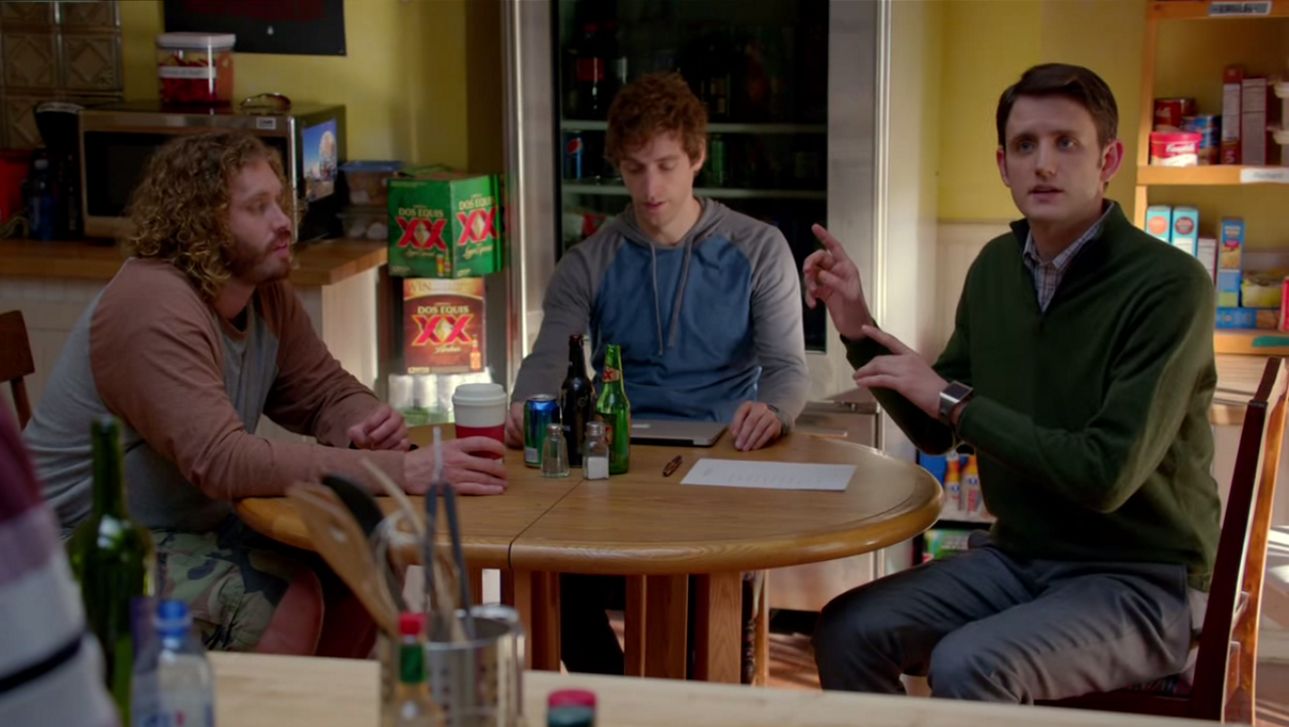
    Silicon-Valley-1x05

    For people of a certain generation, the works of Mike Judge in general, and the film Office Space in particular, are something of a cultural milestone. In fact, Office Space has defined for me (and likely for you, too) my entire approach to corporate culture, and also the restaurant business, and frankly just what it is like to spend the bulk of your waking time doing a job that you, at best, tolerate for a paycheck that, at best, will stretch just far enough to cover your meager expenses. If that sounds terrible, that’s because it is. Welcome to America.

    Skewering corporate culture is nothing new, and it wasn’t when Office Space came out either, but I would argue that Office Space does it best, and especially does it best for the office life of the nineties. In mocking the ridiculous complexities of office culture, Office Space also became engrained within our culture. You’ll be hard-pressed to find anyone born after 1980, give or take, who doesn’t immediately recognize TPS reports, that red Swingline stapler, a case of the Mondays, pieces of flare, or good lord, even a Jump to Conclusions mat. When we’re laughing at Office Space, we’re laughing at ourselves, but we still go to work, day in and day out.

    It’s of course too soon to tell if Silicon Valley will become engrained in the popular culture in the same way, but all of the ingredients are there. Silicon Valley tech culture has almost certainly crossed the line into self-parody, in a world where even goddamn Snapchat is worth billions of dollars, and Silicon Valley captures the height of this nonsense more or less perfectly. At the fictional tech company Hooli, the offices are candy colored, with toys and gadgets and distractions galore, and no one appears to actually be doing any work. And as for the “incubator” that houses our heroes’ startup venture, it’s a house owned by do-nothing rich dude Erlich Bachman. This is a world where ideas rule above all else, but even the ideas are empty, one vapid proposal after the next, purporting to “make the world a better place,” even if it’s something really fucking stupid like Human Heater, the gadget that lowers your gas bill by heating up the top layer of your skin using microwaves.

    The satire is spot on, then, but it quickly becomes apparent that, like much of Judge’s work, Silicon Valley is two separate beasts, with an equal share of the humor coming from the sort of juvenile, bro-y gross-out humor one would find on Beavis and Butthead or, yes, even in Office Space. Silicon Valley’s greatest strength is in its unfailing ability to land a joke. The season is fairly compact, at only eight half-hour episodes, but each episode is remarkably dense with one-liners, runners, and situational comedy. As great as the satire is, it needs this more functional and reliable brand of comedy to prop it up, and Judge and company have struck the necessary balance. I dare you not laugh at the extended, pseudo-mathematical discussion of “optimal tip to tip efficiency” in the finale episode of the same name (which, you definitely want to read this totally NSFW journal article). It’s as though twelve-year old boys somehow went and got doctoral degrees.

    All that said, like any freshman comedy there are issues, though the raw strength of the comedy here suggests that they’ll iron themselves out. Firstly, considering the season’s brevity, it takes forever to really get going with what is a fairly simply plot. It takes until the third episode for the show to catch up with its own promotional materials, and while the pilot is very funny, and lays necessary groundwork about the world of the show, it’s also undeniably heavy on exposition. The characters, similarly, tend to be slightly one-note, though again, that note is often funny. Thomas Middleditch is a fine leading man, playing neurotic yet charming with aplomb, and his Richard is quirky enough to keep from being a boring straight man to the cast of much, much more colorful characters.

    Perhaps the best of the regular bunch is T.J. Miller’s Erlich, who is a do-nothing slacker who sees himself as the Woz to Richard’s Jobs (or is that the other way around?). Either way, beyond bluster and bravado he brings nothing to the table as far as Pied Piper goes, and yet it’s precisely those qualities that make him such a memorably funny character. Also great is Zach Woods, who plays Jared as though Richard were on several different types of drugs simultaneously, just this wired, anxious people-pleaser who doesn’t seem to have acquired a single social skill in two-plus decades of life. Woods has been ubiquitous this past television season, with very good reason—his deadpan delivery and knack for physical comedy make him an invaluable part of the ensemble.

    The rest of the cast is good for one-liners, or else to bounce lines off the main characters, but they hardly register beyond that, even when the writers give them the occasional B-plot. Again, it’s not that Martin Starr, Kumail Nanjiani and Josh Brener aren’t funny, just that they don’t really serve a purpose as anything other than joke machines. And as long as the jokes are funny, great! It’s not like we love Office Space for its deep, nuanced characterization. But at least when the plot wheels did turn, there was enough to make us care, where about Peter’s relationship with Jennifer Aniston, or Milton’s desire to burn down the office, or what have you. Here, Amanda Crew’s Monica might as well not be on the show at all, and her “romance” with Richard is yawn inducing, seemingly there for demographic pandering and little else. Since she’s practically the only woman on the show, that’s doubly damning.

    While we’re talking about the cast, deserving of special mention is Christopher Evan Welch, whose performance as Peter Gregory is delightfully odd, a collection of strange mannerisms and non-sequiturs that feel perfectly emblematic of this bizarre tech culture. Welch tragically died after filming scenes for the first five episodes, and the character is only mentioned for the remainder of the season. It’s a shame we don’t get to see more of him, because he is sublimely hilarious.

    So there are certainly some kinks to work out, but at the end of the day, Silicon Valley succeeds in making you laugh, if at nothing else, and for a comedy, especially a freshman comedy, that’s worth at least 80% of the battle. Since they’ll be forced to retool at least partly in the wake of Welch’s passing, I think we’ll see some useful cast shuffling, hopefully some higher stakes and more thoughtful plotting. The raw material is there, it’s just waiting to be shaped into something with a little more, well, shape. That takes time, and it’s time that I’m willing to give.

  • Emmy Spotlight: The Normal Heart

    Emmy Spotlight: The Normal Heart

    the normal heart

    The Normal Heart arrives on HBO with somewhat lofty expectations, and yet, being a Ryan Murphy production, I wouldn’t blame anyone for approaching it with a healthy measure of skepticism, as well. It’s in many ways a spiritual sequel to Angels in America, another adaptation by HBO of another well-regarded period piece about the AIDS crisis. The Normal Heart has quite a bit in common with that miniseries, but where Angels used the religious and the supernatural to underpin the melodrama at its core, The Normal Heart has no such crutch. As a result, and as is unsurprising for a Ryan Murphy joint, what we get is an often uneven, and yet often incredibly moving, piece of melodrama that occasionally transcends those trappings, and becomes plain drama.

    The film is written by Larry Kramer, based on his 1985 play, and many of its issues can be traced back to the source material. Its subject matter is firmly in Murphy’s wheelhouse, and is in many ways perfectly suited to his directorial style. There is a great sense of atmosphere, of time and place; Murphy, with considerable assistance from Kramer, perfectly captures the gay experience of the eighties, and best of all, presents multiple gay perspectives within the film. It’s obviously very personal material for Murphy, and for the most part his best instincts are on display here.

    Like most of his work it tends toward melodrama, and this is not always to the film’s benefit, especially when the script also tends toward the didactic. Much of the dialogue, and at times entire scenes, feel less like drama, and more like actors quoting from Wikipedia. It can at times be overbearing, too over the nose. But at other times, there is a raw power to the material, and at these times, it’s Murphy’s direction that is largely to thank. He is not a showy director here, and is generally content to leave the camera still, to pick a frame and hold it and let the actors do their work. What he does not do is let it feel like a filmed play; there is a filmic quality to the movie, a liveliness and a gravity. When the material isn’t getting in its own way, the direction is quite good, and is some of the best I think we’ve seen from him. I haven’t seen Eat Pray Love, but based solely on this film, I’d be interested in more feature work from Murphy, especially to see him directing other people’s scripts.

    Since the film is based on a stage play, the big draw here is the actors, and the strength they bring to talky, showy roles. The casting is impeccable and the performances are uniformly strong. Mark Ruffalo plays Ned Weeks, the firebrand gay author at the center of the play, and he is a phenomenal leading man, simply a powerhouse from beginning to end. Ned is a neurotic, almost self-loathing character, but he is also cocky, overbearing, too quick to anger, and too impulsive to really lead the crusade that he thinks he’s leading. He is an extremely difficult character to like, and Ruffalo doesn’t try to make him likeable. Instead he makes him human.

    None of the other actors gets quite so much to do as Ruffalo, but they each shine in one or two showcase scenes. Taylor Kitsch is restrained and barely recognizable as Bruce, the closeted leader of Gay Men’s Health Crisis, while Jim Parsons turns it up to eleven as Tommy, the self-described “Southern bitch”. Both deliver in key emotional scenes, Kitsch especially, when Bruce gets into a fistfight with Ned, then throws a television crew’s camera out the window. Alfred Molina is excellent as Ned’s brother Ben, who nominally wants to be an ally, but who finds it difficult to really understand his gay brother.

    Strangely enough the weakest link in the cast is Julia Roberts, though I would be quicker to blame an underwritten character than her acting ability. She is arresting in her scenes, delivering her lines with a fiery passion, but it’s her scenes more than any others that most cross the line into didactic territory. Her confrontation with the funding panel at the National Institutes of Health towards the film’s end is the most egregious example, as she spouts factoids about the AIDS crisis, her volume ever increasing. It’s meant to be emotionally affecting, a crowning moment for a doomed cause, but it comes off instead as preaching, nearly as pandering, and that damages the overall effect of the scene.

    The true star of the film, however, is Matt Bomer, as Felix Turner. Nestled in among all of the messaging and the melodrama is a brilliant, real, poignant, and moving love story, and it’s this that makes The Normal Heart truly special. Bomer and Ruffalo have tremendous chemistry, but it’s Bomer especially who sells the tragedy of their relationship. Beyond the physical aspects of watching Felix slowly waste away as he succumbs to the disease, Bomer also fully embodies the mental and emotional toll that AIDS takes on the character. There is an undercurrent of fear, of anger, that runs throughout the film, and in that sense, Ned and Felix are essentially two sides of one coin. It makes sense, then, that the larger political story being told revolves around the small love story between them. It’s a smart if risky structural decision, but thanks to Ruffalo and Bomer, that risk pays dividends. The film would not work at all without them.

    Ultimately, The Normal Heart suffers in retrospect because of the progress that has been made with regards to AIDS specifically, and with the gay community in general. In many ways the story it’s telling feels like ancient history; there is an entire subset of the gay community today that has no concept at all of the AIDS crisis, and there is a growing set that has little concept of gay discrimination at all. What was groundbreaking in 1985 is now obvious, and what worked on the stage then doesn’t necessarily play as well on the screen now.

    That said, the story is still important, one that deserves to be told. It’s hard not to grow angry when, after we pan out from Ned, alone at Yale’s “Gay Week,” a title card informs us that Ronald Reagan first publicly mentioned AIDS in 1985, and promised to make it a funding priority, before cutting AIDS funding by 11%; and further, that to date more than 36 million people worldwide have died of HIV/AIDS. Daily, 6,000 people are newly infected. This is a story that needs to be told. It’s a reminder that needs to be made. The Normal Heart wants to be an important film, and while it doesn’t always succeed in that regard, the effort itself is admirable. And even if it does preach too much, even if the education gets in the way of the drama, there is such a strong core in Ned and Felix’s love affair that the scenes that don’t quite work can sort of fall by the wayside. Like most of Murphy’s work, it is best enjoyed in the moment—but what a beautiful moment it is.

    The Normal Heart is nominated for 16 awards including Best TV Movie, Best Lead Actor in a Miniseries/TV Movie (Mark Ruffalo), and Best Supporting Actor in a Miniseries/TV Movie (Matt Bomer).

     
    [maxbutton id=”3″]
     
    Check out our Emmy predictions here!
    Like us on Facebook!

  • Emmy Spotlight: \"Mad Men\"

    Emmy Spotlight: \"Mad Men\"

    mad-men-season-7
    In its final season, Mad Men is determined to come back to basics, and indeed, throughout these seven episodes the audience, and our characters, come face to face over and over again with the idea that happiness, however we define it, is inherently unattainable. Happiness is caught up in desire, and no matter what we have, we’ll always want what’s next.

    There is little here that hasn’t been explicated on the show already, but don’t mistake that for a lack of interest or thoughtfulness. Instead, the first portion of this final season takes us on a much deeper exploration of several (though, sadly, not all) of these characters, and brings questions and themes to the forefront that, until now, have been content to linger back, informing the events of the series, but never quite themselves becoming those events.

    Matthew Weiner and company have become very comfortable with Mad Men, and that comfort shows in this batch of episodes, which are typically competent and confident in their production. Likely owing to the split scheduling of the season, this first set lacks any formal experimentation along the lines of something like “Far Away Places” or “The Suitcase”, or even “The Crash,” though there are certainly moments like these scattered throughout, especially in “The Monolith,” and of course with the delightful sendoff given to Robert Morse’s Bert Cooper.

    The show has always been about the pursuit of happiness, and it has always viewed the ‘60s especially as a decade of progress, of movement from point A to some different, better point B. We are rapidly approaching point B now, as the ‘60s draw to a close, and while it’s different, many of our characters are, finally, hitting the wall that Weiner has been building for six seasons now—there isn’t much better to be found here. The season is littered with signs that the times are running away from Don and crew. Early in “Time Zones,” the season premiere, Don meets Megan at the airport, and the scene is shot in vivid color, a swanky ‘70s riff on the soundtrack, as Megan departs her cab in slow motion, dressed head to toe in the fashion of a decade that’s barely started. There’s a deliberate artifice to this scene, and to many like it throughout the season (like the party Harry takes Don to, for example). Artifice is all over this season, right from the first scene—where Freddie Rumsen speaks a pitch he didn’t write directly into the camera—to the scene in “Waterloo” where Pete, Peggy, Harry and Don rehearse their Burger Shack pitch, using placeholder dialogue all along.

    Also running throughout the season is an uncertainty of reality, one that is explored most obviously in “The Monolith,” as poor Michael Ginsberg is driven slowly insane by SC&P’s new IBM computer. The story, and his behavior, are outright weird, and they bely not just the encroaching ‘70s, but more generally, the advent of technological advances, including the moon landing that closes out the season, that threaten to displace the agency, and thereby the characters. In season six, assassinations dotted the ongoing narrative, increasingly destabilizing the world the characters inhabited. This season, it’s glimpses of the future that destabilize the characters themselves; the world around them, for the most part, is doing just fine without them.

    Even Don himself feels a little less than real, this time around. Peggy views him as this titan of advertising, a force of nature rather than a human being, and it causes her to resent him. When he does return to work, he ends up walking through the office like a bogeyman, talking to tertiary characters, in each shot occupying the middle of the frame uncomfortably. He sits alone, waiting, in the creative room, while behind him the work of the agency continues on. He’s been fired without being fired, and his presence there is awkward for all involved. In many ways, this season is Don’s slow realization of this fact. That extends to his marriage, as well. Toward the end of “Time Zones,” Don meets Lee Cabot (played in a random guest turn by Neve Campbell), and confesses that his marriage is already over—Megan just doesn’t know it yet. Over seven episodes, she has her own epiphany, finally leaving Don in “Waterloo,” although even then, leaving most of the words unspoken.

    Artifice and unhappiness afflict the other characters, too. Peggy ended season six in Don’s office, feet propped up on the desk, but here, she’s right back where she started, and this time she’s languishing under Lou Avery, a competent creative director, but one happy to be an office drone, turning in work good enough to keep from being fired. Don might have been an ass, but he challenged Peggy to do her best work, and now she’s used to that type of boss. Ditto Joan, who continues to be a partner in name only, clawing her way to greater responsibility within the agency. And as for Pete, when we first see him he’s tanned, he’s got a new wardrobe, and he seems to be significantly happier in LA. It’s when he returns to Cos Cob in “The Strategy” that we see the extent to which he’s fallen. Trudy is divorcing him, his daughter doesn’t even recognize him, and Pete is the same sad, manipulative little man he’s always been. It’s already too late for his new girlfriend.

    Despite all that, there’s an underlying humor this season, too. I’ve said before that Mad Men is stealthily one of the funniest shows on television, and that’s owing to the incredibly well drawn characterizations. Everything in the show feels very lived-in, and the hyperrealist approach to the writing and acting means that, sometimes, particular situations or lines of dialogue are just funny, the same way we occasionally find things funny in real life. It’s not a setup-punchline kind of thing, but instead is wonderfully organic humor. Case in point: “Excuse me, could I get a splash of whisky in this?” Especially as things threaten to become increasingly dourer, it’s great to know that we can count on several of these characters for a laugh. Sometimes life is hard, and sometimes it’s unbelievably funny, and Mad Men excels at presenting these moments in equal measure, and in making them as surprising and unexpected as they tend to be in reality.

    In other words, it’s business as usual for Mad Men. Each episode is its own little short story, and when they’re all taken together, they form their own kind of novel, a continuing look at Sterling Cooper & Partners, and the people who work there. The show is serialized only in the way that life is; events keep piling on, some significant, some rather mundane. People flit in and out at the strangest of times, in the unlikeliest of ways. If there’s a criticism to be had here, it’s that it all feels a little too familiar at this point. Once upon a time Mad Men could surprise you, whereas here, it feels a little like we’re going through the motions.

    I also can’t help but feel like I’ve watched an incomplete story. Narratively speaking, we don’t cover much ground this season, and most of the really good stuff seems to have been held on to for the final run, airing next spring. We don’t spend as much time with Pete, or even with Roger, as I’d like. Joan is criminally underused. Surely the writing team was pressed for time, needing to create a complete story in only half the space available—but at the same time, I feel like, as I did with Breaking Bad, that this first half has been stretched out a bit too thin, to allow for a back half that is relatively identical to what would have aired in a traditionally scheduled season.

    Even considering its structural failings (which are more the fault of AMC, really), this season still does a pretty major job of final seasons, which is to refocus on the important themes, and the important characters. In “The Strategy,” Don and Peggy come to the end of a very long journey, dancing together to “My Way,” and finally viewing each other as colleagues and as equals. We’ve been watching this relationship grow, been watching it wax and wane, as Peggy continues to grow as a professional and, finally in this season, begins to surpass her former mentor. It is a moment weighted in the show’s history, and it’s the kind of scene that only a show this detailed can deliver—and even then, it’s a moment that can only be delivered at this point in the narrative. The best thing about Mad Men is that Matthew Weiner has this brilliant, almost instinctual knowledge of structure, knows exactly where to place story beats like this so they might have maximum effect. And so the “My Way” scene doesn’t close the episode. Instead, we go out on Pete, Don and Peggy, eating in Burger Shack together, their own kind of family.

    The bottom line: it’s Mad Men. It’s got one of the best ensemble casts in the history of the medium, a truly stacked bench where great performances can come from any actor, at any moment. And those performances come frequently this season. Elisabeth Moss especially continues to shine, perfectly embodying the basically unwinnable situation Peggy finds herself in. She’s asked to be pretty unlikeable at times this season, especially in “A Day’s Work,” and yet Moss keeps our sympathies with Peggy, and presents a full, complete character at all times. Credit is due also to Kiernan Shipka, whose Sally Draper resembles Betty more with each episode. And now, more than ever, Jon Hamm anchors the show, providing a skeleton to a season that tends to dart around a little. With Don on the ropes, Hamm captures a desperate side to the character that we haven’t really been privy to be for. He’s cowed by Cutler, made subordinate to Peggy, is well on the way to losing wife number two, and just generally unable to keep up with the changing times. Once before, Dick Whitman simply took on a new identity, and everything followed from that. Now that’s not an option, and the result is some fantastic character work from Hamm.

    It’s still well written, and gorgeously shot. Sometimes the symbolism might seem a little bit on the nose (oh, are you stuck outside on the balcony, cold and alone, Don Draper?), but it’s all of a piece with the realist/novelistic approach that has become the show’s signature. You watch Mad Men for the same reason you read Fitzgerald, or Faulkner, or pick a writer: you watch it because there is a stylistic flair, a specific portrait of life that is unique to the writer, or the book, or in this case, to the show. We’re well past the point of debate. It’s a show you either love, or you don’t. The worst thing that can be said about this season is that it feels slightly scattered, spread a little too thin. There’s both a lot going on, and not very much. Once we’ve seen the rest of the story, I imagine this half-season will feel less so. But for now, there’s no escaping that it is half a story, and that takes away from the overall package ever so slightly.

  • Emmy Spotlight: Louie

    Emmy Spotlight: Louie

    louie-ny356

    Louie returned this year after a longer than usual hiatus. When we last left our fictional Louie, Parker Posey had collapsed on the subway and died suddenly, and he flew to China alone for New Year’s Eve. It was a surprisingly melancholy season finale, especially following the “Late Show” three-parter that preceded it. Now in its fourth season, Louie is decidedly more on that melancholy, realist side of things. It’s still very much a comedy, in the sense that it’s designed to draw a laugh, but also in its general approach toward life. What I mean is that it’s a comedy in the Aristotelian sense, as opposed to a tragedy. In other words, what Louie is not, thank goodness, is a sitcom.

    This season of Louie is also the show’s best, a more mature, thoughtful, and yes, funny extension of everything that Louis C.K. has been doing for three years now. As the show’s sole writer, director and editor, C.K.’s mastery of the form becomes more and more evident, while Louie progresses and becomes more and more daring. Surreal at times, and very, very real at others, the show navigates these tonal shifts expertly and to great effect; at any given moment an episode can turn on the dime, but the show never panders, is never egregious. It is often beautifully shot, as in the Emmy-nominated “Elevator, Part 6,” and is brilliantly edited, as in “In the Woods, Part 2,” and it is always excellently written. Uniformly, without exception, and that’s not hyperbole.

    As you may have guessed from the episode titles I’ve called out already, the season is more heavily serialized than the show has typically been in the past. Of fourteen episodes, eleven are part of multi-episode arcs. But that doesn’t mean you need to watch everything to understand what’s going on—it isn’t like this is 24 or something. The episodes interconnect, but they also stand alone, each acting as its own short story. It’s one of many things that Louie has in common with Girls, but it’s no great revelation to say that Louie is on a whole other level than that (also great) series.

    There is such a great depth to this season. By this point it’s a given that Louis C.K. is funny, and talented, and the actors he gathers are equally so. But the storytelling reaches new heights here, with several episodes standing out as series best entries. Take “Elevator, Part Four,” which opens with Janet and Louie in couples’ therapy, a comically surreal scene in which their therapist alternately (and quite meanly) places blame on each of them for the failure of their marriage. C.K. and Susan Kelechi Watson have always had great chemistry, but this season, and especially this episode, delve deeper than ever into their characters’ relationship, and the result is massively rewarding. Louie jokes in the elevator that for the cost of therapy, they could just as easily have their daughter Jane killed. Janet stands there, stone-faced, for a very long moment, until she cracks a laugh just as the scene cuts.

    Even better is what C.K. cuts to, an extended flashback in which a much younger Louie and Janet spend the night at a hotel, admit that they want divorce, and have sex for the very last time. After Louie comments that it would be hilarious if Janet had gotten pregnant. We already know she did. The young actors playing Louie and Janet are perfectly cast, despite the fact that the young Janet is somehow white—she makes you forget that almost instantly, and a little cognitive dissonance only adds to the scene, anyway. They fully encapsulate who these people are, not just at this point in their lives, but fundamentally, across their entire lives. With the combination of acting, writing and directing, the audience is never in doubt that these are the same characters we’ve gotten to know in the present day.

    This is even truer of “In the Woods,” which features flashbacks to a thirteen-year-old Louie’s first adventures with pot, as in the present, Lily discovers the drug at the same age. I absolutely love how C.K. uses temporality to create such a complete picture of Louie as a character, and how he is so thorough in doing so that he also juxtaposes Louie the father with his own mother, Louie the young man with Janet, and so forth. “In the Woods, Part Two,” is almost entirely a flashback, but when it cuts back to the present, it does so meaningfully. When Louie’s mother yells at him, and keeps on yelling, and breaks down crying, it’s a punch to the gut; when the scene cuts to Louie as a father, with his own child to talk with about pot, that’s something else entirely. F. Murray Abraham also gives a guest turn this episode, as Louie’s absent father, and when Louie talks to Lily later on, you can see, from his acting, and from the way the episode is directed and edited, that Louie is afraid of becoming that absent father himself. He sees the peculiar way that life tends to rhyme with itself, and that idea is simultaneously comforting and terrifying. He remembers the way he so disappointed his science teacher, and his mother, and his best friend. But also he knows that Lily needs his love and support, more even than she needs his discipline.

    “In the Woods” is also an extremely serious episode, but it needs to be. It’s not without its laughs, including a pretty amazing turn from Jeremy Renner as Louie’s dealer, but it’s also got these gut-wrenching moments, including Louie’s fight with his mother mentioned above, and his tirade against his father, and the silent treatment his teacher gives him when Louie finally comes clean about his misdeeds. It’s a nightmare of the adult Louie’s, an imagining of every awful thing that could happen to Lily as she grows up, made doubly worse by the fact that those things have happened to Louie already.

    The entire season, in retrospect, is a project in slowly piecing together a man that to some degree has been broken by tragedy. He’s unable to understand the women in his life, and so he’s always starving for emotional connection, and it gets worse the older he gets. C.K. makes this more literal than usual throughout Louie’s extended romance with the Hungarian Amia. Their sex scene in “Elevator, Part 5” was a hot topic after it aired, and it is certainly difficult to tell if or when Amia consents. Louie literally drags her into the bed, and the scene is lit and staged in such a way that it happens in almost pitch darkness. That she speaks to him the following morning in Hungarian, speaking literally a different language, underscores not just the lack of communication that leads to dubious consent, but to Louie’s overall inability when it comes to women. The later episodes in the “Elevator” arc lead up to Hurricane Jasmine Forsythe, and feature several bizarre newscasts, with the anchors spouting gibberish. They’re some of the most laugh-out-loud funny bits in the whole season, but I like to think that they’re also speaking to this theme.

    That running theme is also why ending the season with “Pamela” is such an inspired decision. As played by Pamela Adlon, the character Pamela is even more Louie-esque than Louie himself. She’s incapable of taking anything season, even and especially her own feelings for Louie, and that brusqueness both makes her perfect for him, and makes talking to him nearly impossible. Louie may not be the best at communicating in a relationship, but he desperately wants to communicate in a relationship, whereas Pamela can think of nothing worse. And yet their courtship at the season’s end is touching, and it culminates, as comedy must, in their own little happy ending. Neither character changes, but by meeting in the middle, they can still find a way to make love, or something, work.

    This is an artistic vision that is so singular and so fully realized, quite unlike anything else on television. I can’t use superlatives or hyperbole to compare it to other shows—it’s practically speaking its own language. As I said before, its closest relative is Girls, but even as a fan of that show, Louie blows it out of the water. It’s sometimes as funny as Veep, sometimes as deep and provoking as Mad Men, sometimes even as exhilarating as Breaking Bad, but it is never anything less than its own, special thing. It’s at this point that I’m really glad I was so tough on the previous shows in this spotlight series, because it makes the score I’m about to give that much more emphatic. Louie is a perfect ten. Go watch it.

  • Emmy Spotlight: “House of Cards”

    Emmy Spotlight: “House of Cards”

    05-house-of-cards-s02e13-1
    Where does one begin with House of Cards? It so clearly (I might even say desperately?) wants to be a prestige drama, and it has many of the hallmarks of such series. High-profile director and executive producer from the film world? Check. Even higher-profile movie star making the switch to television? Check. Famous, older film actress arguably staging a comeback in her most notable role in some time? Check, even if I did accidentally insinuate that American Horror Story is a prestige drama just now. In its production, its tone, and the style if not the quality of its writing, House of Cards has just about every characteristic one would assign to a prestige drama.

    And yet House of Cards is not a very good show, is it?

    Let me backpedal here a bit. House of Cards isn’t terrible. It’s perfectly fine. But it’s at its very best when it’s not aiming so damn hard at prestige. Frank’s monologues, lush with purple prose, are often ridiculous, but they are of such heightened, Shakespearean proportion that they enliven what can often be a very tedious show. House of Cards is at its best when it luxuriates in its pulpiness. The thrill of Frank murdering Zoe Barnes is a highlight, but it happens an hour in! Then we’re left to dry for several episodes, with nothing quite so earth-shattering to entertain us, and with a pace that slows to a crawl. At the end of the day House of Cards and Scandal share more DNA than the former might care to admit. That’s a shame, because the scandalous moments (no pun) are the real highlights of the show, and we could do with a great deal more of them.

    frank-underwood-is-embarrassingly-ignorant-about-how-treasury-auctions-workUnfortunately such moments are few and far between for much of the season. That’s for a variety of reasons, not least of which is the show’s curious structure, which stretches storylines over many episodes and allows them to meander at languorous pace. Lucas’ investigation following Zoe’s murder is protracted, and comes to an abrupt end with his arrest, as we instead follow hacker Gavin Orsay on a strange tangent that remains unresolved by season’s end. Doug Stamper is preoccupied by Rachel Posner through much of the season, which means frequent detours into Rachel’s daily life, until Doug intervenes once more—all in the name of giving Frank Underwood yet another life to trample over and utterly ruin. (That said, Rachel’s apparent killing of Doug is another welcome shocker, though, and one that follows through on her promise to him in the season premiere. Frank and Claire’s impromptu threesome with Meechum is another great such moment.) In a binge watch this stop-start pacing might go unnoticed (though honestly, I think it’s actually more obvious), but when considering the episodes as a set, it’s hard to decide how valuable each of these tangents really is.

    More than not delivering on the promise of the season premiere’s twist, the show is frustratingly content to move forward with a predictable inevitability toward its conclusion. There is never for a moment any doubt that Frank will not achieve his goal of ascending to the presidency. We are meant to marvel at the extent to which Frank manipulates Walker and everyone around him, but when it’s so very easy, what does it matter? Even Raymond Tusk, who we’re sold on as a big bad who can put Frank back on his heel, is beaten summarily and without much undue effort on Frank’s part. Frank’s schemes just simply work, every time, without fail. Even his seeming failures are intentional, another layer of manipulation, the villain getting himself captured on purpose. We likely need no more discussion on that tired cliché.

    The persistence of low stakes non-drama falls largely on the glut of characters who are not named Underwood. So many characters are cyphers, such obvious pawns in Frank’s game that to get invested in them is near impossible. Even when the acting is good, as it is with Molly Parker’s Jackie Sharp, the writing doesn’t do enough to make these characters feel alive or three-dimensional. They all exist in relation to Frank, without ever providing any meaningful resistance to Frank. Drama thrives on conflict; stories thrive on a protagonist who faces obstacles. That’s true even when the protagonist is a villain, as Frank so unabashedly is. And when the writing is bad, as it is with President Walker, a bland, milquetoast, stupid man who through some miracle has been elected to his office, the problem is exacerbated that much more. Who cares if Frank usurps his presidency? The man is a moron. It’s basically a requirement of the plot that everyone be a pawn in Frank’s game, but that doesn’t make for very compelling drama, no matter how great the acting around it all is. Take the monologue that closes the first episode: Frank illustrates his grand design to us, and in the moment it’s invigorating, but we really need to see him challenged and it just doesn’t happen!

    To its credit, the show is staged and shot in such a way that plays up this aspect of the writing—for example in “Chapter 17”, where Jackie Sharp and Remy scheme with Frank in his office; Jackie and Remy are shot together, facing the camera (and therefore Frank) as they talk, and every so often the camera cuts back to Frank, facing them, but not facing the camera head on. The alternating shots give the impression of Frank watching a play, which of course he is—one he’s written himself. When Jackie and Remy leave, Frank turns and addresses the audience, furthering this effect. I point this moment out, and the many others like it, to emphasize that there is no artistic failing on the part of the show—it’s well and thoughtfully constructed, and the idea that all these characters are puppets for Frank and Claire Underwood is effectively communicated in all aspects of the production. But when the show purports to be an ensemble drama, as well, when it expects the audience to care about Lucas or Jackie or Rachel independently of their association with the Underwoods, this device falters, and at times it breaks the show. In both the writing and within the story itself, everything the other characters do is in service of Frank Underwood, and never in resistance to him. If a character believes otherwise he is undoubtedly wrong, either lying to himself, or simply ignorant and naïve.

    houseofcards-meechumI fear I’m coming off more negatively than I intend to, so let’s address the nugget of a fantastic show that is nestled within House of Cards. I’m referring of course to the wonderful arc of Frank and Claire’s relationship, which takes center stage this season in a way that nearly manages to anchor the show despite the aforementioned flaws and frustrations. It’s no great surprise that Kevin Spacey is a powerhouse from top to bottom this season. The monologue at the end of the premiere is stunning, the shot of his cufflinks with just enough tongue in cheek. But really it’s that last shot of the season that takes first prize—it’s great enough to make you think you’ve been watching a wholly different show. The show, and Spacey’s performance, borrow liberally from Richard III, smartly so. Even when the script is unwilling or unable to properly shade the events of this story, Spacey’s performance finds nuance and subtlety (even with that accent).

    But really, the MVP of this season is the stellar, absolutely fantastic Robin Wright. Claire’s story, though intermittently focused on throughout the season, is also the strongest of this set of episodes, whether it’s in wrapping up her season one storylines, or with the introduction of her military sex assault legislation midway through the season. Wright doesn’t hit a false note at any point. The dialogue is frequently terrible on this show, on the nose and expository, or else so luridly purple that no actor could possibly compensate. Well, no actor besides Kevin Spacey or Robin Wright, anyway. “I’m willing to let your child wither and die inside you if that’s what’s required,” is a thing of fucking beauty. Claire’s revelatory CNN interview is the centerpiece of “Chapter 17,” and it is marvelous, especially as juxtaposed with that episode’s quarantine at the Capitol. Frank is literally locked away, forced to watch Claire manipulate the interview solo, and he watches on television with loving admiration.

    We’ve known for a while that these two really are a perfect pair, but this season foregrounds their marriage as a partnership in every aspect of their lives, and it does so to great effect. It’s bizarre to think of how functional and happy this marriage really is, considering the work these two get up to on a daily basis. Claire’s admission that she’d been raped is at once a lie and a truth, and it’s a revelation that propels her throughout the remainder of a season. By the end, she has left another life ruined, trampled again in the name of Underwood. There is that wonderful scene in the finale when, upon returning from the home where her latest victim, heavily medicated on lithium, is now suffering a literal psychiatric breakdown, Claire sits on the stairs and collapses into tears, breaking down for literally a second, before she regains her composure and continues to her bedroom. Robin Wright is impossibly good, completely encapsulating such a wide array of emotions in this scene. That she does this consistently throughout the season is nothing short of amazing, and I’d argue that she does more than even Spacey to elevate this material.

    We should also take a moment to recognize Reg E. Cathy’s work as Freddy in his standalone episode late in the season, which feels—intentionally, no doubt—like something out of The Wire. In an initial binge, the episode feels abrupt and out of place, but it’s rightly been recognized as a standout moment of the season. It does something the rest of the show generally fails to do: it expands the scope and the context of Washington, and reminds us that there is a real world beyond all of this scheming. In addition it gives Frank his only failure of the season, and a personal one at that. We know, intellectually, that Frank and Claire have left a trail of (sometimes literal) corpses in their wake, and we’re meant to question the degree to which they feel remorse for their actions. So the idea that Tusk manages to torpedo the only thing remotely close to friendship that Frank has should be momentous, but instead that is isolated to this episode, and that’s a huge problem for the series. Of course we know Frank is a shark, but a little more insight into his emotions would go a very long way. That’s something a show like Scandal doesn’t do, and doesn’t have to do—but if House of Cards is going to be a serious drama, then it needs an episode like this. Not just an episode—it needs to feel like this all of the time, and outside of a few scattered moments, it doesn’t.

    House of Cards has all the components of great television. It’s gorgeously shot, frequently well acted, and occasionally surprising, thrilling, and emotionally deep. But at other times it feels like a rote political procedural, with all the depth and subtlety of something like Political Animals. There’s nothing wrong, necessarily, with a show like that, but it results in a jarring tone when House of Cards tries to have its cake and eat it, too. As with Game of Thrones, House of Cards feels like a series that never quite coalesces, despite having many great constituent parts. It doesn’t feel complete, the way that Breaking Bad or Mad Men or True Detective does. It’s very fun for what it is, and when Spacey or Wright are on screen, it can even be magnetic. More often than not, though, it’s a mechanical progression of events in service of a character whose success is never in doubt. Whatever conflict is presented is often empty, there to prop up Frank Underwood, schemer extraordinaire. I’d like the next go around to be a little more challenging for him.

    That said: also as with Game of Thrones, the finale leaves just enough unsaid to promise a strong third season—with Doug’s body waiting to be found and Rachel Posner on the loose, there are more than a few threads to be pulled that might unravel the Underwood presidency, and that’s a process that I’m still very intrigued to see. On that level, then, the show has succeeded. It just falls short of prestige.

    7/10

  • Emmy Spotlight: “Game of Thrones”

    Emmy Spotlight: “Game of Thrones”

    o-GAME-OF-THRONES-facebook

    The fourth season of Game of Thrones is wildly, frustratingly uneven. On the one hand it features series highlights such as “The Lion and the Rose,” “The Viper and the Mountain,” and “The Children,” but on the other, the premiere is excessively dull, and outside of these jam-packed episodes, there is not very much that happens. Call it a problem of adaptation; after all, this season adapts roughly a third of A Storm of Swords, while also incorporating elements from A Feast for Crows and A Dance with Dragons, while also inventing material for the show (a phenomenon that, as George R. R. Martin himself has noted, compounds itself with each new episode).

    There’s another problem of adaptation this season, as well, one that has become steadily more pronounced at the series wears on. A Song of Ice and Fire is massive and sprawling, and it is structured in such a way as to expand, seemingly exponentially and infinitely, from the inciting events of the first novel. Even on the page, this continued unfurling of the narrative, expansion sideways rather than momentum forward, is tedious. On the screen it can be downright plodding. There are now so many characters, locations, and schemes, so many subplots to keep track of, that it becomes difficult if not impossible to track it all. The series does very little to mitigate this, and in the still overwhelmingly positive reviews, you’ll find most critics making excuses for this quality of the show.

    There are successes of adaptation, as well. One of the biggest has been with Sansa Stark, who on the screen becomes vastly more interesting than she is in the source novels. This owes in part to some effective streamlining in the writing, as well as the dramatization of emotions that are largely internal on the page. But it also owes a tremendous debt to Sophie Turner, who has grown the most of the child actors on this show, and who gives a phenomenally nuanced and subtle performance throughout the season. Whether it’s her grim, tortured silence at Joffrey’s wedding, or her blossoming as a schemer under Littlefinger’s tutelage, Turner fully inhabits this character in a way that Martin is never quite able to.

    PedroPascalasOberynMartellIndiraVarmaasEllariaSand_photoHelenSloan_HBO_a_lAnd of course we must also give credit to Pedro Pascal for his lively, exuberant, memorable turn as the Viper of Dorne, Prince Oberyn Martell. Despite his limited presence in the novels, the character is a noted fan favorite, and Pascal’s performance delivers on this and then some. His death is crushing (no pun intended), and carries with it the appropriate emotional heft that keeps it from seeming like another shocking death for death’s sake.

    When we have a mere scene or two per episode at most, with only a handful of primary characters, screen time becomes a valuable commodity, one that cannot be wasted. This season the writing team has played with structure in some useful ways, allowing large set pieces, such as Joffrey’s wedding, Lysa Arryn’s death, or Oberyn’s fight with the Mountain, to take up large swaths of screen time within episodes. Generally this has been to great effect. But it has also backfired, spectacularly, with the incredibly misguided “The Watchers on the Wall,” a special effects extravaganza that failed to have any dramatic heft to it. On the opposite end of the spectrum you have a story like Bran’s, which is both lacking in material, and which is spread over far too many episodes, with such long gaps between appearances that any attempt at building momentum is doomed to failure.

    To wit: Bran appears in just four episodes. Jaime appears in nine, which may come as a shock, since the character is all but forgotten throughout most of the season. Episode counts aren’t a foolproof way of tracking this sort of thing, but they can be rather informative, and the fact that no character appears in all ten episodes of the season is certainly a sign of a disjointed narrative.

    Now, there’s an argument to be made that Westeros is itself in a period of messy, formless chaos, now that the war is over and the Lannisters are proving poor stewards of the throne. It’s a good argument. But the series could do a better job putting this over in the storytelling itself. In fits and bursts, there sustained sequences of excellence, but even these require the viewer to connect dots across multiple episodes, and even the best stories amount to no more than forty or so minutes across the entire season.

    I’m being perhaps more negative than I mean to be. When the season is on point, it truly is excellent. The episodes I call out above all feature series best scenes and performances. Take Joffrey’s wedding in “The Lion and the Rose,” a masterfully written, staged, shot and directed exercise in building tension that swallows up nearly half of that episode’s run time, yet leaves you demanding more time with each and every character in attendance. The big event is of course Joffrey’s long awaited death, but that’s not what you’ll want to watch again for. No, the real reward of repeated viewings are the many, many small moments that director Alex Graves packs in. Lena Headey alone is an endless source of entertainment, reveling in Cersei’s own delight at the extremely awkward proceedings, before unraveling totally upon the realization that her oldest son is dead.

    “The Lion and the Rose” also excels where so much of this season fails, by unifying its many other characters and locations under a singular theme. I wrote at the time about Melisandre’s conversation with Shireen, which casts the world of the show in binary tones, light and dark, that are in eternal struggle with each other, and speculated that the season would hinge on this framework. But I did not pay enough attention to her following assertion, that there is only one hell: the one we’re living in.

    Again and again this season, that point has been hammered home, and the most effective episodes are the ones that most effectively pull this throughline through each of their stories. We see such success, certainly, in “Mockingbird”, which structures the episode around three separate visits to Tyrion’s cell, while contemplating various other relationships as well. And we see it in “The Children,” by far the strongest episode of the season, as the major plots of the season, such as they are, come to a close, each with a far higher cost than our heroes, such as they are, could have predicted. Arya leaves the Hound for dead, even as we know, or suspect, that he cared more deeply for her than he would ever admit. Jon Snow burns his first love. Cersei is confronted finally with the reality that her father views her as no more than a breeding sow, and does not even credit her enough to believe the truth of her relationship with Jaime. Jojen Reed is killed, and Bran’s dream of walking again is dashed. Daenerys must chain up her dragons, as she slowly realizes she may not be quite so fit to rule. And Tyrion, who has long been perhaps the only honorable man in King’s Landing since Ned Stark lost his head, is a murderer, in cold blood. As befits the episode title, these are all children, victims of this hellish world, doomed to suffer pointlessly and endlessly.

    But for all the strength and power of these themes, and of the closing scenes of the season especially, the season overall is ultimately too scattershot, too inconsistent, and at times too poorly structured, to make effective use of them. The show has always told its stories piecemeal, opting to jump around the globe each episode, checking in on a handful of characters here, another handful there, and it’s always been a conceit that has threatened to become problematic. Here, finally, the show’s scope has outgrown its ability. There are simply too many balls in the air, and just as the novels have become increasingly unfocused and unwieldy, so at times has the show.

    Game-of-Thrones-Season-4-TyrionThe problem is easily rectified, and I suspect it will be, but that doesn’t excuse some frankly confounding structural decisions here. In seasons past, the penultimate episode has been a climax of the season, an ultimate statement on the themes at hand that serves to severely raise the dramatic stakes. And it’s obvious that “The Watchers on the Wall,” which occupies that ninth slot, strives to be so, as well. Instead it is by far the worst episode of the season, assuming on the part of the audience far too much investment in a character (Jon Snow) and a story (the stewardship of the Wall) that the show itself has terribly underserved. The idea that an entire episode should be spent on it is absurd. Besides being uninteresting, boring, action for its own sake, it also wrecks the pacing of the final third of the season, which from Tyrion’s excellent trial scene onward hurtled toward the inevitable conclusion of “The Children” with a growing sense of dread and despair.

    The season is all to prone to these sorts of ill-advised and pointless narrative detours. Yara’s failed rescue of Theon is circular plotting at its absolute worst, clearly meant to fill time and nothing more, as the characters end up right where they started. Ditto Jon’s detour to take care of the mutineers, which serves only to give Kit Harington a paycheck and deliver an action scene in an episode lacking for content. With scenes like these, and with relatively thin stories spread too thin over too many episodes, the whole season feels as though it is treading water. Each burst of momentum is so welcome in part because it has been preceded by dramatic doldrums. Worse, the poor pacing underserves characters like Jaime, who after becoming such an integral presence on the show in season three is largely reduced to window dressing; or Stannis, whose motivations are needlessly obtuse in order to preserve a false element of surprise.

    In a way these complaints are useless, since the source material is there and isn’t changing. With Joffrey’s wedding and Oberyn’s death out of the way, there is frankly very little of consequence left in the remaining novels, especially with Bran and Daenerys’ stories having bled a bit into “A Dance With Dragons” by this point. Perhaps not entirely useless, though; since the producers are slowly pivoting away from the source material, and doing so in ways that are bringing disparate stories together (Brienne and Arya, for instance), perhaps we will see more of this kind of streamlining going forward. There are already several signs of this, with an early introduction of the extent of the White Walkers’ nature, Jojen’s thus-far unwritten death, and the exclusion of Lady Stoneheart, a superfluous and silly character in the novels. As it becomes increasingly less likely that Martin will finish his novels remotely in time to catch up to the show, David Benioff and D.B. Weiss seem to become more confident in their own plan for this story. Except for the curious staging of Jaime and Cersei’s reunion at Baelor, the changes they have made from the source material have by and large been improvements on novels that are often plodding and self-indulgent. So there is hope for the future.

    Ultimately the show needs to get to a place where it is greater than the sum of its parts, which it currently is not. That’s a strange thing to grapple with, since for three seasons, the whole has been greater; but as the story evolves, so must the show, and for as much as season four was a transition season for the story, it feels also like a transition season for the creators, as they learn how better to navigate the larger world they’ve built for themselves. It’s not a bad season by any means, and as I say, the high points are better than most other drama on television. Peter Dinklage continues to give a fantastic performance as Tyrion, especially in the season’s final hours, and I can’t wait to see what he does next season. Charles Dance’s Tywin was an excellent villain, and his presence will be sorely missed. All the performances are wonderful, really, and there’s no denying the show is well put together. But it often feels like two or three different shows, stitched together, and not always very neatly. The final scenes of “The Children” are captivating and moving, setting up a true sense of wonderment, and, bizarrely for this show, suggesting the faintest glimmer of hope, for redemption, for a rescue from this hell. I wish only that the preceding season were so consistently, evocatively beautiful. Like our heroes, we’ll get there eventually.