Whatever your opinion of Breaking Bad (there are apparently some of you out there that don’t enjoy it?), it’s hard to deny that these final eight episodes are triumph of television storytelling. With the final shot of “Gliding Over All” Vince Gilligan and team set into motion an endgame that is marvelous to behold. There is no more piece moving, no more careful setting up of details. No, for eight episodes the dominoes simply fall.
It says something about the sheer quality of the contenders this year that, for all the lavish praise that has been heaped upon it, Breaking Bad is by no means a lock to win Best Drama. And taken as a whole, I don’t know that I would rank the series above something like Mad Men, or The Wire. But just this set of eight episodes? These are something special.
There is an attention to detail in these final installments that is stunning to behold. It’s the resurgence of Walt’s cancer, as on his knees he vomits into the toilet, that leads him to realize that Leaves of Grass is missing, and that Hank is on to him. And like that he is Heisenberg again, and we are right back where we started. Throughout “Blood Money” we are reminded of the show’s past, as Hank rifles through his evidence box, and as he recounts to Walt in his garage all of the times that Walt has lied and manipulated their family. Now his lies are slowly coming down around him
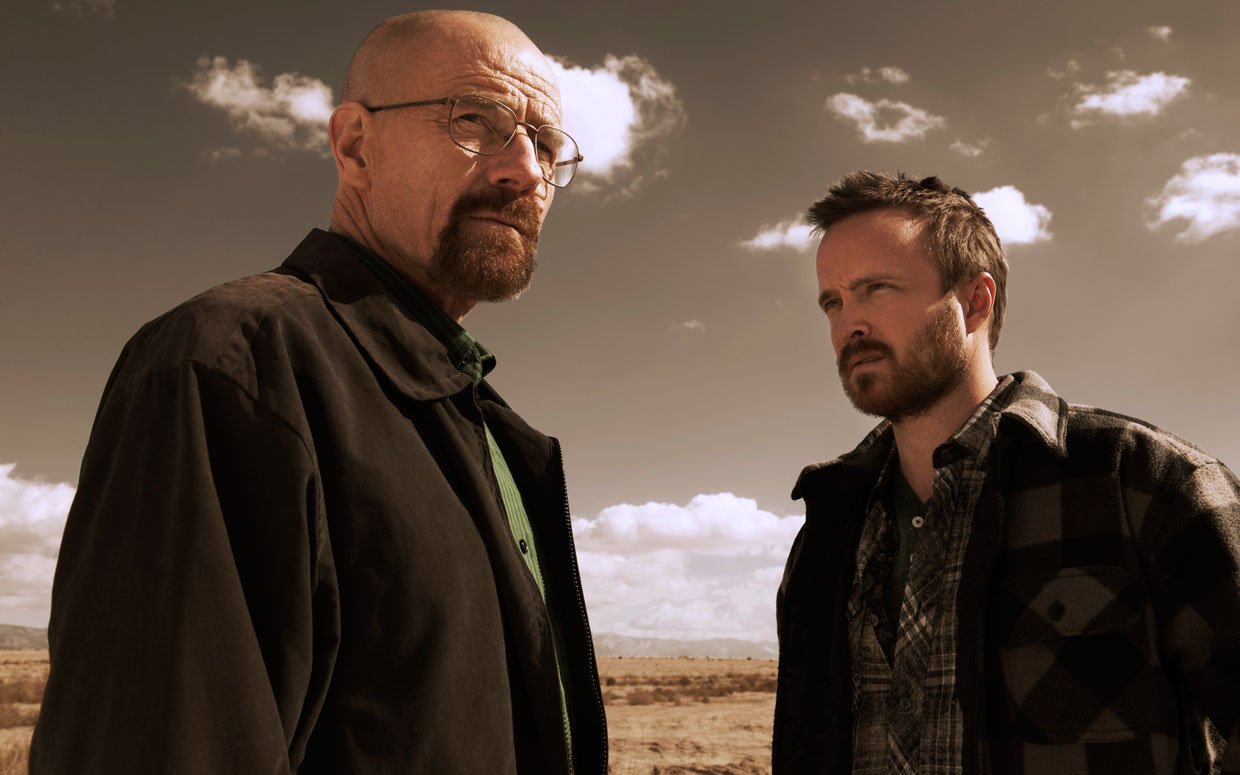
That scene in the garage is key. It’s the first of many scenes that frame this final season as a classic Western, a final, epic, and long overdue showdown between Hank and Walt. It closes the episode, with a challenge from Walt to Hank: tread lightly. His hubris is such that he cannot resist this one last opportunity to one-up his macho brother-in-law. Their relationship has so changed since the pilot, and yet, fundamentally, it has not changed at all. Walter is still a sniveling, chickenshit failure of a chemistry teacher, with a chip on his shoulder and something to prove. In combination, “Blood Money” and “Buried” feature Walt and Hank stepping back into their respective roles; when Hank meets with Jesse at the latter episode’s end, it is triumphant, and suggestive of a way that he will eventually best Walter.
In “Confessions” Walt reframes the entire narrative, but twists it just so, framing Hank. The dinner scene is also spectacular, especially the way that Hank, having initially and instinctively wanted to protect Skyler, is now perfectly content to see her burn too. This is a turning point—not the first and not the last, either—where Walt reveals himself for what he truly is. Our sympathies are now, or should be, entirely with the Schraeders. Also in “Confessions,” Jesse and Walt’s relationship fractures finally and permanently, and sets up their last interaction in “Felina”. Jesse is perhaps underused, especially toward the end of the season, but Aaron Paul is so phenomenal in the role that you forget it. He completely sells even the too-writerly realization of Jesse’s that Walt arranged to have Brock poisoned.
“Rabid Dog” amps up the cat-and-mouse game, placing Jesse in the middle of Hank and Walt’s feud, a pawn to each of them, which is all he’s ever been. By now the season’s structure has taken shape: it is a tightening noose. As ever the acting on key, basically perfect, but here it is the best it’s ever been. Each performance increases in intensity, until everything reaches an impossible and inevitable fever pitch. Dean Norris emerges as a truly brilliant actor, as Hank becomes the moral center of the show. Anna Gunn keeps the audience’s sympathies with Skyler, somehow, even as Skyler’s behavior becomes more and more abhorrent. And of course, Bryan Cranston is a virtuoso, doing his best work on the series in this last run. No nonsense regarding Homeland or House of Cards this year, please—we must recognize this incredible, gargantuan performance once more while we still have the chance.
These last episodes are a classic Western, until suddenly they aren’t. That Uncle Jack puts a bullet in Hank’s head is inevitable, but it is no less shocking for that. And so begins the slow unraveling, the final topple of the last of the dominoes. “To’Hajilee” closes on what should rightfully be a moment of triumph, but it’s too early in the narrative for Walt to be brought down, and deep in our gut we know it. The episode cruelly ends on a cliffhanger, but we know already that Hank and Gomie are doomed. (After all, he took the time to call Marie and revel in his victory—never a good sign for the action hero he’s become.) After lurking around the edges of the season, Uncle Jack and his gang arrive on the scene of Hank’s triumph, guns loaded. The ensuing standoff is straight out of a Clint Eastwood flick, and it is tense. It is paralyzing, in fact, each bullet a new rupture in what until this point has been the relative security of the Western structure. You don’t realize you’ve been holding your breath until you exhale.
But this has all been preamble, because this season features “Ozymandias,” which is the best episode of the series, and frankly is one of the best episodes of television drama ever produced, period. Every compliment one can level at Breaking Bad can be said tenfold of “Ozymandias,” which pulls apart each and every thread of the series, blows up its entire premise, and sets the stage for the final two episodes in grand, bombastic style, as Walter gazes upon Albuquerque in the rear view mirror of Robert Forster’s van. The episode is rightly nominated for Outstanding Writing, for Moira Walley-Beckett’s flawless script; criminally, Rian Johnson’s equally perfect direction has gone unrecognized.If the season is a project in bringing Breaking Bad full circle, then “Ozymandias” is a project in thoroughly dismantling everything we know about this world, these characters, and their relationships.
The first scene takes us back to the show’s origins, Walt looking closer to Bryan Cranston’s other famous role, an apron over his tighty-whiteys, doing the old odd couple routine with Jesse. Now Hank is dead. Skyler lunges at Walt with a kitchen knife, and Walter Jr. flings himself on top of her, protecting her from his father, the monster. And Jesse is chained up like a rabid dog, buried beneath the sand. A commentary on this season could just as easily be a commentary on this episode alone. When Skyler pulls a knife on Walt, and they wrestle to the floor, Walt, Jr. in the frame between them, your heart stops and your breath catches, even more than during the To’Hajilee shootout. We watch the White family not only crumble apart, slowly, over many seasons, but we now watch them explode, violently, in the tensest scene of a series chock full of such set pieces. Walter’s staged speech over the phone, in which he spits invective at her, calls her a stupid bitch, for the benefit of the police and to save her from prosecution, is a stellar performance, is harrowing, and is heartbreaking. What’s worse is that we are complicit in all of this–we who have watched Walt, and cheered him on, all this time. “Ozymandias” is more than the unraveling of this masterfully spun yarn. It is also a judgment, of Walt and of the viewer, one that reframes the entire series and puts us in the proper perspective for its conclusion.
Back when this half-season aired, there was plenty of joking about the idea that Walt by this point is so evil that he can be outdone only by meth-dealing Nazis, which is a fair point, especially given Andrea’s horrible fate. But yet another magic trick the producers pull here is that while yes, they give Walt a worthy enough adversary to remain in the protagonist’s role, they also pull no punches regarding his true nature. Look no further than the closing moments of “Granite State”, when Walt hatches his plan out of pure hubris, sparked by his resentment of Gretchen and Elliot, and when the show’s theme song cues on the soundtrack like it’s the theme from Batman. There can be no doubt: Walter White is a bad man. For this reason I remain amused by the too-common complaint that “Felina” makes him out to be a hero, gives him an easy and triumphant conclusion, and altogether lets him off the hook for his crimes. It’s an abjectly wrong and willfully blind reading of the episode and of the series. Walter White takes out a bunch of meth-dealing Nazis, and saves Jesse, yes. But this is all his design, and he gets no credit for putting an end to a hell of his own making. And when he finally, deservedly dies, he does so alone, having lost his family and perhaps his only true friend.
I remembered the middle of this season being somewhat loose, perhaps long-winded or flabby, but upon rewatch this is not the case. The pacing is nearly perfect, flagging only slightly somewhere in the middle of “Rabid Dog.” There are some other flaws, too; as I said before, Jesse is too absent from the final episodes, and the scope of Walt’s meth empire bordered on unrealistic at some points, especially with the discussion of purity and color as so very important to Lydia’s buyers. But ultimately, any complaints are minor, and misguided. Here is the last act of a great tragedy, and like all great tragedies, the conclusions are foregone. The true artistry on hand here is the unflinching way in which the writing, the direction, the cinematography, the performances—really every single aspect of the production, right on down to the editing and even the costuming—present this tremendous finale to the viewer. Upon finishing you are left barren and hollow, and yet, thoroughly satisfied.
Score: 9.5/10