Blog

  • ‘Vox Lux’ review — A hollow pop musical drama

    ‘Vox Lux’ review — A hollow pop musical drama

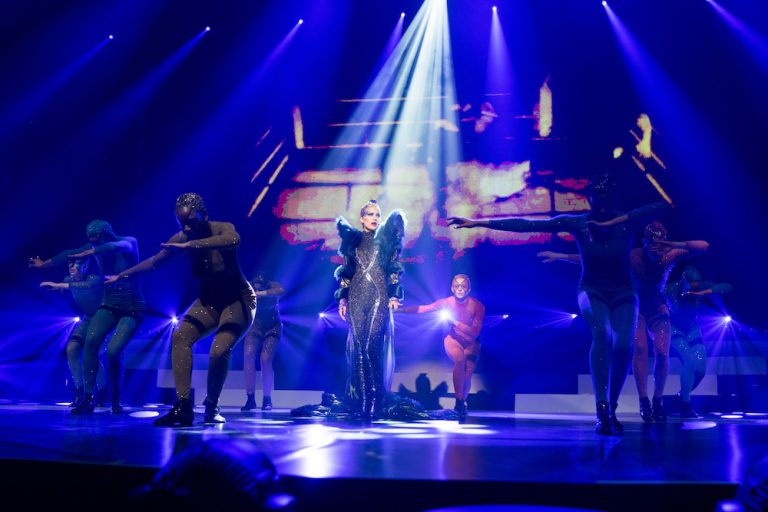
    Vox Lux has an interesting story and visuals, but its lack of focus and uneven characters leave it little more than a hollow pop musical drama.

    Where to watch Vox Lux: Streaming on Hulu. Available to buy or rent on Prime Video.

    Vox Lux has too many ideas it’s trying to grapple with that it ends up not having any ideas. In a year where musical dramas A Star is Born and Bohemian Rhapsody topped the box office and awards conversation, Vox Lux had to do a lot to stand out. And it definitely does from those two other movies—for the wrong reasons

    Actor turned director Brady Corbet—Vox Lux is his second feature after The Childhood of a Leader—begins the movie tackling the very real issue of mass shooting in the United States. Celeste Montgomery (played as a teen by Raffey Cassidy) is sitting in her music class when a fellow student brandishing a gun barges in and shoots their teacher.

    Celeste tries to reason with him to no avail. And he shoots everyone in the classroom. She’s injured, but alive. Slowly recovers from a spinal injury and sings at the memorial for the victims. From there, as told by a voiceover by Willem Dafoe, Celeste is thrown into a whirlwind and we watch her grow into a full-blown pop star—with the help of her manager (Jude Law) and publicist (Jennifer Ehle).

    This first “act” has some pacing issues and Cassidy can’t seem to commit to a character choice—she alternates from shy and reserved to motivated and mature. It feels like a lot of the inconsistency comes from the movie’s attempt to lead us to act two Celeste, played by Natalie Portman—trying to continue her winning streak following Jackie and Annihilation.

    Some fifteen years later, Celeste is a pop star making her comeback. After years of partying and getting into trouble, it seems that she is both done with her public life and conceding to it. The movie tries to comment on the nature of being a celebrity, but its focus on politics, the social environment, and other issues of the day—there are interludes into 9/11 and social media and press—it never quite gets there.
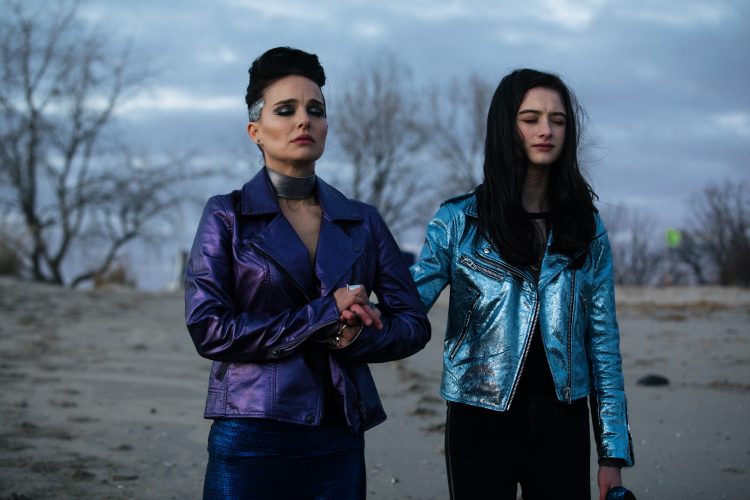
    Vox Lux
    Natalie Portman and Raffey Cassidy in Vox Lux

    Vox Lux’s main issue is that it feels like it starts every scene with “in this day and age,” and at some points characters even say that. It does so much to be “woke” and cultured that at some points it feels like it’s doing it to be relevant.

    It’s unfortunate considering there is a place among the Bohemian Rhapsody’s and A Star is Born’s of the world. It doesn’t have the magic or romance of either of those movies. Vox Lux is about the cold realities of life—it’s almost nihilistic. It would have been interesting to explore stardom from that angle. But the movie has other preoccupations.

    Those preoccupations are also why Portman’s portrayal of Celeste feels so disconnected from Cassidy’s. Portman’s version is tired of the world and wants to make sure the world knows it. It would have worked if the first act built to that, but it doesn’t.

    Vox Lux has an interesting enough story with a unique perspective, but Corbet’s screenplay really lets the movie down. He’s an interesting director, but without someone to rein his ideas in the movie becomes a bit of a mess.

    There are moments of clarity. Specifically in Celeste’s relationship with her older sister Ellie (Stacy Martin) and her daughter (also played by Cassidy), but because of the other ideas, those plotlines are underbaked. Just give A Star is Born another go instead.


    ADVERTISEMENT


    More movies, less problems


    Hey! I’m Karl. You can find me on Twitter and Letterboxd. I’m also a Tomatometer-approved critic.

    💌 Sign up for our weekly email newsletter with movie recommendations available to stream.


    ADVERTISEMENT


  • ‘Gwen (2019)’ mini-review — Bad times in the Welsh hills

    ‘Gwen (2019)’ mini-review — Bad times in the Welsh hills

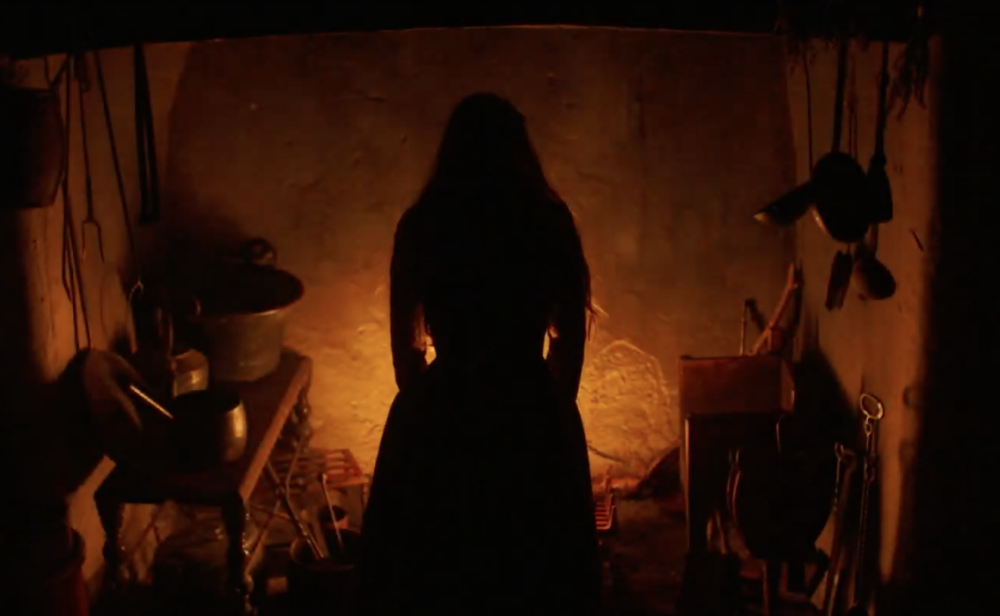
    Gwen follows a young girl must keep her family from falling apart as her community turns against them for mysterious reasons.

    60-second review: Dark storm clouds seem to be rolling into the small Welsh village where Gwen takes place constantly — both literally and figuratively. The film is relentlessly dark as the family of women at the center — consisting of mother Elen (Maxine Peake), teenager Gwen (Eleanor Worthington Cox), and youngest Mari (Jodie Innes) — struggles through plight after plight including losing their father to the war, their farm falling apart, and the owners of the nearby mine threatening their land. The movie is appropriately tense, atmospheric, and filled with a sense of dread.

    However, it struggles to do anything with all that tension. Director William McGregor, in his film debut, proves he’s adept at creating a mood of terror and satisfyingly mixes in elements of gothic and folk horror. But the story never takes off. The journey to its conclusion is so well-crafted, engrossing, and seemingly intentional, but it never says more than what’s on the surface. And unfortunately, the conclusion doesn’t do anything but add another layer of darkness on the already grim narrative.

    It’s easy to compare Gwen to Robert Eggers’ 2015 folk horror The Witch as both deal with a young woman coming of age in a complicated family situation and set against the backdrop of a dreary time. However, The Witch has tangible themes and takes a full dive toward horror whereas Gwen stays in the real world, making it less compelling. It’s unfortunate considering there’s so much strong craft on the screen. I want to see more from McGregor. He has the directoral talent, he just needs a good story to tell.

    Where to watch Gwen: Streaming exclusively on Shudder on August 16th.


    ADVERTISEMENT


    More movies, less problems


    Hey! I’m Karl. You can find me on Twitter and Letterboxd. I’m also a Tomatometer-approved critic.

    💌 Sign up for our weekly email newsletter with movie recommendations available to stream.


    ADVERTISEMENT


    gwen
    Eleanor Worthington Cox in GWEN. Credit: AMC Networks.
  • ‘The Farewell’ review — One wedding and maybe a funeral

    ‘The Farewell’ review — One wedding and maybe a funeral

    The Farewell follows a New Yorker as she travels to China to say goodbye to her sick grandmother — who doesn’t know she’s dying.

    30-second review: The Farewell is a movie of dichotomies — Chinese culture and American culture, parents and children, mourning and celebrating, youth and old age — that appropriately straddles the line between drama and comedy. Even during dramatic moments, it seems that there’s always something lighter going on in the background to remind us that everything in the movie is based in love.

    It’s so difficult to make the exploration of emotions and family strife entertaining, but director Lulu Wang was able to pull it off by avoiding the melodramatics and instead focusing on the characters, their experiences, and their relationships to each other. It also helps that her Awkwafina is an incredible lead with enough charm to pull you in and the dramatic chops to keep you invested.

    Where to watch The Farewell: Now playing in theaters.

    Full review below ?

    One night when I was 14 or 15, my dad — who immigrated to the United States in the 80s from the Philippines — walked into my room, sat down on my bed and started to cry. I never saw my dad cry, not even when both of my grandparents died. It was out of nowhere. And he started talking about how he felt like he was a bad son because he didn’t take care of his parents enough or let them live in our house as they got older. “We have so much space, they could have just stayed here,” he said.

    I later learned that despite the pleading of most of my aunts and uncles, my grandparents never wanted to move in with any of them, afraid they’d be a burden.

    That’s one of the many conundrums of Asian and Asian-American culture that Lulu Wang‘s film The Farewell explores. The fact that showing your emotions is like burdening other people with it. The worst thing that you can do is worry others. It leads to a lot of emotional repression.

    We learn as we grow up that Eastern and Western cultures are like night and day. So for first-generation Americans like myself or people who immigrated to America as a child like the movie’s protagonist Billie (Awkwafina), the clash is hard to navigate. And she’s thrown into a situation where she needs to face it head on.

    A New Yorker to the bone, Billie steadfastly pursues her dreams while watching her bank account suffer as a result. However, when she finds out from her parents — after a lot of prying — that her grandmother who she calls “Nai Nai” (Zhao Shuzhen) has stage four lung cancer she doesn’t hesitate to fly back to her hometown in China, which she left at the age of six with her parents.

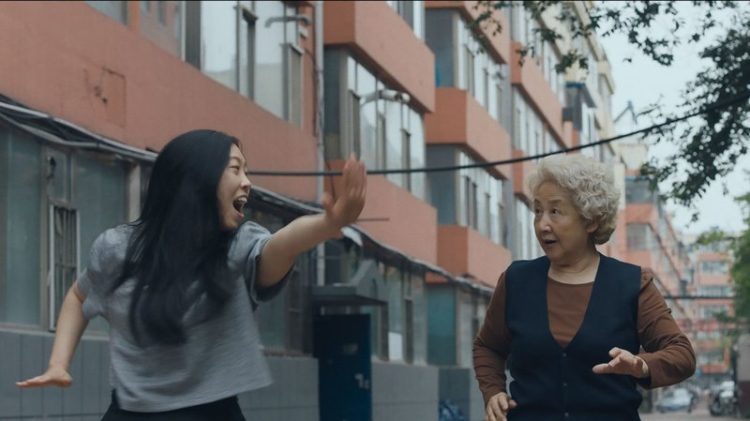
    The Farewell
    Awkwafina and Zhao Shuzhen in THE FAREWELL. Credit: A24.

    The complication is that her entire family including her dad (Tzi Ma), mom (Diana Lin), and uncle Haibin (Jiang Yongbo) have hidden Nai Nai’s true diagnosis from her and instead are visiting under the guise of a wedding for her grandson Hao Hao (Chen Han). In reality, they’re there to say goodbye to her and be with her one last time.

    This leads to plenty of disagreements between Billie and her family based on the differences in cultures, which is explored in more ways than one. However, it also sets the stage for plenty of hilarity as a very real wedding is being put on by Nai Nai even though Hao Hao and his girlfriend Aiko (Aoi Mizuhara) have only been together for three months.

    Even when serious discussions are happening, it always seems like there’s some lightness in the background to remind us that despite the deception it’s all being done out of love. It’s both hilarious and heartbreaking. Awkwafina has proven with roles in Crazy Rich Asians and Ocean’s Eight that she can do the former, The Farewell proves she can also be an emotional powerhouse.

    The movie is made up of these moments where the characters are litigating their decision to not tell Nai Nai the truth. In one scene, Haibin tells Billie that they have to do it so they can bear the emotional burden for her. It makes it all the more tragic because Nai Nai is so full of life and Zhao Shuzhen — who is fully deserving of an Oscar nomination — gives her the richness and sass the character deserves.

    There’s a scene when Billie’s mother asks Little Nai Nai (Lu Hong), Nai Nai’s younger sister, whether she’ll be okay when Nai Nai passes away. She gives a hopeful answer mentioning she wants to travel and maybe visit them in America. She then turns towards her and tells her not to worry about her.

    All any of us want to do — Asian, Asian-American, and otherwise — is to not burden our loved ones with our own problems. That’s the main crux of all the moments that make up The Farewell. It’s all just character’s trying to find ways to make life easier on each other whether it’s sending their kid to America for college or giving their granddaughter money to spend on something special or lying to a grandmother about their health.

    But what Wang brilliantly explores is the consequences of those actions. That kid could never come back or forget their home, the granddaughter would be no better off than they were before, the grandmother could die without properly saying goodbye. She litigates all those decisions without coming down on either side. Instead, she’s on the side of the characters and what they need to go on. Most of them don’t know what that is. But then again, do any of us?


    ADVERTISEMENT


    More movies, less problems


    Hey! I’m Karl. You can find me on Twitter and Letterboxd. I’m also a Tomatometer-approved critic.

    💌 Sign up for our weekly email newsletter with movie recommendations available to stream.


    ADVERTISEMENT

  • ‘Piercing’ review — A twisted homage to 70s horror

    ‘Piercing’ review — A twisted homage to 70s horror

    Piercing is a twisted watch that will completely satisfy genre fans and polarize mainstream audiences — but that’s why it works (mostly).

    Piercing — based on Japanese novelist Ryū Murakami’s book of the same name — feels so familiar. It has story elements of American Psycho and tinge of Phantom Thread while boasting stylistic flourishes reminiscent of 70s horror movies like Carrie and Suspiria— down to the horn-infused score, split-screens, and breezy music montages.

    That isn’t to say that it’s not original. Piercing brings all those elements together as a lean, entertaining genre romp that is a bit hollow in its story and themes, but stunning in execution. 

    Reed (It Comes at Night‘s Christopher Abbott) is an unassuming family man with a beautiful wife Mona (Laia Costa) and adorable newborn. However, like Patrick Bateman, Reed has impulses to kill. He frighteningly hovers an ice pick inches away from his daughter but resists. Instead, he finds another way to relieve his urges. 

    Piercing movie
    Christopher Abbott as Reed in Universal Pictures Content Group’s horror film PIERCING.  Photo courtesy of Universal Pictures Content Group.

    Reed meticulously plans a murder under the guise of a business trip. Director Nicholas Pesce — following up his black-and-white The Eyes of My Mother — does a phenomenal job evoking the very specific era in film. The shadowy cinematography by Zack Galler perfectly underscores the film’s mysterious game of erotic cat-and-mouse.

    We watch as Reed gets to a hotel room to plan, set-up, and rehearse his murder of a prostitute. Did I mention this is a dark comedy? Abbott perfectly plays the part of an awkward psychopath meticulously planning every move — with added sound effects — of his crime. 

    However, for all his planning, he couldn’t plan going up against Jackie (Mia Wasikowska), a prostitute with nefarious motivations of her own. The tension — cut through with darkly funny laughs — is gloriously built up in the first half and pays off sublimely in the disturbing and gory second half.

    Piercing movie
    (L-R) Laia Costa as Mona and Christopher Abbott as Reed in Universal Pictures Content
    Group’s horror film PIERCING. Photo courtesy of Universal Pictures Content Group.

    Wasikowska has carved a glorious niche for herself in dark, brooding horror-thrillers like Stoker, Crimson Peak, and Only Lovers Left Alive. She continues to do great work here playing the crazy counterpart to Abbott’s straight man — but still crazy — Reed. 

    If anything, the biggest criticism of the movie is that it doesn’t give either actor enough time to build the characters and their relationship beyond what is on the page. It frustratingly ends right as we’re starting to get a feel for what the movie has in store for them.

    And while some themes of control and dominance are able to find their way through, the movie is more hallow that it thinks it is. 

    However, it’s hard to complain when at just 81 minutes, Piercing is a twisted watch that will completely satisfy genre fans. It’s a movie designed to be polarizing — think Darren Aronofsky’s mother! — but it’s an exciting risk by an interesting new voice in horror. 

    Where to watch Piercing: Playing in limited release on February 1st. Also available to rent or buy on Prime Video and


    ADVERTISEMENT


    More movies, less problems


    Hey! I’m Karl. You can find me on Twitter and Letterboxd. I’m also a Tomatometer-approved critic.

    💌 Sign up for our weekly email newsletter with movie recommendations available to stream.


    ADVERTISEMENT


  • ‘Under the Silver Lake’ mini-review — To live and trip in L.A.

    ‘Under the Silver Lake’ mini-review — To live and trip in L.A.

    Under the Silver Lake follows an aimless slacker as he unravels a mystery following the disappearance of his neighbor.

    90-second review: Under the Silver Lake alternates between being incredibly compelling and frustratingly confused. It misses the assuredness of director David Robert Mitchell‘s masterpiece film debut It Follows, because he has to spend so much time navigating the tricky world he created. Sometimes he’s successful — particularly when he explores the series of elite Hollywood parties surrounding indie-pop band “Jesus and the Brides of Dracula” — and sometimes he gets distracted by the weirdness of it all.

    The tone reminds me a lot of Boots Riley’s political satire Sorry to Bother You, but unlike that film Under the Silver Lake lacks the point-of-view and narrative clarity to pull it off. In other words, it’s underdeveloped. Mitchell has so many ideas — both thematic and cinematic — that he wants to explore, which explains the bloated 2 1/2 hour running time. When he focuses in on the central mystery of aimless conspiracy theorist and professional slacker Sam’s (Andrew Garfield) missing neighbor Sarah (Riley Keough), the movie and his vision take shape. But then the potential of the neo-noir fantasy world comes into play and muddies the waters.

    It’s not all bad though. He makes some genuinely interesting choices that prove he was never interested in making another It Follows. And so much of it is bold and funny with a dry wit that keeps it entertaining. A lot of that is thanks to Garfield’s immersive performance that is an almost too-accurate portrayal of a scum bum LA conspiracy theorist. Truthfully, I was never bored with it until it began wrapping up.

    Under the Silver Lake is incredibly frustrating because it feels like you can piece together a good movie from what’s on-screen. Even then, it’s not completely clear what Mitchell is trying to say with it. Is he criticizing Hollywood’s misogynistic culture? Or is he more broadly exploring the LA lifestyle? And then there’s the more straightforward read of a man coping with a difficult time by wrapping himself up in a conspiracy and mystery that isn’t his to solve. Whatever the intention of the movie is, it’s unclear. And that’ll work for some. You’ll either love it or hate it. I’m the rare person in the middle ground.

    Where to watch Under the Silver Lake: Streaming for free on Prime Video.


    ADVERTISEMENT


    More movies, less problems


    Hey! I’m Karl. You can find me on Twitter and Letterboxd. I’m also a Tomatometer-approved critic.

    💌 Sign up for our weekly email newsletter with movie recommendations available to stream.


    ADVERTISEMENT


    Under the Silver Lake
    Grace Van Patten in UNDER THE SILVER LAKE. Credit: A24.
  • ‘Spider-Man: Into the Spider-Verse’ review — One of the best superhero movie in years

    ‘Spider-Man: Into the Spider-Verse’ review — One of the best superhero movie in years

    Spider-Man: Into the Spider-Verse is a bright and bold loving critique of the superhero genre and a much needed hard reset.

    30-second review: Spider-Man: Into the Spider-Verse is so keenly aware of what it wants to be even though what it wants to be has never existed before. It’s a bright and bold loving critique of the superhero genre and a much needed hard reset. It doesn’t shy away from the usual tropes, but it tackles them in a way that is innovative, visually jaw-dropping, and laced with real emotion. With great power comes great responsibility, and the responsibility was in the right hands with Into the Spider-Verse.

    Where to watch Spider-Man: Into the Spider-Verse: Available to stream on Netflix. You can also buy or rent it on Prime Video.

    With great power comes… oh, you get it. Full review below ?


    Spider-Man: Into the Spider-Verse leans into the ridiculousness of superhero movies but respects how empowering they can be. In an odd way, Into the Spider-Verse feels akin to The Cabin in the Woods. The 2012 horror film directed by Drew Goddard was a loving hate letter to the genre in played in. Into the Spider-Verse seems to be interested in the same thing. 

    It’s a meta-commentary on the oversaturation of superhero origin stories told over and over again—each hitting the same beats as the last. Hilariously, the movie begins with an origin story montage that pokes fun of previous movie incarnations of the superhero. Specifically, the Sam Raimi trilogy—even the infamous Spider-Man 3 street walk-dance.

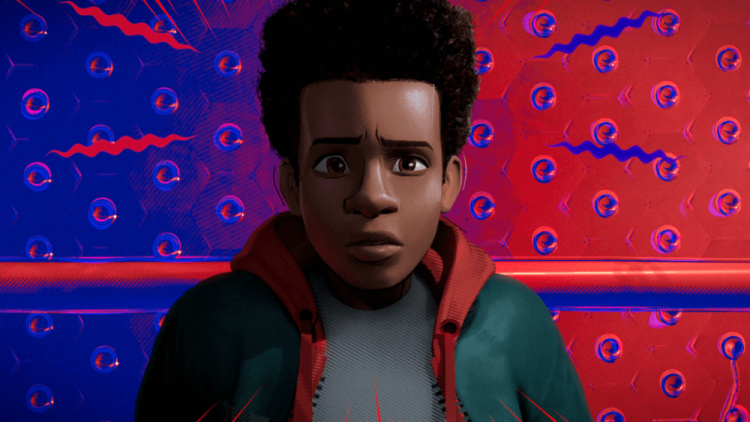
    In Into the Spider-Verse, we watch the origin story of 13-year-old Miles Morales (Shameik Moore), a half-black/half Puerto Rican teen who is unexpectedly thrust into the position of Spider-Man.

    However, this is not your typical origin story. Yes, we hit the familiar beats of the Spider-Man story we all know—bit by a radioactive spider, unexpectedly discovers powers and doesn’t know how to control them—but there’s the added layer of Miles existing in a world where Spider-Man (Chris Pine) is already a fixture.

    So, when that Spider-Man is taken down by baddie Kingpin (Liev Schreiber), Miles is inspired to take over. At first, he’s overwhelmed by his powers and the responsibility. However, he’s not alone.

    Fisk’s evil plan is to open up a multiverse underneath Brooklyn for reasons I will keep unspoiled. However, in doing so, a Spider-Man from another dimension is brought into Miles’. This Spider-Man goes by the name Peter B. Parker (Jake Johnson). In his world, he’s been Spider-Man for a lot longer than the one in Miles’ world and has become jaded—and overweight—by the job.

    Spider-Man: Into the Spider-Verse
    Shameik Moore voices Miles Morales in Spider-Man: Into the Spider-Verse.

    The movie is upbeat, colorful, and hyper-stylized in a way that comic fans will appreciate. Into the Spider-Verse is, perhaps, the best film interpretation of a comic book’s sensibility—it includes on-screen sound effects and the classic comic book text box without feeling gimmicky.

    The filmmakers even went as far as slowing down the frame rate to 12 frames per second—the standard is 24—to make the action look like a moving image. This is best used in a hilarious action scene where Peter B. Parker and Miles first meet.

    As they bounce through the streets of Brooklyn—hilariously attached by their own webs—chased by the police, there is a keen cartoon sensibility to the comedy and comic book veneer to the way the action is rendered. That carries throughout the movie and delivers some of the best action and comedic set pieces of the year. 

    At first, Peter B. Parker, who feels inferior compared his dimensional counterpart, is hesitant to take Miles under his wing. But when he finds out that Miles holds the key to getting him back home he finally accepts. 

    Now that the pair teamed up, they begin to form a mentor/mentee relationship that drives part of the emotional crux of the movie. The other emotional crux is Miles’ relationship with his police officer father Jefferson (Brian Tyree Henry) and with his Uncle Aaron (Moonlight‘s Mahershala Ali)—Miles often feels overwhelmed by his parents’ high expectations of him and goes to his uncle for a reprieve. 

    After a hilarious visit Aunt May (Lily Tomlin)—a badass assistant to this universes Spider-Man—Miles and Peter B. Parker realize that the multiverse has brought in even more Spider-People.

    Spider-Man: Into the Spider-Verse
    Hailee Steinfeld voices Gwen Stacey in Spider-Man: Into the Spider-Verse.

    There’s the dark and gritty—to hilarious levels—film-noir Spider-Man (a terrific Nicolas Cage) who is rendered in high contrast black and white and talks in exactly how you’d expect a noir detective to speak. There’s the anime rendered Penni Parker (Kimiko Glenn) who fights with a spider-like robot she controls with her mind. And there’s Spider-Woman who turns out to be Gwen Stacey (Hailee Steinfeld), a young and energetic Spider-Person.

    Together they work to take down Kingpin and return each Spider-Person to their own universe. Of course, there’s a time crunch. If they aren’t returned soon, their cells will degenerate. Along the way, they battle Kingpin’s goons in fan-service references, callbacks, and homages.

    And what is so refreshing—especially with the MCU being the template for most superhero movies—is that there are real stakes and danger in the action. I found myself tensing at the light and funny action because it feels often like any character could be hurt or killed.

    All the elements I’ve mentioned above make Into the Spider-Verse the boldest superhero movie in years and most innovative animated movies ever made. It’s so keenly aware of what it wants to be even though what it wants to be has never been done before. 

    Audiences have become desensitized by the at least three MCU movies, a cadre of DC movies, and a Sony Marvel movie coming out each year. Into the Spider-Verse is a refreshing reset to the genre. In a world where we know superheroes can do anything—with the help of CGI—how do you keep things interesting? Into the Spider-Verse solves this by playing with—and criticizing—the formula.

    It’s bold, funny, sentimental, and one of the best movies of the year.


    ADVERTISEMENT


    More movies, less problems


    Hey! I’m Karl. You can find me on Twitter and Letterboxd. I’m also a Tomatometer-approved critic.

    💌 Sign up for our weekly email newsletter with movie recommendations available to stream.


    ADVERTISEMENT

  • ‘John Wick: Chapter 3 — Parabellum’ movie review

    ‘John Wick: Chapter 3 — Parabellum’ movie review

    John Wick: Chapter 3 — Parabellum finds John in his most precarious situation yet — and that’s bad news for anyone that gets in his way.

    30-second review: The reason the unlikely John Wick franchise works is because it understands its audience and, more importantly, trusts them. John Wick: Chapter 3 — Parabellum mercifully leaves the bloated plot of the second installment behind to deliver another lean action-thriller with enough forward momentum to give you the genre thrills you crave. And the action is stunning. It becomes a little too self-aware in its third act to stick the landing, but the journey there is definitely worth it.

    Where to watch John Wick: Chapter 3 — Parabellum: Available to buy or rent on Prime Video.

    Tick tock. Full review below ?


    John Wick: Chapter 3 — Parabellum is brilliant because it’s aware it’s the third film in a franchise. By this point in a lesser franchise, audiences are probably getting jaded and experiencing diminishing returns as they call the shots — in this case, headshots — the movie is going to make before it makes them. But John Wick is no normal franchise.

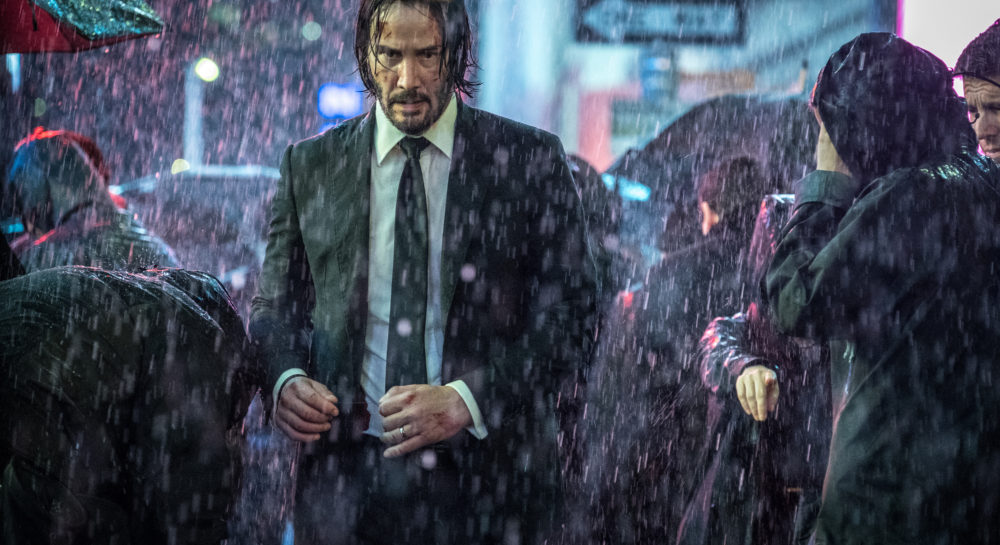
    Instead of going for a trilogy capper or a callback-filled trip down memory lane, Parabellum is about John Wick (Keanu Reeves) being tired he’s in this movie. Who could blame him? The events of the three movies happen back to back, with this one picking up seconds after the last.

    Wick is deemed “excommunicado” by the High Table — who control the sprawling underground infrastructure for the world of assassins — and placed under a $14 million dollar bounty. With just an hour to prepare himself, John makes an attempt to escape a city that has only one goal — to kill him.

    The first act is a stunning, non-stop action scene that brilliantly cuts between Wick’s journey around the city that has a series of fights that will probably rank among the best of the decade. And despite three movies stuffed with fights, this movie finds a way to not repeat itself. Seriously, the first 30-minutes are spent with a weak and injured John fighting off foes off in increasingly creative ways.

    He goes from the New York Public Library where we see him take down a 7-foot killer with a book to a knife-throwing fight in an antique shop to a stable where he strategically uses horses to take down a squad of assassins. On top of that, there’s a motorcycle chase on horseback.

    ohn Wick: Chapter 3 — Parabellum
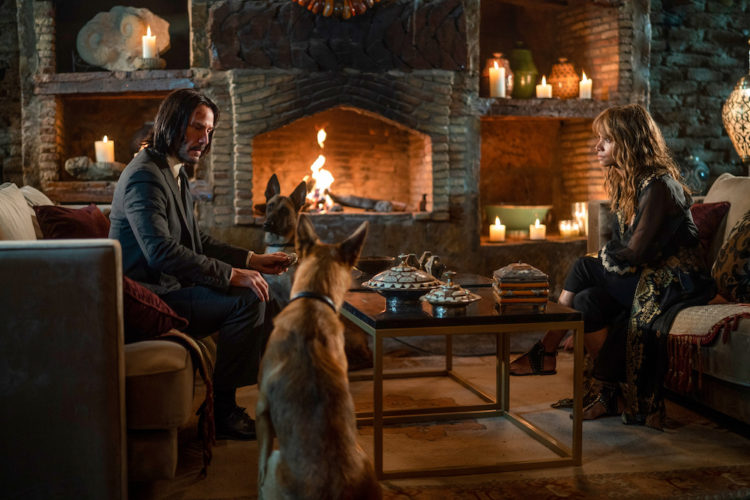
    John (Keanu Reeves) and Sofia (Halle Berry) in JOHN WICK 3: CHAPTER 3 – PARABELLUM.

    Whereas the action in Chapter 2 leaned heavily on blood and gore, Parabellum makes the violence brutal, but oddly beautiful — something I appreciated about Atomic Blonde. Director Chad Stahelski knows how to stage action, in this movie, he learns how to capture it.

    Take the act two capper that finds John in Casablanca with his old friend Sofia (Halle Berry) fighting off a trove of killers that seem to be coming out of nowhere — just like a video game. However, Stahelski makes the decision to shift the point-of-view of the scene to Sofia, which allows us to see some incredible and dynamic coordination between her and her two tactical attack dogs. I was breathless the entire time.

    Of course, we dig further into the world and meet new characters like a shrewd ballet instructor (Anjelica Houston) who helps John get out of the city, an Adjudicator for the High Table (Asia Kate Dillon playing a revolutionary non-binary character) whose task is to bring down anyone who helped John escape with an assist from an assassin called Zero (Mark Dacascos). And thankfully, we spend more time in the Continental with Winston (Ian McShane) and Charon (Lance Reddick), who become even more instrumental to the story.

    But most importantly, we spend time with a tired and rundown John who is now even more infamous than he once was. This fact influences a third act that feels more like a slapstick comedy than it does an action movie. It’s entertaining but distracting. Still, it’s a bold move considering this movie officially brings the franchise to the mainstream.

    Parabellum doesn’t do much work to make you like it. Truthfully, if you made it this far in the franchise, there’s almost no way you don’t. They’ve laid the groundwork to take this story anywhere and you will follow because John Wick and the world he inhabits will never not be interesting. I thought I’d be jaded with the franchise, but keep them coming.


    ADVERTISEMENT


    More movies, less problems


    Hey! I’m Karl. You can find me on Twitter and Letterboxd. I’m also a Tomatometer-approved critic.

    💌 Sign up for our weekly email newsletter with movie recommendations available to stream.


    ADVERTISEMENT
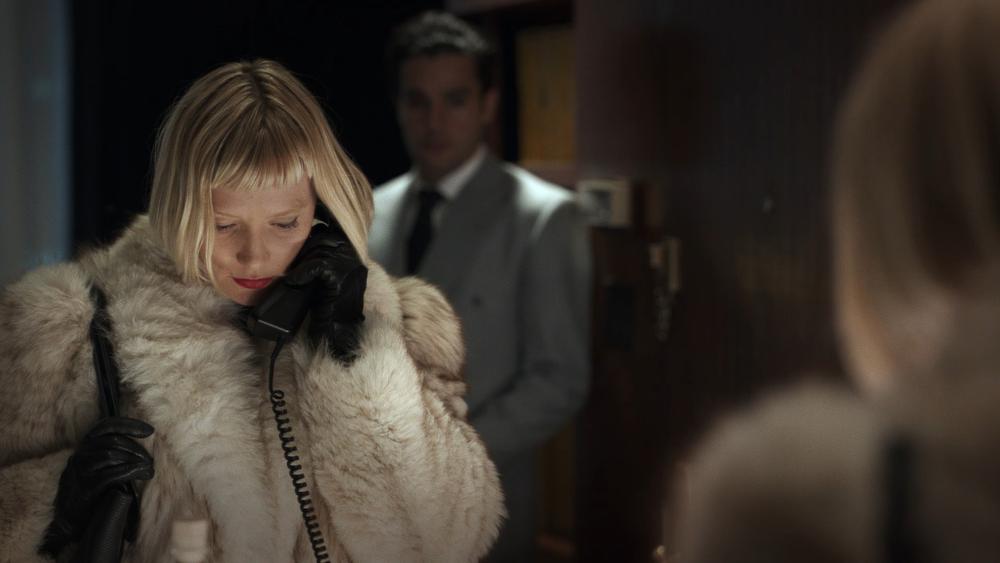

  • ‘Annabelle Comes Home’ movie review — Ghost adventures in babysitting

    ‘Annabelle Comes Home’ movie review — Ghost adventures in babysitting

    Annabelle Comes Home is Adventures in Babysitting by way of an evil possessed doll that wants to steal your soul. Groovy.

    One sentence review: Annabelle Comes Home uses all the tricks in The Conjuring playbook to be one of the scariest and most entertaining movies in the franchise. The movie succeeds by going back to basics. Like the original film, it’s slow, deliberate, atmospheric, and most importantly, terrifying. It also carries on the tradition of inventive scares using some classic tactics — but it also isn’t afraid to subvert expectations. It’s the best film since the original.

    Yet, it’s still a step-down and a great example of why we need to move away from franchises. By being part of a cinematic universe, Annabelle Comes Home allows itself to be formulaic. That formula works but requires additional unique elements to keep it afloat. This movie comes close to having those elements but doesn’t quite get there.

    Where to watch Annabelle Comes Home: Now playing in wide release.

    Grab a crucifix and some holy water. Full review below ?


    You would think that Annabelle Comes Home, the seventh film in The Conjuring universe and the third Annabelle film, is doomed to fail. The franchise has been losing steam as of late, especially after two of the worse entries in the unlikely horror franchise — The Nun and The Curse of La Llorona, which is already a film that doesn’t exist. However, with The Conjuring stars Patrick Wilson and Vera Farmiga reprising their roles as demonologists Ed and Lorraine, Annabelle Comes Home finds itself by leaning on what made the original film so good in the first place. 

    The movie starts where The Conjuring starts. Ed and Lorraine help two young women who are being terrorized by a doll named Annabelle, which is possessed by a demonic entity intent on possessing a human. As they are taking the doll to their home to be blessed and put somewhere it can’t do harm — although that clearly doesn’t work out — they are blocked by a car accident that requires them to take a detour leading to an atmosphere-setting cold open that lets you know you’re in for a ride. 

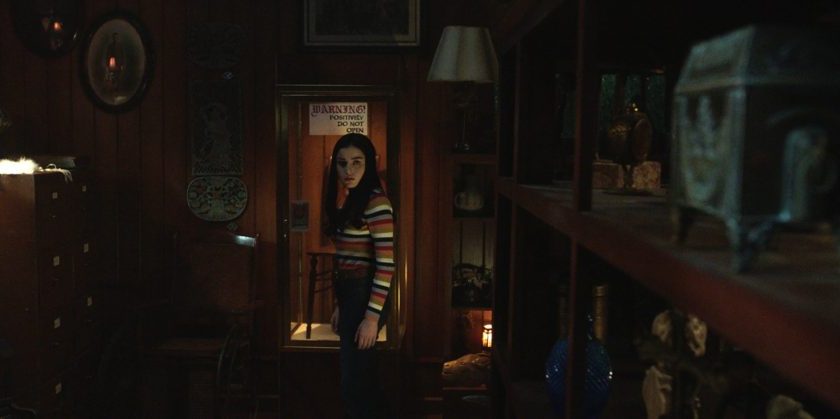
    The Warrens lock Annabelle in a room that is filled with haunted and cursed items ranging from a suit of Samurai armor to a wedding dress to a pile of gold coins. Then, we meet the real protagonists of the film. While the Warrens are away, their daughter Judy (Mckenna Grace) is put in the care of high schooler Mary Ellen (Madison Iseman), who, unlike most babysitters in movies, is actually pretty great. Her friend Daniela (Katie Sarife) is the real trouble maker. 

    When she learns what the Warrens do for a living, she weasels her way into the house under the guise of helping Judy celebrate her birthday, but she has other plans. She makes her way into the locked room and, as the trailer emphasizes, touches everything — including Annabelle. From there, the movie is a twisted and terrifying haunted house horror as each of the girls in the house — and Mary Ellen’s suitor Bob (Michael Cimino) — are harrassed by the unleashed entities. 

    While The Conjuring is certainly a more artful horror film, Annabelle Comes Home is a pure mainstream crowdpleaser — but it still does a lot of what made the original film in the franchise work. Mainly, it doesn’t always go for the easy scare. It lays in weight. It builds tensions. And then it snaps. While Annabelle Comes Home does quite have the same patience, it makes up for it in pure moments of terror. This movie is terrifying from beginning to end and has little reprieve. 

    It also pulls the wrong lessons from The Conjuring 2 and The Nun and features a bit too many CGI-based scares, but they’re not enough to derail the film. Overall, a mix of good old fashioned scares, interesting characters, and an ever-expanding universe of creatures keep this franchise alive and well. 


    ADVERTISEMENT


    More movies, less problems


    Hey! I’m Karl. You can find me on Twitter and Letterboxd. I’m also a Tomatometer-approved critic.

    💌 Sign up for our weekly email newsletter with movie recommendations available to stream.


    ADVERTISEMENT


  • ‘Pet Sematary’ review — Kill it, bury it, and don’t let it come back

    ‘Pet Sematary’ review — Kill it, bury it, and don’t let it come back

    Pet Sematary, a remake of the 1989 film, follows a young family struck by disaster and the lengths they’ll go to undo it

    30-second review: Pet Sematary is appropriately creepy and tense, but with a weak screenplay and direction to match, this horror movie remake is dead on arrival. There are moments in where you can appreciate the craft that went into it. But without characters or a strong story to ground those moments in, they all feel cheap and fleeting. It makes you think why they’d remake it in the first place. Based on the final cut, I’m thinking it has something to do with $$$. 

    Where to watch Pet Sematary: Available to buy or rent on Amazon.

    Go bury yourself in the Pet Sematary and come back. Full review below ?


    Pet Sematary has an interesting story, strong visual style, and a keen sense of atmosphere. However, all those elements that work are betrayed by a bloated script, underwritten characters, and directorial choices that could have been scaled back by at least 75%.

    It’s unfortunate considering the Stephen King story that the movie is based on — it was adapted into a 1989 film — could be mined for incredibly rich subtext on grief and guilt. However, the movie doesn’t find those themes until the final third, which delivers, but ultimately falters because the movie before it doesn’t earn those final 30 minutes.

    The Creed family, consisting of Louis (Jason Clarke), Rachel (Amy Seimetz), and their two children Ellie (Jeté Laurence) and Gage (played by twins Hugo Lavoie and Lucas Lavoie), move from Boston to Maine to live a calmer life. Louis was an ER doctor in Boston and seems to have some PTSD from his experience — the movie, unfortunately, doesn’t explore this thread.

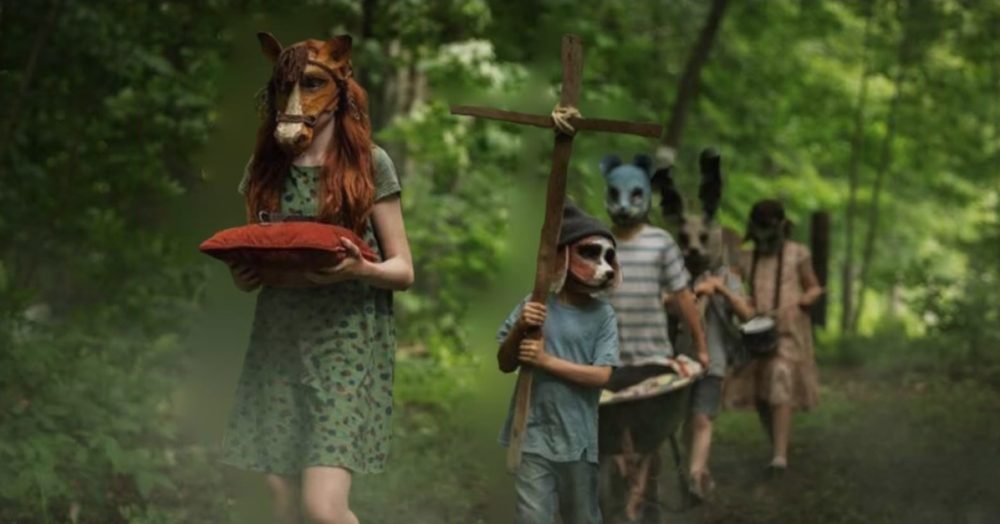
    As she explores their new house and acres of property, Ellie stumbles upon a “Pet Semetary” (sic) where dozens of the town’s deceased pets are buried. There she meets their neighbor Jud (John Lithgow), a widower who quickly takes to Ellie and the rest of the Creeds — though we’re not shown much of their bonding.

    Throughout the film, both Louis and Rachel are haunted by terrifying visions. Louis by a patient he recently lost at his university clinic job, which was supposed to be a relaxing career change and Rachel by memories of her sister who died at a young age from spinal meningitis. The visions are appropriately unsettling, but lose their impact because the trauma that is causing them is overly simplified.

    One day, Jud discovers Ellie’s beloved cat Church dead on the side of the road. It’s assumed that he was hit by one of the trucks that often come barreling down the country road. Instead of devastating his daughter with the news, Louis decides to bury the cat with the help of Jud. However, Jud has another plan.

    Deep in the vast stretches of the swamp on the property is an ancient burial ground used by Native Americans. There Jud tells Louis to bury the cat, leave a tower of stones on top of the grave, and go back home. Louis is disturbed to find Church with Ellie the next morning.

    However, Church isn’t the same. He’s aloof and aggressive. At one point he even attacks Ellie and threatens Gage. Louis, realizing his mistake, takes Church and releases him into the wild. Jud reveals that though the grounds can bring the dead back to life, the returned don’t return the same as they were.

    Pet Semetary has themes built into its concept. Naturally, the plot explores death, our reaction to it, and the guilt we feel after it happens. The issue with this incarnation of the story is that it chooses to emphasize the horror over the characters and their journies. With a story as grounded in real human emotion and experience as this, you need both for it to be effective.

    Look at last year’s Hereditary, which similarly dealt with guilt and grief. If you pulled out the horror elements, you still had a compelling family drama. Do the same to Pet Semetary and you’re not left with much.

    On top of that, the movie has some real structural issues in a screenplay that also has too much clunky exposition to forgive. I truly think directors Kevin Kölsch and Dennis Widmyer do their best with the material but end up making choices that emphasize the issues in the screenplay rather than hide them. In particular, the pacing makes the movie feel both too drawn out and too short at the same time.

    I wish there was more for me to recommend in Pet Sematary. I had high hopes after a run of great horror movies about loss — The Babadook, Under the Shadow, and Hereditary being chief among them. But horror is evolving and it’s not enough to just be atmospheric and scary. Pet Sematary delivers in that aspect, but without the other elements, it’s dead on arrival.


    ADVERTISEMENT


    More movies, less problems


    Hey! I’m Karl. You can find me on Twitter and Letterboxd. I’m also a Tomatometer-approved critic.

    💌 Sign up for our weekly email newsletter with movie recommendations available to stream.


    ADVERTISEMENT
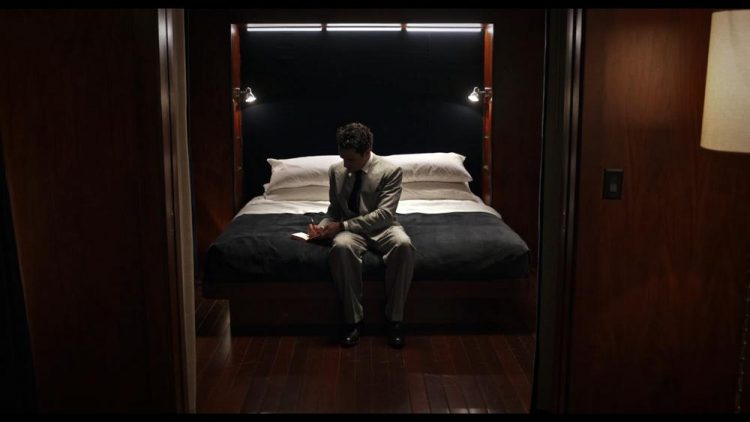

  • ‘Spider-Man: Far From Home’ movie review

    ‘Spider-Man: Far From Home’ movie review

    Spider-Man: Far From Home finds Peter Parker at a crossroads following the fallout of Avengers: Endgame

    30-second review: Spider-Man: Far From Home has the same quirkiness that made Homecoming so successful, but a predictable plot and poor pacing keep it from reaching its predecessor’s heights. However, it also gives us the best interpretation of the “with great power comes great responsibility” theme.

    Tom Holland cements his place as the best actor to portray Spider-Man in Far From Home. But, as a whole, the movie has trouble balancing Peter’s character development with its quirky tone and less than exciting plot. Although, it is still a delight to watch and Jake Gyllenhaal gives a wonderfully bizarre performance.

    Where to watch Spider-Man: Far From Home: Now playing in wide release.

    Don’t forget to pack your suit. Full review below ?


    Spider-Man: Far From Home mostly succeeds in its near-impossible task of following up Avengers: Endgame one of the best entries in the Marvel Cinematic Universe and a quasi-series finale for the “Infinity Saga.” However, it’s clear that the impact of the events of Endgame are going to weigh heavily on the franchise as it moves forward — for better or worse.

    Picking up almost immediately after The Avengers defeat Thanos — losing a few beloved characters on the way — Far From Home does quick work of establishing us in a new reality. Thanos’ snap, known as the blip, has certainly had a massive effect on the planet, but to the happy-go-lucky teen ensemble, all is the same. Other than the fact that half of their classmates have aged five years while they remained the same age. 

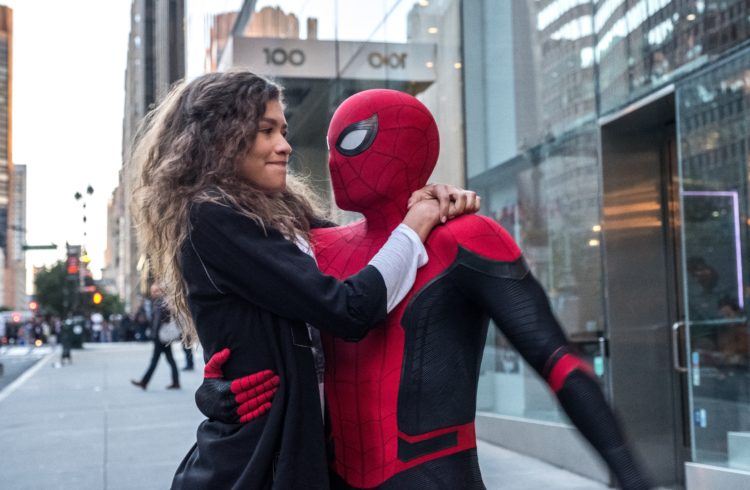
    Peter Parker (Tom Holland) is looking forward to a class trip across Europe to take some time away from being Spider-Man and, more importantly, finally profess his true feelings for MJ (Zendaya). Of course, not everything goes quite to plan.

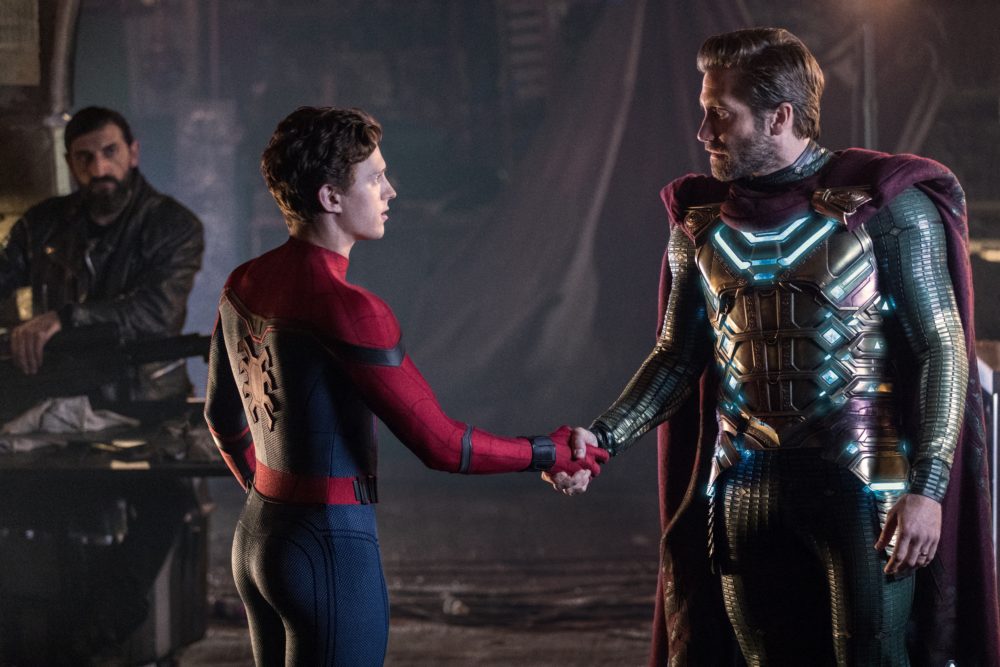
    Nick Fury (Samuel L. Jackson) seeks Peter our to help a new superhero named Quentin Beck (Jake Gyllenhaal) battle monsters made of the four elements — earth, fire, water, and air. However, he’s hesitant to help. Partially because he’s on vacation, but also because the image of a memorialized Tony Stark haunts him everywhere he goes. 

    Spider-Man: Far From Home
    Michelle (Zendaya) catches a ride from Spider-Man in Columbia Pictures’ SPIDER-MAN: ™ FAR FROM HOME.

    Homecoming succeeded when it didn’t try to be a Spider-Man movie and was instead a high school coming-of-age. Far From Home, on the other hand, works so well as a Spider-Man movie — one where Peter directly deals with the “with great power comes great responsibility” adage — but is bogged down by the same quirkiness that made Homecoming so great — Jacob Batalon does great work as Peter’s geeky best friend Ned, but isn’t given enough to do to make the same impact he did in the last film.

    It doesn’t help either that the first half of the film is jarringly paced as it races towards one of the least surprising twists in an MCU film. However, once that’s out of the way, the second half has tons of fun moments, including an Inception-like action scene that is as impressive as it is terrifying and perfectly weird Gyllenhaal performance that just leaves you wanting more.

    And though the movie doesn’t completely work, it solidifies Tom Holland as the best incarnation of Spider-Man. Holland’s ability to translate emotion on screen — and more importantly the emotion of a 16-year-old — carries the movie past the finish line. Where the movie fails in development, he makes up for in performance. Without a doubt, he’s a movie star.

    Far From Home isn’t everything I hoped it would be. It’s a middle tier entry in the franchise at best, but it does serve as a bridge between the past and the future of the MCU. Trust me, you’re gonna want to stick around for the mid and post-credits scenes. Those scenes alone tell us what the MCU needs to do to continue working — it needs to break its own mold and start taking risks. 


    ADVERTISEMENT


    More movies, less problems


    Hey! I’m Karl. You can find me on Twitter and Letterboxd. I’m also a Tomatometer-approved critic.

    💌 Sign up for our weekly email newsletter with movie recommendations available to stream.


    ADVERTISEMENT
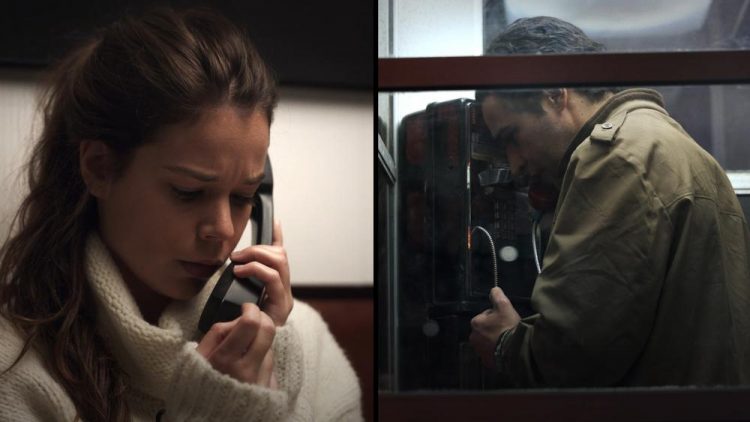

  • ‘Dark Phoenix’ movie review — The X-Men civil war

    ‘Dark Phoenix’ movie review — The X-Men civil war

    Dark Phoenix finds the X-Men fighting each other as they try to save Jean Grey — and the world — from herself

    30-second review: There’s something off about nearly every element of Dark Phoenix. The dialogue is overly-written to the point that you can predict a line before it’s said, the performances are unmotivated, the story is too familiar, and the action scenes lack stakes. However, they’re also not off enough to be interesting. The biggest problem with the film is that it’s bland.

    It’s unfortunate considering the “Dark Phoenix” storyline is a staple of the X-Men canon. Sophie Turner and James McAvoy try to do something interesting with the material, but they’re hindered by the movie’s inability to bring anything new to the table. We’ve seen it all before. For the superhero genre to stay alive it needs innovative. Dark Phoenix is stuck in the past.

    Where to watch Dark Phoenix: Available to buy or rent on Amazon.

    Full review below ?


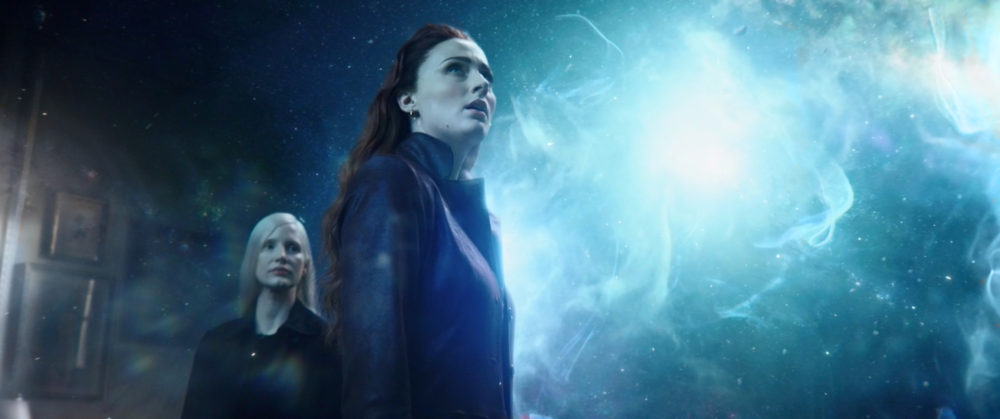
    Full disclosure: I haven’t read and am not familiar with the X-Men comics. What I do know is that the Dark Phoenix saga — also explored in X-Men: The Last Stand — is one of the series’ biggest storylines. The main crux of it finds Jean Grey (Sophie Turner) turned into a conduit for a powerful alien energy force that corrupts her and turns her into an unstoppable and uncontrollable force.

    In Dark Phoenix, written and directed by Simon Kinberg — who wrote three previous X-Men movies — Jean and the other X-Men are tasked with rescuing a shuttle full of astronauts after their spacecraft is disabled by a mysterious floating solar flare. They’re successful in their mission, but Jean is nearly killed when the energy reaches the shuttle with her still in it. However, instead of killing her, she absorbs the energy and returns back to Earth with the other X-Men.

    The film, which takes place ten years after the events of X-Men: Apocolypse, sees the X-Men living in a world where mutants and humans now live in harmony — mostly thanks to the work Dr. Charles Xavier (James McAvoy) has done to bridge the divide by using the X-Men to protect humanity. At one point, he even references the term “superhero.”

    The movie tries to create a Civil War-esque divide between Xavier and Mystique/Raven (Jennifer Lawrence), who thinks that the work they’re doing to be heroes in the eyes of the humans is demeaning as they risk their lives to save theirs. And it’s an interesting theme, but the movie explores it with no passion — and the performances, in turn, have no passion either.

    The main storyline, though, follows Jean as she struggles to control her newfound powers that push her to destructive ends, especially as she learns the truth about her past. Early on — and spoiled in the trailers — one of her destructive spells leads to the death of Mystique, which creates a fissure between the X-Men. On one side, there’s Charles, Scott/Cyclops (Tye Sheridan), Ororo/Storm (Alexandra Shipp), and Kurt/Nightcrawler (Kodi Smit-McPhee). On the other, there’s Erik/Magneto (Michael Fassbender) and Hank/Beast (Nicholas Hoult) — they both seek revenge on Jean for the death of Raven — along with Erik’s minions.

    However, like everything else in the movie, the team turning on each other is half-hearted and doesn’t feel rooted in anything tangible. The movies up to this point haven’t laid the groundwork for us to care about Jean’s fate — or the fate of anyone on the team.

    A more interesting storyline involves a shape-shifting alien race that has come to earth to harness the energy in Jean and, in turn, claiming the Earth as their own. Jessica Chastain, who plays the human form of the lead alien, does her best to make her character a compelling villain. But the storyline feels secondary and means to the final battle that, while entertaining, lacks stakes.

    Dark Phoenix is likely the last X-Men movie in this form as the property is absorbed by Disney and the Marvel Cinematic Universe. Maybe that’s why it lacks passion. It certainly doesn’t help that it comes on the heels of Avengers: EndgameTruly, the movie isn’t a disaster. But even that would be more interesting than what we got.


    ADVERTISEMENT


    More movies, less problems


    Hey! I’m Karl. You can find me on Twitter and Letterboxd. I’m also a Tomatometer-approved critic.

    💌 Sign up for our weekly email newsletter with movie recommendations available to stream.


    ADVERTISEMENT


  • ‘Us’ movie review — Jordan Peele avoids the sophomore slump

    ‘Us’ movie review — Jordan Peele avoids the sophomore slump

    Us, Jordan Peele’s follow up to his Oscar-winning debut Get Out, follows a family being hunted down by their terrifying doppelgängers.

    30-second review: Lupita. N’yongo. While Us is successful in many ways — especially in its horror set pieces surrounding a horrifying home invasion — the central performance by the Oscar winner is the main reason the movie is a worthy follow-up to Get Out. He ups both the horror and the comedy, for better and worse. Though the plot and themes are muddier, Peele focuses on delivering an effective horror film — and that he did. 

    Where to watch Us: Available to buy or rent on iTunes and Amazon.

    Watch yourself. Full review after the jump ?


    For people that complained the Jordan Peele’s directorial debut Get Out wasn’t scary enough, he heard you. While the laughs and biting political commentary that made Get Out such a sensation — and winning him an Oscar for Best Original Screenplay — are still there, Peele’s sophomore effort Us cranks the horror up as far as it can go.

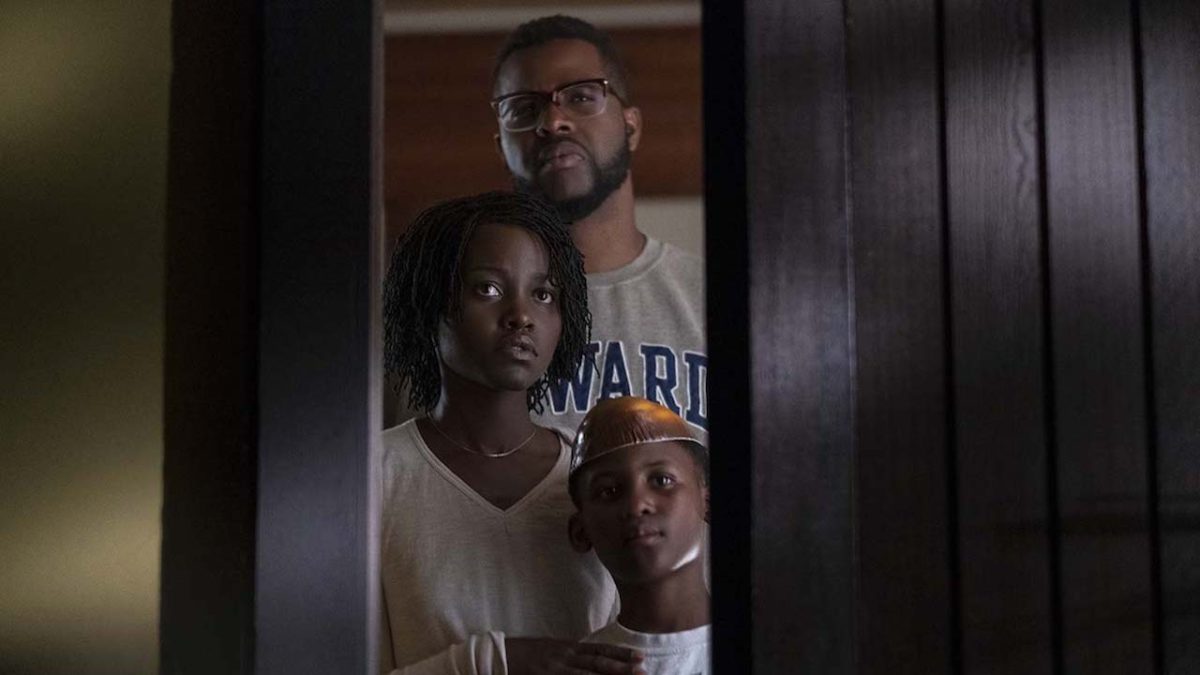
    The first half of the film is laced with unrelenting tension as Adelaide (Lupita N’yongo), her husband Gabe (Winston Duke), and their kids Zora (Shahidi Wright Joseph) and Jason (Evan Alex) are tormented by their scissor-wielding, red jumpsuit-wearing doppelgängers in their beach vacation house.

    The experience is particularly unsettling for Adelaide who had an experience as a child (Madison Curry) where she was separated from her parents (Anna Diop and Yahya Abdul-Mateen II) on a carnival-filled boardwalk to end up in a mirrored fun house where she encountered a girl that looked exactly like her.

    Where Get Out used a premise similar to Invasion of the Body Snatchers and The Stepford Wives to explore race in America, Us uses home invasion movies as its template. It pulls from those movies all the way down to the fact that their tormenters are almost playing with them before finally accomplishing what they set out to do — kill their counterparts.

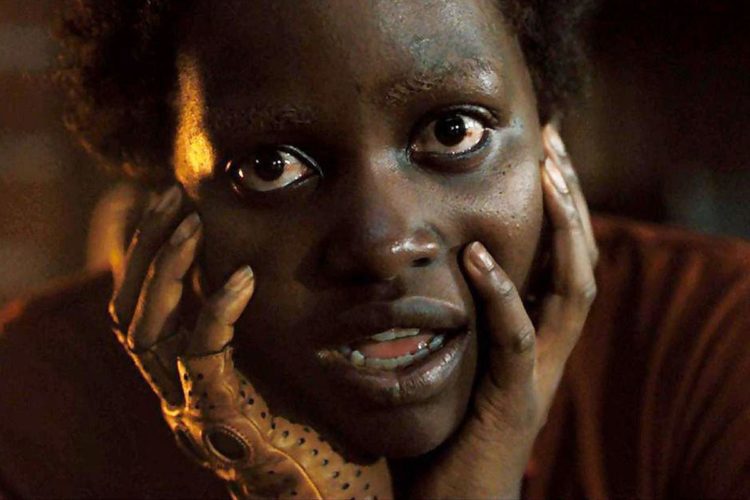
    All the actors portray their doppelgängers to chilling effect, especially N’yongo who nails both the role of a terrified mother desperate to protect her family and her deliciously sinister twin who is hell-bent on some revenge and speaks in a malicious hoarse voice — she’s the only doppelgänger that speaks.

    Us movie
    Lupita N’yongo in Us. Credit: Universal Pictures.

    The plot doesn’t unravel as smoothly as Get Out, which is why the movie isn’t as successful as a whole. The middle act, in particular, ends up stealing a lot of the momentum from the superb first third. It also doesn’t hold up to as much scrutiny. Where Get Out tracks in nearly every beat — like a puzzle that you need to solve and that you can rewatch and find new clues that you might have missed — Us feels more like a maze that you have to wander around before finally solving. Don’t think too much about the mechanics of the movie, it takes away from its charms.

    Tonally, Us is darker, which makes the flashes of humor stick out. Much of the first act is focused solely on atmosphere and tension, so when the middle third comes around the humor deflates a lot of it. But it mostly works. That’s thanks to Duke’s performance — much of the film’s comedy comes from his character’s artificial bravado.

    The allegory, though, and N’yongo’s performance is what keeps the movie from going too far off the rails. The movie’s title can be taken in more ways than one. And while the message is not quite as profound, the movie still completes the job of delivering it with impact.

    Us works a lot better on its surface than it does when it’s dissected. But as a horror movie, it completely works with its centerpiece home invasion sequence being a spectacular horror setpiece that will have you both covering your eyes and having trouble looking away. If anything, come for N’yongo’s performance, which should put her on the track to a much deserved second Oscar nomination.

    Edit: Shadow and Act has a terrific article theorizing on the meaning of the film. You can read it here. 


    ADVERTISEMENT


    More movies, less problems


    Hey! I’m Karl. You can find me on Twitter and Letterboxd. I’m also a Tomatometer-approved critic.

    💌 Sign up for our weekly email newsletter with movie recommendations available to stream.


    ADVERTISEMENT


  • ‘Bad Times at the El Royale’ review — A nostalgic 60s neo-noir

    ‘Bad Times at the El Royale’ review — A nostalgic 60s neo-noir

    Bad Times at the El Royale is a thrilling, character-driven neo-noir homage that will keep you guessing from beginning to end. 

    Don’t let the flashy trailers, catchy title, or A-list stars fool you. Bad Times at the El Royale is not your typical popcorn thriller. Written and directed by Drew Goddard, who had a lot to live up to after his masterpiece debut film The Cabin in the WoodsBad Times unquestionably lives up to its pulpy title and delivers a twisting mystery with a cast of characters whose intentions are always in question.

    However, Bad Times is not a straight-forward entry in the neo-noir genre. It’s not surprising considering Cabin is a loving deconstruction of the horror genre that presupposes — correctly — that both the machine putting out horror movies and the fans that flock to them are off on the wrong track. 

    With Bad Times at the El Royalehe emulates the pulpy neo-noir genre that has found new life through Quentin Tarantino’s carefully crafted homages. The movie is complete with title cards introducing each section — each character’s section is defined by their assigned room. Unlike Tarantino, Goddard is more interested in the themes of the genre. Good and evil, right and wrong, alienation and paranoia. He explores those themes by directly tying them to the time period: 1969.

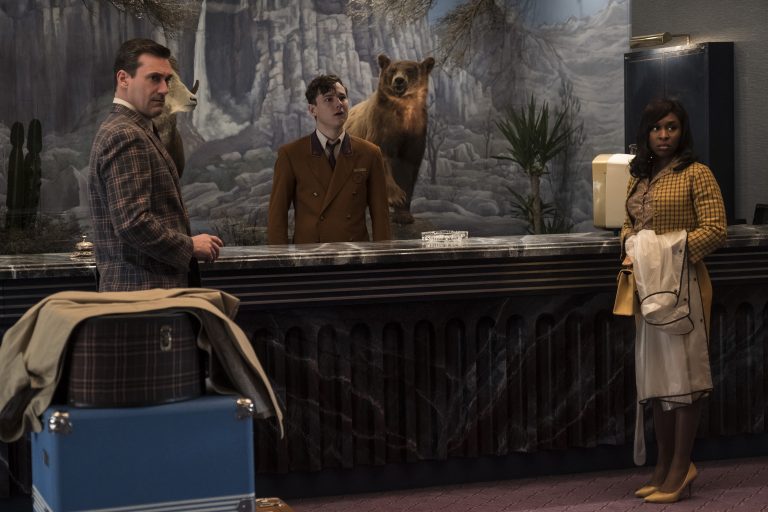
    The El Royale hotel is split right down the middle. Half is in California and half is in Nevada. As the first two guests in our cast of characters arrive, the bright colors and whimsical 60s design of the hotel set us firmly in the time period. However, it’s not indicative of the rest of the movie.

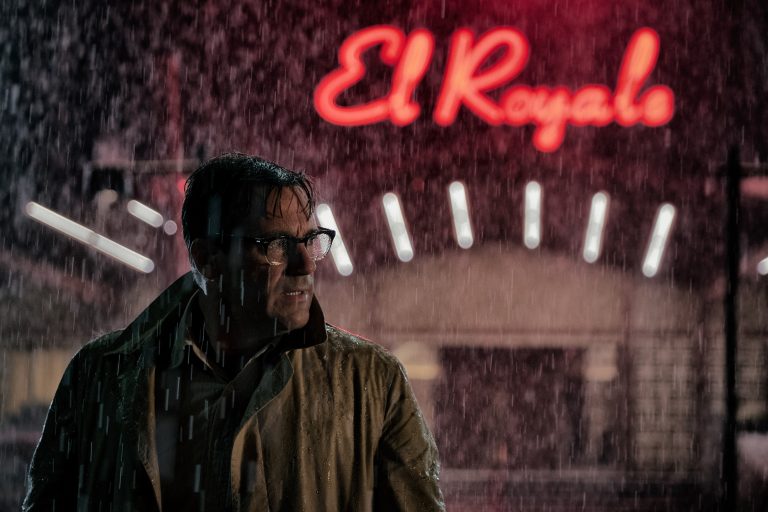
    For almost the whole running time—the movie is set over one night—the hotel is shrouded in darkness and pummeled by a storm that seems to react to the bad times happening in the hotel. And yes, they’re as bad as you imagine. 

    You see, though the guests consist of hopeful lounge singer Darlene Sweet (Cynthia Erivo) and old grizzled priest Daniel Flynn (Jeff Bridges), not everyone has good intentions. The movie is patient. It doesn’t tip its hand too soon. It’s a reason it’s so mesmerizing.

    The slow and methodical cold open where we watch a mystery man (Nick Offerman) arrive in a hotel room and take it apart to hide a bag with unknown contents is captivating even if the camera doesn’t move and nothing really happens. Even the next scene where we watch each guest arrive plays out slowly but with an underlying tension that doesn’t give any hints as to where the story is going. 

    Bad Times at the El Royale
    Jon Hamm stars in Twentieth Century Fox’s BAD TIMES AT THE EL ROYAL. Photo Credit: Kimberley French.

    From there, the movie plays out like an Agatha Christie crime novel mixed with a Hitchcockian thriller with an added dose of Tarantino-esque style. Pieced together with clips from different characters perspectives — often covering the same event — and flashes to their pasts and what led them to the El Royale, the movie doesn’t necessarily have a linear narrative. However, all plotlines lead to one fateful event. 

    The amiable southern vacuum salesman Seymour Sullivan (Jon Hamm) sulks around the hotel before coming across a corridor with two-way mirrors that look into each room — we’ll revisit this place a few times — he watches as each guest does increasingly strange things.

    The nervous, but eager to please concierge/waiter/housekeeper Miles Miller (Lewis Pullman) is struggling with things he’s done in his past that he assures to Father Flynn only get worse. Even more mysterious, and more sinister, is Emily Simmerspring (Dakota Johnson), who has an unusual cargo with her. 

    Eventually, the ghosts that haunt each of the characters begin to intertwine as characters are unmasked to deadly results. Just as the El Royale straddles two states, the characters straddle moments in their lives. It’s a purgatory that each person will leave — alive or dead — as a good or bad person even if the line between the two isn’t as clear as you’d think. And it’s deliciously fun to watch where each guest ends up. 

    Bad Times at the El Royale will be polarizing to mainstream audiences. I’m surprised it’s a wide release at all. At 140 minutes, it could feel like a bloated meandering thriller that takes too long to get to the point. In reality, it’s a slow-burn character drama that puts these seven characters to the test. I know, I only mentioned five. I’ll leave the rest to surprise. What I will say is one of them is an amiable cult leader played by Chris Hemsworth. I’ll let you imagine how he fits in.

    However, if you take a chance and give yourself over to the movie, it’s an extremely fun and surprisingly emotional ride. That’s thanks to the ensemble, which is easily the best this year. In particular, the most junior members of the cast, at least on film, Cynthia Erivo and Lewis Pullman, give the two best performances.

    Erivo belts out songs that often play under scenes to great effect. But she tinges every one of them with a hint of sadness and regret. On the other hand, Pullman’s physicality and delivery reveal a person that is struggling with who they are in a way that you genuinely ache for him. That’s what caught me off guard watching the movie.

    In the end, as each character makes their exit, I was saddened saying goodbye to each of them. All their quirks and flaws. Their bad times at the El Royale were great times to watch in my book. 

    Where to stream Bad Times at the El Royale: Available to rent or buy on Prime Video.

  • ‘Widows’ review — Viola Davis leads the best movie ensemble of the year

    ‘Widows’ review — Viola Davis leads the best movie ensemble of the year

    Widows is successfully a thrilling heist movie, emotional character study, and dissection of our current social climate.

    Widows is based on the 1983 British television show of the same name, but you wouldn’t know that watching Oscar-winning director Steve McQueen’s adaptation from a screenplay written by Gone Girl scribe Gillian Flynn. The film, which changes the location from London to Chicago, is distinctly American.

    The themes ranging from corruption to police shootings to race to the wealth gap are covered with poignancy and impact. However, like all of McQueen’s films, including the Oscar-winning 12 Years a SlaveWidows is also a character study. It’s all packaged up neatly in a twisting heist thriller that makes it one of the most compelling, and best, films of the year.

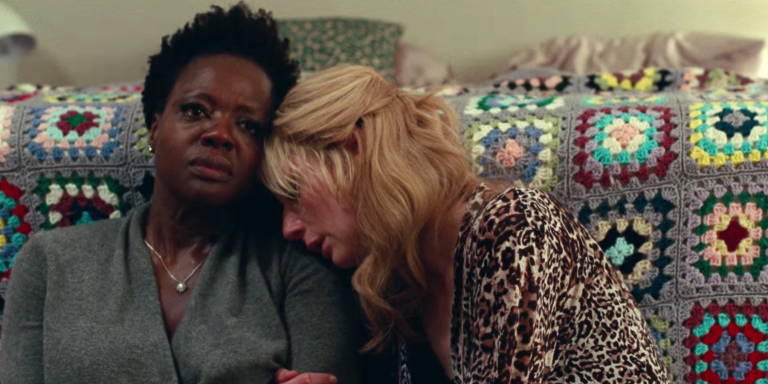
    Widows begins with Veronica (Viola Davis fresh off her Oscar win for Fences) and Harry Rawlings (Liam Neeson) waking up in their sun-drenched Chicago high-rise apartment. Smash cut to four masked men stumbling into a van. One of them is injured and one of them is revealed to be Harry. After a brilliantly captured car chase, the men are brought down in a hail of bullets before their van ultimately explodes.

    However, Veronica doesn’t have much time to grieve as Jamal Manning (Brian Tyree Henry), a crime boss turned alderman-candidate, with his brother Jatemme (Oscar-nominee Daniel Kaluuya of Get Out fame), who acts as his muscle, come to Veronica demanding the $2 million that her husband stole from them.

    Henry and Kaluuya both give menacing performances. Henry is a sneering devil who is calm and composed until he’s not. Kaluuya is similarly, and eerily, quiet, but is unpredictable in his explosive actions, like in Get Out so much of his performance happens just in his face.

    Veronica, who is eventually led to her late husband’s journal by their driver Bash (Garret Dillahunt), recruits the other widows of Harry’s deceased crew to help her finish the job he outlined in his journal to clear his debts and start a new life for herself.

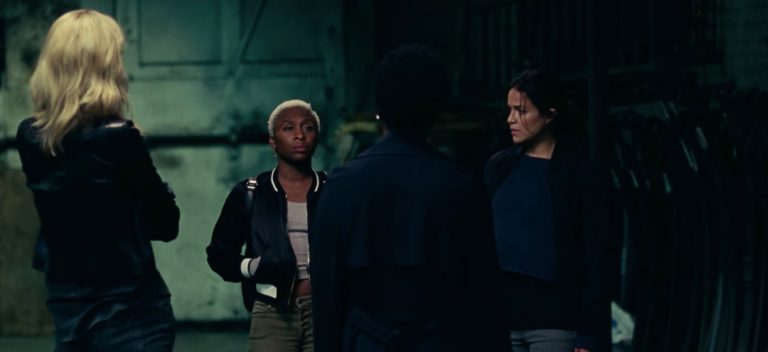
    The other widows, Alice (Elizabeth Debicki) and Linda (Michelle Rodriguez), also have reasons to pull off the heist. Linda lost her store after her husband’s passing and is having trouble supporting her kids with her mother-in-law breathing down her neck. Alice, also looking for money, turns to escorting at her mother’s (Jacki Weaver in a great one-scene performance) suggestion and is eager to get out of it.

    Widows
    Elizabeth Debici, Cynthia Erivo, and Michelle Rodriguez in Widows.

    However, their planning and execution of the heist is not the center of the story. It’s thrilling and suspenseful, especially when Hans Zimmer’s beaming score is supporting it, but it’s not the main propulsion of the story. Instead, it’s the widows themselves that are the narrative and emotional drive as we watch them navigate life after losing their husbands and finding strength in a society that undercuts them as women.

    All the while, in the background, a story of political intrigue plays out as the contentious election between Manning and Jack Mulligan (Colin Farrell) the son of the current alderman of the 18th Ward (Robert Duvall). There, we also confront McQueen’s interest in adapting this story specifically in Chicago and at this time in our political history. 

    The main theme of Widows can be boiled down to dichotomies in our increasingly polarized country. Those lines, drawn across race, wealth, and gender, are captured visually through Sean Bobbitt’s stunning cinematography.

    There are physical separations between each side. In one of the best scenes of the movie, and perhaps of the year, Mulligan, leaving a campaign event, climbs into his limo. However, the camera doesn’t follow him in. Instead, it’s fixed on the hood of the car showing us the neighborhood turn from abandoned lots and distressed storefronts to tree-lined suburban streets with ivy-covered mansions within minutes. It emphasizes the modern-day segregation in Chicago.

    The balancing act McQueen pulls off with the film is impressive. It succeeds on every field it’s playing in. However, if there’s anything takes Widows from good to great, it’s the performances. Every single actor has their moment. Kaluuya and Henry are worthy villains. Cynthia Erivo, who plays a single mother who helps the widows, turns in more great work after nearly stealing Bad Times in the El Royale last month. Carrie Coon and Garret Dillahunt do great work in small roles. Duvall and Farrell make a great onscreen father and son team.

    But the real success her comes from the performances of Michelle Rodriguez, Viola Davis—giving another powerhouse performance—, and particularly, Elizabeth Debicki, whose heartbreaking, funny, and charismatic performance as Alice ranks as one of the best of the year.

    At one point, a cop says, “he should burn in hell, but hey, Chicago will do.” In Widows, Chicago stands in as a microcosm of the United States. Racial tensions are the highest they’ve been in decades, police shootings are on the rise, the wealth gap is turning into a chasm, and women have to fight against a system that oppresses them every day.

    Flynn’s smart screenplay and McQueen’s always stylish and steady direction guide the film through those nuances and the result is nothing short of extraordinary. Widows boast the best cast of the year and is sure to be that rare film that bridges the gap between arthouse and mainstream.

    Widows is in theaters now.

    Karl’s rating:

  • ‘Shoplifters’ review — Touching, funny, and hopeful family drama

    ‘Shoplifters’ review — Touching, funny, and hopeful family drama

    Shoplifters is heartbreaking but often funny and hopeful look at a family of thieves relying on each other to make it day to day.

    Shoplifters is one of those rare movies that you cherish what you don’t know about the characters. Not because what’s beneath the surface will change your opinion of them. It’s because you know when that truth comes out that everything will change and you’d much rather spend more time with them in blissful ignorance.

    That’s what is incredible about the Palme d’Or-winning drama by the renowned Japanese director Hirokazu Kore-eda. We know that there are things that the characters do that we should disavow, but Kore-eda achieves the same effect that Wes Anderson’s The Royal Tenenbaums does. For all the bad the characters do, we can’t help but want to hang out with them for all the good we see in them. 

    In the film, we follow a mismatched familial unit living in a small house in the middle of Tokyo that could barely fit one person, let alone six. There are husband and wife Osamu (Lily Franky) and Nobuyo (standout Sakura Ando), both part-time workers at low wage jobs that force them to rely on their elderly grandmother Hatsue’s (Kirin Kiki is fantastic) monthly pension to live. 

    That’s also the reason that Osamu along with his son Shoto (Kairi Jō) bond by shoplifting. The film even opens with them orchestrating a well-choreographed slick robbery of a grocery store without anyone in the store being the wiser. 

    However, everyone in the family is guilty of some less-than-legal methods for making money. Nobuyo snatches trinkets—a gold tie pin, for example—forgotten in clothes that run through the laundromat she works at. Hatsue has an affinity for pachinko slot machines, even though she doesn’t always use her own money to play. Aki (Mayu Matsuoka), a teen just barely old enough for college works in a porn cafe of sorts where she masturbates for anonymous patrons hidden behind a two-way mirror. 

    It’s not surprising considering their current financial position that the family isn’t happy when Osamu brings home a five-year-old girl names Yuri (Miyu Sasaki) he found alone in the cold. He says he’s only going to take her in for a few days, but when they find signs of abuse, they know they can’t let her go home and informally adopt her. 

    Shoplifters
    The cast of Shoplifters.

    The first half of the movie plays out like a toned-down episode of Shameless. Though some of their methods for surviving or reprehensible, it’s so satisfying to watch this odd family unit interact in often funny, but also sweet exchanges. At one point, as Hatsue lovingly rubs ointment over one of Yuri’s many scars, Nobuyo tells her that even though you still see the scar the pain is gone. 

    Balancing what could have easily been too far into slapstick or overly sentimental, Kore-eda allows the love between the family members to shine at the center of Shoplifters. Though the first half can feel like it’s meandering, it’s all in service of setting up the family unit as a believable one so that when the plot hits do come they land with more impact—and that they do. 

    Eventually, after nearly two weeks, Yuri’s parents report her missing, which only strengthens the family’s urge to protect her—they cut her hair and buy her a new wardrobe to hide her from the police and media. And they fall into a routine. Shoto begins teaching Yuri, who they rename Lin, his shoplifting techniques, Osamu and Nobuyo rekindle their romance, and Aki meets an intriguing client. 

    All the moments that make this film great are quiet but so powerful. You realize that these are all people marginalized and discarded in some way that have come together to build each other back up again. However, what makes Shoplifters one of the best films of the year is the emotional fallout from the high of the first half. Like all good things, the happiness and joy must come to an end. 

    Throughout the movie, truths about the characters are unpacked until we have to re-contextualize everything we know about them and their relationships. But instead of making it a bombastic conclusion—it certainly edges on that—Shoplifters turns to its characters for the emotional wrap-up. 

    The members of the family are flung away from each other, but we’re reminded of what connected them in the first place—love. It’s not always spoken, but it’s always shown. In one of the most striking scenes in the movie—and maybe of the year—Osamu chases after a bus that Shoto is on. Shoto doesn’t turn to look at him until he’s out of view and then mouths the word “dad.” Shoplifters doesn’t need more than that to make its point and make you sob. It’s funny and emotional, uplifting and heartbreaking, it’s one of the best movies of the year. 

    Shoplifters is in theaters nationwide on November 23rd.

    Karl’s rating: