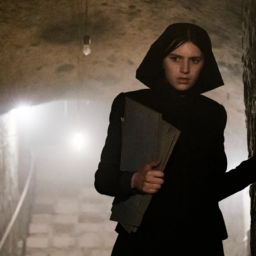
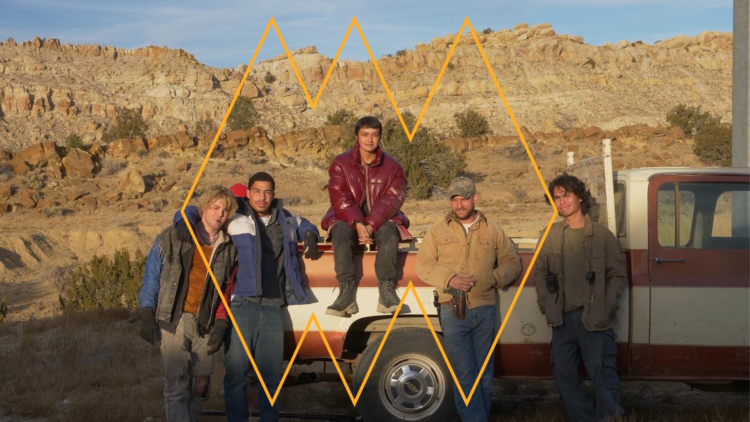
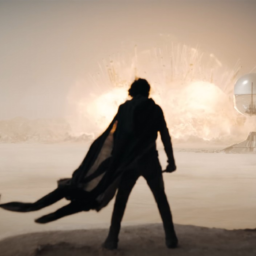
Preceding the 1976 classic, The First Omen follows a young nun-to-be who discovers an insidious plot to bring about the antichrist
Unlike other recent “requels” that are simply retreads of their originals, The First Omen mostly stands on its own as an homage to the original — and the Giallo horrors of the 70s — while feeling fresh and modern. With devilishly delectable imagery as beautiful as it is horrifying, it trades cheap jumpscares for dread-filled tension that gets under your skin and delivers a diabolical thrill that lasts after the credits roll.
The First Omenis in theaters now.
Some horror movies bill themselves as cheap thrills. A fun ride that gives you a temporary rush that ends the second it’s over. Other movies are slower. They methodically sink into your skin. Biding their time so that when you realize how far they’ve sunken in it’s too late. That’s how The First Omen feels. A true blasphemous religious horror that may not feel immediately scary, but the way it presents its story of possession is so deeply disturbing that the walk home from the theater is just as terrifying as the movie itself. It’s the kind of horror that makes you feel dirty after watching it. Like you just saw something you shouldn’t. And that’s real horror.
ADVERTISEMENT
It’s a surprise considering the recent spell of so-called horror “requels” — sequels or prequels to classic movies that are both a continuation and retread of the original — have felt like cheap gags or clear money grabs that rely on fan service ranging from great (Luca Guadagnino’s Supiria) to fine (David Gordon Green’s Halloween) to downright detestable (David Blue Garcia’s Texas Chainsaw Massacre). The First Omen manages to be an homage to the original — and the Giallo horrors of the 70s — while feeling fresh and modern. It stands without any knowledge of the original 1976 The Omen. In some ways, it weaponizes your knowledge of the original against you.
The movie also begins in Rome where Father Brennan (Ralph Ineson) presses Father Harris (Game of Thrones’s Charles Dance) on an ominous photo of a child with the name “Scianna” scrawled on the back. Harris is visibly disturbed by the question but says, “It was an unnatural birth.” Right then, in slow motion stained glass begins falling around the men. Cinematographer Aaron Morton’s naturalistic lighting and grainy compositions are as beautiful as it is eerie. While disaster seems to be averted, when Father Harris turns to leave Brennan realizes a chunk of his skull is missing.
ADVERTISEMENT
It’s the kind of quiet visceral terror that sets The First Omen apart from most modern horror. It’s not the surprise of the scare. It’s the unholiness of the image.
American nun-to-be Margaret Daino (Nell Tiger Free) arrives at Vizzardeli Orphanage to take her vows. She’s bright-eyed and optimistic about her new future but quickly realizes that things might not be as idyllic as she originally thought. Especially when she realizes that one of the children Carlita (Nicole Sorace) is not only ostracized by the other children but feared and mistreated by the nuns who often lock her in the ominously named “bad room” for her erratic behavior like when she inexplicably licks Margaret’s face. Director Arkasha Stevenson maintains a dread-filled atmosphere rather than continually hitting us with unnecessary jump scares. Scenes like Margaret witnessing childbirth rely on what we don’t see as much as on what we see — blood, a dilated pupil, and… is that a demon hand coming out of her?!
In another sequence where Margaret’s roommate and fellow nun-to-be Luz (Maria Caballero) convinces her to go out for one last night of debauchery where she meets Paolo (Andrea Arcangeli). When she follows him onto the dance floor, the strobe lights begin to obscure the image alternating between light and dark. But in those split seconds that we can see small gestures like Paolo pulling her hair back or a hand reaching for flesh feel disturbing until it culminates with Margaret licking his face just as Carlita did to her. The horror is in the image and in the parallel even if it isn’t shocking.
ADVERTISEMENT
Margaret’s journey will take her down a dark path that involves mutilations, freak accidents and, of course, a public suicide just like in the original. However, none of it feels cheap even when the story at times feels like it’s trying too hard to shock you. When it leans in on its dark atmosphere The First Omen fully pulls you in. Even as an atheist, my Catholic upbringing had me reeling at some of the imagery that felt nothing short of evil. The kind of thrill I chase in my horror.
The First Omen is one of the great horror movies of the year against all odds. Sit back and bask in the sinful delight.
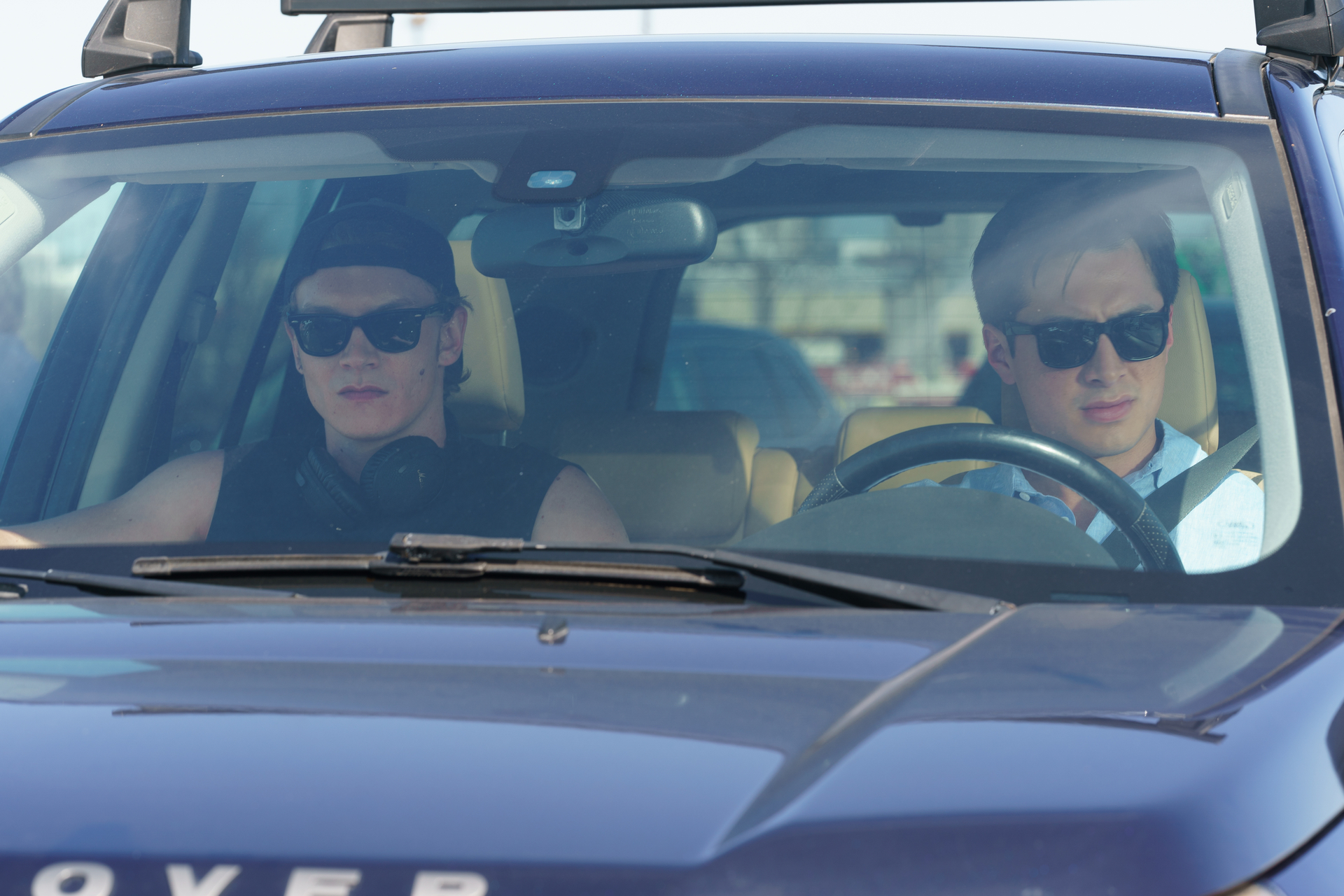
Dev Patel’s directorial debut Monkey Man follows an Indian man on a mission for revenge against the people and politics that wronged him
Dev Patel plays triple duty as action hero star and writer-director of his ultraviolent revenge fable Monkey Man. With action sensibilities akin to John Wick and a politically charged narrative deeply embedded in Indian culture and society, the movie is a roaring crowd-pleaser that is as thrilling as it is emotionally resonant. Though its ambitious plot can feel overstuffed at times, Patel’s magnetic screen presence and assured vision keep you hooked from beginning to end.
Monkey Man is in theaters on Friday, April 5.
When the eponymous “Monkey Man” — simply billed as “Kid” and played by Dev Patel — goes to a black market weapons dealer to buy a small concealable weapon the man jokes he’s like John Wick. It’s an apt comparison in many ways. Both The Kid and Wick spend their movies seeking revenge on people who wronged them in stunning, brutal, and neon-lit fashion. However, that’s where the comparisons end. Where John Wick opted for simplicity in its story and complexity in its world, Monkey Man takes place in our world using themes that feel familiar to us while telling a story that we may not be privy to but can relate to.
ADVERTISEMENT
The first time we meet The Kid he’s donning a monkey mask much like the Hindu legend Hanuman, a monkey whose strength and courage helps him rescue the wife of the deity Rama. He learned the story as a child (Jatin Malik) from his mother (Adithi Kalkunte). However, The Kid is no Hanuman. Instead of a battlefield, he’s waging his war in an underground fight club run by a greedy MC (Sharlto Copley) where his skinny frame is no match for the hulking figures he’s meant to fight who more often than not defeat him in the ring. It doesn’t matter to The Kid though, he’s just doing this and various odd jobs to gather money.
For nearly the first hour, exactly what The Kid’s mission is or why he’s on it is unclear. All we know is that the next step is to get a job at a VIP club run by Queenie (Ashwini Kalsekar), a sharp-tongued businesswoman in stilettos. He finds his way in by orchestrating the stealing of her purse in a kinetic sequence that puts Patel’s directorial skills at the forefront. The purse goes from hand to hand across the fictional Indian city Yatana until it reaches Patel where he uses “finding” it to leverage a job at the club. The sequence drives home that the city is split between the upper echelon and the streets — a theme that continues throughout the film.
ADVERTISEMENT
The club’s clientele is exactly who The Kid is targeting, particularly police chief Rana (Sikandar Kher) who we learn through a series of flashbacks murdered his mother and destroyed the community he called home in favor of further development of the sprawling city. We breezily move between the past and the present with little to slow the narrative down even with diversions to The Kid’s unwitting accomplice Alphonso (Pitobash) and an escort called Sita (Sobhita Dhulipala) who works in the club. When he finally hatches his plan, the movie erupts into a flurry of violence that is captured with the kind of singular Bollywood maximalism that Patel said he was inspired by.
Much of the DNA of Monkey Man feels rooted in Patel’s desire to explore his homeland (he was raised in the U.K. by Kenyan-born Indian parents). That extends to the background of The Kid’s mission and the political corruption that is plaguing the country, represented by faux-spiritual figure Baba Shakti (Makarand Deshpande) who uses his benevolent demeanor to hide his oppression of the poor — including the order to remove The Kid’s community that ended with his mother’s death. There’s almost too much on Patel’s mind to get to everything he wants. Another storyline that involves a group of hirja, a tribe of third-gender people, led by Alpha (Vipin Sharma) displaced by Shakti’s policies feels shirked based on its importance in the movie’s final act.
ADVERTISEMENT
However, Patel’s heart is certainly in the right place. As transgender people worldwide fight for their place, it’s encouraging to see this storyline featured. That can be said for much of what Patel is doing with Monkey Man. While it has the mistakes we often see with first-time directors, and especially actors-turned-directors, the sheer ambition is admirable. It’s best on display in the movie’s stunning final act where we get to see the fruits of The Kid’s journey and Patel’s.
The result is the rip-roaring, white-knuckling action filmmaking that is impossible not to be taken by. With kinetic fight choreography and kinetic cinematography from Sharon Meir, it’s a great omen for Dev Patel’s future as a filmmaker.
A 70s late-night show goes awry when it invites a suspected possession case onto the show in Late Night With the Devil. Nothing like an exorcism to boost ratings.
Late Night with the Devil is one of the best exorcism horror movies in years. With keen 70s aesthetics, a dread-filled atmosphere and career-best performance by character actor David Dastmalchian, this found footage horror transmits its sinister airwaves through the screen resulting in a devilishly fun slow-burn romp.
Late Night With the Devilis in theaters now
Other than a 70s-era 20/20 cold open describing the events of Halloween night 1977 on the Night Owls with Jack Delroy show, Late Night With The Devil plays in real time over the course of the filming of the episode flipping between “actual” footage and behind-the-scenes content during the commercial breaks where we learn how the show is coming together — and falling apart. During his opening monologue, Jack assures the live studio audience along with his sidekick Gus (Rhys Auteri)that the night will be one to remember as they investigate the occult. This is the 70s after all and nothing like a little satanic panic to boost ratings.
ADVERTISEMENT
Among his guests are renowned psychic Christou (Fayssal Bazzi), magician turned skeptic Carmichael (Ian Bliss), and parapsychologist Rose (Laura Gordon). However, the centerpiece of the whole episode is Lilly, a young teen recently rescued from a demon-worshipping cult with whom Rose has been working. Writer-directors Colin and Cameron Cairnes (real-life brothers) wanted to “[recreate] that slightly dangerous, live television atmosphere.” And from the moment Lilly enters the movie, the danger feels real. Despite the “found footage” presentation of the movie, the Cairnes find ways to communicate a dread-filled atmosphere on-screen. Most effectively, Lilly seems to always be staring straight into the camera — and into your soul.
As the night progresses, weird happenings plague the studio before culminating in a chilling exorcism setpiece that will send chills down your spine. However, much like Ti West’s underrated The House of the Devil, the movie never overindulges. It keeps to its grounded 70s aesthetic and maintains a constantly uncomfortable slow burn as the night unfolds. It reminds me of how The Blair Witch Projectapproaches its found footage aspect with an eerily believable realism. The horror isn’t what is on the screen, it’s what’s happening just off of it. The movie relies on the reactions of the characters to communicate the danger, which is why it’s David Dastmalchian’s performance that is the most impressive facet.
ADVERTISEMENT
You might not know Dastmalchian’s name, but you might recognize his face from some of your favorite movies. Perhaps as the creepy bank robber in The Dark Knight or the creepy kidnapping suspect in Prisoners or the creepy Polka-Dot Man in The Suicide Squad. In Late Night With The Devil he proves that he’s one of the most exciting chameleonic character actors working today. His embodiment of an era-accurate late-night show host (think a 70s Conan O’Brien), while never losing sight of his character’s past narrative is impressive to watch and key to the movie’s ultimate success. Believing his motivations — and his own misguided hope that what’s happening is real — sells the horror to the audience. While late-night hosts are meant to make their audience feel safe, Delroy’s desperation makes us worried about what’s coming next.
Late Night With the Devil like The House of the Devil and The Love Witch is an homage to the horror of the period while injecting modern cinematic sensibilities. The result is a spine-tingling and inventive found footage that grabs your attention and never lets go. But that’s just TV, baby.
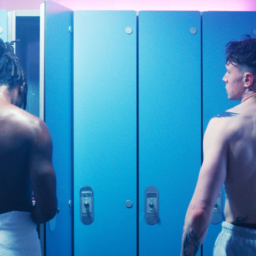
After a homophobic attack, a gay man sets out for revenge on his assailant when he discovers he is closeted in Femme
Anchored by stellar performances by Nathan Stewart-Jarrett and George MacKay, Femme is a tense, sexy and engrossing queer revenge thriller that feels for us and by us. Subverting the classic “femme fatale” erotic thriller trope and archetype, directors Sam H. Freeman and Ng Choon Ping create a morally ambiguous face-off between two queer men that blurs the line between good and evil and right and wrong. One of the best movies of the year so far.
While the inciting incident of first-time directors Sam H. Freeman and Ng Choon Ping’s Femme is a brutal outburst of homophobic violence, I felt an unexpected feeling of relief after it was over. Erotic thrillers like Brian de Palma’s Dressed to Kill or Paul Verhoven’s Basic Instinct and Elle can at times feel exploitative in their use of violence, sex and sexuality as a plot device. And like those films, as the title implies, Femme centers on a “femme fatale” whose sexuality is front and center. However, instead of feeling like the movie is admonishing our fatale or punishing them for the indiscretions it empowers them. The incident while visceral and vicious doesn’t feel lingered on.
ADVERTISEMENT
It’s helpful that unlike the de Palma or Verhoven movies, Freeman and Ping have the utmost respect for their protagonist, drag queen Aphrodite Banks (Nathan Stewart-Jarrett).
When we first meet her, they’re performing a surprisingly high production number for a drag club. After her number, Aphrodite notices tattooed and toned Preston (George MacKay) outside the venue watching intently. Jules catches his gaze that she returns with a charismatic smile — he sulks off. Later in the night, Aphrodite is at a bodega when Preston and his friends enter, posturing as men do.
When they start verbally harassing Aphrodite, there’s a moment where it seems she’s going to try to ignore it and shrink back. But like a switch ticked off in her brain, she decides to take space up as any queer person would and reads them down. Especially Preston who she calls out for checking her out at the club. It’s what leads to Preston’s assault that leaves Aphrodite beaten and naked on the street.
ADVERTISEMENT
Three months later, the incident has left Jules, who has given up his Aphrodite drag persona much to the chagrin of his roommates Alicia (Asha Reid) and Toby (John McCrea), completely withdrawn from the world. That’s until one day he finds himself in a gay bathhouse where he once again encounters Preston who is cruising. For our straight friends, cruising is when you go to a public space looking for someone to have sex with. It’s not helpful that he lashes out at any forward man with a hearty f-slur. “We’re all faggots here,” someone cheekily responds.
Both horrified and intrigued, Jules follows Preston to the locker room. Unaware of who Jules is, Preston invites him back to his apartment for sex. Behind Jules’ eyes — and a testament to Stewart-Jarrett’s quietly powerful and emotive performance — is panic, interest and, horrifyingly to himself and the us, lust. Preston is dominant and very clearly knows what he wants to which Jules obliges, but right as they’re about to have sex, his rowdy and drunk roommates return. Panicked and left alone in the room, Jules makes a last minute decision to don the hoodie that Preston wore when he assaulted him and leave the room.
The risky move pays off when Jules is able to pass himself off as an old friend of Preston’s and is able to slip out. Angered yet impressed by the move, Preston asks to see Jules again saying he’ll text him when he needs him.
ADVERTISEMENT
Fueled by his performance in the apartment, Jules hatches a plan to get revenge on Preston by weaponizing his sexuality against him and secretly recording a revenge sex tape to out him to the world.
This is where Femme takes a hard firm turn towards a dark and brooding erotic thriller. Jules sets out to lure Preston — like a queer femme fatale — before enacting his revenge. The cat-and-mouse game, that is unbeknownst to Preston, occurs as a series of encounters between the pair that challenge our assumptions of what we know of them. To Jules’ surprise, their first meeting after the bathhouse and apartment incident is an intimate dinner where Preston takes care to make Jules comfortable — like a real date. And while the conversation begins to unwrap the mystery, it eventually devolves into a rough sex scene in the woods where Preston leaves Jules to get home on his own.
There’s a distinct queerness to the entire story and the way each of the characters functions in Femme.
It feels like it’s derived from lived experience. Something that the erotic thrillers of the 90s that it sends up doesn’t have with its female characters — those movies are by and large written and directed by men. There isn’t good or evil. The rights are as morally ambiguous as the wrongs. While our sympathies at first lie with Jules, the more we learn about Preston gives us an understanding — albeit opaque — of his own queer trauma that he’s experiencing. While we never fully dive into his backstory, MacKay’s bombastic performance that oscillates between a put on machismo and tender longing tells us everything we need to know about the character — like his tatted skin is a literal armor for his sexuality.
ADVERTISEMENT
Then there’s Jules, who in the pursuit of much-deserved vengeance, has to grapple with the vulnerability and intimacy that he begins to feel towards Preston as he carries out his plan. While the movie never loses its sense of danger and Preston is always presented as a violent figure that could lash out at any moment — especially in an incident when Jules is caught trying to film one of their backseat rendezvous — the focus is very much on a study of the characters. It makes Stewart-Jarrett’s performance all the more impressive as he has to communicate Jules’ thought process with few words rather furtive glances and body language.
And while Femme has empathy for its characters, it doesn’t ask us to forgive them for their sins. That moral ambiguity is what makes the character dynamics as engrossing as the suspense.
As the movie careens to its conclusion, there’s a sense of romance. A sense that perhaps a lesser movie would give into. Instead, Femme understands its characters but isn’t afraid to leave them as imperfect beings. Perhaps they’re capable of change, but that isn’t the story that Freeman and Ping are telling. Instead, they’re interested in what it is to be unapologetically queer in a space that isn’t made for us, how masculinity is a prison that even we sometimes can’t escape and how our feelings, as powerful and magnetic as they are, are messy and can lead us down paths we shouldn’t follow.
Femme is as messy and beautiful and complicated as we are. It’s the kind of queer thriller we deserve.
Director James Gray analyzes his own family in his autobiographical drama Armageddon Time, set during his childhood in a pre-Reagan New York City
Armageddon Time isn’t the first drama in recent memory where a filmmaker reckoned with a formative time in their childhood. But many don’t feel as immediately relevant — perhaps a little too on the nose — as James Gray’s exploration of his “liberal” family’s navigation of a pre-Reagan America in New York City. While presenting itself as a fun childhood romp through the dawn of the 1980s, it quickly turns into a biting indictment of privilege, generational racism, and the white-washing of the American dream.
In Decision to Leave, a picture-perfect detective’s murder investigation slowly goes off the rails when he finds himself fascinated by the victim’s enigmatic wife
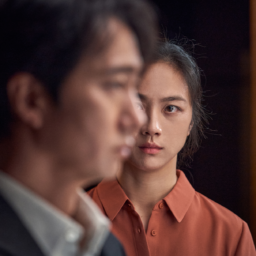
Decision to Leave finds South Korean director Park Chan-wook at the absolute top of his game as he breathes new life into a not-so-classic detective story. The fiercely paced first half is a twisting police procedural that engrosses you with its clever editing and a brilliant score by Jo Yeong-wook before pivoting to a romantic exploration of two people trapped in life patterns finding liberation with each other. While it’s not as subversive as his last film The Handmaiden, Park has a knack for using genre movies to explore deeper themes whilst never being less than entertaining. Park Hae-il’s performance as Inspector Hae-jun joines the pantheon of great detectives while Chinese actress Tang Wei gives the performance of a lifetime. The Oscars should keep an eye on them.
Full review coming soon. Sign up for our newsletter to see it first.
Here is a round-up of three films competing for the Palme d’Or at the 2022 Cannes Film Festival: Boy From Heaven, The Eight Mountains, EO
Boy From Heaven
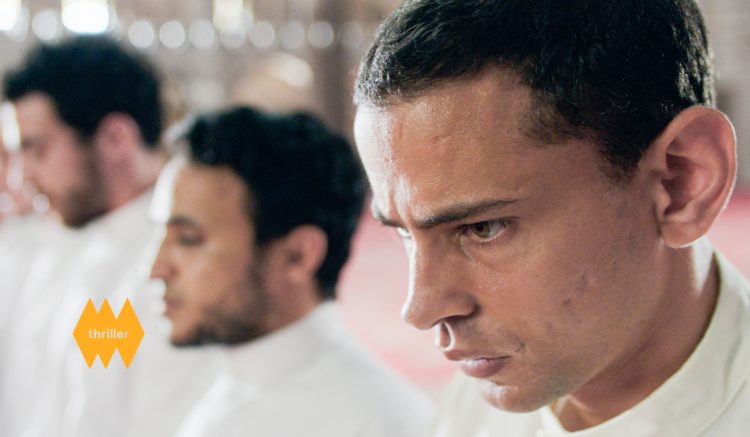
Tawfeek Barhom in Boy From Heaven, which is competing for the Palme d’Or at the Cannes Film Festival. Image Credit: Atmo Rights AB
Boy From Heaven follows young student Adam (Tawfeek Barhom) as he attends Al-Azhar University, the most prestigious Islamic educational institution in the world. The school, which he’s attending on a state scholarship, takes him far from his small fishing town to the bustling metropolis of Cairo. However, plans are in motion in the shadowy corridors after the grand imam, the head of the university and the most influential religious figure in the country dies in front of the school. Looking to install a leader that is in their best interests, state security colonel Ibrahim (Fares Fares) recruits a reluctant Adam to help their cause from the inside.
If this sounds like a story you’ve seen before, then you’re right. A thriller following a young reluctant recruit tasked with spying from within an organization isn’t new. However, what director Tarik Saleh proves is that a story can be fresh and new with a change of setting and perspective. Saleh directs the film with a methodical slow-burn pace that keeps you hooked with every new revelation as Adam’s position puts him into further danger. With each progressive scene, the Hitchcockian influences become even clearer as suspicion and paranoia slowly increase. At just over two hours, it’s surprisingly one of the shorter titles at the 2022 Cannes Film Festival, but never for a moment does it lag.
Though the story may be familiar, the world it takes in, at least to me, is foreign. Saleh tackles the sensitive subject of Egypt’s separation of church and state or lack thereof. The political maneuvering of the state almost completely conflicts with the religion’s “if God wills” teaching. By the movie’s end, the title Boy from Heaven almost feels tongue-in-cheek as Adam’s fate lies in the hand of earthly forces. Newcomer Tawfeek Barhom gives a committed performance of a boy asked to grow up and face the harsh realities of a culture he’s loved as he reluctantly fights for survival. It is one of the best performances of the festival.
ADVERTISEMENT
The Eight Mountains
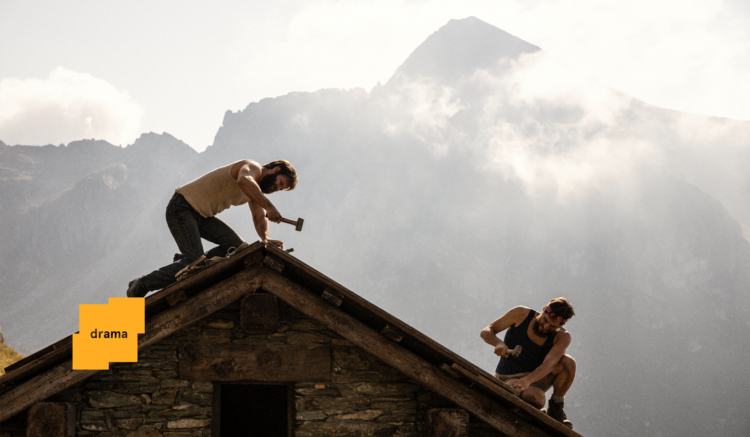
Alessandro Borghi and Luca Marinelli in The Eight Mountains, which is competing for the Palme d’Or at the Cannes Film Festival. Courtesy of Festival du Cannes.
The logline for Felix van Groeningen and Charlotte Vandermeersch’s The Eight Mountains (Le otto montagne in the original Italian) of the friendship between two men that over the years reignites in a remote Alpine village could conjure up comparisons to movies like Into the Wild, Wild, or Brokeback Mountain. However, unlike any of those movies, The Eight Mountains starts at the bottom of an incline but never climbs it.
I had the same problem with Groeningen’s previous film Beautiful Boy as I did this. The craft is undoubtedly beautiful, the score from Daniel Norgren and cinematography from Ruben Impens in particular, but underneath it’s empty. It is nothing but an emotionless exploration of self-identity that doesn’t do anything to actually unpack it. Gratuitous voiceover and a collection of unremarkable scenes are meant to stir some empathy for the characters. Instead, those scenes reek of self-importance. The movie tells us to care instead of showing us why.
It’s unfortunate considering the autobiography of the same name it is based on is regarded highly for its intimacy and perspective. In place of that intimacy, Groeningen and Vandermeersch opted for aesthetics that keep us at an arm’s length from the characters. Perhaps it’s because they themselves don’t understand the story they are telling. Themes of memory, regret, friendship, and loneliness crop up. But once we begin to explore those trails they disappear. For example, when the film’s protagonist Pietro (well-acted by Luca Marinelli) ventures to Nepal to find himself after a loss, he explains in voiceover what he felt, but we never visualize it. We’re told to trust his word that he’s a better person, that he found love, that he understands his life somehow. But it’s impossible to trust someone that we aren’t taught to care for.
Maybe others will be affected by The Eight Mountains. Maybe it’s a journey I haven’t needed to take. But frankly, I’m not sure that Pietro took the journey either — like the equivalent of reading a self-help book instead of going to therapy.
ADVERTISEMENT
Eo
An image from Eo, which is competing for the Palme d’Or at the 75th Cannes Film Festival
EO, which is competing for the Palme d’Or,doesn’t have a plot, little dialogue and, oh, the protagonist is a depressed donkey that may or may not wish he was a horse, but this weird little movie is irresistible. Sure, its lead is a donkey, but this movie is as human as it gets as we watch him journey away from home and back again. And just like Mr. Frodo, he experiences a wide array of people at their best but mostly at their worst.
Polish director Jerzy Skolimowski, who has been a blind spot for me until now, doesn’t over personify his character though. He’ll close in on Eo after a significant event or have him react to something in some way. But he makes clear that he is an animal. That’s not to say he doesn’t care for him. The whole point of the movie is to mine empathy for Eo while also exploring the human world, particularly the conflict in it.
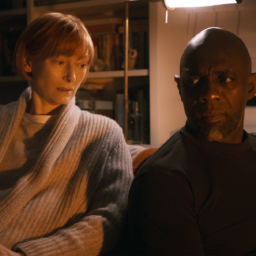
Tilda Swinton plays an academic who frees a Djinn (Idris Elba) from centuries-long imprisonment and is granted three wishes in Three Thousand Years of Longing.
George Miller has never made the same movie twice in his storied career and Three Thousand Years of Longing is no exception. The movie is a visual feast as it hops across millenniums to tell the story of how a Djinn (Idris Elba) found his way into the hands of a lonely academic (Tilda Swinton). Elba’s grainy baritone voice over the lush visuals that Miller renders with the same imaginative spectacle that he did Fury Road draws you in and underlines the movie’s power of storytelling theme. However, whenever the movie trails from that thread and explores that potential romance between Swinton and Elba’s characters the spell is broken. Stories have power, but stories are only as good as their ending. Three Thousand Years of Longing needed one more wish.
Three Thousand Years of Longing is about a genie—or more specifically, a Djinn—and his worst enemy: an intellectual. Many of the myths we know about the concept of a genie tell us that they’re tricksters looking to leave their hapless “master” worse off than before. In that way, they’re cautionary tales. Interestingly, the Djinn at the center of George Miller’s newest film—played by Idris Elba—does the opposite. More than anything, he wants Alithea (Tilda Swinton), the scholar traveling through Istanbul who frees him, to make the right wishes. Still, this is a cautionary tale. One of love and loneliness rather than greed.
ADVERTISEMENT
It’s been seven years since Australian director Miller premiered Mad Max: Fury Road at the Cannes Film Festival and reminded us why he is one of the greatest directors working today, especially in the fantasy genre. Naturally, his return to the festival was one of the most anticipated movie premieres of the year—mine included. With a blank check from the incredible critical and awards success of Fury Road, I was anticipating nothing but the most impressive world-building wrapped in a visual spectacle that has to be seen to believe. Instead, Three Thousand Years of Longing left me yearning for much more like the characters at its center.
Alithea, a dedicated and eccentric scholar, journies to foreign lands to speak about her theories of how fantastical stories in our history have been rendered obsolete by science and now relegated to the pages of comic books. However, science can’t quite explain away the visions of ghosts of history haunt her including one of King Solomon who seems a bit angry at Alithea’s presentation at a conference. After exploring Istanbul with a colleague, she comes across an odd glass bottle. Warped, lined with a swirling blue design, and, of course, sealed shut.
ADVERTISEMENT
When she returns to her hotel room, the bespeckled Alithea inadvertently opens the bottle while cleaning it with her electric toothbrush. A thick dark mist envelopes her hotel room to reveal an enormous Djinn, a ghostlike creature from Arabian mythology but is used interchangeably with a genie in the movie. Elba’s hulking figure and striking face coupled with prosthetic pointed ears and yellow eyes make for a striking effect. He reveals to Alithea that he’s been imprisoned for hundreds of years and that now he owes her three wishes for setting him free.
Alithea, the ever-analyzing historian that she is knows from mythology that these wishes rarely turn out well and refuses. Djinn, sent into a frenzy, cautions that if she does not make her wishes nothing good could come of it recalling how it is what caused his imprisonment for the second time. He reveals to Alithea that he has been imprisoned three times over the past three thousand years.
So begins Three Thousand Years of Longing’s ode to storytelling as Djinn recounts in poetically-written narration his journey through millennia. From the Queen of Sheba (Aamito Lagum) to a poor concubine during the age of the Ottoman Empire, Miller brings each encounter to life as vivid magical landscapes that quite literally shimmer on the screen. However, we’re not given time to luxuriate in each world. This is a story that Djinn is telling us. As with all orally passed down stories, there are gaps as it jumps from moment to moment rarely letting the emotions of the events to seep through. It’s like there’s a barrier between the storyteller and the audience—it’s why Three Thousand Years often feels cold.
ADVERTISEMENT
Based on B.S. Ayatt’s short story The Djinn in the Nightingale’s Eye, Three Thousand Years of Longing feels like a blank check movie in that most studios wouldn’t immediately greenlight a $60 million fantasy romance told mostly in voiced-over flashbacks. You’d expect an epic. However, the movie feels slight because of its structure—especially compared to Fury Road. Though, that slightness is a benefit to the second half of the movie, which shifts—somewhat abruptly—from epic fantasy to a quiet romance.
There are two key ingredients to make a romance work: chemistry and overcoming adversity. Unfortunately, neither work here. Not to the fault of Elba or Swinton, who as always give masterful performances. Particularly Elba who has to literally portray three thousand years of longing and trauma—something he carries on his face throughout the movie. The movie structurally doesn’t give us the chance to fall for the characters as they fall for each other as we switch back and forth between times and places. We don’t have a reason to root for Djinn and Alithea’s love story by the time the movie focuses in on it. It’s a shame since the part of the story is what would have it work. Despite Djinn’s warnings and Alithea’s logic, they still fall into the same traps that Djinn has seen for millennia. It implies that matters of the heart are often clouded because it’s our nature as humans. However, Miller is never able to consummate that theme and the story.
There’s magic to be had in Three Thousand Years of Longing. And if you know Miller’s work—Mad Max, Babe, Happy Feet, The Witches of Eastwick—you know that you’re going to see and feel it. The world he builds is nothing less than spectacle. But behind the sparkling vivid imagery is emptiness. Ironically, the movie leaves us longing for more. More character, more emotion, more humanity. What made Fury Road such a monumental achievement was its ability to consummate a genre story with deeply complex human themes. Three Thousand Years frankly fails on both accounts. Well, here’s hoping for the Furiosa movie.
Hirokazu Kore-eda follows a group of misfits that form a would-be family as they trek across Korea to sell a recently “abandoned” baby in Broker
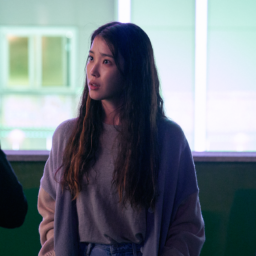
Hirokazu Kore-eda’s Broker is at once a heartwarming cheeky road-trip comedy and a heartbreaking drama of misunderstood misfits that continues his exploration of the meaning of family that he began with his 2018 Palme d’Or winning drama Shoplifters. Though the movie’s slight crime narrative keeps the plot moving, it’s the irresistible and charming cast of characters that keep you engaged — particularly Song Kang-ho’s would-be patriarch Sang-hyeon and Lee Ji-eun’s (better known as singer-songwriter IU) flawed yet complex young mother So-young. Each character and performance feels like an actual person that lived a full life before the movie begins and Kore-eda finds those complexities as they continue to develop during the movie’s breezy running time.
Broker is premiering at the 2022 Cannes Film Festival.Neon acquired the movie for U.S. distribution prior to the festival.
At the start of Broker, we see So-young (Lee Ji-Eun, better known as popstar IU) leave her baby outside a “baby box,” a drop-off point where would-be mothers can leave their unwanted baby in safe hands. Some people would say that she was abandoning her child. But as police sergeant Soo-jin (Bae Doona) puts it later, So-young was protecting her baby. That is a theme throughout Hirokazu Kore-eda’s Palme d’Or competing drama, which premiered at the 2022 Cannes Film Festival. What is perceived as an act of selfishness by some could in fact be an act of love.
ADVERTISEMENT
It’s a similar theme to Kore-eda’s last movie, the Palme-winning Shoplifters, which presupposed that chosen families bonded by similar life experiences or trauma are stronger than those by blood.
However, Broker expands on that to explore the idea that families are only as strong as your actions to protect them. If it sounds like grounds for sentimentality, then you would be right. Kore-eda is a bit of a master when it comes to balancing sweetness with the realities of the world. And if Shoplifters and Broker are any indications he’s most interested in exploring them through complicated characters whose reasonings may not immediately seem just.
Such is the case with the titular “brokers” of the movie — Sang-hyeon (Parasite’s Song Kang-ho and Dong-soo (Gang Dong-won) — who take babies from the baby box of a church and sells them to desperate families for the highest price. One of those babies is So-young’s Woo-sung who Sang-hyeon and Dong-soo feel they can sell despite his thin eyebrows — a fact that is hilariously brought up often. We’ll learn more about why the brokers feel just in their actions, even if it’s not their conscious reason. But that’s the beauty of Broker, Kore-eda fills his script with so many moments of empathy that it’s easy to understand such complex characters.
Eventually, in a surprising change of heart, So-young comes back for Woo-sung. However, because of a technicality she no longer has parental rights to him. Instead, the broker pair convinces her to let them find him a family. The ever street-smart So-young instead uses the opportunity to ensure that Woo-sung goes to a home that deserves him rather than just any family with enough money to buy a baby.
ADVERTISEMENT
Though the entire cast is effortlessly charming with characters that feel lived-in with fully formed pasts and looking towards the future, it’s Song Kang-ho’s would-be patriarch Sang-hyeon and IU’s So-young that are the heart of the movie.
While larger plot machinations come into play including a criminal investigation run by detectives Soo-jin and Lee, the movie’s main focus is each character’s (including the investigators) relationship with their past — and the fight to become more than it. Sang-hyeon, who has an ex-wife and daughter, is seemingly never able to connect with them and is seen as flighty and inconsistent. On the other hand, So-young harbors a secret that gives her pause to start a family with Woo-sung. Though it sounds ripe for manufactured overwrought sentimentality, it never strays into melodrama.
In the most impactful scene in the movie on the precipice of their time together, So-young turns off the light in their hotel room — as to not have to face each member of their ragtag family — and says, “thank you for being born” to each one. There are no waterworks (except from me and the audience), no dramatic declarations, just five people in a room grateful to have found each other. The scene is earned rather than muscled in to pry a few tears from the audience.
Kore-eda understands that drama can be warm without unearned emotionalism. Broker may be charming and slightly heightened, but like any good tale, it’s based in something fully human.
Like Shoplifter before it, Broker doesn’t have an easy ending. Possibly not even one that you’d consider happy. As much as the movie is a serotonin booster and heartstrings-tugger, Kore-eda always finds his way back to the ground level. While this new family that we’ve come to love over a two-hour period may not get a happily ever after, they certainly get a “and life goes on” ending. Taken with Shoplifter, its spiritual prequel, Broker is a promise that although life has its ebbs and flows and happiness is fleeting, there is a way to survive it. And that way to survive is with each other.
A group of billionaires on a private yacht cruise have their world turned upside down when a catastrophic event strikes in Triangle of Sadness
Triangle of Sadness is a two-and-a-half-hour joke-a-minute biting satire of the rich and class that keeps you guessing in every scene. And despite having jokes like an extended 10-minute puke scene, it’s a well-studied character study about people of privilege and how they would react with it taken away. The cast of characters that ranges from a capitalist Russian oligarch, a drunk Yacht captain, and two dating models are perfectly wrought parodies of the rich that you miss hanging out with after the final credits roll. I could have watched it for hours.
Triangle of Sadness is premiering at the 2022 Cannes Film Festival. Update: Neon has acquired the film for distribution later this year
A few times during Triangle of Sadness, Swedish director Ruben Östlund’s Palme d’Or-competing film at the 2022 Cannes Film Festival, we see and hear “everyone’s equal.” But nothing is quite as ironic as that phrase being splashed up on screens at a high fashion runway show or uttered on a luxury cruise targeted at billionaires and influencers. That’s Östlund’s intention. Every one of his films takes aim at something wrong in our society by taking people in power and with privilege and putting them in situations that take them away: an avalanche in Force Majeure, a leaked video in The Square, and now a catastrophe on a yacht in Triangle of Sadness.
But what he was exploring in his prior two films he perfected in Triangle of Sadness. The result is one of the best comedies in years.
ADVERTISEMENT
The movie is split into three parts plus a prologue where we meet model Carl (Harris Dickinson) on a casting call where he’s hilariously told to relax his “triangle of sadness” aka the wrinkles between your eyebrows when you scrunch your face. “Maybe a little botox will help,” says one of the casting directors. Then, part one, titled “Carl and Yaya” begins.
Yaya (Charlbi Dean), a high fashion runway model, and Carl are at dinner when the check comes which she ignores until his hand barely grazes it and she thanks him for paying. This sets off a night-long argument about the principle of paying for dinner — something every couple has experienced at one point or another. Taken as its own short film, part one would be a perfect deconstruction of relationships where currency comes in power given and taken. More than once it’s mentioned that Carl makes less than Yaya but he also points out that it’s not about the money but the principle.
ADVERTISEMENT
We later catch up with them in part two, “The Yacht.” Carl and Yaya are among the passengers on a luxury yacht cruise that plays like a seabound version of Upstairs Downstairs where we spend time with the various ridiculous (and ridiculously rich) passengers and the staff that serves them led an overly ambitious and eager to please cruise director (Vicki Berlin). The part fully becomes a broad comedy as the cast of characters increasingly show how out of touch they are with the real world. Among them are war profiteers proud of their business, a capitalist Russian oligarch and his wife who insists the staff stop work and go for a swim, and the cruise’s drunk captain (Woody Harrelson).
If the first part and cold open were closer to satire, this part is a purely broad comedy with hilarious introductions to the most out-of-touch rich people, a storm-laden drunken dinner, and a ridiculous 15-minute gross-out gag that’s like Titanic with more puking. Particularly hilarious is Harrelson’s Tom, a self-proclaimed socialist, and Dimitry (Zlatko Burić), a capitalist Russian tycoon, having a healthy commiseration of ideologies loudly and drunkenly broadcast over the ship’s PA system.
ADVERTISEMENT
I’m not sure I want to tell you where the movie ends up. Part of the fun is the unexpected turn that it takes for its third and final part that sees the social system turned on its head as Gloria (Dolly de Leon), the Filipino toilet manager of the ship, finds herself in a new position of power. Let’s just say it’s like an episode of Survivor without the film crew. The hyjinks continue as the movie romps its way to a perfect ambiguous conclusion fit for its characters. By the movie’s end, I was sad that I wouldn’t be able to see more of them. I could have watched it for hours more.
Triangle of Sadness comes after a long run of “eat the rich” movies from Get Out to Parasite. While both of those movies have their fun, there is a darkness at their center. The value that Östlund brings to the genre is a lack of self-seriousness. Rich people are out of touch. We know that. He’s not interested in adding the message. He’s here to have fun and take the piss out of deplorable rich people (among other bodily fluids). If Triangle of Sadness proves anything it’s that the broad comedy is not dead.
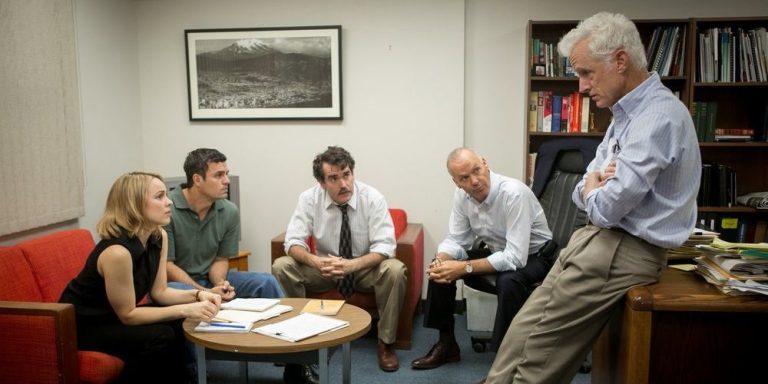
About thirty minutes into Spotlight, Boston Globe reporters Sacha Pfeiffer (Rachel McAdams) and Michael Rezendes (Mark Ruffalo) speak to two of the victims of abuse at the hand of Catholic priests belonging to the Archdiocese of Boston. The two separate interviews are interwoven, one amplifying the message of the other. And in the background — both literally and figuratively — is the Church. It’s scenes like these where Spotlight transforms from an engrossing journalistic slow burn into a marvelous empathetic piece of humanity.
ADVERTISEMENT
Spotlight, directed by Todd McCarthy, tells the story of the Pulitzer Prize-winning investigation into the Boston Catholic Church scandal. Headed by Walter “Robby” Robinson (Michael Keaton), the Boston Globe Spotlight team explore the cover-up of over 90 cases of sexual abuse and molestation of children by Catholic priests.
While Spotlight is a feat of classic screenwriting that harkens back to the days of All the President’s Men or Network, McCarthy’s subtle direction is what amplifies it to greatness.
In frames and in dialogue, the Church’s power is feared and felt. The movie emphasizes: The Church is Boston and Boston is the Church. As attorney Mitch Garabedian (Stanley Tucci) says, “if it takes a village to raise a child, it takes a village to abuse one.” Moments of pure tension — the ones that bring the film alive — are brought about by the invisible power of the Church and the survivor’s trauma. And while their experience is central, it never feels exploitative.
Unlike the inaptly named film Truth from the same year, Spotlight feels like it’s after the truth, just as much as the journalists at its center.
ADVERTISEMENT
Using natural lighting, imperfect takes, and casting actors according to their strengths gives the movie a cinéma vérité feel that is all the more affecting.
McCarthy leaves dramatic moments to characters rather than formulating the plot around shocking reveals or twists.
The entire ensemble — which Open Road has stressed in their campaign, the word ensemble — is at their career bests. John Slattery is perfect in his follow-up to Mad Men in a role that may feel similar but allows him to flex a muscle he’s been honing for the years the show has been on air. And while Michael Keaton and Mark Ruffalo have been receiving the bulk of the acclaim of the actors on the Spotlight team, Rachel McAdams steals the… well, spotlight. Controlled and assured, her performance is an anchoring calm that lets the story take the forefront.
ADVERTISEMENT
And that’s what makes Tom McCarthy’s direction so smart. Its restraint allows its subject to shine. The performances give it the time it deserves. Instead of dramatics, Spotlight feels so character driven.
Spotlight tells the story that started the story. In today’s media environment, the role of the press has been both challenged yet as important as ever. The reverence that the movie has for the journalistic process is not only admirable but essential. It goes against anything that we’ve been forced to understand in film nowadays — bigger, louder, more tears, less emotion. However, Spotlight finds itself the best when the script doesn’t try, the actors don’t act, and camera just follows. Spotlight stays with you, if not for the film, at least for the truths that it uncovers.
It reminds us that we deserve the truth, it just takes someone (or someones) to uncover it.
From psychological to political, here are some of our favorite thrillers since 2020
What is a thriller?
The thriller genre is difficult to nail down because the genre itself is so broad. Where does the thriller genre end and horror begin? Are all action movies thrillers, but not all thrillers action movies? While the definition isn’t exact, there are a few constants: red herrings, plot twists, cliffhangers, and, of course, suspense.
After a shift towards
And without further ado, here are my favorite thrillers since 2010!
The cast of environmental thriller How to Blow Up a Pipeline. Courtesy of Neon.
What it’s about: A ragtag group of environmental activists race against the clock to sabotage an oil pipeline.
Why it’s great: In many ways, How to Blow Up a Pipeline is a classic heist thriller in the vein of Ocean’s 11 as we watch a group of prior strangers come together to pull off a seemingly impossible feat. Director Daniel Goldhaber uses every second of runtime to slowly ratchet up the tension as the crew sets their plan to blow up the eponymous pipeline in motion.
Using a clever non-linear narrative structure the movie feeds you new information about each of the characters and their dynamics to add color to their personal journeys and complications to the mission at hand. The result is a near real-time stunning and anxiety-inducing but deliciously entertaining eco thriller. Read my full review.
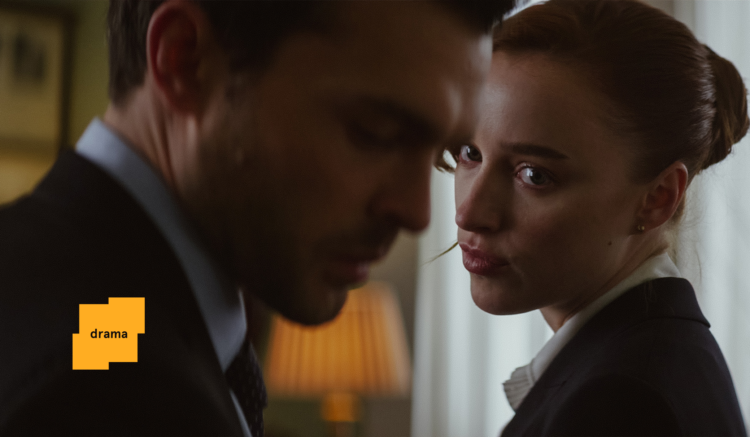
Phoebe Dynevor and Alden Ehrenreich appear in Fair Play by Chloe Domont, an official selection of the U.S. Dramatic Competition at the 2023 Sundance Film Festival. Courtesy of Sundance Institute.
What it’s about: Emily (Bridgerton’s Phoebe Dynevor) and Luke (Alden Ehrenreich) are a crazy, sexy, cool couple drunk (and horny) on their recent engagement that they have to keep secret since they work together at a highly competitive hedge fund firm. But when Emily is promoted over Luke, insecurity, competition and jealousy threaten to destroy their relationship.
ADVERTISEMENT
Why it’s great: Fair Play plays like a ticking time bomb as the couple’s relationship is put under the strain of Luke’s arrogance and Emily’s ambition.
It’s the balancing of those two threads that make the movie — particularly writer director Chloe Domont’s sharp screenplay — so impressive. At times, the movie is a corporate barnburner about Emily navigating her newfound success as a woman in an industry that is decidedly a boy’s club. In others, it’s a darkly funny psychosexual relationship drama about how deviations from the traditional gender dynamics can send men into a tailspin — let’s just say Luke probably loved Joker. And at its most satisfying, both worlds come careening together as the pair navigate the minefield of their relationship in the workplace.
Phoebe Dynevor and Alden Ehrenreich give powerhouse performances that give the melodrama some much needed gravitas. Cutthroat, sharp and entertaining as hell, Chloe Domont didn’t come to play. Read my full review.
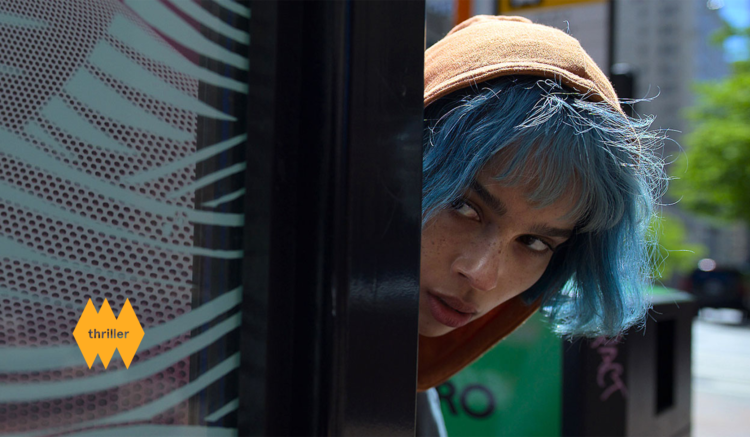
What it’s about: Angela (Zoë Kravitz), whose agoraphobia due to a prior trauma — and now exacerbated by the coronavirus pandemic — confines her to her apartment, works for a tech company monitoring the data from their smart speaker product Kimi (like an Alexa) for quality assurance. However, when one of the files she’s listening to sounds like a crime she’s faced with corporate red tape, conspiracy, and, her worst fear, going outside.
Why you should watch it:Kimi tells a story we’ve seen before — Rear Window and The Girl on the Train immediately come to mind. But Soderbergh throws in these tiny details that make it feel so relevant to our place and time.
ADVERTISEMENT
Like many people watching movies stuck at home, I had headphones on. In one scene, Angela puts on her AirPods to drown out the sound around her. When she puts her right earbud in, our right earbud goes silent. When she puts the left in, our left goes silent. It’s something that you might miss, but that small choice immerses you in this world that is so familiar.
When Angela goes outside for the first time, masked up with packets of hand sanitizer in her pockets, the camera switches from steady and deliberate to frenetic and chaotic as she’s faced with the anxiety of being around people. It elevates Kimi far past its thriller roots.
And sure, you can probably call many of the plot twists. But what Soderbergh constructed is a lean, mean, perfectly-paced thriller that recognizes the time that we’re in. Too many movies being made today ignore the pandemic and the past two years we’ve experienced. Instead, Soderbergh embraces it and uses it to his advantage to not reinvent the wheel but spin it at a different speed. Read my full review.
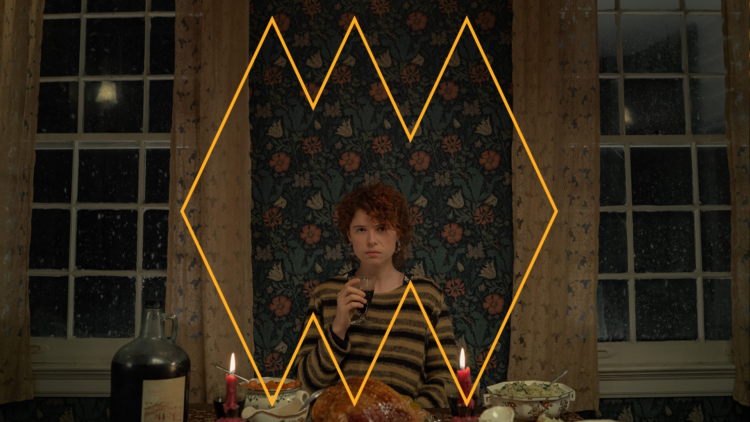
Jessie Buckley in I’m Thinking of Ending Things. Courtesy of Netflix.
What it’s about: A young woman (Jessie Buckley) is driving with her boyfriend (Jesse Plemmons) to meet his parents for the first time. There’s one problem, she’s thinking of ending things. When she meets his mother (Toni Collette) and father (David Thewlis) things go from odd to flat out weird as the world around her changes.
Why it’s great: Loneliness is a prison. The memories, regrets, and what-ifs of life become trapped on repeat in your head forming a blend of reality and fantasy in your psyche in an effort to fill the void of silence that it creates. In the time of the coronavirus pandemic that feeling may hit closer to home, which is why Charlie Kaufman’s I’m Thinking of Ending Things feels so effective as a psychological thriller.
The movie is a slow-burn of conversations that begin as a little off and then become full-tilt bizarre as the world around the couple goes from real to surreal. At the core, psychological thrillers should make you question exactly what is real. In I’m Thinking of Ending Things, the question isn’t what is real, it’s what is reality at all.
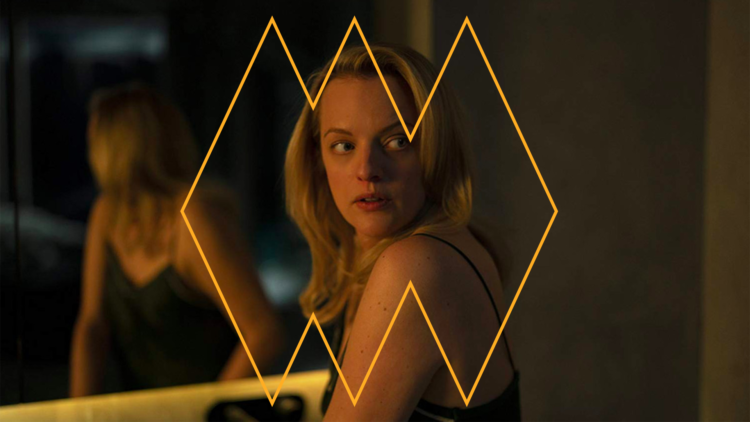
Elizabeth Moss in The Invisible Man. Courtesy of Universal Pictures.
What it’s about: After escaping her abusive tech tycoon boyfriend (Oliver Jackson-Cohen), Cecilia (Elizabeth Moss) thinks she’s finally free from his grasp. However, a vague threat from the past and a series of odd occurrences make her think that he’s watching her every move.
Why it’s great: There is so much to love about director Leigh Whannell’s reinvention of the 1933 original film The Invisible Man, but the best place to start is perhaps the reinvention itself. Instead of treading similar territory, Whannell tackled the very 21st century story of toxic relationships, gaslighting, and emotional abuse.
However, the way he brings about those themes is by combining innovate modern cinematic techniques with the old-fashioned staples of building the suspense. Without compromising its rich themes or depriving the audience of moments of terror to hang onto, Whannell is able to make an artfully made and emotional movie that feels auteur-driven but still made for the mainstream. Read my full review.
This week, we analyze romantic drama Past Lives and discuss how it explores race, the immigrant experience and challenges the concept of a soulmate
Hey! We’re Karl and Ana. Best friends, writers and movie obsessives that love to analyze (overanalyze?) movies. In Movie Therapy, we take a movie that we love and explore its story and themes to understand what it means to us (and maybe you). This week we analyze Past Lives. Spoilers are abound so proceed with caution.
For the best experience, we recommend you read on desktop. This conversation has been edited and condensed.
Karl Delossantos Hello! 👋 Welcome to the first edition of Movie Therapy, a series where my co-movie over-analyzer Ana Toro and I discuss a movie to understand what it means to us (and maybe you). Today, we’re analyzing the meaning behind Celine Song’s Oscar-nominated drama Past Lives. Shameless plug: you can read my review here.
Hello, Ana! Ready to overthink?
Ana Toro Yes! Our specialty!
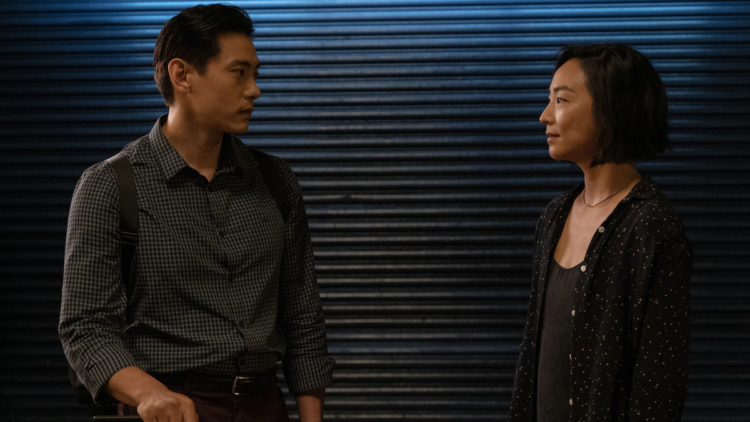
Karl I want to start this discussion at the very end of the movie. We watch Nora (Greta Lee) and Hae Sung’s (Teo Yoo) emotional goodbye. As she walks back towards her home and husband Arthur (John Magaro) in the East Village (in my home neighborhood!) Nora begins to cry. How do you interpret that moment?
Ana I think she’s mourning the past – what could have been. In that moment she witnesses a chapter closing. And though it’s the rational thing to want closure, it tends to bring an unexpected amount of pain.
Karl It’s interesting because it feels like she spends a lot of the movie only looking forward. Even when she does look back in the second act when they reconnect over Skype she quickly realizes that it’s something that’s “holding her back” even if it’s not necessarily the case. But I think because she never allowed herself to confront where she’s come from, she’s never had to close the chapter… until that scene.
But at the same time, she’s where she’s always wanted to be. And if you ask me, where she belongs. Something we might disagree about.
Teo Yoo and Greta Lee in Past Lives. Courtesy of A24.
Ana Haha yes! I mean, the brilliance of this movie is that it is so subtle and nuanced that it really does reflect back at you whatever your current beliefs, or point of views are. When I watched it the first time with you, I was very much in a place in my life where I was looking back to the past, and towards someone from the past specifically. I’m pretty nostalgic by nature, so this wasn’t out of character for me, and I definitely sympathized the most with Hae Sung’s character… to the point where you’ll remember that I was pretty accusatory towards Arthur’s character, believing him to not be right for Nora, and insisting that she should look towards the past to move forward, and be the version of herself that she had left behind.
Karl Projecting, essentially.
ADVERTISEMENT
Ana Exactly. When I watched it a second time I was definitely in a more calm place in my life, having had a bit more closure and feeling a lot more present in my day to day life. So of course, I was more neutral while watching the narrative play out, and I realized that the end wasn’t a tragedy, but rather something beautiful, an acceptance of the past and the present. Nora’s outburst was a catharsis, not necessarily something bad, or more meaningful than it was.
Karl Yeah when we first watched it we were the closest we’ve ever been to arguing in our friendship over whether Hae Sung or Arthur was her soulmate. And perhaps the answer is that soulmates don’t actually exist. At least in the very black-and-white sense that most people think about them.
“Which is interesting because the movie constantly brings up the concept of soulmates, and it’s a recurring motif / theme of the movie so it’s almost like a red herring.“
Ana Which is interesting because the movie constantly brings up the concept of soulmates, and it’s a recurring motif (if not the outright theme!) of the movie. It keeps the viewer guessing as to who she’s going to choose – who is the actual soulmate. For such a quiet movie this is the biggest source of tension that drives the film forward. It almost feels like holding your breath, until the very end when they say goodbye.
Karl Yeah. I mean, the movie is structured like a romance. The direct comparison a lot of people have been making is to the Before trilogy. A series of movies that we love. And in a lot of ways, they are similar in that they talk about the seeming randomness of romance that is actually clouded in fate.
ADVERTISEMENT
Ana It’s like the Before trilogy but happening all at once!
Karl 💯
This might be the time to note too that the writer-director Celine Song based the character of Nora in some part on herself and is currently married to the equivalent of Arthur. Her husband Justin Kuritzkes is a white writer that she lives with in New York. And ironically wrote Challengerswhich is another movie about a love triangle. Maybe they’re dropping hints.
Ana That absolutely changed everything for me. I almost couldn’t believe that in some ways we were given the answer to such an open ended mystery in Past Lives. To me it means that she chooses Arthur in the end! Because he represented her present, and her future. How did you feel when you found that out? Did it change the movie at all for you, or am I reading too much into fiction and its likeness to reality?
Karl I think you can’t not think it’s connected in some way. But unlike you I was always on the side that Arthur is who she should be with. Right now, at least. I think hearing that just affirmed that for me. I went through a pretty big breakup a few years ago and since then I’ve felt very much how Nora felt. Looking forward. Working on my career. Moving myself up and out of my current circumstances.
But I did have times where I thought, “what is this all for?”
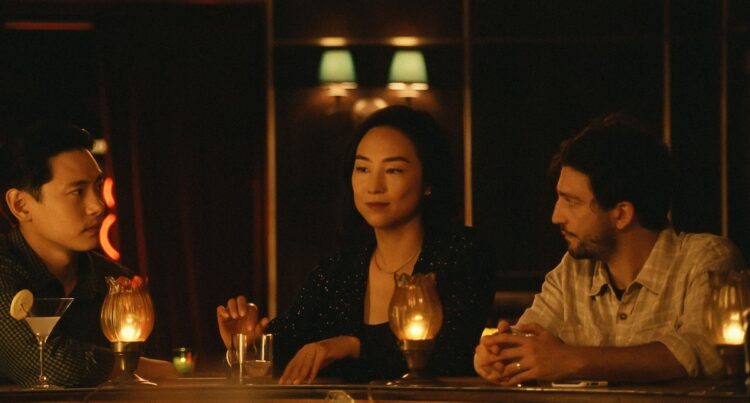
Ana I think that’s the thing that we’re meant to be feeling at the end of the movie though – we aren’t ever going to be sure if something is the right choice or not. There are ways to justify any decision or relationship – Arthur and Nora could have in-yun, but so could Hae Sung and Nora. This concept is even poked at by Hae Sung and Arthur during their conversation at the bar: maybe they’re the ones that have the multiple layers of in-yun! There’s truly no way to know, so we just have to accept whatever choice is made.
Karl It makes me wonder whether Past Lives is almost an exercise to assuage the uncertainty of whether you made the right decision.
Ana That makes me wonder a lot about her intentions for making this film, and how much of it she admits to being autobiographical. It’s a beautiful film regardless, but I think it does bring up questions as to how much art resembles life, and if the film’s narrative should stand alone regardless of what she has revealed during the press circuit.
“Nora and Hae Sung are in many ways in opposition to each other. He stayed in Korea, she moved to Canada and then New York. He followed his head to a technical career. She followed her heart to the arts. He’s living in the culture he grew up in and she’s grounding herself in a new one.“
ADVERTISEMENT
Karl As a viewer the first time without that background I think we still picked up what Song was struggling with. Nora and Hae Sung are in many ways in opposition to each other. He stayed in Korea, she moved to Canada and then New York. He followed his head to a technical career. She followed her heart to the arts. He’s living in the culture he grew up in and she’s grounding herself in a new one.
Which is funny when we learn that Arthur is learning Korean to understand her better. Oddly, I think I also related to Arthur, as well.
Ana I know I’m being superficial and too focused on aesthetics and a simplistic romantic worldview, but I just have to say: it is so unfair that Greta Lee and Teo Yoo are the most beautiful people in the world, with chemistry in this movie that is off the charts, inhabiting a film that comes across as aesthetic visual ASMR, and we don’t actually get to see them profess their love to each other. It’s inevitable to root for the beautiful couple with perfect bone structure, that are also childhood sweethearts, separated by fate. But I guess that’s the expectation we’re meant to be pushing up against.
Teo Yoo, Greta Lee and John Magaro in Past Lives. Courtesy of A24.
Karl The bone structure!! Cut from marble both of them.
Ana No like, they were made to be on camera.
Karl But I think this was an intentional decision. We get all these very superficial indications that Arthur is just some average white guy. The book he authored in the movie is called “Boner” for God’s sake!
ADVERTISEMENT
Ana WITH A JEFF KOONS BALLOON SCULPTURE ON THE COVER. Nothing screams out more “mediocre white man” that fumbled his way to the top more than that. I’m sorry, I’ll relax, but my art history minor clocked that immediately and I am of the belief that every single choice in a film is intentional. So why add that? This would be my question to Celine Song if I were to ever attend a Q&A with her.
Karl #Arthur4Lyfe <3
Ana Rethinking our friendship as we speak. I’d leave the conversation if I wasn’t digitally chained to this chat.
Karl I just knew this would end in an argument. But then we see his relationship with Nora and I think there’s a real love there. That scene in the bedroom before they’re about to go to sleep is oddly the centerpiece of the movie.
Ana Karl. No it is not. It is a movie full of beautiful set pieces, and him trying to say fried chicken in Korean is not the one.
“They never express their full feelings. Which is, as an Asian-American, a very real thing. Whereas Arthur is so willing to vocalize the way he feels in that moment. And he delivers for me the most potent line of the movie: ‘You make my life so much bigger. I’m just wondering if I do the same.’”
ADVERTISEMENT
Karl I think I find that scene so refreshing because Hae Sung and Nora often talk around each other. They never express their full feelings. Which is, as an Asian-American, a very real thing. Whereas Arthur is so willing to vocalize the way he feels in that moment. And he delivers for me the most potent line of the movie: “You make my life so much bigger. I’m just wondering if I do the same.”
For Nora, Arthur does make her life bigger. For Hae Sung, Nora makes his life bigger. But I’m not sure he does the inverse. And that’s why Past Lives feels as much about the transient experience (I’m intentionally not saying immigrant here) as it is this specific romance.
Arthur even calls out in a different story he’d be the villain. Though, you certainly think he is. But he’s not. He’s the third protagonist, if anything.
Ana I’m curious as to why you won’t say immigrant! To me this movie really does encapsulate the immigrant experience. Immigrating is all about that central theme, captured by that same line you just mentioned: what makes your world bigger? Does staying in Korea make your world bigger, or smaller? If you feel like you’ve outgrown a place, and like you can grow so much more outside of it, that’s why you immigrate. So you don’t live an entire life unsatisfied, feeling stuck, and wondering “what if”. Just like you would with a past lover – places can encapsulate the same feeling of lost potential, and wanting more. Nora’s parents, even though her dad was successful filmmaker, knew they could have bigger lives for themselves and their daughters abroad, and so they did.
Hae Sung goes to China for the same reason, it’ll expand his work opportunities. After visiting New York, temporarily making his world that much bigger — literally, does he then seek job options abroad? Maybe! Maybe that’s his smile at the end of the movie — he sees a bigger world for himself thanks to Nora. Maybe not a life with her, but his own future, which he can now literally visualize since Nora paved the way, but he’s also free to pursue, without any attachments (at least romantic) in Korea, or New York.
Karl While I do think it definitely touches on the immigrant experiences and uses it to explore about the sensation you’re describing it feels like with a lot the movie it paints in broader strokes as to allow as many people as possible to relate to it. So what you were about outgrowing a place. That doesn’t necessarily have to tie to leaving your specific country. I left New Jersey to move to New York City and that small of a move still felt like my world was expanding. But I think it could be as simple as just leaving the path that is predestined for you. Hae Sung follows the very pragmatic Korean expectation of living with your parents until you’re married, going to school so you can find a stable job. Even going to China was in service of that mission. But that isn’t specifically the immigrant experience, which is why I used the word transient. Maybe transplant might even be more appropriate.
I think if Past Lives was about the immigrant experience then that first section when they were kids wouldn’t have jumped to 12 years later right when she was about to start her life in Canada.
Ana Fair! Totally understand what you mean, and agree that transplant is a better word. Though in an interview with Deadline, Celine Song does say that while the movie is objectively true to her immigrant experience, she does want people to relate to her story even if their experience is moving from St. Louis to L.A., for example. But this is getting into the weeds of how we define immigrants and transplants.
Karl To wrap this up, because this chat is now over 2000 words, I have one last question: which character (or combination of) do you relate to most and why?
I’ll start with my favorite character… Arthur. Muahaha 😈.
Ana Is he really your favorite?
Karl I love them all for different reasons. I think part of it is my affinity for John Magaro who I’ve loved since First Cow. A movie you have to watch since I know your affinity for cows. And I think he has the dialogue that felt most potent to me in a lot of cases.
I guess I feel like I’m a mix of all three of them in a way. I have the good boy aversion to risk like Hae Sung, the headstrong ambition of Nora and the insecurities of Arthur. And perhaps I’ve felt more Arthur recently than Hae Sung or Nora.
ADVERTISEMENT
Ana I agree, I mean I think the beauty of this movie is that it is up to interpretation, and you could see yourself as any of them depending on your current circumstance, or play out a different reality where you, as Nora, does get into the car with Hae Sung at the end. In my first watch with you, pining for an ex-love, I was fully in Hae Sung’s shoes, living in the past, remembering everything and not moving forward. Now I feel a bit more self-assured about the present and my future, like Nora. But through this conversation I’ve actually had a pretty potent realization —
Karl Ahhh a movie therapy breakthrough!
“The reason I was so put off by Nora and Arthur’s relationship (and why I reactively took Hae Sung’s side at first) was that it reminded me of my own relationships and the insecurities I’ve had in them…”
Ana The reason I was so put off by Nora and Arthur’s relationship (and why I reactively took Hae Sung’s side at first) was that it reminded me of my own relationships and the insecurities I’ve had in them, especially regarding having a white partner as a Colombian that I was afraid would never understand my native language, or my immigrant experience.
Karl Yeah I completely get where you’re coming from. It’s something you become so aware of too as you get older and our understanding of race evolves.
Ana In my early twenties and the immaturity that comes with that time of my life, I definitely felt misunderstood and didn’t have the tools or mental stability to have those conversations about my culture, without feeling…
Karl Without feeling immediately defensive about your feelings.
Ana Exactly! It’s a shame, because I do think that relationship could have had a future if we had met later on in life, when I had actually come to terms with my own immigrant experience and that it doesn’t mean I had to explicitly date someone that came from where I came from — they simply had to love me in spite of our differences, and make a true, honest effort, like Arthur does with Nora.
Seung Min Yim and Seung Ah Moon in Past Lives. Courtesy of A24.
Karl And granted we went to a predominantly white college, which I think made all those differences all the more obvious. Same with how Nora found herself in a place so different and foreign from what she knew.
I also had a white boyfriend around that time.
Ana Oh, I remember!
Karl Haha it was a time!! But something he did that I appreciated was take the time to understand where I was coming from in our relationship. We had a lot of conversations about how we could come off as an interracial Asian/White couple. Like cue the colonizer jokes (often from me…). And it angered him that we would be seen that way but I think he eventually understood is that’s a fact of my life. And that understanding was enough. He didn’t have to solve it. But just know about it.
Maybe that’s why I appreciated Nora and Arthur’s relationship. Particularly the discussion they have mid-way through the movie. All Arthur wanted to do is understand where she comes from — even if she was resistant to look back at her own life.
ADVERTISEMENT
Ana That’s lovely! Yeah I definitely was so insecure during that time, that I became a victim and my own worst enemy when it came to having those conversations. But you live and you learn. Which is funny, this is that same relationship I was wondering about right as we watched Past Lives together, and I was thinking, what if things had been different? What if it all took place now?
I remember that day so distinctly: we were having a reflective day, one of those very beautiful fall days where the city and the light is perfect, and it’s unseasonably warm, but you can still pull off a nice fall outfit. The first of our college friend group turned 30 that day, and we met up with her at a cafe. And I remember thinking that we all felt content about where we were in life at that moment. Naturally, that day fell apart in spectacular fashion for me, but we met up again at the end of it.
Karl And while we were walking I think I remember saying we should watch Past Lives because (1) it’s the kind of movie we love. Melancholic. Introspective. Poetic. And (2) it’s so meditative and poetic that I figured it’d calm you down.
Ana It both calmed me down and sent me spiraling, thank you.
Karl The Karl special.
Ana So we were primed to think about our past, present, and futures that day, and me particularly, to imagine a different reality of a life that could have been. It was the perfect film to watch and it highlighted exactly where I was in that moment in my life.
Karl And it helped us both look at our lives at that moment as this long journey. We both separately post-pandemic went on these journeys that took us away from our comfort zones. The movie looks back and explores the many decisions we make to get to a certain point. But it also emphasizes that it is a necessary exercise to move forward and understand you are in the right place. To bring it back to the movie, Nora and Hae Sung on the street with Arthur waiting for her at their apartment was the right place.
And perhaps that place for us was on my couch in the East Village eating a sweet treat watching a movie.
Ana And that place is also here right now with you. I feel like we unearthed some pretty vital and new realizations despite having talked about this movie non stop since we first watched it, and you talking around the plot for months while I gathered up the will to watch it with you. This has been surprisingly cathartic, but I guess that was the point! Thank you, as always, for these conversations. ❤️
Dune: Part Two finds would-be messiah Paul Atreides on a revenge mission that may take him to the dark side of Arrakis
Dune: Part Two is a visceral masterpiece and one of the best science fiction movies ever made. Besides delivering a visually impressive assault on all the senses, it’s also a riveting political thriller and character study that struggles with morality, religion and power. Director Denis Villeneuve guides every facet of the movie—costumes, production design, visual effects, sound—to the very top of its craft.
Dune: Part Two is a The Empire Strikes Back or The Return of the King-level event. A science fiction classic in the making that’ll inspire the next generation of science fiction and fantasy films. Denis Villeneuve continues his unblemished filmography.
Dune: Part Two is in theaters March 1.
From the opening throngs of Hans Zimmer‘s score and saturated rust-colored first shot of the desert planet Arrakis, it’s impossible not to feel immediately transported. Like you were shot out of a rocket straight into a sand dune—ironic because we first encounter our protagonist (?) buried hiding in the sand. That’s partially thanks to director Denis Villeneuve‘s skillful world-building in the first half of the story that brings a detailed view of the future set out in Frank Herbert’s novel of the same name. But what sets Dune: Part Two apart is its absolute audacity of vision that often has your heart skipping a beat.
ADVERTISEMENT
Like the moment when a group of Harkonnen soldiers leap and gracefully float from a sand dune to a rocky plateau to escape an incoming sandworm. Villeneuve makes the moment one of effortless wonder. Like what is happening in front of us is completely normal and the most incredible feat we’ve ever seen before us—partially because it is.
There are countless moments like that throughout Dune: Part Two. There is the breathless battle sequence where suspected messiah Paul Atreides (Timothée Chalamet) and Chani (Zendaya) along with the desert-born Freman people take down a Harkonnen-held spice mining operation or Paul’s jaw-dropping and anxiety-inducing wormriding rite of passage that involves… well, riding a giant sandworm. Both sequences feel like an assault on every one of your senses. It’s like you can feel the grains of sand whipping by your face when an army of Fremen-ridden sandworms blast through a sandstorm to the apparently inaccessible southern hemisphere of the planet.
ADVERTISEMENT
It’s almost impossible not to overstate Villeneuve’s absolute cinematic achievement. It is perhaps the most visually impressive movie I’ve ever seen—a visual and auditory spectacle that is at times difficult to comprehend in the same way that I imagine audiences felt when seeing Star Wars or 2001: A Space Odyssey for the first time.
And just when you didn’t think it could surprise you any more, it introduces you to the black-and-white Harkonnen world as it explore the sadistic but intoxicating villain Feyd-Rautha Harkonnen (Austin Butler is a terrifying scene stealer in a role that proves that Elvis wasn’t a fluke).
Admittedly, I’ve never read Frank Herbert’s book nor seen David Lynch’s much-maligned 1984 adaptation. And after watching the first part of Villeneuve’s adaptation I was confused why this story had to be retold. The story of Paul, an aristocracy-born and bred white man, tapped to lead an oppressed people against his own enemies wasn’t only formulaic but reductive. Hadn’t we advanced past the white savior narrative? So when Dune: Part Two takes a turn to the morally grey area I wasn’t just enthralled, I was impressed.
ADVERTISEMENT
Throughout the movie, Paul is resistant to the label messiah. Not because of some internal imposter syndrome, but because he is prescient of the potential outcome if he embraces the label. That isn’t a new concept. What does feel fresh is the social and political implications of a messiah—or at the very least a leader that people see as the only way out. Dune: Part Two tackles the moral-quandary from many different angles.
There’s the one of Paul who sees it as both a strategic blessing in his mission of revenge against the people that betrayed his family—mainly the Emperor (Christopher Walken) and Vladimir Harkonnen (Stellan Skarsgård)—and a curse that would betray his closest confidant Chani. There’s his mother Lady Jessica (Rebecca Ferguson who continues her enthralling complex performance) who works on behalf of the Bene Gesserit, a group that aligns itself with those that could best help their pursuit of power. There’s the aristocratic elite, the Emperor and his daughter Princess Irulan (Florence Pugh), who are playing for their own relentless pursuit. And then there’s the Fremen, split into two groups. One that is seeing the messiah as their way out of struggle—particularly Stilgar (Javier Bardem)—and the other that see him as a threat to their pursuit of freedom.
In the middle is Chani, who wants to believe in the good she sees in Paul but worries that her infatuation is clouding her better judgement for her people. Zendaya has for years been bubbling to the surface as one of the great new talents of her generation. Dune: Part Two cements her movie star status.
ADVERTISEMENT
With interwoven plots that involve a meddling mastermind fetus, intergenerational feuds and a social and political game of colonization and power, it could have been easy for Dune: Part Two to buckle under the weight of its ambitions—it’s the reason Lynch’s movie and John Harrison’s miniseries adaptations failed. Instead, Villenueve finds a balance between engrossing political thriller and epic science fiction action that grabs for heart and mind and doesn’t let up through its entire surprisingly breezy runtime.
Dune: Part Two in many ways is the classic blockbuster spectacle with its intense battle sequences, ever unfolding world and characters that are held up as heroes. But the way it subverts the hero’s journey, in a way that angered many in The Last Jedi, is what makes it a classic-in-the-making that feels like it has the gravitas of The Empire Strikes Back or The Return of the King. Like those movies, I could see Dune: Part Two inspiring the next generation of great science fiction and fantasy stories. It is that singular. It is that impressive. It is that awe-inspiring.
Dune: Part Two is a once-in-a-generation cinematic event that you do not want to miss. Will you follow the call?
How to Have Sex follows a trio of friends on a drunken debauched island holiday that leads to trouble
How to Have Sex subverts the 2000s-era raunchy sex comedy to deliver a sobering holiday drama with a melancholic realistic edge. Despite being set in the present, it has a nostalgic quality as it mines the many complicated feelings we experience as we come of age. Isolation, joy, anxiety, hope, fear, longing. As the movie takes its dark turn, it becomes even more piercing in its exploration of girlhood. With Mia McKenna-Bruce‘s heartbreaking performance as its strong beating heart it is much more than another teen movie.
How to Have Sex is now playing in limited release.
The plot and structure of Molly Manning-Walker’s How to Have Sex closely resembles a 2000s-era raunchy sex comedy where the goal is to get laid — think Superbad or The Hangover (or more recently Bottoms, which subverts the genre). But this is no off-the-wall broad comedy — though there are certainly hijinks, jokes, and drinking. Lots and lots of drinking. Manning-Walker grounds the movie in realism to the point that it’s essentially a mumblecore drama where you’re slipping in and out of very specific moments in the character’s lives. The effect is dizzying, entertaining, terrifying and in equal parts uplifting and heartbreaking — the best movie of the year so far.
ADVERTISEMENT
When we first meet our trio of friends Tara (Mia McKenna-Bruce), Skye (Lara Peake) and Em (Enva Lewis) they are the picture-perfect Essex messes — think Love Island: High School Edition. They’re boisterous, brash and have a weekend away with no parents in the Greek party town of Malia. Tara seems like the firebrand of the group and never shirks an opportunity to “woo” at the slightest luxury of the trip. However, we quickly learn that behind their bravado the girls are just insecure teens.
Manning-Walker captures their debaucherous nights out like any good party movie with thumping bass and flashing neon lights giving way to the girls throwing up after drinking from a comically large fishbowl. But what it quickly sets up is the caring dynamic between the trio — something that we’ll see tested through the movie. As much as our first impression portrays the girls as wildly carefree to a fault, we’re able to empathize with their youthful joy. It’s something that Manning-Walker captures so vividly.
ADVERTISEMENT
It’s something that Tara particularly exudes. Behind all her surface confidence is her insecurity around being a virgin, something Skye and Em are working to change. Which is why when they meet their balcony neighbors Badger (Shaun Thomas) and Paddy (Samuel Bottomley) they see the opportunity for Tara. It’s what careens the story from joyful friendship dramedy to something darker. However, How to HaveSex keeps much of its comedic edge. “Romeo, Romeo, for where is you?” Skye says when they first spot Badger on the balcony neighboring theirs.
Where she felt like an assured woman at the start of the movie, Tara becomes a shy girl when she meets the new group. It doesn’t help either that Skye clearly likes Badger and is jealous of the sweet attention he gives to Tara — who would have thought a man with his name tattooed across his chest would be so swoon-worthy! Meanwhile, Em hits it off with their queer friend Amber (Laura Ambler) adding to Tara’s isolation. The dynamic feels so familiar and relatable. Like being at a party you don’t want to be at. Manning-Walker so deftly captures the feeling with the bright dance music making way to a drowning high-pitched buzzing and the bright neon lights becoming blinding. It’s an assault on the senses. Like a cinematic anxiety attack.
ADVERTISEMENT
It puts us firmly in Tara’s point-of-view so when things turn from uncomfortable to downright trouble we’re right there with her. We feel what she’s feeling. At the center of the story are Tara’s relationship dynamics, particularly with Skye, Badger and Paddy. And they all represent different facets of the coming-of-age trope. Though Skye is her best friend, she tends to project her own insecurities onto Tara. In a drunken slip-up, she embarrassingly reveals to the group that Tara is still a virgin. While she shrugs it off as an accident, it’s clearly a sleight. Paddy is a classic f-boy — who hilariously gets an unfetching tattoo on the trip (I don’t want to know how) — who constantly negs Tara but sees himself as a hero. In opposition, Badger makes her feel nothing but comfortable. It’s that dichotomy of gender dynamics that makes How to Have Sex profound.
How to Have Sex feels like a coming-of-age classic-in-the-making. Despite being set in the present, it has a nostalgic quality as it mines the many complicated feelings we experience as we come of age. Isolation, joy, anxiety, hope, fear, longing. As the movie takes its dark turn, it becomes even more piercing in its exploration of girlhood. Anchored by Mia McKenna-Bruce‘s masterful heartbreaking performance, the movie finds a strong beating heart making it so much more than another teen movie. While it’s not a message movie, it reflects hard truths in the world — and the beautiful things we find to combat them — to remind us we are not alone at the party.