Tag: 2024 Toronto International Film Festival

  • ‘Queer’ is messy, mad and marvelous | review and analysis

    ‘Queer’ is messy, mad and marvelous | review and analysis

    Based on William S. Burroughs novel of the same name, Queer follows an American expat’s obsession with a young man he meets in 1950s Mexico City.

    This review was originally published out of the 2024 Toronto International Film Festival.

    Luca Guadagnino’s Queer is a mesmerizing and haunting exploration of desire, loneliness, and the search for connection. Set in 1950s Mexico City, the film follows Lee (Daniel Craig) as he navigates a complicated, obsessive relationship with Eugene (Drew Starkey). Through stunning cinematography, an evocative score, and an engaging, surreal narrative, Guadagnino and screenwriter Justin Kuritzkes deliver a thought-provoking, emotionally raw drama that speaks to queer longing, desire, and the transformative power of intimacy. Bold, challenging, and ultimately moving, Queer is not easily shaken.

    Queer is in limited release on Nov 27. It will be released nationwide on Dec 13 by A24.

    Anyone who claims to fully understand what William S. Burroughs is trying to tell us with his writing is either lying or on some really good drugs—and I’ll have what she’s having. Another filmmaker might have tried to smooth out the raw, jarring edges of Burroughs’s trademark sensibilities. But director Luca Guadagnino (Call Me By Your Name, Challengers) and screenwriter Justin Kuritzkes (Challengers) lean wholeheartedly into his idiosyncratic style, transposing his unsettling blend of mesmerizing horror and reality into something deeply affecting. And somehow, it’s also an aching romance about longing and desire. Amid the drug-addled maze of Burroughs’s thoughts, Guadagnino and Kuritzkes manage to find a thread—a profound one that, once pulled, unravels into a beautiful, moving drama that is, at its core, deeply… well, queer.


    ADVERTISEMENT


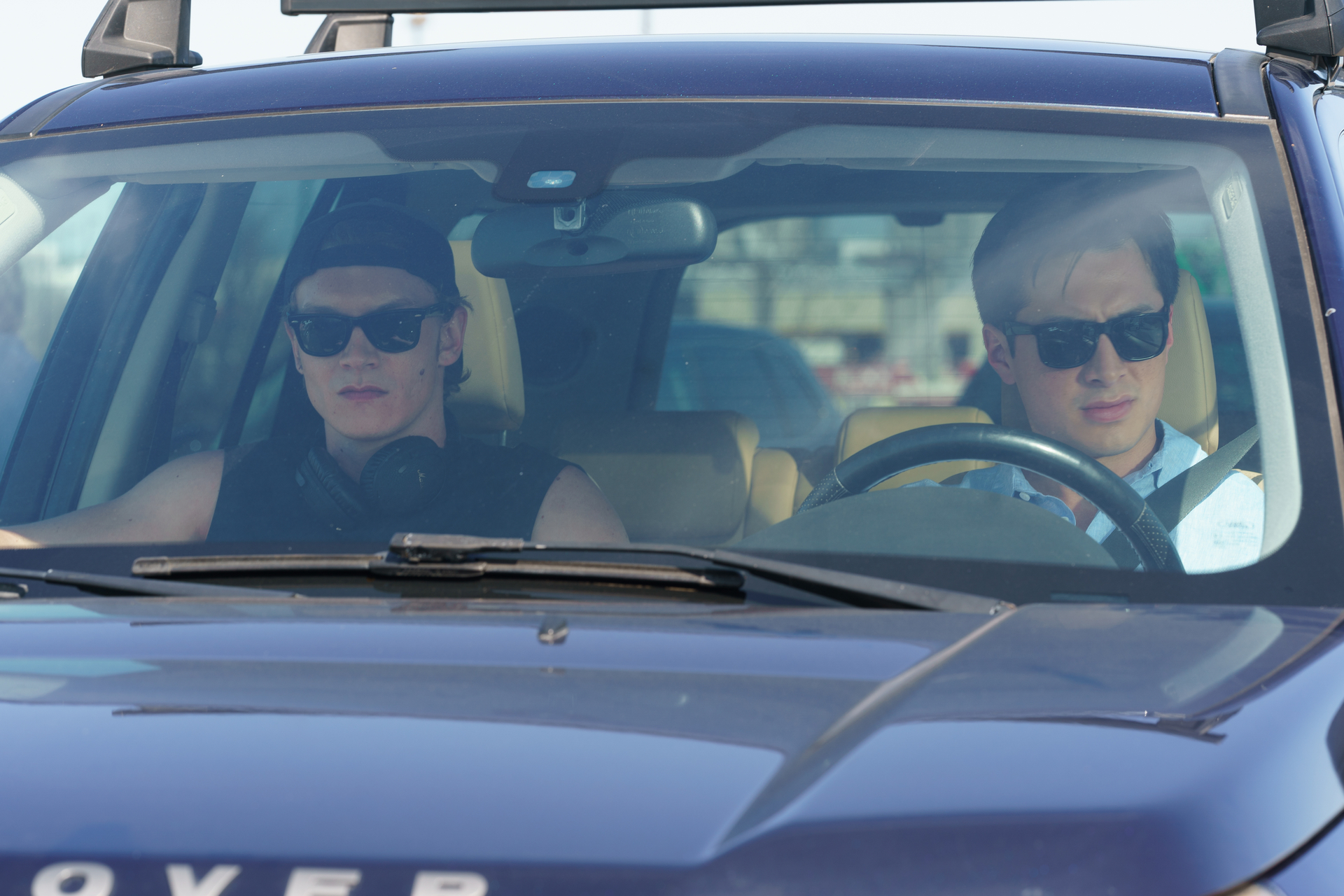
    Set in 1950s Mexico City, the film follows a community of American expatriates, many of whom are queer men, living in a lively enclave of bars where gossip flows as freely as the alcohol. Among them is Lee (Daniel Craig), a man who drifts through the streets in search of something—or someone. Lee’s haggard, drunken appearance and his self-destructive bravado are a stark contrast to Craig’s more notable roles as James Bond and Benoit Blanc. His presence often unsettles those around him. One man who crosses his path later notes to a friend that Lee can never just be friends with someone—it always turns sexual.

    Lee’s only friend, Joe (Jason Schwartzman), rambles about his various sexual exploits, most of which end in robbery, but Joe seems grateful for any company. Lee, on the other hand, is searching for something more meaningful. Though he’s clearly lonely, he seems incapable of breaking through his own emotional walls to form a real connection. Even after a one-night fling with a man at a bar (musician Omar Apollo), Lee is left feeling empty. Even assuming that the man slept with him for money. It’s that insecurity that keeps Lee from experiencing true intimacy. That is, until he spots Eugene Allerton (a sensational Drew Starkey) walking through the sultry streets. In stark contrast to Lee’s disheveled, unkempt appearance, Eugene is effortlessly cool—his tailored polo and well-fitting slacks clinging to his toned physique as passersby steal glances.


    ADVERTISEMENT


    Guadagnino and cinematographer Sayombhu Mukdeeprom beautifully capture the sweaty heat and energy of Mexico City’s bustling nights, imbuing the scenes with such textural detail that you can practically feel the heat on your skin. Eugene, however, seems impervious to the heat, and to everything else. Lee becomes obsessed with discovering who he is, and after exchanging a few furtive glances, he finally approaches Eugene one drunken night. While their conversations aren’t especially titillating, the tension between them is palpable, as if we’re just waiting for the space between them to collapse. At times, we see Lee’s ghostly hand reach out to touch Eugene, as though he’s willing himself to do so but can’t. As Eugene speaks (or listens to others speak), we catch Lee staring at him as if he’s trying to understand what’s going on beneath the surface.

    The first hour of the film moves at a pleasantly meandering pace, as Lee and Eugene oscillate between getting closer and drifting apart—having sex and then completely ignoring each other. It’s as if they both want to turn away from their desires while simultaneously giving in to them. It feels all too relatable to the queer experience—even now. While this dynamic could easily slip into melodrama, Guadagnino skillfully maintains a frenetic, sweltering energy, much like the city itself. This is all underscored by a melancholic score from Trent Reznor and Atticus Ross, with energetic needle drops ranging from Nirvana to Prince.


    ADVERTISEMENT


    As the story moves into its second half, Lee invites Eugene on a journey through South America in search of a mystical herb called yage, which is said to give the consumer telepathic abilities. This is where the film becomes more jumbled—perhaps intentionally, as Lee’s opioid addiction comes to the forefront. While the push and pull between the two men continues, the narrative loses some of its initial focus. Lee’s obsession with the herb seems linked to his desire to understand Eugene, himself, and perhaps his own queerness, but the journey to find it lacks the bite and momentum of the earlier parts of the film. That is, until they finally find the herb.

    In the film’s surreal and entrancing third act, the two men encounter Dr. Cotter (Lesley Manville), a kind of mad scientist living in the Amazon who studies indigenous plants, hunts for her and her partner’s food, and apparently trains their guard snake. Here, Lee learns that yage is more commonly known as ayahuasca, and he eventually persuades Cotter to let him and Eugene take it. The resulting sequence is a feverish, expressionistic dance that finally brings Lee and Eugene together in a moment of understanding. As Burroughs’s own words from his journals echo in the scene—“I’m not queer, I’m disembodied”—it adds an additional layer of meaning to this powerful, otherworldly encounter.


    ADVERTISEMENT


    At its heart, Queer is about queer loneliness, queer desire, and the queer desire to know we’re not alone. In the final moments, Lee faces his own loneliness. To borrow a line from Guadagnino’s Call Me By Your Name, “Is it better to speak or to die?” In that film, the character chooses to speak. Here, Lee suffers a kind of death—a raw, emotional moment that’s deeply impactful. It ultimately makes the film’s challenging journey worthwhile. Queer is a call for intimacy: to reach out, make yourself vulnerable, and let the space between you and others collapse. Because, in the end, where there may be rejection, there may also be acceptance.


    ADVERTISEMENT


    More movies, less problems


    Hey! I’m Karl. You can find me on Twitter and Letterboxd. I’m also a Tomatometer-approved critic.

    💌 Sign up for our weekly email newsletter with movie recommendations available to stream.


    ADVERTISEMENT


  • ‘Presence’ is a ghost story like no other | movie review

    ‘Presence’ is a ghost story like no other | movie review

    Unfolding from the perspective of a ghost haunting their house, a family deals with family tensions in Presence.

    This review was originally published out of the 2024 Toronto International Film Festival.

    If you think you’ve seen every haunted house movie, Presence is here to prove you wrong. Steven Soderbergh ditches the usual ghost story formula by letting us see everything from the spirit’s perspective—turning voyeurism into an eerie, strangely emotional experience. With family drama, supernatural chills, and a sharp, unsettling look at loneliness, this is more than just a spooky flick. At 85 minutes, it’s a quick, haunting watch that lingers long after the credits roll.

    Presence is in theaters now.

    In many ways, director Steven Soderbergh’s Presence is a classic haunted house movie. An idyllic family moves into their dream home in the suburbs, only for it to turn into a nightmare when daughter Chloe (Callina Liang) begins to notice something is amiss inside the house. It starts small. She notices a notebook she thought she had placed on her desk now resting on her bed. A disembodied breath on her neck that she explains away with the classic, “It was the wind.” There are haunts, frustrating skepticism, psychic mediums—the works.

    However, this is no normal ghost story. Like many of our ghosts, the specter lurks in Chloe’s closet. We know this because we watch the movie unfold from its point of view.


    ADVERTISEMENT


    There’s an uneasy feeling as we sweep through the empty house, visiting room after room, before the family enters for the first time with their real estate agent (a punchy cameo from Julia Fox). The sensation of taking the role of an unseen voyeur into this family’s life feels creepy—like the infamous opening shot from Michael Myers’s perspective in Halloween—especially when the specter dares to approach one of the family members. While most of them are unaware, Chloe senses something immediately. From there, still viewing the story through the ghost’s eyes, we get glimpses into the family’s lives.

    There’s headstrong, controlling matriarch Rebecca (Lucy Liu), who makes her preference for her athlete son Tyler (Eddy Maday) painfully evident—“I’ve never felt more connected to another human,” she says, to which he replies, “What about Chloe?” On the other hand, warm, caring patriarch Chris (Chris Sullivan) is more empathetic to Chloe’s plights. While she assumes the role of the typical black-sheep teenager in a ghost story, we learn it’s not without reason—her friend Nadia recently died of an apparent overdose. The ghost watches as these family tensions unfold. After a while, it begins to feel like the phantom itself has emotions—as Chloe’s relationship with her mother sours, she fights with her brother, and she catches the eye of her brother’s friend and the school’s popular boy, Ryan (West Mulholland).


    ADVERTISEMENT


    Presence hits other familiar beats of the ghost story—like the family’s general skepticism when Chloe insists a ghost is haunting her room—before a dramatic moment finally forces them to believe her. But knowing the reason behind those supernatural moments makes them feel new, as if you’ve never seen them in another movie before. In a way, the film feels somewhat plotless and meanderingbut in a surprisingly comforting way, like you’re simply drifting through this family’s life.

    At its core, however, Presence is a family melodrama—filled with biting infighting, teenage and marital angst, and a few, perhaps improbable, twists. However, shifting our perspective to that of the ghost—and therefore limiting us to bits and pieces of the story—smooths out the narrative’s jagged edges. Instead, it leaves us to contemplate some of the film’s more profound lines of dialogue, like when Chris asks Rebecca, “You ever notice how your advice always corresponds with us doing nothing?”

    For some, Presence will just be another experimental work from Soderbergh in his post-“retirement” era. However, there’s something more profound beneath its cinematic tricks. There’s a quiet melancholy, comforting in its relatability. Its portrayal of loneliness and isolation—so easily felt in life, even when you’re not alone—strikes a chord. And perhaps most telling is that, by the end of its breezy 85-minute runtime, you might just find yourself missing being someone’s ghost in a dark corner of their closet.


    ADVERTISEMENT


    More movies, less problems


    Hey! I’m Karl. You can find me on Twitter and Letterboxd. I’m also a Tomatometer-approved critic.

    💌 Sign up for our weekly email newsletter with movie recommendations available to stream.


    ADVERTISEMENT

  • Florence Pugh and Andrew Garfield charm and fall in love in We Live In Time | TIFF 2024

    Florence Pugh and Andrew Garfield charm and fall in love in We Live In Time | TIFF 2024

    TIFF 2024 | Moving back and forth in their history, We Live In Time follows a couple through the ups and downs of life.

    Headlined by charming-than-ever performances by Florence Pugh and Andrew Garfield, We Live In Time is a surprisingly entertaining and funny rom-dramedy that is elevated by a smart non-linear structure and kinetic pace. It’ll warm your heart before tearing it into pieces.

    We Live In Time premiered at the 2024 Toronto International FIlm Festival. A24 will release the film on October 11.

    From their fateful meet cute (if you can consider near vehicular manslaughter one) to the birth of their child to a devastating diagnosis, We Live In Time floats back and forth through time to tell the story of Almut (Florence Pugh) and Tobias’s (Andrew Garfield) relationship. It’s a familiar story. Boy meets girl, boy falls for girl, boy and girl have ups and downs, then something threatens to tear them apart. You can, with some certainty, predict every story beat from start to finish.


    ADVERTISEMENT


    But two things set We Live in Time apart. The non-linear narrative, moved with swift pace thanks to John Crowley’s deft direction and Bryce Dessner’s twinkling score, tells you the ending before showing the journey. It lets you fall into step with the emotion of the story rather than the specifics of it. Second, the charisma and chemistry of Pugh and Garfield are impossible to resist and give Almut and Tobias so much lived-in life and voracity.

    As the movie unravels their pasts, we deepen our understanding of their decisions leaving us with an empathetic portrait of all stages of a relationship and what happens when you merge individuals with their separate ideologies, traumas and hopes into one. And while that might sound heavy, We Live In Time never feels overwrought. The emotions are real, but treated as simply a part of life rather than a plot point. Something that holds weight but because time marches on needs to fade away.


    ADVERTISEMENT


    Almut, a chef at the top of her game who at one point says she couldn’t imagine having a child, and Tobias, a corporate drone with a romantic heart and aspirations for family navigate the trickiness with cheer and humor. British playwright Nick Payne, who penned the screenplay, presupposes that life’s big struggles are best defeated with life’s little joys. In one of the best sequences, type A Tobias is tasked with helping Almut deliver their first child in a gas station bathroom. A trauma that is made better by their ability to laugh through life’s pains. It makes watching them go through it all the more enjoyable. 

    Follow the rest of our coverage of the festival here.


    ADVERTISEMENT


    More movies, less problems


    Hey! I’m Karl. You can find me on Twitter and Letterboxd. I’m also a Tomatometer-approved critic.

    💌 Sign up for our weekly email newsletter with movie recommendations available to stream.


    ADVERTISEMENT


  • Surreal dramedy The Life of Chuck ponders life and death | TIFF 2024

    Surreal dramedy The Life of Chuck ponders life and death | TIFF 2024

    TIFF 2024 | The Life of Chuck follows an enigmatic man starting as a surrealist meditation on existential dread and ending as a life-affirming portrait of youth.

    The Life of Chuck is a dramedy that ponders existential dread through surreal comedy (and a dance number!). A philosophical pondering of the moments that add up to a life set against the temporariness of it all. Airy, abstract but entertaining, it may be polarizing but will deeply move many.

    The Life of Chuck premiered at the 2024 Toronto International Film Festival. It is seeking distribution.


    At the beginning of The Life of Chuck we learn California has sunk into the sea, Florida is underwater and the internet has gone out (maybe for good). But somehow the most inexplicable occurrence in the small town where teacher Marty Anderson (Chiwetel Ejiofor) lives is a billboard that’s seemingly appeared out of thin air with the words “Charles Krantz. 39 great years. Thanks Chuck!” scrawled across it and the photo of a clean cut bespectacled man behind a desk. It begs the question from the townsfolk: who the hell is Chuck?


    ADVERTISEMENT


    Unfolding in three distinct acts, The Life of Chuck is a time and universe hopping story about, well, the life of Chuck based on a short story in Stephen King’s novella collection If It Bleeds. However, in the first act—labeled as “Act 3”—we have no clue who he is. As the world around Marty slowly falls more and more into disarray, he remarks that both marriages and divorces are up. It’s partially what spurs his ex-wife Felicia (Karen Gillan) to call him up amidst the quiet chaos of the end of the world. They talk about whether more people are getting married or divorced in the face of their demise and how in the concept of the Cosmic Calendar by Carl Sagan that explained if the existence of the universe were conceptualized as a single year, humans would occupy just the last few minutes of December 31st.

    It’s the kind of existential pondering that the movie itself tussles with. What does it mean to exist? Does it matter when we occupy so little space and time? Why do advertisements thanking Chuck keep popping up? As the final moments of the world approach, and Marty and Felicia find comfort in each other, images of Chuck begin to appear in the window of every house on the street. Marty jokes that it’s the world’s final meme before blinking out completely and we careen into “Act 2.”


    ADVERTISEMENT


    When we finally meet Chuck (Tom Hiddleston), underscored by narration by Nick Offerman, he’s much more human than his larger-than-life portrayal in the first act. In fact, he’s the most human thing imaginable: an accountant. We also meet a busking street drummer (Taylor Gordon), who we learn recently dropped out of Julliard, as she sets up for the day playing at an outdoor mall and a young woman crying over a break-up (Annalise Basso). The trio all cross paths in front of where the drummer set up her kit for the day. Instead of walking past, Chuck starts to dance. 

    It’s one of those moments that feels like movie magic. The kind that puts a knot in your chest. Not because you understand the feeling, but because you don’t.

    The third part of the movie, labeled “Act 1,” brings us back to Chuck’s childhood. It pulls together all the threads of the story that have remained loose and unpacks the enigma that is chuck. From school dances to early losses to days living with his kooky grandfather (Mark Hamill). While the magical surrealism of the first two acts carries over in some ways, the story becomes grounded in something real. If Chuck was a mysterious otherworldly figure in act three and an enigmatic human in act two, then he’s simply Chuck (played by young actors Benjamin Pajak, Cody Flanagan and Jacob Tremblay) in act three.


    ADVERTISEMENT


    We follow him as he navigates loss, grief and, of course, the horrors of middle school as he discovers who he is. Where the first two acts were abstract and airy meditations, this one feels more trite—for better and worse. While the earnest lessons are admirable, I longed for the most obtuse meditation from the start of the movie that felts more like Charlie Kaufman (Eternal Sunshine of the Spotless Mind and I’m Thinking of Ending Things) or David Lynch (Mulholland Drive). Your mileage with where the story go will vary. But watching Chuck navigate the highs and lows of childhood is admittedly charming.

    The Life of Chuck is about how all the little moments where our lives intersect or divert or run parallel to others eventually lead to, in the case of Chuck, thirty-nine great years. It’s not the big moments or notable accomplishments, it’s the way your mom danced while making breakfast or that drummer you heard on a business trip or one of your grandfather’s ramblings. While it never feels quite as big as it should, that just might be Stephen King and Mike Flanagan’s point. 


    ADVERTISEMENT


    More movies, less problems


    Hey! I’m Karl. You can find me on Twitter and Letterboxd. I’m also a Tomatometer-approved critic.

    💌 Sign up for our weekly email newsletter with movie recommendations available to stream.


    ADVERTISEMENT


  • Diabolically fun horror Heretic will make you believe | TIFF 2024

    Diabolically fun horror Heretic will make you believe | TIFF 2024

    TIFF 2024 | A pair of young Mormon missionaries find themselves at the center of a sinister plot when they knock on the wrong door in Heretic.

    With a devilishly sinister Hugh Grant paired off against stars-on-the-rise Sophie Thatcher and Chloe East as a pair of Mormon missionaries who knocked on the wrong door, Heretic is a frenetic and imminently watchable horror-thriller that keeps you locked in from beginning to end. One of the best horror movies of the year. Pie, anyone?

    Heretic premiered at the 2024 Toronto International Film Festival. A24 will release the movie on November 15.

    I checked my watch after what I thought was about twenty minutes into Heretic and was shocked to see it had been an hour into its premiere at the 2024 Toronto International Film Festival. I suppose time flies when you’re watching a raving heretic played by a devilishly sinister Hugh Grant wax about religious philosophy complete with visual and auditory aids—including a hilarious comparison between different editions of Monopoly and the song “The Air That I Breathe” by The Hollies—will have that effect. But that’s not the only trick writer-directors Scott Beck and Bryan Woods have up their sleeves.


    ADVERTISEMENT


    Mormon missionaries Sister Barnes (Sophie Thatcher), a seasoned albeit jaded veteran, and Sister Paxton (Chloe East), a plucky believer eager to notch her first baptism, are wrapping up their day of peddling the Book of Mormon to the people of a small mountain town. Their mission takes them to the doorstep of Mr. Reed (Grant), an older British man in a quaint cottage against a hillside. The girls are immediately put at ease by his endearing demeanor—he’s wearing a patterned sweater!—and willingness to talk about The Church of Jesus Christ of Latter Day Saints. Though there’s a rule they can’t be in a room alone without a woman present, he assures them his wife is baking up a blueberry pie in the kitchen.

    Beck and Woods move the film along with a steady slow-burn pace as the conversation starts off innocently enough. Mr. Reed shows genuine interest in their beliefs—and seemingly already knows more about the religion than initially letting on. While the home is dark and claustrophobic, with shadowy corners and a suspiciously long and dark corridor leading to the kitchen where the alleged Mrs. Reed is slaving over a hot oven—not to mention the passing comment about metal in the walls and a timer that switches off the lights at regular intervals. The girls are simply eager that someone is so interested in what they truly believe.


    ADVERTISEMENT


    Of course, though, things aren’t quite as easy as… well, pie. Mr. Reed begins to challenge some of the beliefs of Sisters Barnes and Paxton before asking increasingly probing questions like about the scar on Sister Barnes’s arm and their beliefs on the outdated tradition of polygamy. Thatcher and East are sensational as the girls’s slow seeds of suspicion that turn into full blown panic as they realize the front door is locked and the candle placed on the table in front of them is blueberry pie scented.

    The fun of Heretic is that Beck and Woods give you all the pieces to see where the story is going, like a love letter to horror fans. However, it never feels like you’re spoiled. The increasingly frenetic energy of the movie—and Grant’s easy diabolical villain energy—is so enjoyable that you’re giddy with each reveal. As the movie careens into its second act, the name of the game is changed and Grant goes from Paddington to Bond villain as he explains the reason behind his capture of the girls—a reasoning that involves a crash course in the history of religious, a copyright dispute over Radiohead’s “Creep” and Jar Jar Binks. Yet it all makes sense.


    ADVERTISEMENT


    Perhaps Heretic isn’t quite profound enough for anyone to change their mind about religion, but the way the utilize the debate is nothing short of miraculous. As a sadistic game of “choose the right door to exit” brings us to the full-on horror third act, the movie continues to tighten its grip. With an oppressive atmosphere aided by smart sound design and increasingly committed performances by East and Thatcher, it’s impossible to pull yourself out of the world.


    ADVERTISEMENT


    More movies, less problems


    Hey! I’m Karl. You can find me on Twitter and Letterboxd. I’m also a Tomatometer-approved critic.

    💌 Sign up for our weekly email newsletter with movie recommendations available to stream.


    ADVERTISEMENT