Tag: Andrea Riseborough

  • Andrea Riseborough gets her moment with ‘To Leslie’ | SXSW review

    Andrea Riseborough gets her moment with ‘To Leslie’ | SXSW review

    The titular Leslie in To Leslie finds herself deep in the throes of alcoholism after winning the lottery six years earlier.


    To Leslie gets incredibly far on Andrea Riseborough’s watershed performance in the titular role. The movie’s depiction of alcoholism is raw and unflinching — until it isn’t. What begins as a deep exploration of regret, addiction, and reckoning with the past lightens to a familiar feel-good story of redemption that doesn’t feel completely earned. Still, To Leslie finds the winning numbers to get you to feel something.

    To Leslie is playing at the 2022 South by Southwest Film Festival.

    At last call on one of the many nights that Leslie (Andrea Riseborough) spends on a bender in the local bar the jukebox starts to play “Are You Sure” by Willie Nelson. He croons out the question, “are you sure that this is where you want to be?” We don’t get to know Leslie before she wins $160k in the lottery. We don’t even get to know her immediately after. We catch up with her six years later — broke, homeless, and fully in the throes of alcoholism. Screenwriter Ryan Binaco takes a risk to forego the opportunity for the audience to build empathy for the movie’s protagonist — but that might be the point. He challenges us to find something in Leslie. Something to care about.


    ADVERTISEMENT


    That’s a difficult task considering where we find her. Kicked out of the motel she’s been staying out for not paying rent, she seeks out her son James (Owen Teague, who appears in The Cow, which is also premiering at SXSW) who lives in a nearby city. When we meet James the juxtaposition with his mother is stark. He has it together. He has a job, an apartment, friends. Everything that Leslie doesn’t have. And while he’s happy to house his mother while she gets off her feet, he has one rule: no drinking.

    To Leslie’s portrait of addiction feels so grounded. Early in the movie, James confronts Leslie after his roommate’s money goes missing. In one breath, she goes from denying the accusation to playing the guilt card (“I am sick”) to digging for sympathy (“I wanna be a good mama”) to anger when she realizes she’s not going to get her way. Riseborough, a chameleon in every role she’s in, is so good that she makes you almost believe each lie — it’s second nature to her at this point. However, what is even more heartbreaking is James’ retort: “I’m not even 20. I can’t even drink yet and I have to take care of my mother.” Teague, with his limited screen time, haunts the rest of the film with that line.

    Eventually, she finds her way back to her hometown where she finds refuge behind a small motel run by Sweeney (Marc Maron) and Royal (Andre Royo). Though she’s initially run off the property, Sweeney sees something in her and offers her job cleaning rooms in exchange for a small salary and room and board. Well, if anything, he tricks her into taking a job by acting as if she applied for one. It’s like he knows that it has to be her idea for her to commit to it. As the story unfolds, we’ll learn exactly why Sweeney has taken such an interest in Leslie, and why he’s so adept at dealing with such a severe alcoholic. And as their relationship unfurls, Leslie gets her redemption.


    ADVERTISEMENT


    The differences between the first and second halves of To Leslie are stark. Where the first half feels like an intimate and sometimes brutal vision of addiction, the second takes on a feel-good underdog narrative. At times, it feels like the plot is too easy and devoid of conflict. As the first half is unflinching, the second flinches. Thanks to Riseborough and Maron’s charming performances and terrific chemistry it doesn’t completely lose your attention, but it never reaches the heights of its opening scenes.

    Director Michael Morris’ talents are on clear display here, particularly in the well-calibrated performances. But the story left me yearning for more. There are so many threads that we could have followed. A deeper exploration of Leslie’s psyche and how winning the lottery drove her so deep into a hole, more background on Sweeney’s past, and Leslie’s relationship with relative Nancy (Oscar winner Allison Janney), who at some point took James under her wing and came to resent Leslie in the process. Despite its shortcomings, there’s something in To Leslie that got to me. Maybe it’s earnestness. It made me feel something. It made me feel something for Leslie, and that’s all it wants for its audience: empathy.


    ADVERTISEMENT


    More movies, less problems


    Hey! I’m Karl. You can find me on Twitter and Letterboxd. I’m also a Tomatometer-approved critic.

    💌 Sign up for our weekly email newsletter with movie recommendations available to stream.


    ADVERTISEMENT

  • ‘Possessor’ puts gore to good use | movie review

    ‘Possessor’ puts gore to good use | movie review

    Possessor tells the gruesome story of an assassin who is able to take control of a subjects body to carry out her hits

    Possessor may be diabolically gruesome to the point of excess, however, it uses the gut-wrenching feelings it derives to great use in a story that is more than… skin deep.

    One could try and sum up Brandon Cronenberg’s Possessor — which premiered at the Sundance Film Festival earlier this year — as an arthouse techno body horror version of Christopher Nolan’s Inception. Though, that still doesn’t even begin to describe the diabolically visceral experience of watching the film.

    Laced with some of the most horrific gore I’ve seen in a film in, well, ever, Possessor is a lot more than the bloody exploitation of its surface. Like his father, filmmaker legend David Cronenberg (The Fly, Videodrome), the younger Cronenberg uses the disturbing imagery to explore something more. Something deeply human—how our identity alternatively works for and against us.

    In the prologue, we follow a woman we come to know as Holly (Gabrielle Graham). As she stares in the mirror, she plunges a needle attached to a device into her head. As she turns a dial, her emotions change from happy and laughing to crying to nothing. Later, she walks into a crowded restaurant, grabs a knife, and violently murders a man before her. She takes a gun that she brought and goes to turn it on herself. However a force prevents her from pulling the trigger. Instead, as the cops arrive, she turns the gun on them and is shot multiple times until she’s dead.


    ADVERTISEMENT


    Chloé Zhao makes Nomadland‘s melancholic but hopeful story of nomads traversing the American West a stunningly complex character study of life on the margins of society.


    Later we’ll learn that Holly wasn’t actually controlling her own body—it makes Graham’s short performance all the more impressive—and instead it was Tasya Vos (Andrea Riseborough), a sort of assassin who uses brain-implant technology to inhabit a subjects body and use them to carry out hits for clients without anyone suspecting a thing.

    Such is the case with her next job which involves inhabiting the body of Colin Tate (Christopher Abbott), to murder his girlfriend Ava (Tuppence Middleton) and her father John (Sean Bean), a billionaire and CEO of a large corporation, so that his stepson could take control of the business. Using Colin’s drug use and insecure masculinity as a cover for the crime.

    Refreshingly, Possessor avoids much of the heavy exposition that a movie with as high a concept usually is bogged down by. Instead, Cronenberg only gives us enough information to understand while focusing more on story and character, which is wise considering there is so much to unpack.


    ADVERTISEMENT


    While we watch Tasya in Colin’s body go about setting up the crime, there is the subtext of her slow loss of grip on reality. Earlier we watch her go to visit her husband and son, however before going in she prepares rehearses what to say. Not because she’s nervous, but seemingly because she forgot how to be a person. Taking someone’s identity and committing increasing vile and gruesome murders will do that to a person.

    Usually, that’d be an asset to someone with Tasya’s choice of career, however instead of helping her, it’s giving Colin an opening to take control back of his body. And that’s where Possessor becomes truly great. With sometimes stomach-churning gore, Cronenberg portrays the psychic warfare between Tasya and Colin as a neon-drenched assault on the senses that is as engrossing as it is disturbing to watch.

    While Cronenberg doesn’t take full advantage of everything the world he’s concocted has to offer, he instead relied on its simplicity to dive into its complexities. Supported by understated but emotive cinematography by and Karim Hussain and engrossing score by Jim Williams, Possessor is nothing short of a test of will, but a test that is rewarding in the end. Because amid the carnage is something beautifully human.

    Possessor will be available on VOD next month.


    ADVERTISEMENT


    More movies, less problems


    Hey! I’m Karl. You can find me on Twitter and Letterboxd. I’m also a Tomatometer-approved critic.

    💌 Sign up for our weekly email newsletter with movie recommendations available to stream.


    ADVERTISEMENT


    💌 Sign up for our weekly email newsletter with movie recommendations available to stream.


    ADVERTISEMENT



    ADVERTISEMENT


  • Never hold a 'Grudge' — and don't watch it either — movie review

    Never hold a 'Grudge' — and don't watch it either — movie review

    The Grudge is back for its third haunt as a Japanese curse haunts multiple families connected by one house.

    Quick review: The Grudge is more horrifying than any horror movie — because it’s boring. The cheap scares and thin plot do nothing but… well, make you hold a grudge against it.

    For the briefest of moments, I thought director Nicolas Pesce’s remake of The Grudge was going to be not terrible. I was sorely mistaken. Pesce directed the very solid and very disturbing Piercing last year, which relied on a bleak tone and anxiety-inducing imagery to create a surprisingly effective horror. That, along with a strong cast, gave me hope that maybe he could make up for the dreadful — and not in a good way — 2004 American remake starring Sarah Michelle Geller. The opening moments proved to be all I needed to know otherwise.

    Sticking to the script

    Like the original 2002 Japanese version, Ju-On: The Grudge, and the 2004 American remake, this version of The Grudge is told as a non-linear narrative following various families who have encountered a vengeful spirit that is created when someone dies in the grip of extreme rage or sorrow. Anyone that crosses its path is killed and the curse is reborn to terrorize another unwitting victim. 

    At the center of the film is Detective Muldoon (Andrea Riseborough) and her partner Detective Goodman (Demian Bichir) who discover the decomposed body of Lorna Moody (Jacki Weaver) in her car in the middle of the woods. That leads them to other connected murders that have taken place of several the past few years involving real estate agents and expecting parents Peter and Nina (John Cho and Betty Gilpin), elderly couple William and Faith (horror legend Lin Shaye and William Sadler), and a young mother (Tara Westwood).

    As the plot gets going, it’s interesting enough. Pesce seems to be attracted to slow burns and other than the confounding cold open, he sticks to that pace. By the time we’re introduced to John Cho and Betty Gilpin’s characters and storyline— two of the actors I was most excited to see — we’re already deep into the mystery. Their scenes are easily the most successful narratively and often have the best scares.

    However, even those scares feel empty.

    💌 Sign up for our weekly email newsletter with movie recommendations available to stream.


    ADVERTISEMENT


    What you don’t know won’t hurt you

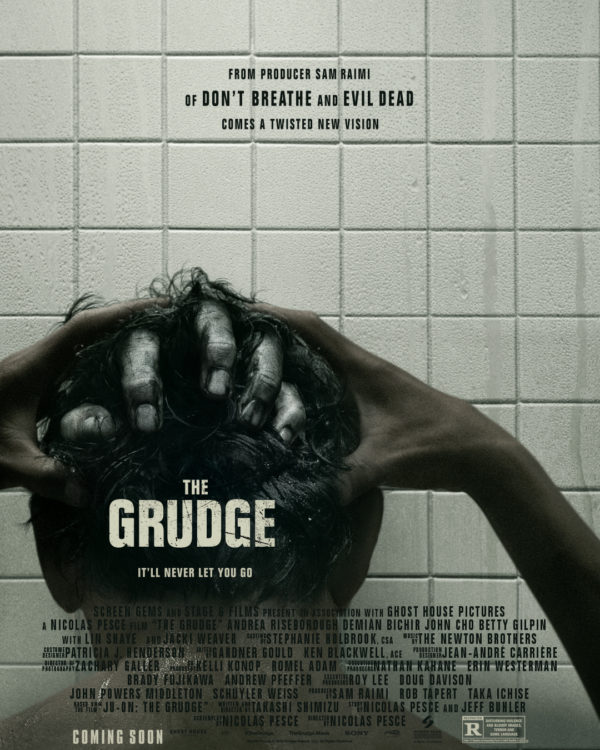
    The Grudge Poster

    For all the flaws with the screenplay, it isn’t the main reason for the movie’s ineffectiveness. The scares leave a lot to be desired. Japanese horror — or J-horror — relies on two things: atmosphere and imagery. The former is often melancholic and full of dread. The latter is what makes J-horror the most terrifying movies. They’re less focused on the shock and instead look to unnerve. The biggest issue with The Grudge is that every scare is a jumpscare with no build — yet, they’re all predictable.

    It also relies on the tired trope of something happening behind the characters that they can’t see. Then they turn around and it’s gone. That trick is good for a scare maybe once. However, nearly every scare uses that setup. It’s almost as if they didn’t feel there weren’t enough moments of horror, so they used them to fill the gaps.

    Horror works because fear is a universal emotion. By removing the anticipation of a scare, you almost lose all of its effectiveness. Add flat characters and a thin plot and The Grudge is yet another in a long line of failed horror reboots.

    Random thoughts ?

    • The final shot — and entire conclusion — basically comes out of nowhere. It’s almost like they forgot to write an ending and just threw something in.
    • One of the first shots of the movie is of the ghost. Note for future filmmakers: Make us want to and be terrified to see your monster. That means making us wait.
    • None of The Grudge movies are particularly good. So, why do we keep making them?
    • The entire cast actually does great work — especially Andrea Riseborough, John Cho, and Betty Gilpin.