Tag: Best of 2024

  • No Other Land is the most important documentary of our time | movie review

    No Other Land is the most important documentary of our time | movie review

    NYFF 2024 | No Other Land follows a Palestinian activist as he documents the destruction of his community in the Israeli-occupied West Bank


    “We have no other land.” That’s what a mother cries as she wants helplessly as Israeli soldiers protect a bulldozer as it rips into her home in the West Bank, the center of the Israel-Palestine conflict at the time. Her daughter sits in the sand nearby. Her expression is conflicted. There’s confusion and fear but mostly it feels that the camera captures her innocence. The cameraman is Basel Adra, a Palestinian lawyer, journalist and activist from Masafer Yatta. That’s where he films the destruction of the only land that he has called his home.


    ADVERTISEMENT


    Filmed between 2019 and October 2023, No Other Land is as much a documentary and piece of reporting as it is a personal diary of Basel’s experience of the Israeli occupation of the West Bank. At the start of the documentary, he’d already been documenting and posting his videos online for nearly a decade. You wouldn’t know by the way he springs into action whenever he gets a call that another village in the rural region is being demolished by Israeli military forces. When he questions the soldiers, he gets the same answer: that they are illegally housed in a military training area. 

    It’s a pattern we watch several times through both Basel’s camera and the camera of his Israeli co-directors Rachel Szor and Yuval Abraham and Palestinian photographer Hamdan Ballal. Yet somehow, it doesn’t become easier to stomach it each time. That’s due to its seemingly unstoppable repetition and the filmmaker’s focus on the people being displaced. Their cries coming from such a gutterall human place that even the sound of it is enough to send chills through your body. Even then, the documentary is adorned save for a few voiceovers from Basel offering his own personal experiences of the occupation through childhood and recent years. They allow the annihilation to speak for itself.


    ADVERTISEMENT


    Through the years, however, the scenes of violence are intercut with moments of pseudo-normalcy and peace among the people of Masafer Yatta. In one throughline, we follow a displaced family settling into a cave, the only place they’ve found that they’re able to live in some sort of peace—they aren’t allowed to leave the West Bank even though Israelis are free to move across the border. The family is Harun Abu Aram’s, an activist who we see shot during one eviction. For years, we watch his mother care for him in the “dirty cave” while begging whoever will listen to allow him access to a clean place to heal. However, those devastating scenes are balanced with her young granddaughter watching a show on a TV precariously mounted to the wall of the cave or asking to play a game on her grandmother’s iPhone. Somehow, these flashes of normalcy make it all the more difficult to watch. 

    Over and over we watch these scenes play. One time it’s a school demolished. In another, a farm where chickens are trapped under the rubble. But then, we watch as a group sits around a fire just talking about their day. Perhaps about the destruction, perhaps not. A reminder that this is everyday life. The wonder of No Other Land isn’t just the urgency of its story but how true its perspective feels. In an impactful would-be final scene, Basel and Yuval sit outside late at night when Yuval chides, “when are we gonna get married?” The pair joke about it before a solemness falls over them. “Maybe one day” is their answer. No Other Land is a movie of hope in a seemingly hopeless situation. A testament to the human spirit, the power of activism and friendship. It doesn’t supply any answers. But maybe it’s an answer itself.


    ADVERTISEMENT


    More movies, less problems


    Hey! I’m Karl. You can find me on Twitter and Letterboxd. I’m also a Tomatometer-approved critic.

    💌 Sign up for our weekly email newsletter with movie recommendations available to stream.


    ADVERTISEMENT


  • Anora gives Mikey Madison her star-is-born moment | Cannes review

    Anora gives Mikey Madison her star-is-born moment | Cannes review

    When escort Anora meets the son of a Russian oligarch it seems like a too-good-to-be-true Cinderella story—and it is.

    Anora starts as a kinetic gallivanting-through-New York romp before giving way to a deeply empathetic portrait of a woman on the fringe. With a star-is-born performance by Mikey Madison and an imminently refreshing direction by Sean Baker that toes a tonal line between comedy and drama, Anora is the best of the year.


    ❖ Best of 2024

    Anora premiered in competition at the 2024 Cannes Film Festival. Neon will distribute.

    After all the roaring debauchery and chaotic slapstick-like comedy in this grittier and meaner sendup of Pretty Woman, the final scenes of Anora are surprisingly quiet. Just two characters occupying the same space saying anything but addressing the tension occupying the room around them—and after the night they had that’s understandable. Then, finally, something breaks and we’re left stunned not because of the shock but because of the catharsis. 


    ADVERTISEMENT


    That’s often how auteur Sean Baker’s films end. After moments of joy and sadness and laughs and pain he allows us, and his characters, one final exhale. If the first two hours of Anora’s surprisingly robust 140-minute runtime—surprising because it goes by in a flash—make it a great movie, then the final ten minutes—the exhale—make it the best movie of the year. Even more, it is a masterpiece.

    That’s a word that has been thrown around haphazardly, but in the case of Baker it is most apt. After four films that each seemed to build in quality and assuredness, Anora feels like the culmination. It is a perfection of the darkly comedic exploration of human pathos he’s been building his entire career. 

    Baker’s fascination has always lied with people on the fringes of society particularly exploring the dignity of sex work—Tangerine and Red Rocket, specifically. Here we follow Anora (Mikey Madison), who insists on being called Ani, an exotic dancer at a high-end strip club in midtown Manhattan—her thick Queens accent made me feel like I was back home even while sitting in the premiere screening at the 2024 Cannes Film Festival where the movie is competing for the Palme d’Or. Her flirtatious attitude mixed with an admirable tenacity reminded me of Maris Tomei’s Oscar-winning performance in My Cousin Vinny (if you know you know).


    ADVERTISEMENT


    As she hustles from patron to patron giving a lap dance here and flirty banter there, one thing is certain, she is good at her job. So good that her boss pulls her for a special assignment looking after the young son of a Russian oligarch called Ivan (Mark Eidelstein)—when asked about his father he simply says, “Google him.” It doesn’t hurt that Ani can speak Russian, though she prefers to respond in English. Whether it’s because she doesn’t think her Russian is strong enough or some other reason isn’t immediately apparent, like many things about her.

    After a particularly salacious private room session, Ivan invites Ani to his Brighton Beach mansion for more time together—off the clock but still paid. In the dark neon lighting of the club, Ivan came off like a man. However, in the bright sunlight of the window-lined mansion, he looks every bit as much as the kid he is. Eidelstein, with a tall and lanky frame and a spate of black curls that evokes a Timothée Chalamet-Troye Sivan hybrid, plays Ivan with a perfectly measured dweebish physicality that tells you exactly who he is: a spoiled rich kid that was never asked to grow up—and doesn’t want to. His broken English mixed with Russian is essentially a mix of “fuck yeah” and requests for more alcohol.

    That’s juxtaposed against Anora’s easy self-assuredness cut with a Queens attitude. Even though she’s just two years older than him, it’s clear that circumstances have helped toughen her to the world. Their interactions have the flow and charm of the best romantic comedies, even if most of it is just posturing. Ivan offers Ani $10k to be his “girlfriend” for a week. She promptly asks for $15k, which he agrees to (though he quickly chides he would’ve given her $30k). After the raucous week and particularly eye-opening sex scene where Ani teaches Ivan the pleasure of restraint, the pair marry in a kitschy Vegas wedding. 


    ADVERTISEMENT


    The movie’s first hour is a kinetic gallivanting-through-New York romp. The pair hops from Ivan’s mansion to Coney Island to Vegas with an irresistible fast-paced tempo driven by Madison and Eidelstein’s charming performances. You could live in the movie’s world for hours, but when Bake switches up the tempo it is also a welcome shift. 

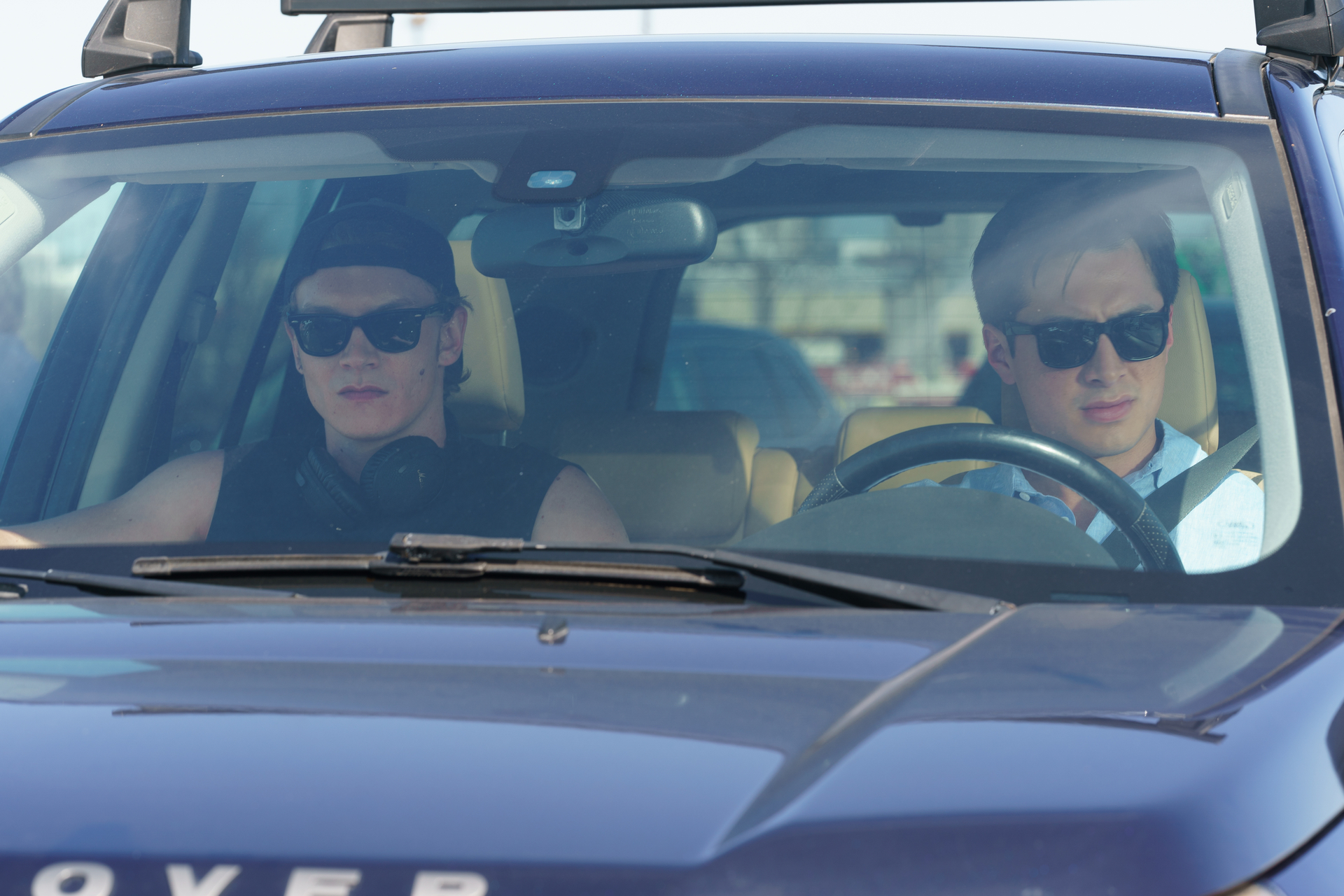
    When Ivan’s parents find out about the pair’s nuptials, they sick no-nonsense Toros (Karren Karagulian) and his cronies snarky oft-injured Garnick (Vache Tovmaysa) and sensitive Igor (Yura Borisov) on the couple.  The momentum never ceases, but the subversive romantic comedy transforms into a quasi-chase thriller mixed with a dark slapstick comedy (think Home Alone) that is as delightful as the first part in its unique way. Like when Ani breaks Garnick’s nose and is promptly tied up with a telephone wire by Igor, Toros walks in and questions, “Why did you tie her up?” “She’s dangerous,” Garnick quips. 


    ADVERTISEMENT


    The madcap energy draws comparisons to The Safdie Brother’s Good Time or Uncut Gems. Even if the story has grit and bleakness, the series of unfortunate events is devilishly enjoyable to watch unfold. Part of that is because of Baker’s direction that toes a tonal line between comedy and drama that is imminently refreshing. The other is Madison’s performance, which feels like a Hollywood star being born before out eyes. Her charisma holds your attention for every frame she is on screen while her voracity converts you into a fanatic.

    But let’s return to the final scenes of Anora, which elevate the film to a masterpiece. Reflecting on the entire movie in the context of these surprising final moments adds a layer of complexity that makes every element even more impressive, especially the performances of Madison and Borisov. While melancholy is woven into the fabric of all of Baker’s films, in Anora, he conceals it until the end, revealing its presence only then. This artistic sleight of hand makes Anora one of the year’s best films and guarantees you won’t forget Mikey Madison’s unforgettable star turn.


    ADVERTISEMENT


    More movies, less problems


    Hey! I’m Karl. You can find me on Twitter and Letterboxd. I’m also a Tomatometer-approved critic.

    💌 Sign up for our weekly email newsletter with movie recommendations available to stream.


    ADVERTISEMENT


  • Strange Darling, a thriller to die for | movie review

    Strange Darling, a thriller to die for | movie review

    While it begins as a cat-and-mouse thriller, Strange Darling evolves (and genre-bends) into a psychological quasi-horror that keeps you guessing.

    Strange Darling is frenetic maximalist romp that murders your expectations at every turn. With its saturated cinematography bringing a mad technicolor world to life and crisp near-deafening sound underlined by Craig DeLeon‘s discordant bass guitar score rattling, it feels like you’re on the fury road—and you might as well be. A pitch-black devilishly entertaining homage to 70s exploitation thrillers that will have you begging for more.

    Strange Darling is in theaters now.

    The title card for Strange Darling splashes onto the screen paired with the subtitle “a thriller in six chapters” before cheekily jumping to chapter 3. From that moment on director J.T. Toller keeps you guessing as he grabs you by your collar and takes you on a frenetic maximalist romp. When you think it is going to zig, it zags. When you think it’s going to jump, it soars. The opening chapters of the movie, shot in glorious 35mm by Giovanni Rabisi, are an assault on the senses. With saturated cinematography bringing a mad technicolor world to life and crisp near-deafening sound underlined by Craig DeLeon‘s discordant bass guitar score thrumming it feels like you’re on the fury road—and you might as well be.


    ADVERTISEMENT


    While the opening credits roll, our protagonist simply known as The Lady (Willa Fitzgerald) runs across a field. Her blond hair is flattened by sweat, a bloody bandage covers her ear and she looks like she’s seen the devil himself. That’s apt considering her pursuer is billed as The Devil (Kyle Gallner). Chapter 3 starts with a title card that tells us that the movie is a dramatization of the final string of murders of an infamous serial killer stalking rural America. Every detail of Strange Darling down to the film grain evokes a 70s exploitation thriller—think Quentin Tarantino’s own homages like Reservoir Dogs and Pulp Fiction—complete with all its glorious bloody violence and action. It isn’t until we see a vape and cell phone that we feel like it’s within our timeline.

    Gallner’s silent, motivated and precise characterization gives his character a mystical patina. Not unlike the iconic supernatural inhuman slasher villains of the time period—Michael Myers, eat your heart out. On the other end of his silver shotgun is Fitzgerald’s classic-in-the-making scream queen performance that has you genuinely terrified for her. The cat-and-mouse sequence that lasts just ten minutes, but feels like a lifetime, has everything from a car chase and crash, game of hide-and-seek in the woods and a horrifying wound sterilization. The tension is nearly unbearable.


    ADVERTISEMENT


    That carries into chapter five that brings the chase into a mountain house before smashing back to chapter one. With each subsequent chapter, Toller gives you just enough information to change the field of play—because at its core Strange Darling is about two people at play with each other even if it is a sadistic game. To talk about Strange Darling without ruining its devilish entertaining magic would be a fool’s errand. But know, that nothing is as it seems—even the movie. With shades of an erotic thriller, slasher, crime caper and even satirical comedy, there truly isn’t a way to pin it down other than watching it.


    ADVERTISEMENT


    More movies, less problems


    Hey! I’m Karl. You can find me on Twitter and Letterboxd. I’m also a Tomatometer-approved critic.

    💌 Sign up for our weekly email newsletter with movie recommendations available to stream.


    ADVERTISEMENT


  • Queer revenge thriller Femme slays | review

    Queer revenge thriller Femme slays | review

    After a homophobic attack, a gay man sets out for revenge on his assailant when he discovers he is closeted in Femme

    Anchored by stellar performances by Nathan Stewart-Jarrett and George MacKay, Femme is a tense, sexy and engrossing queer revenge thriller that feels for us and by us. Subverting the classic “femme fatale” erotic thriller trope and archetype, directors Sam H. Freeman and Ng Choon Ping create a morally ambiguous face-off between two queer men that blurs the line between good and evil and right and wrong. One of the best movies of the year so far.

    While the inciting incident of first-time directors Sam H. Freeman and Ng Choon Ping’s Femme is a brutal outburst of homophobic violence, I felt an unexpected feeling of relief after it was over. Erotic thrillers like Brian de Palma’s Dressed to Kill or Paul Verhoven’s Basic Instinct and Elle can at times feel exploitative in their use of violence, sex and sexuality as a plot device. And like those films, as the title implies, Femme centers on a “femme fatale” whose sexuality is front and center. However, instead of feeling like the movie is admonishing our fatale or punishing them for the indiscretions it empowers them. The incident while visceral and vicious doesn’t feel lingered on.


    ADVERTISEMENT


    It’s helpful that unlike the de Palma or Verhoven movies, Freeman and Ping have the utmost respect for their protagonist, drag queen Aphrodite Banks (Nathan Stewart-Jarrett). 

    When we first meet her, they’re performing a surprisingly high production number for a drag club. After her number, Aphrodite notices tattooed and toned Preston (George MacKay) outside the venue watching intently. Jules catches his gaze that she returns with a charismatic smile — he sulks off. Later in the night, Aphrodite is at a bodega when Preston and his friends enter, posturing as men do. 

    When they start verbally harassing Aphrodite, there’s a moment where it seems she’s going to try to ignore it and shrink back. But like a switch ticked off in her brain, she decides to take space up as any queer person would and reads them down. Especially Preston who she calls out for checking her out at the club. It’s what leads to Preston’s assault that leaves Aphrodite beaten and naked on the street.


    ADVERTISEMENT


    Three months later, the incident has left Jules, who has given up his Aphrodite drag persona much to the chagrin of his roommates Alicia (Asha Reid) and Toby (John McCrea), completely withdrawn from the world. That’s until one day he finds himself in a gay bathhouse where he once again encounters Preston who is cruising. For our straight friends, cruising is when you go to a public space looking for someone to have sex with. It’s not helpful that he lashes out at any forward man with a hearty f-slur. “We’re all faggots here,” someone cheekily responds.

    Both horrified and intrigued, Jules follows Preston to the locker room. Unaware of who Jules is, Preston invites him back to his apartment for sex. Behind Jules’ eyes — and a testament to Stewart-Jarrett’s quietly powerful and emotive performance — is panic, interest and, horrifyingly to himself and the us, lust. Preston is dominant and very clearly knows what he wants to which Jules obliges, but right as they’re about to have sex, his rowdy and drunk roommates return. Panicked and left alone in the room, Jules makes a last minute decision to don the hoodie that Preston wore when he assaulted him and leave the room. 

    The risky move pays off when Jules is able to pass himself off as an old friend of Preston’s and is able to slip out. Angered yet impressed by the move, Preston asks to see Jules again saying he’ll text him when he needs him. 


    ADVERTISEMENT


    Fueled by his performance in the apartment, Jules hatches a plan to get revenge on Preston by weaponizing his sexuality against him and secretly recording a revenge sex tape to out him to the world. 

    This is where Femme takes a hard firm turn towards a dark and brooding erotic thriller. Jules sets out to lure Preston — like a queer femme fatale — before enacting his revenge. The cat-and-mouse game, that is unbeknownst to Preston, occurs as a series of encounters between the pair that challenge our assumptions of what we know of them. To Jules’ surprise, their first meeting after the bathhouse and apartment incident is an intimate dinner where Preston takes care to make Jules comfortable — like a real date. And while the conversation begins to unwrap the mystery, it eventually devolves into a rough sex scene in the woods where Preston leaves Jules to get home on his own. 

    There’s a distinct queerness to the entire story and the way each of the characters functions in Femme.

    It feels like it’s derived from lived experience. Something that the erotic thrillers of the 90s that it sends up doesn’t have with its female characters — those movies are by and large written and directed by men. There isn’t good or evil. The rights are as morally ambiguous as the wrongs. While our sympathies at first lie with Jules, the more we learn about Preston gives us an understanding — albeit opaque — of his own queer trauma that he’s experiencing. While we never fully dive into his backstory, MacKay’s bombastic performance that oscillates between a put on machismo and tender longing tells us everything we need to know about the character — like his tatted skin is a literal armor for his sexuality. 


    ADVERTISEMENT


    Then there’s Jules, who in the pursuit of much-deserved vengeance, has to grapple with the vulnerability and intimacy that he begins to feel towards Preston as he carries out his plan. While the movie never loses its sense of danger and Preston is always presented as a violent figure that could lash out at any moment — especially in an incident when Jules is caught trying to film one of their backseat rendezvous — the focus is very much on a study of the characters. It makes Stewart-Jarrett’s performance all the more impressive as he has to communicate Jules’ thought process with few words rather furtive glances and body language.

    And while Femme has empathy for its characters, it doesn’t ask us to forgive them for their sins. That moral ambiguity is what makes the character dynamics as engrossing as the suspense.

    As the movie careens to its conclusion, there’s a sense of romance. A sense that perhaps a lesser movie would give into. Instead, Femme understands its characters but isn’t afraid to leave them as imperfect beings. Perhaps they’re capable of change, but that isn’t the story that Freeman and Ping are telling. Instead, they’re interested in what it is to be unapologetically queer in a space that isn’t made for us, how masculinity is a prison that even we sometimes can’t escape and how our feelings, as powerful and magnetic as they are, are messy and can lead us down paths we shouldn’t follow.

    Femme is as messy and beautiful and complicated as we are. It’s the kind of queer thriller we deserve.


    ADVERTISEMENT


    More movies, less problems


    Hey! I’m Karl. You can find me on Twitter and Letterboxd. I’m also a Tomatometer-approved critic.

    💌 Sign up for our weekly email newsletter with movie recommendations available to stream.


    ADVERTISEMENT


  • ‘How to Have Sex’ is the best movie of the year | movie review

    ‘How to Have Sex’ is the best movie of the year | movie review

    How to Have Sex follows a trio of friends on a drunken debauched island holiday that leads to trouble

    How to Have Sex subverts the 2000s-era raunchy sex comedy to deliver a sobering holiday drama with a melancholic realistic edge. Despite being set in the present, it has a nostalgic quality as it mines the many complicated feelings we experience as we come of age. Isolation, joy, anxiety, hope, fear, longing. As the movie takes its dark turn, it becomes even more piercing in its exploration of girlhood. With Mia McKenna-Bruce‘s heartbreaking performance as its strong beating heart it is much more than another teen movie.

    How to Have Sex is now playing in limited release.

    The plot and structure of Molly Manning-Walker’s How to Have Sex closely resembles a 2000s-era raunchy sex comedy where the goal is to get laid — think Superbad or The Hangover (or more recently Bottoms, which subverts the genre). But this is no off-the-wall broad comedy — though there are certainly hijinks, jokes, and drinking. Lots and lots of drinking. Manning-Walker grounds the movie in realism to the point that it’s essentially a mumblecore drama where you’re slipping in and out of very specific moments in the character’s lives. The effect is dizzying, entertaining, terrifying and in equal parts uplifting and heartbreaking — the best movie of the year so far.


    ADVERTISEMENT


    When we first meet our trio of friends Tara (Mia McKenna-Bruce), Skye (Lara Peake) and Em (Enva Lewis) they are the picture-perfect Essex messes — think Love Island: High School Edition. They’re boisterous, brash and have a weekend away with no parents in the Greek party town of Malia. Tara seems like the firebrand of the group and never shirks an opportunity to “woo” at the slightest luxury of the trip. However, we quickly learn that behind their bravado the girls are just insecure teens.

    Manning-Walker captures their debaucherous nights out like any good party movie with thumping bass and flashing neon lights giving way to the girls throwing up after drinking from a comically large fishbowl. But what it quickly sets up is the caring dynamic between the trio — something that we’ll see tested through the movie. As much as our first impression portrays the girls as wildly carefree to a fault, we’re able to empathize with their youthful joy. It’s something that Manning-Walker captures so vividly.


    ADVERTISEMENT


    It’s something that Tara particularly exudes. Behind all her surface confidence is her insecurity around being a virgin, something Skye and Em are working to change. Which is why when they meet their balcony neighbors Badger (Shaun Thomas) and Paddy (Samuel Bottomley) they see the opportunity for Tara. It’s what careens the story from joyful friendship dramedy to something darker. However, How to Have Sex keeps much of its comedic edge. “Romeo, Romeo, for where is you?” Skye says when they first spot Badger on the balcony neighboring theirs. 

    Where she felt like an assured woman at the start of the movie, Tara becomes a shy girl when she meets the new group. It doesn’t help either that Skye clearly likes Badger and is jealous of the sweet attention he gives to Tara — who would have thought a man with his name tattooed across his chest would be so swoon-worthy! Meanwhile, Em hits it off with their queer friend Amber (Laura Ambler) adding to Tara’s isolation. The dynamic feels so familiar and relatable. Like being at a party you don’t want to be at. Manning-Walker so deftly captures the feeling with the bright dance music making way to a drowning high-pitched buzzing and the bright neon lights becoming blinding. It’s an assault on the senses. Like a cinematic anxiety attack. 


    ADVERTISEMENT


    It puts us firmly in Tara’s point-of-view so when things turn from uncomfortable to downright trouble we’re right there with her. We feel what she’s feeling. At the center of the story are Tara’s relationship dynamics, particularly with Skye, Badger and Paddy. And they all represent different facets of the coming-of-age trope. Though Skye is her best friend, she tends to project her own insecurities onto Tara. In a drunken slip-up, she embarrassingly reveals to the group that Tara is still a virgin. While she shrugs it off as an accident, it’s clearly a sleight. Paddy is a classic f-boy — who hilariously gets an unfetching tattoo on the trip (I don’t want to know how) — who constantly negs Tara but sees himself as a hero. In opposition, Badger makes her feel nothing but comfortable. It’s that dichotomy of gender dynamics that makes How to Have Sex profound.

    How to Have Sex feels like a coming-of-age classic-in-the-making. Despite being set in the present, it has a nostalgic quality as it mines the many complicated feelings we experience as we come of age. Isolation, joy, anxiety, hope, fear, longing. As the movie takes its dark turn, it becomes even more piercing in its exploration of girlhood. Anchored by Mia McKenna-Bruce‘s masterful heartbreaking performance, the movie finds a strong beating heart making it so much more than another teen movie. While it’s not a message movie, it reflects hard truths in the world — and the beautiful things we find to combat them — to remind us we are not alone at the party.


    ADVERTISEMENT


    More movies, less problems


    Hey! I’m Karl. You can find me on Twitter and Letterboxd. I’m also a Tomatometer-approved critic.

    💌 Sign up for our weekly email newsletter with movie recommendations available to stream.


    ADVERTISEMENT