Tag: Bill Skarsgard

  • ‘John Wick: Chapter 4’ is an action magnum opus | movie review

    ‘John Wick: Chapter 4’ is an action magnum opus | movie review

    Keanu Reeves returns as an assassin trying to survive an onslaught from the all-powerful High Table in John Wick: Chapter 4.


    John Wick: Chapter 4 takes the over-the-top action it’s known for and cranks it up to the highest level. After a slow start it moves like a beast through some of the best action sequences of the series. It lacks some of the forward plot machinations that make the other three films so breezy. Still, it’s thrilling and innovative — and even the funniest of the sreies. The house sequence is maybe one of the best action scenes in a decade. It’s imperfect but so much fun. Oh and Rina Sawayama slays.

    Over the last decade, the John Wick series has been an unlikely success story in a Hollywood that has been increasingly reliant on well-known IP and action movies that include men in tights saving the world — I love Marvel, don’t come for me. Even the franchise’s director Chad Stahelski and producer David Leitch thought that the movie was going to flop. As they put it, who would want to watch a movie about a man that viciously murders more than 80 people to avenge his dog? Apparently, a lot since the franchise has grossed over half a billion dollars. By the time we reach John Wick: Chapter 4, Wick has been battered, bruised, stabbed, and shot more than any man should be able to handle. But he is no man. He’s the boogeyman.


    ADVERTISEMENT


    The Marquis de Gramont (Bill Skarsgård), a high-ranking member of the all-powerful High Table, tells blind assassin Caine (Donnie Yen) there are three types of people: those who have something to live for, those who have something to die for, and those who have something to kill for. He then says that John Wick (Keanu Reeves)has none of those. He did at one time. He had his wife Helen. And then her final gift to him — his canine companion whose untimely demise sets up the start of the series. Then he killed his way out of New York City and back again to protect his friend and send an FU to the High Table. What does he have left to kill for?

    That’s what John Wick: Chapter 4 grapples with as Wick once again finds himself at the center of the High Table’s target list. This time, though, they’ve sicked the ruthless Marquis de Gramont on him—and this time The Continental rules are out the window as evidenced by the Marquis’ destruction of the New York branch while he strips the title of manager from Winston (Ian McShane). With no place to turn and his pool of friends shrinking, Wick goes to the Osaka Continental Hotel managed Shimazu (Hiroyuki Sanada) and his concierge and daughter  Akira  (musician Rina Sawayama in her film debut — Pixels, rise up!) for safe housing. 

    This first third of the movie is surprisingly meditative compared to past entries of the series that have tended to throw us into the action immediately. The first action sequence of John Wick: Chapter 3 is among the great action scenes of all time. However, this slow start is not without reason. As Marquis’s right-hand man Chidi (Marko Zaror) and his army of High Table mercenaries descend on the hotel, Shimazu, imbued with stoic power by Sanada’s performance, tells his daughter they must fight for those they love. And we’ll come to learn what it is each character is fighting for.


    ADVERTISEMENT


    What it lacks in propulsive plot momentum, Chapter 4 makes up for in perhaps the most ambitious action sequences in the series’ history. Seemingly endless sections of the movie are dedicated to Wick carving his way through the High Table’s infinite supply of henchmen—two sequences even clock in at nearly thirty minutes. The Osaka Contintental sequence is classic John Wick as the staff of the hotel, largely donning swords, knives, and bows-and-arrows, take on the heavily armed High Table army. Grandiose and epic in scale, it’s perhaps the most ambitious set-piece of the series… up until that point at least. 

    What’s particularly refreshing is our point-of-view switches between Shimazu, Akira, John, and even Caine, who has been coerced into helping the High Table in a bid to protect his daughter. Each character moves the plot forward as they all push forward with their own motivations as their futures are entwined. However, what’s apparent is that while everyone else falls into one of the three categories the Marquis lists, John does not. 

    Eventually, John and Winston reunite and concoct a way out of their precarious position with the High Table: challenging the Marquis to a duel. However, to do that, John has to secure the blessing and crest of his estranged Bulgarian family. So begins a classic John Wick tale that will bring him around the world and back — and perhaps to redemption. Along the way, another assassin known as The Tracker (Shamier Anderson) and his trusty canine sidekick — cinematic parallels! — are roped in the Marquis’s scheme, John fights his way through a crowded club in a callback to Chapter 2, and participates in perhaps the greatest action sequence of all time.


    ADVERTISEMENT


    John Wick: Chapter 4 is an immense action magnum opus. It is near non-stop wall-to-wall combat, car chases, and shoot-outs on a level not seen since Mad Max: Fury Road. The sequence following John Wick through Paris, around the Arc de Triomphe, into an abandoned haussmann-style house (where one of the greatest single-take action sequences will blow your mind as the camera moves in near impossible ways), and up a set of stairs in the funniest and most brutal fights of the series, could bring any action fan to tears.

    However, what sticks with you is that initial question. What does John Wick have left to fight for? Where the movie ends up with that question may divide fans. What won’t be controversial is why the other characters old — Winston, King of the Bowery (Laurence Fishburne) — and new — Akira, Caine — are still fighting. Why they have something to live for, to die for, or to kill for. As a series, John Wick, dripped in all its glorious violence and bloodshed, has always been about love. And by the time you watch John claw his way through dozens of men up a flight of stairs you realize that no matter the motivation, you will always root for John Wick.


    ADVERTISEMENT


    More movies, less problems


    Hey! I’m Karl. You can find me on Twitter and Letterboxd. I’m also a Tomatometer-approved critic.

    💌 Sign up for our weekly email newsletter with movie recommendations available to stream.


    ADVERTISEMENT

  • ‘Barbarian’ is for the camp horror girlies | review

    ‘Barbarian’ is for the camp horror girlies | review

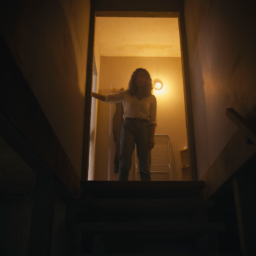
    Barbarian follows a woman staying in an Airbnb in a rough neighborhood of Detroit who gets more than she bargains for when she finds a man already staying there.

    Barbarian is B-movie camp. It feels like it’s from the same grotesque weird wicked world that Sam Raimi is operating in. The twists are surprising, scares genuinely frightening, and comedy sharp. See it in a theater with a crowd.

    Don’t read this review. Barbarian is a movie that is best enjoyed unspoiled. And when I say unspoiled, I really mean it. That’s not to say it can’t be enjoyed entirely knowing what it’s about. But where’s the fun in that? It’s like a magic trick. The same way magicians use misdirection, distractions, and spectacles to hide how a trick is done, director Zach Cregger tricks you into thinking the movie is one thing. But while he’s showing you his left hand is empty, his right is getting ready to shock you. And unless you’re a boring cynic, you want to be tricked.

    It’s the same way I felt about James Wan’s Malignant, which feels like a spiritual sister to Barbarian. Both movies mine the tropes and imagery of Giallo flicks—a genre of movies popularized in Italy that combine elements of suspense, horror, and psychological erotic thrillers. The result is a maximalist horror that never fails to shock you with its devilishly fun twists and keep you entertained with delicious camp. At any given moment you’re not sure whether to laugh, cry, or just lose your damn mind. I, and the rest of my audience, seemed to be doing all three. Grab a bowl of popcorn, your closest horror-loving friend, and go for a ride. 

    For those who aren’t going to heed my warning, I’ll try to keep the rest of this review relatively spoiler-free.


    ADVERTISEMENT


    The first act of Barbarian will feel familiar to horror fans, whether it’s the camera movements reminiscent of Leigh Whannel or John Carpenter-esque score.

    It’s almost as if Cregger wanted to prove that he’s done his horror homework before completely flipping the genre on its head. There’s an almost cozy feeling when Tess (Georgina Campbell) drives up to the front of an unassuming single-family home at night… in the middle of a rainstorm. Yeah horror fans, your alarm should be going off. If it wasn’t already, it should be blaring when Tess finds the key in the lockbox already gone. Even worse, when she calls the phone number on the faux-Airbnb listing, it goes to the voicemail of a home management company. However, her luck sees a turn—for the worse or better we’re not sure—when a man answers the door.

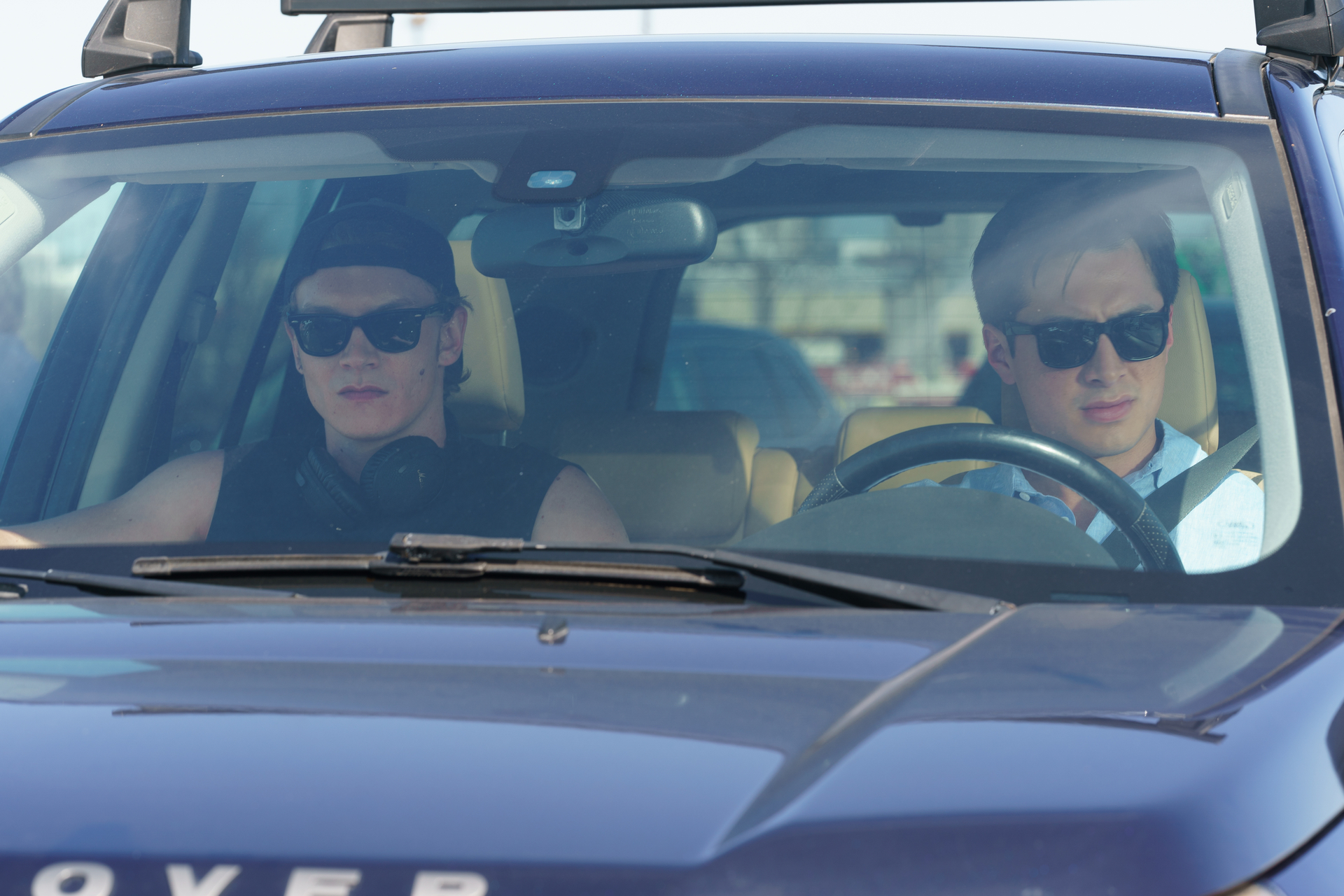
    Keith is tall and handsome, but has a bit of a creepy edge to him. Bill Skarsgard, best known for his terrific turn as Pennywise the Clown in It, is perfectly cast. His look alone perfectly exudes a charmingly endearing energy that is alluring, but creepy at the same time—it would confuse any sensible person’s stranger danger senses. His apologetic and kind tone gets Tess to accept his invite to share the space while she sorts out her housing situation. Skarsgard’s performance continues to toe the line between genuinely charming and creepily rehearsed—but whether there is more to him is unclear.


    ADVERTISEMENT


    The movie actively ratchets up the tension even as Tess’ fears are assuaged in a perfectly calculated slow burn that keeps you searching for the twist—trust me, you won’t find it.

    When Tess steps out of the house the next morning to go to the job interview she’s in town for, she sees the state of the neighborhood. The house she’s staying in is lovingly renovated, but the rest of the neighborhood is a dilapidated ghost town. All this setup eventually leads to Tess returning to the home and finding a hidden corridor in the basement out of the house.

    From there, the movie takes pivots to the grotesque, absurd, and downright batshit. But what I love is that it doesn’t feel the need to explain itself or its lore further than needed. Some would call those plot holes—I’d call it strategic information withholding. Barbarian almost makes itself immune to story criticism because it only gives you enough to piece your own background story together. The same goes for its potential social commentary. It could follow It Follows and Don’t Breathe in the Detroit-horror subgenre that touches on race and class. However, it never fully forms those ideas—but it doesn’t spend valuable time on them either.

    There is a #MeToo subplot that takes the movie to a new place from the first half—Justin Long makes an appearance that I wish was hidden in the marketing. And while the message may be obvious, it helps tie the absurdity into a satisfying character journey. Barbarian isn’t going to be for everyone. It’s like Sam Raimi movies or Giallo films. If you know you know. Like Evil Dead 2 or Malignant, Barbarian feels like it’s from the same grotesque weird wicked world where twists are surprising, scares genuinely frightening, and comedy sharp. See it in a theater with a crowd.


    ADVERTISEMENT


    More movies, less problems


    Hey! I’m Karl. You can find me on Twitter and Letterboxd. I’m also a Tomatometer-approved critic.

    💌 Sign up for our weekly email newsletter with movie recommendations available to stream.


    ADVERTISEMENT


  • ‘It Chapter Two’ review — Once a loser, always a loser

    ‘It Chapter Two’ review — Once a loser, always a loser

    It Chapter Two finds the members of the “Loser Club” returning to their hometown to face Pennywise one last time

    30-second review: Rather than adding onto and complementing the first movie, It Chapter Two feels bogged down by it. Director Andy Muschietti and screenwriter Gary Dauberman try to make the movie funnier, scarier, more intense, and more emotional. As a result, it’s none of those things.

    The movie returns to the playbook that made many of the set pieces in the first work and doubles down on each of those elements, which seems instinctive, but instead, it just means each scene is predictable. That coupled with the overreliance on CGI, formless structure, and execssive plotiness makes It Chapter Two an uninspiring conclusion.

    Where to watch It Chapter Two: Now playing in theaters.

    There’s a recurring joke in It Chapter Two surrounding the grown-up Bill (played by James McAvoyJaeden Martell plays him as a teen). After leaving Derry, he went on to become an author, eventually adapting his books into films. However, he’s constantly teased about not knowing how to end his stories. Well, this movie, which completes the story arc started in 2017’s It, has a similar problem.

    Andy Muschietti returns to direct the film, which takes place 27 years after the original. As we see in the first 45 minutes, each member of the self-proclaimed “Losers Club” have gone on to achieve relatively normal lives despite the trauma they experienced in their youth. As Mike (Isaiah Mustafa as an adult and Chosen Jacobs as a teen), who never left the town of Derry, Maine, tells them, the further you get from the town the more the memories fade away. But he remembers what happened to them — and it’s happening again.

    The first part of the movie is dedicated to Mike getting the gang back together, which includes Bill, his love interest Beverly (Jessica Chastain and Sophia Lillis), fouled-mouth jokester Richie (Bill Hader and Finn Wolfhard), former fat kid (and now hot) Ben (Jay Ryan and Jeremy Ray Taylor), hypochondriac Eddie (James Ransone and Jack Dylan Grazer), and Andy Bean and Wyatt Oleff as Stanley.

    While it’s all fun and games at first, Pennywise (Bill Skarsgard) quickly starts up his old tricks to torment the gang as they try to figure out how to defeat him. Old memories are rehashed and wounds are reopened as each of the “Losers” face their pasts. Each of them gets their moment. However, the movie doesn’t really explain why each of them needs one. Yes, they all have chips on their shoulder, but each character vignette feels more like a way of letting the starry cast each have their turn in the spotlight. It feels more like filler than an actual plot — which explains the unnecessarily bloated 169-minute runtime.

    it chapter two
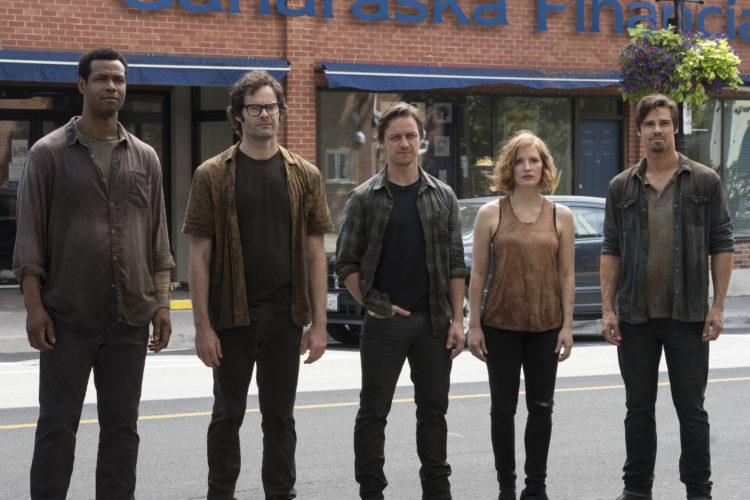
    Isaiah Mustafa, Bill Hader, James McAvoy, Jessica Chastain, and Jay Ryan in It Chapter Two. Credit: Warner Bros. Pictures.

    Rather than adding onto and complementing the first movie, Chapter Two feels bogged down by it. Muschietti and screenwriter Gary Dauberman try to make the movie funnier, scarier, more intense, and more emotional. As a result, it’s none of those things. I liked the first movie quite a bit. Though it isn’t perfect, the plot is more focused and intentional, which makes each scene (and scare) more effective.

    Chapter Two returns to the playbook that made many of the set pieces in the first work and doubles down on each of those elements, which seems instinctive, but instead, it just means each scene is predictable. That coupled with the overreliance on CGI makes the movie completely devoid of horror.

    Because the middle section drags so much, the plot is stuffed into the first and last 45 minutes. However, there is so much plot — and so much exposition — that we never get a chance to reform the emotional bond with the characters that makes the first so successful. The end of Chapter Two, which should feel triumphant and bittersweet instead feels hollow.

    Hader and Ransone do some of the best work of the cast and get chances to flesh out their characters a bit more, especially Hader, though there is some subtext that is a little too subtle to be notable. The rest of the cast, however, never really connect.

    If you haven’t noticed, I haven’t mentioned Pennywise, the eponymous “It” much yet. And that’s because he’s less than his already scant screentime in the first movie. Skarsgard is so good in the role, but Muschietti is more obsessed with action-based setpieces than he is actual horror, so he never gets a proper chance to shine.

    To be honest, there’s so much more I can criticize and tear apart in It Chapter Two, but I’ll spare you and say this. Clearly, Muschietti had a long list of things he wanted to do and tackle in this movie — and he did all of it. Unfortunately, the movie didn’t need most of it.


    ADVERTISEMENT


    More movies, less problems


    Hey! I’m Karl. You can find me on Twitter and Letterboxd. I’m also a Tomatometer-approved critic.

    💌 Sign up for our weekly email newsletter with movie recommendations available to stream.


    ADVERTISEMENT


  • ‘It’ (2017) review — More thrilling than scary, but certainly entertaining

    ‘It’ (2017) review — More thrilling than scary, but certainly entertaining

    Following the 1990 miniseries, It reimagines Stephen King’s classic novel as a frightening romp through the 1980s.

    30-second review: A key change was made from Stephen King’s classic novel It for its 2017 film adaptation directed by Andy Muschietti. The film’s timeline was moved from the 50s to 1988. That change brought some refreshing updates — raunchy humor and fun pop-culture callbacks — but also some issues.

    However, Muschietti focuses the movie on these set pieces pulled straight from the novel that makes you question the treatment of the child actors in the best way possible. The twisting creatures of the film, including a decomposing leper and a burned decapitated corpse, are fancifully realized and used to great effect. But it makes you think one thing: how messed up is Stephen King?

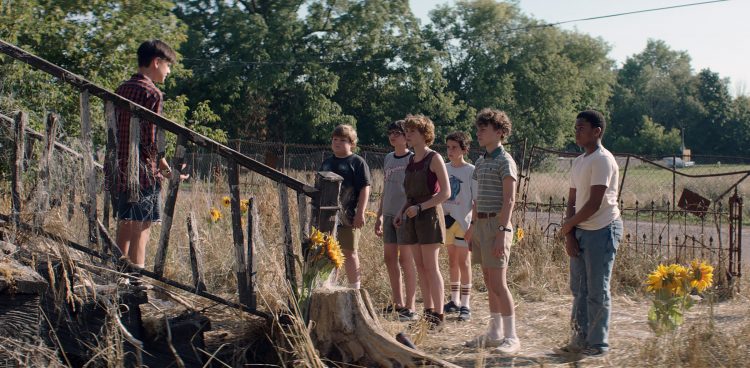
    It follows seven friends who make up the self-named Losers Club. Billy (Jaeden Lieberher), recently lost his little brother Georgie (Jackson Robert Scott) to the eponymous monster, though he relentlessly searches for him with help of his friends. However, when the same monster comes after the group, they must get over their fears and band together to defeat him.

    The set pieces at the center of the film are visually splendid and offer genuine thrills that will keep word of mouth churning for the film. However, after each of those scenes, the tension is drained usually after an awkward tonal shift. The film, which was adapted by Chase Palmer, Gary Dauberman, and Cary Fukunaga — who was attached to direct originally, feels a lot like Stranger Things.

    Whether it’s the 80s setting or Finn Wolfhard — he stars in Stranger Things — the humor, style, and even the scares feel more like the sci-fi drama than a real horror movie. Still, what stays with you are the set pieces. Each character has their fear realized when they are alone, and that’s where the film excels. One scene in particular, which takes place in a bathroom, was the closest the film got to terrifying. It was measured, tense, and paid off in a great way. Plus, the absolute drenching of blood gave of Carrie vibes that felt like a subtle nod, unlike a lot of the movie’s references.

    The character pieces in between, though, fall flat. Though the movie really feels from the point of view from adolescents, the story elements feel jammed in. A sexual abuse storyline is overtly alluded to, even though it seems like the movie thinks it’s being subtle. The history of the town and the potential source of It is crammed down our throats in clunky exposition scenes. Much of Billy’s storyline concerns his search for Georgie and his constant denial of his death, however even this is done in an unsubtle way.

    Jaeden Liberher in It

    However, three key performances save those sections from detracting too much from the film as a whole. First off, Sophia Lillis, who plays the only female member of the Losers Club, Bev, carries a lot of the emotional weight of the movie on her shoulders and does so naturally. But what stands out for me is her watershed moment in a bathroom with gallons of blood drenching her and her surroundings.

    For a movie about fear, she certainly knows how to portray it convincingly. Wolfhard, who plays Richie closely to his Stranger Things character, gets a lot of the one-liners and lands them every single time. He often walks away with every scene he’s in and, at points, he got the entire theater clapping. But the arguable lead of the film, Lieberher, gives the best performance of the Losers Club by fleshing out a character that isn’t given that much of a personality. He has a stutter, which he doesn’t let define the performance, and instead uses an intense love of Billy’s brother to drive the character’s motivations. It’s a sublime performance. Between this and Midnight Special, Lieberher may be the rising star among young actors.

    But still, the scares, all belong to Pennywise the Dancing Clown played masterfully by Bill Skarsgard. Skarsgard, who stunned in Atomic Blonde this year, builds on Curry’s classic 1990 performance as the character and infuses a physicality that Curry’s performance didn’t quite have. No scene displays the virtues of his performance more than the famous sewer scene that opens the movie. 

    He uses a similar throaty cartoon voice to Curry’s but adds menace with his delivery. More importantly, the amount of movement that he uses in his mouth area is a small but effective way to up the creep factor. Even when he’s not speaking he pinches and moves his lower jaw in a manner that I can only describe as deliciously creepy. All the nightmarish imagery aside, Skarsgard delivers the chills in the movie like no other monster can.

    It is frustratingly close to being a great movie. The 80s references — from Molly Ringwald to New Kids on The Block — are fun, but ultimately bog down the themes that make the novel a classic. The set pieces are scary but short-lived and the movie lacks the tension it needed to be an effective horror movie. You can count the number of changes that would make the movie a near-masterpiece on one hand, but it gets a lot right.

    It’s shot and designed beautifully — the creature design is phenomenal — and is cast superbly. Look at the movie as more of a sci-fi drama than an outright horror movie and you’ll definitely be more enthralled — this was one of the most fun times I had at the theater this year. Either way, when Pennywise tells you you can float too, you’ll feel a chill down your spine. Just like King intended.


    ADVERTISEMENT


    More movies, less problems


    Hey! I’m Karl. You can find me on Twitter and Letterboxd. I’m also a Tomatometer-approved critic.

    💌 Sign up for our weekly email newsletter with movie recommendations available to stream.


    ADVERTISEMENT

  • Atomic Blonde review — Charlize Theron is the action hero we need

    Atomic Blonde review — Charlize Theron is the action hero we need

    Atomic Blonde is a fun, 80s romp of an action movie with a performance announcing Charlize Theron as our next great action heroine

    There’s a scene about two-thirds of the way through Atomic Blonde that can only be summed up as “that scene.” It’s the scene that will stick with you at the end movie. At the end of it, I sighed under my breath, “oh my god,” in awe. David Leitch, the stuntman turned director best known for John Wick, knows how to capture action the same way he knows how to choreograph it.


    Atomic Blonde is based on the graphic novel The Coldest City, which isn’t surprising watching the film. Every frame feels like it could be a comic panel. Tight close-ups on the characters are given equal weight as the epic wide shots. The opening text explains how the Berlin Wall would eventually come to fall before quickly clarifying that this is now that story. The movie is framed by a debriefing of Lorraine (Charlize Theron), an MI6 operative that went rogue in the days leading up to the fall of the wall. When we first see our protagonist, she rises out of a bathtub filled with ice badly bruised across her entire body. “What happened? ” you might ask. Well, that’s exactly what MI6’s Eric Gray (Toby Jones) and the CIA’s Emmett Kurzfeld (John Goodman) are trying to figure out.

    By framing the movie as a debriefing where Lorraine is telling us the story of the past ten days, the rest of the movie is essentially told by an unreliable narrator. One that is especially hostile towards her interrogators. It makes the twisting plot all the more interesting. She is tasked with going to Berlin to find a list containing secrets of the agents in Berlin. It’s the classic espionage movie setup, but Leitch has fun with it. Throughout the movie spies, assassins, and double agents are thrown at Lorraine. Secret messages are traded. It feels like a classic spy movie.

    David Leitch doesn’t hold back when it comes to action sequences. Though, he uses them sparingly. Unlike John Wick, Atomic Blonde isn’t non-stop action. It allows time to build relationships and character. Even if the story does get lost in the plot heavy second act, stylistically it’s beautiful to watch. It also helps that they’re undercut with 80s hits like “Father Figure,” “99 Luftballoons,” “Voices Carry” and “Under Pressure.” It’s bright, it’s efficient, and it has a musicality to it that makes it a pleasure to watch.

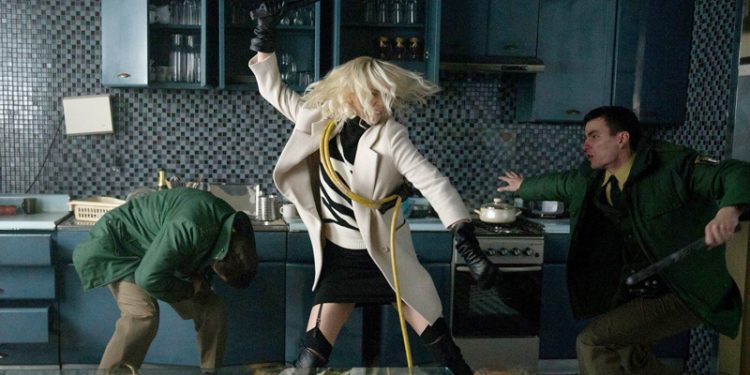
    The first and last thirds of the movie, though, are what makes Atomic Blonde great and a delight to watch. The first real action sequence of the movie shows Lorraine fighting her way out of a car, then fighting her way out of an upper floor apartment. So much of the movie’s action is her escaping. It’s almost as if she never intends to get into fights. It’s refreshing considering so many action movies today are focused on getting to something or getting revenge. The violence in this movie is necessary, but it’s never lingered on.

    https://www.instagram.com/p/BhXj-wng8B8/?taken-by=cinemabunbaking


    However, for all the incredible action, well-curated soundtrack, and sleek directing choices, it’s the actors that elevate it past the page. Theron’s impressive action sequences — she did most of her own stunts — and icy demeanor make her an instantly likable action heroine. And though she definitely gives the movie its edge, other characters give it life. James McAvoy does great work as the eccentric Percival and makes every moment he’s on screen count. Even the smaller roles make a huge impact. Sofia Boutella’s role as a mysterious woman that encounters Lorraine — in more ways than one — is a strong emotional core that with a different actress could have made the end of the movie very different. The standout in the supporting cast, for me, is Bill Skarsgard as an MI6 agent supporting Lorraine in Berlin. He portrays so much with just looks. He’s a surprising highlight in the film.

    Atomic Blonde looks and feels different than any action movie before it. It takes every beat with a spring in its step. However, when it has to get down to business, it gets down to business. Whenever I think of the movie, I always go back to “that scene.” It’s tightly choreographed and shot to look like a 10-minute continuous take. You can’t do anything but hold your breath until it’s over. It’s that effective. Nearly every element of the film comes together to sell it. However, the film surrounding that film is pure fun. It’s the action romp that feels right at home in summer blockbuster season.

    ★★★★ out of 5


    Watch Atomic Blonde on Amazon!