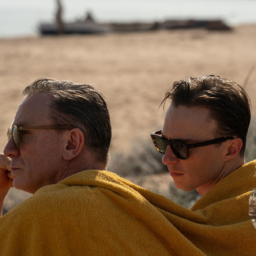
Based on William S. Burroughs novel of the same name, Queer follows an American expat’s obsession with a young man he meets in 1950s Mexico City.
This review was originally published out of the 2024 Toronto International Film Festival.


Luca Guadagnino’s Queer is a mesmerizing and haunting exploration of desire, loneliness, and the search for connection. Set in 1950s Mexico City, the film follows Lee (Daniel Craig) as he navigates a complicated, obsessive relationship with Eugene (Drew Starkey). Through stunning cinematography, an evocative score, and an engaging, surreal narrative, Guadagnino and screenwriter Justin Kuritzkes deliver a thought-provoking, emotionally raw drama that speaks to queer longing, desire, and the transformative power of intimacy. Bold, challenging, and ultimately moving, Queer is not easily shaken.
Queer is in limited release on Nov 27. It will be released nationwide on Dec 13 by A24.
Anyone who claims to fully understand what William S. Burroughs is trying to tell us with his writing is either lying or on some really good drugs—and I’ll have what she’s having. Another filmmaker might have tried to smooth out the raw, jarring edges of Burroughs’s trademark sensibilities. But director Luca Guadagnino (Call Me By Your Name, Challengers) and screenwriter Justin Kuritzkes (Challengers) lean wholeheartedly into his idiosyncratic style, transposing his unsettling blend of mesmerizing horror and reality into something deeply affecting. And somehow, it’s also an aching romance about longing and desire. Amid the drug-addled maze of Burroughs’s thoughts, Guadagnino and Kuritzkes manage to find a thread—a profound one that, once pulled, unravels into a beautiful, moving drama that is, at its core, deeply… well, queer.
ADVERTISEMENT
Set in 1950s Mexico City, the film follows a community of American expatriates, many of whom are queer men, living in a lively enclave of bars where gossip flows as freely as the alcohol. Among them is Lee (Daniel Craig), a man who drifts through the streets in search of something—or someone. Lee’s haggard, drunken appearance and his self-destructive bravado are a stark contrast to Craig’s more notable roles as James Bond and Benoit Blanc. His presence often unsettles those around him. One man who crosses his path later notes to a friend that Lee can never just be friends with someone—it always turns sexual.
Lee’s only friend, Joe (Jason Schwartzman), rambles about his various sexual exploits, most of which end in robbery, but Joe seems grateful for any company. Lee, on the other hand, is searching for something more meaningful. Though he’s clearly lonely, he seems incapable of breaking through his own emotional walls to form a real connection. Even after a one-night fling with a man at a bar (musician Omar Apollo), Lee is left feeling empty. Even assuming that the man slept with him for money. It’s that insecurity that keeps Lee from experiencing true intimacy. That is, until he spots Eugene Allerton (a sensational Drew Starkey) walking through the sultry streets. In stark contrast to Lee’s disheveled, unkempt appearance, Eugene is effortlessly cool—his tailored polo and well-fitting slacks clinging to his toned physique as passersby steal glances.
ADVERTISEMENT
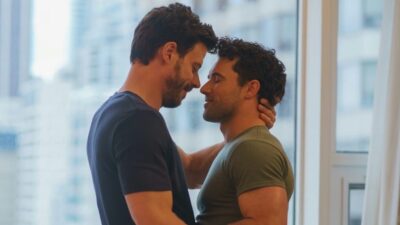
Guadagnino and cinematographer Sayombhu Mukdeeprom beautifully capture the sweaty heat and energy of Mexico City’s bustling nights, imbuing the scenes with such textural detail that you can practically feel the heat on your skin. Eugene, however, seems impervious to the heat, and to everything else. Lee becomes obsessed with discovering who he is, and after exchanging a few furtive glances, he finally approaches Eugene one drunken night. While their conversations aren’t especially titillating, the tension between them is palpable, as if we’re just waiting for the space between them to collapse. At times, we see Lee’s ghostly hand reach out to touch Eugene, as though he’s willing himself to do so but can’t. As Eugene speaks (or listens to others speak), we catch Lee staring at him as if he’s trying to understand what’s going on beneath the surface.
The first hour of the film moves at a pleasantly meandering pace, as Lee and Eugene oscillate between getting closer and drifting apart—having sex and then completely ignoring each other. It’s as if they both want to turn away from their desires while simultaneously giving in to them. It feels all too relatable to the queer experience—even now. While this dynamic could easily slip into melodrama, Guadagnino skillfully maintains a frenetic, sweltering energy, much like the city itself. This is all underscored by a melancholic score from Trent Reznor and Atticus Ross, with energetic needle drops ranging from Nirvana to Prince.
ADVERTISEMENT
As the story moves into its second half, Lee invites Eugene on a journey through South America in search of a mystical herb called yage, which is said to give the consumer telepathic abilities. This is where the film becomes more jumbled—perhaps intentionally, as Lee’s opioid addiction comes to the forefront. While the push and pull between the two men continues, the narrative loses some of its initial focus. Lee’s obsession with the herb seems linked to his desire to understand Eugene, himself, and perhaps his own queerness, but the journey to find it lacks the bite and momentum of the earlier parts of the film. That is, until they finally find the herb.
In the film’s surreal and entrancing third act, the two men encounter Dr. Cotter (Lesley Manville), a kind of mad scientist living in the Amazon who studies indigenous plants, hunts for her and her partner’s food, and apparently trains their guard snake. Here, Lee learns that yage is more commonly known as ayahuasca, and he eventually persuades Cotter to let him and Eugene take it. The resulting sequence is a feverish, expressionistic dance that finally brings Lee and Eugene together in a moment of understanding. As Burroughs’s own words from his journals echo in the scene—“I’m not queer, I’m disembodied”—it adds an additional layer of meaning to this powerful, otherworldly encounter.
ADVERTISEMENT
At its heart, Queer is about queer loneliness, queer desire, and the queer desire to know we’re not alone. In the final moments, Lee faces his own loneliness. To borrow a line from Guadagnino’s Call Me By Your Name, “Is it better to speak or to die?” In that film, the character chooses to speak. Here, Lee suffers a kind of death—a raw, emotional moment that’s deeply impactful. It ultimately makes the film’s challenging journey worthwhile. Queer is a call for intimacy: to reach out, make yourself vulnerable, and let the space between you and others collapse. Because, in the end, where there may be rejection, there may also be acceptance.
ADVERTISEMENT
More movies, less problems
- Cannes 2024: Three great movies in Un Certain Regard

- “Heated Rivarly” episode 6 recap and review: “The Cottage”
- “Heated Rivalry” episode 3 review: “Hunter”
Hey! I’m Karl. You can find me on Twitter and Letterboxd. I’m also a Tomatometer-approved critic.
💌 Sign up for our weekly email newsletter with movie recommendations available to stream.
ADVERTISEMENT