Tag: George MacKay

  • Queer revenge thriller Femme slays | review

    Queer revenge thriller Femme slays | review

    After a homophobic attack, a gay man sets out for revenge on his assailant when he discovers he is closeted in Femme


    Anchored by stellar performances by Nathan Stewart-Jarrett and George MacKay, Femme is a tense, sexy and engrossing queer revenge thriller that feels for us and by us. Subverting the classic “femme fatale” erotic thriller trope and archetype, directors Sam H. Freeman and Ng Choon Ping create a morally ambiguous face-off between two queer men that blurs the line between good and evil and right and wrong. One of the best movies of the year so far.

    While the inciting incident of first-time directors Sam H. Freeman and Ng Choon Ping’s Femme is a brutal outburst of homophobic violence, I felt an unexpected feeling of relief after it was over. Erotic thrillers like Brian de Palma’s Dressed to Kill or Paul Verhoven’s Basic Instinct and Elle can at times feel exploitative in their use of violence, sex and sexuality as a plot device. And like those films, as the title implies, Femme centers on a “femme fatale” whose sexuality is front and center. However, instead of feeling like the movie is admonishing our fatale or punishing them for the indiscretions it empowers them. The incident while visceral and vicious doesn’t feel lingered on.


    ADVERTISEMENT


    It’s helpful that unlike the de Palma or Verhoven movies, Freeman and Ping have the utmost respect for their protagonist, drag queen Aphrodite Banks (Nathan Stewart-Jarrett). 

    When we first meet her, they’re performing a surprisingly high production number for a drag club. After her number, Aphrodite notices tattooed and toned Preston (George MacKay) outside the venue watching intently. Jules catches his gaze that she returns with a charismatic smile — he sulks off. Later in the night, Aphrodite is at a bodega when Preston and his friends enter, posturing as men do. 

    When they start verbally harassing Aphrodite, there’s a moment where it seems she’s going to try to ignore it and shrink back. But like a switch ticked off in her brain, she decides to take space up as any queer person would and reads them down. Especially Preston who she calls out for checking her out at the club. It’s what leads to Preston’s assault that leaves Aphrodite beaten and naked on the street.


    ADVERTISEMENT


    Three months later, the incident has left Jules, who has given up his Aphrodite drag persona much to the chagrin of his roommates Alicia (Asha Reid) and Toby (John McCrea), completely withdrawn from the world. That’s until one day he finds himself in a gay bathhouse where he once again encounters Preston who is cruising. For our straight friends, cruising is when you go to a public space looking for someone to have sex with. It’s not helpful that he lashes out at any forward man with a hearty f-slur. “We’re all faggots here,” someone cheekily responds.

    Both horrified and intrigued, Jules follows Preston to the locker room. Unaware of who Jules is, Preston invites him back to his apartment for sex. Behind Jules’ eyes — and a testament to Stewart-Jarrett’s quietly powerful and emotive performance — is panic, interest and, horrifyingly to himself and the us, lust. Preston is dominant and very clearly knows what he wants to which Jules obliges, but right as they’re about to have sex, his rowdy and drunk roommates return. Panicked and left alone in the room, Jules makes a last minute decision to don the hoodie that Preston wore when he assaulted him and leave the room. 

    The risky move pays off when Jules is able to pass himself off as an old friend of Preston’s and is able to slip out. Angered yet impressed by the move, Preston asks to see Jules again saying he’ll text him when he needs him. 


    ADVERTISEMENT


    Fueled by his performance in the apartment, Jules hatches a plan to get revenge on Preston by weaponizing his sexuality against him and secretly recording a revenge sex tape to out him to the world. 

    This is where Femme takes a hard firm turn towards a dark and brooding erotic thriller. Jules sets out to lure Preston — like a queer femme fatale — before enacting his revenge. The cat-and-mouse game, that is unbeknownst to Preston, occurs as a series of encounters between the pair that challenge our assumptions of what we know of them. To Jules’ surprise, their first meeting after the bathhouse and apartment incident is an intimate dinner where Preston takes care to make Jules comfortable — like a real date. And while the conversation begins to unwrap the mystery, it eventually devolves into a rough sex scene in the woods where Preston leaves Jules to get home on his own. 

    There’s a distinct queerness to the entire story and the way each of the characters functions in Femme.

    It feels like it’s derived from lived experience. Something that the erotic thrillers of the 90s that it sends up doesn’t have with its female characters — those movies are by and large written and directed by men. There isn’t good or evil. The rights are as morally ambiguous as the wrongs. While our sympathies at first lie with Jules, the more we learn about Preston gives us an understanding — albeit opaque — of his own queer trauma that he’s experiencing. While we never fully dive into his backstory, MacKay’s bombastic performance that oscillates between a put on machismo and tender longing tells us everything we need to know about the character — like his tatted skin is a literal armor for his sexuality. 


    ADVERTISEMENT


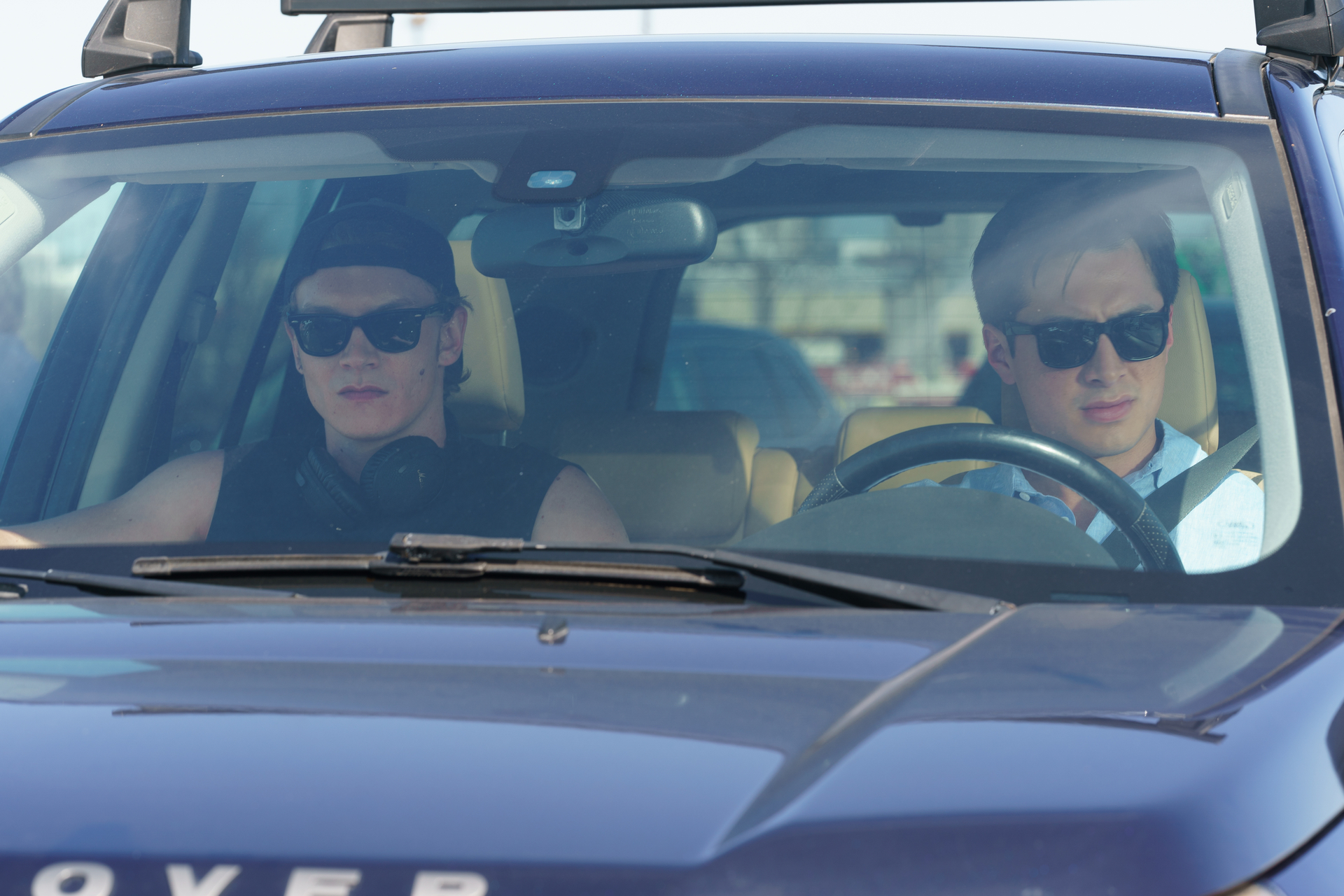
    Then there’s Jules, who in the pursuit of much-deserved vengeance, has to grapple with the vulnerability and intimacy that he begins to feel towards Preston as he carries out his plan. While the movie never loses its sense of danger and Preston is always presented as a violent figure that could lash out at any moment — especially in an incident when Jules is caught trying to film one of their backseat rendezvous — the focus is very much on a study of the characters. It makes Stewart-Jarrett’s performance all the more impressive as he has to communicate Jules’ thought process with few words rather furtive glances and body language.

    And while Femme has empathy for its characters, it doesn’t ask us to forgive them for their sins. That moral ambiguity is what makes the character dynamics as engrossing as the suspense.

    As the movie careens to its conclusion, there’s a sense of romance. A sense that perhaps a lesser movie would give into. Instead, Femme understands its characters but isn’t afraid to leave them as imperfect beings. Perhaps they’re capable of change, but that isn’t the story that Freeman and Ping are telling. Instead, they’re interested in what it is to be unapologetically queer in a space that isn’t made for us, how masculinity is a prison that even we sometimes can’t escape and how our feelings, as powerful and magnetic as they are, are messy and can lead us down paths we shouldn’t follow.

    Femme is as messy and beautiful and complicated as we are. It’s the kind of queer thriller we deserve.


    ADVERTISEMENT


    More movies, less problems


    Hey! I’m Karl. You can find me on Twitter and Letterboxd. I’m also a Tomatometer-approved critic.

    💌 Sign up for our weekly email newsletter with movie recommendations available to stream.


    ADVERTISEMENT

  • ‘True History of the Kelly Gang’ and its punk rock Ned Kelly | movie review

    ‘True History of the Kelly Gang’ and its punk rock Ned Kelly | movie review

    True History of the Kelly Gang is a fictional punk rock western about the Australian bushranger Ned Kelly and his gang of outlaws

    Quick review: True History of the Kelly Gang is a punky auteurist vision of adrenaline that makes the already chaotic story disorienting, and, most importantly, unrelenting.

    “Nothing you’re about to see is true.” That’s the cheeky title card that starts True History of the Kelly Gang (available on VOD April 24). And for a movie about an Australian bushranger — the equivalent of an American outlaw — known for his brutality and violence over several years in the 1870s, it’s a surprising start. However, director Justin Kurzel remains steadfast in his portrayal of this anti-hero (or pure villain depending on how you look at it) throughout the film and gives the story a punk rock patina that feels particularly apt to tell this version of Kelly’s story.

    The movie, which is based on Peter Carey’s 2000 novel of the same name, portrays Kelly (played by 1917-breakout George Mackay) and his gang as the fearsome, gun-totting rebels that they’re notoriously known as. However, Kurzel infuses them with punk rock energy that includes having them go into battle wearing dresses to strike fear in their enemies. Plus, it makes the homoerotic energy between the members of the gang and with their primary foe even more compelling.

    💌 Sign up for our weekly email newsletter with movie recommendations available to stream.


    ADVERTISEMENT

    The movie is split into three sections: boy, man, and monitor. In boy, a young Ned Kelly (Orlando Schwerdt) comes of age in the Australian bush with his mother Ellen (Essie Davis), a hardened Irish transplant, who is regularly harassed for sexual favors by Sergeant O’Neill (Charlie Hunnam), one of many toxic male figures in Ned’s life. His disdain for his alcoholic father and care for his mother is Oedipal in nature. It’s just another point in his childhood that explains his brute and violent nature as an adult. 

    However, no one affects him more than the old, grizzled bushranger Harry Power (Russell Crowe) who becomes his mentor as a favor to his mother. He experiences horrors and violence that no child should have to witness. 

    The first act’s visual flair, including striking cinematography by Ari Wegner that captures the desolation of the Australian outback and the distinctly modern stylistic sensibilities that Kurzel is attracted to in his period pieces, dunks us in the movie’s semi-fictional world that this Ned Kelly occupies. 

    The first half of the movie is far from typical, but it feels more like a traditional biopic. When we make the shift to the adult Ned Kelly all hell breaks loose. Kurzel delivers an expressionistic blur of sound and light that makes the already chaotic story disorienting, and, most importantly, unrelenting. However, it’s his foe that makes it most compelling. 

    True History of the Kelly Gang
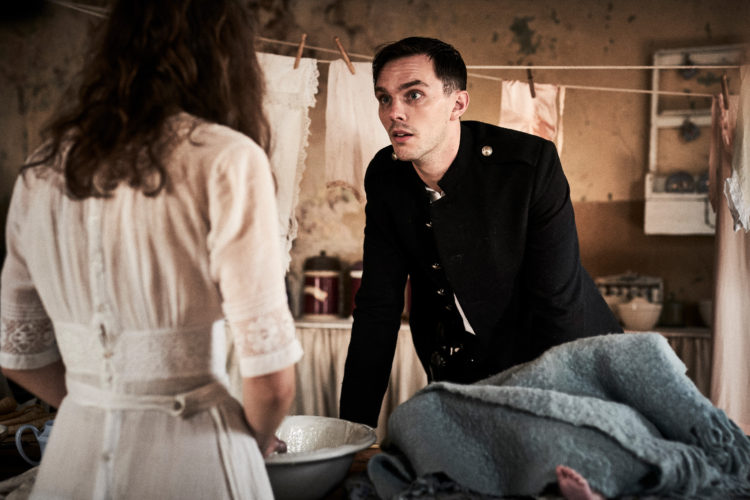
    Nicholas Hoult as “Constable Fitzpatrick” in Justin Kurzel’s True History of the Kelly Gang. Courtesy of IFC Films. An IFC Films release.

    After Oscar-worthy character turns in Mad Max: Fury Road and The FavouriteNicholas Hoult gets to dig his teeth into the meaty and campy Constable Fitzpatrick — a cartoon-ish mustache-twirling villain (without the ‘stache). In one stunning scene across from Kelly’s love interest Mary (Jojo Rabbit‘s Thomasin McKenzie), he employs an interrogation tactic involving a baby that feels so punk it could only live in this world. 

    True History of the Kelly Gang is greater than the sum of its parts. Watching it is a hypnotic experience that will be polarizing to mainstream audiences — it’s oddly meta for an outlaw who was similarly polarizing. Still, it’s impossible to not be affected by it in some way after its final frame. Kurzel takes a huge swing, whether or not he hits depends on you. Either way, the movie feels like a baseball bat to the head — in the best way.   

  • ‘1917’ review — A war movie like we’ve never seen before

    ‘1917’ review — A war movie like we’ve never seen before

    Presented in one unbroken shot, 1917 follows two young soldiers as they embark on an impossible mission to warn a battalion of an impending ambush.

    One-sentence review: 1917 is not only a technical feat, it’s also an anxiety-inducing war thriller that manages to differentiate itself from anything that’s come before it.

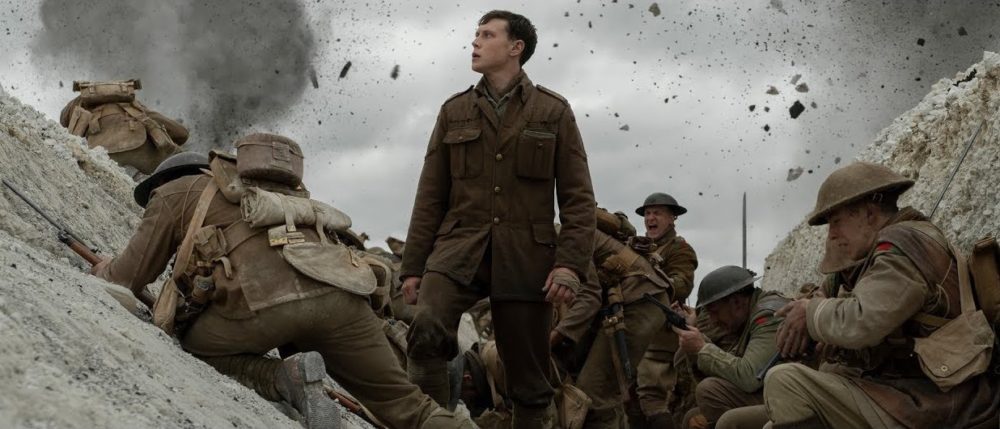
    There’s a scene in 1917 where Lance Corporal Scofield (George MacKay giving an Oscar-worth performance), after encountering yet another brush with death, sinks to his knees and cries. I wanted to do the same thing multiple times while watching this movie. The greatest war movies should make it feel like you just went through battle — 1917 makes you feel like you went through an entire tour.

    Set during the height of the First World War, 1917 follows two young British soldiers — Schofield and Blake (Dean-Charles Chapman) — who are sent on a seemingly impossible mission to cross enemy territory and deliver a warning of an impending ambush in the coming day. To add to the stakes, Blake’s older brother is part of the battalion in danger. 

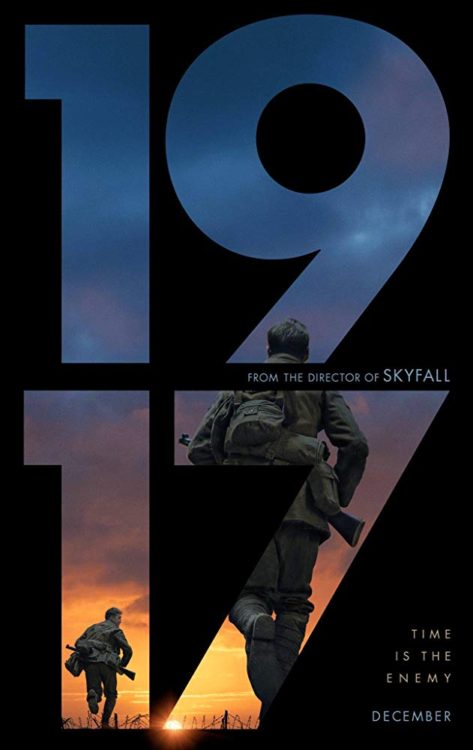
    1917 poster

    A lot of the buzz around 1917 comes from the decision to present it as one continuous shot — like Best Picture winner Birdman. Other recent Oscar movies have presented long takes like La La Land and Gravity, which is probably the more apt comparison to this movie. Without any cuts, there isn’t anything to break the tension. It almost has more in common with a horror movie than it does a war movie. It’s overwhelming. 

    And while it can sometimes come off as a gimmick, 1917 is largely successful in the same way that Children of Men’s long takes are successful. Director Sam Mendes — who co-wrote the script with Krysty Wilson-Cairns — uses the technique to build suspense and anchor you in the moment with the characters. There’s rarely a shot, if any, where you’re not looking at a character or seeing something from their perspective. 

    It’s especially effective as Blake and Scofield navigate the endless trenches — both on their side and the Germans. As their environment changes, from the trenches to the open countryside to a deserted village, so do the challenges involved in capturing the action. The sheer impressiveness of the feat is enough to keep you engaged. The production design by Dennis Gassner is almost unbelievable as we trek through what feels like miles of endless war zone.

    Natural comparisons will be made to Christopher Nolan’s Dunkirk. And while they are similar in that they are action-forward war movies, 1917 isn’t as interested in the story as it is the human condition. What does it feel like to feel untethered from the world? From who you are? From time? There are small moments that point to this. In one, a character, after narrowly escaping death in a mine shaft, pulls a tin out of his pocket, looks at it for a moment, and then puts it back. Eventually we’ll see what’s in the tin, but what’s more important is the character trying to ground himself in something “real.”

    Mendes plays with time in subtle ways that are as beautiful as they are disorienting — that’s where 1917 really soars. It’s almost reminiscent of French impressionistic films. Coupled with legend Roger Deakins’ dreamy cinematography — he’s on track to win his second Oscar — and Thomas Newman’s emotional orchestral score, Mendes has created the technical achievement of the year.

    As I was thinking about how to wrap up this review, one question kept gnawing at me: why does 1917 matter? We’ve seen endless carbon copies of this same story, so why pay attention to this one? Yes, it’s a technical achievement and that should be reason enough. However, I think it’s truly a gamechanger. It proves that there isn’t one way to tell a story and that the boundaries of filmmaking are yet to be met.