Tag: Great Movies

  • ‘Hamnet’ transforms grief into art | analysis and review

    ‘Hamnet’ transforms grief into art | analysis and review

    TIFF 2025 | “Hamnet” follows a couple as they grow into a family only to suffer a devastating loss that forces them to confront the question of how to move on


    “Hamnet” is devastating, but what makes it so powerful is that it is about the living—and what keeps us living. It’s our memories. It’s our art. It’s our stories. It’s our culture. They are why as we leave some behind we persist through grief. Through a vivid dreamlike vision, Chloe Zhao tackles the mysticism and lyricism of a family confronting loss with power and empthy. A cinematic masterpiece.

    Hamnet is playing at the 2025 Toronto International Film Festival.

    “Hamnet” may be about a death, but what makes it so powerful is that it is about the living—and what keeps us living. In the face of a devastating loss, two parents have to find a way to go on. Writer-director Chloe Zhao, adapting Maggie O’Farrell’s novel of the same name, has an answer for them. It’s our memories. It’s our art. It’s our stories. It’s our culture. It is these pieces of our history and humanity that push us to persist through the pain of grief as we leave some behind. Not in spite of the loss, but in honor of it. To mourn is to remember. And to remember is to love. And “Hamnet” will be remembered as one of the best movies of the decade.


    ADVERTISEMENT


    Adapting the novel was no easy task. While the story is simple, there’s a quiet mysticism and lyricism that ebbs and flows to create a tapestry of the family at its center. Not to mention, the Shakespeare of it all. It’s an atmosphere not easily captured on film. Zhao and cinematographer Łukasz Żal allow each frame to speak for the characters. They allow each image to carry all the interiority and emotionality of the characters. When William Shakespeare (Paul Mescal, “Aftersun“) and Agnes (Jessie Buckley, “I’m Thinking of Ending Things“) meet, it is like a force is driving them together. With few words and gentle touches, the magnitude of their connection is understood and will eventually drive them to marry.

    There is a dreamlike quality to the early scenes of “Hamnet.” As we watch William and Agnes grow up out of their families—they both never quite fit in with them anyway—and into their own just the two of them, it’s like we’re watching a prophecy fulfilled in front of us. And in a way, Agnes, who we learn is rumored to be the daughter of a forest witch, has a certainty to her life through an ability to see a person’s true nature (and future) by holding a person’s hand between the thumb and index finger.

    Zhao allows the story to unfold without urgency. Vivid visuals and crisp sound carry us through William and Agnes’s lives as they move into their own house, get married, and have children—Susanna and twins Judith and Hamnet (Jacobi Jupe). Warmth and joy are emanating from the screen, especially thanks to Buckley’s performance, which makes Agnes feel like a character with a past and future and Mescal who allows William’s interior genius to show on the surface. All is well until it isn’t.


    ADVERTISEMENT


    Like its namesake play, “Hamnet” is a tragedy. However, because the movie takes its time building this family before our eyes, the death doesn’t simply feel like a piece of a story. It feels like a tragedy happening to us, like we are being robbed of our time with these people. Their loss is our loss. And like all grief, the rest plays in fits and starts as William disappears and Agnes performs the machinations of everyday life, filled with sadness, anger, and questioning. But that isn’t the story’s main focus.

    Instead, it strives to give the family and us, the audience, catharsis. In its stunning final act, we watch the story of “Hamnet” transform into the tale we’ve known for centuries. Except now, we have its intention. We can see the grief, anger, and questioning that we watched this family suffer. But we can also see the joy and time that they lost being reclaimed and enshrined in a story that we’re still telling today. That is the magnificent part of “Hamnet” and what makes it a masterpiece. It is cinema as therapy. It holds up a mirror to the audience and asks, “to be or not to be.” And the answer is clear.


    ADVERTISEMENT


    More movies, less problems


    Hey! I’m Karl. You can find me on Twitter and Letterboxd. I’m also a Tomatometer-approved critic.

    💌 Sign up for our weekly email newsletter with movie recommendations available to stream.


    ADVERTISEMENT

  • ‘Dìdi’ is a love letter to an Asian-American childhood | movie review

    ‘Dìdi’ is a love letter to an Asian-American childhood | movie review

    Dìdi is an autobiographical romp through the life of a shy 13-year-old Taiwanese-American as he tries to find his place in the summer before high school.

    As a second generation Asian-American, watching Dìdi, Taiwanese-American director Sean Wang’s own ode to his childhood, was an entertaining, affirming, slightly cringy, but healing experience. Wang takes threads about boyhood and the Asian-American diaspora and the American dream and race and releases them. Not to remove them from his narrative, but to feel at peace. I’m not sure whether the story of Dìdi is something Wang experienced first hand or is simply a way to work through his own generational traumas, but what he did was heal mine just a bit. If anything, just to be known and seen for 90 minutes.

    Dìdi is streaming on Prime Video.

    There’s been a spate of 90s and 2000s-set coming-of-age dramedies in recent years, a result of millennial filmmakers being old enough to tell the stories of their childhoods. There’s Greta Gerwig’s Sacramento love letter Lady Bird and Jonah Hill’s slacker skater romp Mid90s or Kelly Fremont Craig’s meditation of teenage girlhood The Edge of Seventeen and Bo Burnham’s anxious pseudo-horror Eighth Grade. But I’ve never seen myself reflected back by any of those movies. Sometimes, I’d see shadows of myself in the awkwardness of adolescence, but never something that made me feel known and seen. That’s why as a second generation Asian-American watching Dìdi, Taiwanese-American director Sean Wang’s own ode to his childhood, was an entertaining, affirming, slightly cringy, but healing experience.


    ADVERTISEMENT


    Wang too seems to be healing through the story. It is a semi-autobiographical look at his childhood growing up in the suburbs of the Bay Area.

    The fictionalized version of himself Chris (Izaac Wang)—dìdi is a Chinese term for “little brother”—is a shy, acne-suffering 13-year-old facing down the summer before his first year of high school. He and his older sister Vivan (Shirley Chen) lob verbal insults at each other like grenades while he has a gentler touch with his grandmother (Chang Li Hua), his father’s mother, who he films with his camcorder and assures her she’s beautiful.

    While Chris is quiet compared to his friends Fahad (Raul Dial) and Jimmy (Aaron Chang), it doesn’t stop him from chasing what he believes to be the ideal life. Whether it’s trying (and mostly failing) to impress his crush Madi (Mahaela Park) or becoming friends with a group of cool skaters that he offers to film videos for. The way Wang recreates the late-2000s is impressive as he finds ways to seamlessly incorporate the online world into real life. Entire plot moments happen online and decisions made in the virtual space affect what is happening in the real world. Like when Chris takes a look at one of his friend’s top eight on MySpace and finds his name missing or when instead of admitting to his crush he was embarrassed by something over AOL Instant Messenger he blocks her or how a simple comment on a Facebook photo can send you into a spiral. The impact of doing (or not doing) something online has as much impact as in the physical world. Dìdi captures the anxiety around that with painful relatability. 


    ADVERTISEMENT


    As we watch Chris hang out with friends (who he often questions the loyalty of), go to parties (he’s not sure he’s wanted at), and try different versions of himself to fit in, we also get insight into his insecurities. While many coming-of-age movies lean into the stupidity-driven debauchery of youth, Dìdi presupposes that all of that bravado is an act to feel like you belong or are cool or are simply normal. It’s how the movie is inseparably tied to its Asian identity. Chris tries to separate himself from his identity perceiving it as something to be ashamed of. At one point, he even lies that he is half-white. Wang never dwells on those details for long, rather letting their impact linger. That theme is what drives so much of the movie’s story even in its comfortable plotlessness.

    However, like many movies in the subgenre, Dìdi is all about his mother.

    They have a contentious relationship like any parent and their teen. He sees her as unable to understand him and any attempt to as suffocating. When she pushes him to enroll in an SAT course, he sees it as a slight against his intelligence. When she asks him about a video he’s watching on YouTube, he diminishes her curiosity as manipulative.  


    ADVERTISEMENT


    However, we also get to see shades of the life that Chungsing Wang (Joan Chen, best known as Josie Packard in Twin Peaks) leads in the periphery of Chris’s story. She struggles against constant criticism from her mother-in-law who accuses her of letting the household fall into disarray while her husband and Chris’s father is away for work. We get insight into her dream deferred to be an artist—she shows Chris one of her paintings she wanted to submit in a competition which he so eloquently calls “ugly as shit”. 

    It all comes to a head in a scene between the two that feels like it tears into years of generational trauma—and dispels it.

    With maternal warmth but steadfast female strength, Joan Chen delivers the movie’s thesis—and catharsis. It’s an argument for her to receive her first Oscar nomination. The surprisingly simple scene delivers on the promise of all the movie’s threads about boyhood and the Asian-American diaspora and the American dream and race and releases them. Not to remove them from his narrative, but to feel at peace. I’m not sure whether the story of Dìdi is something Wang experienced first hand or is simply a way to work through his own generational traumas, but what he did was heal mine just a bit. If anything, just to be known and seen for 90 minutes.


    ADVERTISEMENT


    More movies, less problems


    Hey! I’m Karl. You can find me on Twitter and Letterboxd. I’m also a Tomatometer-approved critic.

    💌 Sign up for our weekly email newsletter with movie recommendations available to stream.


    ADVERTISEMENT

  • ‘The Worst Person in the World’ and the millennial crisis | review and analysis

    ‘The Worst Person in the World’ and the millennial crisis | review and analysis

    The Worst Person in the World explores the millennial urge to reinvent yourself every time things get hard through an aimless 30-year-old navigating her life in Oslo

    How do you balance living for yourself while also being a good person? Isn’t that the mad irony of our existence? We’re given a set amount of time on this earth and we’re meant to immediately know what we want to do with that time. As if that wasn’t enough, we’re also expected to spend some of that limited time leaving something behind, even if that’s just in the people that have known us. The almost unspoken impossible nature of that is what makes the title The Worst Person in the World is so apt for Joachim Trier’s fifth film and third in his Oslo Trilogy. 

    As we go through our lives, we weave and shape them in ways that change the design of everything entirely. We make decisions, some for the better and some for the worse, and we have no choice but to live with them. As millennials, we are particularly hard on ourselves — it feels like we can never make the right decision, and when we go for a decision that makes us feel good, the world around us tells us we’re being selfish. But what if for a moment we could make the world stop? What if we could make a decision without worrying about how it’ll affect the people around us or how it’ll change the trajectory of our lives? What if we could live in the now? Well, it might make us the worst person in the world. 

    But at the very least we lived.


    ADVERTISEMENT


    Our protagonist Julie (Renate Reinsve) (antagonist in her own eyes), is at a point in her life where she is confronting those decisions at a rapid pace. The movie, which is broken into twelve chapters, starts with a prologue where Julie, like many of us, blows up her life. She stops pursuing a medical degree on a whim in order to chase a different whim — becoming a photographer because she took one good photo with her iPhone. She quickly dumps a model she met pursuing that career path for a guy she meets at a bar. Immediately after, she moves in with him. And that’s all before the movie truly begins. 

    In a post-screening Q&A, Reinsve said that she hopes that those who watch the film, whether they’re Julie’s age, just starting out in life, or in their final chapter, find at least some of their own experiences in it. Which is what helped me love the film – after all, how much could I, a gay Asian-American man living in New York City, relate to a story about a straight Norwegian woman living in Oslo? Or how could a person in the final years of their life identify with a person just starting theirs? It turns out a lot. That’s because the movie presupposes that the millennial experience is a universal one. We’re just the first generation to talk about it. 

    Julie is in the midst of experimenting with the shape of her life – she’s trying out different versions of herself until she finds one that fits. The trouble is, that instead of looking inward, she looks for herself in a career, hobbies, or in a significant other. Aksel (Anders Danielson Lie), the guy at the bar from the prologue, represents an exciting new version. He’s older and has an accomplished career as a comic book artist, two things that Julie is chasing. And for a time, their toe to toe wit keeps their relationship alive. However, Julie, like so many millennials when we taste stability, begins to question her decisions. 

    Trier isn’t precious about the themes, though. He’s focused on Julie as a singular character and a marvelous one at that. Reinsve’s sardonic wit and doe-eyed patina is at times charming, funny, and painfully relatable. The entire movie is. Not a moment passes that you aren’t laughing, crying, or doing both while cursing the screenplay’s ability to know you so well. 


    ADVERTISEMENT


    And that’s the odd comfort of The Worst Person in the World – for an international film, it fluently speaks the language of a generation.

    In the same ways life does, the movie takes many twists and turns. New people crop up — mainly Herbert Nordrum’s Eivind, who makes Julie question her current situationship — while others fall away. Moments of tragedy strike unexpectedly and the past is revisited in both joy and pain. But what Trier assumes is that the sum of these moments, the ones that make us laugh, cry, and scream (and the movie will have you doing all three), add up to a full picture of your life, with the realization that happiness isn’t an end in of itself, but rather the journey of your life in all its ebbs and flows and thinking, “it’s all going to be okay.”

    In the end, does Julie find the right version of herself? Maybe. Maybe not. But at the very least, she doesn’t feel like the worst person in the world — and neither do we.


    ADVERTISEMENT


    More movies, less problems


    Hey! I’m Karl. You can find me on Twitter and Letterboxd. I’m also a Tomatometer-approved critic.

    💌 Sign up for our weekly email newsletter with movie recommendations available to stream.


    ADVERTISEMENT


  • ‘EO’ and the donkey that enchanted Cannes | movie review

    ‘EO’ and the donkey that enchanted Cannes | movie review

    Eo follows life through the eyes of the eponymous donkey as he experiences life and conflict in the human world

    Eo doesn’t have a plot, little dialogue and, oh, the protagonist is a depressed donkey that wishes he was a horse, but this weird little movie is irresistible. Sure, its lead is a donkey, but it is as human as it gets. Constructed from our hero donkey’s journey away and back again, Eo meditates on loneliness, human nature, and empathy.

    Full review coming soon.


    ADVERTISEMENT


    More movies, less problems


    Hey! I’m Karl. You can find me on Twitter and Letterboxd. I’m also a Tomatometer-approved critic.

    💌 Sign up for our weekly email newsletter with movie recommendations available to stream.


    ADVERTISEMENT


  • ‘Apollo 11’ documents history like never before | movie review

    ‘Apollo 11’ documents history like never before | movie review

    Apollo 11 assembles incredible unseen footage — from Earth and into space — of the mission to put man on the moon.

    30-second review: It’s almost unbelievable that Apollo 11 is made solely of archive footage. Every shot and camera move feels so intentional. It’s been 25 years since Hoop Dreams became the first and only documentary to be nominated for Best Film Editing at the Oscars. It looks like it’s time for another to join its ranks.

    Apollo 11 has the ability to give you a sense of wonder about real life. It’s one of the best documentaries of the year (decade?) because it doesn’t feel like a documentary at all — it’s a bold and breathtaking exercise in storytelling.

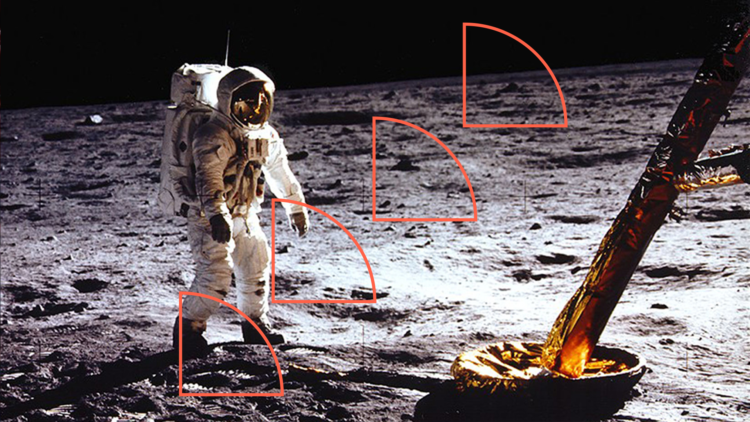
    If you thought the moon landing sequence in First Man was thrilling, then Apollo 11‘s very real footage is going to be sensational for you. In the completely uncut 4-minute shot, you can’t see more than the lunar surface getting closer and closer as a small line of text in the corner tells you how much fuel the Apollo Lunar Module called the Eagle has left and how far they are from the surface.

    Matt Morton’s score, fit for a Hollywood thriller, pulses underneath while you hear Commander Neil Armstrong and Lunar Module Pilot Buzz Aldrin converse with Houston in technical jargon. You know how it ends up. The craft lands and Armstrong becomes the first man to set foot on our moon. It’s the masterful and daring filmmaking that makes it a breathtaking moment in cinema. 

    Apollo 11 is made of those moments. Even the simple ones where we’re sweeping a crowd of onlookers excited to watch the Apollo 11 rocket blast off into space are almost hard to comprehend. Documentary filmmaking like this relies on masterful curation and an understanding of the story you’re trying to tell. The fact that director and editor Todd Douglas Miller was able to find clips that gave off the exact emotion he was looking for is astonishing. 

    Apollo 11 Documentary
    Photo by NASA/REX/Shutterstock (3683583c) (Real lunar mission image) Buzz Aldrin stands beside Lunar Module strut and probe Apollo 11 Moon landing mission – 1969

    It’s so hard to make a clear narrative solely from archive footage. Usually, documentarians need to rely on interviews or voiceovers to fill in the gaps. In Apollo 11, there is none of that. Yet you’re never at a loss for what is happening — even when the jargon becomes too technical — and you’re always in tune to what the overwhelming emotion behind a scene is. 

    Even though it’s a subject we all know about — or at least think we do — the piece that we’re always missing is the emotion — it’s why First Man is so successful. Apollo 11 is brimming with empathy for everyone involved — the astronauts, mission control, and the public.

    Sensational feels like the right word to use when explaining the feeling of watching this movie. Apollo 11 is as thrilling as any sci-fi and emotional as a sweeping drama. It’s an astonishing watch and one of the best movies of the year. 


    ADVERTISEMENT


    More movies, less problems


    Hey! I’m Karl. You can find me on Twitter and Letterboxd. I’m also a Tomatometer-approved critic.

    💌 Sign up for our weekly email newsletter with movie recommendations available to stream.


    ADVERTISEMENT


  • ‘Support the Girls’ review — Regina Hall is a powerhouse

    ‘Support the Girls’ review — Regina Hall is a powerhouse

    Support the Girls is a charming and emotional day-in-the-life dramedy with another magnificent performance by Regina Hall. 

    Regina Hall is one of the best and most underrated actresses working today. From her perfectly timed one-liners in Scary Movie to her grounded and emotional performance at the core of Girls Trip she has been consistently great in so many projects. It’s time Hollywood took notice. And if there’s ever been a movie for them to look to, it’s her latest performance in Support the Girls.

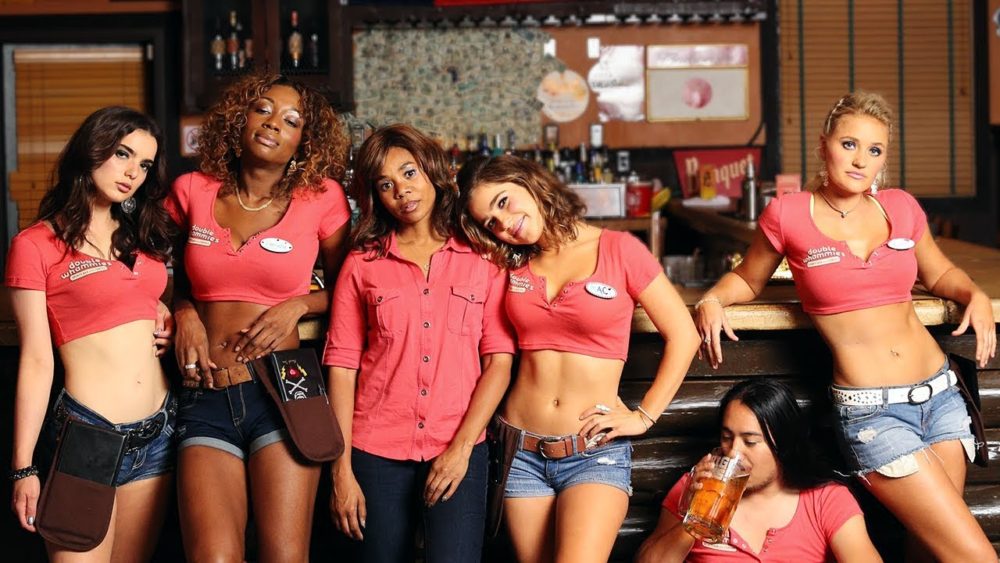
    Hall plays Lisa, the manager of a Hooters-like bar and restaurant called Double Whammies where twentysomething waitresses wearing crop tops and Daisy Dukes serve beer and wings to less than subtle men. When we meet her, she’s in the middle of a crying spell in the parking lot before the lunchtime rush. There’s no context for why as we watch her try to get herself under control. It’s a perfect scene to display Hall’s talents as she somehow imbues some subtlety into the least subtle human emotional response. Eventually, one of the waitresses Maci (Haley Lu Richardson in yet another great performance after last year’s Columbus and Split) interrupts her and walks her into the restaurant. No questions asked. 

    It’s that kind of quiet realism that defines Support the Girls and most of the director and screenwriter Andrew Bujalski’s career. Noted as the “Godfather of Mumblecore”—a subgenre of indie film that focuses on naturalistic dialogue and performances over plot—Bujalski brings an incredibly specific style to seemingly mundane storylines. It’s what made Jim Jarmusch’s Paterson so compelling.

    Support the Girls
    Shayna McHayle, Haley Lu Richardson, and AJ Michalka in Support the Girls.

    We follow Lisa through her day as she troubleshoots the ever-growing list of problems she faces as the general manager of Double Whammies—a would-be robber stuck in the air vents, a waitress who gets a curious tattoo, an off-the-books car wash fundraiser, a misogynist owner (James LeGros) breathing down her neck, and on top of that the cable is out just when there is going to be a big boxing match. However, Lisa tackles each one with a smile and still has time to make sure every single waitress that works there feels safe.

    However, there’s not much more to the plot than that. Along the way we meet a cast of characters that all bring different kinds of humor and charm to the movie. There’s Lisa’s right-hand woman Danyelle (Shayna McHayle giving a great debut performance) who delivers sharp one-liners and observations, butch lesbian regular Bobo (Lea Delaria) whose sharp respect for the girls sometimes gets her in trouble, and ditzy new hire Jennelle (Dylan Gelula) whose character could be summed up when she says, “I’m like a marketing major.”

    Admittedly, I didn’t understand Support the Girls for much of the running time. It feels like scene after scene of nothing happening. However, the remarkable final 20 minutes pull the entire movie together. It was all on the screen. I was just looking in the wrong place. The movie lies in the faces of each of the characters, every one of whom carries the baggage of their days and lives with them. That’s why Regina Hall is so incredible in the lead role. From the first frame where we watch her crying in a car facing the day to the last as she closes one out, we know exactly what she is feeling.

    Support the Girls is—as deservedly corny as it sounds—about the power of sisterhood and the work that women put in every day to just survive. However, unlike other female empowerment movies, everything doesn’t work out for all of our characters. It’s just reality. As one character notes, you cry until you laugh and you laugh until you scream. If Support the Girls wants you to walk away with one thing it’s that it’s okay to do all those things. Life is frustrating. Just take it one day at a time.

    Support the Girls is available to buy or rent on Amazon!

    Karl’s rating:

  • ‘If Beale Street Could Talk’ review — An intimate and political love story

    ‘If Beale Street Could Talk’ review — An intimate and political love story

    If Beale Street Could Talk is gorgeous, powerful, stunningly crafted, and another masterpiece from Barry Jenkins.

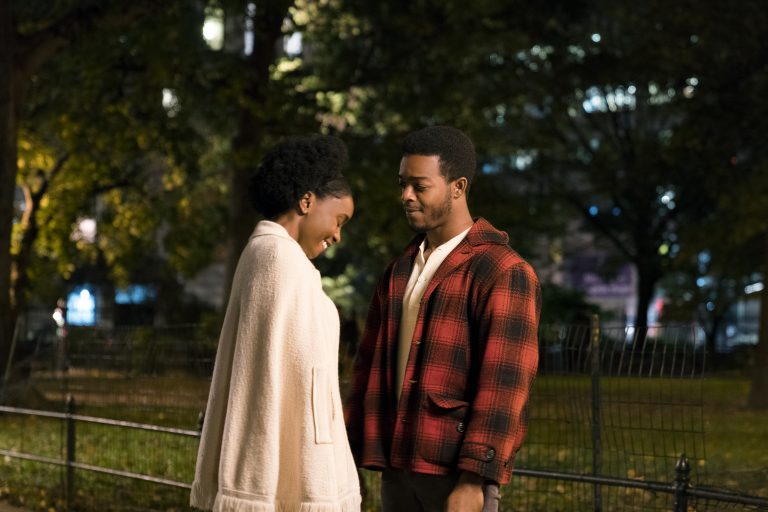
    If Beale Street Could Talk is a love story at its core the same way that Moonlight, director Barry Jenkins’ last film, is. It makes sense considering Jenkins excels at everything you need to make a good romance. He nails communicating intimacy on screen, often using delicious close-ups of faces and people touching.

    And like Moonlight, If Beale Street Could Talk is cast against a melancholic theme that tests the relationship. In Moonlight, the main character fights against his own identity and the circumstances of his coming-of-age as a queer black man. In If Beale Street Could Talk, the challenges are more tangible. 

    The main couple, sweet perfume counter clerk Tish (Kiki Layne) and swoon-worthy woodworker Fonny (Stephan James), have known each other since childhood. Through Tish’s gentle voiceover we learn about their love story and how it developed from friendship to something more. However, Fonny is in trouble. 

    He is accused by a white cop (an extremely creepy Ed Skrein) of raping a Puerto Rican woman named Victoria Rogers (Emily Rios). With only Tish and an old friend Daniel (Brian Tyree Henry in a masterful one scene performance) with a criminal record as his alibi, Tish must work to free him.

    It wasn’t always easy for the couple as the movie shows — it’s structured as a series of vignettes from their relationship sprinkled between moments from the present, which is 1970s Harlem.

    If Beale Street Could Talk
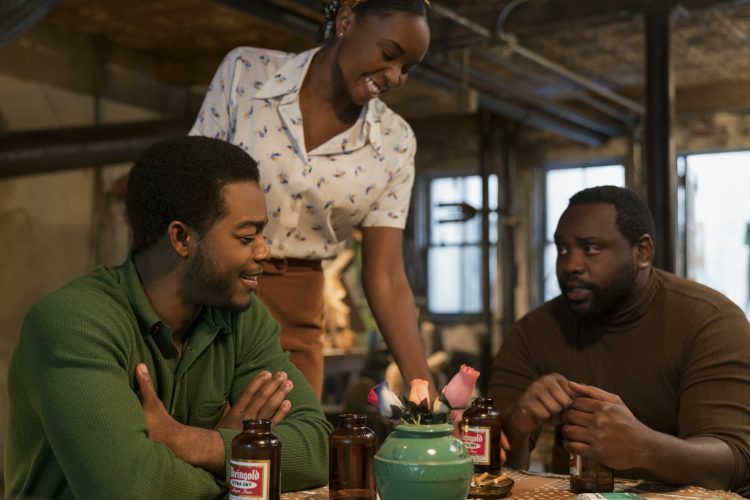
    Stephan James as Fonny, KiKi Layne as Tish, and Brian Tyree Henry as Daniel Carty star in Barry Jenkins’ IF BEALE STREET COULD TALK, an Annapurna Pictures release.

    The first 30 minutes are dedicated to Tish trying to tell her family that she and Fonny are expecting a child. Her mother Sharon (Regina King) is warm and supportive. And after an initial shock, so are her father Joseph (Coleman Domingo) and sister Ernestine (Teyonah Parris). But, she is also tasked with telling Fonny’s deeply religious mother (Aunjanue Ellis).

    That first scene is a masterful practice in acting and staging supported by Jenkins’ generous screenplay — based off of James Baldwin’s novel of the same name. It all feels like a stage play with actors navigating the space in relation to each other and changing positions as the power in the scene ebbs and flows. 

    If Jenkins is best at anything it’s his ability to communicate emotion and power without words. In another scene, Fonny and Tish prepare to have sex for the first time. The music in the background drops out to make way for the sound of rain as we watch their bodies intertwine. It’s a powerful and emotional scene dripping with intimacy.

    Moonlight grappled with the themes of care — for oneself and others — and love. Often that care and love were represented by a safe space. If Beale Street Could Talk deals with that same idea. What is a safe space for a black person? Well, the movie answers that with its opening quote:

    “Every black person born in America was born on Beale Street, born in the black neighborhood of some American city, whether in Jackson, Mississippi or in Harlem, New York. Beale Street is our legacy.”

    James Baldwin

    What is so heartbreaking about If Beale Street Could Talk is that it presupposes that those safe spaces are almost impossible to find in America.

    If Beale Street Could Talk
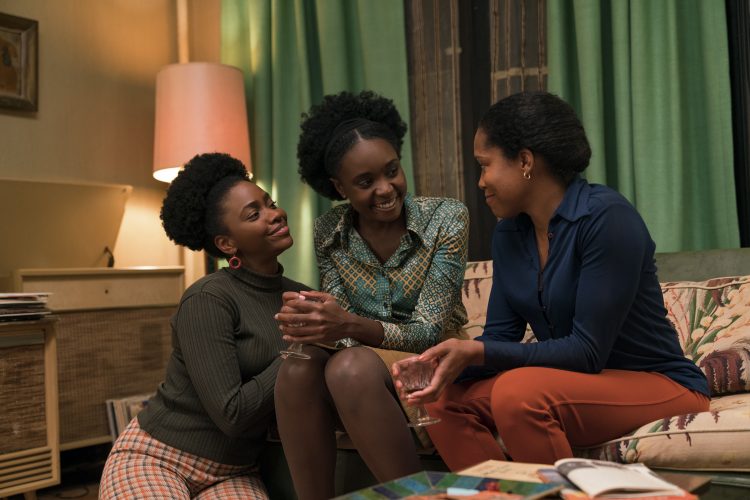
    (l to r.) Teyonah Parris as Ernestine, KiKi Layne as Tish, and Regina King as Sharon star in Barry Jenkins’ IF BEALE STREET COULD TALK, an Annapurna Pictures release.

    There are pockets where it exists — a grocery store where an elderly woman defends Tish and Fonny from a racist cop or an old warehouse where the Jewish landlord (Dave Franco) is willing to rent to the couple — but largely those places are vanishing. Fonny and Tish’s story acts as the conduit to explore that theme and their love story is what makes that exploration so effective.

    The film is pieced together like a memory — it’s edited by Joi McMillon and Nat Sanders, the Oscar-nominated editors of Moonlight — and Nicholas Britell’s score — also a collaborator on Moonlight — is a melancholic piece with notes of hope and yearning — the best score of the year. All those elements come together to create a masterwork of mood.

    Like his last film, Jenkins and casting director Cindy Tolan pieced together a flawless group of actors. Kiki Layne and Stephen James are both marvelous discoveries who possess so much chemistry with each other that it’s nearly impossible to resist falling for them as a couple.

    However, it’s the supporting cast that standout. Particularly, Coleman Domingo is a strong but sentimental steady hand, and Regina King — worthy of an Oscar — has a show-stopping segment set in Puerto Rico that cements her performance as one of the best of the year.

    If Beale Street Could Talk has so many moving parts that make it work. However, the core of its success is the main couple’s story. Not just the story to get Fonny freed but their love story — a beautiful black love story that we should be seeing more of. Gorgeous, powerful, and stunningly crafted, If Beale Street Could Talk is another masterpiece from Barry Jenkins.

    If Beale Street Could Talk will be in theaters on December 14th.

    Karl’s rating:

  • ‘Avengers: Endgame’ is a fitting end to the MCU — movie review

    ‘Avengers: Endgame’ is a fitting end to the MCU — movie review

    Avengers: Endgame is an epic, emotional, spectacle-driven farewell to the Marvel Cinematic Universe as we know it — and it’s perfect in every way. 

    30-second review: Avengers: Endgame is an epic, emotional, spectacle-driven farewell to the Marvel Cinematic Universe as we know it. And the fact that it is so clearly an end is part of the reason it’s so successful. There are many callbacks and moments of familiarity that will make fans cheer, but they don’t feel pandering. Screenwriters Christopher Markus and Steven McFeely took care to earn every one of the moments and often having them based in character.

    It also helps that the movie’s structure is that of an epic balancing multiple story threads and arcs without feeling overstuffed. And it all culminates in a satisfying, glorious end that reminds us why seeing movies with a crowd is so powerful. The MCU is an incredible feat and Avengers: Endgame is the perfect capper to it.

    Where to watch Avengers: Endgame: Available to buy or rent on Amazon.

    Whatever it takes. Full review below ?


    Don’t get it wrong, Avengers: Endgame is the end of the Marvel Cinematic Universe. Yes, these movies will continue. But this is a series finale. And like any good series finale, it’s filled with moments of joy — and fan service (more on that later) — sadness, nostalgia, and, most importantly, a vision for the future. Whatever comes next is something new — and that’s the way it should be.

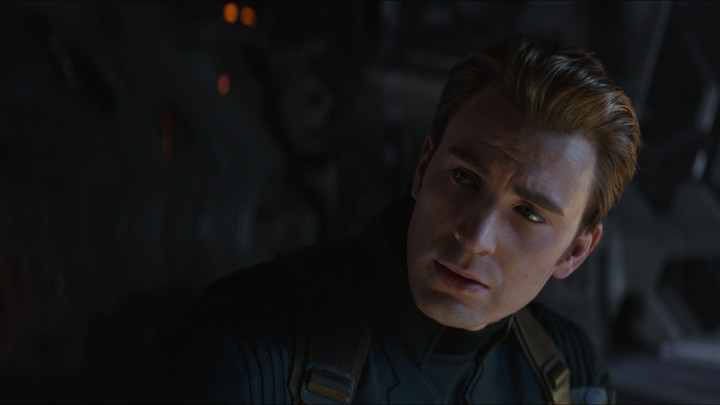
    To the credit of MCU mastermind Kevin Feige and directors Joe and Anthony Russo, this movie is proof that every movie, every moment, and every character along the way mattered. Endgame is a celebration of the journey and the six heroes that began it all — Tony Stark/Iron Man (Robert Downey Jr.), Steve Rogers/Captain America (Chris Evans), Thor (Chris Hemsworth), Natasha Romanoff/Black Widow (Scarlett Johannson), Clive Barton/Hawkeye (Jeremy Renner), and Bruce Banner/The Hulk (Mark Ruffalo). It’s their finale — and what an emotional, surprising, and exciting curtain call it is.

    It’s difficult to talk about Endgame without spoiling any plot details — and yes, avoid spoilers at all costs. I’ll be vague here. Because even if you think you know what’s going to happen, you don’t. We begin about a month after Thanos (Josh Brolin) wiped out half the population of the universe using the six Infinity Stones and the Avengers are at a loss.

    Even though Endgame clocks in at just over 3 hours, it doesn’t drag. Though the first act spends a lot of time with the characters working through their defeat. They have always been the world’s hope. Now, they’re the ones in need of some hope.

    It’s the raw moments with these characters that I missed in Infinity War. That movie had the difficult job of setting up the stakes for this movie and it did that successfully. But what makes the MCU so impressive is its willingness to slow the action down for the sake of character development. So much of Endgame is spent delivering payoffs and callbacks for fans. A large chunk of the movie is a clever and entertaining trip down memory lane. That doesn’t mean that it doesn’t earn the emotional payoffs for its characters — particularly the original six Avengers.

    Eventually, the story shifts to a Hail Mary attempt at reversing the effects of Thanos’ snap that is so ridiculous that it might just work. And the screenplay penned by Christopher Markus and Stephen McFeely keeps things moving. I’ve always praised the original Avengers movie for its brilliant story structure, Endgame is similarly well-paced and focused. It builds to a brilliant final act that can only be described as Earth-shattering. It’s not an exaggeration to say I was physically shaking.

    But that’s what these movies do so well. They get you laughing when they want you to laugh, crying when they want you to cry, cheering when they want you to cheer. If the Russo’s specifically are to be credited with anything it’s that they get you to do those things without feeling like you’ve been manipulated.

    Some of the praise for that has to be given to the performances as well. Chris Evans gives the best performance of his decade-long turn as Captain America while Robert Downey Jr. absolutely nails every emotional beat of Tony’s storyline. On the other hand, Chris Hemsworth and Mark Ruffalo hold down the comedic end. It’s a well-oiled machine that chugs to its incredibly satisfying conclusion.

    Which is good, since this is the end. The MCU will go on, but this is a bittersweet finale this 22-movie run. Storylines come to a end — all well-earned — and characters leave — some die, some move forward to uncertain futures, some stay right where they are. Still, they’re all changed. Every single character is different from when they were first introduced and that’s why no franchise has been able to do what the Marvel Cinematic Universe has been able to do.

    Endgame is a farewell. An epic, emotionally draining, spectacle-driven farewell. And yet, things are just getting started.


    ADVERTISEMENT


    More movies, less problems


    Hey! I’m Karl. You can find me on Twitter and Letterboxd. I’m also a Tomatometer-approved critic.

    💌 Sign up for our weekly email newsletter with movie recommendations available to stream.


    ADVERTISEMENT


  • ‘You Were Never Really Here’ review — A crime thriller masterpiece

    ‘You Were Never Really Here’ review — A crime thriller masterpiece

    You Were Never Really Here is a hypnotic and thrilling crime drama that doesn’t let you go until the credits begin to roll. 

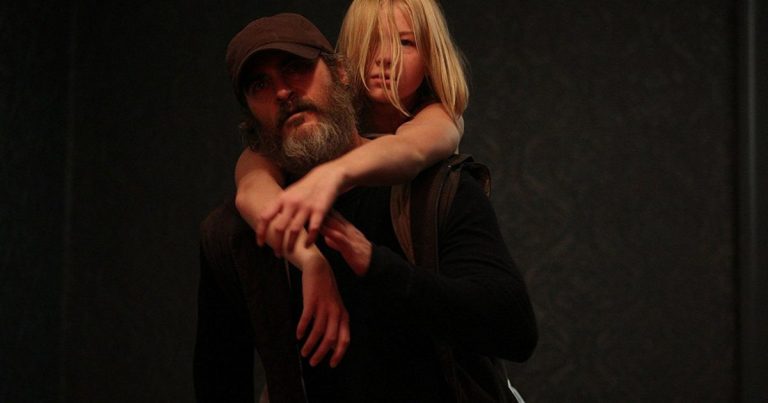
    A third of the way through the breezy 90-minute running time of You Were Never Really Here, essentially director Lynne Ramsey’s arthouse version of Taken, Joe (Joaquin Phoenix) lays down next to a hitman he has just shot. As “I’ve Never Been To Me” plays in the background, the two men lay side by side. The hitman extends his hand to Joe and they lay on the floor singing along.

    It’s an odd moment of humanity in a movie filled with inhuman behavior and something you’d never see in another crime thriller. Ramsey, who broke out in 2011 with We Need to Talk About Kevin, isn’t interested in the violence aspect of the story, though there is plenty of it. Instead, she focuses on the characters and specifically Joe’s internalized struggle with his past. 

    The plot is quite simple, unlike movies with similar premises. Joe is a hired gun who tracks down kidnapped children. His handler John McCleary (John Doman) delivers him a new job to track down the kidnapped daughter (Ekaterina Samsonov) of a New York State Senator.

    However, the job quickly spirals out of control. That’s really all there is to it. But Ramsey doesn’t let a single minute go wasted. It’s tense from beginning to end, save for a few tender scenes with Joe’s mother (a great Judith Roberts).

    You Were Never Really Here
    Joaquin Phoenix plays Joe, a hired gun, in Lynne Ramsey’s You Were Never Really Here.

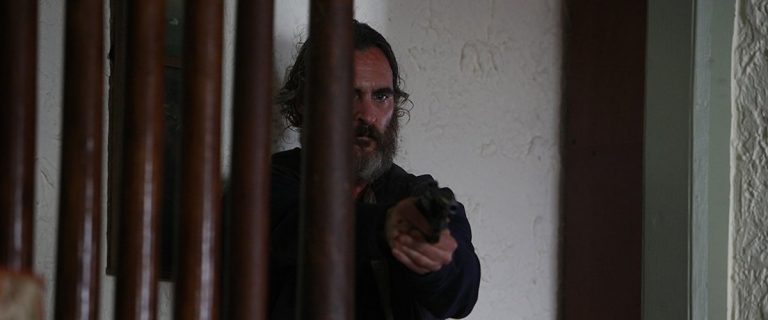
    There are a lot of scenes of violence, but Ramsey doesn’t glorify it. In one of the most stunning sequences, Ramsey tracks Joe through a house via surveillance cameras after he takes down guard after guard. It’s brutal, but not over-the-top as the camera gives us a detached view from it.

    As we cycle through various views from the cameras, we hear the croon of “I Wouldn’t Dream of It” through the halls. The sound design is impeccable with both diegetic and non-diegetic sounds. Much of what we see is internalized within Joe, but at moments the line is blurred.

    Phoenix has never been better. Joe is haunted by the moments in his past that we only see in brief flashes—him as a child hiding in the closet, his mother cowering under a table. The violence of his past invades the violence that he is committing in the present. However, the violence of his present is justified. At least, that’s how he gets through it. Without much goading, we are instantly endeared to Joe and his struggles despite his haggard appearance and hulking form.

    You Were Never Really Here doesn’t write a new song, but Lynne Ramsey performs it beautifully. Jonny Greenwood, after composing one of the best scores of the century for Phantom Thread, goes for a more fragmented approach here to great effect.

    It’s an art piece through and through, but also riveting and thrilling throughout. The second it ended I wanted to start watching it again and dissect every movement, every beat, and every sound. You will be mesmerized by it.

    You Were Never Really Here is now streaming on Prime Video. It is also rent and buy on Amazon.

  • ‘The Farewell’ review — One wedding and maybe a funeral

    ‘The Farewell’ review — One wedding and maybe a funeral

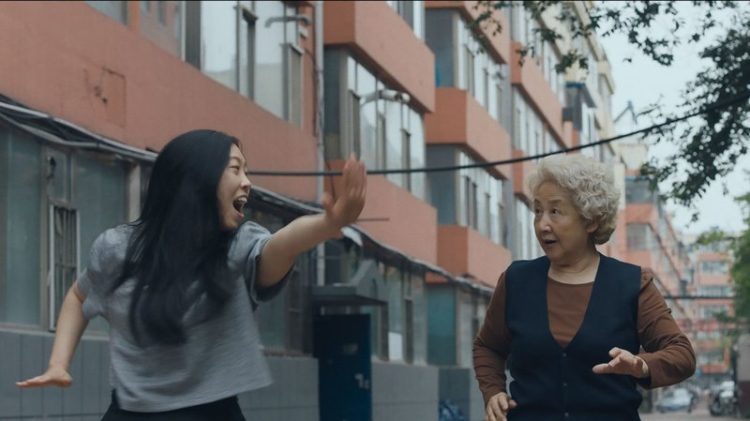
    The Farewell follows a New Yorker as she travels to China to say goodbye to her sick grandmother — who doesn’t know she’s dying.

    30-second review: The Farewell is a movie of dichotomies — Chinese culture and American culture, parents and children, mourning and celebrating, youth and old age — that appropriately straddles the line between drama and comedy. Even during dramatic moments, it seems that there’s always something lighter going on in the background to remind us that everything in the movie is based in love.

    It’s so difficult to make the exploration of emotions and family strife entertaining, but director Lulu Wang was able to pull it off by avoiding the melodramatics and instead focusing on the characters, their experiences, and their relationships to each other. It also helps that her Awkwafina is an incredible lead with enough charm to pull you in and the dramatic chops to keep you invested.

    Where to watch The Farewell: Now playing in theaters.

    Full review below ?

    One night when I was 14 or 15, my dad — who immigrated to the United States in the 80s from the Philippines — walked into my room, sat down on my bed and started to cry. I never saw my dad cry, not even when both of my grandparents died. It was out of nowhere. And he started talking about how he felt like he was a bad son because he didn’t take care of his parents enough or let them live in our house as they got older. “We have so much space, they could have just stayed here,” he said.

    I later learned that despite the pleading of most of my aunts and uncles, my grandparents never wanted to move in with any of them, afraid they’d be a burden.

    That’s one of the many conundrums of Asian and Asian-American culture that Lulu Wang‘s film The Farewell explores. The fact that showing your emotions is like burdening other people with it. The worst thing that you can do is worry others. It leads to a lot of emotional repression.

    We learn as we grow up that Eastern and Western cultures are like night and day. So for first-generation Americans like myself or people who immigrated to America as a child like the movie’s protagonist Billie (Awkwafina), the clash is hard to navigate. And she’s thrown into a situation where she needs to face it head on.

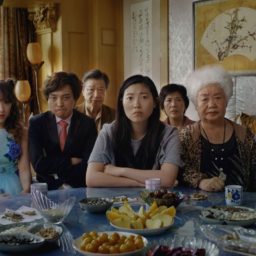
    A New Yorker to the bone, Billie steadfastly pursues her dreams while watching her bank account suffer as a result. However, when she finds out from her parents — after a lot of prying — that her grandmother who she calls “Nai Nai” (Zhao Shuzhen) has stage four lung cancer she doesn’t hesitate to fly back to her hometown in China, which she left at the age of six with her parents.

    The Farewell
    Awkwafina and Zhao Shuzhen in THE FAREWELL. Credit: A24.

    The complication is that her entire family including her dad (Tzi Ma), mom (Diana Lin), and uncle Haibin (Jiang Yongbo) have hidden Nai Nai’s true diagnosis from her and instead are visiting under the guise of a wedding for her grandson Hao Hao (Chen Han). In reality, they’re there to say goodbye to her and be with her one last time.

    This leads to plenty of disagreements between Billie and her family based on the differences in cultures, which is explored in more ways than one. However, it also sets the stage for plenty of hilarity as a very real wedding is being put on by Nai Nai even though Hao Hao and his girlfriend Aiko (Aoi Mizuhara) have only been together for three months.

    Even when serious discussions are happening, it always seems like there’s some lightness in the background to remind us that despite the deception it’s all being done out of love. It’s both hilarious and heartbreaking. Awkwafina has proven with roles in Crazy Rich Asians and Ocean’s Eight that she can do the former, The Farewell proves she can also be an emotional powerhouse.

    The movie is made up of these moments where the characters are litigating their decision to not tell Nai Nai the truth. In one scene, Haibin tells Billie that they have to do it so they can bear the emotional burden for her. It makes it all the more tragic because Nai Nai is so full of life and Zhao Shuzhen — who is fully deserving of an Oscar nomination — gives her the richness and sass the character deserves.

    There’s a scene when Billie’s mother asks Little Nai Nai (Lu Hong), Nai Nai’s younger sister, whether she’ll be okay when Nai Nai passes away. She gives a hopeful answer mentioning she wants to travel and maybe visit them in America. She then turns towards her and tells her not to worry about her.

    All any of us want to do — Asian, Asian-American, and otherwise — is to not burden our loved ones with our own problems. That’s the main crux of all the moments that make up The Farewell. It’s all just character’s trying to find ways to make life easier on each other whether it’s sending their kid to America for college or giving their granddaughter money to spend on something special or lying to a grandmother about their health.

    But what Wang brilliantly explores is the consequences of those actions. That kid could never come back or forget their home, the granddaughter would be no better off than they were before, the grandmother could die without properly saying goodbye. She litigates all those decisions without coming down on either side. Instead, she’s on the side of the characters and what they need to go on. Most of them don’t know what that is. But then again, do any of us?


    ADVERTISEMENT


    More movies, less problems


    Hey! I’m Karl. You can find me on Twitter and Letterboxd. I’m also a Tomatometer-approved critic.

    💌 Sign up for our weekly email newsletter with movie recommendations available to stream.


    ADVERTISEMENT

  • ‘Spider-Man: Into the Spider-Verse’ review — One of the best superhero movie in years

    ‘Spider-Man: Into the Spider-Verse’ review — One of the best superhero movie in years

    Spider-Man: Into the Spider-Verse is a bright and bold loving critique of the superhero genre and a much needed hard reset.

    30-second review: Spider-Man: Into the Spider-Verse is so keenly aware of what it wants to be even though what it wants to be has never existed before. It’s a bright and bold loving critique of the superhero genre and a much needed hard reset. It doesn’t shy away from the usual tropes, but it tackles them in a way that is innovative, visually jaw-dropping, and laced with real emotion. With great power comes great responsibility, and the responsibility was in the right hands with Into the Spider-Verse.

    Where to watch Spider-Man: Into the Spider-Verse: Available to stream on Netflix. You can also buy or rent it on Prime Video.

    With great power comes… oh, you get it. Full review below ?


    Spider-Man: Into the Spider-Verse leans into the ridiculousness of superhero movies but respects how empowering they can be. In an odd way, Into the Spider-Verse feels akin to The Cabin in the Woods. The 2012 horror film directed by Drew Goddard was a loving hate letter to the genre in played in. Into the Spider-Verse seems to be interested in the same thing. 

    It’s a meta-commentary on the oversaturation of superhero origin stories told over and over again—each hitting the same beats as the last. Hilariously, the movie begins with an origin story montage that pokes fun of previous movie incarnations of the superhero. Specifically, the Sam Raimi trilogy—even the infamous Spider-Man 3 street walk-dance.

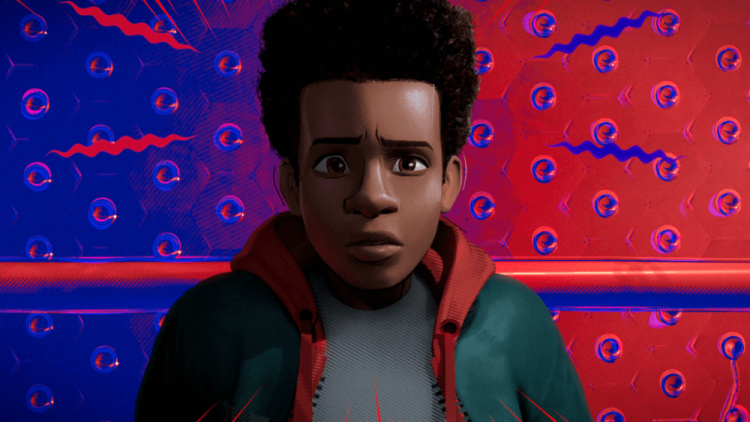
    In Into the Spider-Verse, we watch the origin story of 13-year-old Miles Morales (Shameik Moore), a half-black/half Puerto Rican teen who is unexpectedly thrust into the position of Spider-Man.

    However, this is not your typical origin story. Yes, we hit the familiar beats of the Spider-Man story we all know—bit by a radioactive spider, unexpectedly discovers powers and doesn’t know how to control them—but there’s the added layer of Miles existing in a world where Spider-Man (Chris Pine) is already a fixture.

    So, when that Spider-Man is taken down by baddie Kingpin (Liev Schreiber), Miles is inspired to take over. At first, he’s overwhelmed by his powers and the responsibility. However, he’s not alone.

    Fisk’s evil plan is to open up a multiverse underneath Brooklyn for reasons I will keep unspoiled. However, in doing so, a Spider-Man from another dimension is brought into Miles’. This Spider-Man goes by the name Peter B. Parker (Jake Johnson). In his world, he’s been Spider-Man for a lot longer than the one in Miles’ world and has become jaded—and overweight—by the job.

    Spider-Man: Into the Spider-Verse
    Shameik Moore voices Miles Morales in Spider-Man: Into the Spider-Verse.

    The movie is upbeat, colorful, and hyper-stylized in a way that comic fans will appreciate. Into the Spider-Verse is, perhaps, the best film interpretation of a comic book’s sensibility—it includes on-screen sound effects and the classic comic book text box without feeling gimmicky.

    The filmmakers even went as far as slowing down the frame rate to 12 frames per second—the standard is 24—to make the action look like a moving image. This is best used in a hilarious action scene where Peter B. Parker and Miles first meet.

    As they bounce through the streets of Brooklyn—hilariously attached by their own webs—chased by the police, there is a keen cartoon sensibility to the comedy and comic book veneer to the way the action is rendered. That carries throughout the movie and delivers some of the best action and comedic set pieces of the year. 

    At first, Peter B. Parker, who feels inferior compared his dimensional counterpart, is hesitant to take Miles under his wing. But when he finds out that Miles holds the key to getting him back home he finally accepts. 

    Now that the pair teamed up, they begin to form a mentor/mentee relationship that drives part of the emotional crux of the movie. The other emotional crux is Miles’ relationship with his police officer father Jefferson (Brian Tyree Henry) and with his Uncle Aaron (Moonlight‘s Mahershala Ali)—Miles often feels overwhelmed by his parents’ high expectations of him and goes to his uncle for a reprieve. 

    After a hilarious visit Aunt May (Lily Tomlin)—a badass assistant to this universes Spider-Man—Miles and Peter B. Parker realize that the multiverse has brought in even more Spider-People.

    Spider-Man: Into the Spider-Verse
    Hailee Steinfeld voices Gwen Stacey in Spider-Man: Into the Spider-Verse.

    There’s the dark and gritty—to hilarious levels—film-noir Spider-Man (a terrific Nicolas Cage) who is rendered in high contrast black and white and talks in exactly how you’d expect a noir detective to speak. There’s the anime rendered Penni Parker (Kimiko Glenn) who fights with a spider-like robot she controls with her mind. And there’s Spider-Woman who turns out to be Gwen Stacey (Hailee Steinfeld), a young and energetic Spider-Person.

    Together they work to take down Kingpin and return each Spider-Person to their own universe. Of course, there’s a time crunch. If they aren’t returned soon, their cells will degenerate. Along the way, they battle Kingpin’s goons in fan-service references, callbacks, and homages.

    And what is so refreshing—especially with the MCU being the template for most superhero movies—is that there are real stakes and danger in the action. I found myself tensing at the light and funny action because it feels often like any character could be hurt or killed.

    All the elements I’ve mentioned above make Into the Spider-Verse the boldest superhero movie in years and most innovative animated movies ever made. It’s so keenly aware of what it wants to be even though what it wants to be has never been done before. 

    Audiences have become desensitized by the at least three MCU movies, a cadre of DC movies, and a Sony Marvel movie coming out each year. Into the Spider-Verse is a refreshing reset to the genre. In a world where we know superheroes can do anything—with the help of CGI—how do you keep things interesting? Into the Spider-Verse solves this by playing with—and criticizing—the formula.

    It’s bold, funny, sentimental, and one of the best movies of the year.


    ADVERTISEMENT


    More movies, less problems


    Hey! I’m Karl. You can find me on Twitter and Letterboxd. I’m also a Tomatometer-approved critic.

    💌 Sign up for our weekly email newsletter with movie recommendations available to stream.


    ADVERTISEMENT

  • ‘Bad Times at the El Royale’ review — A nostalgic 60s neo-noir

    ‘Bad Times at the El Royale’ review — A nostalgic 60s neo-noir

    Bad Times at the El Royale is a thrilling, character-driven neo-noir homage that will keep you guessing from beginning to end. 

    Don’t let the flashy trailers, catchy title, or A-list stars fool you. Bad Times at the El Royale is not your typical popcorn thriller. Written and directed by Drew Goddard, who had a lot to live up to after his masterpiece debut film The Cabin in the WoodsBad Times unquestionably lives up to its pulpy title and delivers a twisting mystery with a cast of characters whose intentions are always in question.

    However, Bad Times is not a straight-forward entry in the neo-noir genre. It’s not surprising considering Cabin is a loving deconstruction of the horror genre that presupposes — correctly — that both the machine putting out horror movies and the fans that flock to them are off on the wrong track. 

    With Bad Times at the El Royalehe emulates the pulpy neo-noir genre that has found new life through Quentin Tarantino’s carefully crafted homages. The movie is complete with title cards introducing each section — each character’s section is defined by their assigned room. Unlike Tarantino, Goddard is more interested in the themes of the genre. Good and evil, right and wrong, alienation and paranoia. He explores those themes by directly tying them to the time period: 1969.

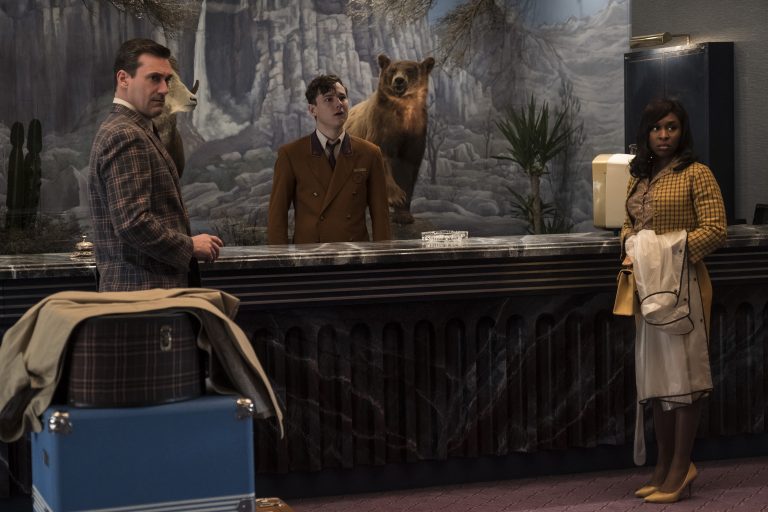
    The El Royale hotel is split right down the middle. Half is in California and half is in Nevada. As the first two guests in our cast of characters arrive, the bright colors and whimsical 60s design of the hotel set us firmly in the time period. However, it’s not indicative of the rest of the movie.

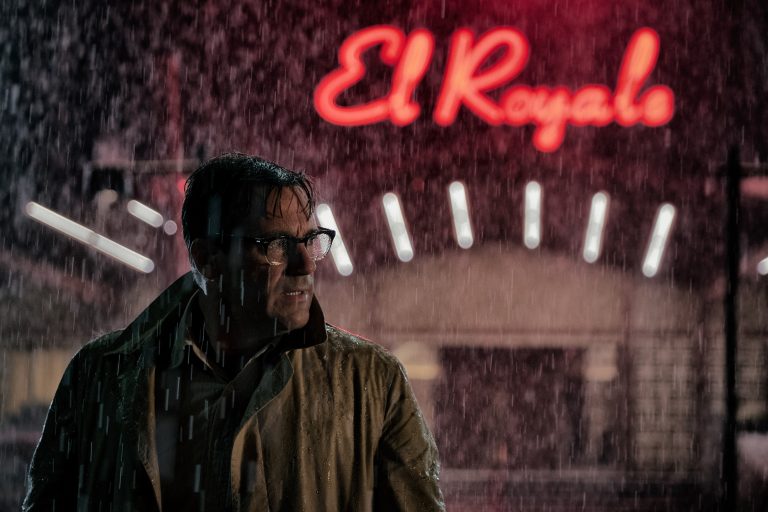
    For almost the whole running time—the movie is set over one night—the hotel is shrouded in darkness and pummeled by a storm that seems to react to the bad times happening in the hotel. And yes, they’re as bad as you imagine. 

    You see, though the guests consist of hopeful lounge singer Darlene Sweet (Cynthia Erivo) and old grizzled priest Daniel Flynn (Jeff Bridges), not everyone has good intentions. The movie is patient. It doesn’t tip its hand too soon. It’s a reason it’s so mesmerizing.

    The slow and methodical cold open where we watch a mystery man (Nick Offerman) arrive in a hotel room and take it apart to hide a bag with unknown contents is captivating even if the camera doesn’t move and nothing really happens. Even the next scene where we watch each guest arrive plays out slowly but with an underlying tension that doesn’t give any hints as to where the story is going. 

    Bad Times at the El Royale
    Jon Hamm stars in Twentieth Century Fox’s BAD TIMES AT THE EL ROYAL. Photo Credit: Kimberley French.

    From there, the movie plays out like an Agatha Christie crime novel mixed with a Hitchcockian thriller with an added dose of Tarantino-esque style. Pieced together with clips from different characters perspectives — often covering the same event — and flashes to their pasts and what led them to the El Royale, the movie doesn’t necessarily have a linear narrative. However, all plotlines lead to one fateful event. 

    The amiable southern vacuum salesman Seymour Sullivan (Jon Hamm) sulks around the hotel before coming across a corridor with two-way mirrors that look into each room — we’ll revisit this place a few times — he watches as each guest does increasingly strange things.

    The nervous, but eager to please concierge/waiter/housekeeper Miles Miller (Lewis Pullman) is struggling with things he’s done in his past that he assures to Father Flynn only get worse. Even more mysterious, and more sinister, is Emily Simmerspring (Dakota Johnson), who has an unusual cargo with her. 

    Eventually, the ghosts that haunt each of the characters begin to intertwine as characters are unmasked to deadly results. Just as the El Royale straddles two states, the characters straddle moments in their lives. It’s a purgatory that each person will leave — alive or dead — as a good or bad person even if the line between the two isn’t as clear as you’d think. And it’s deliciously fun to watch where each guest ends up. 

    Bad Times at the El Royale will be polarizing to mainstream audiences. I’m surprised it’s a wide release at all. At 140 minutes, it could feel like a bloated meandering thriller that takes too long to get to the point. In reality, it’s a slow-burn character drama that puts these seven characters to the test. I know, I only mentioned five. I’ll leave the rest to surprise. What I will say is one of them is an amiable cult leader played by Chris Hemsworth. I’ll let you imagine how he fits in.

    However, if you take a chance and give yourself over to the movie, it’s an extremely fun and surprisingly emotional ride. That’s thanks to the ensemble, which is easily the best this year. In particular, the most junior members of the cast, at least on film, Cynthia Erivo and Lewis Pullman, give the two best performances.

    Erivo belts out songs that often play under scenes to great effect. But she tinges every one of them with a hint of sadness and regret. On the other hand, Pullman’s physicality and delivery reveal a person that is struggling with who they are in a way that you genuinely ache for him. That’s what caught me off guard watching the movie.

    In the end, as each character makes their exit, I was saddened saying goodbye to each of them. All their quirks and flaws. Their bad times at the El Royale were great times to watch in my book. 

    Where to stream Bad Times at the El Royale: Available to rent or buy on Prime Video.

  • ‘Widows’ review — Viola Davis leads the best movie ensemble of the year

    ‘Widows’ review — Viola Davis leads the best movie ensemble of the year

    Widows is successfully a thrilling heist movie, emotional character study, and dissection of our current social climate.

    Widows is based on the 1983 British television show of the same name, but you wouldn’t know that watching Oscar-winning director Steve McQueen’s adaptation from a screenplay written by Gone Girl scribe Gillian Flynn. The film, which changes the location from London to Chicago, is distinctly American.

    The themes ranging from corruption to police shootings to race to the wealth gap are covered with poignancy and impact. However, like all of McQueen’s films, including the Oscar-winning 12 Years a SlaveWidows is also a character study. It’s all packaged up neatly in a twisting heist thriller that makes it one of the most compelling, and best, films of the year.

    Widows begins with Veronica (Viola Davis fresh off her Oscar win for Fences) and Harry Rawlings (Liam Neeson) waking up in their sun-drenched Chicago high-rise apartment. Smash cut to four masked men stumbling into a van. One of them is injured and one of them is revealed to be Harry. After a brilliantly captured car chase, the men are brought down in a hail of bullets before their van ultimately explodes.

    However, Veronica doesn’t have much time to grieve as Jamal Manning (Brian Tyree Henry), a crime boss turned alderman-candidate, with his brother Jatemme (Oscar-nominee Daniel Kaluuya of Get Out fame), who acts as his muscle, come to Veronica demanding the $2 million that her husband stole from them.

    Henry and Kaluuya both give menacing performances. Henry is a sneering devil who is calm and composed until he’s not. Kaluuya is similarly, and eerily, quiet, but is unpredictable in his explosive actions, like in Get Out so much of his performance happens just in his face.

    Veronica, who is eventually led to her late husband’s journal by their driver Bash (Garret Dillahunt), recruits the other widows of Harry’s deceased crew to help her finish the job he outlined in his journal to clear his debts and start a new life for herself.

    The other widows, Alice (Elizabeth Debicki) and Linda (Michelle Rodriguez), also have reasons to pull off the heist. Linda lost her store after her husband’s passing and is having trouble supporting her kids with her mother-in-law breathing down her neck. Alice, also looking for money, turns to escorting at her mother’s (Jacki Weaver in a great one-scene performance) suggestion and is eager to get out of it.

    Widows
    Elizabeth Debici, Cynthia Erivo, and Michelle Rodriguez in Widows.

    However, their planning and execution of the heist is not the center of the story. It’s thrilling and suspenseful, especially when Hans Zimmer’s beaming score is supporting it, but it’s not the main propulsion of the story. Instead, it’s the widows themselves that are the narrative and emotional drive as we watch them navigate life after losing their husbands and finding strength in a society that undercuts them as women.

    All the while, in the background, a story of political intrigue plays out as the contentious election between Manning and Jack Mulligan (Colin Farrell) the son of the current alderman of the 18th Ward (Robert Duvall). There, we also confront McQueen’s interest in adapting this story specifically in Chicago and at this time in our political history. 

    The main theme of Widows can be boiled down to dichotomies in our increasingly polarized country. Those lines, drawn across race, wealth, and gender, are captured visually through Sean Bobbitt’s stunning cinematography.

    There are physical separations between each side. In one of the best scenes of the movie, and perhaps of the year, Mulligan, leaving a campaign event, climbs into his limo. However, the camera doesn’t follow him in. Instead, it’s fixed on the hood of the car showing us the neighborhood turn from abandoned lots and distressed storefronts to tree-lined suburban streets with ivy-covered mansions within minutes. It emphasizes the modern-day segregation in Chicago.

    The balancing act McQueen pulls off with the film is impressive. It succeeds on every field it’s playing in. However, if there’s anything takes Widows from good to great, it’s the performances. Every single actor has their moment. Kaluuya and Henry are worthy villains. Cynthia Erivo, who plays a single mother who helps the widows, turns in more great work after nearly stealing Bad Times in the El Royale last month. Carrie Coon and Garret Dillahunt do great work in small roles. Duvall and Farrell make a great onscreen father and son team.

    But the real success her comes from the performances of Michelle Rodriguez, Viola Davis—giving another powerhouse performance—, and particularly, Elizabeth Debicki, whose heartbreaking, funny, and charismatic performance as Alice ranks as one of the best of the year.

    At one point, a cop says, “he should burn in hell, but hey, Chicago will do.” In Widows, Chicago stands in as a microcosm of the United States. Racial tensions are the highest they’ve been in decades, police shootings are on the rise, the wealth gap is turning into a chasm, and women have to fight against a system that oppresses them every day.

    Flynn’s smart screenplay and McQueen’s always stylish and steady direction guide the film through those nuances and the result is nothing short of extraordinary. Widows boast the best cast of the year and is sure to be that rare film that bridges the gap between arthouse and mainstream.

    Widows is in theaters now.

    Karl’s rating:

  • ‘Shoplifters’ review — Touching, funny, and hopeful family drama

    ‘Shoplifters’ review — Touching, funny, and hopeful family drama

    Shoplifters is heartbreaking but often funny and hopeful look at a family of thieves relying on each other to make it day to day.

    Shoplifters is one of those rare movies that you cherish what you don’t know about the characters. Not because what’s beneath the surface will change your opinion of them. It’s because you know when that truth comes out that everything will change and you’d much rather spend more time with them in blissful ignorance.

    That’s what is incredible about the Palme d’Or-winning drama by the renowned Japanese director Hirokazu Kore-eda. We know that there are things that the characters do that we should disavow, but Kore-eda achieves the same effect that Wes Anderson’s The Royal Tenenbaums does. For all the bad the characters do, we can’t help but want to hang out with them for all the good we see in them. 

    In the film, we follow a mismatched familial unit living in a small house in the middle of Tokyo that could barely fit one person, let alone six. There are husband and wife Osamu (Lily Franky) and Nobuyo (standout Sakura Ando), both part-time workers at low wage jobs that force them to rely on their elderly grandmother Hatsue’s (Kirin Kiki is fantastic) monthly pension to live. 

    That’s also the reason that Osamu along with his son Shoto (Kairi Jō) bond by shoplifting. The film even opens with them orchestrating a well-choreographed slick robbery of a grocery store without anyone in the store being the wiser. 

    However, everyone in the family is guilty of some less-than-legal methods for making money. Nobuyo snatches trinkets—a gold tie pin, for example—forgotten in clothes that run through the laundromat she works at. Hatsue has an affinity for pachinko slot machines, even though she doesn’t always use her own money to play. Aki (Mayu Matsuoka), a teen just barely old enough for college works in a porn cafe of sorts where she masturbates for anonymous patrons hidden behind a two-way mirror. 

    It’s not surprising considering their current financial position that the family isn’t happy when Osamu brings home a five-year-old girl names Yuri (Miyu Sasaki) he found alone in the cold. He says he’s only going to take her in for a few days, but when they find signs of abuse, they know they can’t let her go home and informally adopt her. 

    Shoplifters
    The cast of Shoplifters.

    The first half of the movie plays out like a toned-down episode of Shameless. Though some of their methods for surviving or reprehensible, it’s so satisfying to watch this odd family unit interact in often funny, but also sweet exchanges. At one point, as Hatsue lovingly rubs ointment over one of Yuri’s many scars, Nobuyo tells her that even though you still see the scar the pain is gone. 

    Balancing what could have easily been too far into slapstick or overly sentimental, Kore-eda allows the love between the family members to shine at the center of Shoplifters. Though the first half can feel like it’s meandering, it’s all in service of setting up the family unit as a believable one so that when the plot hits do come they land with more impact—and that they do. 

    Eventually, after nearly two weeks, Yuri’s parents report her missing, which only strengthens the family’s urge to protect her—they cut her hair and buy her a new wardrobe to hide her from the police and media. And they fall into a routine. Shoto begins teaching Yuri, who they rename Lin, his shoplifting techniques, Osamu and Nobuyo rekindle their romance, and Aki meets an intriguing client. 

    All the moments that make this film great are quiet but so powerful. You realize that these are all people marginalized and discarded in some way that have come together to build each other back up again. However, what makes Shoplifters one of the best films of the year is the emotional fallout from the high of the first half. Like all good things, the happiness and joy must come to an end. 

    Throughout the movie, truths about the characters are unpacked until we have to re-contextualize everything we know about them and their relationships. But instead of making it a bombastic conclusion—it certainly edges on that—Shoplifters turns to its characters for the emotional wrap-up. 

    The members of the family are flung away from each other, but we’re reminded of what connected them in the first place—love. It’s not always spoken, but it’s always shown. In one of the most striking scenes in the movie—and maybe of the year—Osamu chases after a bus that Shoto is on. Shoto doesn’t turn to look at him until he’s out of view and then mouths the word “dad.” Shoplifters doesn’t need more than that to make its point and make you sob. It’s funny and emotional, uplifting and heartbreaking, it’s one of the best movies of the year. 

    Shoplifters is in theaters nationwide on November 23rd.

    Karl’s rating: