Tag: Issa Rae

  • ‘American Fiction’ satirically rewrites race into Hollywood | review

    ‘American Fiction’ satirically rewrites race into Hollywood | review

    TIFF 2023 | American Fiction follows a fed-up Black author who facetiously writes a “Black novel” to poke fun at media’s desire for tragic POC stories only to find himself with his most success to date


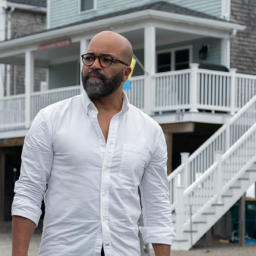
    American Fiction is an uproarious absurd comedy, uplifting family drama, and swoony romantic comedy, and all wrapped up in a hilarious crowd-pleasing satire about the stories the media deem worthy of telling about marginalized people. It’ll have you crying from laughter and then asking, “Am I the problem?” With a stellar ensemble cast anchored by Jeffrey Wright giving a career-best performance, American Fiction is one of the most-entertaining and best movies of the year.

    American Fiction premiered at the 2023 Toronto International Film Festival.

    You might also like: Everything Everywhere All At Once, Get Out

    In adapting the 2001 novel Erasure, writer-director Cord Jefferson basically delivers three separate movies. On one end, American Fiction is a Nora Ephron-esque romantic comedy about a cranky writer and the love he finds with his newly divorced neighbor. On the other, it’s a family drama about a Black family and their various personal struggles. Bridging the two is a witty comedy about the (very white) media machine and its hunger for stories about marginalized people — only if they’re sad. If it sounds like a lot, you’re right. However, through clever writing, a stellar ensemble and plot that keeps you guessing, the result is a hilarious crowd-pleasing satire that will have you nodding and laughing along in agreement, but also wondering, “Am I the problem?”


    ADVERTISEMENT


    Because while American Fiction chides the stereotypical “tragedy porn” that typically encompasses the most popular Black stories — think Oscar successes 12 Years a Slave or Precious — it also emulates them. It’s like the book that first frustrates author Thelonious “Monk” Ellison (Jeffrey Wright) about the hypocrisy. After speaking on a sparsly attended panel at a book festival, Monk walks by a packed conference hall where Sintara Golden (Issa Rae) is addressing a largely white audience about her best-selling debut novel We’s Lives in Da Ghetto. She reads a passage and it’s every bit as bad as you’d imagine it’d be — the audience eats it up.

    Things are excasserbated when Monk goes to a local bookstore looking for a copy of his book. Instead of finding it in historical fiction an unassuming teen employee guides him to the “African-American” stories section. When Monk questions him on why it’s there, he responds, “I imagine this author is Black.” Monk retorts, “The blackest thing about this book is the ink!” After his book agent Arthur informs him another publisher has passed on his newest novel for “not being black enough,” Monk faceciously writes My Pafology. As he types, the two characters Willy the Wonker (Keith David) and Van Go Jenkins (Okieriete Onaodowan) enter the room and enact the story. There’s a drug deal, shootout, missing father reveal. Everything that Monk hates about the state of Black media. He signs the manuscript Stagg R. Leigh and sends it off to Arthur to send to publishers as a “f— off.”

    They love it.


    ADVERTISEMENT


    From there, Monk deals with the fallout from the book’s success including a potential movie adaptation that a producer (Adam Brody) is circling, becoming a finalist for a literary prize that Monk is on the jury for, and a small hitch where people inadvertadly become convinced “Stagg” is a wanted fugitive on the run from the authorities (it adds to the mystique!). All the while, Monk is dealing with his kooky family — responsible doctor sister Lisa (Tracee Ellis Ross), immature gay plastic surgeon brother Clifford (Sterling K. Brown), aging mother Agnes (Leslie Uggams), and childhood nanny Lorraine (Myra Lucretia Taylor) — and potential romance with his newly single neighbor Coraline (Erika Alexander).

    If that sounds like a lot of story to balance, you’d be right. But Jefferson never loses control of any of the plotlines. The romance is romantic. The family drama is compelling. The satire is incisive. Each thread delivers its own resonant commentary that eventually layer into the thoughtful themes of American Fiction.

    While sitting on the jury for a literary prize that he’s never won — they ask him to be on the judging panel after calls for diversity — Monk and Sintara sit amongst three white authors as they debate the authenticity and worthiness of My Pafology as a story. Monk and Sintara are understandably dubious about the novel while the other three white judges proclaim, “we need to listen to more Black voices!” — all as they ignore the two in the room. To add insult to injury, one gleefully says, “I’m thrilled to read about a BIPOC man harmed by our carceral state.” Monk and Sintara can just roll their eyes. What American Fiction understands is people will pay attention to Black stories and opinions when it feels comfortable for them.


    ADVERTISEMENT


    The beauty of the movie, though, is that while it in some ways emulates the kinds of stories its criticizing, it leaves room for joy on the screen. The balance between sincerity, parody, and satire is nothing short of miraculous.

    American Fiction is packed to the brim with jokes, hijinks and gags. From Monk sting like a hardened criminal in a meeting with a film producer to sell the book’s rights or when the family arrives at the beach house to be greeted by two speedo-clad gay men making breakfast with Clifford or a montage on a Hallmark-like channel celebrating Black stories all of which are about slavery, poverty, or gangs, there’s nary a moment without something to laugh at. But within those absurd moments, there’s poignancy. In particular, Clifford confides to Monk his regret about not coming out to their father before he died. “He never knew the entirety of me,” he laments. That line neatly packages what Jefferson is trying to communicate. Monk, in another scene, observes that the media people consume about the Black experience “flatten our lives.” American Fiction tries to add color back into those stories — and it’s one of the year’s best because of it.


    ADVERTISEMENT


    More movies, less problems


    Hey! I’m Karl. You can find me on Twitter and Letterboxd. I’m also a Tomatometer-approved critic.

    💌 Sign up for our weekly email newsletter with movie recommendations available to stream.


    ADVERTISEMENT

  • ‘Barbie’ is hot pink-splashed post-modern meta romp | review and analysis

    ‘Barbie’ is hot pink-splashed post-modern meta romp | review and analysis

    Barbie leads a perfect life, until something goes horribly wrong. To save herself, she needs to leave her pink utopia Barbieland and venture into the real world. Ken’s there too.

    Barbie looks camp right in the eye and turns it into a hot pink-splashed post-modern meta exploration of existentialism, feminism, the patriarchy and masculinity packaged in a satirical surreal musical comedy homage to classic. It isn’t just a movie of our time. It is the movie of our time.

    Barbie is in theaters now.

    Before I begin: I want to vocalize by full support of the Writers Guild of America and the Screen Actors Guild as they fight for a fair deal. 

    I’m so happy I live in a world where a major studio gave a female filmmaker a $145 million dollar budget to make a post-modern meta-exploration of existentialism, feminism, the patriarchy and masculinity packaged as a satirical surreal musical comedy homage to classic cinema based on a children’s toy. They’d probably faint if I tried to explain this to a Victorian child. Barbie is a movie of today. Or, more aptly, Barbie is *the* movie of today. 

    Writer-director Greta Gerwig (Lady Bird, Little Women)—she co-wrote the movie with her husband Noah Baumbach—captures our current societal, political, and cultural moment with confident hot pink-splashed ease as she double winks at the audience with the surreal absurdity of Barbieland. That is the most remarkable achievement of the movie. Barbie knows that we know that they know that we know exactly what they’re doing. It’s like a movie of a dream sequence in a movie in a dream. Things don’t quite make sense, but it adds up. In the case of Barbie, it adds up to a sharp, incisive, and profound reflection of our world—that also happens to be a hilarious summer romp that we’ve been craving.


    ADVERTISEMENT


    We begin in Barbieland, a picturesque bright idealistic world made of plastic. It’s basically the “how society would look if” meme if it was pink. Every morning the “Barbies” wake up, brush their teeth with comically-sized toothbrushes, “shower” with no water, and float down from their roofs to begin their day of… well, being perfect. Barbie is president (Issa Rae in a charming supporting role). She also holds every seat on the Supreme Court. She’s a doctor. A lawyer. Barbie is everything. As narrator Helen Mirren puts it in a cheeky voiceover, “all problems of feminism and equal rights have been solved” in the real world because of Barbie… or so the Barbies in Barbieland are led to believe—more on that later.

    All the visual gags and well-publicized hyper-stylized quirks are as delightful as you’d imagined (Her heels don’t hit the ground! They drink from cups with nothing in them! Gravity is more of a concept than reality!). The specificity and absolute absurdity of the world-building is joyous, as is the “giant blowout party with all the Barbies, and planned choreography, and a bespoke song.” Margot Robbie as our protagonist Stereotypical Barbie (her words not mine)—aka the Barbie you think of when someone tells you to think of a Barbie—is perhaps the most charismatic and perfect of them all (if that’s even possible). 

    But then at the end of their perfect Disco-inspired musical number to Dua Lipa’s “Dance the Night” a though creeps into Barbie’s head: “Do you guys ever think about dying?” Cue the record scratch.

    The next day, Barbie’s perfect morning isn’t quite perfect. Her “shower” is cold, waffles burnt, and, most alarmingly, her feet are flat (*gay gasp*)! She laments, “I would never wear heels if my feet were shaped this way.” There are countless of those precise observational quips. This leads her to Weird Barbie (Kate McKinnon)—a Barbie who was played with too hard and can’t seem to keep herself out of the splits—who explains that someone playing with her in the real world is making her this way (she even starts to get *gulps* cellulite on her thigh). Weird Barbie offers her a red pill and a blue pill. Well, in the world of Barbie it’s a pink sparkly pump and a Birkenstock. Go to the real world and fix the problem or stay here and suffer—she chooses the pump. Weird Barbie makes clear it wasn’t an option to begin with. So Barbie takes a car to a bike to a rocket to an RV to a boat into the real world… oh, and Ken (Ryan Gosling) is there too.


    ADVERTISEMENT


    Like Singin’ in the Rain—a clear inspiration for the movie—delightfully wrestled with the change from silent movies to sound, Barbie wrestles with the change from Barbie’s ignorant utopic existence in Barbieland to the bleak reality of the real world where she’s ogled on by men in a world ruled by them. Ken, on the other hand, is like a teenage boy discovering the Joe Rogan podcast. His eyes are “opened” to the possibilities of being a man and a world ruled by the patriarchy—and learns its limits. His world shifts from only have a good day if Barbie looks at him to seeing he can have that power all to himself—what could possibly go wrong?

    Gerwig bakes the themes of the movie into the world and story seamlessly. She makes the concept of Barbie inseparable from gender and gender roles—her very existence is rooted in the experience of being a woman. In a climactic scene, Gloria (America Ferrara), a Mattel employee in the real world, lists the all the reasons why being a woman is so frustrating (you have to be skinny, but you can’t say you’re skinny you have to say you’re “healthy”; you have to strive to be successful, but you can’t be mean). It calls into question Barbie’s place in the real world—is she there to just make women feel bad that they can never achieve that level of success? Though Mattel is directly involved in the movie, they are just as much of a target of the movie’s dismantling of the paradoxes that make up our society—represented here by a bumbling CEO played by Will Ferrell and low-level intern Aaron (Connor Swindells).

    Like any hero’s journey, Barbie’s adventure leads her back to Barbieland where things are looking different—and with more horses. From there, Barbie evolves to a battle of philosophies that call into question the foundations of our society.


    ADVERTISEMENT


    While Robbie’s performance is pitch-perfect playing up the plastic perfection (and realistic ignorance) of Barbie as she discovers what it is to be human (it’s giving Tyra Banks in Life Size), it’s Ryan Gosling’s performance as Ken that perhaps best encapsulates the high wire act that Gerwig accomplishes between the energetic larger-than-life tone and complex societal themes. In a scene that is destined to be his Oscar clip, Gosling portrays a devastated Ken experiencing real emotion for the first time while throwing himself around the Barbie dream house in what can only be described as a slapstick tantrum over the nearly impossible balancing act of existing not for something but yourself.

    It’s difficult to watch Barbie and not be enamored by the sheer audacity of it all. It looks camp right in the eye and turns it into an artful, wildly entertaining, sharply funny deconstruction of the very fabric of our existence and the existence of our society. That isn’t even a hyperbolic statement. The intro parody of 2001: A Space Odyssey isn’t only brilliantly hilarious, it’s the perfect cinematic comparison. Barbie exists in a different meta-plane than other movies. By the time an Avengers: Endgame-level battle is levied between Gosling’s Ken and Simu Liu‘s Ken using sports equipment that eventually devolves into a “Greased Lightning”-inspired musical number it feels like you’ve seen the bounds of cinema expanded. As Billie Eilish’s “What Was I Made For?” underscores and an emotional montage on screen you can help but be moved by this movie about a doll.

    So take the sparkly pink pump and step into Barbieland.


    ADVERTISEMENT


    More movies, less problems


    Hey! I’m Karl. You can find me on Twitter and Letterboxd. I’m also a Tomatometer-approved critic.

    💌 Sign up for our weekly email newsletter with movie recommendations available to stream.


    ADVERTISEMENT