Tag: James McAvoy

  • ‘It Chapter Two’ review — Once a loser, always a loser

    ‘It Chapter Two’ review — Once a loser, always a loser

    It Chapter Two finds the members of the “Loser Club” returning to their hometown to face Pennywise one last time

    30-second review: Rather than adding onto and complementing the first movie, It Chapter Two feels bogged down by it. Director Andy Muschietti and screenwriter Gary Dauberman try to make the movie funnier, scarier, more intense, and more emotional. As a result, it’s none of those things.

    The movie returns to the playbook that made many of the set pieces in the first work and doubles down on each of those elements, which seems instinctive, but instead, it just means each scene is predictable. That coupled with the overreliance on CGI, formless structure, and execssive plotiness makes It Chapter Two an uninspiring conclusion.

    Where to watch It Chapter Two: Now playing in theaters.

    There’s a recurring joke in It Chapter Two surrounding the grown-up Bill (played by James McAvoyJaeden Martell plays him as a teen). After leaving Derry, he went on to become an author, eventually adapting his books into films. However, he’s constantly teased about not knowing how to end his stories. Well, this movie, which completes the story arc started in 2017’s It, has a similar problem.

    Andy Muschietti returns to direct the film, which takes place 27 years after the original. As we see in the first 45 minutes, each member of the self-proclaimed “Losers Club” have gone on to achieve relatively normal lives despite the trauma they experienced in their youth. As Mike (Isaiah Mustafa as an adult and Chosen Jacobs as a teen), who never left the town of Derry, Maine, tells them, the further you get from the town the more the memories fade away. But he remembers what happened to them — and it’s happening again.

    The first part of the movie is dedicated to Mike getting the gang back together, which includes Bill, his love interest Beverly (Jessica Chastain and Sophia Lillis), fouled-mouth jokester Richie (Bill Hader and Finn Wolfhard), former fat kid (and now hot) Ben (Jay Ryan and Jeremy Ray Taylor), hypochondriac Eddie (James Ransone and Jack Dylan Grazer), and Andy Bean and Wyatt Oleff as Stanley.

    While it’s all fun and games at first, Pennywise (Bill Skarsgard) quickly starts up his old tricks to torment the gang as they try to figure out how to defeat him. Old memories are rehashed and wounds are reopened as each of the “Losers” face their pasts. Each of them gets their moment. However, the movie doesn’t really explain why each of them needs one. Yes, they all have chips on their shoulder, but each character vignette feels more like a way of letting the starry cast each have their turn in the spotlight. It feels more like filler than an actual plot — which explains the unnecessarily bloated 169-minute runtime.
    it chapter two
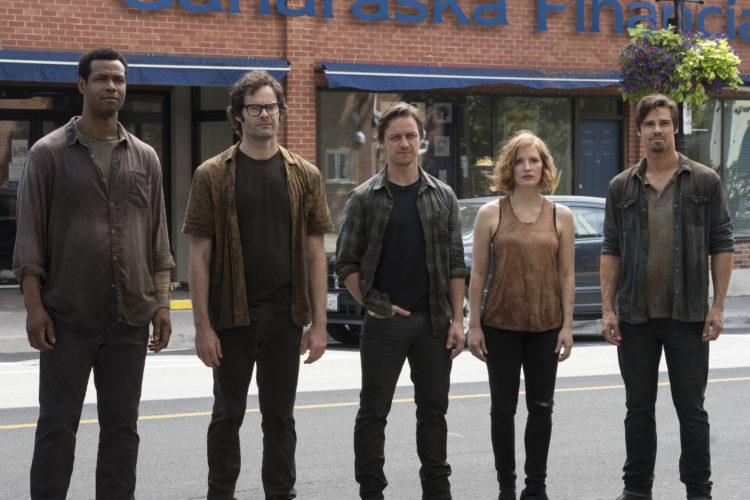
    Isaiah Mustafa, Bill Hader, James McAvoy, Jessica Chastain, and Jay Ryan in It Chapter Two. Credit: Warner Bros. Pictures.

    Rather than adding onto and complementing the first movie, Chapter Two feels bogged down by it. Muschietti and screenwriter Gary Dauberman try to make the movie funnier, scarier, more intense, and more emotional. As a result, it’s none of those things. I liked the first movie quite a bit. Though it isn’t perfect, the plot is more focused and intentional, which makes each scene (and scare) more effective.

    Chapter Two returns to the playbook that made many of the set pieces in the first work and doubles down on each of those elements, which seems instinctive, but instead, it just means each scene is predictable. That coupled with the overreliance on CGI makes the movie completely devoid of horror.

    Because the middle section drags so much, the plot is stuffed into the first and last 45 minutes. However, there is so much plot — and so much exposition — that we never get a chance to reform the emotional bond with the characters that makes the first so successful. The end of Chapter Two, which should feel triumphant and bittersweet instead feels hollow.

    Hader and Ransone do some of the best work of the cast and get chances to flesh out their characters a bit more, especially Hader, though there is some subtext that is a little too subtle to be notable. The rest of the cast, however, never really connect.

    If you haven’t noticed, I haven’t mentioned Pennywise, the eponymous “It” much yet. And that’s because he’s less than his already scant screentime in the first movie. Skarsgard is so good in the role, but Muschietti is more obsessed with action-based setpieces than he is actual horror, so he never gets a proper chance to shine.

    To be honest, there’s so much more I can criticize and tear apart in It Chapter Two, but I’ll spare you and say this. Clearly, Muschietti had a long list of things he wanted to do and tackle in this movie — and he did all of it. Unfortunately, the movie didn’t need most of it.


    ADVERTISEMENT


    More movies, less problems


    Hey! I’m Karl. You can find me on Twitter and Letterboxd. I’m also a Tomatometer-approved critic.

    💌 Sign up for our weekly email newsletter with movie recommendations available to stream.


    ADVERTISEMENT

  • ‘Dark Phoenix’ movie review — The X-Men civil war

    ‘Dark Phoenix’ movie review — The X-Men civil war

    Dark Phoenix finds the X-Men fighting each other as they try to save Jean Grey — and the world — from herself

    30-second review: There’s something off about nearly every element of Dark Phoenix. The dialogue is overly-written to the point that you can predict a line before it’s said, the performances are unmotivated, the story is too familiar, and the action scenes lack stakes. However, they’re also not off enough to be interesting. The biggest problem with the film is that it’s bland.

    It’s unfortunate considering the “Dark Phoenix” storyline is a staple of the X-Men canon. Sophie Turner and James McAvoy try to do something interesting with the material, but they’re hindered by the movie’s inability to bring anything new to the table. We’ve seen it all before. For the superhero genre to stay alive it needs innovative. Dark Phoenix is stuck in the past.

    Where to watch Dark Phoenix: Available to buy or rent on Amazon.

    Full review below ?


    Full disclosure: I haven’t read and am not familiar with the X-Men comics. What I do know is that the Dark Phoenix saga — also explored in X-Men: The Last Stand — is one of the series’ biggest storylines. The main crux of it finds Jean Grey (Sophie Turner) turned into a conduit for a powerful alien energy force that corrupts her and turns her into an unstoppable and uncontrollable force.

    In Dark Phoenix, written and directed by Simon Kinberg — who wrote three previous X-Men movies — Jean and the other X-Men are tasked with rescuing a shuttle full of astronauts after their spacecraft is disabled by a mysterious floating solar flare. They’re successful in their mission, but Jean is nearly killed when the energy reaches the shuttle with her still in it. However, instead of killing her, she absorbs the energy and returns back to Earth with the other X-Men.

    The film, which takes place ten years after the events of X-Men: Apocolypse, sees the X-Men living in a world where mutants and humans now live in harmony — mostly thanks to the work Dr. Charles Xavier (James McAvoy) has done to bridge the divide by using the X-Men to protect humanity. At one point, he even references the term “superhero.”

    The movie tries to create a Civil War-esque divide between Xavier and Mystique/Raven (Jennifer Lawrence), who thinks that the work they’re doing to be heroes in the eyes of the humans is demeaning as they risk their lives to save theirs. And it’s an interesting theme, but the movie explores it with no passion — and the performances, in turn, have no passion either.

    The main storyline, though, follows Jean as she struggles to control her newfound powers that push her to destructive ends, especially as she learns the truth about her past. Early on — and spoiled in the trailers — one of her destructive spells leads to the death of Mystique, which creates a fissure between the X-Men. On one side, there’s Charles, Scott/Cyclops (Tye Sheridan), Ororo/Storm (Alexandra Shipp), and Kurt/Nightcrawler (Kodi Smit-McPhee). On the other, there’s Erik/Magneto (Michael Fassbender) and Hank/Beast (Nicholas Hoult) — they both seek revenge on Jean for the death of Raven — along with Erik’s minions.

    However, like everything else in the movie, the team turning on each other is half-hearted and doesn’t feel rooted in anything tangible. The movies up to this point haven’t laid the groundwork for us to care about Jean’s fate — or the fate of anyone on the team.

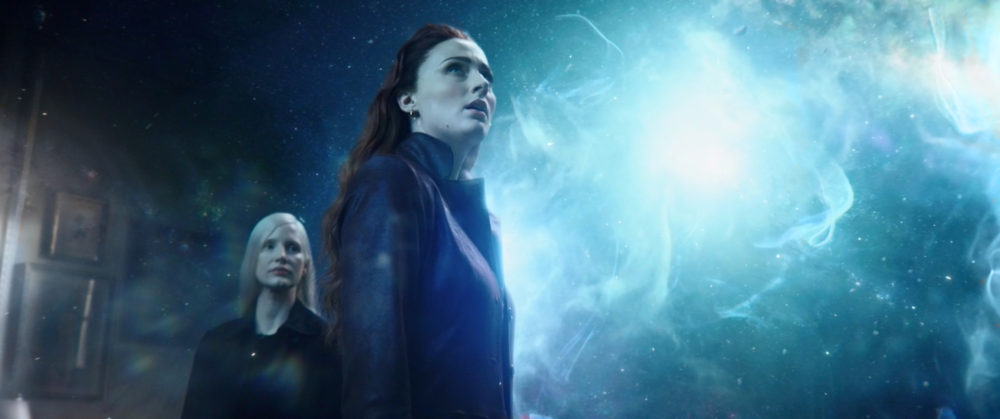
    A more interesting storyline involves a shape-shifting alien race that has come to earth to harness the energy in Jean and, in turn, claiming the Earth as their own. Jessica Chastain, who plays the human form of the lead alien, does her best to make her character a compelling villain. But the storyline feels secondary and means to the final battle that, while entertaining, lacks stakes.

    Dark Phoenix is likely the last X-Men movie in this form as the property is absorbed by Disney and the Marvel Cinematic Universe. Maybe that’s why it lacks passion. It certainly doesn’t help that it comes on the heels of Avengers: EndgameTruly, the movie isn’t a disaster. But even that would be more interesting than what we got.


    ADVERTISEMENT


    More movies, less problems


    Hey! I’m Karl. You can find me on Twitter and Letterboxd. I’m also a Tomatometer-approved critic.

    💌 Sign up for our weekly email newsletter with movie recommendations available to stream.


    ADVERTISEMENT


  • ‘Glass’ review — Wild, ambitious, and confounding

    ‘Glass’ review — Wild, ambitious, and confounding

    Glass is a wildly ambitious conclusion to M. Night Shyamalan’s Unbreakable trilogy that succeeds and fails in many ways. 

    Glass — the finale of M. Night Shyamalan’s surprise Unbreakable trilogy — is ambitious and wild. It works completely in some aspects and fails in others. But I’m glad that it exists. Shyamalan took the initiative and self-financed the film, but it’s the kind of risky movie that I want to see coming from studios.

    After the critical reevaluation of the original Unbreakable that has pushed it to become the #filmtwitter default pick for M. Night Shyamalan’s best film and Split’s surprise twist of being in the same universe as Unbreakable, it was only natural that Shyamalan finished his comic book film series as a trilogy.

    Though, that begs the question of whether or not a third film was actually necessary. Unbreakable is driven by the mystery of whether or not David Dunn (Bruce Willis reprising his role) is actually a superhero — spoiler: the answer is a resounding yes — and Split works completely in a vacuum as a kidnapping thriller. So, what’s the point of merging the two?

    I’m not sure Shyamalan even knows the answer to that other than that it would be cool to have David Dunn — now known as “The Overseer” — go up against James McAvoy’s “The Beast” introduced in Split. The result is a muddled but interesting story that could have been tightened up as the pacing revs up and slows down throughout.

    Glass picks up 19 years after the events of Unbreakable and three weeks after the events of Split. David Dunn, with the help of his son Joseph (Spencer Treat Clark reprising his role from the original), is continuing his work as a vigilante in Philadelphia. With superhuman strength, near invincibility, and the ability to sense evildoings in people past, he is a proper superhero.

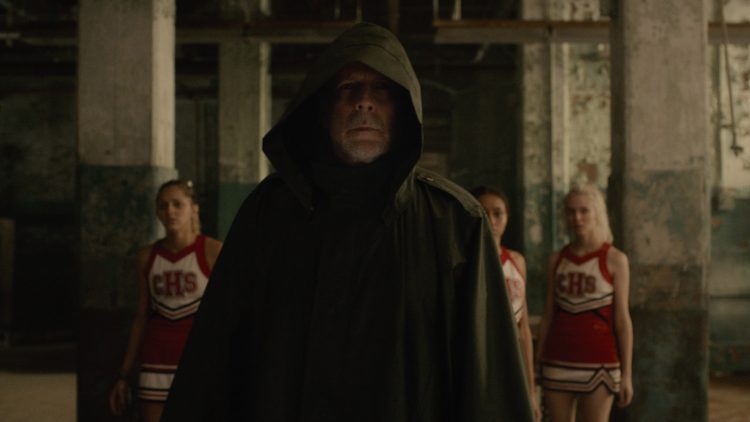
    Elsewhere, Kevin Wendell Crumb (James McAvoy) — the body that houses 24 distinct personalities including a nefarious group called “The Horde” and a human-animal called “The Beast” — has taken four cheerleaders for a sacrifice.

    Dunn tracks “The Horde” to an old factory after weeks of searching. After releasing the cheerleaders he goes head to head with “The Beast” in a near perfect matchup. However, they’re soon incapacitated and taken by Dr. Ellie Staple (Sarah Paulson) and a SWAT team.

    There is so much to admire about the movie. For the first act, Shyamalan essentially gives you want you wanted — an Unbreakable and Split crossover with David Dunn going up against “The Horde.” It’s the kind of white-knuckle suspense that he does so well.

    From the cold open where David incapacitates a pair of neighborhood hooligans who knock out people for fun to Joseph helping him track down “The Horde” to the warehouse brawl, Shyamalan reminds us why he was such a successful director in the first place. It’s kinetic and tense and scary. So when Dr. Staple takes over the movie it’s a jarring switch.

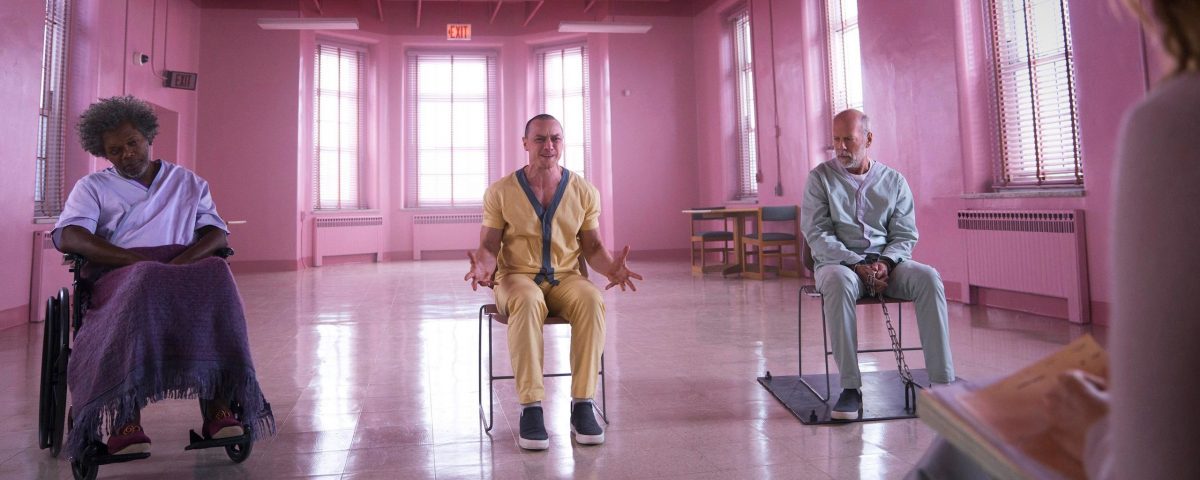
    David and “The Horde” are locked in a high-security mental institution — David in a room that would flood him with water (his one weakness) if he tried to escape and “The Horde” with a flashing light that incapacitates them and switches the personality in control.

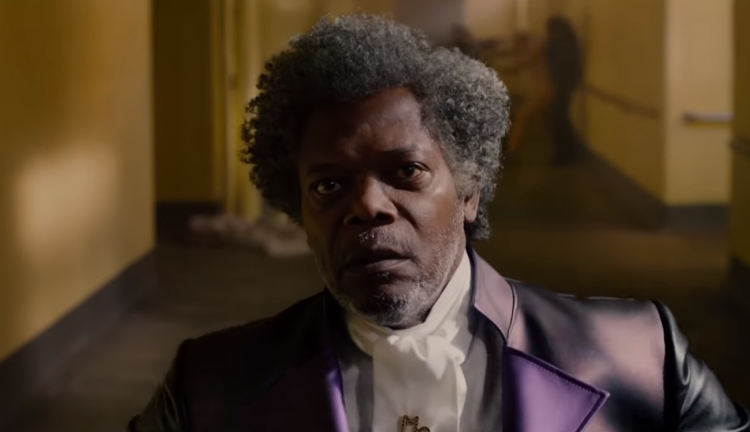
    Also in the facility is Elijah Price — aka Mr. Glass — who was David’s arch-nemesis in Unbreakable. However, he has been heavily sedated and unresponsive for years. Though his mother Mrs. Price (Charlayne Woodard — fantastic here) still tries to visit him.

    Glass movie
    Samuel L. Jackson in M. Night Shyamalan’s GLASS

    We learn that Dr. Stapler is a specialist in people with the specific delusion of being a superhero and was given three days to convince the trio that they don’t actually have powers. So, much of this section of the movie — the largest section — is monologuing about the very nature of superheroes. Glass continues to explore the mythology started in the first movie about comic books being records of the remarkable things that people can actually do.

    More interestingly, though, it forces David and “The Horde” to actually reconsider their importance in the world. They truly question whether they are just normal people with very specific traumas. The movie becomes a dance between Dr. Staple, “The Horde,” David, and Mr. Glass — who might be more aware than he lets on.

    The plot stalls in a way that will divide audiences. Truthfully, it didn’t entirely work for me. But it completely worked for my boyfriend. And I can see how someone would be completely taken with the movie. The pacing didn’t work for me, but all the punches it was taking landed.

    The final act is something of a marvel. What the movie pulls off is quite a stunner, which is why I end up being more positive on the movie as a whole than negative. Glass is not structured like a movie “should” be, but it somehow still builds towards a satisfying finale involving Joseph, Mrs. Price, and Split’s Casey Cooke (the great Anya Taylor-Joy). Let’s just say that Shyamalan still knows how to pull off a twist — or a couple.

    I owe Glass another viewing. It’s ridiculous and ambitious and unexpected, which are all reasons why I didn’t connect with it this time around. I have a feeling knowing what I’m getting into will make me understand it more. Either way, whatever you think of M. Night Shyamalan, you have to appreciate what he’s done here. He maybe doesn’t have all the skills to pull something off, but he certainly has the guts. And sometimes that’s all it takes.

    Glass is in theaters now.

  • ‘Split’ review — James McAvoy gives the performance of his career

    ‘Split’ review — James McAvoy gives the performance of his career

    Split is an incredibly tense and well-made thriller that features fantastic performances by James McAvoy and Anya Taylor Joy.

    M. Night Shyamalan is back, for better or worst. The last Shyamalan movie I watched was 2008’s The Happening, so you could understand my hesitance going into this movie. Although I heard mostly good things about his last movie The Visit, dissociative identity disorder or multiple personalities is a hard subject to pull off well. Of course, you get into the dilemma of portraying mental illness as a danger to society. However, Shyamalan toes the line gently with Split

    The movie opens with a slow dolly shot of Casey (Anya Taylor-Joy) at a classmate’s birthday party in a suburban mall. She’s contemplative, uncomfortable, and obviously doesn’t belong. After her ride fails to show up, she hitches a ride with two of her classmates, Claire (Haley Lu Richardson) and Marcia (Jessica Sula). However, their driver, Claire’s father, doesn’t show up in the driver’s seat. As the camera menacing approaches the father packing gifts in the trunk, we realize that we are watching from the perspective of a malevolent force. A strange man (James McAvoy) steps into the car instead of Claire’s father. After knocking out Claire and Marcia, he turns to Casey, then we cut to the main title sequence.


    This scene is a perfect study of the patience and grasp of tension Shyamalan has in this movie. He lets shots linger. Like when the mysterious stranger approaches the car or the opening shot of Casey. Coupled with the brilliant cinematography by Mike Gioulakis, who shot 2015’s It Follows to great success, the opening is an incredible practice in tension and visual storytelling, which is something that we haven’t seen from Shyamalan since 2002’s Signs.

    And it’s not just the opening scene that is filled with tension. All of Split has this impressive slow-burning dread that underlies every scene. It makes you want to turn away from the screen. It’s a combination of the creative elements that Shyamalan was able to pull together that pulls it off. Specifically, the simple production design of the bunker, which feels like an endless maze of tunnels, the heavy bass of the score, the cinematography, and the performances come together to create an ominous mood. When we start getting into the meat of the story some of that goes away, but generally, the movie keeps tightening and tightening until the last 20 minutes.

    The girls’ captor is revealed to have Dissociative Identity Disorder, which means 23 different personalities control this one body — a spirited nine-year-old, an obsessive-compulsive brute, a disciplined and proper English woman. The main alter, Barry is a fashion designer with a generally happy attitude and motivation to get past his condition. His scenes with his therapist Dr. Karen Fletcher (Betty Buckley) have nearly as much tension as the scenes with the three girls as they attempt to escape from the bunker he brought them to. It’s difficult to talk about why the use of DID as a plot device is justified without edging into spoilers. However, this is a movie that is recontextualized by its ending — for the better.

    James McAvoy is remarkable. Not only because he has to play a menagerie characters, but because the way he distinguishes between each is so specific. When he walks into a room you can tell just by his posture which alter he is. And when he becomes each alter, he inhabits them wholly in his speech, facial expressions, and even the way he moves his jaw. Though he’s certainly playing to the back of the theater, it works because of the recontextualization of the movie.

    That’s not to take away from the other performances. Betty Buckley is marvelous and sure-footed as Dr. Fletcher and Anya Taylor-Joy gives a complex, yet nuanced performance as Casey. But you just can’t help but be both drawn in and terrified by McAvoy.

    Split is built like a mystery that allows the audience to piece together the clues without tipping its ultimate hand.


    We know and fully expect a plot twist in an M. Night Shyamalan movie. However, the question becomes whether it enhances or destroys the plot. And honestly, it does both. For those who are confused or put off by the movie’s

    Up until the last 20 or so minutes, Split is a tense, tightly directed thriller that would probably have ended up among my favorite movies at the end of the year. It is still a really great movie, but the ending nearly takes all the momentum it had going. Does it make it a bad movie? No. It’s still a good movie. While Shyamalan is known for his self-indulgence – some low brow humor and of course an appearance in the movie – he shows restraint for most of the movie. However, nearly all of its success has to be put on James McAvoy who should hopefully finally get the roles and respect he deserves. If anything, watch Split for the masterclass in acting happening on the screen.

    ★★★ out of 5


    Split is available on Blu-Ray and Digital HD on Amazon!

  • Atomic Blonde review — Charlize Theron is the action hero we need

    Atomic Blonde review — Charlize Theron is the action hero we need

    Atomic Blonde is a fun, 80s romp of an action movie with a performance announcing Charlize Theron as our next great action heroine

    There’s a scene about two-thirds of the way through Atomic Blonde that can only be summed up as “that scene.” It’s the scene that will stick with you at the end movie. At the end of it, I sighed under my breath, “oh my god,” in awe. David Leitch, the stuntman turned director best known for John Wick, knows how to capture action the same way he knows how to choreograph it.


    Atomic Blonde is based on the graphic novel The Coldest City, which isn’t surprising watching the film. Every frame feels like it could be a comic panel. Tight close-ups on the characters are given equal weight as the epic wide shots. The opening text explains how the Berlin Wall would eventually come to fall before quickly clarifying that this is now that story. The movie is framed by a debriefing of Lorraine (Charlize Theron), an MI6 operative that went rogue in the days leading up to the fall of the wall. When we first see our protagonist, she rises out of a bathtub filled with ice badly bruised across her entire body. “What happened? ” you might ask. Well, that’s exactly what MI6’s Eric Gray (Toby Jones) and the CIA’s Emmett Kurzfeld (John Goodman) are trying to figure out.

    By framing the movie as a debriefing where Lorraine is telling us the story of the past ten days, the rest of the movie is essentially told by an unreliable narrator. One that is especially hostile towards her interrogators. It makes the twisting plot all the more interesting. She is tasked with going to Berlin to find a list containing secrets of the agents in Berlin. It’s the classic espionage movie setup, but Leitch has fun with it. Throughout the movie spies, assassins, and double agents are thrown at Lorraine. Secret messages are traded. It feels like a classic spy movie.

    David Leitch doesn’t hold back when it comes to action sequences. Though, he uses them sparingly. Unlike John Wick, Atomic Blonde isn’t non-stop action. It allows time to build relationships and character. Even if the story does get lost in the plot heavy second act, stylistically it’s beautiful to watch. It also helps that they’re undercut with 80s hits like “Father Figure,” “99 Luftballoons,” “Voices Carry” and “Under Pressure.” It’s bright, it’s efficient, and it has a musicality to it that makes it a pleasure to watch.

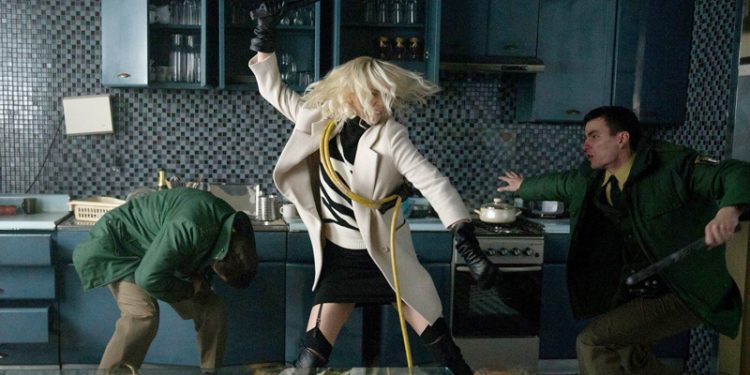
    The first and last thirds of the movie, though, are what makes Atomic Blonde great and a delight to watch. The first real action sequence of the movie shows Lorraine fighting her way out of a car, then fighting her way out of an upper floor apartment. So much of the movie’s action is her escaping. It’s almost as if she never intends to get into fights. It’s refreshing considering so many action movies today are focused on getting to something or getting revenge. The violence in this movie is necessary, but it’s never lingered on.

    https://www.instagram.com/p/BhXj-wng8B8/?taken-by=cinemabunbaking


    However, for all the incredible action, well-curated soundtrack, and sleek directing choices, it’s the actors that elevate it past the page. Theron’s impressive action sequences — she did most of her own stunts — and icy demeanor make her an instantly likable action heroine. And though she definitely gives the movie its edge, other characters give it life. James McAvoy does great work as the eccentric Percival and makes every moment he’s on screen count. Even the smaller roles make a huge impact. Sofia Boutella’s role as a mysterious woman that encounters Lorraine — in more ways than one — is a strong emotional core that with a different actress could have made the end of the movie very different. The standout in the supporting cast, for me, is Bill Skarsgard as an MI6 agent supporting Lorraine in Berlin. He portrays so much with just looks. He’s a surprising highlight in the film.

    Atomic Blonde looks and feels different than any action movie before it. It takes every beat with a spring in its step. However, when it has to get down to business, it gets down to business. Whenever I think of the movie, I always go back to “that scene.” It’s tightly choreographed and shot to look like a 10-minute continuous take. You can’t do anything but hold your breath until it’s over. It’s that effective. Nearly every element of the film comes together to sell it. However, the film surrounding that film is pure fun. It’s the action romp that feels right at home in summer blockbuster season.

    ★★★★ out of 5


    Watch Atomic Blonde on Amazon!