
Tag: Joaquin Phoenix

  • Put on A Happy Face: Joker, Performance, and Emotional Labor — Analysis

    Put on A Happy Face: Joker, Performance, and Emotional Labor — Analysis

    Joker is an example of the mental toll that the struggle to adequately perform emotional labor can have on a person who is already struggling.

    In The Managed Heart: Commercialization of Human Feeling, by Arlie Russell Hochschild, (1983) Hochschild defines emotional labor in the following way:

    “This labor requires one to induce or suppress feeling in order to sustain the outward countenance that produces the proper state of mind in others-in this case, the sense of being cared for in a convivial and safe place. This kind of labor calls for a coordination of mind and feeling, and it sometimes draws on a source of self that we honor as deep and integral to our individuality.”

    (Hochschild, 7)

    While this concept is strongly linked to gender (women are often expected to perform emotional labor in both professional and personal life) it is also a concept strongly linked to class — many of the careers most notable for their demands of emotional labor are working class and middle-class professions — nurses, bank tellers, social workers, and careers in hospitality and food service.

    Joker is a film concerned with performance in a variety of spheres. For example, in its aesthetic and philosophical fixation on masks, dance, and stand-up comedy. It also explores the way a failure at emotional performance can have severe material and psychological ramifications for vulnerable members of society. One such person is Joker’s protagonist Arthur Fleck (Joaquin Phoenix), a man struggling with poverty, childhood trauma, and mental illness. “The worst part about having a mental illness is people expect you to behave as if you don’t,” Arthur writes in the diary he is instructed to keep by a social worker. The expectation of gleeful subservience (“Don’t forget to smile!”) is one not only required by Arthur’s job as a clown — to repress, to entertain, primarily in order to turn a profit for others —  but also in his personal life as a person with a mental illness and obtrusive neurological disorder. 
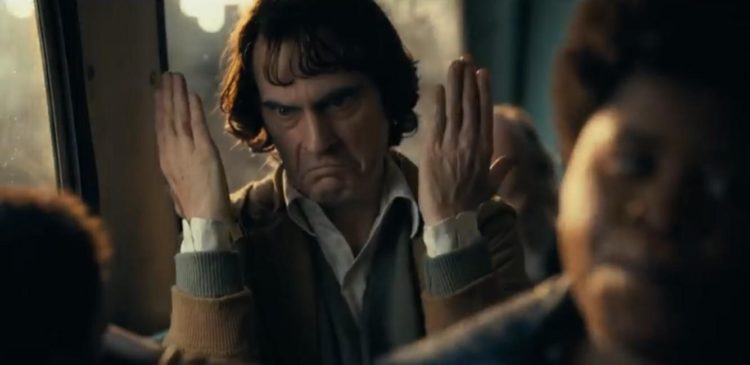
    Joker
    Joaquin Phoenix in Joker. Credit: Warner Bros. Pictures.

    Arthur is a pleasant person for the early portions of the film. He is a diligent caretaker of his ailing mother (Frances Conroy), polite to those around him, and hardworking at his job. Despite his efforts to make those around him not only at ease but happy, Arthur is still left lonely, unheard, and rejected. He is described by his boss as simply “weird” and that he makes people uncomfortable. He is a plain, even unkempt dresser, sickly thin with poor posture, often feminine in his mannerisms, with a disorder that attracts negative attention; his inability to convincingly play the role of normative manhood and regulate his outward expression of emotion has a material effect on his social and financial mobility, leaving him trapped in abject poverty.

    “For the flight attendant, the smiles are a part of her work, a part that requires her to coordinate self and feeling so that the work seems to be effortless. To show that the enjoyment takes effort is to do the job poorly.”

    (Hochschild, 8)

    Joker intertwines Arthur’s class and psychological state with a surprising level of emotional depth and social consciousness. Arthur doesn’t just have one bad day that makes him snap, he lives within a system that demands that his entire existence as a member of the working class involves assuring the comfort and entertainment of those around him. His repeated failure to live up to this task eventually causes him to give up the pursuit altogether.

    Ancillary characters, predominantly the black employees of state-sponsored institutions, are also shown to have their emotional labor taken for granted. Social workers, an administrative clerk at Arkham Asylum (Brian Tyree Henry), and Sophie (Zazie Beetz), a single mother working as a bank teller, it is the job of these four characters in their professional and personal lives to constantly consider the feelings of those around them, even when they are rarely afforded the same courtesy by those of higher status. 

    Garbage piles up around the city of Gotham, Thomas Wayne (Brett Cullen) shows nothing but patronizing disdain for those in need, and these characters are expected to continue to perform their roles with a smile. When Gotham cuts social service funding for the office, Arthur’s social worker says that the city doesn’t care about people like him, and doesn’t care about people like her either. But the two must both put on a pleasant face, their happiness taken for granted as they are abandoned by the government systems that should be supporting them.

    “The deferential behavior of servants and women-the encouraging smiles, the attentive listening, the appreciative laughter, the comments of affirmation, admiration, or concern-comes to seem normal, even built into personality rather than inherent in the kinds of exchange that low-status people commonly enter into.”

    (Hochschild 84-85)

    Arthur’s journey is in many ways an escape from a life of performing for others’ benefit, a process of committing himself to free expression for his own sake. He abandons self-consciousness and repression and learns to express his feelings fully, and violently. In the climax of the film, Arthur’s posture and voice have changed, he is vibrant in his dress and physically expressive, free from societal expectations of anonymity and subservience. It is horrific to see Arthur enact so much violence in the film’s final scenes, but there is also a sense of triumph in seeing a downtrodden, abused man free himself from the demands of others, to find cohesion between his internal self and external expression.

    Notably, Arthur’s convulsive laughter is largely absent once he adopts the Joker persona in earnest; the manifestation of the innermost chaos which he was constantly struggling to stifle no longer plagues him. Unconcerned with economic class, social acceptance, or the care of others, escaped from the artifice of emotional labor, Arthur is at home in his body and mind, and is free to behave — horrifically, theatrically, truthfully, as his heart desires.


  • ‘Joker’ review — All clown, no bite

    ‘Joker’ review — All clown, no bite

    Joker reimagines the iconic Batman villain as a mentally ill, impoverished standup comedian.

    One-sentence review: Joker is well-made and full of interesting choices that all feel hollow when you consider what the movie is trying to say — the answer: not much.

    Details: ? Todd Phillips // ?? U.S. // ⏳ 122 minutes

    The cast: Joaquin Phoenix, Robert DeNiro, Zazie Beetz, Frances Conroy

    Where to watch Joker: Now playing in theaters.

    Joker is not a comic book movie. That’s not where it draws its inspirations from. Sure, The Joker is a comic book villain — maybe THE comic book villain — living in the fictional city of Gotham. However, director Todd Phillips is trying to emulate Martin Scorsese more than he is any version of a comic book movie we’ve seen before. Even Christopher Nolan’s darker and grittier Dark Knight series has nothing on Joker. But that’s part of the problem.

    Arthur Fleck (Joaquin Phoenix) can’t catch a break. He’s a clown for hire that has to deal with bullying everywhere he goes. In the opening scene, he’s jumped by a group of kids who beat him in an alleyway. Even in the locker room where he’s surrounded by other clowns he’s bullied. A lot of it comes from the fact that he’s mentally ill. Unfortunately, his actual condition is never discussed other than his inability to control his laughter, which often comes at inappropriate times.

    However, he has dreams of something greater than just being a clown. Arthur’s main goal is to be a standup comedian like his idol late-night talk show host Murray Franklin (Robert De Niro). De Niro’s inclusion here is a clear nod to Scorsese’s often overlooked 1983 film The King of Comedy, which also followed a celebrity-obsessed comedian trying to emulate his hero.

    One day, a co-worker gives Arthur a gun to protect himself from the people that bully him around. That’s how he ends up killing a trio of drunk wealthy wall street-types who jump him on the subway. The scene is masterful and full of tension as the lights of the subway flicker on and off as the men taunt Arthur. That killing sparks something in Arthur. Something darker. It also sparks anarchy in the city as the “poor” and “disenfranchised” use the man in clown makeup as their symbol of revolt.

    For all the discourse around Joker, I was expecting something truly abhorrent — for better or worse. What I was shocked to find is how little of a bite it has. All the moments of Joker’s infamous chaos feel so contrived that even if his actions are chaos for the sake of chaos, they have no impact. I don’t even think Phillips is completely sure why Arthur is the way he is. He’s not an incel or a misunderstood mentally ill person. He’s a character that someone thought would be cool.

    Joaquin Phoenix in Joker. Credit: Warner Bros. Pictures.

    It’s that juvenile perspective that really betrays Joker. What made Christopher Nolan’s take on the character so compelling — in addition to Heath Ledger’s stellar performance — is he was a mysterious force of evil. Not knowing his motivations made him all the more terrifying. In a way, Joker over explains the character’s reasons for being evil to the point that anything and everything he does is unsurprising.

    ⚠️ Slight spoiler alert.

    The great Zazie Beetz appears in the film as a young mother who lives a few doors down from Arthur. The two strike up a friendship despite Arthur’s clear oddities that carries throughout the film. In the end, it’s revealed that all his interactions with her were imagined. However, I think the movie would have been stronger if the friendship was real and the twist being Beetz’s character finding out that Arthur is a danger. It might not be as shocking or subversive, but it would at least ground the Joker in something rather than being a comic book villain in a gritty and realistic world.

    I’ve had such a hard time articulating what I thought about Joker, and that’s part of the problem. It’s a movie that thinks it’s more important, edgier, and more shocking than it is. It’s a shame because there are interesting ideas there. The movie needed a director more adept at thinking through those ides.

  • ‘You Were Never Really Here’ review — A crime thriller masterpiece

    ‘You Were Never Really Here’ review — A crime thriller masterpiece

    You Were Never Really Here is a hypnotic and thrilling crime drama that doesn’t let you go until the credits begin to roll. 

    A third of the way through the breezy 90-minute running time of You Were Never Really Here, essentially director Lynne Ramsey’s arthouse version of Taken, Joe (Joaquin Phoenix) lays down next to a hitman he has just shot. As “I’ve Never Been To Me” plays in the background, the two men lay side by side. The hitman extends his hand to Joe and they lay on the floor singing along.

    It’s an odd moment of humanity in a movie filled with inhuman behavior and something you’d never see in another crime thriller. Ramsey, who broke out in 2011 with We Need to Talk About Kevin, isn’t interested in the violence aspect of the story, though there is plenty of it. Instead, she focuses on the characters and specifically Joe’s internalized struggle with his past. 

    The plot is quite simple, unlike movies with similar premises. Joe is a hired gun who tracks down kidnapped children. His handler John McCleary (John Doman) delivers him a new job to track down the kidnapped daughter (Ekaterina Samsonov) of a New York State Senator.

    However, the job quickly spirals out of control. That’s really all there is to it. But Ramsey doesn’t let a single minute go wasted. It’s tense from beginning to end, save for a few tender scenes with Joe’s mother (a great Judith Roberts).

    You Were Never Really Here
    Joaquin Phoenix plays Joe, a hired gun, in Lynne Ramsey’s You Were Never Really Here.

    There are a lot of scenes of violence, but Ramsey doesn’t glorify it. In one of the most stunning sequences, Ramsey tracks Joe through a house via surveillance cameras after he takes down guard after guard. It’s brutal, but not over-the-top as the camera gives us a detached view from it.

    As we cycle through various views from the cameras, we hear the croon of “I Wouldn’t Dream of It” through the halls. The sound design is impeccable with both diegetic and non-diegetic sounds. Much of what we see is internalized within Joe, but at moments the line is blurred.

    Phoenix has never been better. Joe is haunted by the moments in his past that we only see in brief flashes—him as a child hiding in the closet, his mother cowering under a table. The violence of his past invades the violence that he is committing in the present. However, the violence of his present is justified. At least, that’s how he gets through it. Without much goading, we are instantly endeared to Joe and his struggles despite his haggard appearance and hulking form.

    You Were Never Really Here doesn’t write a new song, but Lynne Ramsey performs it beautifully. Jonny Greenwood, after composing one of the best scores of the century for Phantom Thread, goes for a more fragmented approach here to great effect.

    It’s an art piece through and through, but also riveting and thrilling throughout. The second it ended I wanted to start watching it again and dissect every movement, every beat, and every sound. You will be mesmerized by it.

    You Were Never Really Here is now streaming on Prime Video. It is also rent and buy on Amazon.