
Tag: Julianne Moore

  • Natalie Portman and Julianne spar in high camp melodrama ‘May December’ | review and analysis

    Natalie Portman and Julianne spar in high camp melodrama ‘May December’ | review and analysis

    NYFF 2023 | May December follows an actress (Natalie Portman) as she prepares to play a notorious tabloid figure (Julianne Moore) by shadowing her dredging up old wounds


    May December begins with Julianne Moore dramatically opening a refrigerator door, while a dissonant chord strums and the camera locks into a closeup, and deadpan delivers the line, “I don’t think we’re going to have enough hot dogs.” While it is a high camp melodrama filled with a cast of near-absurd characters, at its heart it’s a complex exploration of trauma, exploitation, and how all “grown-ups” are just children pretending to be adults. With Oscar winners Julianne Moore and Natalie Portman squaring off as dueling narcissists and Charles Melton giving a star-is-born performance, May December is one of the year’s best.

    May December had its North American premiere at the 2023 New York Film Festival.

    Right before the title card for director Todd Haynes‘ new film May December smash cuts onto the screen, Gracie Atherton-Yoo (Julianne Moore) swings open a refrigerator door. As the camera closes in on her face and a dissonant chord strums, she dramatically delivers the line, “I don’t think we’re going to have enough hot dogs.” From then on, it’s impossible not to be transfixed by the high camp of this melodrama.

    And there’s so much devilishly delightful sparing between Gracie and actress Elizabeth Berry (Natalie Portman), who visits Gracie’s Georgia home to prepare to play her in an upcoming movie, that it’s surprising when the movie hits you with a flurry of complex emotions. Screenwriter Samy Burch, who marked her first appearance on the promotional circuit at the 2023 New York Film Festival, said of her screenplay, “I really like the tonal mix of humor and real, genuine sadness and heartbreak.” It’s that exact melange of the darkly comedic melodrama and the deeply felt character study that make May December a satisfying — and deeply odd — romp.


    ADVERTISEMENT


    The reason Gracie’s life warrants a movie is her notorious highly-publicized tabloid romance with her now husband Joe (Charles Melton) that swept the nation in the 90s. You see, Gracie and Joe started dating when she was 36-years-old and he was just thirteen-years-old. Twenty years later, the pair still receive their fair of attention — often of the fecal variety — as they live a quiet existence in their Savannah, Georgia seaside home. That is, until Elizabeth arrives.

    Portman plays Elizabeth, who from what we can gather is best-known for her performance on a Grey’s Anatomy-type show, with a satirical edge — perhaps chiding her own star persona (or at the very least her iconic accent from her performance in Jackie). She probes Gracie’s life like a psychologist analyzing her patient or a serial killer their prey. She observes her mannerisms, dissects every decision she makes, even copies her makeup routine in a scene that edges on Persona-esque horror — a clear inspiration.

    As she observes more people in Gracie’s orbit, we uncover the ripple effects of her crimes that she went to prison for as we see in hilariously accurate tabloid covers (“Pregnant in Prison!”). Her ex-husband Tom (D.W. Moffat) swears he’s over all of it before snapping as he starts to recall the incident, Gracie and Tom’s son Georgie (Cory Michael Smith) — yup, his name is Georgie — is a man-child who is the diva lead singer of a band that performs at a local pub, meanwhile the current manager of the pet shop where Gracie and Joe first met milks the publicity for everything it’s worth — even keeping a laminated copy of a newspaper article about the incident on the counter.


    ADVERTISEMENT


    The cast of characters border on absurd almost becoming caricature, but Haynes keeps the film grounded in some reality despite the camp hijinks. However, Elizabeth isn’t some innocent voyeur. When she finds herself in the notorious storeroom where Gracie and Joe’s first sexual encounter took place she acts it out so convincingly you can’t tell whether she’s actually pleasuring herself. We’re always kept a distance from her true intentions, but at the very least we can infer that she’s not as afraid of exploiting the family for her own work as she says she is.

    However, Gracie isn’t as forthcoming with the truth as she thinks she is either. She’s almost dismissive of her past. “Everyone’s got skeletons in their closet,” she says as if she’s referring to a spat of unpaid parking tickets. Both women are unwilling to cede their true selves to the other. Burch’s screenplay doesn’t shy away from making Gracie and Elizabeth irredeemable. Something we don’t often get to see.

    And while there is legitimate fun to be had with the passive-aggressive meeting of two different breeds of narcissist, at the heart of May December is a sensitive character study of a man who was both asked to grow up too fast and not afforded the opportunity to. Melton, in a star-making Oscar-worthy performance, portrays Joe with a depth that makes you so sympathetic to his plight that it almost feels like whiplash compared to melodrama. While he starts off as the capable father or doting husband, when he begins interacting with Elizabeth — she herself is 36-years-old, the age that he met Gracie — we watch his body language revert to the 13-year-old boy in that pet store storage room.


    ADVERTISEMENT


    With hunched shoulders, his hands in his pockets, and mumbled replies, we see that through all these years Joe has just been putting on the air of an adult. In one of the most heartbreaking scenes, he smokes weed for the first time ever — surprising for a man in his late 30s — with his college-bound son (Gabriel Chung) and through sobs tells him of his hopes that he will live a happy life: “I don’t know if we’re connecting, or if I’m creating a bad memory for you.” In the subtext, he hopes that he won’t suffer the same traumas that he himself had to endure. It’s that incisive insight that makes the movie as compelling as it is entertaining.

    On the surface, May December shouldn’t work with its contrasting tones of dark comedy mixed with near-parody satirical elements and sentimental dramatics with complex human condition. However, it manages to find balance in way that allows you to enjoy it without letting you get too comfortable with the sensitive situation.

    In a climactic scene, Elizabeth tells a despondent Joe, “this is what grown-ups do.” However, what Burch’s screenplay presupposes is that the concept of a “grown-up” doesn’t actually exist. Regardless of age, people are not much more than their child-self reacting to the things in their present filtered through their past. Every character in the movie has been stunted in their coming-of-age in some way — perhaps because you never stop coming of age. We watch in real-time as Gracie tears into her own children with the gusto of Faye Dunaway in Mommie Dearest — perhaps its generational trauma or maybe she’s just a sociopath — meanwhile Joe is trying everything in his power to not let them suffer the same fate.

    The beauty of May December is that it doesn’t give its characters a melodramatic ending — again, keeping one step in the real-world. Dare I say, the movie comes to a close with some hope. Still, we’re treated to one last flash of glorious camp that sets it as one of the year’s best.


    ADVERTISEMENT


    More movies, less problems


    Hey! I’m Karl. You can find me on Twitter and Letterboxd. I’m also a Tomatometer-approved critic.

    💌 Sign up for our weekly email newsletter with movie recommendations available to stream.


    ADVERTISEMENT


  • ‘When You Finish Saving The World’ | Sundance review

    ‘When You Finish Saving The World’ | Sundance review

    When You Finish Saving the World follows a mother and son pair who are, in their own ways, finding ways to leave their mark on the world

    When You Finish Saving the World is playing at the 2022 Sundance Film Festival.

    When You Finish Saving the World comes close to finding its footing in the final twenty minutes, which is typically when a movie reveals its design to deliver a message or lesson. Actor-turned-director Jesse Eisenberg would have succeeded in that emotional gut-punch had the prior 70 minutes been more nuanced in its skewering of white upper middle-class suburban progressives. Instead, we’re hit over the head with obvious artifacts and dialogue to hammer in the point to oblivion. They drive a smart car! They listen to classical music! They think white people shouldn’t play the blues!

    However, that is what makes it the perfect movie for Sundance. Audiences are typically more-forgiving and gravitate towards movies that have a message with a capital M. It’s no wonder the fest has become a bastion for actors to test their aptitude as writers and directors for the first time. First-time directors already have the tendency to over-direct and write. Actors who assume the director’s chair seem to make that mistake even more. It doesn’t help that Eisenberg also wrote the original story — released as an audiobook — and adapted it. Without someone to filter through all of the layers of this work, the movie becomes overwhelmed by its own sensibilities. 


    ADVERTISEMENT


    Had When You Finish Saving the World either leaned more into its satire or had taken a more nuanced approach it might have succeeded– and there are flashes of success in both arenas. Evelyn (Julianne Moore) somberly assures Kyle (Billy Bryk), the son of a woman staying at the domestic abuse shelter she runs, that he’s not going to become his father. Hilariously, he responds, “why would I become him? I’m not worried about that.”

    Evelyn’s son Ziggy (Finn Wolfhard), on the other hand, tries to connect with his politically engaged crush Lila (Alisha Boe) by touting his international online presence. “I have 20 thousand followers and I think what they like about me are my passion and charisma,” he says, making a point to single out one of his Chinese viewers.

    Evelyn and Ziggy are both passionate about what they do, but also fundamentally misunderstand each other’s motivations — and their own. In theory, the movie’s central struggle is this mother-son dynamic and their inability to find value in the other’s mission. Evelyn is by the book, so much so that she sometimes comes off as disconnected. Ziggy is a free spirit and his songs, that exude mid-2000s garage emo pop-punk self-important sincerity, communicate a similar disconnect from reality.


    ADVERTISEMENT


    However, their screen time together is so limited that we’re unable to explore their connection to the depths we need to be interested as an audience. Their own storylines — Evelyn trying to “save” one of her charges and Ziggy trying to become “political” — feel so disparate that the movie becomes less than the sum of its parts.

    Eisenberg’s heart is in the right place. The movie has its moments where it feels like the biting indictment of the white savior narrative almost takes full form, but when it’s as shallow as its two leads it becomes the exact thing it’s trying to lambast. The movie is for people that have the resources to help and the desire to help, but lack the emotional stakes and inherent empathy it takes to be an actual ally. It’s like a person saying they’re an empath and asking a crying person if they’re sad. The idea is there. It’s a minor, but well-intentioned vision, and unfortunately, too singular of a viewpoint to be effective in its primary message – that of saving the world. 


    ADVERTISEMENT


    More movies, less problems


    Hey! I’m Karl. You can find me on Twitter and Letterboxd. I’m also a Tomatometer-approved critic.

    💌 Sign up for our weekly email newsletter with movie recommendations available to stream.


    ADVERTISEMENT


  • Dear Evan Hansen, you owe us an apology | TIFF movie review

    Dear Evan Hansen, you owe us an apology | TIFF movie review

    Dear Evan Hansen follows a high school senior with a social anxiety disorder who suddenly finds himself as the hero of his town after a student commits suicide

    Undoubtedly one of the worst movie-musicals ever made. Overwrought and emotionless at the same time, insensitive towards trauma and mental illness, and out of touch with reality. Jail to everyone.


    Dear Evan Hansen, 

    Today was not a good day because I was subjected to watching you. 

    Sincerely,
    Me

    Usually I don’t like being mean about the films I don’t like. Also, I’m a firm believer that almost every film made with the best of intentions has some good you can derive from it. However, Dear Evan Hansen doesn’t sit right with me. At its root, it feels rotten. Like its intentions are misplaced or, given the benefit of the doubt, misunderstood. Director Stephen Chbosky, whose films The Perks of Being a Wallflower and Wonder I truly enjoy, was simply handed a bad project.


    ADVERTISEMENT


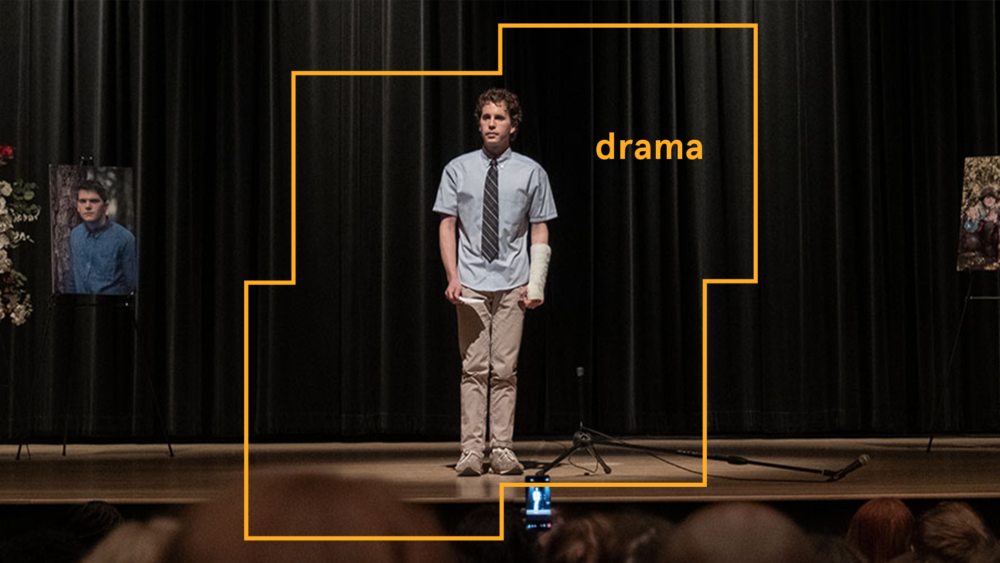
    The movie follows Evan Hansen (played by Ben Platt), your typical high school senior with a social anxiety disorder who is tasked by his therapist to write a letter to himself every day. After a misunderstanding causes him to become the hero of his town following the suicide of his classmate Connor (Colton Ryan), Evan must continually expand his web of lies and keep all he has gained from the fallout. 

    This includes lying to Connor’s family (Amy Adams and Danny Pino) about being friends with their son, dating Connor’s sister (Kaitlyn Dever), working with Alana (Amandla Stenberg) on an entire organization and fundraiser honoring him. The list goes on and on. No one is safe from his deceit. The fact that this is a musical is confounding because watching Evan spin lie after lie in songs like “For Forever” and, even more maliciously, fabricate evidence in “Sincerely, Me” almost makes light of the damage his actions are bound to cause.

    At this point, if you’re already asking yourself why this seemingly terrible human is the protagonist of the story then we are on the same page. The film, which is an adaptation of the Broadway musical of the same name featuring music by Oscar winners Benj Pasek and Justin Paul, was meant to “immortalize” 27-year-old Platt’s Tony-winning performance. However, Dear Evan Hansen seems to be a story that only worked in the thin period of time when it came out. It already feels dated — as does Platt’s hair.

    💌 Sign up for our weekly email newsletter with movie recommendations available to stream.


    ADVERTISEMENT


    ADVERTISEMENT


    Reportedly, changes were made in the adaptation to address some of the more polarizing issues with the story. If that’s the case, then I’d hate to see what was wrong with the musical. At its core, the musical is meant to preach that everyone is dealing with their own traumas whether it be depression, social anxiety, suicidal thoughts, insecurities, however it doesn’t take any time to actually explore the reality of those traumas. Instead, it’s a surface level assessment of them. Hollywood’s “glamourized” version where consequences don’t exist.

    Because of its purely uninformed and disingenuous portrayal of mental illness — and apparent disregard of therapy — the movie feels overwrought and emotionless at the same time. It mines melodrama with no actual basis for it. It feels like the characters are just pawns in this power grab for sympathy. And while there is some good acting here — Julianne Moore, Amandla Stenberg, and Kaitlyn Dever, in particular — the rest of the cast feels like they’re in a competition of who can ugly cry the most.

    Evan Hansen, whose actions throughout the film could only be described as monstrous, is meant to meet consequences at the end of the film and Connor is meant to be humanized. Instead, Evan’s behavior, which is harmful to the stigma around mental illness, is excused as a product of past trauma. Something the movie was supposedly supposed to fix. Or maybe, just maybe, this was a story we didn’t need to have told again.


    ADVERTISEMENT


    ADVERTISEMENT


    More movies, less problems


    Hey! I’m Karl. You can find me on Twitter and Letterboxd. I’m also a Tomatometer-approved critic.

    💌 Sign up for our weekly email newsletter with movie recommendations available to stream.


    ADVERTISEMENT


    💌 Sign up for our weekly email newsletter with movie recommendations available to stream.


    ADVERTISEMENT