Tag: Mark Hamill

  • Surreal dramedy The Life of Chuck ponders life and death | TIFF 2024

    Surreal dramedy The Life of Chuck ponders life and death | TIFF 2024

    TIFF 2024 | The Life of Chuck follows an enigmatic man starting as a surrealist meditation on existential dread and ending as a life-affirming portrait of youth.


    The Life of Chuck is a dramedy that ponders existential dread through surreal comedy (and a dance number!). A philosophical pondering of the moments that add up to a life set against the temporariness of it all. Airy, abstract but entertaining, it may be polarizing but will deeply move many.

    The Life of Chuck premiered at the 2024 Toronto International Film Festival. It is seeking distribution.


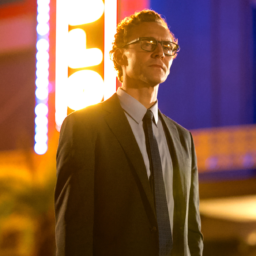
    At the beginning of The Life of Chuck we learn California has sunk into the sea, Florida is underwater and the internet has gone out (maybe for good). But somehow the most inexplicable occurrence in the small town where teacher Marty Anderson (Chiwetel Ejiofor) lives is a billboard that’s seemingly appeared out of thin air with the words “Charles Krantz. 39 great years. Thanks Chuck!” scrawled across it and the photo of a clean cut bespectacled man behind a desk. It begs the question from the townsfolk: who the hell is Chuck?


    ADVERTISEMENT


    Unfolding in three distinct acts, The Life of Chuck is a time and universe hopping story about, well, the life of Chuck based on a short story in Stephen King’s novella collection If It Bleeds. However, in the first act—labeled as “Act 3”—we have no clue who he is. As the world around Marty slowly falls more and more into disarray, he remarks that both marriages and divorces are up. It’s partially what spurs his ex-wife Felicia (Karen Gillan) to call him up amidst the quiet chaos of the end of the world. They talk about whether more people are getting married or divorced in the face of their demise and how in the concept of the Cosmic Calendar by Carl Sagan that explained if the existence of the universe were conceptualized as a single year, humans would occupy just the last few minutes of December 31st.

    It’s the kind of existential pondering that the movie itself tussles with. What does it mean to exist? Does it matter when we occupy so little space and time? Why do advertisements thanking Chuck keep popping up? As the final moments of the world approach, and Marty and Felicia find comfort in each other, images of Chuck begin to appear in the window of every house on the street. Marty jokes that it’s the world’s final meme before blinking out completely and we careen into “Act 2.”


    ADVERTISEMENT


    When we finally meet Chuck (Tom Hiddleston), underscored by narration by Nick Offerman, he’s much more human than his larger-than-life portrayal in the first act. In fact, he’s the most human thing imaginable: an accountant. We also meet a busking street drummer (Taylor Gordon), who we learn recently dropped out of Julliard, as she sets up for the day playing at an outdoor mall and a young woman crying over a break-up (Annalise Basso). The trio all cross paths in front of where the drummer set up her kit for the day. Instead of walking past, Chuck starts to dance. 

    It’s one of those moments that feels like movie magic. The kind that puts a knot in your chest. Not because you understand the feeling, but because you don’t.

    The third part of the movie, labeled “Act 1,” brings us back to Chuck’s childhood. It pulls together all the threads of the story that have remained loose and unpacks the enigma that is chuck. From school dances to early losses to days living with his kooky grandfather (Mark Hamill). While the magical surrealism of the first two acts carries over in some ways, the story becomes grounded in something real. If Chuck was a mysterious otherworldly figure in act three and an enigmatic human in act two, then he’s simply Chuck (played by young actors Benjamin Pajak, Cody Flanagan and Jacob Tremblay) in act three.


    ADVERTISEMENT


    We follow him as he navigates loss, grief and, of course, the horrors of middle school as he discovers who he is. Where the first two acts were abstract and airy meditations, this one feels more trite—for better and worse. While the earnest lessons are admirable, I longed for the most obtuse meditation from the start of the movie that felts more like Charlie Kaufman (Eternal Sunshine of the Spotless Mind and I’m Thinking of Ending Things) or David Lynch (Mulholland Drive). Your mileage with where the story go will vary. But watching Chuck navigate the highs and lows of childhood is admittedly charming.

    The Life of Chuck is about how all the little moments where our lives intersect or divert or run parallel to others eventually lead to, in the case of Chuck, thirty-nine great years. It’s not the big moments or notable accomplishments, it’s the way your mom danced while making breakfast or that drummer you heard on a business trip or one of your grandfather’s ramblings. While it never feels quite as big as it should, that just might be Stephen King and Mike Flanagan’s point. 


    ADVERTISEMENT


    More movies, less problems


    Hey! I’m Karl. You can find me on Twitter and Letterboxd. I’m also a Tomatometer-approved critic.

    💌 Sign up for our weekly email newsletter with movie recommendations available to stream.


    ADVERTISEMENT

  • ‘Star Wars: The Last Jedi’ review — Gorgeously shot, complex, and thrilling

    ‘Star Wars: The Last Jedi’ review — Gorgeously shot, complex, and thrilling

    The Last Jedi is easily the best-made Star Wars film as director Rian Johnson explores deeper and more complex themes than past films

    Spoiler Alert! I’m not holding back on any plot points. Based on the box office though, it seems like everyone has watched the movie already. 

    30-second review: Admittedly, I was never a huge fan of the Star Wars franchise. I always appreciated its place as a corner of modern-day cinema and believe that The Empire Strikes Back is one of the greatest sci-fi movies of all time. But I’ve never been a fanboy. The Force Awakens was a fun space romp that was well made, but further highlighted my issues with the franchise. Issues that competing franchise Star Trek seemed to solve a long time ago (in a galaxy far, far away). However, Rian Johnson’s The Last Jedi doesn’t only give me a new hope for the franchise.

    It raises the bar for blockbuster filmmaking the same way that Mad Max: Fury Road did a few years ago and Blade Runner 2049 did this year. The difference is that no matter what, any Star Wars movie is going to be seen. And it’s going to be seen by a lot of people. Whether or not Johnson considered this when crafting the narrative I don’t know, but he has moved the franchise forward in quality and perspective. Before continuing, I want to say thank you to Johnson and Kelly Marie Tran. For the first time in my life, I felt like an action hero.

    Continuing in the spirit of the franchise, The Last Jedi picks up immediately after the events of The Force Awakens. Rey (Daisy Ridley continues to do great work) has found Luke (Mark Hamill) on an isolated island looking to bring him back to the waning resistance to help empower their forces and to further explore her newfound power with the force. Much of this sounds like The Empire Strikes Back retreaded, but Johnson constantly upends expectations in a way that constantly keeps you guessing.

    Hamill has never been better as Luke (he was also great in Brigsby Bear this year). Refreshingly, he’s not the hero that he once was. Hamill famously was unsure about the direction of the character, but eventually came around. I understand why he was concerned. For years he was sold as the undisputed hero of the series, and in this film that is the legend that has persisted. But as the old adage goes, never meet your heroes.

    The scenes between Rey and Luke don’t work as well as the rest of the film. However, the theme of the storyline is one that the series has never addressed: what does it mean to be a hero. Rey wants to be a hero, but Luke doesn’t quite believe them anymore. It’s incredibly mature storytelling for a series that has mostly kept its themes surface level.

    The rest of the resistance is engaging in only what I could call a Mad Max-style chase with the First Order. The theme of what it means to be a hero carries on here, but it also points to a new direction for the series. Star Wars, in spite of its title, has never felt like a war movie. Last year’s Rogue One came close, but The Last Jedi is the first movie to completely feel like it completely embraced the title. The action sequences, which are beautifully directed, visually and structurally feel like war battle sequences.

    However, I want to pay specific attention to the opening battle. This is the kind of battle that George Lucas would end the movie on. It’s a triumphant victory achieved in spectacular fashion. Instead, Johnson focuses on the losses of the battle. In particular, he focuses on one resistance fighter’s attempt to drop bombs on a First Order dreadnought. Her ultimate sacrifice is what drives the movie’s narrative. Not her specific sacrifice, but the reason she’s doing it. Johnson is a superb visual storyteller and he makes these scenes feel like they can stand alone. Of course, that emotional arc pays off in the form of Rose (Kelly Marie Tran, a revelation and breakout).

    Fewer characters were introduced in this film, but of all the new characters in this trilogy, she may be one of the best. Not only does she have a backstory and a complex character arc, she’s an Asian woman. Diversity has never been Star Wars‘ strong suit, thought The Force Awakens did a great job in adding some to the cast, but Rose feels different. Of course, this is coming from someone who is Filipino-American. Still, I’ve never felt like I could be an action hero. However, her inclusion points to another improvement for the series. For the first time, each character feels complex and like they have to make decisions that have consequences.

    For the entire running time, the resistance has their backs against a wall, which adds stakes to the story. Something that the previous movies never had. The Last Jedi is easily the most consistently exciting film in the series. For fans of Battlestar Galactica, it is reminiscent of the series premiere where fleet must constantly evade their enemies through a series of jumps through hyperspace. Johnson’s direction of the sequences are sensational and the effects are among the strongest of the year. However, what is more interesting is General Leia (Carrie Fisher — she gives a performance that reminds us how far presence can get you in a scene) and her attempt to save what is left of the resistance. Poe (Oscar Isaac), who seems to be the new Han Solo, has the “shoot from the hip” attitude that got our heroes out of more than one sticky situation in the original trilogy. Instead, Johnson makes it a point to highlight the strategic side of the fight. At one point Leia becomes so angry at Poe taking the heroic path rather than the strategic one that she slaps him and delivers the soon-to-be iconic line, “get your head out of your cockpit.”

    Thematically, the film explores what it means to be a hero through Poe and his contentious relationship with Admiral Holdo (Laura Dern, a standout). More interestingly, though, it also blurs the line between good and evil. As a space western, the Star Wars films have always felt like good vs. evil. The Last Jedi explores what it is to be good or evil as Rey and Kylo Ren (Adam Driver) become linked to each other through the force by Supreme Leader Snoke (Andy Serkis), which culminates in one of the best lightsaber battles in the series’ history.

    Johnson elevates the design of the universe by showing us corners that we’ve never seen before. The casino that Rose and Finn (John Boyega) visit is a highlight. And in the final battle sequence, the salt planet serves as an incredible backdrop for the rebels’ last stand. It’s that kind of visual innovation that the series lacked in The Force Awakens, which just felt like more of the same, even if that same is delightful.

    Coming from a background of appreciation rather than complete adoration, I never understood the undying love for the series. Well, The Last Jedi made me understand it. I felt emotional during the hero moments because I felt attached for the first time. Partially because I got to know them on a deeper level, but also because people of color and women got a chance to have those hero moments.

    They truly saved the day. Will that anger some fans? Yes. But objectively, The Last Jedi is the best Star Wars movie to ever be released. That fact can’t be disputed. It may not be the Star Wars you remember, but change, in the end, is good. And to the fans that are unhappy about the changes or the diversity, I leave you with this: “we’re going to win this war not by fighting what we hate, but saving what we love.”


    ADVERTISEMENT


    More movies, less problems


    Hey! I’m Karl. You can find me on Twitter and Letterboxd. I’m also a Tomatometer-approved critic.

    💌 Sign up for our weekly email newsletter with movie recommendations available to stream.


    ADVERTISEMENT