Tag: Mark Rylance

  • ‘The Trial of the Chicago 7’ shows Sorkin’s weaknesses | movie review

    ‘The Trial of the Chicago 7’ shows Sorkin’s weaknesses | movie review

    The Trial of the Chicago 7 tells the very true and very relevant story of seven protesters on trial for inciting a riot during the 1968 Democratic National Convention


    Despite it’s stacked cast, relevant topics, and high-production value, The Trial of the Chicago 7 is too interested in portraying the facts and not enough in portraying the real-life characters at its center.

    Look at the greatest films Aaron Sorkin has penned. I’m thinking of David Fincher’s The Social Network or Bennett Miller’s highly underrated Moneyball. He structures his screenplay—often non-linear or playing with pace—and writes his dialogue—meant to be delivered in a quick quippy rhythm—with the cinematic expression in mind. You can tell he’s asking himself how this is going to translate to the screen. He’s not looking to emulate reality, even though many of his works are based on true events. Instead, he focuses on telling the story in the most engaging way possible. But what makes those two films great is how their respective director’s balancing of Sorkin’s tricks.

    However, what’s clear from Sorkin’s first two directorial efforts, Molly’s Game and now Netflix’s newest film The Trial of the Chicago 7, is that as a director his interest is enhancing those storytelling choices rather than balancing them. I say that because it’s those choices in the screenplay, more than any other of the films he’s penned, that bog down The Trial of the Chicago 7—a look at the Chicago riots during the 1968 Democratic National Convention and the ensuing riots.

    The film is told in fits and starts cutting between the trial and the actual events of the riots in question. The prosecution, led by Richard Schultz (Joseph Gordon-Levitt in his most subdued role in recent years), is contesting that the seven men—a group of mostly unconnected activists against the Vietnam War—went to Chicago with intention of inciting a riot. The defense, led by William Kunstler (Mark Rylance) and Leonard Weinglass (Ben Shenkman), attest that it was the cops that instigated the violence. On the periphery, the leader of the Black Panther Party Bobby Seale (Yahya Abdul-Mateen II) has been roped into the trial as a way of connecting the seven men to the group. 

    Sorkin is quite clinical in his narrative. He embellishes as much as he has to, but not more than he’s done in the past in service of the story he’s trying to tell. In this case, he’s clearly tapping into the very relevant story of the failure of our justice system, especially in cases of protest in support of civil rights and equality. Though this was filmed before the murder of George Floyd and the ensuing protests, the movie is only made more relevant by it. And for a time that gives the movie a rhythm that is hard not to get swept up in. However, the momentum quickly gives way to monotony. 
    The Trial of the Chicago 7
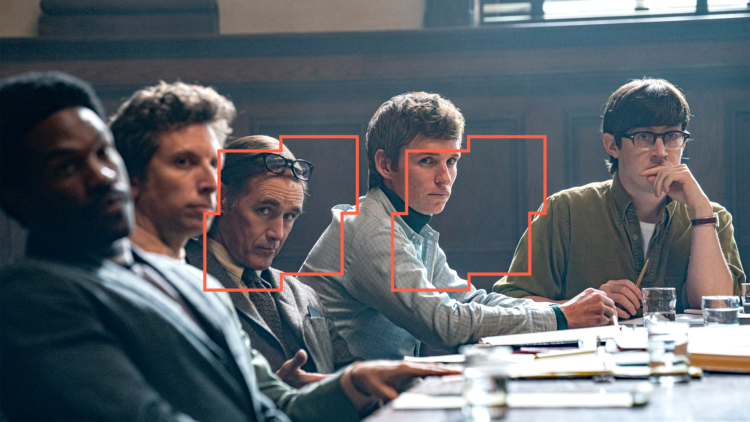
    Yahya Abdul-Mateen II, Ben Shenkman, Mark Rylance, Eddie Redmayne, and Alex Sharp in The Trial of the Chicago 7. Courtesy of Netflix.

    That’s largely because we’re not entirely focused on a single character—or even any character really. Of the seven, we spend the most time with Tom Tom Hayden (Eddie Redmayne) for a reason that becomes clear towards the film’s conclusion. However, his motivations and feeling are left opaque as a way to lend impact to the end of his arc. But in return all we feel is a disconnect. Secondarily, we get to know Abbie Hoffman (Sasha Baron Cohen) and Jerry Rubin (Jeremy Strong), two hippies who are a strong juxtaposition to Tom’s more straight-laced activist, and their reasons for protesting a bit more. If any of the cast were to be up for Oscar consideration it ought to be Baron Cohen whose comedic schtick is underlined by the complex and contradictory thoughts that Abbie feels in relation to the movement. 

    But because we’re so focused on the proceedings of the trial rather than the character impact, the real focus is on Rylance’s Kunstler, whose passions and frustrations are most front and center—especially his confrontations with the judge of the case Judge Julius Hoffman (Frank Langella), who is clearly biased against the seven. That focus does give us several Oscar-baity moments with Abdul-Mateen’s Bobby who is clearly being used as a pawn by the prosecution and the target of discrimination by Judge Hoffman. However, that story, at times more compelling than the main one we’re following, is on the periphery. 

    The final 30 minutes of the film, which is filled with the dramatics that is to be expected of a courtroom drama, give a lot of what I was craving throughout the whole film: humanity. What directors like David Fincher and Bennett Miller do with Sorkin’s material that he doesn’t do himself is infuse it with humanity. Sorkin writes characters and he directs them as such. In two pivotal scenes we see Tom prepare for testimony and Abbie take the stand. There we are treated to the character study that The Trial of the Chicago 7 should have been. I could have read the facts of the case on Wikipedia, what I’m interested in is the politics, the emotions, and the characters. As great as Sorkin can be, he can also be his own worst enemy. 

    Hi, I’m Karl ? Follow me on Twitter and Letterboxd! I’m also a Tomatometer-approved critic on Rotten Tomatoes ?

    💌 Sign up for our weekly email newsletter with movie recommendations available to stream.


    ADVERTISEMENT

  • ‘Ready Player One’ review — Colorful video game world, dull characters

    ‘Ready Player One’ review — Colorful video game world, dull characters

    Ready Player One is a visual feast and boasts impressive action sequences that will certainly entertain, but it’s missing heart, which makes the movie a letdown.

    The culture that Steven Spielberg’s latest film Ready Player One invokes is one that he had a hand in creating. Geek culture is something today that is discussed both positively and negatively. It’s about passion over a specific topic. However, it seems in recent times that that passion has grown to dangerous levels. It’s an angle that could have been interesting to explore, especially considering Ernest clines novel of the same name that the film is based on makes a point to criticize the pop culture obsessed. However, Spielberg celebrates the positive aspects of geek culture without acknowledging the negatives.

    The entire conceit of Ready Player One is a world where knowledge of pop culture — particularly that of the 80s — is now the currency. That’s because James Halliday (Mark Rylance in a weird, but great performance), has created a virtual world where people have invested all their real world time and money into living in — the Oasis. Players can enter the space and be whoever they want to be, which means a lot of 80s references. A lot. However, this has also caused the real world to crumble. Society has crumbled and completely transferred online. It’s an aspect of the premise that Spielberg ignores to the detriment of the rest of the film.

    Wade Watts (Tye Sheridan), who was named that by his father because it sounds like a superhero’s secret identity (references and nostalgia!). Wade lives in the stacks. A discombobulated structure of twisted metal and mobile homes built up stories high on the outskirts of the Columbus, Ohio — the fastest growing city in the world. We don’t learn a lot about Wade. We know his home life isn’t great, though that’s barely touched on, which is why he escapes to an abandoned van outside the stacks to live in the Oasis.

    In the Oasis, Wade becomes Parzival. He’s an extremely skilled player and Gunter. Gunters, which is short for Egg Hunters, are players who are focused on unlocking Halliday’s last dying wish in the Oasis. Halliday created a scavenger hunt where players must find 3 keys to win complete control of the Oasis both in the game and the real world.

    Compared to the book, which I enjoyed, the film is a lot simpler in its execution. To its detriment, the creation of the Oasis and its impact on society are quickly glossed over, which ultimately changes what the film is commenting on versus the book. The book takes time to set up that the world has become an oppressive environment where movement between classes has become impossible, except for in the Oasis. By stripping that message out and barely touching on the dichotomy of geek culture, the movie ends up not saying very much.

    It does attempt to have some commentary through Artemis (Olivia Cooke — she does great work here with the little material she’s given). She leads a group of resistance members — at one point she actually says, “welcome to the resistance” — that are focused on preventing IOI, a video game conglomerate that creates most of the equipment used to access the Oasis, from winning the prize. IOI and its CEO Nolan Sorrento (Ben Mendohlsen) have been forcing people into indentured servitude to help them win the game — essentially they raise an army. However, even with that storyline ripe for some commentary, the story breezes over it.

    Not every movie needs to be subversive. However, Ready Player One is asking us to care about its main characters because they are fighting for something bigger than themselves. But without making them struggle or there being some sense of stakes in the real world, it makes any moment that feels like a rallying cry fall flat. There are moments where a character is all but standing on a soapbox and there is almost no impact.

    Ready Player One suffers from a similar problem to last year’s Valerian and the City of a Thousand Planets. It’s visually a feast — an accomplishment of CGI. There are sequences that feel like they’re going to be iconic in the future. Dare I say, sequences that people will be nostalgic for. Specifically, the second act The Shining sequence is one of the few references that made me perk up. However, it feels like it achieves those moments at the stake of the plot and characters. No characters, lead or supporting, feel fully drawn out or have complete arcs.

    Spielberg seemed more interested in the possibilities that the Oasis presents rather than the societal implications of such a world. He set out to make a modern-day Willy Wonka and the Chocolate Factory but forgot to make the characters as colorful as the world around them. Spielberg is the master of setpieces the race for the first egg — it feels like the perfect amount of homage — and The Shining sequence are both evidence of that. It’s enough to make Ready Player One at least enjoyable. However, it’s one of those movies that slips through your fingers. If you’re looking for a colorful, video game-inspired, 80s homage, give Thor: Ragnarok a chance. It’s everything I wish this movie was.