Tag: Marvel Cinematic Universe

  • ‘Black Panther: Wakanda Forever’ helps us grieve together | review

    ‘Black Panther: Wakanda Forever’ helps us grieve together | review

    Black Panther: Wakanda Forever follows the nation as it navigates grief, politics, and new enemies after the death of King T’Challa.


    • Black Panther: Wakanda Forever is closer to a drama meditating on loss and grief than it is a comic book movie. Even when those elements come in, they’re tied into the plot.
    • The tone of the movie is notably more somber than other Marvel Cinematic Universe movies. Although there are flashes of humor, director Ryan Coogler never strays far from the movie’s darker undertones.
    • The first and last scenes are the most dramatically satisfying and moving in any MCU movie. Letitia Wright, Danai Gurrira and Angela Bassett’s performances become the movie’s heart in Boseman’s stead. Not by replacing him, but by continually reminding us of his impact.
    • Tenoch Huerta is a revelation. A goddamn STAR. His Namor constantly feels dangerous, but finds complexities in his motivations and very existence. Like any good villain (anti-hero?), he very nearly convinces you that he is right. He also very nearly runs away with the movie.
    • The first half has a perfect rhythm. It kept my heart pounding and eyes on the verge of tears. The second loses momentum as it expands its worldly themes. Still, Coogler knows how to keep you in. Along with Chloe Zhao and Sam Raimi, he’s the MCU’s future.

    By the time the Marvel logo came up at the start of Black Panther: Wakanda Forever, this time with a purple background rather than its usual trademark red, I was already on the verge of tears. There’s a melancholy in those opening minutes that we haven’t yet seen in a Marvel Cinematic Universe movie. The real raw human emotion that has mostly gone untapped in the franchise hits you like a gut punch — and we all know why. While director-writer Ryan Coogler was still in the middle of writing the script, star Chadwick Boseman died from colon cancer. Something unknown to Coogler and producer Kevin Feige. There wasn’t a world that they, or we, imagined without Boseman as T’Challa, the Black Panther and King of Wakanda. Now faced with his absence, they had to go back to the drawing board. What they came up with was exactly that: his absence.


    ADVERTISEMENT


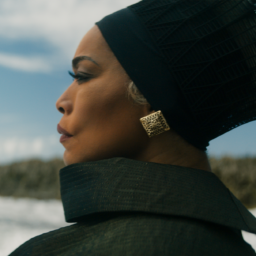
    Instead of shying away from his death or recasting the character, Coogler unflinchingly faces grief and loss head-on dealing with each surviving character’s struggles and how they deal with his absence. The details of T’Challa’s death aren’t specific. A mystery illness with no cure that quickly and quietly led to the King’s demise despite his sister Shuri’s (Letitia Wright) attempts to recreate the heart-shaped herb in a last-ditch effort to save him. It’s her grieving process — and guilt — that propels us for the first half of the movie as we learn of the geopolitical implications of T’Challa’s death including the rise of his mother Queen Ramonda (Angela Bassett) as the head of the nation. Seeing an opening, other nations are seeking to share in Wakanda’s supply of vibranium going as far as raiding outposts with the substance. Queen Ramonda gives an impassioned speech in front of the United Nations — one of many stellar moments of Bassett’s performance in typical Waiting to Exhale mic drop car-burning fashion — accusing them of taking advantage of their supposed weakness.

    And she’s right. Shortly after we see an American ship using a machine designed to find vibranium deposits encounter a potential supply at the ocean’s floor. However, before they can even get so much as a glance at it, they are ambushed by a group of blue amphibious humanoids that easily dispatch with the crew before one cloaked in shadow (with wings on his feet) single handedly takes down a helicopter. We come to learn that this is Namor (newcomer Tenoch Huerta). Or as he says with perfect supervillain delivery: “my people call me K’uk’ulkan, the feathered serpent god. My enemies call me Namor.”

    Like the first movie, Wakanda Forever moves rhythmically for the first half. Composer Ludwig Göransson — he won the Oscar for the first movie — expands the score’s musical language to work with Coogler’s melancholy tone and the political intigue of the plot. In some ways, the movie feels like a noir — albeit a brightly lit and action-oriented one. The mystery of Namor and his people, the Talokan, fuel much of the setup. Namor’s introduction — easily breezing into the (nearly) impenetrable Wakanda for a conversation with Queen Ramonda and Princess Shuri — is a showcase for Huerta. He explains to them that Wakanda’s cooperation with the outside world puts his own underwater kingdom at risk, so he tasks them with bringing the scientist responsible for creating the vibranium-detecting machine to him to kill.


    ADVERTISEMENT


    This sets off a series of moral, political, and personal dilemmas as Queen Ramonda looks to protect her nation and Princess Shuri discovers that there’s more in common between her people and her supposed enemy. Throughout the movie, but especially in the first half, Coogler is in the pocket — completely in rhythm with the story he’s telling. Nearly every single element that made the first movie the first (and still only) comic book movie to be nominated for Best Picture at the Oscars is even further elevated, especially the costumes by Ruth E. Carter and production design by Hannah Bechler. Coogler himself is more visually daring, presenting action setpieces and fights that feel dangerous.

    However, Black Panther: Wakanda Forever begins to come apart when it has to consummate its very sensitive exploration of grief with the demands of a comic book movie. And often in the second half, those two elements are in direct opposition to each other. Coogler does his best to use Shuri’s emotional journey to hold the two together, but in the end there are a few jumps the audience needs to make to believe in where the story ends up. The element that is successful at briging those two ideas together is Huerta’s Namor.


    ADVERTISEMENT


    The backstory of the Tatoklan almost begs for its own movie and gives the themes of grief, loss, and trauma structure. Much of this is in thanks to Tenoch Huerta’s revelatory performance. He is a goddamn star. His Namor constantly feels dangerous, even just with his words — especially important as comic book movies become increasingly predictable. However, he finds complexities in his motivations. Like any good villain he very nearly convinces you that he is right. In a way, he’s not even a villain, but an anti-hero in his own story. 

    Black Panther: Wakanda Forever is for better and worse emblematic of the fourth phase of the Marvel Cinematic Universe. Rather than returning to the same formula that made the franchise a success, Coogler pushes the narrative and artistic boundaries to create a flawed but ultimately satisfying chapter.


    ADVERTISEMENT


    More movies, less problems


    Hey! I’m Karl. You can find me on Twitter and Letterboxd. I’m also a Tomatometer-approved critic.

    💌 Sign up for our weekly email newsletter with movie recommendations available to stream.


    ADVERTISEMENT

  • ‘Thor: Love and Thunder’ leans into weirdness and queerness | movie review

    ‘Thor: Love and Thunder’ leans into weirdness and queerness | movie review

    In his fourth solo outing, Thor: Love and Thunder finds Thor and Valkyrie align with an unlikely new hero to take down a villain with a taste for revenge.

    Thor: Love and Thunder makes up for what it lacks in structure and narrative in charming oddball energy, maximal laughs-per-minute, and a cast that is game for anything. Director Taika Waititi, returning after a very successful entry in Thor: Ragnorok, throws everything but the kitchen sink into the movie—for both better and worse. Sometimes the emotional beats are betrayed by the comedic tone and vice-versa, but when the movie gets it right—like in the riotous but stirring reveal of The Mighty Thor—it’s perfection.

    Thor: Love and Thunder might be more of a Taika Waititi movie than it is a Marvel Cinematic Universe movie. I mean, it’s colorful, gay, and has a running gag about screaming goats—it doesn’t get much more Waititi than that.

    While the most recent movies in Phase Four of the Marvel Cinematic Universe have to do much heavy-lifting in setting up the rest of the series, Thor: Love and Thunder stands on its own—even with the cameos.

    After all, the last time we saw Thor (Chris Hemsworth) was in Avengers: Endgame where he became one of the few main superhero holdovers from the original Avengers. Much time has passed and there is much to catch up on, which we see in a sleek and often-hilarious montage narrated by fan-favorite Korg (voiced by Waititi). Korg explains that Thor has been galavanting across the universe with the Guardians of the Galaxy “helping” various worlds with their problems. What the catch-up is meant to explain (other than how Thor dropped all his Endgame weight) is how Thor has become a bit more of a bohemian narcissist as he’s searched for meaning after helping defeat Thanos.


    ADVERTISEMENT


    Another thing Phase Four has had in common is the use of cameos to draw audiences in (I’m looking at your Spider-Man: No Way Home). And while the move can sometimes come off as cumbersome pandering, the Guardians’ (Chris Pratt, Pom Klementieff, Karen Gillan, Vin Diesel, Bradley Cooper, Sean Gunn, Dave Bautista) appearance feels slight enough to not detract from the movie. Were they completely necessary? Probably not. But they were a welcome sight.

    Eventually, following a distress message from Sif (Jamie Alexander reprising her role), Thor learns that Gorr the God Butcher (Christian Bale under heavy makeup) has been going from planet to planet murdering Gods. In the movie’s cold open, we see Gorr lose his daughter after he’s slighted by the God he worshipped spurring his journey of revenge. More importantly, Sif reveals that New Asgaard is next.

    The Sif scene is the perfect example of Waititi maintaining his comedic tone while still delivering on narrative. Sif asks Thor to let her die following a battle with Gorr so that she can go to Valhalla. An apologetic Thor informs her that she actually needs to die in the battle to go to Valhalla, but quips in the movie’s funniest one-liner that maybe her missing arm made it to Valhalla.

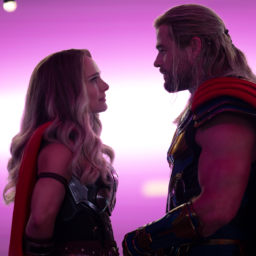
    Thor rushes back to the settlement of Asgardians where leader King Valkyrie (Tessa Thompson) is battling with the shadow creatures sent by Gorr. In yet another scene of Waititi’s ingenuity, we are treated to an epic battle, introduced to The Mighty Thor, and see a hilarious montage of how Thor and his one true love Jane Foster’s (Natalie Portman) relationship crumbled under the weight of both of their duties—Thor’s to the Avengers and Jane’s to her research.

    We learn that Jane, who is suffering from cancer, was called to Thor’s destroyed hammer Mjölnir. When she got to the hammer, it repaired and gifted itself to Jane in an attempt to save her. Now, as The Mighty Thor, she vows to help Thor and Valkyrie defeat Gorr who kidnaps New Asgard’s children to a mysterious land called the shadow realm.


    ADVERTISEMENT


    Thor and Jane’s relationship acts as the emotional anchor for the movie through all its absurdness. However, as often as the tonal balance between humor, thrills, and drama works—it doesn’t.

    The journey to the shadow realm takes our heroic quartet to Omnipotence City, a haven for the gods, where they hope to drum up support in their battle against Gorr. Specifically, they want to get the help of Zeus (Russell Crowe in a hilarious extended cameo). Unfortunately, Zeus is more interested in showing off with his lightning bolt for the other gods and, oh yeah, the orgy scheduled for later in the day.

    The riortous scene is comedy gold (pun intended) where we get to see just how far Marvel is willing to let Waititi go (we go as far as seeing Chris Hemsworth’s golden buns). We’re also treated to Valkyrie queering it up—and bopping to Mary J. Blige’s “Family Affair”—a gold-splashed action scene, and, of course, screaming goats. It’s a highlight scene.

    On the action side, a battle in the “shadow realm” is presented almost completely in black-and-white in one of the most thrilling creative decisions I’ve seen in a Marvel in quite some time. The scene is almost pure horror, but because of the tone up until that point it’s difficult to feel the stakes. While Bale is completely committed to the role of Gorr—and is often terrifying—you never truly feel he’s dangerous.

    That’s why when the movie works best when it focuses on just the characters.

    With Tessa Thompson’s Valkyrie, a history lesson on Korg’s people, and Chris Hemsworth’s peach, Love and Thunder is easily the queerest MCU movie yet.

    Still, it was a low bar. In the first three phases of the MCU, it seemed that LGBTQ+ people did not exist despite romance and sexuality being front and center. I mean, one of the first few scenes of Iron Man was Tony Stark sleeping with a female reporter. Queer representation in the MCU has only now started to settle in with characters like Phastos in Eternals and now Thompson’s Valkyrie and Waititi Korg in the Thor franchise wearing their queerness unapologetically. The result? A more colorful movie, both literally and figuratively.


    ADVERTISEMENT


    The dimension that it adds to a character like Valkyrie helps elevate the movie to a more profound plane in the same way that Thor and Jane’s past gives us an emotional investment in their narrative. Instead of being heroes of perfection, they themselves have trauma that drives them forward—or hold them back. Waititi’s grasp of tone and narrative in those scenes is perfection—much like his underrated gem Hunt for the Wilderpeople. It’s when he has to dig back into the MCU formula that the movie loses its color.

    It’s clear that the best way for the MCU to move forward is to give its directors full creative control over their movies from screenplay to direction.

    Much of Thor: Love and Thunder feels like MCU mastermind Kevin Feige handing Taika Waititi a blank check and a script and saying, “go,” much like Doctor Strange in the Multiverse of Madness felt like it had Sam Raimi’s DNA in it. However, these two movies in addition to Chloé Zhao’s Eternals show that unless Marvel truly allows these directors to completely run away with their movies—story and all—it’s difficult to meld the two visions. Of those three movies, I think Love and Thunder might be the least successful because Waititi had the more difficult balancing act. He was making a comedy. All the while, Disney needed him to deliver a popcorn blockbuster and Marvel needed him to deliver on storylines familiar to comic readers. He mostly succeeds. It’s clunky, the pacing is off, but I can’t deny that I laughed nearly every second of screentime.


    ADVERTISEMENT


    More movies, less problems


    Hey! I’m Karl. You can find me on Twitter and Letterboxd. I’m also a Tomatometer-approved critic.

    💌 Sign up for our weekly email newsletter with movie recommendations available to stream.


    ADVERTISEMENT


  • ‘Doctor Strange in the Multiverse of Madness’ brings horror to the MCU | movie review

    ‘Doctor Strange in the Multiverse of Madness’ brings horror to the MCU | movie review

    Doctor Strange has to go up against his fellow Avenger Wanda Maximoff in order to save a young girl and the fabric of the multiverse

    Don’t worry, Sam Raimi fans. Doctor Strange in the Multiverse of Madness fully goes horror—jump scares, body horror, a smattering of diabolical kills and all. It’s a Marvel Cinematic Universe movie through and through but has Raimi’s creepy groovy campy deranged DNA all over it. It’s messy, uneven, and ridiculous but also may have made a play to be my favorite MCU movie of all time. Start the Elizabeth Olsen Oscar campaign.

    The Marvel Cinematic Universe is at its best when the powers that be allow the director’s DNA to weave its way into the tried and true formula. There was Taika Waititi’s slapstick-infused and witty Thor: Ragnarok, Chloé Zhao’s quiet existential musings in Eternals, and now the groovy creepy fun delights Sam Raimi’s Doctor Strange in the Multiverse of Madness.

    When Raimi, best known for creating the cult classic Evil Dead horror franchise, was first tapped to direct many speculated that the movie may go full horror after all before the universe where that version of the movie existed was quashed. However, if the jump scares, body horror, and smattering of downright devilish and diabolical kills are any indication, Doctor Strange in the Multiverse of Madness is a horror movie through and through. 


    ADVERTISEMENT


    Of course, though, it’s a Marvel movie first and begins with an action scene traversing through an ethereal low gravity universe where a different universe’s Doctor Strange is trying to reach The Book of Vishanti along with America Chavez (16-year-old newcomer Xochitl Gomez) while being pursued by a giant monster. Just as she is about to be caught, a portal to our universe suddenly opens giving her an escape. Of course, though, things are not that simple and a monster has followed her right in the middle of Christine Palmer’s (Rachel McAdams for the first time since appearing in the first Doctor Strange movie) wedding that a heartbroken Strange is attending. I mean, she is his ex-girlfriend.

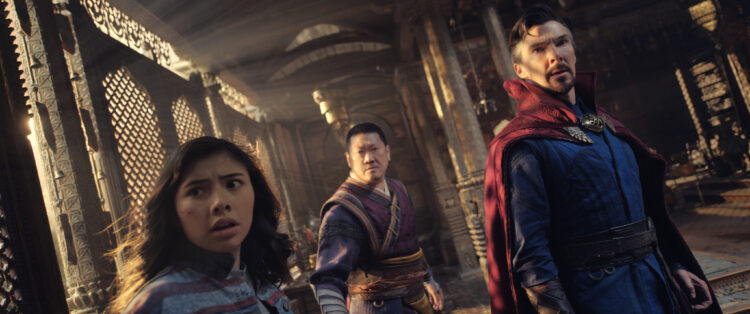
    After dispatching the monster, he and Wong (Benedict Wong) learn that Chavez has the one-of-a-kind ability to travel the multiverse. Though, she’s not exactly sure how she does it. Clearly, some force wants that power. Wong takes her to the Masters of the Mystic Arts fortress Kamar-Taj for safekeeping while Strange seeks out Wanda (Elizabeth Olsen) for help. 

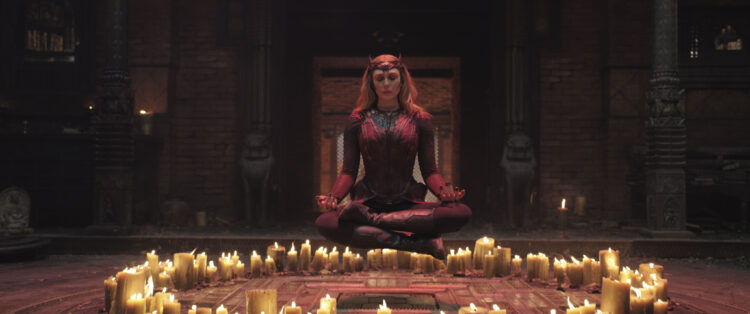
    However, in a surprisingly quick twist, we learn that Wanda herself is behind the attack in an effort to take America’s power and find a universe where she could be reunited with her sons who she lost in the Disney+ series WandaVision. She gives Strange until sunset to turn her in, which, of course, he does not do causing Wanda to take the fortress by force.

    What begins as a classic MCU action scene quickly turns into a clear announcement of Raimi as the creative force behind the movie as the horror elements he’s so known for start to creep in — whispered voices, tilting camera angles, quick-cut editing all reminiscent of The Evil Dead. That’s what’s most exciting about Multiverse of Madness. It’s not afraid to be scary. It stretches that PG-13 rating to its absolute limit.

    America again escapes with Strange to the multiverse leading to perhaps one of the most thrilling, deranged, terrifying, and twisted sequences in Marvel Cinematic Universe history that feels more akin to Prime Video’s The Boys than your classic superhero movie. Combined with some stellar and applause-inducing cameos, it propels the movie into a confident and assured second half that brings new (and ridiculous) ideas — a feat for a franchise with 27 movies and six television series.

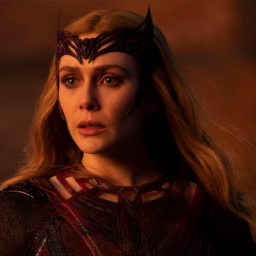
    Speaking of television series, Elizabeth Olsen continues to be a standout as her storyline continues from her Emmy-nominated turn in WandaVision. It almost makes more sense to call the movie Wanda’s Multiverse of Madness because she dominates every frame that she’s in. She chews the scenery with her villainous turn as a mother trying to be reunited with her kids to incredible and terrifying results. You feel the weight and danger of her presence — even when she isn’t on screen. While Benedict Cumberbatch, Benedict Wong, and Xochitl Gomez do great work, Elizabeth Olsen easily runs away with the entire movie. She’s even Oscar-worthy.


    ADVERTISEMENT


    Does the story have the same narrative implications as Spider-Man: No Way Home? No. It’s far from inconsequential, but the story does feel contained. That relative slightness is what allowed Raimi to chew into each action setpiece with his full might. Not a moment of the well-paced and lean 126-minute running time is wasted. The movie hits the gas from minute one and doesn’t let up until it crashes — in the best way possible.

    Doctor Strange in the Multiverse of Madness is messy, uneven, ridiculous, and at times confusing — and that’s why I loved it. In all the chaos and depravity is a future where the MCU is more than just a formula. It shows that auteurs with a singular vision can have the vision realized while still fitting into the grander scheme of the franchise. Sam Raimi swings for the outer reaches of the multiverse to absurd results — however, he’s in full control. Every campy unhinged decision is done with a wink and a nudge to the audience. Mileage may vary by viewer. For this critic, it went the distance. Creepy, campy, groovy, devilish fun from beginning to end. 


    ADVERTISEMENT


    More movies, less problems


    Hey! I’m Karl. You can find me on Twitter and Letterboxd. I’m also a Tomatometer-approved critic.

    💌 Sign up for our weekly email newsletter with movie recommendations available to stream.


    ADVERTISEMENT

  • What's next? Who should direct 'Doctor Strange: Multiverse of Madness'

    What's next? Who should direct 'Doctor Strange: Multiverse of Madness'

    With Doctor Strange director Scott Derrickson out for the sequel, we throw out our suggestions for who should replace him

    Doctor Strange was one of the most visually stunning episodes in the decade-long run of the Marvel Cinematic Universe. It’s also one of its most inessential. There’s nothing you learn about the titular character in his solo introduction to the series that can’t be learned in the character’s cameo in Thor: Ragnarok or the first fifteen minutes of Avengers: Infinity War, and unless you’re dying to see Chiwetel Ejiofor’s inevitable ally-turned-nemesis Baron Mordo, there’s not much to take away from the 2015 film aside from the aforementioned visuals.

    It was director Scott Derrickson who was able to take those visuals from concept to screen, and many had shown excitement about the director’s return for the sequel, which was announced at Kevin Feige’s mic-drop moment at 2019’s San Diego Comic-Con. Feige outlined the next 4-5 years of films and shows on Disney+, and the newly-minted Doctor Strange in the Multiverse of Madness was one of the most-discussed announcements in the recap videos released throughout the YouTube community in the following days.

    With the multiverse teased — and eventually revealed as a red herring — in Spider-Man: Far From Home, fans had already begun their rampant theorizing about what effects a multiverse could have on the MCU. Dr. Strange seemed to be the perfect bridge between the two, and with the announcement that Elizabeth Olsen’s Scarlet Witch (okay, fine, Wanda Maximoff) will be appearing alongside Benedict Cumberbatch’s protagonist, it was clear that Marvel is pushing its chips to the center of the table, hoping Multiverse of Madness will do for Dr. Strange what The Winter Soldier and Ragnarok did for Captain America and Thor, respectively. 

    Derrickson joined Feige, Olsen, and Cumberbatch on stage in San Diego last summer, where the creators and actors showed their shared enthusiasm for what was dubbed the “first horror film” in the MCU’s history. Given the director’s pedigree and experience in the genre, it seemed like this was going to be another slam-dunk entry in the MCU, with the promise of the multiverse providing limitless potential for where the film could go. 

    https://twitter.com/scottderrickson/status/1215428331450953728?s=20

    Well, it seems like a few limits have been reached, or at least set forth by the powers that be within Marvel, as Derrickson took to Twitter this past week to announce he’d no longer be directing the film, slated for release in 2021. Citing creative differences, Derrickson will still be involved as an executive producer, though the extent of his influence will remain to be seen. With so much invested in the film, both in star power and in potential, the obvious question needs to be asked: what now? Below, you’ll find a few suggestions for directors who may be able to take this setback as an opportunity to advance the MCU in a new, exciting direction. 

    Ari Aster

    If there’s anyone who’s more interesting in horror right now than Ari Aster, I’d love to see how their last two films match up to Aster’s debut couplet of Hereditary and Midsommar. Aster has been able to create real terror in both films, the kind that will benefit a skilled acting group like the one Multiverse has assembled.

    Aster has also directed Toni Colette and Florence Pugh to Oscar nomination-worthy portrayals of the lead actress in crisis, which would greatly benefit Olsen. Olsen will have completed her character’s Disney+ show WandaVision, which has been heavily implied to lead directly into the second installment of the Dr. Strange series, so if that show ends with something happening to Vision (again), Aster would have a lot of trauma to sort through with Wanda, setting Olsen up for a potential behemoth of a performance. 

    💌 Sign up for our weekly email newsletter with movie recommendations available to stream.


    ADVERTISEMENT

    Robert Eggers

    Perhaps just a step below Aster in terms of buzz right now, Robert Eggers has established himself as another creative force in horror, thanks to the spectacularly eerie The Witch and absolutely bonkers The Lighthouse. Eggers’s flair for the supernatural would make him an asset for Marvel in Multiverse, and he’s proven that he can take several creative risks in his storytelling and still pull great performances out of his actors in the process. Seeing Chiwetel Ejiofor reprise his role as Mordo and take on the full-blown-psycho role like Willem Dafoe did in The Lighthouse would be a jolt to the MCU, who’ve always struggled in creating interesting villains. 

    Jordan Peele

    While Aster and Eggers are the indie darlings of horror right now, the genre is operating within Jordan Peele’s grasp. I’d give this about a 1% chance of actually happening, seeing as Peele’s passion for telling stories in his way will likely veer from Marvel’s path too much, but Peele’s involvement with CBS All Access’s The Twilight Zone could provide a spark of hope to get him involved in this big-budget playground. If Marvel lets Jordan Peele’s imagination run wild a little, he could tread a new path for the entire franshise moving forward. 

    Ava DuVernay

    There are concerns with bringing in DuVernay on this film, sure, but she’s absolutely worth considering. Yes, A Wrinkle in Time underwhelmed, but the visuals were never the issue, and with Derrickson exiting, it would do Marvel some good to bring in a director who has shown their own talent for creating visually stunning effects. DuVernay is currently tapped to direct New Gods for the DC Universe, but given the lack of knowledge and even deeper lack of interest for the project, I’d expect getting out of that deal wouldn’t be that difficult at this point. 

    Melina Mantzoukas

    You know what’s really scary? Actual stakes of life and death. The argument can be made that no director handled that better than Mantzoukas did in Queen and Slim last year, as she followed two outlaws trying to outrun their own building legend. From the time we start our journey on the run with the couple until the film’s tension-filled ending, Mantzoukas builds the stakes wonderfully, and keeps the focus on the individuals at the film’s center. With so many different visual possibilities likely to be present in Multiverse, adding Mantzoukas to keep the focus on Stephen Strange and Wanda Maximoff will help the film keep some semblance of reality in the madness. 

    💌 Sign up for our weekly email newsletter with movie recommendations available to stream.


    ADVERTISEMENT

  • ‘Spider-Man: Far From Home’ movie review

    ‘Spider-Man: Far From Home’ movie review

    Spider-Man: Far From Home finds Peter Parker at a crossroads following the fallout of Avengers: Endgame

    30-second review: Spider-Man: Far From Home has the same quirkiness that made Homecoming so successful, but a predictable plot and poor pacing keep it from reaching its predecessor’s heights. However, it also gives us the best interpretation of the “with great power comes great responsibility” theme.

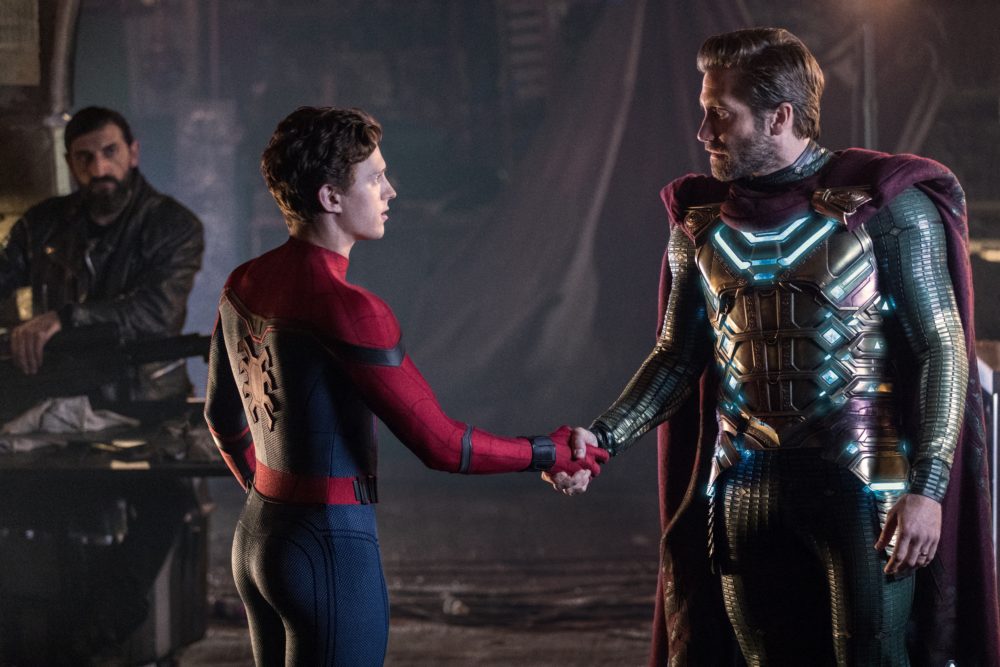
    Tom Holland cements his place as the best actor to portray Spider-Man in Far From Home. But, as a whole, the movie has trouble balancing Peter’s character development with its quirky tone and less than exciting plot. Although, it is still a delight to watch and Jake Gyllenhaal gives a wonderfully bizarre performance.

    Where to watch Spider-Man: Far From Home: Now playing in wide release.

    Don’t forget to pack your suit. Full review below ?


    Spider-Man: Far From Home mostly succeeds in its near-impossible task of following up Avengers: Endgame one of the best entries in the Marvel Cinematic Universe and a quasi-series finale for the “Infinity Saga.” However, it’s clear that the impact of the events of Endgame are going to weigh heavily on the franchise as it moves forward — for better or worse.

    Picking up almost immediately after The Avengers defeat Thanos — losing a few beloved characters on the way — Far From Home does quick work of establishing us in a new reality. Thanos’ snap, known as the blip, has certainly had a massive effect on the planet, but to the happy-go-lucky teen ensemble, all is the same. Other than the fact that half of their classmates have aged five years while they remained the same age. 

    Peter Parker (Tom Holland) is looking forward to a class trip across Europe to take some time away from being Spider-Man and, more importantly, finally profess his true feelings for MJ (Zendaya). Of course, not everything goes quite to plan.

    Nick Fury (Samuel L. Jackson) seeks Peter our to help a new superhero named Quentin Beck (Jake Gyllenhaal) battle monsters made of the four elements — earth, fire, water, and air. However, he’s hesitant to help. Partially because he’s on vacation, but also because the image of a memorialized Tony Stark haunts him everywhere he goes. 

    Spider-Man: Far From Home
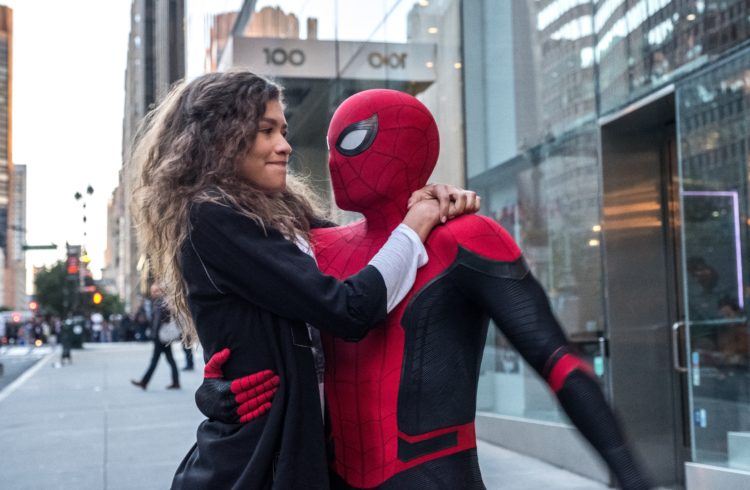
    Michelle (Zendaya) catches a ride from Spider-Man in Columbia Pictures’ SPIDER-MAN: ™ FAR FROM HOME.

    Homecoming succeeded when it didn’t try to be a Spider-Man movie and was instead a high school coming-of-age. Far From Home, on the other hand, works so well as a Spider-Man movie — one where Peter directly deals with the “with great power comes great responsibility” adage — but is bogged down by the same quirkiness that made Homecoming so great — Jacob Batalon does great work as Peter’s geeky best friend Ned, but isn’t given enough to do to make the same impact he did in the last film.

    It doesn’t help either that the first half of the film is jarringly paced as it races towards one of the least surprising twists in an MCU film. However, once that’s out of the way, the second half has tons of fun moments, including an Inception-like action scene that is as impressive as it is terrifying and perfectly weird Gyllenhaal performance that just leaves you wanting more.

    And though the movie doesn’t completely work, it solidifies Tom Holland as the best incarnation of Spider-Man. Holland’s ability to translate emotion on screen — and more importantly the emotion of a 16-year-old — carries the movie past the finish line. Where the movie fails in development, he makes up for in performance. Without a doubt, he’s a movie star.

    Far From Home isn’t everything I hoped it would be. It’s a middle tier entry in the franchise at best, but it does serve as a bridge between the past and the future of the MCU. Trust me, you’re gonna want to stick around for the mid and post-credits scenes. Those scenes alone tell us what the MCU needs to do to continue working — it needs to break its own mold and start taking risks. 


    ADVERTISEMENT


    More movies, less problems


    Hey! I’m Karl. You can find me on Twitter and Letterboxd. I’m also a Tomatometer-approved critic.

    💌 Sign up for our weekly email newsletter with movie recommendations available to stream.


    ADVERTISEMENT


  • ‘Captain Marvel’ movie review — A 90s origin story throwback

    ‘Captain Marvel’ movie review — A 90s origin story throwback

    Captain Marvel features Brie Larson as the first lead female superhero in the Marvel Cinematic Universe as she a young Nick Fury solve the mystery of her identity.

    One sentence review: Captain Marvel is a fun, corny, and empowering origin story that feels like a bridge between the past and the future of the Marvel Cinematic Universe.

    One paragraph review: Captain Marvel harkens back to the MCU origin stories that kicked off this wave of superhero movies — and that’s a good thing. It’s smaller, tighter, and more character driven than the other movies in the franchise, even if it feels non-essential. It also helps that Brie Larson and Samuel L. Jackson have firecracker chemistry and are supported by a stellar cast — Ben Mendelsohn and Lashana Lynch are standouts.

    Where to watch Captain Marvel: Available to buy or rent on Amazon

    Grab your leather jacket and sunglasses. Full review after the jump ?


    Captain Marvel had one of the hardest time slots on the Marvel Cinematic Universe calendar. If the forthcoming Avengers: Endgame is the series finale, then Captain Marvel is the penultimate episode. However, like many penultimate episodes, it feels like any typical entry in the Marvel Cinematic Universe — for both better and worse.

    Like last year’s Bumblebee — the out of sequence 80s dripped entry in the Transformers franchise — Captain Marvel is a prequel to almost all of the MCU — except Captain America: The First Avenger. Taking place in the 90s and following a Kree soldier called Vers (Brie Larson), Captain Marvel is less about forwarding the overall storyline of the MCU — though it certainly connects some dots — and more about giving Captain Marvel a warm welcome to the MCU with her own origin story.

    And while the movie hits a lot of the same beats as a typical superhero origin story, it presents them in an interesting way. That’s because Vers spends most of the running time of the movie trying to make sense of these dreams of a life on Earth that feel like memories.

    Along with her crew of Kree warriors — Vers’ mentor and commander Yon-Rogg (Jude Law), Minn-Erva (a criminally underused Gemma Chan), Korath (Djimon Hounsou reprising his Guardians of the Galaxy role, among others — Vers continues the long-running war with a shape-shifting species called Skrulls. However, after being captured in a battle, Vers escapes only to crash land on Earth.

    There, she catches the attention of S.H.I.E.L.D operative Nick Fury (a de-aged Samuel L. Jackson — the CGI is phenomenal) who helps her on her quest to find out who she is and defeat the Skrulls.

    The movie balances funny fish-out-of-water moments as Vers marvels at the 90s culture and technology — she literally crash-lands into a blockbuster — with a charming buddy comedy between Fury and Vers. And while it’s all fun and entertaining, the movie does get at something deeper.

    So much of what works in Captain Marvel comes from directors Anna Boden and Ryan Fleck (best known for Half Nelson, which scored Ryan Gosling his first Oscar nomination). MCU mastermind Kevin Feige choosing the duo to tackle the introduction of what is most likely going to be their most important hero to date was surprising. They’ve directed quiet character-centric indies for most of their careers. But it’s that indie intimacy that drives the movie’s best moments.

    Vers finally tracks down some answers in the form of her former best friend on Earth Maria (a terrific Lashana Lynch). And instead of it being this huge melodramatic moment where the hero reunites with their best friend or finally learns their identity, the movie slows down and gives a genuinely emotional moment between these two women. Lynch nails the scene. She’s a standout.

    To both its benefit and detriment, Captain Marvel is essentially inconsequential in the MCU timeline. We could have jumped into Endgame without this story. It pulls some of the tension and stakes out of it — even the villain of the piece Talos (Ben Mendohlson — truly great) is mostly benign. However, it also allows the movie to be that corny, fun, and uplifting origin story that we’ve seen, but still eat up.

    It helps that Brie Larson is magnetic as Captain Marvel. She’s not your typical superhero. There’s something genuine about her. Even when she truly harnesses the extent of her powers, it feels like a real person experiencing something extraordinary. Speaking of the extent of her powers, Thanos better beware.

    At just two hours, Captain Marvel is really just a blast to watch. It’s a movie that I think will replay a lot better than in this current moment when we can separate it from the conclusion of the franchise. It doesn’t bring much new to the table other than the fact that the hero is a woman. But with that, it inherently has these touching moments of empowerment that make this an important entry in the MCU.

    Also, did I mention there’s an adorable cat named Goose and Annette Bening?


    ADVERTISEMENT


    More movies, less problems


    Hey! I’m Karl. You can find me on Twitter and Letterboxd. I’m also a Tomatometer-approved critic.

    💌 Sign up for our weekly email newsletter with movie recommendations available to stream.


    ADVERTISEMENT