Tag: Michelle Yeoh

  • ‘Wicked: For Good’ stays true to its story, for better and worse | movie review

    ‘Wicked: For Good’ stays true to its story, for better and worse | movie review

    Wicked: For Good” brings the story of Elphaba and Glinda to a satisfying conclusion, even as its source material’s flaws glimmer through.


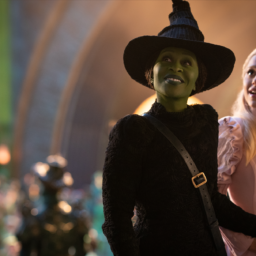
    Wicked: For Good is, much like Act 2 of the stage show, a mixed bag. It highlights the strongest aspects with raw and visceral musical numbers that underline the emotional struggles of the characters. At the same time, however, it emphasizes its weaknesses as it clunkily weaves “The Wizard of Oz” into the story. Still, and most importantly, the relationship between Elphaba and Glinda hits all the emotional notes that made Wicked such an enduring story. Cynthia Erivo continues to captivate on the screen, but it is Ariana Grande’s magnificent performance as an emotionally-torn Glinda that gives the movie the complexity and depth to become greater than the sum of its parts.

    “Wicked: For Good” is in theaters Friday.

    For better (good?) or worse, “Wicked: For Good is exactly the movie you’re expecting. For fans of the stage show, it highlights its strongest aspects. The musical numbers have the same raw, visceral emotionality just blown up in scale while the characters’ complex journeys are even more deeply felt. With that, however, it emphasizes its notorious weaknesses. In particular, the way the plot twists to tie to “The Wizard of Oz still feels clunky. Despite its failings, and most importantly, the relationship between Elphaba and Glinda hits all the emotional notes that’s made “Wicked such an enduring classic. Perhaps even more so in the movie version.


    ADVERTISEMENT


    Part one of the Wicked duology has the easier job. Not only is its tie to “The Wizard of Oz” tenuous, the archetypes of the characters are simple and familiar. Elphaba (Cynthia Erivo) is the brainy outsider that rails against injustice and Glinda (Ariana Grande) is the self-absorded popular girl with an unexpected heart. “For Good” takes those archetypes, and throws them into a complex situation that mirrors the very real structures of oppression in our society. Structures that director Jon M. Chu emphasizes even more with propaganda against Elphaba flying through the streets of Oz and added scenes of prejudice that could be taken straight out of a Holocaust movie. Yeah, things get a little convoluted.

    The story’s clear ties to the darkest instincts of society sometimes rub against the silliness of a world where munchkins co-exist with talking animals. It’s maybe even more stark with the additions to the plot by screenwriters Winnie Holzman (who penned the stage version) and Dana Fox. Among those additions is a new song sung by Elphaba called “There’s No Place Like Home” where she encourages the animals, who are forced into hiding, to fight for their homeland. Like many of the changes to the story, it feels gratuitous and out-of-place in an attempt to emphasize a theme that is already underlined in the source material. Unlike the changes to the first movie that felt in service to the characters’ journeys. Holzman should have trusted her original writing because what works most often in the movie is what is taken directly from the stage. 


    ADVERTISEMENT


    The second act of Wicked has always felt like Glinda’s story as she struggles between two truths: that she enjoys the adoration brought to her by working with The Wizard (Jeff Goldblum) and Madame Morrible (Michelle Yeoh), and the fact that she knows that her friend is a good person. Ariana Grande’s magnificent performance underlines that paradox as she tries to hold on to her newfound power in Oz while protecting her friend. Part of that involves ignoring what is happening around her with the glimmer of hope that it’s not as bad as Elphaba says and that it is not too late to change course. But Grande never lets that hope come off as delusion. For a character as high off the ground as Glinda, she always feels grounded in something real.

    As the story progresses and alliances shift or are revealed, the main trio of Elphaba, Glinda and Fiyero (Jonathan Bailey) circle each other with fiery passion fueled by their histories. Like in “As Long As Your Mine,” which feels even more like a showstopper in the movie. Bailey exchanges his character’s bravado for real bravery as he bares his genuine feelings for the first time. As the camera swirls around the couple, it feels like classic romantic movie magic. That is juxtaposed against “No Good Deed,” which burns with anger and pain as Elphaba, delivered with unrestrained ferocity by Erivo, faces her past and present failings in a desperate attempt to save what she loves. Chu finds the emotional core of each of these numbers and amplifies them to the cinematic proportions they deserve, even as his direction fails in other aspects.

    The final act, torn directly from the stage version, finally reaches the levels of greatness set by the first movie. And that is because at its core “Wicked” is a story about two women that in finding compassion in their differences drive each other to be better people. Erivo and Grande seem to understand that as they sing the title number to each other. Somehow they fill the space between the characters with all the hopes, regrets and words unsaid between them. It is movie musical magic. Despite its flaws, the booming crescendo of the piece, which has the characters facing uncertain futures, is deeply felt. It leaves you missing them as the screen fades to black. It is the raw and plain power musical theater captured on film. 


    ADVERTISEMENT


    More movies, less problems


    Hey! I’m Karl. You can find me on Twitter and Letterboxd. I’m also a Tomatometer-approved critic.

    💌 Sign up for our weekly email newsletter with movie recommendations available to stream.


    ADVERTISEMENT

  • ‘Wicked’ defies expectations, a fearless movie-musical | movie review

    ‘Wicked’ defies expectations, a fearless movie-musical | movie review

    Wicked, the long-awaited adaptation of the smash Broadway musical, finally flies its way into theaters

    Wicked is a bold, vibrant movie-musical that celebrates its Broadway roots with expansive musical numbers and captivating performances. Director Jon M. Chu’s adaptation embraces the magic of the original, expanding the world and deepening the characters. With stunning chemistry between Ariana Grande and Cynthia Erivo, this film is a must-see for musical fans.

    Wicked is in theaters on Nov 22.

    In recent years, there’s been a troubling trend of studios shying away from marketing their movie-musicals as… well, musicals. The Mean Girls remake famously didn’t show any songs in its trailer (and some audience members were shocked when the characters started singing), and director Todd Phillips humorously insisted his movie Joker: Folie à Deux wasn’t a musical. When asked to describe it he basically defined what a musical is. That’s why director Jon M. Chu’s adaptation of the Broadway hit Wicked (sometimes subtitled The Untold Story of the Witches of Oz) is such a refreshing and magical experience. With expansive, dynamic musical numbers that fill the screen, a fast-paced rhythm, and larger-than-life characters, Wicked is proudly and unapologetically a musical.


    ADVERTISEMENT


    Full disclosure: I didn’t grow up with a deep love for Wicked. In fact, I was actively not a fan (I was more of an Avenue Q person during the great Broadway war of 2004). Maybe there was some personal bias there, but I’ve always felt that Stephen Schwartz’s iconic score and the dazzling production were overshadowed by a plot-heavy story, uneven pacing, and underdeveloped characters. That’s why, despite the backlash from some fans, I actually thought splitting the movie into two parts—keeping the two acts of the stage musical separate—was a smart choice. And I’m happy to say, I was right.

    One of the smartest decisions in Wicked’s adaptation is knowing where to expand the story. Sticking mostly to the first act of the musical, the film opens with Glinda the Good (Ariana Grande) announcing to the citizens of Munchkinland that the Wicked Witch of the West is dead. The townspeople rejoice, dancing and tearing down wanted posters of the green-skinned witch, even burning a wicker statue of her ominous figure. From the very beginning, Chu’s grand and vibrant direction is on full display, with dancers filling every corner of the set (and yes, it’s a real set, not CGI!). Christopher Scott’s choreography matches the large-scale action, adding drama and flair. While the design clearly nods to The Wizard of Oz, it takes creative liberties, modernizing and expanding the world.


    ADVERTISEMENT


    The plot quickly jumps to a flashback of Glinda’s first day at Shiz University, when she was known as Galinda Upland. She’s eager to impress the headmistress, Madame Morrible (Michelle Yeoh), and learn sorcery. But things take an unexpected turn when the green-skinned Elphaba (Cynthia Erivo)—who will later become the Wicked Witch—accidentally unleashes her powers while protecting her wheelchair-user sister, Nessarose (Marissa Bode). Morrible, impressed by Elphaba’s abilities, invites her to study sorcery, which sparks a rivalry with Galinda. This rivalry sets the stage for a story of self-discovery, friendship, and unexpected bonds.

    In a lesser movie-musical, certain moments, like Elphaba’s backstory, might have been relegated to just dialogue. But in Chu’s hands, even these moments maintain the talk-singing style of the stage production, keeping the story flowing with rhythm and energy. The screenplay by Winnie Holzman and Dana Fox takes its time, fleshing out the world and its characters. The students at Shiz, for example, become characters in their own right, thanks in part to Galinda’s hilarious minions (played by Bowen Yang and Bronwyn James). The expanded focus on Ozian history, including talking animals, gives the story a deeper sense of lived-in complexity.


    ADVERTISEMENT


    But what really sets Wicked apart is how the film brings its most iconic musical moments to life on a grand cinematic scale. Take Fiyero (a charming Jonathan Bailey), who performs the joyful and rebellious “Dancing Through Life” in a Shiz University library that’s been transformed into a spectacular set. Bailey and his dancers glide, twirl, and leap across bookshelves in a thrilling, acrobatic performance that feels both theatrical and cinematic.

    At its heart, though, Wicked is a story about two young women who find friendship in each other. Erivo’s Elphaba, ostracized and defiant in the face of bullying, delivers her first major song, “The Wizard and I,” with a stunning vocal performance that conveys both her strength and vulnerability. Her portrayal adds layers to the character, making her feel even more complex than in the stage version.

    On the other hand, Grande’s portrayal of Glinda is effortlessly comedic, capturing the character’s ditzy, privileged, and slightly bratty nature. At times, she completely steals the scene, nailing the character’s comedic timing and delivery. Her performance during “Popular” is pure musical theater golden camp—her take on the iconic scene feels fresh, like it’s always been meant to be performed that way. It’s an Oscar-worthy turn.


    ADVERTISEMENT


    But it’s the chemistry between Erivo and Grande that makes Wicked* soar. Their dynamic is electric, and their energy together makes it easy to believe in their growing bond, even as they face adversity. As the two of them venture to the Emerald City to meet the Wizard (Jeff Goldblum), their connection feels real, and the final half-hour of the film—culminating in the iconic “Defying Gravity” number—is breathtaking. With thrilling action, musical perfection, and two watershed performances, it’s a moment that encapsulates everything that makes Wicked so special.

    Will Wicked have mainstream appeal? That’s yet to be determined. However, its fearless approach to adapting a Broadway musical for the screen will have fans and skeptics leaping to their feet. It captures the raw feeling of watching live theater. The kind of live theater that makes your heart skip a beat and makes you stare in wonder at the sheer talent and audacity. Then again, that’s what it takes to defy gravity.


    ADVERTISEMENT


    More movies, less problems


    Hey! I’m Karl. You can find me on Twitter and Letterboxd. I’m also a Tomatometer-approved critic.

    💌 Sign up for our weekly email newsletter with movie recommendations available to stream.


    ADVERTISEMENT

  • A movie like ‘Everything Everywhere All At Once’ has never existed before | SXSW review

    A movie like ‘Everything Everywhere All At Once’ has never existed before | SXSW review

    In Everything Everywhere All At Once, an unremarkable Chinese-American woman finds out that the fate of the multiverse lies in her (and her other versions) hands.

    When I say a movie like Everything Everywhere All At Once has never existed, I mean that a movie like it has truly never existed. Though it spans countless genres, experiments with several mediums, and references dozens of films from 2001: A Space Odyssey to Ratatouille to Kill Bill to In the Mood For Love it feels so singular and assured. Director duo Daniels crafted a romp through the multiverse that is an assault on the mind as much as it is an assault on the senses. Absurd, hilarious, heartfelt, thrilling. It is one of the best movies of the year.

    Everything Everywhere All At Once is playing at the 2022 South by Southwest Film Festival.

    Everything Everywhere All At Once may be one of the most accurate movie titles in history. Filmmaking duo Daniels (Dan Kwan, Daniel Scheinert) throw everything, kitchen sink and all, into their action-thriller-comedy romp through their version of the multiverse — like the silly fever dream ideas of every person in existence brought to life in insanely colorful detail. The movie is so jam-packed that its cinematic references range from Stanley Kubrick’s sci-fi epic 2001: A Space Odyssey to Pixar’s animated Ratatouille to Wong Kar-wai’s arthouse romance In the Mood For Love. And these aren’t just throwaway references. Each movie is woven inseparably into the plot.

    That’s not to say it’s unfocused either. The movie’s story, for as complex as the lore gets, is relatively straightforward and it earns nearly every one of its digressions — yes, even the thread about humans with hot dogs for fingers and the universe where humans never evolved and are simply insentient rocks that communicate in subtitles. I’m telling you, this movie is one of a kind. But, as we know, bizarreness doesn’t necessarily make a good movie — though it certainly makes for an entertaining one. It’s how Daniels use the bizarreness to tell their story that makes it great.


    ADVERTISEMENT


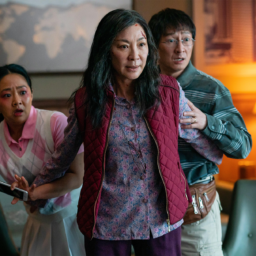
    Evelyn is a Chinese-American immigrant who, along with her husband Waymond (Ke Huy Quan), owns a laundromat that she works hard to run, albeit robotically. After years on the grind she’s simply going through the motions, something that has distanced her from her husband and daughter Joy (Stephanie Hsu). It’s not even that she’s unhappy with her life — she’s simply not living it. She has one problem though: she hasn’t paid her taxes. That leads Evelyn, Waymond and her father Gong Gong (James Hong) to the IRS where inspector Deirdre Beaubeirdra (Jamie Lee Curtis) performs an audit of their business.

    But like anyone trying to pay their taxes, things quickly go awry.

    In a bit of a exposition dump that blessedly make the concept of the multiverse easy-to-follow, Waymond, or at least another version of Waymond from a different universe called the Alpha-verse, inhabits the body of… this universe’s Waymond (okay, maybe it’s not that easy to follow, but the Daniels find ways to guide you through it) and explains to Evelyn that every decision you make splits off a new universe and different version of you and your life. That means there are millions of versions of Evelyns and Waymonds. Alpha-verse Waymond explains that in his universe Evelyn created a technology that gives them the ability to jump across the multiverse into different versions of themselves.

    He seeked out this universe’s Evelyn to recruit her to help defeat the evil inter-dimensional Jobu Tupaki, another version of Joy who wants to destroy the multiverse, by teaching her how to shift between different versions of herself to access their abilities. In perhaps the most impressive fight scene of the many impressive fight scenes in the movie, Evelyn shifts into a version of herself who broke up with Waymond before they could get married and instead became a martial arts master and subsequently a successful actress — yes, it’s as meta as it sounds — and fights a version of Deidre who is a pro-wrestler. Yes, Jamie Lee Curtis gets in on the action too.


    ADVERTISEMENT


    Like The Matrix where Evelyn is Neo and Waymond is Morpheus, she must try to master the ability to jump between versions and prevent Jobu Tupaki from taking over her universe. In the process we see movie star Evelyn (an homage to In the Mood for Love), sign spinner Evelyn, and hibachi chef Evelyn which features the movie’s funniest references to Ratatouille and Guardians of the Galaxy.

    Underneath all the absurdity, though, is a well-realized exploration of the Asian and Asian-American experiences. Coming into the movie, I didn’t expect to be taken so emotionally by the movie’s deeper themes as the son of Asian immigrants. The experience of generational trauma takes form in Evelyn and Joy’s relationship — one strained by her mother’s desire to hold onto her vision of what Joy’s life should be, which is fueled by Evelyn’s father’s vision of what her life should be. The parent-child relationship has become a focus of movies lately. Perhaps because the millennial generation is now watching their boomer parents reach the later years of their lives. Daniels explore the tension of how one generation’s regrets, trauma, dreams bleed into the next but are often rejected because each generation is born into a different world.

    To try to write about Everything Everywhere All At Once is like trying to explain the dream you had last night. The details are outlandish, maybe a little fuzzy, sometimes terrifying, but often connected to something in your subconscious. Some thought or insecurity or desire deep down that is suppressed deep in your psyche for one reason or another. On its face, Everything Everywhere is a wickedly entertaining, high-octane action romp that is destined for instant cult classic status. But it has more on its mind than hot dog hands, butt plugs and world-ending everything bagels — not just more. Everything.


    ADVERTISEMENT


    More movies, less problems


    Hey! I’m Karl. You can find me on Twitter and Letterboxd. I’m also a Tomatometer-approved critic.

    💌 Sign up for our weekly email newsletter with movie recommendations available to stream.


    ADVERTISEMENT

  • 2019 Oscar Predictions: Best Supporting Actress

    2019 Oscar Predictions: Best Supporting Actress

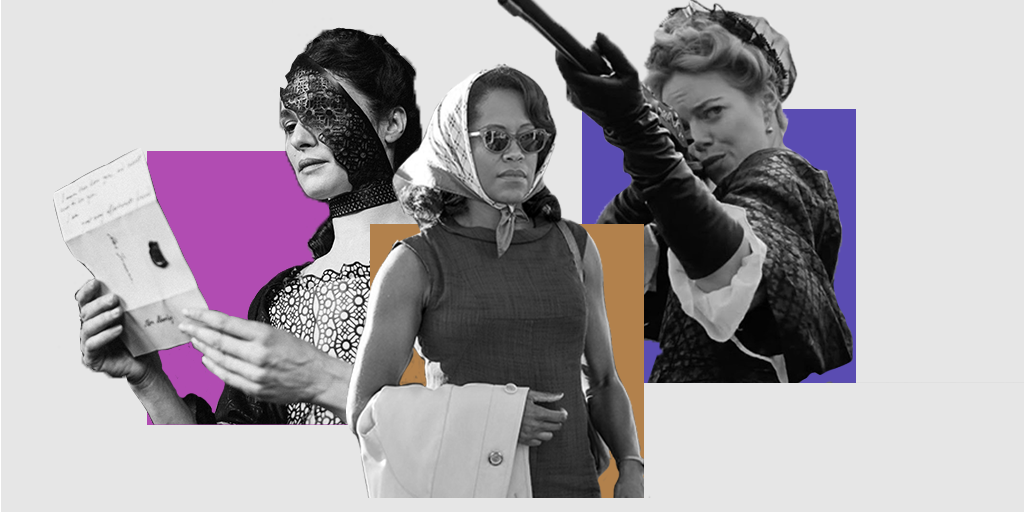
    Best Supporting Actress has a frontrunner in Regina King, but there’s a good chance she is upset by Rachel Weisz or even Marina de Tavira.

    Best Supporting Actress is possibly the trickiest category to predict at the Oscars this year.

    Here are my current rankings:

    1. Regina King (If Beale Street Could Talk) — Golden Globe, Critics Choice
    2. Amy Adams (Vice)
    3. Rachel Weisz (The Favourite)
    4. Marina de Tavira (Roma)
    5. Emma Stone (The Favourite)

    Check out all our 2019 Oscar Predictions: Best Picture | Best Actor | Best ActressBest Supporting Actor | Best Supporting Actress

    Despite winning nearly every critics’ group prize — including the OFCS, the group I’m a part of — Regina King isn’t the surefire frontrunner she should be for her warm and emotional performance in If Beale Street Could Talk.

    That’s because she missed a nomination at the BAFTAs and the Screen Actors Guild Awards. For context, that last winner of Best Supporting Actress that didn’t at least get a nomination at the SAG Awards was 2000 when Marcia Gay Harden won the Oscar for Pollack.

    You have to go back to 2007 for the last time the winner of this category didn’t also win the Oscar — that year, Ruby Dee won the SAG for American Gangster and Tilda Swinton won the Oscar for Michael Clayton.

    King has to worry about that first statistic more than the second since this year’s winner of the SAG Award was Emily Blunt for A Quiet Place, who wasn’t even nominated at the Oscars.

    best supporting actress
    Regina King is the frontrunner for Best Supporting Actress for IF BEALE STREET COULD TALK

    The fact that one of her fellow Oscar nominees didn’t win will help her. Especially, Amy Adams for her performance as Lynne Cheney in Vice and Rachel Weiss for her performance in The Favourite — both of whom are her biggest competition.

    Adams, with her six nominations, could become the living actor with the most Oscar nominations without a win if Glenn Close finally wins on her seventh nomination in Best Actress, as expected. Her overdue narrative can push her to a win. The problem, though, is that her performance isn’t nearly as well received as her other nominations and ultimately takes a backseat to Christian Bale’s transformative performance as Dick Cheney.

    Who might really be the favorite is Rachel Weisz. This year has eerily followed the 2015 Best Supporting Actor race where Sylvester Stallone was the frontrunner — winning the Golden Globe and being snubbed by SAG (which is won by non-Oscar nominee Idris Elba) and BAFTA just like King — to lose the Oscar to the BAFTA winner, Mark Rylance.

    Whoever wins the BAFTA could be the actual frontrunner for Best Supporting Actress. However, watchout for an outside chance that Marina de Tavira turns her surprise nomination into a surprise win if Roma ends up sweeping on Oscar Sunday.