
Tag: Mind-Bending

  • ‘Synchronic’ is what I love about science fiction | movie review

    ‘Synchronic’ is what I love about science fiction | movie review

    After discovering a drug sends you back in time, a paramedic uses it to help his best friend find his daughter in Synchronic


    Synchronic has a fun enough concept to keep you hooked, but Aaron Moorhead and Justin Benson—along with a stellar performance by Anthony Mackie—add in their effortlessly charming direction to make it the exact kind of science fiction romp that I crave even if it doesn’t quite stick the landing.

    Aaron Moorhead and Justin Benson are perhaps one of the most underrated indie filmmaking duos working today. Their specific brand of high-concept but endearingly down-to-earth science fiction storytelling has brought us great films like The Endless, Resolution and Spring. However, so much of what makes them successful is their low-fi approach to sci-fi. Partially from choice, but mostly because of their budgetary constraints. It forces them to be more clever with their directorial choices and storytelling.

    However, with Synchronic, their biggest step forward into the mainstream, they have the resources to go all the way with their concept of a drug that makes its user travel through time—complete with high production values and two A-list stars above the title. And in some ways, it removes the charm that has made them so successful up to this point. However, in others, it removes the restrictions that would have prevented them from going full tilt otherwise. The results are decisively mixed.


    ADVERTISEMENT


    The first thirty minutes of the film, though, represent the best of the duo. We’re immediately dropped into a mystery where two paramedics, Steve (Anthony Mackie) and Dennis (Jamie Dornan), begin to encounter increasingly odd calls. In one, a man was impaled by a sword that looks to be from the 1600s. In another, a woman was bitten by a snake that hasn’t been seen in the area for a decades—maybe more. The only thing they have in common is in both cases the victims were high on a drug called “Synchronic.”

    The story, moving swiftly between scenes showing the drug’s unique effects—the duo also edited the film, quickly sets up that Steve and Dennis have been friends for since high school and know more about each other than anyone else. They’re so close, in fact, that when Steve finds out he has a brain tumor that will likely kill him with in months, his first reaction is to figure out how to tell his family—in this case, Dennis.
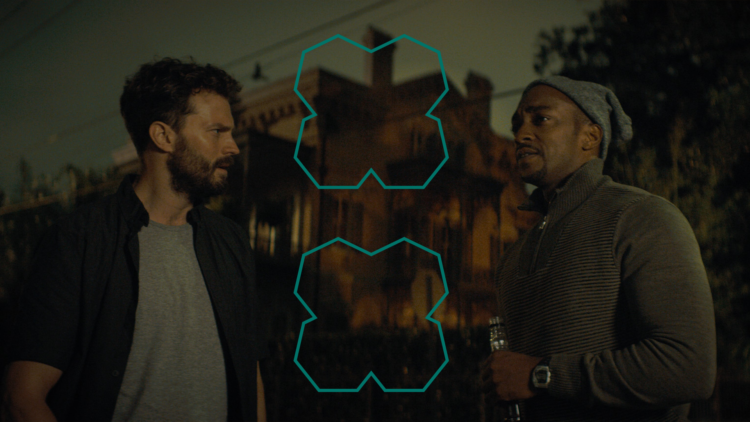
    Synchronic movie
    Jamie Dornan and Anthony Mackie in Synchronic. Courtesy of Well Go USA Entertainment.

    Though gorgeously atmospheric through Moorhead’s moody cinematography and Jimmy LaValle’s synth-heavy score, almost verging on horror, Synchronic maintains an immensely watchable tone. Moorhead and Benson’s signature dark humor is embedded just beneath the surface and Mackie handles it with ease. His emotional turmoil from his diagnosis coupled with his newfound interest in the source of “synchronic” is a masterclass in showing instead telling.

    The duo’s entanglement with the drug gets even more complicated when Dennis’ teenage daughter Brianna (Ally Ioannides) goes missing after taking “synchronic.” With nothing to lose, Steve buys all the remaining supplies of the drug and learns from the creator that it shifts time for the user, but only with specific parameters. The rest of the movie is structured as a series of experiments where Steve attempts to understand how it works in the hopes that he can use it to save Brianna from whatever time she has become stuck in.


    ADVERTISEMENT


    Steve’s exploits with “synchronic,” that are presented as a series of taped experiments, are exactly what I love about science fiction. What Moorhead and Benson excel at is taking a concept—one that we may have thought of ourselves—and exploring it, not as a high-concept, but instead as a simple romp based on “what-ifs.” And the world that they build in Synchronic is ripe for multiple fun excursions.

    Unfortunately, the movie never takes it as far as you want it. It comes close. Steve’s brush with the indigenous people of the New Orleans swamps or the early 20th century when people probably weren’t as keen on a Black man appearing out of nowhere in their yard are interesting applications of the possibilities. But when the story looks to wrap up, it retracts and becomes small again. I almost wish 30 minutes was added on to the running time just so we could watch Steve play in the possibilities.

    The final act is really where Synchronic falters. It hits the correct beats, but doesn’t add enough tension or suspense—something that Moorehead and Benson excel at in the first third. However, their careful character mapping and emotional arcs payoff—again thanks to Mackie’s awards-worthy performance. Even so, Synchronic is the exact kind of science fiction I love—eerie, entertaining, complex but full of humanity.


    ADVERTISEMENT


    More movies, less problems


    Hey! I’m Karl. You can find me on Twitter and Letterboxd. I’m also a Tomatometer-approved critic.

    💌 Sign up for our weekly email newsletter with movie recommendations available to stream.


    ADVERTISEMENT

    💌 Sign up for our weekly email newsletter with movie recommendations available to stream.


    ADVERTISEMENT

  • ‘Ad Astra’ uses space travel as therapy | movie review

    ‘Ad Astra’ uses space travel as therapy | movie review

    Ad Astra follows an astronaut as he goes on an interstellar mission to undo the effects of his father’s failed mission 30 years earlier.

    Quick cut review: Ad Astra isn’t the thrilling space adventure it’s being marketed as — for good reason — and is instead a deepl moving meditation on emotional repression and the traumas that shape our lives.

    Science fiction is one of my favorite genres because the further you get from Earth and from what you know and understand to be true about our world, the more you have to grapple with your own humanity and the baggage that goes along with it. The best sci-fi movies understand that.

    Arrival is a meditation on grief. Interstellar explores the limitations — or lack thereof — of human connection. Blade Runner questions the very fabric of our humanity. However, none of those movies are quite as idiosyncratic as James Gray’s magnificent Ad Astra. If anything, this film has more in common with Apocolypse Now or The Tree of Life than any other sci-fi movie we’ve seen since 2001: A Space Odyssey.

    It’s the near future and space travel is as common as flying across the country — complete with overpriced snacks offered by the flight attendants. Major Roy McBride (Brad Pitt), a seasoned veteran of the United States Armed Forces branch operating in Space, has the remarkable ability to stay calm under the most stressful of circumstances. Not just calm, it’s noted that he never lets his heart rate rise above 80 BPM. When he’s thrown off an impossibly high structure jutting into space by an unexplained electrical pulse in the thrilling opening scene he never panics. Even as he tumbles to Earth disoriented and rained on with debris. 

    And as much as that’s an asset to his job, it’s a hindrance to most other parts of his life. His estranged wife Eve (Liv Tyler) — who we see in short flashes — cites his distance — both physical and emotional — as the main reason for their strained relationship. It’s fitting then that “ad astra” translates to “to the stars.” That’s where Roy finds his calm and where he escapes the milieu of life.

    After that mission, he’s informed by his superiors that the electrical pulse that nearly killed him is one of many — and they’re getting worse. They believe that they’re being caused by a past mission called “The Lima Project,” which his father Clifford (Tommy Lee Jones) commanded twenty-six years prior with the goal of finding extraterrestrial life. However, the mission ended in failure and none of the crew, including Clifford, were never heard from again.

    Though, for reasons unknown, Roy’s superiors believe that Clifford is still alive on the “Lima Project” base and may be able to stop the power surges before they destroy the entire solar system. However, the base has been unresponsive. So, they task Roy with venturing to the Moon and then Mars to relay a message to his father. 

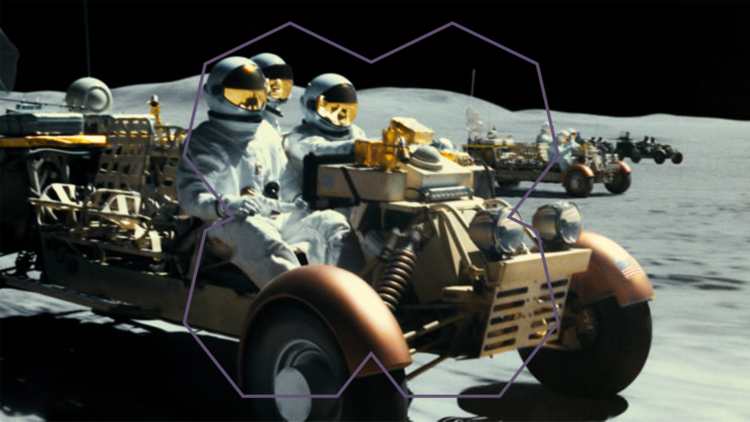
    James Gray’s Ad Astra. Credit: Twentieth Century Fox.

    Along the way, Roy encounters different situations and people — including his father’s old associate (Donald Sutherland) and the director of the Mars base (a terrific Ruth Negga) — that challenges his belief in emotional repression. The entire movie is essentially through Roy’s internal monologue, giving us an almost procedural view of each event — even when they’re as exciting as fighting moon pirates and laboratory baboons. 

    However, it makes sense because Roy is so confused, conflicted, and frightened by emotions — particularly his own — that he’s robotic in his perceptions and actions. At one point he says, “we’re here and then we’re gone.” It’s that nihilistic world view that puts him at odds with most people around him.

    Admittedly, I watched Ad Astra at a particularly difficult time in my life where I’m dealing with the repercussions of being emotionally distant, which is why the movie was so impactful on me — as is the case with movies that are more meditations than narratives. I’ve always struggled to face the difficulties weighing me down, often opting to avoid them. If you don’t face them, you don’t have to be hurt by them.

    What Ad Astra presupposes is to heal the hurt in your life you have to lean further into them and eventually through them, as hard as that is. In one of the most stunning sequences of the film, Roy is in the middle of a two-month journey from Mars to Neptune. As he tolls the days away around the ship, his voice-over repeats “I am alone, I am selfish,” two phrases I’m incredibly familiar with — especially when I finally give in to my feelings.

    And as exciting as the movie gets, the plot is really a red herring to what Gray is truly trying to get at. There are well-choreographed action setpieces, scenes of pure terror and tension, however, it’s the moments when Roy has to deal with his own internal struggle that the movie makes the most sense. Actually, the movie almost makes no sense plotwise, but that’s not the point. 

    That will frustrate audiences. Especially since 20th Century Fox is marketing it as a movie closer to Gravity or The Martian. And if you separate the plot from the more meditative elements, you do have one of those movies. But Ad Astra has more on its mind. James Gray has more on his mind. And Pitt, better than he has been in years, understands that. 

    Grappling with your self is so difficult. It takes so much work to accept the things that shaped you — the people and events that made you who you are. The movie faces those things head-on. That’s why for me and Roy space travel is a form of therapy. For him, the act of getting further from Earth and closer to the source of his pain is a way to finally get over it. For me, it’s a guide of what to do to get better. In that way, Ad Astra is a wakeup call more than it is a movie. 


    ADVERTISEMENT


    More movies, less problems


    Hey! I’m Karl. You can find me on Twitter and Letterboxd. I’m also a Tomatometer-approved critic.

    💌 Sign up for our weekly email newsletter with movie recommendations available to stream.


    ADVERTISEMENT


    💌 Sign up for our weekly email newsletter with movie recommendations available to stream.


    ADVERTISEMENT