Tag: Natalie Portman

  • Natalie Portman and Julianne spar in high camp melodrama ‘May December’ | review and analysis

    Natalie Portman and Julianne spar in high camp melodrama ‘May December’ | review and analysis

    NYFF 2023 | May December follows an actress (Natalie Portman) as she prepares to play a notorious tabloid figure (Julianne Moore) by shadowing her dredging up old wounds


    May December begins with Julianne Moore dramatically opening a refrigerator door, while a dissonant chord strums and the camera locks into a closeup, and deadpan delivers the line, “I don’t think we’re going to have enough hot dogs.” While it is a high camp melodrama filled with a cast of near-absurd characters, at its heart it’s a complex exploration of trauma, exploitation, and how all “grown-ups” are just children pretending to be adults. With Oscar winners Julianne Moore and Natalie Portman squaring off as dueling narcissists and Charles Melton giving a star-is-born performance, May December is one of the year’s best.

    May December had its North American premiere at the 2023 New York Film Festival.

    Right before the title card for director Todd Haynes‘ new film May December smash cuts onto the screen, Gracie Atherton-Yoo (Julianne Moore) swings open a refrigerator door. As the camera closes in on her face and a dissonant chord strums, she dramatically delivers the line, “I don’t think we’re going to have enough hot dogs.” From then on, it’s impossible not to be transfixed by the high camp of this melodrama.

    And there’s so much devilishly delightful sparing between Gracie and actress Elizabeth Berry (Natalie Portman), who visits Gracie’s Georgia home to prepare to play her in an upcoming movie, that it’s surprising when the movie hits you with a flurry of complex emotions. Screenwriter Samy Burch, who marked her first appearance on the promotional circuit at the 2023 New York Film Festival, said of her screenplay, “I really like the tonal mix of humor and real, genuine sadness and heartbreak.” It’s that exact melange of the darkly comedic melodrama and the deeply felt character study that make May December a satisfying — and deeply odd — romp.


    ADVERTISEMENT


    The reason Gracie’s life warrants a movie is her notorious highly-publicized tabloid romance with her now husband Joe (Charles Melton) that swept the nation in the 90s. You see, Gracie and Joe started dating when she was 36-years-old and he was just thirteen-years-old. Twenty years later, the pair still receive their fair of attention — often of the fecal variety — as they live a quiet existence in their Savannah, Georgia seaside home. That is, until Elizabeth arrives.

    Portman plays Elizabeth, who from what we can gather is best-known for her performance on a Grey’s Anatomy-type show, with a satirical edge — perhaps chiding her own star persona (or at the very least her iconic accent from her performance in Jackie). She probes Gracie’s life like a psychologist analyzing her patient or a serial killer their prey. She observes her mannerisms, dissects every decision she makes, even copies her makeup routine in a scene that edges on Persona-esque horror — a clear inspiration.

    As she observes more people in Gracie’s orbit, we uncover the ripple effects of her crimes that she went to prison for as we see in hilariously accurate tabloid covers (“Pregnant in Prison!”). Her ex-husband Tom (D.W. Moffat) swears he’s over all of it before snapping as he starts to recall the incident, Gracie and Tom’s son Georgie (Cory Michael Smith) — yup, his name is Georgie — is a man-child who is the diva lead singer of a band that performs at a local pub, meanwhile the current manager of the pet shop where Gracie and Joe first met milks the publicity for everything it’s worth — even keeping a laminated copy of a newspaper article about the incident on the counter.


    ADVERTISEMENT


    The cast of characters border on absurd almost becoming caricature, but Haynes keeps the film grounded in some reality despite the camp hijinks. However, Elizabeth isn’t some innocent voyeur. When she finds herself in the notorious storeroom where Gracie and Joe’s first sexual encounter took place she acts it out so convincingly you can’t tell whether she’s actually pleasuring herself. We’re always kept a distance from her true intentions, but at the very least we can infer that she’s not as afraid of exploiting the family for her own work as she says she is.

    However, Gracie isn’t as forthcoming with the truth as she thinks she is either. She’s almost dismissive of her past. “Everyone’s got skeletons in their closet,” she says as if she’s referring to a spat of unpaid parking tickets. Both women are unwilling to cede their true selves to the other. Burch’s screenplay doesn’t shy away from making Gracie and Elizabeth irredeemable. Something we don’t often get to see.

    And while there is legitimate fun to be had with the passive-aggressive meeting of two different breeds of narcissist, at the heart of May December is a sensitive character study of a man who was both asked to grow up too fast and not afforded the opportunity to. Melton, in a star-making Oscar-worthy performance, portrays Joe with a depth that makes you so sympathetic to his plight that it almost feels like whiplash compared to melodrama. While he starts off as the capable father or doting husband, when he begins interacting with Elizabeth — she herself is 36-years-old, the age that he met Gracie — we watch his body language revert to the 13-year-old boy in that pet store storage room.


    ADVERTISEMENT


    With hunched shoulders, his hands in his pockets, and mumbled replies, we see that through all these years Joe has just been putting on the air of an adult. In one of the most heartbreaking scenes, he smokes weed for the first time ever — surprising for a man in his late 30s — with his college-bound son (Gabriel Chung) and through sobs tells him of his hopes that he will live a happy life: “I don’t know if we’re connecting, or if I’m creating a bad memory for you.” In the subtext, he hopes that he won’t suffer the same traumas that he himself had to endure. It’s that incisive insight that makes the movie as compelling as it is entertaining.

    On the surface, May December shouldn’t work with its contrasting tones of dark comedy mixed with near-parody satirical elements and sentimental dramatics with complex human condition. However, it manages to find balance in way that allows you to enjoy it without letting you get too comfortable with the sensitive situation.

    In a climactic scene, Elizabeth tells a despondent Joe, “this is what grown-ups do.” However, what Burch’s screenplay presupposes is that the concept of a “grown-up” doesn’t actually exist. Regardless of age, people are not much more than their child-self reacting to the things in their present filtered through their past. Every character in the movie has been stunted in their coming-of-age in some way — perhaps because you never stop coming of age. We watch in real-time as Gracie tears into her own children with the gusto of Faye Dunaway in Mommie Dearest — perhaps its generational trauma or maybe she’s just a sociopath — meanwhile Joe is trying everything in his power to not let them suffer the same fate.

    The beauty of May December is that it doesn’t give its characters a melodramatic ending — again, keeping one step in the real-world. Dare I say, the movie comes to a close with some hope. Still, we’re treated to one last flash of glorious camp that sets it as one of the year’s best.


    ADVERTISEMENT


    More movies, less problems


    Hey! I’m Karl. You can find me on Twitter and Letterboxd. I’m also a Tomatometer-approved critic.

    💌 Sign up for our weekly email newsletter with movie recommendations available to stream.


    ADVERTISEMENT


  • ‘Thor: Love and Thunder’ leans into weirdness and queerness | movie review

    ‘Thor: Love and Thunder’ leans into weirdness and queerness | movie review

    In his fourth solo outing, Thor: Love and Thunder finds Thor and Valkyrie align with an unlikely new hero to take down a villain with a taste for revenge.

    Thor: Love and Thunder makes up for what it lacks in structure and narrative in charming oddball energy, maximal laughs-per-minute, and a cast that is game for anything. Director Taika Waititi, returning after a very successful entry in Thor: Ragnorok, throws everything but the kitchen sink into the movie—for both better and worse. Sometimes the emotional beats are betrayed by the comedic tone and vice-versa, but when the movie gets it right—like in the riotous but stirring reveal of The Mighty Thor—it’s perfection.

    Thor: Love and Thunder might be more of a Taika Waititi movie than it is a Marvel Cinematic Universe movie. I mean, it’s colorful, gay, and has a running gag about screaming goats—it doesn’t get much more Waititi than that.

    While the most recent movies in Phase Four of the Marvel Cinematic Universe have to do much heavy-lifting in setting up the rest of the series, Thor: Love and Thunder stands on its own—even with the cameos.

    After all, the last time we saw Thor (Chris Hemsworth) was in Avengers: Endgame where he became one of the few main superhero holdovers from the original Avengers. Much time has passed and there is much to catch up on, which we see in a sleek and often-hilarious montage narrated by fan-favorite Korg (voiced by Waititi). Korg explains that Thor has been galavanting across the universe with the Guardians of the Galaxy “helping” various worlds with their problems. What the catch-up is meant to explain (other than how Thor dropped all his Endgame weight) is how Thor has become a bit more of a bohemian narcissist as he’s searched for meaning after helping defeat Thanos.


    ADVERTISEMENT


    Another thing Phase Four has had in common is the use of cameos to draw audiences in (I’m looking at your Spider-Man: No Way Home). And while the move can sometimes come off as cumbersome pandering, the Guardians’ (Chris Pratt, Pom Klementieff, Karen Gillan, Vin Diesel, Bradley Cooper, Sean Gunn, Dave Bautista) appearance feels slight enough to not detract from the movie. Were they completely necessary? Probably not. But they were a welcome sight.

    Eventually, following a distress message from Sif (Jamie Alexander reprising her role), Thor learns that Gorr the God Butcher (Christian Bale under heavy makeup) has been going from planet to planet murdering Gods. In the movie’s cold open, we see Gorr lose his daughter after he’s slighted by the God he worshipped spurring his journey of revenge. More importantly, Sif reveals that New Asgaard is next.

    The Sif scene is the perfect example of Waititi maintaining his comedic tone while still delivering on narrative. Sif asks Thor to let her die following a battle with Gorr so that she can go to Valhalla. An apologetic Thor informs her that she actually needs to die in the battle to go to Valhalla, but quips in the movie’s funniest one-liner that maybe her missing arm made it to Valhalla.

    Thor rushes back to the settlement of Asgardians where leader King Valkyrie (Tessa Thompson) is battling with the shadow creatures sent by Gorr. In yet another scene of Waititi’s ingenuity, we are treated to an epic battle, introduced to The Mighty Thor, and see a hilarious montage of how Thor and his one true love Jane Foster’s (Natalie Portman) relationship crumbled under the weight of both of their duties—Thor’s to the Avengers and Jane’s to her research.

    We learn that Jane, who is suffering from cancer, was called to Thor’s destroyed hammer Mjölnir. When she got to the hammer, it repaired and gifted itself to Jane in an attempt to save her. Now, as The Mighty Thor, she vows to help Thor and Valkyrie defeat Gorr who kidnaps New Asgard’s children to a mysterious land called the shadow realm.


    ADVERTISEMENT


    Thor and Jane’s relationship acts as the emotional anchor for the movie through all its absurdness. However, as often as the tonal balance between humor, thrills, and drama works—it doesn’t.

    The journey to the shadow realm takes our heroic quartet to Omnipotence City, a haven for the gods, where they hope to drum up support in their battle against Gorr. Specifically, they want to get the help of Zeus (Russell Crowe in a hilarious extended cameo). Unfortunately, Zeus is more interested in showing off with his lightning bolt for the other gods and, oh yeah, the orgy scheduled for later in the day.

    The riortous scene is comedy gold (pun intended) where we get to see just how far Marvel is willing to let Waititi go (we go as far as seeing Chris Hemsworth’s golden buns). We’re also treated to Valkyrie queering it up—and bopping to Mary J. Blige’s “Family Affair”—a gold-splashed action scene, and, of course, screaming goats. It’s a highlight scene.

    On the action side, a battle in the “shadow realm” is presented almost completely in black-and-white in one of the most thrilling creative decisions I’ve seen in a Marvel in quite some time. The scene is almost pure horror, but because of the tone up until that point it’s difficult to feel the stakes. While Bale is completely committed to the role of Gorr—and is often terrifying—you never truly feel he’s dangerous.

    That’s why when the movie works best when it focuses on just the characters.

    With Tessa Thompson’s Valkyrie, a history lesson on Korg’s people, and Chris Hemsworth’s peach, Love and Thunder is easily the queerest MCU movie yet.

    Still, it was a low bar. In the first three phases of the MCU, it seemed that LGBTQ+ people did not exist despite romance and sexuality being front and center. I mean, one of the first few scenes of Iron Man was Tony Stark sleeping with a female reporter. Queer representation in the MCU has only now started to settle in with characters like Phastos in Eternals and now Thompson’s Valkyrie and Waititi Korg in the Thor franchise wearing their queerness unapologetically. The result? A more colorful movie, both literally and figuratively.


    ADVERTISEMENT


    The dimension that it adds to a character like Valkyrie helps elevate the movie to a more profound plane in the same way that Thor and Jane’s past gives us an emotional investment in their narrative. Instead of being heroes of perfection, they themselves have trauma that drives them forward—or hold them back. Waititi’s grasp of tone and narrative in those scenes is perfection—much like his underrated gem Hunt for the Wilderpeople. It’s when he has to dig back into the MCU formula that the movie loses its color.

    It’s clear that the best way for the MCU to move forward is to give its directors full creative control over their movies from screenplay to direction.

    Much of Thor: Love and Thunder feels like MCU mastermind Kevin Feige handing Taika Waititi a blank check and a script and saying, “go,” much like Doctor Strange in the Multiverse of Madness felt like it had Sam Raimi’s DNA in it. However, these two movies in addition to Chloé Zhao’s Eternals show that unless Marvel truly allows these directors to completely run away with their movies—story and all—it’s difficult to meld the two visions. Of those three movies, I think Love and Thunder might be the least successful because Waititi had the more difficult balancing act. He was making a comedy. All the while, Disney needed him to deliver a popcorn blockbuster and Marvel needed him to deliver on storylines familiar to comic readers. He mostly succeeds. It’s clunky, the pacing is off, but I can’t deny that I laughed nearly every second of screentime.


    ADVERTISEMENT


    More movies, less problems


    Hey! I’m Karl. You can find me on Twitter and Letterboxd. I’m also a Tomatometer-approved critic.

    💌 Sign up for our weekly email newsletter with movie recommendations available to stream.


    ADVERTISEMENT


  • ‘Vox Lux’ review — A hollow pop musical drama

    ‘Vox Lux’ review — A hollow pop musical drama

    Vox Lux has an interesting story and visuals, but its lack of focus and uneven characters leave it little more than a hollow pop musical drama.

    Where to watch Vox Lux: Streaming on Hulu. Available to buy or rent on Prime Video.

    Vox Lux has too many ideas it’s trying to grapple with that it ends up not having any ideas. In a year where musical dramas A Star is Born and Bohemian Rhapsody topped the box office and awards conversation, Vox Lux had to do a lot to stand out. And it definitely does from those two other movies—for the wrong reasons

    Actor turned director Brady Corbet—Vox Lux is his second feature after The Childhood of a Leader—begins the movie tackling the very real issue of mass shooting in the United States. Celeste Montgomery (played as a teen by Raffey Cassidy) is sitting in her music class when a fellow student brandishing a gun barges in and shoots their teacher.

    Celeste tries to reason with him to no avail. And he shoots everyone in the classroom. She’s injured, but alive. Slowly recovers from a spinal injury and sings at the memorial for the victims. From there, as told by a voiceover by Willem Dafoe, Celeste is thrown into a whirlwind and we watch her grow into a full-blown pop star—with the help of her manager (Jude Law) and publicist (Jennifer Ehle).

    This first “act” has some pacing issues and Cassidy can’t seem to commit to a character choice—she alternates from shy and reserved to motivated and mature. It feels like a lot of the inconsistency comes from the movie’s attempt to lead us to act two Celeste, played by Natalie Portman—trying to continue her winning streak following Jackie and Annihilation.

    Some fifteen years later, Celeste is a pop star making her comeback. After years of partying and getting into trouble, it seems that she is both done with her public life and conceding to it. The movie tries to comment on the nature of being a celebrity, but its focus on politics, the social environment, and other issues of the day—there are interludes into 9/11 and social media and press—it never quite gets there.

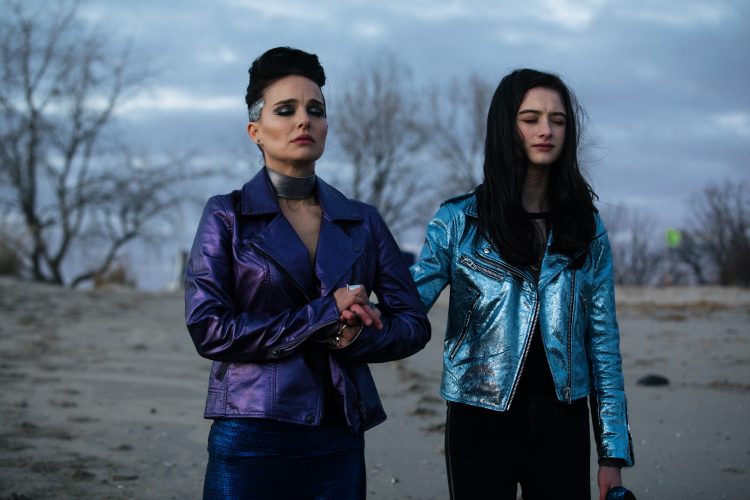
    Vox Lux
    Natalie Portman and Raffey Cassidy in Vox Lux

    Vox Lux’s main issue is that it feels like it starts every scene with “in this day and age,” and at some points characters even say that. It does so much to be “woke” and cultured that at some points it feels like it’s doing it to be relevant.

    It’s unfortunate considering there is a place among the Bohemian Rhapsody’s and A Star is Born’s of the world. It doesn’t have the magic or romance of either of those movies. Vox Lux is about the cold realities of life—it’s almost nihilistic. It would have been interesting to explore stardom from that angle. But the movie has other preoccupations.

    Those preoccupations are also why Portman’s portrayal of Celeste feels so disconnected from Cassidy’s. Portman’s version is tired of the world and wants to make sure the world knows it. It would have worked if the first act built to that, but it doesn’t.

    Vox Lux has an interesting enough story with a unique perspective, but Corbet’s screenplay really lets the movie down. He’s an interesting director, but without someone to rein his ideas in the movie becomes a bit of a mess.

    There are moments of clarity. Specifically in Celeste’s relationship with her older sister Ellie (Stacy Martin) and her daughter (also played by Cassidy), but because of the other ideas, those plotlines are underbaked. Just give A Star is Born another go instead.


    ADVERTISEMENT


    More movies, less problems


    Hey! I’m Karl. You can find me on Twitter and Letterboxd. I’m also a Tomatometer-approved critic.

    💌 Sign up for our weekly email newsletter with movie recommendations available to stream.


    ADVERTISEMENT


  • ‘Annihilation’ review — Science fiction that will make your skin crawl

    ‘Annihilation’ review — Science fiction that will make your skin crawl

    Annihilation is equal parts beautiful, terrifying, and intellectual while also including an emotional truth about what it means to be human.

    High-minded sci-fi has defined the late 2010s with entries like Arrival and Blade Runner 2049 defining the period. Another film that could be included in that group is Alex Garland’s Ex Machina. Garland explored extremely human topics by framing it in something not human. So, he seemed like the perfect fit to be tackling Jeff VanderMeer’s Annihilation a novel that I loved. What I loved about it is it poses more questions than it offers answers. And while Garland’s adaptation certainly seems to offer more answers, he grounds the sci-fi in another exploration of what it is to be human. That’s not to say that this film is straightforward or easy-to-digest. It’s quite the opposite actually. Annihilation feels like an assault on the senses without going over-the-top with its style. To call it engrossing would be an understatement.

    While I loved the novel, the film doesn’t follow it except for its basic premise. Most sequences that occur in the book don’t appear in the film. But I think that it’s for the better. Garland takes the Southern Reach and Area X and uses them to explore different ideas. It’s a thrilling discovery for book readers unless you live by the novel. What Garland carries over from the novel is the atmosphere. Area X, an ever-expanding bubble bordered off by something called “the shimmer,” is a mysterious and disorienting place that challenges almost all of our scientific beliefs. The film is unsettling the same way that The Blair Witch Project is. Annihilation infringes on your comfort zone and makes you feel disoriented the second the characters step into Area X.

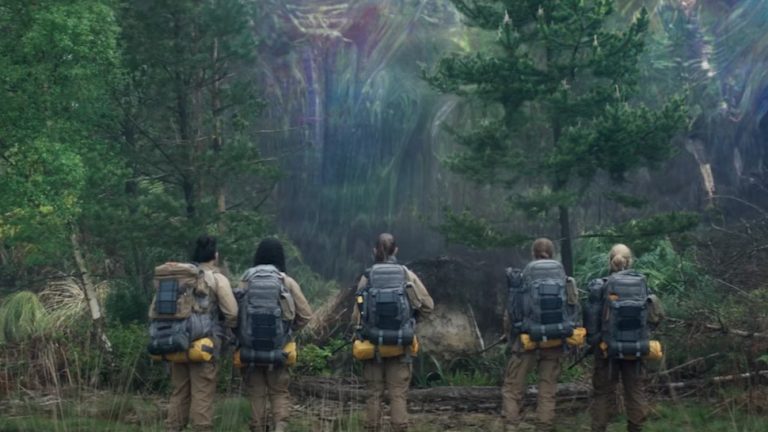
    But before all that happens, we see a meteor-like object strike a lighthouse on the Gulf Coast before cutting to Lena (Natalie Portman), a professor of biology who seems like a shell of a person as she mourns her husband, Kane (Oscar Isaac), who went missing on a mysterious mission a year prior. However, one day, he shows up. But it’s clear that the man that returned to her is not the man that left her. He is confused, unsure of how he got there or where he’s been, then his organs begin to fail. On route to the hospital, the ambulance is forced to stop by a squad of black SUVs that take Kane and Lena to a facility called the Southern Reach. Lena wakes up in a cell with Dr. Ventress (Jennifer Jason Leigh), a psychologist. Ventress explains that the Southern Reach has sent dozens of research teams into Area X and have never heard back from any of them, that is until Kane reappeared. Lena learns that her husband was a part of one of these teams and is the first person to return from across the shimmer. Eventually, seeking answers to help her husband, Lena decides to enter The Shimmer along with Dr. Ventress, paramedic Anya (Gina Rodriguez), physicist Josie (Tess Thompson, fresh off of Thor: Ragnarok), and anthropologist Cass (Tuva Novotny). It would be an understatement to say what happens beyond The Shimmer is extraordinary.

    The set-up and much of the story is told in fragmented scenes that give us some information, but end up raising more questions. It makes sense, though. The story is framed by Lena’s interrogation following her return from Area X — it’s revealed almost at the beginning of the film, as are the fates of every character. That’s just a testament to what Garland was able to do. Despite knowing the outcome, Annihilation is never less tense or horrifying. That doesn’t mean that it leans heavily on gore or horror movie logic. In fact, it’s quite the opposite. The movie is heady and cerebral. The same can be said for the thrills and action. Every image and moment feels calculated. The movie gets under your skin.

    Much of the film follows how you’d expect a movie about an exploration into an alien world to go. Each character is picked off one by one. But even the circumstances around their demises remain mysterious. That’s what separates it from Alien and other films that came after it. Even each death feels like another piece of the complex puzzle of Area X and the film itself. In that way, it feels more similar to Arrival or 2015’s Coherence. It’s as concerned with the emotional implications of the plot as it is the science. At one point, Cass tells Lena that all the women — it’s refreshing that all the people on the expedition being women is not a major plot point — have experienced some type of loss or are on some type of path of self-destruction. By the mind-bending final scenes, you understand why this discussion is so important.

    There has been a lot of talk about how Paramount essentially dropped all hope of Annihilation having a theatrical life from the moment producer Scott Rudin refused to “dumb down” the film. After watching it, I understand why. Though the design and thrills of Area X are impeccable, the true beauty of the film lies beneath. And it’s a beauty that you have to work for. Unfortunately, modern movie audiences aren’t ready for that type of sci-fi. Arrival and Interstellar may be the two examples of intellectual sci-fi surviving in this age of blockbusters. However, Annihilation is a film that has to be experienced on the big screen. There’s too much nuance to be affected by it on Netflix.

    A lot of that nuance comes from the cast. After giving the best performance of her career in Jackie, Natalie Portman gives perhaps the second best performance in this film. Playing a seven-year army vet and biology professor as both strong and vulnerable is a task that few actors could succeed in. On top of that, the character’s emotional journey is explored almost silently, particularly in the last 15 minutes. Without her, the impact wouldn’t be as strong. The same could be said for the set design by Mark Digby. His realization of Area X and all its oddities are equal parts beautiful and unsettling. As are the creatures that they encounter. The film is impeccably designed. The score also stands out — “The Alien” may be one of the most terrifying pieces I’ve ever heard in a film.

    Annihilation is complex, terrifying, engrossing, and beautiful, but above all, it feels completely unique. While the actual design and direction are unique, the themes it deals with and the way it comes to terms with those themes are what really sets it apart. It taps on a human process that we are too afraid to confront — our mortality and self-destruction. However, that is even a simplistic way to describe the themes. It’s truly a movie that has to be experienced and experienced on the biggest screen possible. It envelops you, gets under your skin, and stays with you long after it ends. Annihilation has monsters, but it exposes that the biggest monster of all is our own humanity.

    ★★★★½ out of five