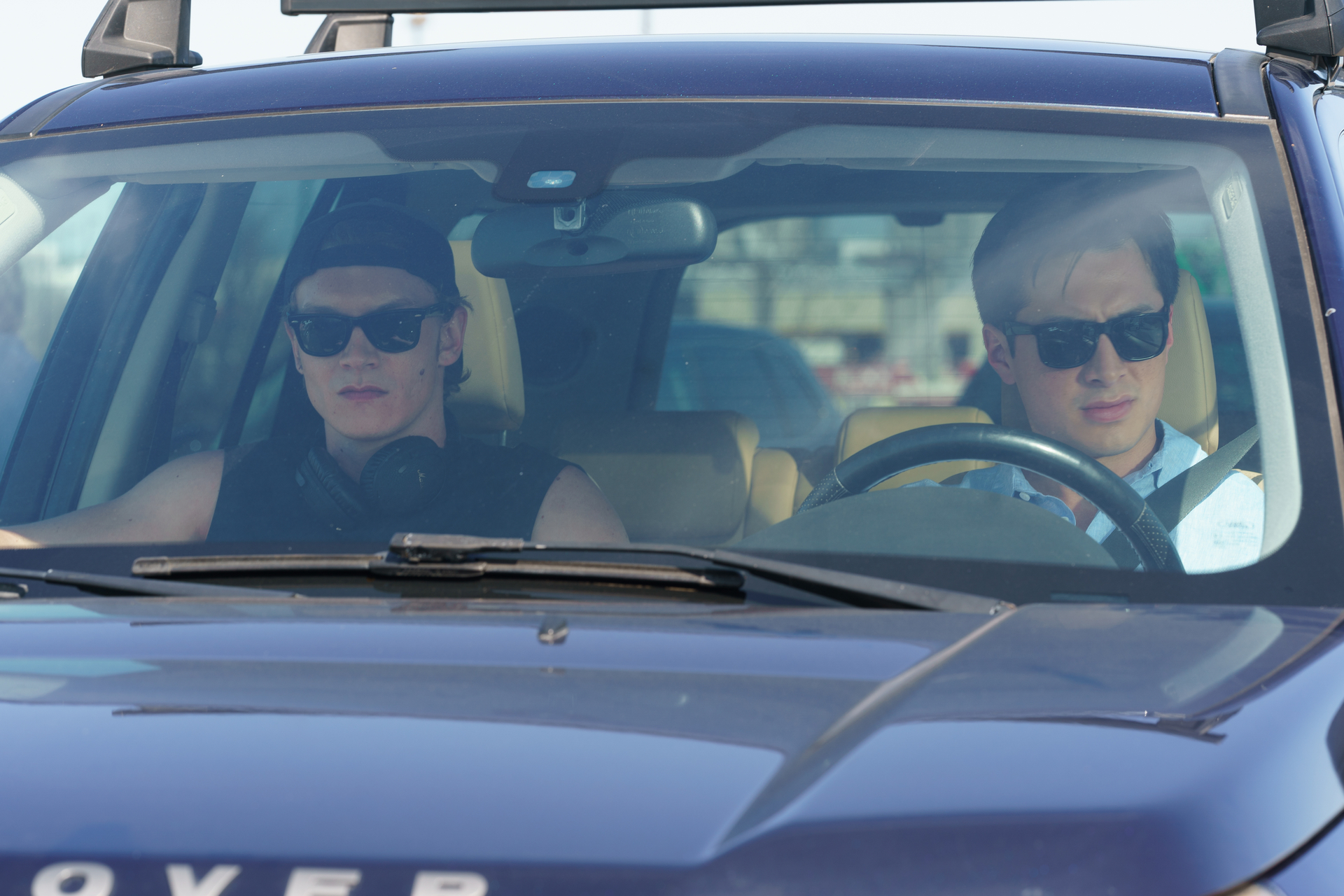
Tag: Nick Offerman

  • Surreal dramedy The Life of Chuck ponders life and death | TIFF 2024

    Surreal dramedy The Life of Chuck ponders life and death | TIFF 2024

    TIFF 2024 | The Life of Chuck follows an enigmatic man starting as a surrealist meditation on existential dread and ending as a life-affirming portrait of youth.


    The Life of Chuck is a dramedy that ponders existential dread through surreal comedy (and a dance number!). A philosophical pondering of the moments that add up to a life set against the temporariness of it all. Airy, abstract but entertaining, it may be polarizing but will deeply move many.

    The Life of Chuck premiered at the 2024 Toronto International Film Festival. It is seeking distribution.


    At the beginning of The Life of Chuck we learn California has sunk into the sea, Florida is underwater and the internet has gone out (maybe for good). But somehow the most inexplicable occurrence in the small town where teacher Marty Anderson (Chiwetel Ejiofor) lives is a billboard that’s seemingly appeared out of thin air with the words “Charles Krantz. 39 great years. Thanks Chuck!” scrawled across it and the photo of a clean cut bespectacled man behind a desk. It begs the question from the townsfolk: who the hell is Chuck?


    ADVERTISEMENT


    Unfolding in three distinct acts, The Life of Chuck is a time and universe hopping story about, well, the life of Chuck based on a short story in Stephen King’s novella collection If It Bleeds. However, in the first act—labeled as “Act 3”—we have no clue who he is. As the world around Marty slowly falls more and more into disarray, he remarks that both marriages and divorces are up. It’s partially what spurs his ex-wife Felicia (Karen Gillan) to call him up amidst the quiet chaos of the end of the world. They talk about whether more people are getting married or divorced in the face of their demise and how in the concept of the Cosmic Calendar by Carl Sagan that explained if the existence of the universe were conceptualized as a single year, humans would occupy just the last few minutes of December 31st.

    It’s the kind of existential pondering that the movie itself tussles with. What does it mean to exist? Does it matter when we occupy so little space and time? Why do advertisements thanking Chuck keep popping up? As the final moments of the world approach, and Marty and Felicia find comfort in each other, images of Chuck begin to appear in the window of every house on the street. Marty jokes that it’s the world’s final meme before blinking out completely and we careen into “Act 2.”


    ADVERTISEMENT


    When we finally meet Chuck (Tom Hiddleston), underscored by narration by Nick Offerman, he’s much more human than his larger-than-life portrayal in the first act. In fact, he’s the most human thing imaginable: an accountant. We also meet a busking street drummer (Taylor Gordon), who we learn recently dropped out of Julliard, as she sets up for the day playing at an outdoor mall and a young woman crying over a break-up (Annalise Basso). The trio all cross paths in front of where the drummer set up her kit for the day. Instead of walking past, Chuck starts to dance. 

    It’s one of those moments that feels like movie magic. The kind that puts a knot in your chest. Not because you understand the feeling, but because you don’t.

    The third part of the movie, labeled “Act 1,” brings us back to Chuck’s childhood. It pulls together all the threads of the story that have remained loose and unpacks the enigma that is chuck. From school dances to early losses to days living with his kooky grandfather (Mark Hamill). While the magical surrealism of the first two acts carries over in some ways, the story becomes grounded in something real. If Chuck was a mysterious otherworldly figure in act three and an enigmatic human in act two, then he’s simply Chuck (played by young actors Benjamin Pajak, Cody Flanagan and Jacob Tremblay) in act three.


    ADVERTISEMENT


    We follow him as he navigates loss, grief and, of course, the horrors of middle school as he discovers who he is. Where the first two acts were abstract and airy meditations, this one feels more trite—for better and worse. While the earnest lessons are admirable, I longed for the most obtuse meditation from the start of the movie that felts more like Charlie Kaufman (Eternal Sunshine of the Spotless Mind and I’m Thinking of Ending Things) or David Lynch (Mulholland Drive). Your mileage with where the story go will vary. But watching Chuck navigate the highs and lows of childhood is admittedly charming.

    The Life of Chuck is about how all the little moments where our lives intersect or divert or run parallel to others eventually lead to, in the case of Chuck, thirty-nine great years. It’s not the big moments or notable accomplishments, it’s the way your mom danced while making breakfast or that drummer you heard on a business trip or one of your grandfather’s ramblings. While it never feels quite as big as it should, that just might be Stephen King and Mike Flanagan’s point. 


    ADVERTISEMENT


    More movies, less problems


    Hey! I’m Karl. You can find me on Twitter and Letterboxd. I’m also a Tomatometer-approved critic.

    💌 Sign up for our weekly email newsletter with movie recommendations available to stream.


    ADVERTISEMENT

  • ‘Origin’ traverses time to investigate the roots of oppression | review

    ‘Origin’ traverses time to investigate the roots of oppression | review

    TIFF 2023 | Origin follows an author’s pursuit of the roots of oppression against the backdrop of her own personal struggles

    In adapting the nonfiction book Caste: The Origins of Our Discontents by Pulitzer Prizer winner Isabel Wilkerson, Ava DuVernay set out to unpack a complex topic that recontextualizes our conception of race and oppression that spans centuries and societies. It’s no small feat, especially for a book as well-researched and intellectual as Wilkerson’s. How does she tackle something this epic in scale? She shrinks it down to its smallest element: humans. Instead of following the idea, she follows Wilkerson’s journey (played by Aunjanue Ellis-Taylor) to understand it — from present-day Florida to the Jim Crow South to late 19th century India. But first, DuVernay wants us to understand Isabelle herself.


    ADVERTISEMENT


    Origin begins in the shadow of the murder of Trayvon Martin (Miles Frost), which DuVernay sensitively recreates through the chilling 911 call that stunned the nation. Like all of us, the story rocks Isabelle who is courted by a former colleague to write an article on the shooting. However, we see that Isabelle’s mind is elsewhere. Her mother (Emily Yancy) makes the decision to move into an assisted-living facility and while Isabelle’s husband Brett (Jon Bernthal) supports her, she feels guilt and regret. In these early scenes, we often see Isabelle framed against the sky (the film’s stunning cinematography is by Matthew J. Lloyd) like she’s floating untethered from the ground. She is at an impasse.

    That’s when the unthinkable happens. Losing her husband and mother in quick succession throws Isabelle into grief. Poetically translated onto the screen to helps us understand how an incident with a plumber (Nick Offerman) sporting a “Make American Great Again” hat throws her back into work. Using her grief and anger as a motivator, she’s dives head-first into her work trying to find answers to impossible questions. But that insatiable appetite for knowledge and eye for patterns is nothing short of gripping to watch. Like the greatest journalism movies — Spotlight, All the President’s Men — Origin moves with swiftness driven by an urgency to solve the mystery. However, unlike those movies the mystery is at the very core of our world.


    ADVERTISEMENT


    To help us fully understand Isabelle’s thoughts, we hear excerpts from Caste played over reenactments of three historical threads. In the first, we follow German man August (Finn Wittrock) and Jewish woman Irma (Victoria Pedretti), who defied rule in Nazi-era Germany. From there, we connect with a pair of Black anthropologists (Isha Blacker and Jasmine Cephas-Jones) who after witnessing the rise of the Nazi party in Germany embed themselves in the Jim Crow South to investigate the racial divide. Lastly, in an Eat, Pray, Love-like trip to India, Isabelle uncovers the caste system and subordination of the Dalit people.

    Each of these threads weave into a tapestry that form Isabelle’s argument: racism and oppression are not synonymous. Oppression exists with or without race. By analyzing each of these disparate systems of oppression, she supports her argument. Cycling between these asides, scenes from Isabelle’s past, and her present research, Origin pieces together a puzzle of our world and Isabelle’s place in it.


    ADVERTISEMENT


    For some, Origin may come off as pedantic. In communicating Wilkerson’s work for a broad audience, DuVernay over-explains herself. Taken as each individual element, the movie could feel more like an issues documentary than an effective narrative. But taken as a sum of its parts, Origin is a dazzling epic of large ideas and the smallness of those affected by them. Two moments emotionally drive the movie’s real purpose. In one, a small Black boy celebrating a win with his little league team is denied entry to a whites-only pool. Eventually, the lifeguard allows him to enter the pool on the condition he remains on a pool float and doesn’t touch the water. As his white teammates look on with confusion the lifeguard moves the boy around the pool on a float. Like the shots of Isabelle against the cast blue sky, the boy himself is floating in space. Untethered and unable to move unless moved.

    The second moment is the movie’s watershed moment — Ellis-Taylor’s most exhilarating moment as an actress. As Isabelle, thousands of miles away in India, speaks on the phone to her ailing cousin and confidant Marion (Niecy Nash-Betts in a stellar supporting turn) she asks her to “cover me.” For me, It invoked “I’ll Cover You,” a song from musical Rent where a character and his lover promise to protect each other. In that emotional conversation on distant two points on the globe, Isabelle finds her grounding. Origin, for all its sweeping thoughts, can be simply distilled to that one very human idea. Connection, to the past or our present, tethers us to our humanity. An experience that is as universal as the connection between two people.


    ADVERTISEMENT


    More movies, less problems


    Hey! I’m Karl. You can find me on Twitter and Letterboxd. I’m also a Tomatometer-approved critic.

    💌 Sign up for our weekly email newsletter with movie recommendations available to stream.


    ADVERTISEMENT