Tag: NYFF 2019

  • ‘Marriage Story’ NYFF review: Now processing heartbreak

    ‘Marriage Story’ NYFF review: Now processing heartbreak

    Marriage Story follows an actress and her director husband as they go through a messy bicoastal divorce.

    One-sentence review: Marriage Story is a heartbreaking but funny and entertaining sendup of marriage, divorce, and what it means to be a couple.

    Where to watch Marriage Story: Streaming on Netflix.

    I just went through a breakup. A five-year relationship that seemed to be endless gone in a single night. There’s so much sadness and anger and denial and grief. However, the overwhelming feeling is confusion. It’s not hyperbolic to say it feels like you’re going to die. Perhaps that is hyperbolic. At the very least, there’s a constant sense of dread. You ask yourself so many questions. Am I making the right decision for me? How about for him? Should I have fought harder? Is he going to be alright? Those are the things that are the hardest to process. I bring this up to give you context for why watching writer-director Noah Baumbach‘s latest film Marriage Story, which premiered at the 57th New York Film Festival, a wrenching and difficult but ultimately cathartic experience.

    The thesis of Marriage Story is delivered via two numbers from Stephen Sondheim’s classic musical Company. The first features Nicole (Scarlett Johansson) — along with her mother Sandra (Julie Hagerty) and sister Cassie (Merritt Weaver) — singing “You Could Drive a Person Crazy.” In the song, the three women that the perpetual bachelor main character Robert is seeing sing in an Andrews sisters-style number about his inability to commit.

    The second is Sandra’s ex-husband Charlie (Adam Driver) singing finale number “Being Alive” in the middle of a bar surrounded by the theater company he founded with Sandra. The song sees Robert finally accepting the notion of love and commitment. In particular, the challenges that come along with the vulnerability that a relationship requires. The song is a moment of acceptance in both Marriage Story and the musical. In the musical, it’s about being able to accept love and all the things that make it complicated. In Marriage Story, the song is about the acceptance that sometimes love isn’t enough. 


    ADVERTISEMENT


    New York vs. Los Angeles: A battle of desires

    The movie begins with Charlie confessing about what he loves about Nicole. A montage of the couple’s life in happier times with their son Henry (Azhy Robertson) plays beneath the voiceover. Then, the movie switches to Nicole’s perspective as she talks about what she loves about Charlie. In so many ways, what they admire about each other are in opposition as is often the case with couples. That’s why they work. Baumbach gives us a chance to explore deep care the couple has — perhaps had — for each other. They’ll question it throughout, but we know it’s there. 

    There are these moments where they will be speaking in their Brooklyn apartment like things are normal, then one of them walks away and immediately begins crying. It’s the death of the normalcy that’s the hardest. However, things are changing for the pair. Nicole is heading to Los Angeles to star in a TV pilot while Charlie is hard at work on his latest play with the theater company. They decide that Henry will temporarily stay with Nicole in LA while she’s filming and Charlie will fly back and forth.

    Laura Dern and Scarlett Johanson in Marriage Story. Credit: Netflix.

    Nicole took the pilot because she wanted to do something truly for herself for once. The two met in their 20s. Young, free, artistic, and ready to take on the world. She had a promising career in film as hinted by with a clip from her breakout role in the teen romance “All Over the Girl,” but after falling for Charlie she flew across the country to be at the center of his theater company. She always had yearnings of returning to LA and even discussed it with Charlie, which he’d placate her with “one day” and “in the future.”

    However, Charlie has never been able to see past his own grand vision for life. “We’re a New York family,” as he often said during the divorce proceedings when they really get rough. However, their son Henry says he likes LA and Nicole’s TV pilot looks like it might be going to series — still, what he thinks is right for the family is for them all to be in New York. It perpetuates the reason Nicole wanted to split up in the first place — this is Charlie’s life, she’s just living in it. 


    ADVERTISEMENT


    Divorces have to get ugly before they get better

    After it becomes clear that Charlie won’t accept the family moving across the country, Nicole hires celebrity divorce lawyer Nora Fanshaw (Laura Dern) to represent her. Dern is an absolute knockout in the role of a woman whose understanding of relationships and the male psyche would better suit her as a therapist. However, her veracity also makes her the perfect lawyer. She explains to Nicole that hiring her isn’t a shot across the bow, but a claiming of her wants and desires as her own. 

    Charlie is shocked by the decision as he’s hilariously served papers in a standout scene by Nicole’s sister Cassie. He sees it as a shot across the bow. He even says it feels like the divorce is happening to him — another sign that he just doesn’t get it. 

    From here, the movie devolves into a series of messy arguments and tactics in an attempt to get each side what they want. And at every turn, it feels like Charlie is losing — he can’t use a specific lawyer because Nicole already consulted with them, he needs to establish residence in LA to be close to his son but needs to maintain one in New York to prove they’re a “New York family.”

    This is a movie about the process of divorce and how messy it is — morally and legally. At one point, Dern’s Nora and Charlie’s lawyer Jay (Ray Liotta) go up against each other in court by twisting things Nicole and Charlie have said about each other in increasing preposterous ways to smear the other’s reputation. It highlights the need for a divorce to be messy to actually work. In the case of Charlie and Nicole, it’s a wakeup call. 

    It’s a man’s world

    Charlie is obsessed with saying what he thinks is right for other people. I mean, he’s a director after all — that just bleeds into his own life too. Despite all indications pointing to LA being the right place for their son to grow up — hilariously, characters always remark at how much space there is in LA — Charlie is insistent that they need to be in New York because he wants to be in New York. He just disguises it as what he thinks is best for them. 
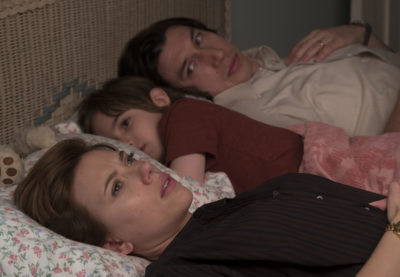
    Scarlett Johanson, Azhy Robertson, and Adam Driver in Marriage Story. Credit: Netflix.

    As Nora delivers in a fiery monologue, we live in a society where women are meant to bend their desires to men and whatever they deem comfortable. Even Nicole’s mom seemingly sides with Charlie because of her old-fashioned view of things. For once, Nicole is doing something for herself, and in Charlie’s view that makes her the bad guy. In our view too. The movie is largely told from Charlie’s perspective, so our sympathies automatically lie with him. Then, Baumbach pulls the rug out from under us and reminds us that we’re so immeshed in these societal expectations that we don’t even realize why we’re thinking in that way. 


    ADVERTISEMENT


    The only way to get over sadness is to go through it

    However, it’s called Marriage Story for a reason. Except, instead of the making of a marriage, it’s the breaking of one. Like I said at the beginning, as messy as the actual logistics of it are, it’s the emotional gymnastics that we have to do to get through it that’s that hardest. 

    I’ve been trying so hard to convince myself that I’m going to be alright in my breakup — and that he would be alright. And we both will be, but not right away. Maybe it will take weeks, months, or even years to get over it. To get over the emotional ties that we have to each other. There hasn’t been a day that I’ve woken up feeling utterly alone and just crave the normalcy we once had. But that’d be unfair. 

    Like Nicole and Charlie, we met each other at a specific time in life. One where we were still forming who we are. The sad fact of the matter is that it changes with time. Your wants and desires clear up, your lifestyle comes into focus, and that causes rifts. There are some that you should bend for and some you shouldn’t. It’s so hard to be honest about them, but in the long run you’re only causing more hurt if you continue to ignore them. 

    Nicole realizes that. Society taught her to not want, but she slowly realizes that she’s allowed to. Charlie doesn’t realize that. His nature tells him he’s doing the right thing for his family. Those final two songs from Company tell us exactly where they are in emotional maturity. Nicole is past acceptance and Charlie is just getting there. He gets there when he is finally able to be sad and angry about what’s going on. Because the only way to get over it is to go through it. 

    Marriage Story brings us through it, unveils truths about ourselves and society, and does it in a funny and entertaining way. It’s a nearly impossible feat to make a 136-minutes movie about a divorce entertaining, but it is. The process is inherently silly and the things we do make no sense. The way people around us react doesn’t help, but it just exposes truths about life — it’s consistently inconsistent. As messy and devastating as the process of breaking up is, it makes you feel alive. Maybe it’s a good thing in the long run. 


    ADVERTISEMENT


    More movies, less problems


    Hey! I’m Karl. You can find me on Twitter and Letterboxd. I’m also a Tomatometer-approved critic.

    💌 Sign up for our weekly email newsletter with movie recommendations available to stream.


    ADVERTISEMENT


  • ‘Bacurau’ NYFF review — The weird western Tarantino never made

    ‘Bacurau’ NYFF review — The weird western Tarantino never made

    Set in a Brazillian village in the near future, Bacurau follows the inhabitants as they become the victims to a sinister set of events.

    One-sentence review: Bacurau is a wonderfully weird western that is as funny as it is hard hitting and thrilling.

    Details: ? Kleber Mendonça Filho & Juliano Dornelles // ?? Brazil // ⏳ 130 minutes

    The cast: Sônia Braga, Udo Kier, Bárbara Colen

    Where to watch Bacurau: Playing at the New York Film Festival October 1st & 2nd. Tickets here.

    The inhabitants of the small remote fictional Brazilian village Bacurau don’t know it yet, but they’re at the center of a sinister act of greed, racism, and privilege. There are signs of the impending events. One night dozens of horses stampede through the center of the town. Another night the truck that supplies the village with water arrives with bullet holes in its side. When one of the village’s leaders and teacher (Wilson Rabelo) goes to show his students where Bacurau is on a map, it’s missing. Oh, and there’s a UFO-shaped drone stalking people. 

    All the oddball energy extends to the cast of characters that call the village home. There’s the boozed-up doctor unafraid to speak her mind (Sônia Braga), an outlaw who can never turn his machismo off (Thomas Aquino), and a DJ who doesn’t have a radio station and instead just broadcasts on giant speakers for anyone to hear.

    The tone of Bacurau, which had its North American premiere at the 57th New York Film Festival, is so unexpectedly delightful. It’s like the weird western that Quentin Tarantino never made — perhaps even lighter and sillier than even Tarantino. There are so many subtle quips and observations from characters that make you want to delve even deeper into their inner lives and history — the movie might have taken inspiration from Bong Joon-ho’s work including his most recent work Parasite, also playing at the fest. It makes the ensuing events even more difficult to stomach.

    The community is tight-knit. Almost alarmingly so. They’re so wary of outsiders that even when the skeevy mayor (Thardelly Lima) pays a visit they all disperse as he tries to buy their affection with less than stellar gifts — books dropped off by garbage trucks, illegal prescription medicine, expired food. It’s a less-than-subtle indictment of Brazil’s current powers-that-be. However, directors Kleber Mendonça Filho & Juliano Dornelles make it a point to center the movie of the community. The inhabitants of Bacurau are the strong beating heart at its center.

    bacurau
    The cast of Bacurau.

    It would be extremely difficult to review Bacurau without revealing at least in some part where the movie leads. However, that’s also part of the fun. So, I will say this before diving further into details. This movie is a genre-bender. It’s a western, a satire, a comedy, an action movie, a mystery all rolled up into beautifully packaged — and wild — narrative. And it ends up nowhere you think it would.


    ADVERTISEMENT


    ⚠️ Light spoiler warning.

    Eventually, the villagers realize that something is amiss. Along with all the weird events happening, they discover some inhabitants murdered. It’s revealed that the village is about to be besieged by a group of heavily armed American tourists in a twist of The Most Dangerous Game or The Purge. Another inspiration, as evidenced by the score and opening credits, is John Carpenter’s Assault on Precinct 13.

    We get to know this group and their motivations as well as the villagers. And it’s laid out pretty bluntly that this is an allegory for colonialization, class warfare, and the current political climate in Brazil and throughout the world. Exploring those themes as a sendup of 70s westerns and exploitation movies is a brilliant decision.

    While a lot of the movie’s themes and its portrayal of the community and its lore, which in some parts nearly veer into fantasy, are so specific to Brazil. There are so many threads connecting it to what’s happening in the United States. In fact, the white tourists, who are clearly parodies of rural Americans, feel entitled to their “hunt” of the villagers. For them, it only makes sense.

    If I have one complaint about Bacurau it’s that, whether intentional or not, the filmmakers clearly outline — almost too clearly — the message they’re trying to get across. It’s almost propagandist. However, that is forgivable because they go so hard on the quirkiness and camp of it all. Bacurau is a pure, hilarious, violent, and surprising delight.


    ADVERTISEMENT


    More movies, less problems


    Hey! I’m Karl. You can find me on Twitter and Letterboxd. I’m also a Tomatometer-approved critic.

    💌 Sign up for our weekly email newsletter with movie recommendations available to stream.


    ADVERTISEMENT


  • ‘Parasite’ NYFF review — Upstairs, downstairs like you never seen before

    ‘Parasite’ NYFF review — Upstairs, downstairs like you never seen before

    Parasite follows a poor but clever family’s attempt to climb up the social ladder by cozying up to a wealthy family.

    One-sentence review: Parasite is unlike any movie that’s existed — at the same time funny, terrifying, thrilling, and relevant — and one of the best movies of the year.

    Details: ? Bong Joon-ho // ⏳ 132 minutes // ? 2019

    The cast: Song Kang-ho, Lee Sun-kyun, Cho Yeo-jeong, Choi Woo-shik, Park So-dam

    Where to watch Parasite: In theaters now.

    It’s taken me a while to really crack how to talk about Parasite. There’s so much to unpack and so much I loved that it seemed nearly impossible to do without having a drawn-out, rambling mess. But then, director Bong Joon-ho did the work for me. 

    “I tried to express a sentiment specific to Korean culture, all the responses from different audiences were pretty much the same. Essentially we all live in the same country… called capitalism.”

    I think what’s so interesting about that quote is that he explains that he didn’t intend to make a social satire that could be universally related to. He’s as surprised by the response to the movie as anyone else. Yet, Parasite feels like a movie that’s made for the masses. Still, at its core, it’s a bizarre, pitch-black arthouse comedy set in South Korea. Which is exactly why it’s one of the best movies of the year. 

    A plot better shrouded in mystery

    I’m going to be careful in describing the plot to Parasite because part of the effectiveness is the surprise. Either way, you should go in mostly blind. Calling it one of the best movies of the year should be reason enough to see it. If you still need to be convinced, you’ve been warned. 

    Parasite revolves around two families. The Kim family, father Ki-taek (the great Song Kang-ho), mother Chung-sook (Jang Hye-jin), and kids Ki-woo (Choi Woo-shik) and Ki-jeong (Park So-dam), is just barely scraping by by folding pizza boxes for the local pizza joint and leeching off the WiFi of a nearby coffee shop. 

    Parasite
    The Kim Family (Woo-sik Choi, Kang-ho Song, Hye-jin Jang, So-dam Park) in Parasite. Courtesy of NEON CJ Entertainment.

    So, when the particularly clever Ki-woo gets the chance to tutor Da-hye (Jung Ji-so), the daughter of wealthy tech exec Dong-ik and his high-strung wife Yeon-gyo (Cho Yeo-jeong), he hatches up a way to get his entire family in on his good fortune by lying and conniving their way into various roles working for the family.

    The situation requires much grifting and maneuvering, which of course leads to some hilarious slapstick moments and incredible acts of criminal malice. But things take a turn. That turn is when Parasite goes from a crowd-pleasing criminal romp to a deeper take on the very fabric of our society. It’s a wonder that Joon-ho was able to craft something so complex, rich with meaning, and filled with wonderfully off-kilter characters and performances, while still being entertaining, thrilling, and, at parts, terrifying. 

    Constructing his greatest movie yet

    Unlike his last two movies — Snowpiercer and OkjaParasite very much takes place in our world. Perhaps a slightly heightened version of it, but ours nonetheless. Mixing that with his usual dark humor and oddly specific characters make for an experience like no other. It allows him to zig when we expect him to zag. Knowing each character’s true feelings and intentions is impossible, and that’s where he wants us. 

    Instead, he builds in clues everywhere else. In the dialogue, the production design (all the sets were built for the film), and the carefully crafted shots. Like all the best directors, no scene or camera movement or line is wasted. Everything matters. And that is the sign of a masterpiece. 

    Parasite is so indescribable that I’m having a tough time… well, describing it. Particularly what makes it a near-perfect film. But I always come back to that quote from Director Bong and how this is a universal story. The final sequence is a universal feeling. As wild as the ride is, it’s comforting knowing that in some way we’re all on the same page. 

  • ‘The Irishman’ NYFF review — Scorsese’s tribute to Scorsese

    ‘The Irishman’ NYFF review — Scorsese’s tribute to Scorsese

    Based on a true story, a hitman for the mob looks back at his life and the events that shaped him in The Irishman.

    One-sentence review: The Irishman combines the meditative pace of Silence, the sharp humor and style of The Wolf of Wall Street, and the narrative of Martin Scorsese’s greatest gangster movies to form a self-reflective magnum opus.

    Details: ? Martin Scorsese // ?? U.S. // ⏳ 209 minutes

    The cast: Robert DeNiro, Joe Pesci, Al Pacino

    Where to watch The Irishman: In theaters November 2nd. On Netflix November 27.

    The Irishman feels like a culmination of all the films that came before it in Martin Scorsese’s filmography. You can piece it together from his various projects. It’s deliberately paced and meditative like Silence with a sharp sense of humor like The Wolf of Wall Street. The plot treads close to any of his classic gangster movies and it grapples with toxic masculinity like many of his movies, but Taxi Driver feels like the closest comparison. It feels like an epilogue to his storied career — but it also makes clear that Marty is far from being obsolete. 

    Getting the mob back together

    If the 2010s have shown us anything, it’s that Scorsese isn’t done experimenting and trying new things. As much as this feels like a Scorsese picture, it’s more like it’s influenced by his past work rather than trying to recreate it — even though it reunites him with old collaborators Robert DeNiro and Joe Pesci.

    The movie, stitched together by long-time editor Thelma Schoonmaker, follows Frank “The Irishman” Sheeran (DeNiro) as he recounts his life as a hitman for Russell Bufalino (Pesci) and his entire organization. The decades-spanning narrative, which required them to digitally de-age the actors, covers Sheeran’s beginning as a small-time criminal stealing meat off of butcher trucks to his fateful meeting Russell to his friendship with famed and bombastic labor union leader Jimmy Hoffa (Al Pacino).

    The Irishman
    THE IRISHMAN (2019) Ray Ramano (Bill Bufalino ) Al Pacino (Jimmy Hoffa) and Robert De Niro (Frank Sheeran)

    Brilliantly, the movie jumps around in time and feels like it rambles at times — just like you’d expect an old man to talk about the events in his life. The formlessness of the narrative is both an asset and a liability. An asset because it really feels like you’re talking to someone about their life. A liability because you do feel the 3 ½ hour runtime at points. 

    Balancing crime with comedy and character

    However, it is also often hilarious with killer (pun intended) timing that you’re able to get through the rough patches with ease. The movie especially shines when Sheeran becomes a confidant for Hoffa, who Pacino plays with all the bombast and energy you’d expect him to deliver in a Scorsese movie — shockingly, this is his first time working with the director. There’s plenty of wise guy talk, politicking between various groups, and mob-antics that go wrong and some that go right — everything you’d expect Scorsese to cover. It’s the way he covers it that makes The Irishman special. 

    Robert DeNiro hasn’t been this good in years in his role as Frank. And while many people were tepid on the decision to use the same actors to play characters over a span of decades, it pays off. It makes each character, especially Frank, feel lived in. You feel the toll of every sin he commits weight on him and on his daughter Peggy (a criminally underused Anna Paquin) as time goes by.

    It’s difficult to describe the plot because the movie is essentially structure-less, but the main throughline of the film is Frank’s relationships with Russell and Jimmy and his lack of a relationship with his family. In so many mob movies, including Scorsese’s, the men operate unchecked and without moral consequence. The Irishman attempts to reckon with the emotional impact of being in the mob. It’s a welcome change of pace late in the movie.

    The Irishman ends up being greater than the sum of its parts. It could have been easily cut down and end with the same effect, but each part in a vacuum works so well that it’s easy to overlook. Oddly, I think this movie will play well on Netflix versus a theater. It’s a movie that will immerse you either way.

  • ‘Atlantics’ NYFF review — Transatlanticism in a movie

    ‘Atlantics’ NYFF review — Transatlanticism in a movie

    Atlantics follows a group of workers in Dakar as they leave the country by boat looking for a better life.

    One-sentence review: Atlantics has an intriguing enough story and Mati Diop manages some fascinating scenes of tension and emotion, but it lacks the narrative momentum for it to really take off.

    Details: ? Mati Diop // ?????? Senegal, France, Belgium // ⏳ 104 minutes

    The cast: Mame Bineta Sane, Amadou Mbow, Ibrahima Traoré

    Where to watch Atlantics: Playing at the New York Film Festival October 9th & 10th. Tickets here.

    Atlantics is a meditative movie. Director Mati Diop — who became the first black woman to compete for the Palme d’Or at the Cannes Film Festival this year — wasn’t afraid to go slow or make the story relatively slight considering where it could have gone. The end product is better and worse for it. 

    Atlantics takes place in Dakar, on the Atlantic coast of Senegal in West Africa, where a group of workers argues with the management of the construction project they’re working on. They haven’t been paid in months and they’re fed up. One of those workers, Souleiman (Ibrahima Traoré) sneaks away to meet up with his girlfriend Ada (Mame Bineta Sane) to try and tell her something, but she brushes him off and tells him to save it for when they meet up later that night. However, that meeting never happens.

    Ada, who is engaged to a wealthy man named Omar (Babacar Sylla), sneaks out to meet Souleiman at a local haunt. When she gets there, all she finds are women from whom she learns that the workers set off to sea to find work overseas in Spain. She’s heartbroken that Souleiman has left her and that she must marry Omar. However, one night during a celebration for the couple, a fire breaks out. Though no one is hurt, several witnesses said that it was Souleiman who set the fire, which Ada knows is impossible. Still, the detective assigned to the case (Amadou Mbow) is convinced that it is him. 

    Ibrahima Traoré and Mame Bineta Sane in Atlantics. Credit: NYFF.

    The movie is based on Diop’s own short documentary about Senegalese migrants voyaging overseas in search of work, which is something I wish the movie explored a little more. Much of the focus of the first part of the movie is table-setting. Mostly, establishing Ada as the main character and her struggle following Souleiman’s departure. However, it’s hard to connect with her — or feel sympathy for her — because we don’t get to spend much time with the couple. Their relationship isn’t explored except for a brief scene. 

    That’s the main crux of the problem with Atlantics. There is a rich story about migrant workers, class, and female oppression waiting to be tapped. However, Diop instead takes a more cerebral and meditative approach. The result is a first half that drags a bit before the real narrative starts kicking in. The movie takes an unexpected turn to the supernatural, which breathes new life into it. In a way, it feels akin to Olivier Assayas’ Personal Shopper as it explores magical realism. Unfortunately, where that movie is an effective meditation on grief, the themes in Atlantics feel muddled. 

    That all being said, where the movie ends up is interesting. The final few scenes feel so impactful and even emotional — particularly one set in a graveyard and one set in a beachside bar. Or at least feel like they could have been impactful if the preceding hour were better plotted. However, they do point to some real talent that Diop has had they been applied to a stronger screenplay. You can never criticize a movie for being a slow burn. However, you can criticize what it does with that pace. Atlantics doesn’t do quite enough.