Tag: Olivia Cooke

  • ‘Sound of Metal’ gives Riz Ahmed his Oscar role | movie review

    ‘Sound of Metal’ gives Riz Ahmed his Oscar role | movie review

    In Sound of Metal, a drummer for a heavy metal band is forced to confront a very different future when he suddenly loses his hearing


    Sound of Metal is one of the best portrayals of deafness in film using smart sound design and a stellar performance by Riz Ahmed to communicate the experience. And while it loses steam as it makes its way to the finale the core message is powerful and poignant.

    There is a scene about halfway through Darius Marder‘s Sound of Metal, which is being released on Amazon Prime Video on December 4th, where Joe (Paul Raci) gives Ruben Stone (Riz Ahmed) the assignment of sitting in a room with a cup of coffee and a notepad and do nothing. He tells him if he gets the urge to do something to write in the notepad. For most people, it sounds like an easy task, but have you ever done it?

    That is the most impactful scene in Sound of Metal because it, like many other of the film’s decisions, helps put you in the mind space of Ruben, a drummer and recovering addict who suddenly loses almost all of his hearing, by turning it into something you can relate to. When you’re uncomfortable with yourself, the silence—whether literal or figurative—when you’re not accomplishing something is deafening.

    And for Ruben, whose band consists of himself and his girlfriend Lou (Thoroughbreds’ Olivia Cooke), standing still feels like death.


    ADVERTISEMENT


    That’s apparent in his go-getter attitude when it comes to their music as they shuffle from gig to gig with their unique experimental rock sound that he hopes drives them to be something one day. Instead, he’s faced with the choice to lose it all when he all of a sudden loses most of his hearing. As the doctor puts it, what is gone will never come back, so his job now is to retain what is left—that is to say, no loud noises—which makes his decision to play a show that night confounding.

    However, when he breaks down and Lou realizes what is happening she makes the tough decision to part ways. She goes home to France and he goes into a community for the deaf where his sponsor sets him up with a narcotics anonymous group. There, he comes to terms with his disability and learns how those around him also cope.

    Sound of Metal‘s greatest strength is its ability to immerse you Ruben’s world. Through visual cues and smart sound design where we shift in and out of Ruben’s ability of hearing, we feel what he’s feeling. Both the silence and the moments of magic created by this deaf community. In these communities—many of the film’s actors are actually deaf including Lauren Ridloff‘s Diane, a teacher—being deaf is seen as a blessing and that Marder’s direction coupled with Ahmed’s engrossing performance communicate that.
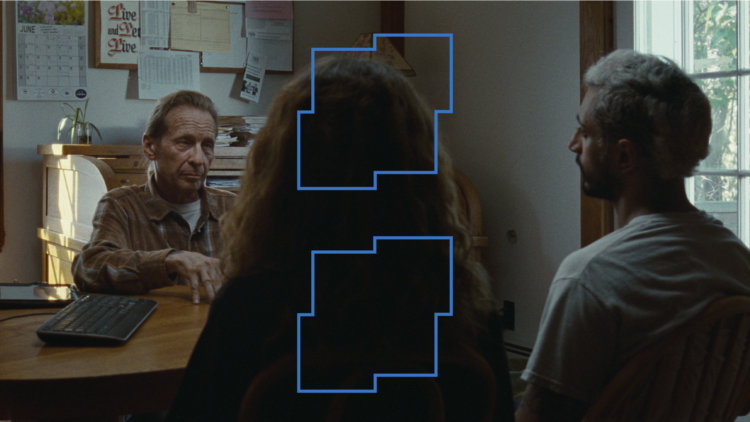
    Paul Raci, Olivia Cooke, and Riz Ahmed in Sound of Metal. Courtesy of Amazon Studios.

    ADVERTISEMENT


    The central conflict of the film is Ruben’s decision of whether or not to get an incredibly expensive surgery to regain his hearing—in actuality, the procedure tricks the brain into thinking its hearing resulting in something like… well, the sound of metal. On one hand he’s seeing the beauty of his new condition, on the other, so much of his life has been driven by pushing forward with his music, with his relationship, and with his recovery. Without the distraction of those things, he and Lou are afraid he’d relapse.

    Eventually, Marder, who penned the screenplay along with his brother Abraham Marder, writes himself into a corner which makes the third act feel like a break in the momentum. Nevertheless, the message never strays: accepting yourself is finding the ability to sit still and be okay with that. Which is why the film’s perfect final shot, a combination of the film’s greatest assets—the sound design and Ahmed’s performance, sticks with you.


    ADVERTISEMENT


    More movies, less problems


    Hey! I’m Karl. You can find me on Twitter and Letterboxd. I’m also a Tomatometer-approved critic.

    💌 Sign up for our weekly email newsletter with movie recommendations available to stream.


    ADVERTISEMENT

    💌 Sign up for our weekly email newsletter with movie recommendations available to stream.


    ADVERTISEMENT


  • ‘Thoroughbreds’ review — Coming-of-age has never been so diabolical

    ‘Thoroughbreds’ review — Coming-of-age has never been so diabolical

    Thoroughbreds is a twisted and darkly funny coming-of-age debut film about what it means to be evil

    Thoroughbreds is about evil. What makes someone evil? However, it begs that question in two ways. What makes someone evil—meaning what action or actions that a person takes that makes them considered evil—and what makes someone evil—in that what happens in someone’s genetics or upbringing that could make them evil. The film, however, is more opaque than that. Director Cory Finney’s first feature is a subversive coming-of-age that is deliciously twisted and bleakly hilarious in a way that we haven’t seen since Park Chan-Wook’s Stoker.

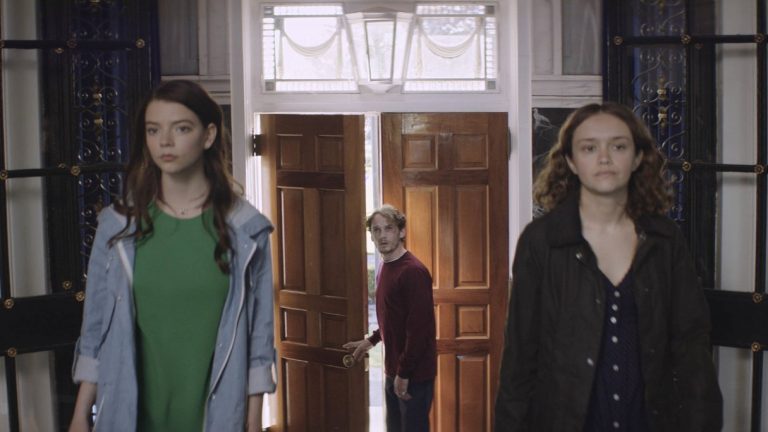
    The characters in Thoroughbreds come from privilege and imbue everything that comes with that. Lily (Anya Taylor-Joy following up her breakout roles in The Witch and Split) is a polished and intelligent boarding school girl who has countless prospects in life. Amanda (Olivia Cooke), on the other hand, could simply care less about what life has in store for her. She admittedly is completely devoid of emotion and can’t even process it in other people. However, the two were old friends and have again started to talk to each other, even though they both know that it’s because Amanda’s mother Karen (Kaili Vernoff) paid Lily to casually tutor her.

    The two girls haven’t spoken to each other in years since drifting apart after middle school—the way it always goes—and Lily is clearly hesitant to interact with Amanda after she euthanized her injured horse with nothing but a knife. And while their reunion is uneasy, the quickly bond over one thing: Lily’s contempt for her stepfather Mark (Paul Sparks). Amanda quickly dispatches an easy solution: murder Mark.

    Like most film noir’s, which Finley used as the basic structure, Thoroughbreds is interested in the morality of its character’s actions. Much of the film’s lean 90-minute running time is spent with the pair debating the absurd plan’s ethics in darkly funny exchanges. Cooke delivers Amanda’s dialogue with a pointed deadpan that always seems to get to Taylor-Joy’s Lily. Connecting back to the central question of the movie, Amanda is the makes question and Lily is the what question.

    “You cannot hesitate. The only thing worse than being incompetent, or being unkind, or being evil, is being indecisive.”

    — Amanda (Olivia Cooke), Thoroughbreds

    Eventually, the low-level drug dealer Tim (Anton Yelchin in one of his final film roles before his tragic death) is introduced into the story. His kicked assumed tough guy exterior mixed with a kick puppy dog endearment makes him an interesting third wheel in the story. He serves as a bridge between the two extremes of the girl. He may be doing something harmful—dealing drugs to teenagers—but he’s doing it for a noble purpose—pursuing his slice of the American dream. Yelchin’s performance just makes the sting of losing him even worse. Few actors could both endear themselves to an audience with characters that don’t always deserve it.

    The girls plan to use Tim as a hitman to murder Mark, who Sparks plays absolutely despicably with few redeeming qualities if any. But does he truly deserve to die for that? Instead of going for genre thrills, Thoroughbreds is more meditative than that. Case in point, a climactic scene is a single image that doesn’t change except for the sounds we hear just outside the frame. This may be Finley’s first film, but he’s extremely assured as a director.

    Thoroughbreds is a perfect example of various elements coming together to make a great film. Taylor-Joy and Cooke deliver incredible performances that act as foils to one another while Yelchin, though limited in screentime, acts as an emotional grounding for the film. The twisted but simple plot is expertly stitched together by Louise Ford and scored by Erik Friedlander—one of the best movie scores of the year. And at the core is a stunning feature debut by Finley. The movie flies by, but it’s impactful and daring. Thoroughbreds is one of the year’s best.

    Thoroughbreds is available to watch on Amazon ➤

    Karl’s rating:

  • ‘Ready Player One’ review — Colorful video game world, dull characters

    ‘Ready Player One’ review — Colorful video game world, dull characters

    Ready Player One is a visual feast and boasts impressive action sequences that will certainly entertain, but it’s missing heart, which makes the movie a letdown.

    The culture that Steven Spielberg’s latest film Ready Player One invokes is one that he had a hand in creating. Geek culture is something today that is discussed both positively and negatively. It’s about passion over a specific topic. However, it seems in recent times that that passion has grown to dangerous levels. It’s an angle that could have been interesting to explore, especially considering Ernest clines novel of the same name that the film is based on makes a point to criticize the pop culture obsessed. However, Spielberg celebrates the positive aspects of geek culture without acknowledging the negatives.

    The entire conceit of Ready Player One is a world where knowledge of pop culture — particularly that of the 80s — is now the currency. That’s because James Halliday (Mark Rylance in a weird, but great performance), has created a virtual world where people have invested all their real world time and money into living in — the Oasis. Players can enter the space and be whoever they want to be, which means a lot of 80s references. A lot. However, this has also caused the real world to crumble. Society has crumbled and completely transferred online. It’s an aspect of the premise that Spielberg ignores to the detriment of the rest of the film.

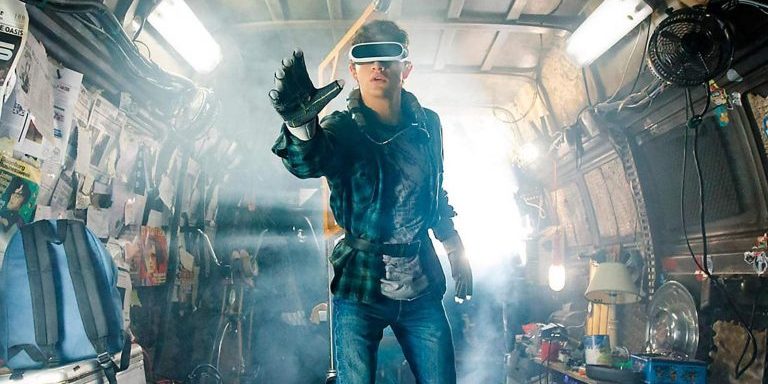
    Wade Watts (Tye Sheridan), who was named that by his father because it sounds like a superhero’s secret identity (references and nostalgia!). Wade lives in the stacks. A discombobulated structure of twisted metal and mobile homes built up stories high on the outskirts of the Columbus, Ohio — the fastest growing city in the world. We don’t learn a lot about Wade. We know his home life isn’t great, though that’s barely touched on, which is why he escapes to an abandoned van outside the stacks to live in the Oasis.

    In the Oasis, Wade becomes Parzival. He’s an extremely skilled player and Gunter. Gunters, which is short for Egg Hunters, are players who are focused on unlocking Halliday’s last dying wish in the Oasis. Halliday created a scavenger hunt where players must find 3 keys to win complete control of the Oasis both in the game and the real world.

    Compared to the book, which I enjoyed, the film is a lot simpler in its execution. To its detriment, the creation of the Oasis and its impact on society are quickly glossed over, which ultimately changes what the film is commenting on versus the book. The book takes time to set up that the world has become an oppressive environment where movement between classes has become impossible, except for in the Oasis. By stripping that message out and barely touching on the dichotomy of geek culture, the movie ends up not saying very much.

    It does attempt to have some commentary through Artemis (Olivia Cooke — she does great work here with the little material she’s given). She leads a group of resistance members — at one point she actually says, “welcome to the resistance” — that are focused on preventing IOI, a video game conglomerate that creates most of the equipment used to access the Oasis, from winning the prize. IOI and its CEO Nolan Sorrento (Ben Mendohlsen) have been forcing people into indentured servitude to help them win the game — essentially they raise an army. However, even with that storyline ripe for some commentary, the story breezes over it.

    Not every movie needs to be subversive. However, Ready Player One is asking us to care about its main characters because they are fighting for something bigger than themselves. But without making them struggle or there being some sense of stakes in the real world, it makes any moment that feels like a rallying cry fall flat. There are moments where a character is all but standing on a soapbox and there is almost no impact.

    Ready Player One suffers from a similar problem to last year’s Valerian and the City of a Thousand Planets. It’s visually a feast — an accomplishment of CGI. There are sequences that feel like they’re going to be iconic in the future. Dare I say, sequences that people will be nostalgic for. Specifically, the second act The Shining sequence is one of the few references that made me perk up. However, it feels like it achieves those moments at the stake of the plot and characters. No characters, lead or supporting, feel fully drawn out or have complete arcs.

    Spielberg seemed more interested in the possibilities that the Oasis presents rather than the societal implications of such a world. He set out to make a modern-day Willy Wonka and the Chocolate Factory but forgot to make the characters as colorful as the world around them. Spielberg is the master of setpieces the race for the first egg — it feels like the perfect amount of homage — and The Shining sequence are both evidence of that. It’s enough to make Ready Player One at least enjoyable. However, it’s one of those movies that slips through your fingers. If you’re looking for a colorful, video game-inspired, 80s homage, give Thor: Ragnarok a chance. It’s everything I wish this movie was.