Tag: Oscar Isaac

  • ‘Dune’ is a spectacle that gets lost in a sandstorm | TIFF movie review

    ‘Dune’ is a spectacle that gets lost in a sandstorm | TIFF movie review

    House Atreides is tasked with controlling the mining operation on the dangerous desert planet of Dune, but what they don’t know is political intrigue is afoot


    On the surface, Dune is ambitious and thrilling. However, it feels like a good movie that flirts with greatness but never quite gets there. Though it’s stunningly made and designed, the classic story just doesn’t hold the same weight as it did when it was first released and the decision to only release half of it doesn’t help.

    Why did Blade Runner 2049 work when it really shouldn’t have? When it was announced that Denis Villeneuve would direct the sequel to Blade Runner it had already toiled in development hell for nearly two decades, usually the kiss of death even if the film eventually does see the light of day. However, Villeneuve delivered a singular meditative vision that didn’t set out to remake the original, but rather expand on the world that was already there and dive even further into its thematic depths. That’s what Villeneuve had to do with Dune, especially after David Lynch’s much-maligned 1984 adaptation. And while he delivered on the world-building and action, underneath feels like a lack of a beating heart.

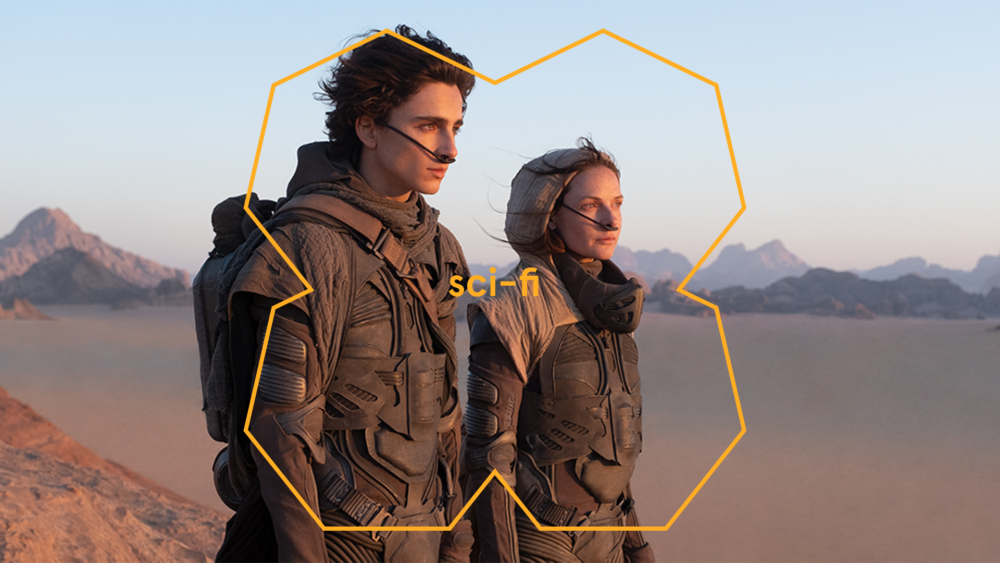
    Erring closely to Frank Herbert’s 1965 novel, Dune follows the members of House Atreides. Duke Leto Atreides (Oscar Isaac) is tasked with stewarding the dangerous desert planet Arrakis, which is used by the Empire for its endless supply of “spice,” a powerful substance that has supernatural effects on humans. He, along with his concubine Lady Jessica (Rebecca Ferguson) and son Paul (Timothée Chalamet), journeys to the planet to begin the difficult work controlling the spice mining operation. However, political intrigue is afoot as Vladimir (an unrecognizable Stellan Skarsgård), Baron of House Harkonnen, is plotting the downfall of House Atreides.


    ADVERTISEMENT


    The world, captured gloriously by cinematographer Greig Fraser (Lion, Zero Dark Thirty), is built with terrific detail that makes it so fun to explore. The world is littered with fun details in the costumes (Ferguson’s Lady Jessica is a fashion icon), ships (dragonfly spaceships!), and culture. The mythology feels rich and deep. Like there are endless layers to parse through. 

    There is a gaggle of names and places to keep in order, but Villeneuve’s deliberate pacing makes it easy to keep track of the story — almost too easy. The story is quite simple, for better and worse. Better because heavy exposition tends to bog down sci-fi. On the other hand, he exposes how thinly built the plot of Dune is.

    Though Dune was heavily acclaimed at the time of its release and still stands as one of the most influential novels ever written, nearly six decades later we’ve seen countless iterations of the “chosen one” storyline that is at its core — Star Wars, The Terminator, The Matrix, even Harry Potter. This undercuts the exceptional world-building that Villeneuve accomplishes by giving us a story that frankly fails to take full advantage of what the world has to offer. 

    💌 Sign up for our weekly email newsletter with movie recommendations available to stream.


    ADVERTISEMENT


    ADVERTISEMENT


    And the main part of that failure is Paul himself. The movie hinges on our desire for his success and the success of his people. And while yes, it’s easy enough to understand that House Atreides and the Fremen are good and House Harkonnen is bad, we’re never shown in earnest why we should root for them. We’re simply told.

    On the surface, Dune is ambitious and thrilling. The few action set-pieces are tight and suspenseful as are the scenes of pure dramatic heft. In particular, many of the scenes between Ferguson’s Lady Jessica and Chalamet’s Paul start to find the humanistic quality that the rest of the film is missing. In one scene, Jessica and Paul use their shared knowledge of hand signs and telepathic powers to take down a group of soldiers. It’s the kind of plot and character-driven action that made Blade Runner 2049 so successful. However, in Dune it feels like it slips away like sand through your hands as soon as it is over because it’s difficult to muster up a connection to any of the characters. 

    Dune, or Dune Part 1 as the title card puts it, feels like half of a movie. Unlike all the “chosen one” films I listed above, it can’t stand on its own. Even the introduction of the Fremen people (led by Zendaya and Javier Bardem) feels cut short. There is a lot of story to get through, but the decision to split the film may have stretched the story to its absolute limit. I don’t mean to sound overly negative. Dune is a good movie that flirts with greatness but just never quite gets there — much like the chosen one. But perhaps, as the story goes, it’ll get there in the end.


    ADVERTISEMENT


    ADVERTISEMENT


    More movies, less problems


    Hey! I’m Karl. You can find me on Twitter and Letterboxd. I’m also a Tomatometer-approved critic.

    💌 Sign up for our weekly email newsletter with movie recommendations available to stream.


    ADVERTISEMENT


    💌 Sign up for our weekly email newsletter with movie recommendations available to stream.


    ADVERTISEMENT


  • ‘Annihilation’ review — Science fiction that will make your skin crawl

    ‘Annihilation’ review — Science fiction that will make your skin crawl

    Annihilation is equal parts beautiful, terrifying, and intellectual while also including an emotional truth about what it means to be human.

    High-minded sci-fi has defined the late 2010s with entries like Arrival and Blade Runner 2049 defining the period. Another film that could be included in that group is Alex Garland’s Ex Machina. Garland explored extremely human topics by framing it in something not human. So, he seemed like the perfect fit to be tackling Jeff VanderMeer’s Annihilation a novel that I loved. What I loved about it is it poses more questions than it offers answers. And while Garland’s adaptation certainly seems to offer more answers, he grounds the sci-fi in another exploration of what it is to be human. That’s not to say that this film is straightforward or easy-to-digest. It’s quite the opposite actually. Annihilation feels like an assault on the senses without going over-the-top with its style. To call it engrossing would be an understatement.

    While I loved the novel, the film doesn’t follow it except for its basic premise. Most sequences that occur in the book don’t appear in the film. But I think that it’s for the better. Garland takes the Southern Reach and Area X and uses them to explore different ideas. It’s a thrilling discovery for book readers unless you live by the novel. What Garland carries over from the novel is the atmosphere. Area X, an ever-expanding bubble bordered off by something called “the shimmer,” is a mysterious and disorienting place that challenges almost all of our scientific beliefs. The film is unsettling the same way that The Blair Witch Project is. Annihilation infringes on your comfort zone and makes you feel disoriented the second the characters step into Area X.

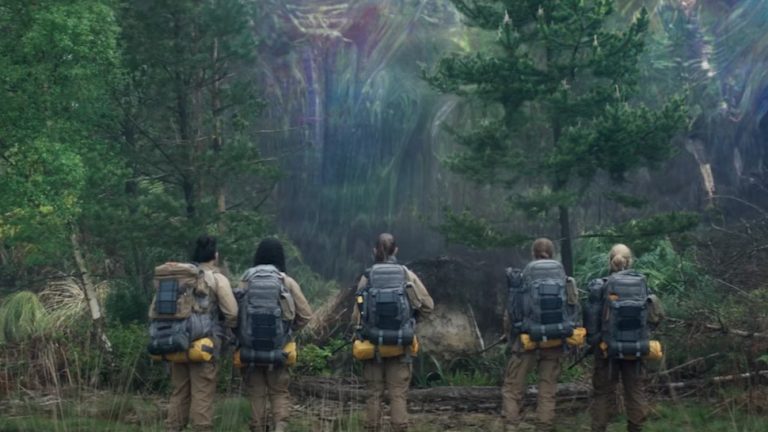
    But before all that happens, we see a meteor-like object strike a lighthouse on the Gulf Coast before cutting to Lena (Natalie Portman), a professor of biology who seems like a shell of a person as she mourns her husband, Kane (Oscar Isaac), who went missing on a mysterious mission a year prior. However, one day, he shows up. But it’s clear that the man that returned to her is not the man that left her. He is confused, unsure of how he got there or where he’s been, then his organs begin to fail. On route to the hospital, the ambulance is forced to stop by a squad of black SUVs that take Kane and Lena to a facility called the Southern Reach. Lena wakes up in a cell with Dr. Ventress (Jennifer Jason Leigh), a psychologist. Ventress explains that the Southern Reach has sent dozens of research teams into Area X and have never heard back from any of them, that is until Kane reappeared. Lena learns that her husband was a part of one of these teams and is the first person to return from across the shimmer. Eventually, seeking answers to help her husband, Lena decides to enter The Shimmer along with Dr. Ventress, paramedic Anya (Gina Rodriguez), physicist Josie (Tess Thompson, fresh off of Thor: Ragnarok), and anthropologist Cass (Tuva Novotny). It would be an understatement to say what happens beyond The Shimmer is extraordinary.

    The set-up and much of the story is told in fragmented scenes that give us some information, but end up raising more questions. It makes sense, though. The story is framed by Lena’s interrogation following her return from Area X — it’s revealed almost at the beginning of the film, as are the fates of every character. That’s just a testament to what Garland was able to do. Despite knowing the outcome, Annihilation is never less tense or horrifying. That doesn’t mean that it leans heavily on gore or horror movie logic. In fact, it’s quite the opposite. The movie is heady and cerebral. The same can be said for the thrills and action. Every image and moment feels calculated. The movie gets under your skin.

    Much of the film follows how you’d expect a movie about an exploration into an alien world to go. Each character is picked off one by one. But even the circumstances around their demises remain mysterious. That’s what separates it from Alien and other films that came after it. Even each death feels like another piece of the complex puzzle of Area X and the film itself. In that way, it feels more similar to Arrival or 2015’s Coherence. It’s as concerned with the emotional implications of the plot as it is the science. At one point, Cass tells Lena that all the women — it’s refreshing that all the people on the expedition being women is not a major plot point — have experienced some type of loss or are on some type of path of self-destruction. By the mind-bending final scenes, you understand why this discussion is so important.

    There has been a lot of talk about how Paramount essentially dropped all hope of Annihilation having a theatrical life from the moment producer Scott Rudin refused to “dumb down” the film. After watching it, I understand why. Though the design and thrills of Area X are impeccable, the true beauty of the film lies beneath. And it’s a beauty that you have to work for. Unfortunately, modern movie audiences aren’t ready for that type of sci-fi. Arrival and Interstellar may be the two examples of intellectual sci-fi surviving in this age of blockbusters. However, Annihilation is a film that has to be experienced on the big screen. There’s too much nuance to be affected by it on Netflix.

    A lot of that nuance comes from the cast. After giving the best performance of her career in Jackie, Natalie Portman gives perhaps the second best performance in this film. Playing a seven-year army vet and biology professor as both strong and vulnerable is a task that few actors could succeed in. On top of that, the character’s emotional journey is explored almost silently, particularly in the last 15 minutes. Without her, the impact wouldn’t be as strong. The same could be said for the set design by Mark Digby. His realization of Area X and all its oddities are equal parts beautiful and unsettling. As are the creatures that they encounter. The film is impeccably designed. The score also stands out — “The Alien” may be one of the most terrifying pieces I’ve ever heard in a film.

    Annihilation is complex, terrifying, engrossing, and beautiful, but above all, it feels completely unique. While the actual design and direction are unique, the themes it deals with and the way it comes to terms with those themes are what really sets it apart. It taps on a human process that we are too afraid to confront — our mortality and self-destruction. However, that is even a simplistic way to describe the themes. It’s truly a movie that has to be experienced and experienced on the biggest screen possible. It envelops you, gets under your skin, and stays with you long after it ends. Annihilation has monsters, but it exposes that the biggest monster of all is our own humanity.

    ★★★★½ out of five