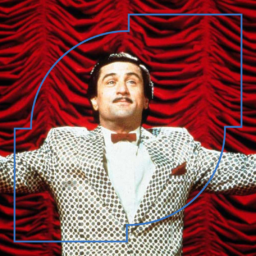
Tag: Robert De Niro

  • ‘The King of Comedy’ is Scorsese’s misunderstood masterpiece | movie review

    ‘The King of Comedy’ is Scorsese’s misunderstood masterpiece | movie review

    In their fifth collaboration, Martin Scorsese and Robert De Niro explore the lengths one man will go to be given a chance in The King of Comedy


    For a movie about a failed standup comedian, The King of Comedy difficult to watch. Rupert’s delusions of success are funny at first but then grow cringe-worthy — and then dangerous. But there’s a third act pivot that makes this one of my favorite Scorsese movies. It’s so subtle but brilliant. It changes our perception of the characters and their motivations and makes us question who we were rooting for all along

    Chloé Zhao makes Nomadland‘s melancholic but hopeful story of nomads traversing the American West a stunningly complex character study of life on the margins of society.



    Since Todd Phillips’ forthcoming movie Joker has clear influences from Martin Scorsese’s The King of Comedy — it even features Robert De Niro in a role similar to Jerry Lewis’ in the movie — I’m taking a look back at the 1983 satirical black comedy.

    I was ready to call Martin Scorsese’s The King of Comedy a great and underrated entry in his filmography, but I wasn’t ready to give it the masterpiece reevaluation that some critics have given it. Then, Jerry Langford (talk show legend Jerry Lewis playing a version of himself) stands in front of an electronics store with dozens of TVs tuned into Rupert Pupkin (Robert De Niro) performing a standup comedy set on Langford’s show.


    ADVERTISEMENT


    We never see Langford’s reaction to the set. We don’t need to. In that one sequence, Scorsese is changing our perception of what we watched in the preceding 90 minutes. I think this is what a lot of people get wrong about The King of Comedy. To me, it isn’t an indictment of celebrity or a cautionary tale about the tantalizing allure of fame. The way the ending is framed makes Pupkin an anti-hero — not dissimilar to Travis Bickle in Taxi Driver.

    The brilliance of the movie comes from Scorsese’s decision to make Pupkin the villain for most of the story. We’re never truly on his side. We’re really on no one’s side, which is why it’s an almost unpleasant experience to watch. Roger Ebert even said:

    It is frustrating to watch, unpleasant to remember, and, in its own way, quite effective.

    — Roger Ebert
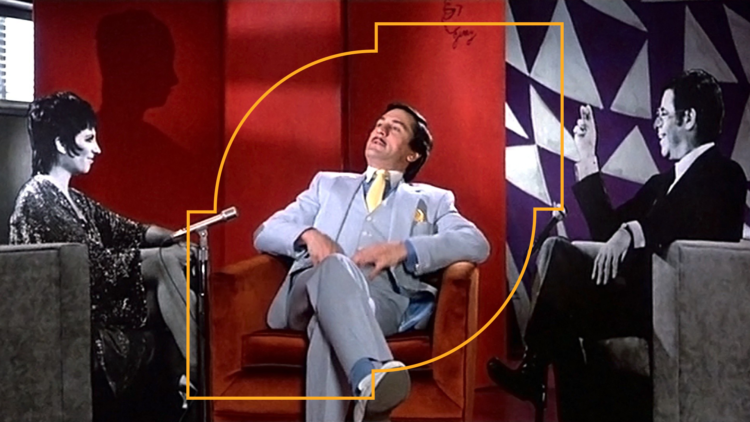
    The King of Comedy
    Robert De Niro in The King of Comedy. Credit: 20th Century Fox.

    💌 Sign up for our weekly email newsletter with movie recommendations available to stream.


    ADVERTISEMENT

    But then, after all the awkwardness and cringe-worthy antics from Pupkin, we see him perform. At that moment — and the one with Langford in front of the electronics store — I understood that this isn’t a movie about celebrity or fame. It’s a movie about talent going unrecognized and the struggle of being a creative or performer.

    The obsession with celebrity and fame is explored with Sandra Bernhard‘s character of Masha, who is portrayed — a bit problematically — as someone with a mental illness, which drives her to stalk Langford. And her character looked at through the lens of the film, she’s actually a foil to Pupkin. She has no reason to be in Langford’s life other than a selfish one. Pupkin, on the other hand, has a reason and purpose, but still isn’t afforded the same opportunity.


    ADVERTISEMENT


    Scorsese’s longtime editor Thelma Schoonmaker does some clever work here stitching together Pupkin’s delusional conversations and interviews with Langford, showing us both reality and what’s in Pupkin’s mind. And her masterful work doesn’t stop there. Every scene feels important and intentional. Not a single second is wasted on anything else but the developments and information we need to see — a rarity, unfortunately.

    While Scorsese is a director that often likes to show his work on screen, this is one of his few movies that is driven by its screenplay. He lets the story speak for itself and shows restraint, which we haven’t seen from him in a while. It may never be the classic that Taxi Driver or Goodfellas is — this movie is slight in comparison — but The King of Comedy deserves a more respected place in the Scorsese canon.


    ADVERTISEMENT


    More movies, less problems


    Hey! I’m Karl. You can find me on Twitter and Letterboxd. I’m also a Tomatometer-approved critic.

    💌 Sign up for our weekly email newsletter with movie recommendations available to stream.


    ADVERTISEMENT


    💌 Sign up for our weekly email newsletter with movie recommendations available to stream.


    ADVERTISEMENT

  • ‘The Irishman’ NYFF review — Scorsese’s tribute to Scorsese

    ‘The Irishman’ NYFF review — Scorsese’s tribute to Scorsese

    Based on a true story, a hitman for the mob looks back at his life and the events that shaped him in The Irishman.

    One-sentence review: The Irishman combines the meditative pace of Silence, the sharp humor and style of The Wolf of Wall Street, and the narrative of Martin Scorsese’s greatest gangster movies to form a self-reflective magnum opus.

    Details: ? Martin Scorsese // ?? U.S. // ⏳ 209 minutes

    The cast: Robert DeNiro, Joe Pesci, Al Pacino

    Where to watch The Irishman: In theaters November 2nd. On Netflix November 27.

    The Irishman feels like a culmination of all the films that came before it in Martin Scorsese’s filmography. You can piece it together from his various projects. It’s deliberately paced and meditative like Silence with a sharp sense of humor like The Wolf of Wall Street. The plot treads close to any of his classic gangster movies and it grapples with toxic masculinity like many of his movies, but Taxi Driver feels like the closest comparison. It feels like an epilogue to his storied career — but it also makes clear that Marty is far from being obsolete. 

    Getting the mob back together

    If the 2010s have shown us anything, it’s that Scorsese isn’t done experimenting and trying new things. As much as this feels like a Scorsese picture, it’s more like it’s influenced by his past work rather than trying to recreate it — even though it reunites him with old collaborators Robert DeNiro and Joe Pesci.

    The movie, stitched together by long-time editor Thelma Schoonmaker, follows Frank “The Irishman” Sheeran (DeNiro) as he recounts his life as a hitman for Russell Bufalino (Pesci) and his entire organization. The decades-spanning narrative, which required them to digitally de-age the actors, covers Sheeran’s beginning as a small-time criminal stealing meat off of butcher trucks to his fateful meeting Russell to his friendship with famed and bombastic labor union leader Jimmy Hoffa (Al Pacino).

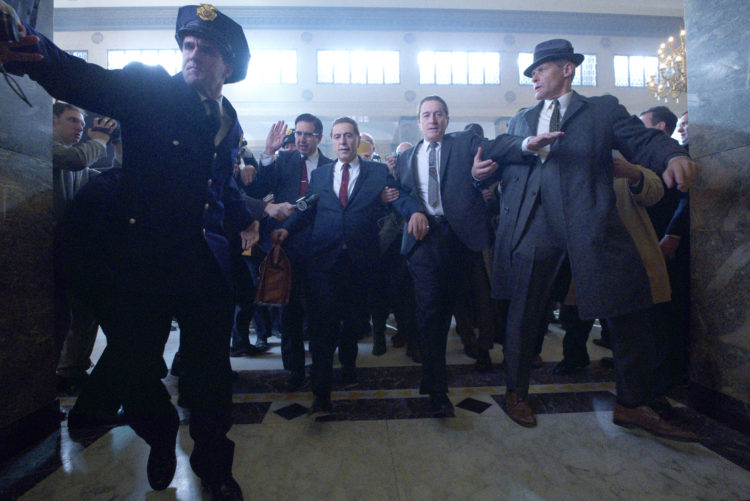
    The Irishman
    THE IRISHMAN (2019) Ray Ramano (Bill Bufalino ) Al Pacino (Jimmy Hoffa) and Robert De Niro (Frank Sheeran)

    Brilliantly, the movie jumps around in time and feels like it rambles at times — just like you’d expect an old man to talk about the events in his life. The formlessness of the narrative is both an asset and a liability. An asset because it really feels like you’re talking to someone about their life. A liability because you do feel the 3 ½ hour runtime at points. 

    Balancing crime with comedy and character

    However, it is also often hilarious with killer (pun intended) timing that you’re able to get through the rough patches with ease. The movie especially shines when Sheeran becomes a confidant for Hoffa, who Pacino plays with all the bombast and energy you’d expect him to deliver in a Scorsese movie — shockingly, this is his first time working with the director. There’s plenty of wise guy talk, politicking between various groups, and mob-antics that go wrong and some that go right — everything you’d expect Scorsese to cover. It’s the way he covers it that makes The Irishman special. 

    Robert DeNiro hasn’t been this good in years in his role as Frank. And while many people were tepid on the decision to use the same actors to play characters over a span of decades, it pays off. It makes each character, especially Frank, feel lived in. You feel the toll of every sin he commits weight on him and on his daughter Peggy (a criminally underused Anna Paquin) as time goes by.

    It’s difficult to describe the plot because the movie is essentially structure-less, but the main throughline of the film is Frank’s relationships with Russell and Jimmy and his lack of a relationship with his family. In so many mob movies, including Scorsese’s, the men operate unchecked and without moral consequence. The Irishman attempts to reckon with the emotional impact of being in the mob. It’s a welcome change of pace late in the movie.

    The Irishman ends up being greater than the sum of its parts. It could have been easily cut down and end with the same effect, but each part in a vacuum works so well that it’s easy to overlook. Oddly, I think this movie will play well on Netflix versus a theater. It’s a movie that will immerse you either way.

  • ‘Joker’ review — All clown, no bite

    ‘Joker’ review — All clown, no bite

    Joker reimagines the iconic Batman villain as a mentally ill, impoverished standup comedian.

    One-sentence review: Joker is well-made and full of interesting choices that all feel hollow when you consider what the movie is trying to say — the answer: not much.

    Details: ? Todd Phillips // ?? U.S. // ⏳ 122 minutes

    The cast: Joaquin Phoenix, Robert DeNiro, Zazie Beetz, Frances Conroy

    Where to watch Joker: Now playing in theaters.

    Joker is not a comic book movie. That’s not where it draws its inspirations from. Sure, The Joker is a comic book villain — maybe THE comic book villain — living in the fictional city of Gotham. However, director Todd Phillips is trying to emulate Martin Scorsese more than he is any version of a comic book movie we’ve seen before. Even Christopher Nolan’s darker and grittier Dark Knight series has nothing on Joker. But that’s part of the problem.

    Arthur Fleck (Joaquin Phoenix) can’t catch a break. He’s a clown for hire that has to deal with bullying everywhere he goes. In the opening scene, he’s jumped by a group of kids who beat him in an alleyway. Even in the locker room where he’s surrounded by other clowns he’s bullied. A lot of it comes from the fact that he’s mentally ill. Unfortunately, his actual condition is never discussed other than his inability to control his laughter, which often comes at inappropriate times.

    However, he has dreams of something greater than just being a clown. Arthur’s main goal is to be a standup comedian like his idol late-night talk show host Murray Franklin (Robert De Niro). De Niro’s inclusion here is a clear nod to Scorsese’s often overlooked 1983 film The King of Comedy, which also followed a celebrity-obsessed comedian trying to emulate his hero.

    One day, a co-worker gives Arthur a gun to protect himself from the people that bully him around. That’s how he ends up killing a trio of drunk wealthy wall street-types who jump him on the subway. The scene is masterful and full of tension as the lights of the subway flicker on and off as the men taunt Arthur. That killing sparks something in Arthur. Something darker. It also sparks anarchy in the city as the “poor” and “disenfranchised” use the man in clown makeup as their symbol of revolt.

    For all the discourse around Joker, I was expecting something truly abhorrent — for better or worse. What I was shocked to find is how little of a bite it has. All the moments of Joker’s infamous chaos feel so contrived that even if his actions are chaos for the sake of chaos, they have no impact. I don’t even think Phillips is completely sure why Arthur is the way he is. He’s not an incel or a misunderstood mentally ill person. He’s a character that someone thought would be cool.

    Joaquin Phoenix in Joker. Credit: Warner Bros. Pictures.

    It’s that juvenile perspective that really betrays Joker. What made Christopher Nolan’s take on the character so compelling — in addition to Heath Ledger’s stellar performance — is he was a mysterious force of evil. Not knowing his motivations made him all the more terrifying. In a way, Joker over explains the character’s reasons for being evil to the point that anything and everything he does is unsurprising.

    ⚠️ Slight spoiler alert.

    The great Zazie Beetz appears in the film as a young mother who lives a few doors down from Arthur. The two strike up a friendship despite Arthur’s clear oddities that carries throughout the film. In the end, it’s revealed that all his interactions with her were imagined. However, I think the movie would have been stronger if the friendship was real and the twist being Beetz’s character finding out that Arthur is a danger. It might not be as shocking or subversive, but it would at least ground the Joker in something rather than being a comic book villain in a gritty and realistic world.

    I’ve had such a hard time articulating what I thought about Joker, and that’s part of the problem. It’s a movie that thinks it’s more important, edgier, and more shocking than it is. It’s a shame because there are interesting ideas there. The movie needed a director more adept at thinking through those ides.