Tag: Steven Yeun

  • ‘Beef’ is road rage revenge well done | Non-spoiler review

    ‘Beef’ is road rage revenge well done | Non-spoiler review

    Beef starts as a road rage revenge comedy that quickly careens into a dark but profoundly complex character study of the Asian-American experience


    Beef is a delightfully unhinged road rage revenge dark comedy that careens into a complex character study of the American Dream and two different people united by their dissatisfaction with life — and enraged by the people around them. Steven Yeun and Ali Wong are sublime anti-heroes.

    Beef begins streaming on Netflix on April 6th.

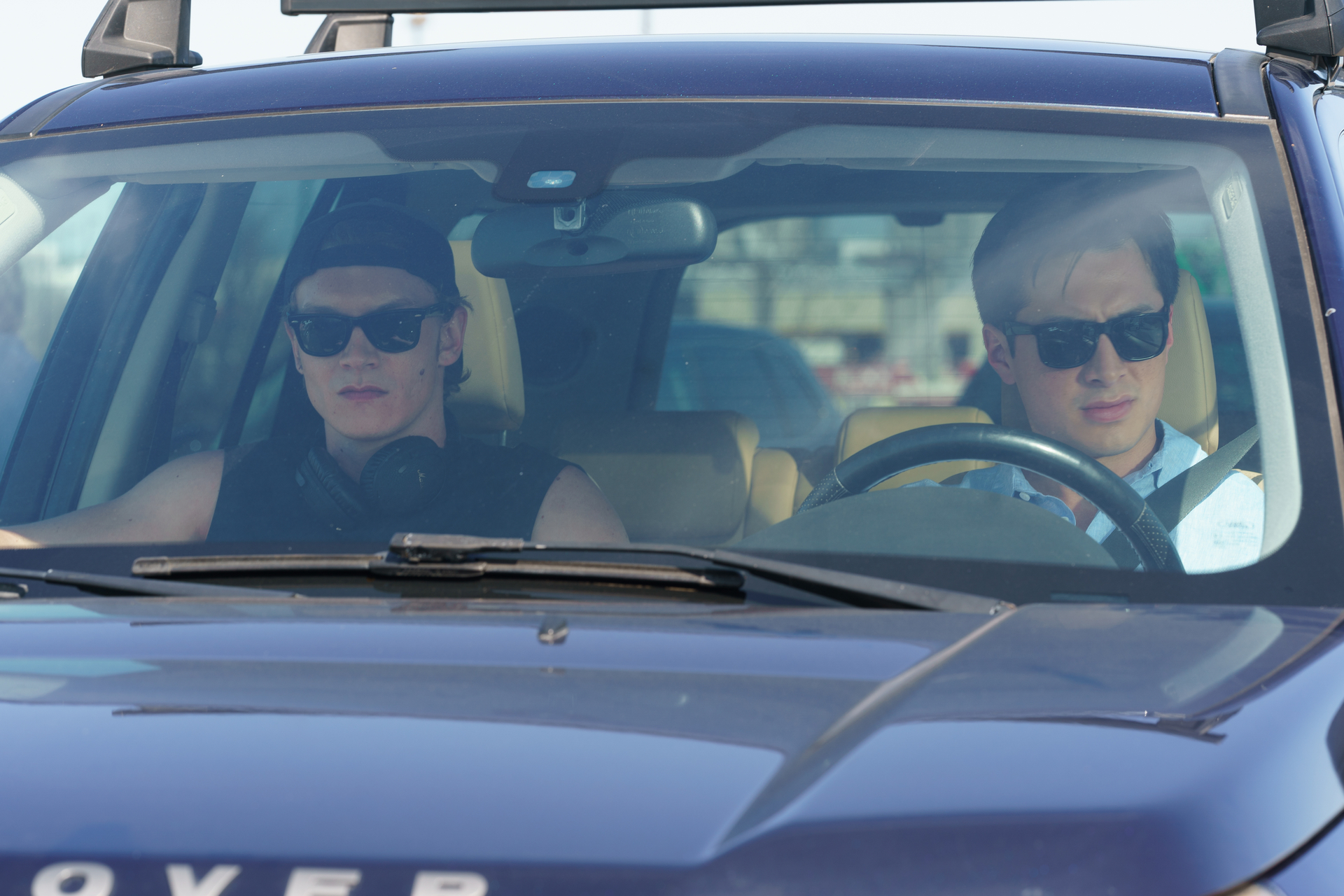
    While the inciting incident of Netflix’s new series Beef is dramatic, it’s perhaps not quite as dramatic as you’d expect. When we are first introduced to Danny Cho (Steven Yeun) he’s in line at a home improvement store called Forsters suspiciously returning three portable grills and a carbon monoxide alarm. “You’ve tried to return these three times before,” the cashier quips before Danny sulks back to his car. However, as he backs out of his parking spot he nearly hits a white Mercedes SUV. The driver honks their horn a touch too long, which annoys the already aggravated Danny. To make matters worse, they stop, roll down their window, and flip Danny the bird. 


    The ensuing chase is reckless as Danny tries to get a look at the driver. Flower beds are destroyed, red lights are run, and near crashes abound. However, they never come face to face. Instead, Danny memorizes the license plate and vows to track her down. The cold open is so concise and sharp. Without the context of the participants it’s shocking. However, as “The Birds Don’t Sing, They Screech in Pain” goes on, we learn exactly why Danny and Amy’s (Ali Wong) reactions make sense and how it careens both of them into an existential tail spin — that’s where the real dramatics start.

    When you’re at the edge of a cliff, the smallest nudge will send you plummeting over the edge.

    We’re introduced to both of our protagonists’ — or are they antagonists? (only time will tell) — inner circles. There’s Amy’s house husband George (Joseph Lee), a paragon of the wealthy Los Angelean holistic bohemian, who instead of asking Amy what’s troubling her when she returns home tells her to take a deep breath and focus on the positive — “let’s fill out our gratitude journals,” he suggests. On the other side, Danny’s brother Paul (Young Mazino) is a man-child who spends his days playing video games and trading crypto instead of working with Danny on his contractor business. While both characters fill archetypes — as does all of the supporting cast — the series progressively challenges our assumptions about them each episode. 

    https://www.youtube.com/watch?v=AFPIMHBzGDs

    Amy, a successful entrepreneur who founded a luxury plant brand, is in the throes of a deal with Jordana Forster (Maria Bello), the egregiously wealthy owner of the Forster line of home improvement stores. Wong’s portrayal of Amy as a product of the #girlboss generation is instantly intriguing as she makes sure to show the cracks in the facade. Glimmers of her 1,000-watt smile fading tell us everything we need to know about her — she has to remain in control but is slowly losing it. Even in couples therapy where Amy and George are working through his penchant for liking her employee’s thirst trap pictures on Instagram — “Baby I can explain, I’m just saving the captions” — she has a rehearsed, well-studied response that is designed to appease anyone with a psych degree. It doesn’t. Eventually someone under that much pressure will eventually crack. 

    However, there are moments when Amy shows her hand. Like when she lets slip about her mother, “she thought that talking about your feelings is the same as complaining.” It’s those flashes of biting commentary about the first generation Asian-American experience that surprise you amongst the nearly slapstick chaos of Beef. Danny, seemingly a chronic failure to start, would rather lie and tear the people around him down to make them than seem like he’s failed again. Amy, a workaholic, can’t seem to let go of the ladder that she’s been climbing for decades, one that she doesn’t seem to want to climb, even if it means leaving those she cares about on the ground.


    ADVERTISEMENT


    The eponymous beef between Danny and Amy gives them both purpose. Even if that purpose is to win at all costs. What’s incredible about Beef‘s trajectory, is that when blood is spilled in the final episodes, we almost forget what exactly they were beefing about in the first place.

    In “The Drama of Original Choice,” we learn more about both Amy and Danny’s pasts as Beef further digs into its exploration of the Asian diaspora. However, we don’t just see their pasts, we see their parents’. We see the hope and dreams that they put upon their kids — just like the bagel in Everything Everywhere All At Once — and the sacrifice they had to make to give them the opportunity. That amount of pressure will cause anything to break, even if it becomes a diamond first like Amy.

    By series end, all the periphery characters become victims of both Danny and Amy’s own pride — and their beef. No one makes it out unscathed or unchanged. Whether it’s Paul who lives constantly in Danny’s shadow (and unwanted protection) or Amy’s husband George who has to find validation from his mother Fumi (Patti Yasutake) rather than his own wife. There’s Amy’s neighbor and Jordana’s confidant Naomi (Ashley Park), whose seemingly idealistic housewife life is threatened by Amy’s success — “I work,” she tells Amy, “I have my non-profit.”Beef is about trauma and our response to it. But the road rage incident isn’t the trauma. It’s the inciting incident of Danny and Amy’s reckoning with their pasts, how it affects their presents, and their paths for the future. It is one of the most incisive deconstructions of the first generation Asian-American experience.

    In the series’ most-powerful moment — and Ali Wong’s future Emmys clip — Amy asks her therapist, “do you think love could really be unconditional?” The series answers that question in its own way. Even if things need to be destroyed to get there.


    ADVERTISEMENT


    More movies, less problems


    Hey! I’m Karl. You can find me on Twitter and Letterboxd. I’m also a Tomatometer-approved critic.

    💌 Sign up for our weekly email newsletter with movie recommendations available to stream.


    ADVERTISEMENT

  • ‘The Humans’ is the next great NYC drama | TIFF movie review

    ‘The Humans’ is the next great NYC drama | TIFF movie review

    The Humans takes place over a single night as a family gathers in a lower Manhattan apartment for Thanksgiving — and that’s a horror.

    The Humans is a terrifically acted New York City-set family drama that plays like a horror movie about existential dread and the figurative, and literal, claustrophobia of life… so the most East Coast movie I’ve ever seen. I want to watch it 100 times

    The Humans, along with Florian Zeller’s The Father, might be one of the most exciting play-to-movie adaptations for its pure embrace of the cinematic language. Throughout the film, which is set in a two-floor New York City apartment in Chinatown, the bulbs in each of the rooms progressively go out. The space the characters inhabit is literally shrinking and they’re forced to face the darkness — and each other. The tension builds until the final bulb finally burns out and all that they’re left to see is what’s in their heads — existential dread, worry, regret. So, basically, the most New York movie ever made. 

    If that sounds like horror to you, then you’re right. Though the premise of the film, which Stephen Karam adapted from his play of the same name, isn’t one that lends itself to the genre it very much is. And it oddly inhabits a new subgenre of family drama horror along with films like Krisha or the recent Shiva Baby. It makes sense, though. What is more horrifying than facing the truth in front of people that you’ve known your whole life. 


    ADVERTISEMENT


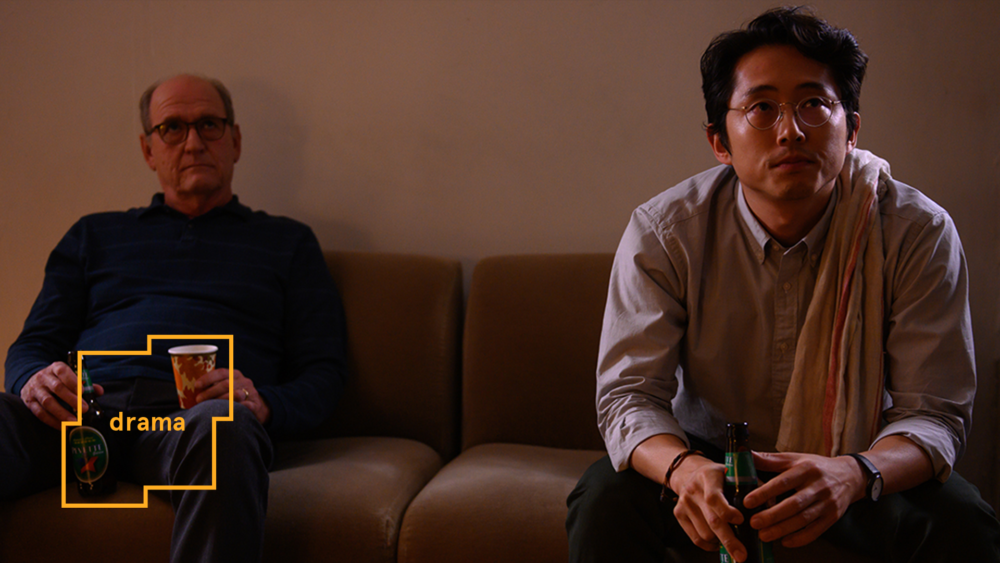
    Forgoing family tradition, the Blake family spends Thanksgiving in younger daughter Brigid (Beanie Feldstein) and her boyfriend Richard’s (Steven Yeun fresh off his Oscar nomination for Minari) new apartment in Lower Manhattan. For anyone who grew up outside New York — like yours truly (Jersey!) — and moved into the city, having your parents come to your apartment is a stressful experience.

    Yes, this is a family drama and quasi horror, but it’s also a dark comedy that hilariously understands the intricacies of the family dynamic. Mom talks about the latest odd death that she heard about on Facebook (“Mom, you don’t have to tell me every time a lesbian kills herself,” says Amy Schumer as eldest daughter Aimee), Dad walks around the apartment finding things to fix and chastises Brigid for not telling the super. All the while, their grandmother Momo (June Squibb), who suffers from dementia, babbles on.

    The camera lingers on the artifacts of New York City apartments that are so familiar — the odd water stains on the wall, clanking radiators, shoddy light fixtures. And of course, Brigid’s parents Deidre and Erik (Jayne Houdyshell and Richard Jenkins) notice every single detail. These artifacts are a part of the horror of the film. Like a hidden totem of the unspoken trauma occurring outside of the walls of the apartment. For people that live in the city, those things fade away. For everyone else, they’re all too apparent.

    💌 Sign up for our weekly email newsletter with movie recommendations available to stream.


    ADVERTISEMENT


    There are other horror tropes that Karam uses to make you uneasy about what’s happening in The Humans. The camera creeps from around corners and frames characters with plenty of negative space around them. He tracks characters walking down the narrow halls and sometimes even includes a jump scare. 

    When stage plays are adapted to film you can often tell. There’s a certain cadence to the dialogue that feels just next to normal. And typically directors focus too closely on the dialogue. The Humans does the exact opposite. Dialogue happens in the background just out of the frame. Conversations are happening around the characters. We’ll focus on one of them and slowly close in. We see their reactions — or lack thereof — to what is going on around them. 

    But why is The Humans a horror? Why not just make it a family drama? I haven’t said much about the plot yet, but that’s because there really isn’t one. Each of the members of the family is dealing with their own issues — Aimee is dealing with a breakup, Erik is worried about finances — and the relationship dynamics that existed way before the movie began — how many of us could be a little nicer to our moms. But real life can be horrifying in that way. There’s nothing more horrifying than facing your own failures and the existential dread of life.


    ADVERTISEMENT


    As the night trudges on, revelations are made, arguments are had, and, of course, there are moments of familial bliss. In particular, Richard’s attempt to assimilate into the family is particularly hilarious, as anyone that has brought a significant other home could attest to. The movie maintains this tone dancing around drama and dark comedy as it explores the intricacies of the family dynamic and of being alive. It’d make a perfect companion piece to fellow New York City-set dramedy The Daytrippers

    This is one of those films that I have difficulty talking about because the reason it works is so personal. You can pick out moments of relatability — both positive and negative — throughout the film and with every character. It’s an incredibly humane film that begs for empathy for its characters. You feel like you get to know them as well as your own family. If I could say one thing to convince you to watch this movie it is this: by the end, you’ll be sad you can’t hang out in that apartment anymore. 


    ADVERTISEMENT


    More movies, less problems


    Hey! I’m Karl. You can find me on Twitter and Letterboxd. I’m also a Tomatometer-approved critic.

    💌 Sign up for our weekly email newsletter with movie recommendations available to stream.


    ADVERTISEMENT

    💌 Sign up for our weekly email newsletter with movie recommendations available to stream.


    ADVERTISEMENT


  • ‘Sorry to Bother You’ review — A wild, terrifying, and brilliant social satire

    ‘Sorry to Bother You’ review — A wild, terrifying, and brilliant social satire

    Sorry to Bother You is uncategorizable as a movie because nothing has taken the same risks, but the outcome is stunning

    Sorry to Bother You is overwhelming, mesmerizing, confusing, terrifying, and perhaps, almost too smart for its own good. That being said, there’s never been a more stunning takedown of capitalism than this movie. Get Out changed cinema as a mainstream social satire that works effectively both on the level of a horror movie and comedy. And while Sorry to Bother You doesn’t quite reach that level — the pacing feels precisely too slow and too fast at the same time — it’s heartening to see something like it exist. Mostly because a movie like it has never existed. If any movie is postmodern, it’s this one.

    In the movie, which is Boots Riley’s debut feature, television is dominated by the news, a show called “I Got the S#*@ Kicked Out of Me!”—it’s exactly what it sounds like—and ads for Worry Free Living. Worry Free is a company that offers free housing (a tiny room filled with rows of two people to a single bed), free food (the worst cafeteria food), and no bills in exchange for free labor. It’s a heightened version of reality, but still, sadly, based in some reality. At one point, we cut to a newspaper headline that says that Senate declares Worry Free’s practices legal and not slavery, though it clearly is. It’s that kind of confrontational messaging that makes Sorry to Bother You soar.

    Lakeith Stanfield plays Cassius “Cash” Green, who we meet in the middle of a job interview for the telemarketing company RegalView. Hilariously, he comes in holding an employee of the month plaque and enormous trophy from high school. However, the interviewer notices that a job on his resume is a fake—since he was the manager of the bank that Cash allegedly worked at. Still, Cash is hired—mostly because the job takes almost no skills other than “sticking to the script.”

    Sorry to Bother You
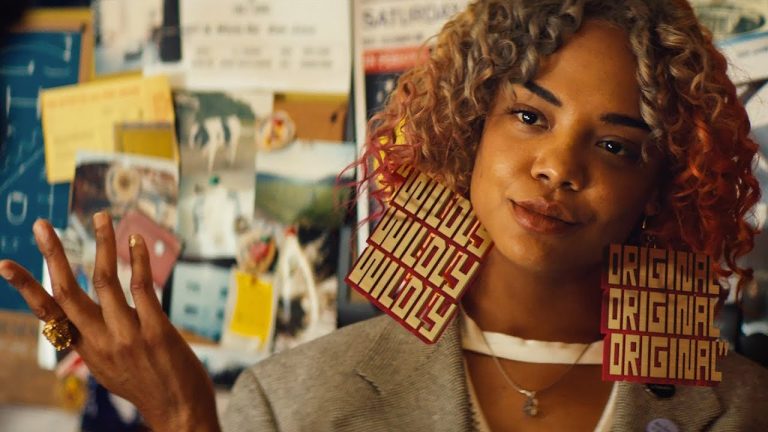
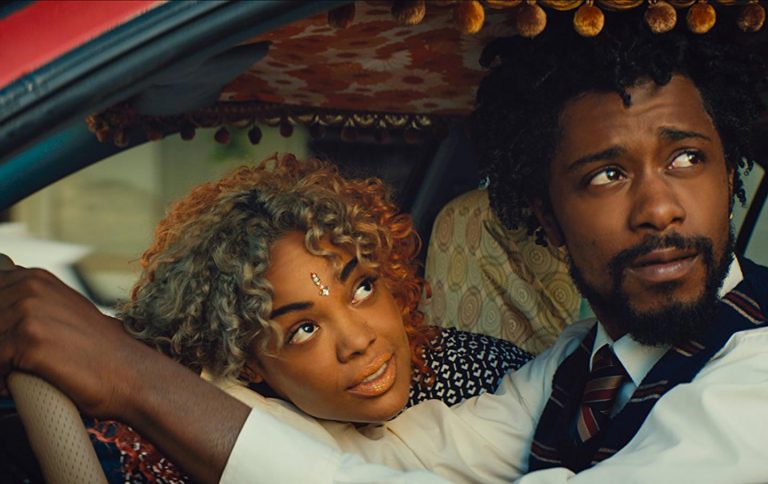
    Tessa Thompson in Sorry to Bother You.

    Cash struggles with the job at first. He’s unable to get any customers to buy anything, which even drives him to consider working for Worry Free. His artist-activist girlfriend Detroit (Tessa Thompson) vehemently opposes the concept of the company and often vandalizes their billboards as part of an activist group called “The Left Eye”. Eventually, Langston (Danny Glover), one of Cash’s coworkers, gives him the tip of using his “white voice” when talking to customers. It’s exactly what you think it’d sound like. Cash’s white voice is voiced by David Cross. Again, it’s a provocative, ridiculous, but incredibly effective way to portray the code-switching that black people often have to do depending on the setting. However, the tactic makes Cash one of the best telemarketers in the company and setting on a path to become a “power caller”.

    After the end of each shift Cash’s friend Salvador (an underutilized Jermaine Fowler), who also works at RegalView, and co-worker Squeeze (Steven Yeun) go to a local bar to decompress from the day. Squeeze mentions wanting to start a union to demand raises. Salvador, Cash, and Detroit, who has begun working at the telemarketing company, all join along with most of the staff. They stage a strike in the middle of the day that angers management, and though Cash is part of the strike, management still promotes him to “power caller” based on his performance. He is sent up in a golden elevator with a ridiculously long passcode—one of the best sequences of the film—and meets his manager, whose name is bleeped out, who explains that power callers sell everything from weaponry to workers for Worry Free.

    From there, Sorry to Bother You somehow gets even more bizarre for better and for worse. Riley leverages provocative imagery that we have seen—protests getting violent as they clash against authorities— and that I sure as hell hope we never see—something involving horses. However, it shows that he has a clear message, even if that message isn’t communicated as clearly as I would have hoped. Some aspects or threads are dropped, some for the better and some for worse. However, it’s just the mark of a first time director.

    By the time Armie Hammer’s villainous Worry Free CEO Steve Lift comes into the mix to present Cash with an offer, the movie is off the rails in that the means of the plot becomes pure fantasy, but the message remains a troublingly realistic one. Riley targets our society today with dead-on aim from politicians being outraged without any follow through to the very concept of capitalism. And while cinematically the movie doesn’t always work, that aspect is there. Sorry to Bother You has so many ideas and delivers on a lot of them and falters on some, but the very idea of the movie is the protest. Yes, it’s weird. Yes, it’s shocking. But I am so glad this movie exists. Riley, Stanfield, and Thompson are stars on their way up. Sorry to Bother You is just another step in that ascension.

    Sorry to Bother You is available to buy or rent on Amazon!

    Karl’s rating: