
Tag: Trevante Rhodes

  • ‘Bird Box’ review — Netflix’s uneven but entertaining post-apocalyptic thriller

    ‘Bird Box’ review — Netflix’s uneven but entertaining post-apocalyptic thriller

    Bird Box doesn’t bring anything new to the post-apocalyptic thriller genre despite a strong third act and solid performances.

    Bird Box certainly has the pedigree of a great movie behind it. The Netflix-produced movie is directed by the Emmy-winning director of The Night Manager Susanne Bier—she pulled off an upset against The People v. O.J. Simpson—written by the Oscar-nominated screenwriter of Arrival Eric Heisserer, and based off Josh Malerman’s novel of the same name, which is one of the best novels of the decade. 

    However, all the talent doesn’t necessarily translate onto the screen. Bird Box tells the story of the end of the world that is eerily similar to A Quiet Place, which premiered earlier this year. A phenomenon of people killing themselves after seeing some mysterious creatures is spreading across the globe. Unlike A Quiet Place, Bird Box—to its detriment—shows us the end of the world. 

    Reluctant expecting mother Malorie (Sandra Bullock) is taken to a prenatal checkup at a hospital by her plucky and excited sister Jessica (Sarah Paulson). As the sister’s make their way to the hospital, news about an odd phenomenon happening in Europe and Asia dominate the TV and radio. Something is making people commit suicide in droves and it just arrived on Malorie and Jessica’s doorstep.

    There’s a fantastic action sequence in the underrated World War Z where Brad Pitt and his family must escape Philadelphia while a wave of newly zombified corpses floods the streets. Bird Box goes for the same effect here to less successful results. Bier does a great job of adding tension to set pieces, however, some of the choices she makes take away from that tension.

    Sandra Bullock and Sarah Paulson in Bird Box. Courtesy of Netflix.

    As they’re trying to escape the chaos unfolding, Jessica sees whatever creature is causing the phenomenon and crashes the car. Malorie is able to escape to a nearby house with the help of Iraq war vet Tom (Moonlight‘s Trevante Rhodes) where she finds a group of people trying to process what just happened.

    In the house, we find conspiracy theorist grocery store employee Charlie (Lil Rey Howery of Get Out fame), an older woman named Sheryl (Jacki Weaver), and the bothersome alcoholic Douglas (John Malkovich). Those character descriptions I gave are all we ever know about these and the other characters in the house including some that we know even less about—Greg (B.D. Wong), Felix (Colson Baker aka Machine Gun Kelly), Lucy (Rosa Salazar).

    The group falls into a routine with Tom taking a leadership role and Douglas continuing to antagonize the group. Eventually, a soft-spoken pregnant young woman named Olympia (Danielle Macdonald—a standout) comes to the door in one of the more memorable sequences in the film. Her character is one of the few that is given some depth and often drives emotion into the story. 

    The house is fortified by covering the windows with newspapers and no one goes outside without a blindfold. Desperate for food, the group leaves the safety of the house in a completely blacked out car to venture to a grocery store. As they make their way, the sounds of the crumbled society echo around them—the issue here is that Bier shows us what is happening outside the car leaving little intrigue.

    For the first two-thirds of the film, the screenplay often falls into cliches of the apocalypse genre—, particularly in the often messy dialogue. What made the novel and A Quiet Place is the scarcity of details and genre. Bird Box, on the other hand, goes too far into the weeds to explain characters and the situation they’re in. Yet somehow, we come away knowing less than we did before.
    Bird Box
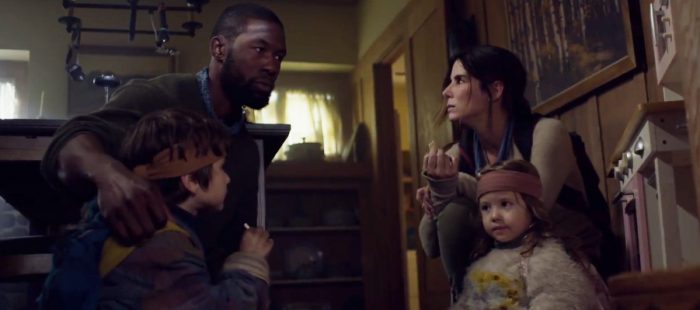
    Trevante Rhodes and Sandra Bullock in Bird Box. Courtesy of Netflix.

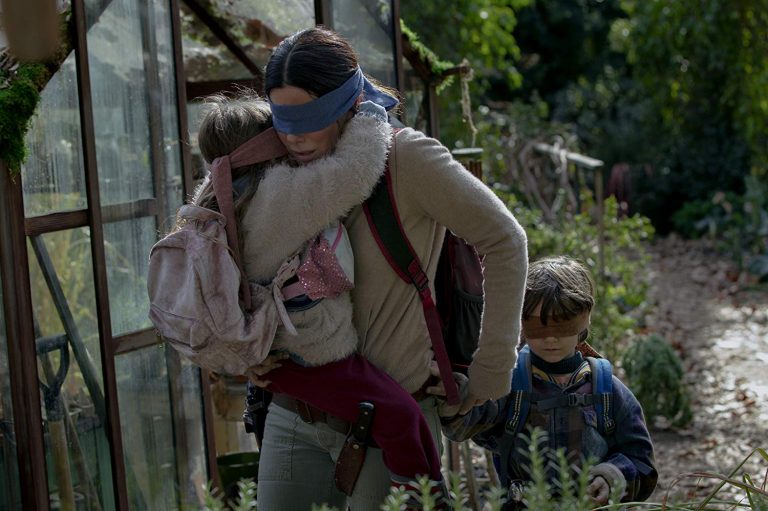
    However, parts of the movie do work. Sprinkled throughout the film are flashforwards to a time further into the crisis in scenes that feel like they’re pulled from A Quiet Place. Malorie along with two young children named simply Girl (Vivien Lyra Blair) and Boy (Julian Edwards) take a boat down a river to some mythic sanctuary where they hope to be safe from the creatures. 

    Here, Bier and Heisserer take a simplistic approach. There’s little to see and little dialogue. These scenes are easily the best and most tense, so when the film completely reverts to these flashforwards for the third act it takes off. There’s something heightened and terrifying about not being able to see and Bird Box translates that feeling onto the screen as Malorie and kids encounter dangers down the river. If anything, the third act redeems the movie as a whole.

    The premise of Bird Box is so promising and its source material is some of the best horror fiction ever written. However, it often feels like both Bier and Heisserer don’t trust the audience enough to deliver a stripped-down story. Maybe that’s because Netflix was looking for a mainstream blockbuster type, which they certainly got—this movie is going to be a crowdpleaser, most likely. 

    The third act is where thematically the film comes together as Malorie struggles with motherhood in the face of a hopeless world. Bullock is solid as always in these scenes, but Rhodes is the steady hand here that elevates the material and delivers the thesis of the movie. It makes me wish this is what Bird Box was the entire time, but that would just be A Quiet Place wouldn’t it?

    Bird Box will be available to stream on Netflix on December 25th. You can get the book here.

    Karl’s rating:

  • Moonlight Movie Review — An instant classic and landmark in film history

    Moonlight Movie Review — An instant classic and landmark in film history

    Moonlight is gorgeously crafted, masterfully acted, surprisingly timely, and demands to be watched and respected

    It wasn’t until I got into my twenties that I became aware of what identity is. Identity is as much how you view yourself as what the world views you as. You may be a minority or gay or poor, but that doesn’t mean you have to identify as those things. It’s truly your experience that shapes your identity. Any LGBTQ+ person knows what it is to struggle with identity. Hell, anyone that is anything different from what society views as normal has struggled with identity. It’s a process that is as emotionally taxing as it is satisfying. Learning who you truly are and who you see yourself to be is one of the most liberating — sometimes heartbreaking — experiences. That’s what Moonlight really is about: identity. Not only the concept of identity, but the process of discovering, struggling, and ultimately accepting who you are.

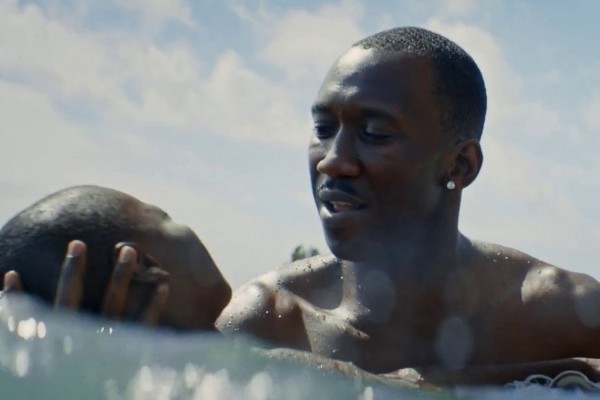
    Moonlight is split up into three parts that are named after the nicknames that our main character is called: Little, Chiron, and Black. In little, we meet young Chiron (Alex Hibbert) as he is running away from a group of taunting classmates. Eventually, he finds shelter in a crack house and is soon discovered by Juan (Mahershala Ali), who takes him under his wing. Juan is an interesting character. He is the only character whose perspective we see outside of Chiron’s. This is an important choice because Juan is a character whose identity as a drug dealer directly contradicts his caring personality.


    Eventually, Juan takes him under his wing along with his girlfriend Teresa (Janelle Monae). They become Chiron’s figurative parents while his real mother, Paula (Naomie Harris), is on drugs or with random men. This part is about Chiron discovering his identity. Juan is there to assure him that there are other people out there like Chiron.

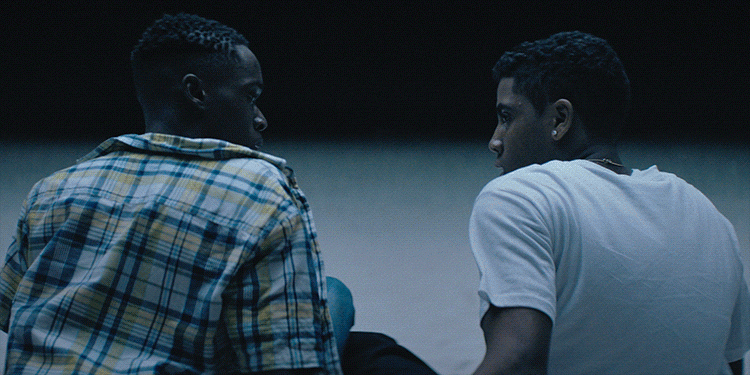
    The second part of the film follows Chiron as a teenager as he struggles with his identity. At this point in his journey, he’s as confused and vulnerable as ever. He must deal with his mother falling further into drug addiction, his place as a punching bag for the school’s bullies, and his deepening confusion about his sexuality. However, maintaining a close eye on his subjects, Jenkins portrays Chiron’s struggle with a chilling intimacy that culminates in a chilling final shot.

    In the final act, Chiron has transformed into Juan both physically, professionally, and mentally. There is even a scene where he gives a pep talk to a younger associate. However, this act is outlined by his acceptance of who he is. Ultimately, he must face his past ghosts and find a way to embrace it as part of his identity.

    moonlight movie review

    Jenkins and cinematographer James Laxton were careful to shoot nearly the entire film in close-up. It’s a deeply personal story. However, Jenkins also doesn’t shy away from cinematic flair. In particular, composer Nicholas Brittell’s score mixes old school rap and hip hop with classical music to outline the beauty and savagery of growing up. The most surprising element though is the sound. It comes in and drops out in the perfect places. However, the most effective part of its design is when we hear dialogue, but all we see is a look in the actors’ faces.

    I need to take a moment to talk about this incredible cast. First, the three actors that portray Chiron are revelations and bring entirely different perspectives on the role that come together to create this dynamic character. Alex Hibbert, who portrays the young Chiron, has this knowing look that captures his attempt to understand something that is just out of grasp. Teen Chiron, portrayed by Ashton Sanders, instead uses his physicality to show his inner battle to embrace who he truly is or what society wants him to be. Finally, Trevante Rhodes’ performance as the adult Chiron shows the character at his most emotionally vulnerable.


    However, they are joined by a supporting cast that use their limited screentime to make huge impacts. Naomie Harris, who plays Chiron’s mother in all three parts of the film, is phenomenal throughout the film. But her third act monologue is one of the best-acted scenes of the year. Jharelle Jerome, who plays Chiron’s love interest Kevin as a teenager, is a surprisingly naturalistic performer. Mahershala Ali, though, towers in the film. Though his screen time is short, his impact is felt throughout the movie. It’s truly a masterclass in acting. Then there is Andre Holland who plays Kevin as an adult. His performance is perhaps one of the best of the year. Along with Rhodes, he created scenes that felt so natural and real that I was floored that this was actually a movie. 

    LGBTQ+ characters are marginalized in film. However, black gay characters are completely in the periphery. Moonlight bravely brings them into the forefront. It is easily a turning point for queer cinema and black cinema alike. In the end, though, Moonlight is a love letter to the people that struggle with their identity and sometimes feel isolated. It works as both a comfort and a glimmer of hope. But that’s not to take away from the craft of the film. The only way to describe Moonlight is as art. It’s pure, unadulterated art. It’s storytelling at it’s best. It’s filmmaking at it’s best. It’s romantic, emotional, and, most importantly, a film that needs to be seen. 

    10/10

    Preorder Moonlight on DVD, Blu-Ray, or digital on Amazon!