While much of the attention and conversation on the French riviera is around the buzzy films competing for the prestigious Palme d’Or, often some of the beset films of the festival can be found in the Un Certain Regard section. Here are some of our favorites so far:
“On Becoming a Guinea Fowl” (dir. Rungano Nyoni)
On Becoming a Guinea Fowl
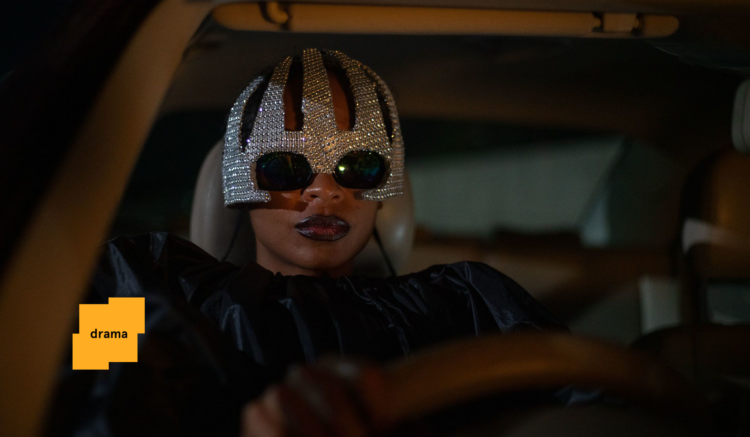
Driving home from a fancy dress party in the middle of the night, Shula stumbles across her uncle’s body on an empty Zambian road. As the funeral unfolds, the dark secrets of her middle-class family — and of the man they mourn — begin to surface.
There’s a sick joke at the heart of Rungano Nyoni’s sophomore feature, and she knows exactly how to land it. A woman finds a dead man and nobody seems to care, least of all her. What unfolds is a funeral you can’t look away from — absurdist, stinging, and unexpectedly funny in the way that only the most painful truths tend to be. Nyoni doesn’t hold your hand through any of it. She just pulls you into the rituals and silences of a family that has perfected the art of looking away, until the young women in its orbit decide they’re done doing that. Molasses-dark comedy wrapped around something that burns.
“My Sunshine” (dir. Hiroshi Okuyama)
On the snow-covered island of Hokkaido, a shy boy with a stutter falls under the spell of a figure skating prodigy and her quietly guarded coach. A tentative trio forms on the ice as winter begins its slow retreat.
Some films whisper. Hiroshi Okuyama’s gentle coming-of-age drama is barely above a breath — shot in hazy, overexposed light that makes the whole thing feel like a half-remembered childhood afternoon. The two young leads carry years of unspoken feeling in their faces, communicating more in a glance across an ice rink than most films manage in a whole monologue. It feels like a memory — the kind you’re not quite sure is real. Sweet and soft and quietly uplifting in a way that sneaks up on you. Not because it shook you. Because it held you.
“Flow“ (dir. Gints Zilbalodis)
After a catastrophic flood swallows the world, a solitary black cat finds reluctant refuge on a drifting sailboat alongside a capybara, a lemur, a dog, and a great bird. No humans. No dialogue. Just survival, and something that starts to feel like trust.
Not a single word is spoken in Gints Zilbalodis’ extraordinary second feature, and honestly? It doesn’t need one. Built entirely in open-source software by a Latvian director still in his twenties, Flow moves like water — fluid, alive, impossible to hold still. It has the visual grammar of a dream and the emotional pull of something far older and more primal. Watching that cat inch toward its fellow survivors, sharing fish, learning to steer, you feel something loosen in your chest. Cinema doesn’t always need language. Sometimes it just needs a cat on a boat at the end of the world.
Timothée Chalamet stars as a would-be table tennis star tears through New York City in the pursuit of greatness—and some cash—in “Marty Supreme”
“Marty Supreme” is basically a comedy of errors, and series of unfortunate events, that pits would-be table tennis star Marty against his greatest enemy—failure. And for 149 glorious meteoric minutes, we want nothing more than for Marty to keep going. With a career-best performance by Timothée Chalamet, “Marty Supreme” is messy and maddening, but impossible to turn away from.
“Marty Supreme” is in theaters on Christmas Day.
After a series of setbacks that leaves a trail of black eyes, smashed cars, and orange ping pong balls, Marty Mauser (Timothée Chalamet) is told by a potential way out, “there are no second chances in life.” To which he responds with an emphatic, “why not?” That’s the attitude in which Marty walks (or perhaps “trounces” is more suitable) through life. He talks a mile a minute, lies like his life depends on it (because sometimes it does) and makes decisions like consequences don’t exist. And for 149 glorious meteoric minutes, we want nothing more than for Marty to keep going. Even if we can’t decide if we want to cheer, cry or hit him upside the head, there’s something intoxicating about the New York playground writer-director Josh Safdie allows Marty to play in.
ADVERTISEMENT
We get to see this version of 1950s post-World War II New York the way Marty sees it, full of opportunity, danger and people that simply don’t understand if you want something you just have to try harder. Chalamet, sporting wire-framed glasses, greasy hair and even greasier mustache, is devilishly charming as we watch him float through the city trying to shake down his uncle for cash to get to the table tennis championships in London (armed robbery is the solution, of course). When he gets there, we get to understand what drives him: greatness. He doesn’t even say he’s competing in a tournament, which assembles the best table tennis players in the world, he says he’s winning it. Like this is a reality in his mind. The same reality that drives him to rack up a bill in the thousands at the Ritz Carlton, even after he’s told that treatment is reserved for the star players (he is one, in his mind).
After watching him compete through several thrilling rounds of table tennis, which Safdie captures with sweat-dripping intensity, he makes it to the final against Japanese phenom Endo (Koto Kawaguchi. Despite his hard-hitting and running and diving, Marty is no match for Endo’s innovative technique. Marty is enraged, calling the win a sham and accusing him of cheating. There’s no way he lost (again, at least in his mind). It sets him on a course for revenge, if only he can gather the money to get to the next championship in Japan.
“Marty Supreme” is basically a comedy of errors, and series of unfortunate events, that pits Marty against his greatest enemy—failure. As he tears through the city weaponizing his signature charm to try to gather the money for his flight, we see the limits of his own self-deluded confidence. From the Lower East Side to Chelsea to Jersey, Marty leaves a messy path as he storms through. We meet a cast of characters along the way including acclaimed Marty’s old gambling buddy Wally (a hilarious Tyler Okonma aka Tyler, The Creator), his mischievous mistress Rachel (a fabulous Odessa A’zion), and silent movie actress Kay Stone (Gwyneth Paltrow) whose husband Milton (Kevin O’Leary of “Shark Tank” giving a surprisingly delightful performance) could hold the key to Marty’s success.
ADVERTISEMENT
Like his previous movies “Good Time” and “Uncut Gems“, Safdie balances the dark comedy and devastating reality of male hubris to a dizzying effect that is not just hypnotic, but damn entertaining. Marty’s inability to get any part of his plan right is satisfying for an audience that knows exactly who this man is. A man who believes that he is owed success and will do anything to obtain it. Chalamet is so convincing as Marty that it feels like he truly believes his own lies as he switches effortlessly between a charm offensive, machismo, or straight-up violence to get what he wants. It’s masterful and sinfully entertaining.
However, it is to an end. While “Marty Supreme” could have easily been just another entry in the dirtbag scammer movie, Safdie casts it against a world in flux where there’s nothing but opportunity whether for a Jewish girl from the Lower East Side or a Japanese table tennis player with his country on his shoulder. It is about dreams and who is allowed to chase them. It’s where those opposing forces of hoping Marty will stop ruining his own life and urging him to go on come from. While it is all fun and games (I mean, it’s literally ping pong), it’s also the stuff humanity is made of.
The movie may not be perfect. “Marty Supreme” is messy and maddening, but isn’t life?
“Wicked: For Good” brings the story of Elphaba and Glinda to a satisfying conclusion, even as its source material’s flaws glimmer through.
“Wicked: For Good“is, much like Act 2 of the stage show, a mixed bag. It highlights the strongest aspects with raw and visceral musical numbers that underline the emotional struggles of the characters. At the same time, however, it emphasizes its weaknesses as it clunkily weaves “The Wizard of Oz” into the story. Still, and most importantly, the relationship between Elphaba and Glinda hits all the emotional notes that made Wicked such an enduring story. Cynthia Erivo continues to captivate on the screen, but it is Ariana Grande’s magnificent performance as an emotionally-torn Glinda that gives the movie the complexity and depth to become greater than the sum of its parts.
“Wicked: For Good” is in theaters Friday.
For better (good?) or worse, “Wicked: For Good”is exactly the movie you’re expecting. For fans of the stage show, it highlights its strongest aspects. The musical numbers have the same raw, visceral emotionality just blown up in scale while the characters’ complex journeys are even more deeply felt. With that, however, it emphasizes its notorious weaknesses. In particular, the way the plot twists to tie to “The Wizard of Oz”still feels clunky. Despite its failings, and most importantly, the relationship between Elphaba and Glinda hits all the emotional notes that’s made “Wicked”such an enduring classic. Perhaps even more so in the movie version.
ADVERTISEMENT
Part one of the Wicked duology has the easier job. Not only is its tie to “The Wizard of Oz” tenuous, the archetypes of the characters are simple and familiar. Elphaba (Cynthia Erivo) is the brainy outsider that rails against injustice and Glinda (Ariana Grande) is the self-absorded popular girl with an unexpected heart. “For Good” takes those archetypes, and throws them into a complex situation that mirrors the very real structures of oppression in our society. Structures that director Jon M. Chu emphasizes even more with propaganda against Elphaba flying through the streets of Oz and added scenes of prejudice that could be taken straight out of a Holocaust movie. Yeah, things get a little convoluted.
The story’s clear ties to the darkest instincts of society sometimes rub against the silliness of a world where munchkins co-exist with talking animals. It’s maybe even more stark with the additions to the plot by screenwriters Winnie Holzman (who penned the stage version) and Dana Fox. Among those additions is a new song sung by Elphaba called “There’s No Place Like Home” where she encourages the animals, who are forced into hiding, to fight for their homeland. Like many of the changes to the story, it feels gratuitous and out-of-place in an attempt to emphasize a theme that is already underlined in the source material. Unlike the changes to the first movie that felt in service to the characters’ journeys. Holzman should have trusted her original writing because what works most often in the movie is what is taken directly from the stage.
ADVERTISEMENT
The second act of Wicked has always felt like Glinda’s story as she struggles between two truths: that she enjoys the adoration brought to her by working with The Wizard (Jeff Goldblum) and Madame Morrible (Michelle Yeoh), and the fact that she knows that her friend is a good person. Ariana Grande’s magnificent performance underlines that paradox as she tries to hold on to her newfound power in Oz while protecting her friend. Part of that involves ignoring what is happening around her with the glimmer of hope that it’s not as bad as Elphaba says and that it is not too late to change course. But Grande never lets that hope come off as delusion. For a character as high off the ground as Glinda, she always feels grounded in something real.
As the story progresses and alliances shift or are revealed, the main trio of Elphaba, Glinda and Fiyero (Jonathan Bailey) circle each other with fiery passion fueled by their histories. Like in “As Long As Your Mine,” which feels even more like a showstopper in the movie. Bailey exchanges his character’s bravado for real bravery as he bares his genuine feelings for the first time. As the camera swirls around the couple, it feels like classic romantic movie magic. That is juxtaposed against “No Good Deed,” which burns with anger and pain as Elphaba, delivered with unrestrained ferocity by Erivo, faces her past and present failings in a desperate attempt to save what she loves. Chu finds the emotional core of each of these numbers and amplifies them to the cinematic proportions they deserve, even as his direction fails in other aspects.
The final act, torn directly from the stage version, finally reaches the levels of greatness set by the first movie. And that is because at its core “Wicked” is a story about two women that in finding compassion in their differences drive each other to be better people. Erivo and Grande seem to understand that as they sing the title number to each other. Somehow they fill the space between the characters with all the hopes, regrets and words unsaid between them. It is movie musical magic. Despite its flaws, the booming crescendo of the piece, which has the characters facing uncertain futures, is deeply felt. It leaves you missing them as the screen fades to black. It is the raw and plain power musical theater captured on film.
“Black Phone 2” channels “A Nightmare on Elm Street” as Ethan Hawke’s serial killer The Grabber comes back from the dead
Fans of the first movie will find the expansion of the boundaries of its world and the exploration of its characters’ wounds in “Black Phone 2” engaging. Is that enough nightmare fuel to hypnotize anyone else? Perhaps not.
“Black Phone 2“ is in theaters now.
There is a cacophony of influences you can see in Scott Derrickson’s “Black Phone 2“, the follow-up to his surprise 2021 horror-thriller hit. The icy, snowstorm-plagued setting on the film harkens directly to Stanley Kubrick’s “The Shining” while the dream-world horror briefly explored in the first film is expanded to reference Freddy Krueger’s sleep-killing demonics in “A Nightmare on Elm Street“. There are shades of various camp slashers like “Friday the 13th“and “Curtains” filtered through the lens of Stephen King’s visceral hauntings. And while all these references come together to create a film that is meaner, scarier and more effective than its predecessor, it also emphasizes the fact that it’s not as good as any of these stories.
Trading the quiet of suburbia for the eerie isolation of a winter sleepaway camp, “Black Phone 2” continues the story of siblings Finney (Mason Thames), the only survivor of serial killer The Grabber, and his clairvoyant sister Gwen (Madeleine McGraw). This time, however, the nightmare becomes an actual nightmare as the now dead Grabber (Ethan Hawke) turns his murderous sights to Gwen’s dreams that take place in a sort of spirit plane where he now resides. If it doesn’t make a whole lot of sense to you, take solace in the fact that the logic never fully adds up.
What is clear is how viscerally terrifying Gwen’s dreams are. Filmed in Super 16 film to create a moody dreamlike quality, the sequences feel like they give “Black Phone 2” a purpose. Haunted by both the souls of boys killed at the sleepaway camp and The Grabber himself, Gwen finds herself at war with the demon. However, those sequences lose their impact with time and the real world scares, mostly surrounding Finney and the eponymous black phone that saved him in the first movie, don’t give the same skin-crawling creeps.
“Black Phone 2“doesn’t ever lose you during its robust 114-minute runtime. But it never blows you away either, except perhaps a dream battle that blurs the line between nightmare and reality. It comes close when Derrickson fully commits to his 80s-tinged homage to horror movies past, but it never truly adds up to something that feels like it has reason to exist.
If you liked the first movie, the expansion of the boundaries of its world and the exploration of its characters’ wounds will be engaging. Is that enough nightmare fuel to hypnotize anyone else? Perhaps not.
An NFL prospect who falls under the tutelage of an enigmatic star of the game who may have sinister intentions in Jordan Peele-produced “Him”
“Him” has a lot of potential, but mostly disappointment. Though it is teeming with ideas about sport, sacrifice, and legacy, they never become more than just that, ideas. Tyriq Withers, a genuine star-in-the-making, lights up the screen with every moment, but is ultimately let down by a weak screenplay and directorial vision.
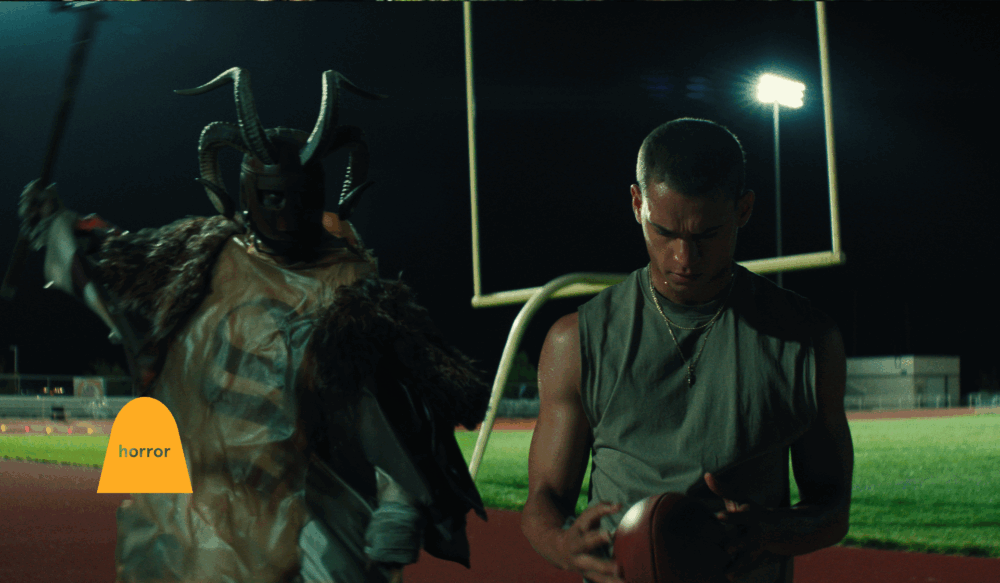
Few things are more terrifying to me than American Football. Pushing the limits of the human body, the toxic levels of testosterone, and the thirst for literal blood, sweat, and tears draw a visceral reaction. It is a culture and industry ripe for a horror movie. Frequently, director Justin Tipping’s “Him” draws comparisons between the sport and the gladiators of ancient times. So much of the way the sport (and business of the sport) is played today is akin to the forced violence of the Colosseum, where men are coerced into a spectacle. When the movie is actively drawing those comparisons, it finds its footing both thematically and narratively. The horrors feel close to reality. However, the movie too frequently strays from those ideas in favor of shock.
ADVERTISEMENT
Something that Jordan Peele, whose company Monkeypaw produced the movie, has perfected is using terror as a means to an end. Nothing feels gratuitous, and everything has a line back to his ideas. It’s something that “Him” lacks, specifically in its main characters. Cameron Cade (star-on-the-rise Tyriq Withers) has been tapped as the next best thing in football as he ends his college career and begins to weigh his prospects in the NFL. That is, until a devastating attack leaves him with a potential traumatic brain injury that threatens his campaign for greatness.
Not all is lost, however, when his agent (Jim Jeffries) reveals that football legend Isaiah White (Marlon Wayans) has invited Cam to train at his sprawling, isolated private compound. Over five days, in the dark, bruatlist passageways, Cam is treated to the highest quality care and training with the hope of reaching the heights of White’s career. And for White, he hopes he leaves a lasting legacy. However, as with all things that seem too good to be true, they often are.
ADVERTISEMENT
At first, Isaiah’s tutelage seems simply strict—no phones, no outside distractions, and no masturbation. However, very quickly, his instruction becomes increasingly devious as he strips Cam down—at times, literally—to his most animalistic tendencies. In one scene, perhaps the best of the film, Isaiah turns a passing drill into a game of survival. For each hesitation or dropped pass, Isaiah has a football shot into the face of a hapless free agent player desperate to get on his good side. It’s horrifying and forces Cam to be better, faster, and more than human.
However, moments like these feel few and far between as the horror begins to feel formulaic—terrifying training drill, calm tension-building recovery, jump scare to the next day. Wayans is menacing enough as a tormenter, but the screenplay doesn’t allow him to explore all the intricacies of Isaiah as a character. There’s an idea about success and sacrifice percolating in some scenes, but the movie never fully explores them. It is simply terror without meaning.
ADVERTISEMENT
By the time “Him” reaches its endgame, which is admittedly thrilling and shows flashes of the premise’s potential, there’s a sense of coldness. Unlike the rousing ending of Peele’s “Get Out” that feels like the natural conclusion, the finale of “Him” doesn’t feel earned. Instead, it simply ends because it must. Isaiah’s wife Elsie (a devilishly entertaining Julia Fox) and trainer (Tim Heidecker) add some amount of satisfaction to the conclusion, but you find yourself with more questions rather than answers.
“Him” feels like the outline of a great film. It has the ideas to form into a compelling story about greatness and sacrifice and the aesthetics to derive real terror as you push the human body to its limit, but it never fully combines those things into something that feels complete. Each scene simply feels like it attaches to that last with the thinnest of threads, and the characters all the same. Tyriq Withers is a movie-star-in-the-making and very often when the movie works, it’s because of his performance. But it’s all wasted potential. It’s all greatness gone to waste.
TIFF 2025 | ‘Carolina Caroline’ twists the Bonnie and Clyde story for the turn of the century as a couple stages a crime spree across the American south.
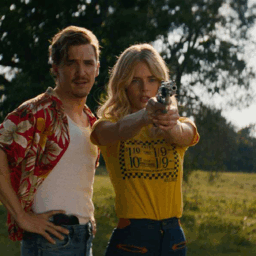
“Carolina Caroline” is a fiery blend of romance and crime that crackles with energy, driven by Samara Weaving and Kyle Gallner’s irresistible chemistry. Set against a ‘70s West Texas backdrop, the film turns small-time cons into a stylish, music-fueled crime spree that builds toward an inevitable crash. Director Adam Carter Rehmeier keeps the thrills high while asking whether the love is real or just another beautiful lie. Sexy, daring, and slyly subversive, it’s a crime romance worth taking for a ride.
“Carolina Caroline“ premiered at the Toronto International Film Festival.
“Let’s rob the whole world.” When titular Caroline mutters those words in the passenger seat of a hot-wired muscle car your heart skips a beat. It flutters from the romance of it. After all, she and her bank robbing beau Oliver fell in love over the fiery energy and adrenaline of committing a crime. But in the pit of your stomach you know that it can’t last because you’ve seen this story told countless times. You know that this kind of love and passion needs to have its tragic end. Its those expectations that writer-director Adam Carter Rehmeier relies on. Robbery and romance are just a part great American tale at the end of the day.
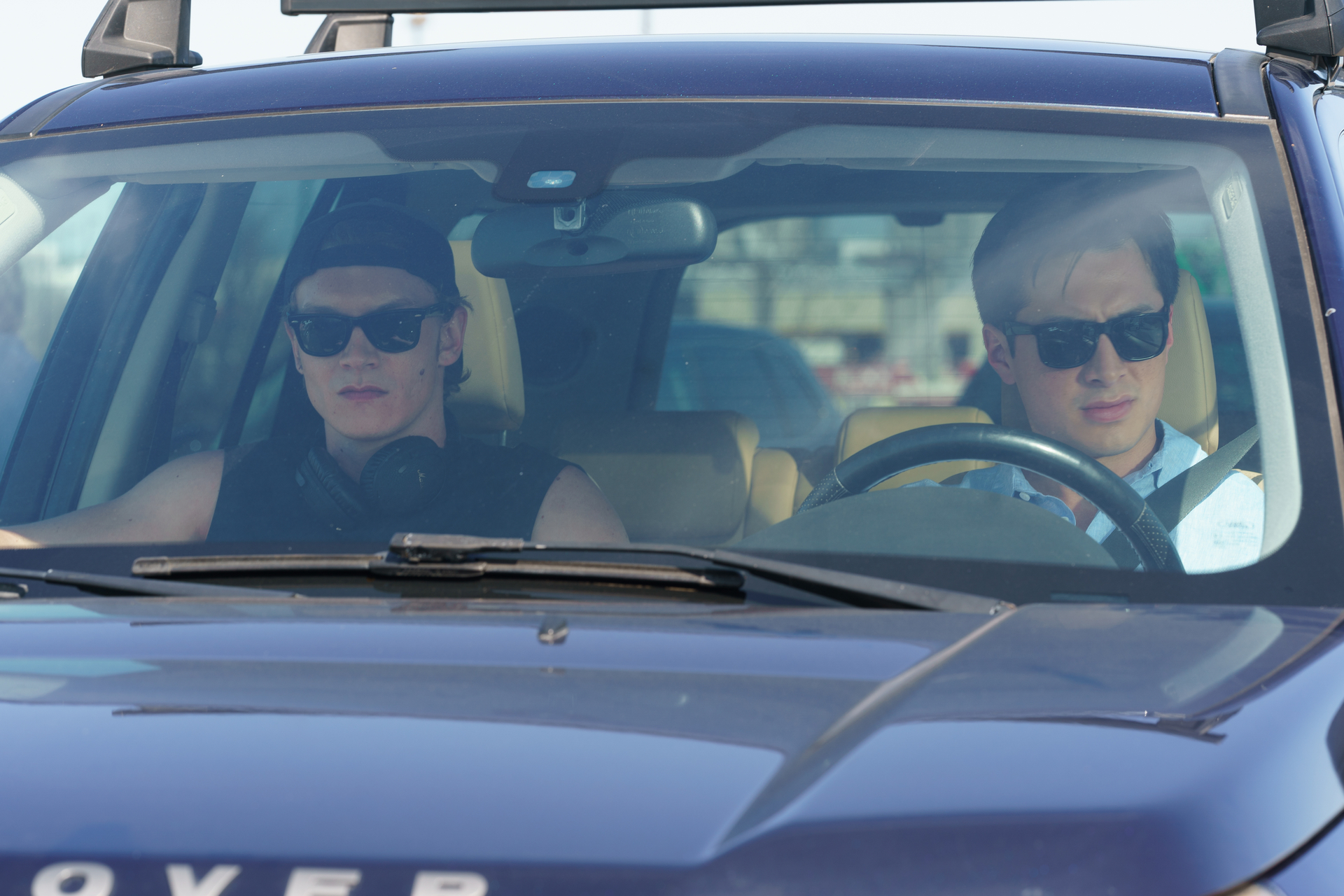
Despite the familiar, “Carolina Caroline” constantly feels exciting. It’s like being behind the wheel of a vintage sports car. The rumble and purr of the engine gets your adrenaline going because you know the second you hit the gas there’s no slowing down. There’s a charming rhythm to the way Caroline and Oliver banter from the moment they meet cute over a small-time con he pulls off in the gas station she works at. It’s love at first fraud. Samara Weaving (“Ready or Not“) and Kyle Gallner (“Strange Darling“) ooze with charisma on screen. The 70s West Texas world of the film is built entirely on their backs. Their thick southern drawls, easy charm and instant chemistry immediately transport you.
Their steamy tryst culminates in a proposition. Oliver asks Caroline for 500 dates. An offer Caroline can’t quickly refuse seeing as she’s never been outside of West Texas. Oliver’s easy cool, like a scruffy 70s James Dean, also isn’t easily refused. Just like his marks for a swindle, he seems to know what Caroline wants before she does. Thus begins a country music-driven romp through a slice of Americana as Oliver teaches Caroline the art of the grift—pickpocketing, hot-wiring and smooth talking—with the same breezy confidence that made Steven Soderbergh’s “Ocean’s Eleven” a modern classic.
However, petty theft has its limitations and Caroline and Oliver have a hunger for more just as their desire for each other grows. After all, justifying their actions by saying they’re stealing back from the corporations stealing from them doesn’t exactly work when they’re robbing small town gas stations. So, donning a severe black bob, dark sunglasses and a set of killer outfits, they set their sights on something bigger—the banks. Caroline hatches a series of bank robberies across the South with Oliver as getaway driver. Their debaucherous and sexy crime spree is impossible to resist.
But the real brilliance of “Carolina Caroline” becomes obvious when it comes careening towards its inevitable conclusion. When you realize that you were the mark. Because if there’s anything more American than robbery, it’s lies. Just as Caroline and Oliver lie to themselves, and each other, they also convince us that this wasn’t a romanticized dream and that one day they’d drive off into the sunset having done justice. There aren’t any easy answers as to what is real and what is just a convincing lie they are telling themselves—or we are telling ourselves.
Rehmeimer isn’t interested in guiding us to any sort of conclusions about the characters either. Their motivations are mostly kept close to their chests other than a scintillating one scene barn-burner performance from Kyra Sedgwick that pushes Caroline even further into her debauched decisions. Instead he convinces us of their love story and then asks the same questions Caroline asks herself, “are we good people doing bad things?” Instead of answering that question, “Carolina Caroline” asks us if the love was real or just another way to avoid reality. And what is more American than that?
TIFF 2025 | “Hamnet” follows a couple as they grow into a family only to suffer a devastating loss that forces them to confront the question of how to move on
“Hamnet” is devastating, but what makes it so powerful is that it is about the living—and what keeps us living. It’s our memories. It’s our art. It’s our stories. It’s our culture. They are why as we leave some behind we persist through grief. Through a vivid dreamlike vision, Chloe Zhao tackles the mysticism and lyricism of a family confronting loss with power and empthy. A cinematic masterpiece.
Hamnet is playing at the 2025 Toronto International Film Festival.
“Hamnet” may be about a death, but what makes it so powerful is that it is about the living—and what keeps us living. In the face of a devastating loss, two parents have to find a way to go on. Writer-director Chloe Zhao, adapting Maggie O’Farrell’s novel of the same name, has an answer for them. It’s our memories. It’s our art. It’s our stories. It’s our culture. It is these pieces of our history and humanity that push us to persist through the pain of grief as we leave some behind. Not in spite of the loss, but in honor of it. To mourn is to remember. And to remember is to love. And “Hamnet” will be remembered as one of the best movies of the decade.
ADVERTISEMENT
Adapting the novel was no easy task. While the story is simple, there’s a quiet mysticism and lyricism that ebbs and flows to create a tapestry of the family at its center. Not to mention, the Shakespeare of it all. It’s an atmosphere not easily captured on film. Zhao and cinematographer Łukasz Żal allow each frame to speak for the characters. They allow each image to carry all the interiority and emotionality of the characters. When William Shakespeare (Paul Mescal, “Aftersun“) and Agnes (Jessie Buckley, “I’m Thinking of Ending Things“) meet, it is like a force is driving them together. With few words and gentle touches, the magnitude of their connection is understood and will eventually drive them to marry.
There is a dreamlike quality to the early scenes of “Hamnet.” As we watch William and Agnes grow up out of their families—they both never quite fit in with them anyway—and into their own just the two of them, it’s like we’re watching a prophecy fulfilled in front of us. And in a way, Agnes, who we learn is rumored to be the daughter of a forest witch, has a certainty to her life through an ability to see a person’s true nature (and future) by holding a person’s hand between the thumb and index finger.
Zhao allows the story to unfold without urgency. Vivid visuals and crisp sound carry us through William and Agnes’s lives as they move into their own house, get married, and have children—Susanna and twins Judith and Hamnet (Jacobi Jupe). Warmth and joy are emanating from the screen, especially thanks to Buckley’s performance, which makes Agnes feel like a character with a past and future and Mescal who allows William’s interior genius to show on the surface. All is well until it isn’t.
ADVERTISEMENT
Like its namesake play, “Hamnet” is a tragedy. However, because the movie takes its time building this family before our eyes, the death doesn’t simply feel like a piece of a story. It feels like a tragedy happening to us, like we are being robbed of our time with these people. Their loss is our loss. And like all grief, the rest plays in fits and starts as William disappears and Agnes performs the machinations of everyday life, filled with sadness, anger, and questioning. But that isn’t the story’s main focus.
Instead, it strives to give the family and us, the audience, catharsis. In its stunning final act, we watch the story of “Hamnet” transform into the tale we’ve known for centuries. Except now, we have its intention. We can see the grief, anger, and questioning that we watched this family suffer. But we can also see the joy and time that they lost being reclaimed and enshrined in a story that we’re still telling today. That is the magnificent part of “Hamnet” and what makes it a masterpiece. It is cinema as therapy. It holds up a mirror to the audience and asks, “to be or not to be.” And the answer is clear.
TIFF 2025 | Bear gets more than he bargained for when his wish that his long-time crush falls in love with him goes awry in “Obsession”
With every eerie creep and dread-soaked beat, Obsession feels like a classic we’ve been watching for years—less derivative than timeless. It’s unquestionably a horror classic in the making.
“Him” is in theaters September 19th.
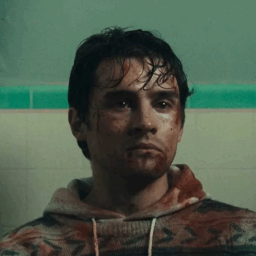
“Be careful what you wish for” has been a cornerstone of storytelling for ages. From genies to witches to mysterious neon-green serums that birth younger versions of ourselves, we’ve seen countless victims of desire fall prey to wanting more without sacrifice. Often, that premise has paired neatly with body horror—think “The Picture of Dorian Gray” or, more recently, “The Substance“. Both turn desire into a weapon against us. Writer-director Curry Barker taps into that tradition for his debut feature Obsession, delivering a film steeped in familiar tropes yet stamped with a singular vision. Remarkably, with every eerie creep and dread-soaked beat, Obsession feels like a classic we’ve been watching for years—less derivative than timeless. It’s unquestionably a horror classic in the making.
ADVERTISEMENT
The setup is simple: Bear (Michael Johnston), a quintessential nice guy with little game, pines for his childhood friend and co-worker Nikki (Inde Navarrette). Despite warnings from his best friend Ian (Cooper Tomlinson), he plans to confess his feelings with a gift. At a crystal shop, he finds a red box straight out of a 1960s infomercial. The “One Wish Willow” promises its owner a single granted wish if they break the branch inside. When Bear chickens out after driving Nikki home, frustration gets the better of him. He wishes for Nikki to love him more than anything in the world—and breaks the branch. Instantly, Nikki appears on her porch, staring. She looks like Nikki, but instead of playful sarcasm, her voice drips with desperate affection. Bear is hooked.
Their whirlwind “romance” escalates fast. Nikki practically moves in overnight, smothering him with affection, buying gifts, and clinging to his every move. Friends, especially Sarah (Megan Lawless), are baffled—after all, she recalls Nikki told her she saw Bear as a little brother. Bear ignores the comments. He finally got what he wanted. But of course, you know how the story goes: be careful what you wish for.
The only red flag, if you will, is Nikki sometimes snaps into another persona—confused, screaming, as if her soul were in torment. She stares at Bear from the dark corners of his bedroom, hyperventilates at the slightest criticism, and, oh, may have cooked his cat into a sandwich. At least she leaves him a cute love note.
ADVERTISEMENT
The brand of horror that Barker presents isn’t necessarily new, but he employs it brilliantly. Through shadow and light, Nikki becomes a specter (or demon) haunting Bear’s apartment, creating an atmosphere of constant dread. It’s like a haunted house and the ghost is your girlfriend. Her unnatural, unpredictable movements recall Japanese horror like “The Grudge” and “Pulse“, or possession films like “The Exorcist“, where the terror lies in losing control of your body. Subtle hints suggest what happened to the real Nikki, but “Obsession” wisely never explains everything, making the story all the more horrifying.
Johnston’s endearing performance has an easy charm that would’ve played perfectly in the romantic comedy. Alas, “Obsession” isn’t one. You feel for Bear. And you’re rooting for him. It makes the horror to come all the more tragic. As Bear finally admits that something may be wrong with Nikki, he starts to distance himself from her. She doesn’t take it well. As she turns from his dream girl to his worst nightmare, a path of blood and destruction follows that will have you glued to your seat and gripping the arm rest.
ADVERTISEMENT
Obsession feels like part of a new wave of horror. Alongside filmmakers like Zach Cregger (Barbarian, Weapons) and the Philippou brothers (Talk to Me), Barker leaves “prestige horror” behind in favor of something meaner, darker, and more cynical—where the consequences are deserved, brutal, and terrifying in their simplicity: you wanted too much. It’s horror for the post-pandemic age, where nothing is scarier than our own choices. At the same time, it’s devilishly entertaining, laced with dark comedy and kinetic filmmaking that make it endlessly rewatchable. Obsession feels like the kind of classic horror you revisit every October—that you fall in love with every moment of. Guess you could say we’re…
TIFF 2025 | ‘Hamlet’ gets a modern retelling that trades Denmark for London’s high society, infused with Hindu culture and led by Oscar winner Riz Ahmed.
Aneil Karia’s “Hamlet” fuses Shakespeare’s lyrical verse with Hindu culture and a majority South Asian cast, yielding a fresh, electric retelling. Riz Ahmed commands the screen, from a ferocious BMW-set soliloquy to a reimagined wedding sequence that spirals into chaos. Though shifting the story to corporate intrigue limits its scope and sidelines subplots, Karia’s visceral, emotive filmmaking and Ahmed’s powerhouse performance anchor the film. Not every reinvention lands, but its clarity of vision makes it undeniably compelling.
Hamlet is playing at the 2025 Toronto International Film Festival.
Shakespeare’s rich, lyrical language delivered by a majority South Asian cast already breathes fresh energy into this modern retelling of “Hamlet”, giving it a mesmerizing, electric charge. Yet it isn’t simply the infusion of Hindu culture that makes Aneil Karia’s adaptation so compelling. Its strength lies in his bold reimagining of the play’s most iconic moments, rendered with filmmaking that is visceral, muscular, and deeply emotive. These choices elevate both the performances, particularly Oscar winner Riz Ahmed (“Sound of Metal“) in the title role, and, at times, the story itself, pushing them beyond their already formidable power.
A gripping reinvented wedding
It is best displayed when the movie reaches its peak in a stunning sequence where “The Murder of Gonzago” scene from the play is reimagined as a choreographed performance at Claudius (Art Malik) and Gertrude’s (Sheeba Chaddha giving a gripping performance) wedding. Hamlet transforms the festivities into an accusation, using the stage to expose what he believes is his uncle’s crime. The dancers begin with a joyous traditional Indian routine, vibrant and full of life. Then, at Hamlet’s direction, the celebration curdles. Movements grow jagged and violent as the performers tear and claw at the main dancer representing the king. The murder is pantomimed in escalating frenzy, while the lighting and editing spiral into chaos, building toward a breathless climax that leaves the wedding suffocated in silence.
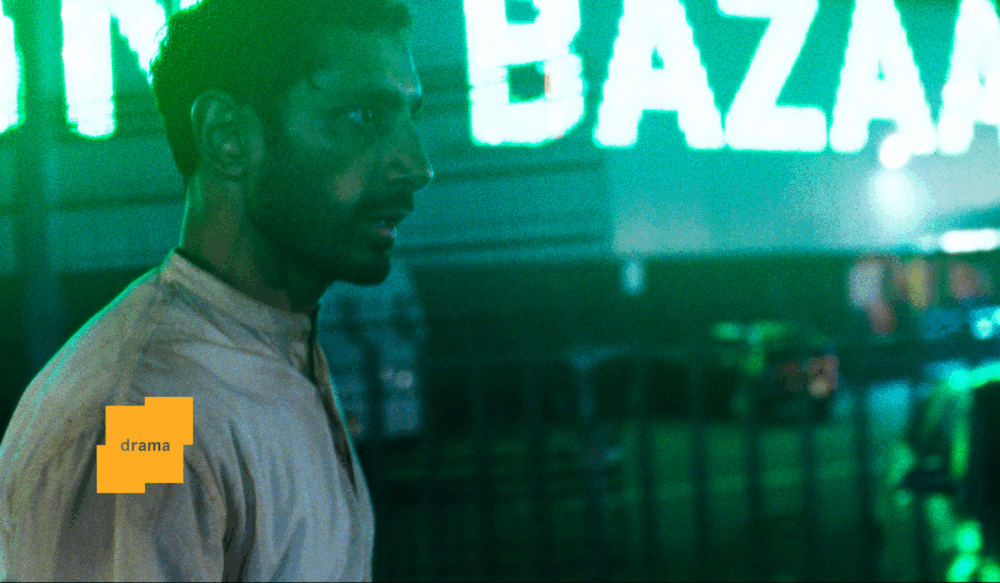
Ahmed’s turn in the title role carries the same breathtaking force. Karia stages the “to be or not to be” soliloquy inside a speeding BMW, as Hamlet barrels through London’s midnight streets in a fit of road rage. Ahmed’s face grips the screen, taut with intensity, as he unfurls Shakespeare’s verse in a rhythm that lands with the precision of a freestyle rap. When Hamlet releases the wheel and lets the car drift into oncoming traffic, the monologue explodes into pure cinema: headlights slash across the frame, horns blare, and vehicles swerve in a symphony of chaos. Ahmed and Karia channel fury rather than melancholy, as the character is iconically known for, reframing Hamlet as a man consumed by rage.
A scaled down “Hamlet”
Not every reinvention strikes the same chord. Shifting the action from Denmark to the interal politics of a family-run conglomerate narrows the scope, trading Shakespeare’s sense of epic tragedy for corporate intrigue. The film hints at social commentary in its depiction of the company’s gentrification schemes, but these threads never fully develop, in part because so much dialogue is lifted wholesale from the play. The focus instead tightens on Hamlet’s grief, amplifying Ahmed’s towering performance but diminishing other arcs—his fractured bond with Ophelia (a luminous Morfydd Clark), or the political maneuverings of Polonius (an always terrific Timothy Spall) and his fiery son Laertes (a delightful Joe Alwyn). The result is a portrait of Hamlet that burns brilliantly at the center, even as the world around him flickers at the edges.
Some may argue that Karia never fully justifies why this version of Hamlet needs to exist. And to a degree, the film doesn’t wring every nuance from Shakespeare’s text. Yet the sheer force of weaving Hindu culture and South Asian performers into the fabric of those iconic lines feels like reason enough—even if this isn’t the brooding “sad boy” Hamlet audiences have come to expect. The vision remains clear and intentional, even when the storytelling falters. “To be or not to be”—Karia responds with a defiant answer: “I choose to be myself.“
Oh, Hi stars Molly Gordon and Logan Lerman as a would-be couple whose romantic rural getaway is turned upside down by a misunderstanding that careens into comedy of errors.
What starts as charming rom-com quickly careens into a tragicomedy about a situationship from hell when would-be couple Iris (Molly Gordon) and Isaac (Logan Lerman) realize they’re not on the same page about their relationship. Despite story flaws, Oh, Hi‘s comedic highs and surprise profundidty make it worth the committment.
Oh, Hi is in theaters now.
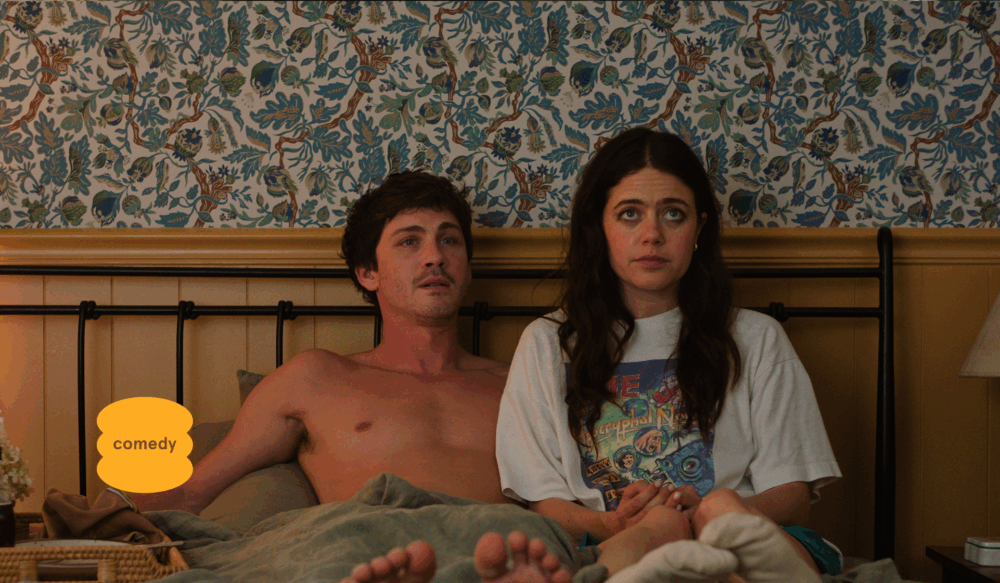
Iris (Molly Gordon) is having an idyllic weekend Isaac (Logan Lerman) in the comfy countryside of High Falls, which she mistakenly reads as “O High” on a dilapited sign. The couple’s playful chiding after her mistake and a hilarious run-in with a strawberry stand (no but literally, Isaac accidentally drives into the stand leaving the woman behind it in disbelief) is swoon-inducing. It just seems like they get each other and their weird quirks. As they make out in their rustic vacation rental, their adorable banter about suffering from a rare disorder that forces them to have sex immediately whenever they visit somewhere new (“I haven’t seen you at the meetings,” Isaac quips), you can’t help but think they’re a match made in heaven even though they’ve only been seeing each other a few months.
Freeze frame. They weren’t.
ADVERTISEMENT
The first act of Oh, Hi is a charming rom-com conceit. A new couple from the city take a romantic trip to the countryside to be met with a series of ridiculous situations that just further strengthen their bond. Like while swimming in the pond just off the property they’re chastised by local Steve (David Cross) for having sex in the water (they weren’t). They laugh it off like they seem to do in any situation. They abide by relationship rule number one: commit to the bit. It’s a delight to watch and often laugh out loud funny. It helps that Gordon and Lerman have so much charisma and chemistry. That’s why when they decide to have some fun with a pair of handcuffs they find in the bedroom closet, it’s all fun and games. Until it isn’t.
In the afterglow of their sexual experimentation while Isaac is still handcuffed to the bed, Iris reveals she’s falling in love with him. Immediately, the warm spell of the movie is broken when Isaac quickly corrects her that he’s not looking for anything serious… Yeah, Iris doesn’t take that well. The revelation leads to a comedy of errors as Iris, fueled by her mother’s encouragement to fight for their relationship and, the real evil, relationship influencers, attempts to get Isaac to fall in love with her.
At times, Oh, Hi flirts with pulling a Misery. Gordon’s high-strung mania makes you feel like she can take a sledgehammer to Isaac’s ankles at any moment. Instead, the movie stays firmly in comedy territory as Iris’s increasingly desperate attempts to get Isaac to see the error of his ways gets more ridiculous. Eventually, she calls in reinforcements in the form of her best friend Max (Geraldine Viswanathan), and Max’s boyfriend, Kenny (John Reynolds), who may cause more harm than good.
ADVERTISEMENT
The ridiculousness of the situation often threatens to derail the legitimately biting probe into modern-day relationship dynamics and the dreaded situationship hell that is plauging every 20-somethings dating life. It’s a tragicomedy in that way. However, writer-director Sophie Brooks and Gordon, who co-penned the screenplay, struggle with the movie’s identity. At times Oh, Hi is a slapstick comedy of errors and others a profound dating dramedy and it can’t seem to find the right formula.
Despite its drawbacks, Oh, Hi‘s highs are… well, high. Lerman’s performance is a deeply complex speciman of the male psyche and their inability to get out of their own way (men would rather by handcuffed to a bed for days than go to therapy). Gordon, along with Viswanathan and Reynolds, hits every comedic beat with her drive delivery and manic mood swings. And the movie finds a touching middle ground in its debate of who’s right and who’s wrong in this situationship. Perhaps there was a great version of this movie to be found, but what’s there is worth the commitment.
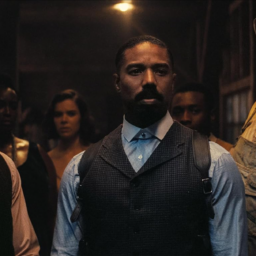
Sinners follows a pair of infamous twins who return to their hometown to open a juke joint of their own only to find a darkness pervades.
Sinners manages to be a folk horror, western drama, southern gothic, Blaxploitation thriller, quasi-musical and, oh yeah, a vampire movie exploring deeply rooted themes about our society while being one of the most devilishly entertaining movies of the year. With immersive world-building, a memorable cast of characters elevated by a stellar ensemble and musical numbers and action scenes that will take your breath away, writer-director Ryan Coogler may have just given us his magnum opus.
Sinners now streaming on HBO Max.
💌 Get weekly streaming movie recommendations in your inbox
Although it takes place over a single day, Sinners is about centuries. It’s about the foundations of our culture, our country and our world. It’s about how the trauma of hate and division crosses time, boundaries and races like an illness that can destroy what we love—and how joy is the antidote. That’s a lot of thematic heft for a movie that is in equal parts a folk horror, western drama, Blaxploitation thriller, quasi-musical and, oh yeah, a vampire movie. The most impressive feat director-writer Ryan Coogler (Black Panther, Creed) achieves is finding a balance between genre and meaning—and one begets the other. And in the end, creating something completely singular. Perhaps his masterpiece.
ADVERTISEMENT
It’s the Southern United States in the 1930s. Jim Crow era. Infamous twins Smoke and Stack (both played by Michael B. Jordan doing stellar work defining the twins’ separate personalities) return to their small hometown with a dream to fulfill: open the best juke joint in the county in a barn they recently bought from a maybe-Klan member. Hell, maybe even the state. Armed with a truck full of liquor and beer from their time in Chicago crossing (and double crossing) with the Irish and Italian mobs, they trek across the county to put the finishing touches on their new joint. Quite literally getting the band together.
They pick up their young cousin and blue guitar prodigy Sammie (Miles Caton) much to the chagrin of his pastor father who warns him of “temptations” that lurk. Smoke picks up lush but talented pianist Delta Slim (Delroy Lindo) by bribing him with real Irish beer to play at their joint instead of his usual gig. Stack picks up his former lover Annie (Wunmi Mosaku)—she serves as a sort of general store for the community though her proclivities for the mystical come in handy—with whom he shares trauma with. He asks her to cater the opening. Chinese storeowners and couple Bo (Yao) and Grace (Li Jun Li) are tasked with making signage for the venue while their old pal Cornbread (Omar Benson Miller) is asked to be bouncer.
ADVERTISEMENT
The first act of the movie has the breezy coolness of Coogler’s other work—like he’s allowing the rhythm of composer Ludwig Göransson’s blues-inspired score to keep us moving. The world building, while a slow burn, is immersive and detailed in a way that is so enjoyable to explore. Like you can feel the dust-filled breeze and summer heat as the twins charm and strongarm their way across town gathering what they need for the opening. The movie could have lazed with these characters for hours and I would’ve been grateful. However, for as enjoyable as it is, it starts to lay the foundation for the southern gothic horror that is rooted in the very real horrors of a Jim Crow-era South.
By the time evening falls, it’s easy to forget that Sinners is a horror movie. Though Coogler maintains a dread-filled atmosphere, the movie is about Black joy, Asian joy and simply the joy of being sure and safe somewhere where your identity is accepted and understood. The successful launching of the juke joint in the barn itself feels momentous because in a short amount of time we’ve grown to know and love the characters. Whether it’s the easy banter between the twins, the warmth of Annie, the humorous drunken quips of Delta and Cornbread, or the seductive allure of Pearline (Jayme Lawson) and Mary (Hailee Steinfeld). It makes the turn to horror all the more entertaining (and heartbreaking)
ADVERTISEMENT
When it does take the turn, it does so with a devilish grin courtesy of Jack O’Connell as the charming but menacing Remmick who has slowly recruited more people to join his group of undead townsfolk that really want to get in on the action of the party. With the same acute attention to detail and rhythm, Coogler masterfully guides the movie towards full-blown genre in a way that is irresistibly macabre.
However, the heart of Sinners—both figuratively and literally the middle of the movie—is a musical scene that sees eras and people and races and music blending together in the barn. It is an amalgamation of all that makes the movie great. Its eclectic score paired with its warm cinematography swirling around characters we’ve grown to love and will miss when they’re no longer on our screens dancing with nothing but love and joy in their hearts. Meanwhile, the weight of their collective histories and futures join them in the frame to create in a single image a thesis of Sinners. That through all the pain and hate we experience, it is for the love and joy we fight it with that we endure it.
Slow burn horror movies done right can be some of the scariest movies in the genre. Here are some of our favorites!
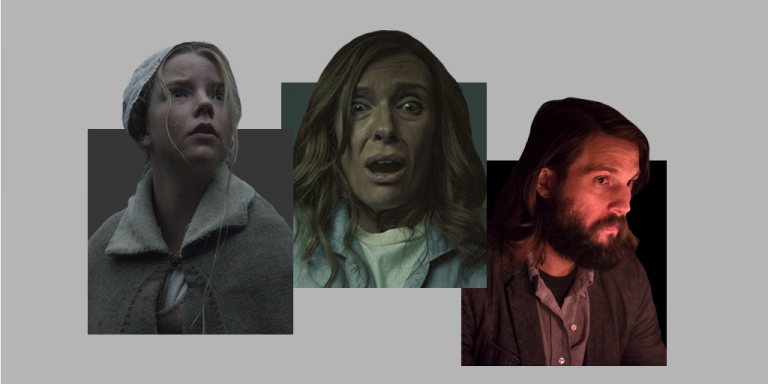
Horror movies today rely on unsuspecting *JUMP SCARES* to entertain audiences. But we all know—at least you should—that a good horror movie is built on suspense and tension. That’s why some of the best horror movies are slow burn. These movies don’t tell you everything. Instead, they’re puzzles that you have to solve. And sometimes the terror is in what you can’t figure out.
From folk horror to ghost stories to slashers, here are some of my favorite slow burn horror movies!
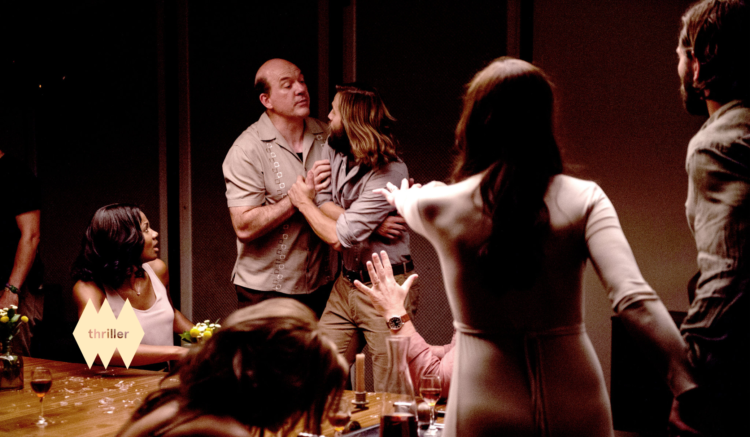
What it’s about: Will (Logan Marshall-Greene) and his new girlfriend Kira (Emayatzy Corinealdi) are invited to his ex-wife (Tammy Blanchard) and her new husband’s (The Haunting at Hill House’s Michiel Huisman) house for a dinner with old friends. However, a reunion isn’t the only thing planned for the night.
Why it’s great: Of the movies on this list, Karyn Kusama’s The Invitationis arguably the most underrated. It is the definition of a slow burn. Really nothing happens in the plot until the last 25 minutes. But by then, you’ve run through all the possibilities for what’s actually going on in your head and you’re prepared to find out exactly what’s happening.
The amount of tension—both horror and emotional—that the movie builds before its conclusion is incredible. And any payoff would work. Still, it feels like the movie still picks the best possible ending—and the final shot is stunning.
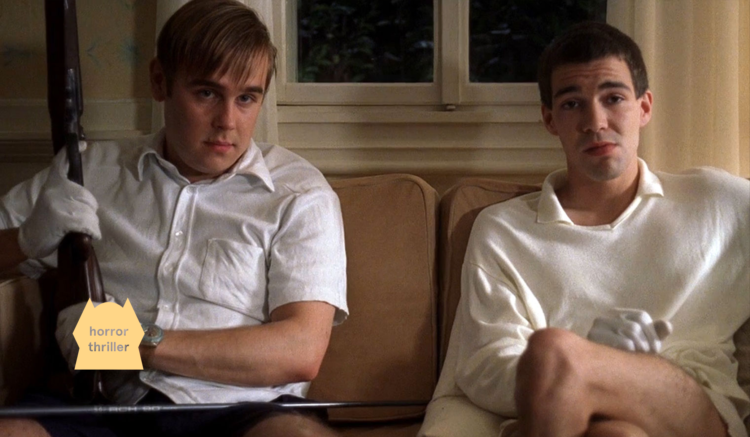
What it’s about: Georg (Ulrich Mühe), his wife Anna (Susanne Lothar), their son Georgie (Stefan Clapczynski), and their dog Rolfi arrive at their lakeside vacation home for a week of relaxation. However, when Paul (Arno Frisch) and Peter (Frank Giering) arrive, their weekend becomes anything but.
Why it’s great: Funny Games might be an uncomfortable experience, but it’s impossible to turn away from the screen once it gets going. The movie’s slow-burn pace never feels sluggish as Paul and Peter’s games become more sadistic and the family’s attempts at survival more fleeting.
It’s a lean and mean horror-thriller that clearly has more on its mind, but it’s never overindulgent. There’s also a shot-for-shot English remake directed by Haneke himself, which is just as good as the original. 109 mins.
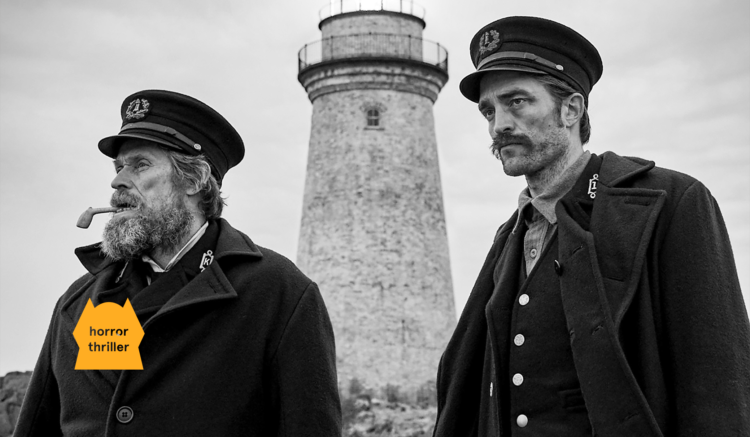
Here’s what it’s about: In the late 19th century, a lighthouse keeper (Willem Dafoe) and his assistant (Robert Pattinson) slowly descend into suspicion and madness as they become isolated on a tiny New England island by a storm.
Why you should watch it: Just like his breakthrough first feature The Witch, The Lighthouse is an immersive experience. Shot with stark black-and-white cinematography and presented in a glorious 1.19:1 aspect ratio, Robert Eggers throws you headfirst into the deep end of the late 19th century with every period detail intact — it’s almost unbelievable that the lighthouse was built for the film.
The layered sound and striking visuals make it feel like the movie is wrapping around you as the pair fall further into insanity. The story, compelling from beginning to end and aided by a career-best performance by Dafoe, challenges your perception of what is real before leaving you either perplexed or jaw-dropped. Just let it take you.
What it’s about: Jay (Maika Monroe) is a normal teenage girl who spends time at the pool and goes on dates. But after sleeping with a guy, she is tracked down by a mysterious entity that takes the form of anyone—a stranger or someone she knows—until “it” finally gets her.
Why it’s great: It Follows takes the classic slasher movie rule “never have sex” to the extreme. What’s really interesting about the movie is that it subverts a couple of different genres. It has the elements of a slasher movie and a ghost movie which makes the finished product something else entirely.
However, instead of jump scare prone ghosts or agile serial killer, the eponymous “it” is slow-moving and creeping in its pursuit of the teenagers. And unlike the other movies on this list, It Follows isn’t about uncovering a mystery—it’s about surviving.
There is also little jump scares, but the movie leverages creepy imagery to add to the tense atmosphere. Plus, Disasterpiece’s pulsing synth score makes every beat all the more intense.
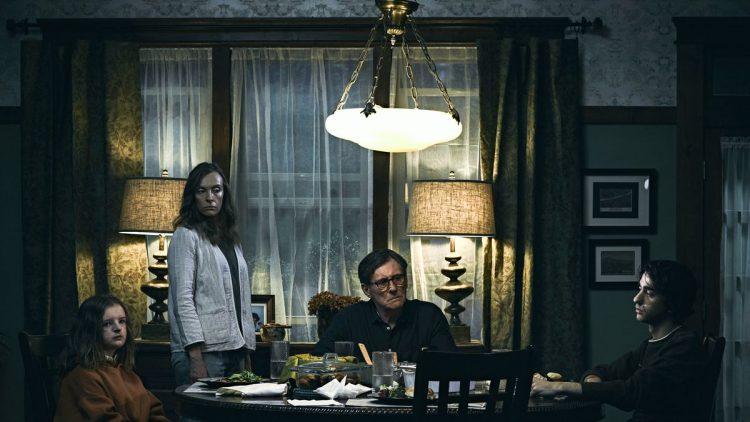
What it’s about: After the death of her mother, Annie (Toni Collette), her husband Steve (Gabriel Byrne), and their kids (Alex Wolff and Milly Shapiro) begin to uncover sinister secrets about their family.
Why it’s great: Hereditary is without qualification the scariest movie I saw in theaters. It’s also a horror fan’s dream. It’s a puzzle that you have to solve and unlike a lot of slow burn horror movies, it gives you the clues, you just have to find them.
Hereditary is also patient in its scares—in addition to its story. The horror set pieces are long drawn out and some you don’t even notice until a second look. That’s what makes this a masterpiece. It replaces jump scares with truly frightening imagery and an unsettling atmosphere.
Everything from the score to the production design to the sound design drip with evil. And it also has a smoldering family drama underneath it all. Not to mention one of the great horror performances from Toni Collette. It’s also one of our favorite movies of 2018.
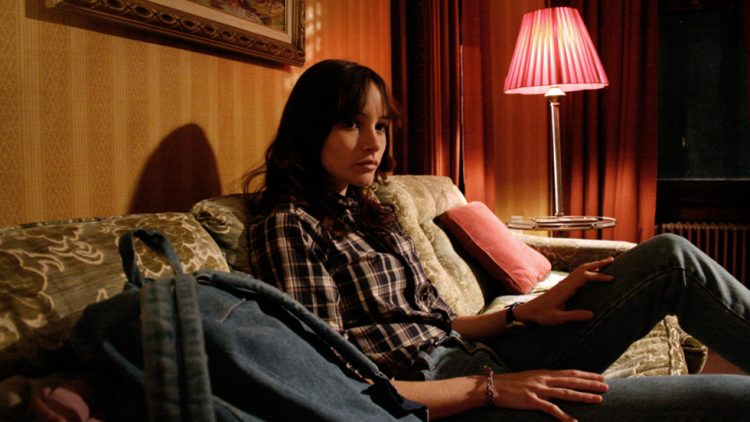
What it’s about: It’s the 1980s, The Fixx is burning up the charts, there’s a full lunar eclipse, and Samantha (Jocelin Donahue) has a babysitting job at a mansion in the middle of nowhere. What can go wrong?
Why it’s great: The House of the Devil is a pitch-perfect homage to the satanic panic films of the 70s and 80s—think Rosemary’s Baby and The Omen—complete with camera zooms and freeze frames. Another thing it nails from the era is the slow burn.
You never truly know what’s going on in the movie until it lets you in on it. And I will warn you, this movie is the slowest of slow burns. It doesn’t give you much indication—or horror—for a good while. But the ending is worth the wait.
Plus, there’s bad 80s pop rock, feathered hair, and Sony Walkman. It’s all you can ask for.
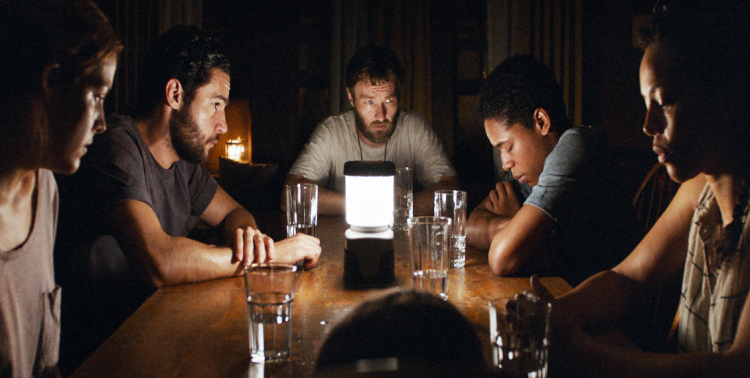
What it’s about: After a mysterious apocalyptic illness wipes out the population, a family (Joel Edgerton, Carmen Ejogo, and Kelvin Harrison Jr.) must battle the horrors outside the house—and some inside.
Why it’s great:It Comes at Nightsuffered from its marketing in its initial theatrical run. While it was being sold as an apocalypse horror, it was closer to a psychological thriller with truly unsettling moments.
Trey Edward Shults—who also directed the phenomenal Krisha—balances unnerving imagery with a slow burn story that isn’t about what’s going on the outside, but what’s going on on the inside.
The chilling final 20 minutes are the payoff of an emotional rollarcoaster where relationships are tested and trust is earned and lost.
💌 Sign up for our weekly email newsletter with movie recommendations available to stream.
ADVERTISEMENT
The Killing of a Sacred Deer (2017)
What it’s about: The Murphy Family, cardiovascular surgeon Steven (Colin Farrell), his wife Anna (Nicole Kidman), and his two kids (Raffey Cassidy and Sunny Suljic), become the fascination of a mysterious teen Martin (Barry Keoghan) who seems to be up to no good.
Why it’s great: Director Yorgos Lanthimos’ signature style—deadpan acting and generally nihilistic worldview—is sometimes hard to appreciate, but it applies so well to the psychological thriller The Killing of a Sacred Deer.
There is a sense of impending doom throughout the entire film as Martin’s increasingly nefarious plan falls into place. What makes him such a compelling villain is that you never truly know what he is up to. Neither does the Murphy Family—until it’s too late.
During the last act, Lanthimos’ style adds even more tense energy as a decision on the level of Sophie’s Choice is made. It’s darkly funny, suspenseful, and creepy. The perfect combination for a slow burn horror movie.
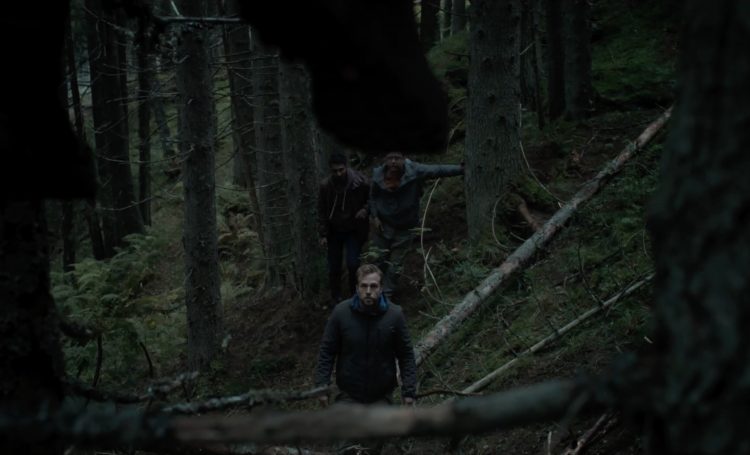
What it’s about: After a tragic incident, four friends reunite for a trip into the mountains and forests of Sweden. However, little do they know they’re not alone.
Why it’s great: A slow burn story is almost a requirement for a folk horror movie, and The Ritual is no exception. Though the story is one that we’ve seen before—it’s comparable to The Descent earlier on this list—The Ritual delves into incredibly interesting mythology.
While the group of friends ventures deeper into the forest—The Blair Witch Project-style—increasingly distressing and creepy occurrences build suspense until the movie finally reveals exactly what’s going on.
The Ritual is paced incredibly well and never lets any tension go. And while it might be the least original of the movies on this list, its execution makes for a perfect stormy movie night.
Where to stream it: The Ritual is streaming on Netflix.
ADVERTISEMENT
The Witch (2015)
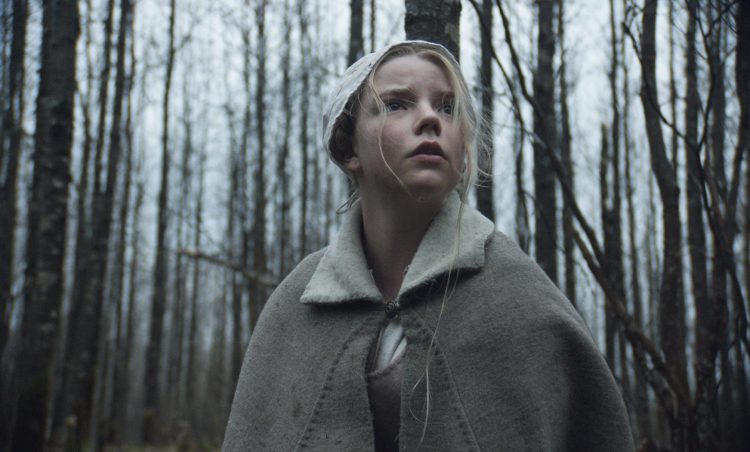
What it’s about: In 1630s New England a devout Christian family is exiled from their settlement to live in the wilderness. All is well until weird occurrences start to make the family members question if they can trust each other.
Why it’s great: Described as a New England folktale, The Witch does a fantastic job of immersing you in the world—the old English, the perfect production design, stunning performances. It’s all ground setting for a chilling tale.
However, the slow burn doesn’t come from whether or not there is a witch, that question is answered relatively quickly. Instead, the mystery is who you can trust.
And the movie doesn’t give you a clear answer. But along the way, you encounter terrifying scenes from a creepy black goat to one of the most stunning exorcism scenes I’ve ever seen. Plus, there’s a fantastic performance by newly anointed scream queen Anya Taylor-Joy.
Where to stream it: The Witch is available to stream on Netflix and Prime Video! It’s also available to rent or buy.
ADVERTISEMENT
The Night House (2020)
What does a house feel like when one of its inhabitants is gone? It feels empty. Incomplete. Cold. That’s the feeling that director David Bruckner’s new film The Night House, which premiered as part of the Midnight section of the 2020 Sundance Film Festival,gives off at the start as Beth (Rebecca Hall), a high school teacher, copes with the suicide of her husband Owen (Evan Jonigkeit). As she strolls through their lakeside home, built and designed by Owen, you can feel the vacant space. It probably doesn’t help that the home is filled with large windows opening into the darkness of the woods and lake. However, eventually, like Bruckner’s last film The Ritual, that feeling eventually gives way to a pervasive dread.
Based on William S. Burroughs novel of the same name, Queer follows an American expat’s obsession with a young man he meets in 1950s Mexico City.
This review was originally published out of the 2024 Toronto International Film Festival.
Luca Guadagnino’s Queer is a mesmerizing and haunting exploration of desire, loneliness, and the search for connection. Set in 1950s Mexico City, the film follows Lee (Daniel Craig) as he navigates a complicated, obsessive relationship with Eugene (Drew Starkey). Through stunning cinematography, an evocative score, and an engaging, surreal narrative, Guadagnino and screenwriter Justin Kuritzkes deliver a thought-provoking, emotionally raw drama that speaks to queer longing, desire, and the transformative power of intimacy. Bold, challenging, and ultimately moving, Queer is not easily shaken.
Queer is in limited release on Nov 27. It will be released nationwide on Dec 13 by A24.
Anyone who claims to fully understand what William S. Burroughs is trying to tell us with his writing is either lying or on some really good drugs—and I’ll have what she’s having. Another filmmaker might have tried to smooth out the raw, jarring edges of Burroughs’s trademark sensibilities. But director Luca Guadagnino (Call Me By Your Name, Challengers) and screenwriter Justin Kuritzkes (Challengers) lean wholeheartedly into his idiosyncratic style, transposing his unsettling blend of mesmerizing horror and reality into something deeply affecting. And somehow, it’s also an aching romance about longing and desire. Amid the drug-addled maze of Burroughs’s thoughts, Guadagnino and Kuritzkes manage to find a thread—a profound one that, once pulled, unravels into a beautiful, moving drama that is, at its core, deeply… well, queer.
ADVERTISEMENT
Set in 1950s Mexico City, the film follows a community of American expatriates, many of whom are queer men, living in a lively enclave of bars where gossip flows as freely as the alcohol. Among them is Lee (Daniel Craig), a man who drifts through the streets in search of something—or someone. Lee’s haggard, drunken appearance and his self-destructive bravado are a stark contrast to Craig’s more notable roles as James Bond and Benoit Blanc. His presence often unsettles those around him. One man who crosses his path later notes to a friend that Lee can never just be friends with someone—it always turns sexual.
Lee’s only friend, Joe (Jason Schwartzman), rambles about his various sexual exploits, most of which end in robbery, but Joe seems grateful for any company. Lee, on the other hand, is searching for something more meaningful. Though he’s clearly lonely, he seems incapable of breaking through his own emotional walls to form a real connection. Even after a one-night fling with a man at a bar (musician Omar Apollo), Lee is left feeling empty. Even assuming that the man slept with him for money. It’s that insecurity that keeps Lee from experiencing true intimacy. That is, until he spots Eugene Allerton (a sensational Drew Starkey) walking through the sultry streets. In stark contrast to Lee’s disheveled, unkempt appearance, Eugene is effortlessly cool—his tailored polo and well-fitting slacks clinging to his toned physique as passersby steal glances.
ADVERTISEMENT
Guadagnino and cinematographer Sayombhu Mukdeeprom beautifully capture the sweaty heat and energy of Mexico City’s bustling nights, imbuing the scenes with such textural detail that you can practically feel the heat on your skin. Eugene, however, seems impervious to the heat, and to everything else. Lee becomes obsessed with discovering who he is, and after exchanging a few furtive glances, he finally approaches Eugene one drunken night. While their conversations aren’t especially titillating, the tension between them is palpable, as if we’re just waiting for the space between them to collapse. At times, we see Lee’s ghostly hand reach out to touch Eugene, as though he’s willing himself to do so but can’t. As Eugene speaks (or listens to others speak), we catch Lee staring at him as if he’s trying to understand what’s going on beneath the surface.
The first hour of the film moves at a pleasantly meandering pace, as Lee and Eugene oscillate between getting closer and drifting apart—having sex and then completely ignoring each other. It’s as if they both want to turn away from their desires while simultaneously giving in to them. It feels all too relatable to the queer experience—even now. While this dynamic could easily slip into melodrama, Guadagnino skillfully maintains a frenetic, sweltering energy, much like the city itself. This is all underscored by a melancholic score from Trent Reznor and Atticus Ross, with energetic needle drops ranging from Nirvana to Prince.
ADVERTISEMENT
As the story moves into its second half, Lee invites Eugene on a journey through South America in search of a mystical herb called yage, which is said to give the consumer telepathic abilities. This is where the film becomes more jumbled—perhaps intentionally, as Lee’s opioid addiction comes to the forefront. While the push and pull between the two men continues, the narrative loses some of its initial focus. Lee’s obsession with the herb seems linked to his desire to understand Eugene, himself, and perhaps his own queerness, but the journey to find it lacks the bite and momentum of the earlier parts of the film. That is, until they finally find the herb.
In the film’s surreal and entrancing third act, the two men encounter Dr. Cotter (Lesley Manville), a kind of mad scientist living in the Amazon who studies indigenous plants, hunts for her and her partner’s food, and apparently trains their guard snake. Here, Lee learns that yage is more commonly known as ayahuasca, and he eventually persuades Cotter to let him and Eugene take it. The resulting sequence is a feverish, expressionistic dance that finally brings Lee and Eugene together in a moment of understanding. As Burroughs’s own words from his journals echo in the scene—“I’m not queer, I’m disembodied”—it adds an additional layer of meaning to this powerful, otherworldly encounter.
ADVERTISEMENT
At its heart, Queer is about queer loneliness, queer desire, and the queer desire to know we’re not alone. In the final moments, Lee faces his own loneliness. To borrow a line from Guadagnino’s Call Me By Your Name, “Is it better to speak or to die?” In that film, the character chooses to speak. Here, Lee suffers a kind of death—a raw, emotional moment that’s deeply impactful. It ultimately makes the film’s challenging journey worthwhile. Queer is a call for intimacy: to reach out, make yourself vulnerable, and let the space between you and others collapse. Because, in the end, where there may be rejection, there may also be acceptance.
Aftersun follows the childhood memory of a girl on vacation with her father to the Turkish coast. But where there’s sun there is also shadow.
Aftersun is one of the greatest depictions of depression and grief captured on film as it meditates on childhood, parenthood, and memory. Beautifully wrought with cinematography and score that play like a memory on loop. As the movie comes to its stunningly satisfying and emotional conclusion—perhaps one of the greatest final moments of a movie I’ve seen in some time—we’re taught that opening that box might be a means to an end. A means to heal the burn that memories can leave.
Do you know that lethargic feeling after sitting in the sun on a hot summer day? Or the melancholic daze that follows you home after a perfect vacation? Do you get blotches in your vision after looking into a bright light or staring up at the sun? All those sensations perfectly described Charlotte Wells’ debut feature Aftersun, which feels like the perfect term to encapsulate each of those feelings. And that is what the whole movie is: a feeling. For its largely plotless 96-minute runtime nothing really happens in front of you. But rest assured, there’s plenty happening in the shadows of the sunny father-daughter beach holiday at the center of the movie.
💌 Get weekly streaming movie recommendations in your inbox
Wells presents Aftersun as a childhood memory flashing into the mind of a girl 20 years later—when she’s the same age as her father at the time. But as with any memory, things look different in retrospect.
In the early 90s, young father Calum (Normal People’s Paul Mescal) brings his 11-year-old daughter Sophie (played as a child by Francesca Corio, a real festival breakout) on a sleepy summer vacation on the Turkish coast. Gregory Oke’s dreamy cinematography simultaneously underlines the sunny haziness of a beachy summer and the soft edges of memory. In between days lounging at the pool, trips to the resort’s restaurant, and interactions with the other guests, we see interstitial clips from home video of the trip filmed by either Sophie or Calum. It’s in those clips—and interruptions often taking place at night while Sophie is asleep—that we sense there’s more meaning and heaviness in this vacation for Calum.
Those feelings only come in waves though. We never see Calum being less than a devoted (and goofy) father to Sophie, almost a complete juxtaposition to the view we have of the usual young parent—sometimes he’s even mistaken for her brother. Sophie, as a child, sees him as nothing less than an invincible infallible hero—how many of us see our parents. Her childlike wonder extends to the world around her as she becomes enamored with a group of older kids—a bit of a nod to the typical coming-of-age story, of which Aftersun is decidedly not. However, that wonder also leads to conflict when Sophie’s frank questions lead to revealing that not all is great and perfect in the background of Calum’s life. At the moment, she thinks nothing of them. However, when adult Sophie looks back at the same clips we’re watching, they play very differently. Like videos taken before a coming disaster.
Memories always have their blind spots. You remember the bright moments while blocking out the darker ones. It’s not until you look back and unpack them as an adult that you see their profundity.
31-year-old Sophie (Celia Rowlson-Hall), who we cut to for short moments throughout the movie, is the same age as her father when they went on that vacation. As she remembers the bright spots—the late night karaoke, her first kiss, her dad clumsily juggling bread rolls at dinner—the darker ones slip in as well. Or, at the very least, she fills them in—her dad crying in the middle of the night, his quiet swaying while smoking a cigarette on the balcony, his muffled contentious phone calls back home. However, the movie never lingers on those moments—like adult Sophie is trying to keep them out of her perfect vision of that summer vacation. The same way that we exclude the awkward pauses at an otherwise lovely dinner or the arguments heard through walls late at night after you went to bed in our memories. You keep the good and avoid the bad until you can no longer stand the weight of the past.
It’s difficult to describe Aftersun because nothing and everything is happening at the same time. Though what’s happening on screen may seem mundane, it’s drenched in subtext. For those that aren’t looking in the right places, the movie might be tedious to get through.
ADVERTISEMENT
Aftersun is about many things, but at its core it’s about the blindspots of our memories and traumas—and how we fill them in to make them whole again.
Our parents try to create the best childhood for us. Short of that, they at least try to create the best version of those memories for you, whether intentionally or unintentionally. It’s why nostalgia exists and why some memories float to the surface while others burrow themselves deep into our psyches. Charlotte Wells uses Aftersun to show us what it’s like to unlock that box that we all keep away in a hidden dark corner of our minds. What it’s like to admit that our perfect childhood memories are just afterimages of the brightest moments. As the movie comes to its stunningly satisfying and emotional conclusion fittingly underscored by Queen’s “Under Pressure”—perhaps one of the greatest final moments of a movie I’ve seen in some time—we’re taught that opening that box might be a means to an end. A means to heal the burn that memories can leave.
HIM, produced by the Oscar winner and directed by Justin Tipping, is a chilling descent into fame, football, and obsession
The first trailer has dropped for HIM, the latest psychological horror film from Oscar winner Jordan Peele (Get Out, Us, Nope) and Monkeypaw Productions — and it’s sending shivers down the spine of sports and horror fans alike.
Starring Marlon Wayans in a chilling dramatic turn, HIM follows rising football star Cameron Cade (Tyriq Withers, Atlanta), a gifted quarterback with his sights set on greatness. But when a violent encounter with an obsessed fan leaves him with traumatic brain injury, Cam’s dreams are all but shattered. Enter Isaiah White (Wayans), an eight-time championship legend and Cam’s childhood idol, who offers him a second chance — at a price.
Isolated at Isaiah’s mysterious, high-tech compound alongside his glamorous influencer wife, Elsie (Julia Fox, Uncut Gems), Cam’s rehabilitation quickly spirals into something darker. As the mentorship turns sinister, Cam is forced to question the very identity he’s sacrificed everything to build.
Directed by Justin Tipping (Kicks) from a Black List script by Zack Akers & Skip Bronkie (Limetown), HIM blurs the lines between ambition and manipulation, asking: how far would you go to become the best?
The film boasts a unique supporting cast that includes comedy icons Tim Heidecker and Jim Jefferies, as well as feature film debuts from MMA fighter Maurice Greene and musicians Guapdad 4000 and Grammy-nominated Tierra Whack.
Produced by Ian Cooper, Jordan Peele, Win Rosenfeld, and Jamal M. Watson, HIM promises an intense, genre-bending experience that explores the toxic underbelly of fame and hero worship — all with Peele’s signature psychological dread.
HIM is set to terrify audiences later this year. Watch the trailer now and prepare to question everything you thought you knew about greatness.