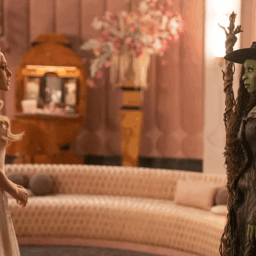
“Wicked: For Good” brings the story of Elphaba and Glinda to a satisfying conclusion, even as its source material’s flaws glimmer through.


“Wicked: For Good“ is, much like Act 2 of the stage show, a mixed bag. It highlights the strongest aspects with raw and visceral musical numbers that underline the emotional struggles of the characters. At the same time, however, it emphasizes its weaknesses as it clunkily weaves “The Wizard of Oz” into the story. Still, and most importantly, the relationship between Elphaba and Glinda hits all the emotional notes that made Wicked such an enduring story. Cynthia Erivo continues to captivate on the screen, but it is Ariana Grande’s magnificent performance as an emotionally-torn Glinda that gives the movie the complexity and depth to become greater than the sum of its parts.
“Wicked: For Good” is in theaters Friday.
For better (good?) or worse, “Wicked: For Good” is exactly the movie you’re expecting. For fans of the stage show, it highlights its strongest aspects. The musical numbers have the same raw, visceral emotionality just blown up in scale while the characters’ complex journeys are even more deeply felt. With that, however, it emphasizes its notorious weaknesses. In particular, the way the plot twists to tie to “The Wizard of Oz” still feels clunky. Despite its failings, and most importantly, the relationship between Elphaba and Glinda hits all the emotional notes that’s made “Wicked” such an enduring classic. Perhaps even more so in the movie version.
ADVERTISEMENT
Part one of the Wicked duology has the easier job. Not only is its tie to “The Wizard of Oz” tenuous, the archetypes of the characters are simple and familiar. Elphaba (Cynthia Erivo) is the brainy outsider that rails against injustice and Glinda (Ariana Grande) is the self-absorded popular girl with an unexpected heart. “For Good” takes those archetypes, and throws them into a complex situation that mirrors the very real structures of oppression in our society. Structures that director Jon M. Chu emphasizes even more with propaganda against Elphaba flying through the streets of Oz and added scenes of prejudice that could be taken straight out of a Holocaust movie. Yeah, things get a little convoluted.
The story’s clear ties to the darkest instincts of society sometimes rub against the silliness of a world where munchkins co-exist with talking animals. It’s maybe even more stark with the additions to the plot by screenwriters Winnie Holzman (who penned the stage version) and Dana Fox. Among those additions is a new song sung by Elphaba called “There’s No Place Like Home” where she encourages the animals, who are forced into hiding, to fight for their homeland. Like many of the changes to the story, it feels gratuitous and out-of-place in an attempt to emphasize a theme that is already underlined in the source material. Unlike the changes to the first movie that felt in service to the characters’ journeys. Holzman should have trusted her original writing because what works most often in the movie is what is taken directly from the stage.
ADVERTISEMENT
The second act of Wicked has always felt like Glinda’s story as she struggles between two truths: that she enjoys the adoration brought to her by working with The Wizard (Jeff Goldblum) and Madame Morrible (Michelle Yeoh), and the fact that she knows that her friend is a good person. Ariana Grande’s magnificent performance underlines that paradox as she tries to hold on to her newfound power in Oz while protecting her friend. Part of that involves ignoring what is happening around her with the glimmer of hope that it’s not as bad as Elphaba says and that it is not too late to change course. But Grande never lets that hope come off as delusion. For a character as high off the ground as Glinda, she always feels grounded in something real.
As the story progresses and alliances shift or are revealed, the main trio of Elphaba, Glinda and Fiyero (Jonathan Bailey) circle each other with fiery passion fueled by their histories. Like in “As Long As Your Mine,” which feels even more like a showstopper in the movie. Bailey exchanges his character’s bravado for real bravery as he bares his genuine feelings for the first time. As the camera swirls around the couple, it feels like classic romantic movie magic. That is juxtaposed against “No Good Deed,” which burns with anger and pain as Elphaba, delivered with unrestrained ferocity by Erivo, faces her past and present failings in a desperate attempt to save what she loves. Chu finds the emotional core of each of these numbers and amplifies them to the cinematic proportions they deserve, even as his direction fails in other aspects.
The final act, torn directly from the stage version, finally reaches the levels of greatness set by the first movie. And that is because at its core “Wicked” is a story about two women that in finding compassion in their differences drive each other to be better people. Erivo and Grande seem to understand that as they sing the title number to each other. Somehow they fill the space between the characters with all the hopes, regrets and words unsaid between them. It is movie musical magic. Despite its flaws, the booming crescendo of the piece, which has the characters facing uncertain futures, is deeply felt. It leaves you missing them as the screen fades to black. It is the raw and plain power musical theater captured on film.
ADVERTISEMENT
More movies, less problems
- Cannes 2024: Three great movies in Un Certain Regard

- “Heated Rivarly” episode 6 recap and review: “The Cottage”
- “Heated Rivalry” episode 3 review: “Hunter”
Hey! I’m Karl. You can find me on Twitter and Letterboxd. I’m also a Tomatometer-approved critic.
💌 Sign up for our weekly email newsletter with movie recommendations available to stream.
ADVERTISEMENT