Category: Movies

  • ‘The Irishman’ NYFF review — Scorsese’s tribute to Scorsese

    ‘The Irishman’ NYFF review — Scorsese’s tribute to Scorsese

    Based on a true story, a hitman for the mob looks back at his life and the events that shaped him in The Irishman.

    One-sentence review: The Irishman combines the meditative pace of Silence, the sharp humor and style of The Wolf of Wall Street, and the narrative of Martin Scorsese’s greatest gangster movies to form a self-reflective magnum opus.

    Details: ? Martin Scorsese // ?? U.S. // ⏳ 209 minutes

    The cast: Robert DeNiro, Joe Pesci, Al Pacino

    Where to watch The Irishman: In theaters November 2nd. On Netflix November 27.

    The Irishman feels like a culmination of all the films that came before it in Martin Scorsese’s filmography. You can piece it together from his various projects. It’s deliberately paced and meditative like Silence with a sharp sense of humor like The Wolf of Wall Street. The plot treads close to any of his classic gangster movies and it grapples with toxic masculinity like many of his movies, but Taxi Driver feels like the closest comparison. It feels like an epilogue to his storied career — but it also makes clear that Marty is far from being obsolete. 

    Getting the mob back together

    If the 2010s have shown us anything, it’s that Scorsese isn’t done experimenting and trying new things. As much as this feels like a Scorsese picture, it’s more like it’s influenced by his past work rather than trying to recreate it — even though it reunites him with old collaborators Robert DeNiro and Joe Pesci.

    The movie, stitched together by long-time editor Thelma Schoonmaker, follows Frank “The Irishman” Sheeran (DeNiro) as he recounts his life as a hitman for Russell Bufalino (Pesci) and his entire organization. The decades-spanning narrative, which required them to digitally de-age the actors, covers Sheeran’s beginning as a small-time criminal stealing meat off of butcher trucks to his fateful meeting Russell to his friendship with famed and bombastic labor union leader Jimmy Hoffa (Al Pacino).
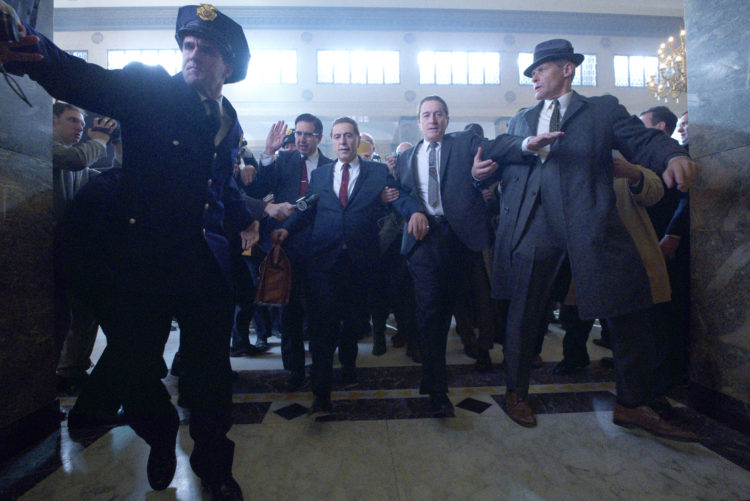
    The Irishman
    THE IRISHMAN (2019) Ray Ramano (Bill Bufalino ) Al Pacino (Jimmy Hoffa) and Robert De Niro (Frank Sheeran)

    Brilliantly, the movie jumps around in time and feels like it rambles at times — just like you’d expect an old man to talk about the events in his life. The formlessness of the narrative is both an asset and a liability. An asset because it really feels like you’re talking to someone about their life. A liability because you do feel the 3 ½ hour runtime at points. 

    Balancing crime with comedy and character

    However, it is also often hilarious with killer (pun intended) timing that you’re able to get through the rough patches with ease. The movie especially shines when Sheeran becomes a confidant for Hoffa, who Pacino plays with all the bombast and energy you’d expect him to deliver in a Scorsese movie — shockingly, this is his first time working with the director. There’s plenty of wise guy talk, politicking between various groups, and mob-antics that go wrong and some that go right — everything you’d expect Scorsese to cover. It’s the way he covers it that makes The Irishman special. 

    Robert DeNiro hasn’t been this good in years in his role as Frank. And while many people were tepid on the decision to use the same actors to play characters over a span of decades, it pays off. It makes each character, especially Frank, feel lived in. You feel the toll of every sin he commits weight on him and on his daughter Peggy (a criminally underused Anna Paquin) as time goes by.

    It’s difficult to describe the plot because the movie is essentially structure-less, but the main throughline of the film is Frank’s relationships with Russell and Jimmy and his lack of a relationship with his family. In so many mob movies, including Scorsese’s, the men operate unchecked and without moral consequence. The Irishman attempts to reckon with the emotional impact of being in the mob. It’s a welcome change of pace late in the movie.

    The Irishman ends up being greater than the sum of its parts. It could have been easily cut down and end with the same effect, but each part in a vacuum works so well that it’s easy to overlook. Oddly, I think this movie will play well on Netflix versus a theater. It’s a movie that will immerse you either way.


  • ‘Honey Boy’ review — Shia LeBeouf plays his own abusive father

    ‘Honey Boy’ review — Shia LeBeouf plays his own abusive father

    Shia LaBeouf plays his own abusive father in Honey Boy, which is a semi-autobiographical film about his time as a child actor and in rehab

    One-sentence review: Honey Boy sees Shia LeBeouf grappling with his past in a highly personal and emotionally devastating drama.

    Details: ? Alma Har’el // ⏳ 93 minutes // ? 2019

    The cast: Shia LeBeouf, Lucas Hedges, Noah Jupe, FKA Twigs

    Where to watch Honey Boy: In theaters November 8th.

    Anyone who’s done therapy knows that it’s an often frustrating and confusing process that is without a doubt the most rewarding thing you could do for yourself. And that’s what’s fascinating about Honey Boy. Shia Lebouf wrote the movie as a semi-autobiographical telling of his life as a child actor and his very high-profile struggles with addiction a decade later. However, the movie isn’t really a narrative. Like therapy, the screenplay is more of an exploration. LeBeouf is using the movie to understand what he went through. He even plays his own father in the film.

    Honey Boy deals with LeBeouf’s past in two different times

    Honey Boy is split into two timelines: 1995 and 2005. In 2005, we meet Otis Lort (Lucas Hedges) as he’s filming a scene that looks like it was pulled straight out of a Michael Bay movie — you know which one. Then in a breezy montage, we see all the things he did to land himself in rehab. There, his therapist (Laura San Giacomo) asks him to recall his relationship with his father, which she uncovers caused Otis to have PTSD. In real life, the incident that landed him in rehab happened in 2017, which is also where he wrote the screenplay for the film. 

    Noah Jupe stars in Honey Boy. Courtesy of Amazon Studios.

    In 1995, he’s filming a scene for an unspecified children’s TV show — you know which one. His father James (a nearly unrecognizable LeBeouf) — a former rodeo clown — is his paid chaperone who he also lives with at a seedy motel crawling with unsavory characters. There we explore their often turbulent relationship. James himself is plagued by PTSD from serving in the army and is a recovering alcoholic who is acutely aware that without his son, he’d been in even worse shape. At one point, the two argue about how it must feel for him to work for his son. Otis shoots back, “if I didn’t pay you, you wouldn’t be here.”

    The flashback scenes are so interesting because they’re presented in the way that someone would approach trauma in therapy. Each scene is so clear, but also inconsistent and sometimes erratic. It feels like we go over the same argument multiple times, which is a frustrating experience at first. But when you take into account that those scenes are the older Otis processing what happened to him, then it makes complete sense. After all, James was verbally and physically abusive towards him. He was terrified and confused, so the memories are probably blurred. 

    LeBeouf gives the best performance of his career and deserves to be in the Oscar conversation

    It also helps that LeBeouf gives a powerhouse performance — a classic Best Supporting Actor turn — that is as complex as the thoughts and feelings he must have been working through. James isn’t completely vilified. However, he isn’t completely redeemed either. Otis doesn’t make it out unscathed either. The movie isn’t interested in justifying his behavior more than it is in explaining it. 

    Admittedly, though, as good as Hedges is, the 2005 scenes don’t work nearly as well as the flashbacks. Director Alma Har’el — she’s directed documentaries in the past, but Honey Boy is her first narrative feature — has a clear vision for the scenes surrounding the young Otis. Like her documentary work, the scenes are impressionistic and ethereal — the score is twinkling and the cinematography warm or neon splashed. It’s fitting then that singer-songwriter FKA Twigs plays a large role as a resident of the motel who befriends Otis.

    The movie ends up being a little more than the sum of its parts. The lack of a plot is both refreshing and frustrating. At some points, I wished something more substantial would happen — maybe nothing did in real-life. However, that doesn’t take away from the fact that this is highly personal meditation on one’s life. One that you can feel the catharsis of. By the end, you can feel LeBeouf exhaling and accepting his past for what it is. It’s chilling to see. 

  • ‘Jojo Rabbit’ review — Nazis are dumb

    ‘Jojo Rabbit’ review — Nazis are dumb

    Jojo Rabbit follows a misguided Nazi youth whose imaginary friend is a buffoonish version of Hitler. It’s a comedy.

    One-sentence review: Jojo Rabbit lacks a real hop in its step to be truly great, but director Taika Waititi’s comedic sensibilities are enough to make it an enjoyable crowdpleaser.

    Details: ? Taika Waititi // ⏳ 108 minutes // ? 2019

    The cast: Roman Griffin Davis, Thomasin McKenzie, Taika Waititi, Rebel Wilson, Stephen Merchant, Alfie Allen, Sam Rockwell, Scarlett Johansson

    Where to watch Jojo Rabbit: In theaters now.

    Taika Waititi has built his career on being silly. I mean, his breakout movie was a mockumentary about mild-mannered New Zealand vampires and his fire big Hollywood blockbuster reimagined Thor as a hilarious slapstick comedy. Jojo Rabbit is his first “blank check” movie — a term used for directors that earned the right to minimal studio input on projects — which would make you think that he’d push the boundaries as far as they could go. In actuality, he stays within his borders. 

    Jojo Rabbit follows Johannes “Jojo” Betzler (Roman Griffin Davis gives a massively charming performance), a ten-year-old boy living in Nazi Germany at the tail end of World War II. Like many boys his age, he’s completely bought into the Nazi propaganda and national pride. His imaginary friend is even a larger-than-life version of Hitler (Taika Waititi) who he often talks to and gets misguided encouragement from. 

    He gets sent to a Hitler Youth training camp led by Captain Klensendorf (Sam Rockwell), who was demoted “since Operation Screw-Up, where [he] lost a perfectly good eye in a totally preventable enemy attack.” Joining him is the equally misguided Fraulein Rahm (Rebel Wilson) and Finkel (Alfie Allen). However, after a totally preventable accident involving a hand grenade, Jojo is sent home to his loving mother Rosie (Scarlett Johansson) who seems to be harboring a secret. 

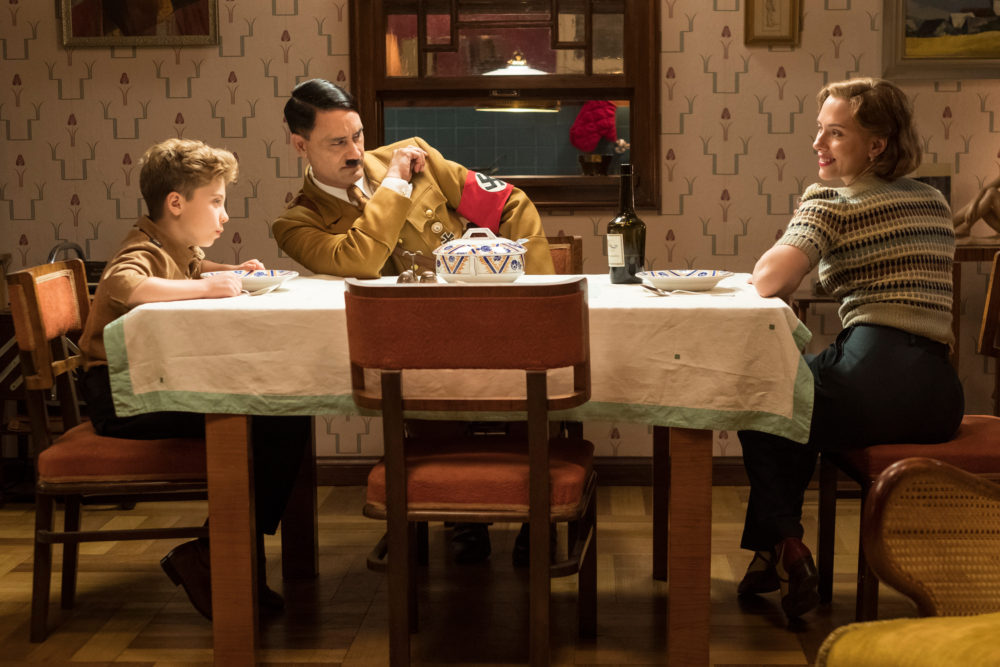
    Jojo rabbit
    (From L-R): Sam Rockwell, Scarlett Johansson and Roman Griffin Davis in the film JOJO RABBIT. Photo by Larry Horricks. © 2019 Twentieth Century Fox Film Corporation All Rights Reserved

    That secret comes in the form of Elsa (Thomasin McKenzie, who broke out in last year’s Leave No Trace), a Jewish girl Rosie is hiding in the walls of the home who Jojo soon discovers. From there, he must decide whether to turn her in or go on protecting her, which goes against everything he’s learned about being a Nazi. 

    Like all of his films — Hunt for the Wilderpeople, in particular — Waititi mixes real character development and emotional beats with gut-busting deadpan humor and slapstick sensibilities. Here, he hones in on the ridiculousness of anti-Semitism and the perils of blind patriotism. And while it’s an admirable subject, something about it lacks real bite to be truly effective. 

    Much of the movie is spent between Jojo and Elsa negotiating their various positions. Hilariously, Elsa seemingly always has the upper hand. The real issue with the plot, though, is that Jojo’s trajectory is obvious and Waititi doesn’t really pull any punches we didn’t see coming: being a Nazi is bad and blind patriotism is foolish. He could have made up for the simplicity of the message by filling out the running time spending time with the many hilarious side characters — Stephen Merchant has a too short role as a Gestapo agent and Archie Yates steals nearly every scene he’s in as Jojo’s best friend. 

    To compare the movie to Green Book, which oversimplifies race relations in the Jim Crow-era South, is probably overstepping, but it does describe the problem with Jojo Rabbit. Thankfully, Waititi isn’t feigning and self-importance like Green Book. He knows he’s making a simplistic crowdpleaser, even if it isn’t as satisfying one would hope. It’s a crowdpleaser nonetheless. 

  • ‘Waves’ review — One family faces the music

    ‘Waves’ review — One family faces the music

    Waves follows an all-American family as a tragedy sends them into a tailspin

    One-sentence review: Waves is an electrifying and music-filled family drama that is as emotional as it is thrilling to watch.

    Details: ? Trey Edward Shultz // ⏳ 130 minutes // ? 2019

    The cast: Taylor Russell, Kelvin Harrison Jr., Sterling K. Brown, Renée Elise Goldsberry, Lucas Hedges, Alexa Demie, Neal Huff

    Considering the number of needle drops and montages set to rap and R&B songs in new drama Waves — including songs by Frank Ocean, Alabama Shakes, Animal Collective, and Radiohead — you could almost classify it as a musical. And when the movie imbues the fluidity and momentum of a musical, it really soars. Take the disorienting opening scene where we meet high school senior Tyler (Kelvin Harrison Jr. — who is Oscar-worthy as he was with Luce earlier this year) as he goes through his daily routine — school, wrestling practice, time with his girlfriend Alexis (Alexa Demie). The camera whips and tracks through his life as we rapidly cut between scenes. It’s like the opening number of a broadway musical that’s meant to get you on its wavelength. It succeeds. 

    That energy is kept up throughout the movie as we watch Tyler interact with his hard and demanding father Ronald (a terrific Sterling K. Brown), who pushes his son to be better in every aspect of his life, often to a toxic level. It’s not without reason. As Ronald says in one scene, as black men they have to be 10x better to get anywhere in life — and still it doesn’t seem to be enough. Without realizing it, though, the pressure he’s putting on Tyler is manifesting itself in dangerous ways. It’s something Ronald’s wife and Tyler’s stepmom Catherine (Renée Elise Goldsberry doing great work) is acutely aware of. Off in the periphery is the youngest of the family, Emily (Taylor Russell is a breakout). We’ll come back to her. 

    Kelvin Harrison Jr. and Alexa Demie in Waves. Credit A24.

    The first half of the movie is spent with Tyler. We watch as the pressure to do better and be better gets to him. He begins taking prescription painkillers to ease the pain of an injured shoulder — his doctor tells him to stop physical activity, but Tyler ignores him. He begins to party and drink excessively. At one point, Emily finds him on the bathroom floor incoherent and crying. She comforts him in that moment. 

    Then something happens. Something stunning. Something that you shouldn’t know about until you watch the movie. It changes our perspective of the film — literally and figuratively — and sends us off on a tailspin with no end in sight. However, there is an ending and Waves nails it.

    Shultz, who has done great work in his career between psychological family drama Krisha and post-apocalyptic thriller It Comes at Night, is so assured of his style. With Waves, he takes it to the next level. There’s rarely a moment to rest, which makes it a nearly unbearable viewing experience in the best way. Each scene and shot feels so intentional — like they’re musical numbers. But really what makes this melodrama work is the assuredness of the narrative. 

    Each character, including Emily’s love interest Luke (Lucas Hedges), has their baggage. You can see the things that shaped them in life. The wounds that made them who they are — whether it plays out in the movie or happened years before it’s set. What Waves presupposes is that we’re all broken people, but not unfixable. The first half of the movie is dedicated to the events and traumas in life that tear us down and make the cracks in our psyche larger. The second half is dedicated to how we can heal them. It’s the Kramer vs. Kramer or Ordinary People of our day. Along with Marriage Story, also released this year, it’s taking a look at our own psyche. 

    Unlike any of those movies, Waves is extremely experimental in its form. It feels like Moonlight — another drama set in South Florida — in that it uses cinematic language to communicate human emotion. Shultz achieves feelings of fear, sadness, suspense, hope, heartbreak, and more without much dialogue. Sometimes it’s a look or touch between characters or a camera movement. The most inventive times it’s a piece of sound design where the movie plays with what we can and can’t hear — sound designer Johnnie Burn is deserving of an Oscar. It’s a movie that shows more than it tells. 

    There is a lull midway through that prevents it from being a real masterpiece — trust me, it comes close in the first half. However, it pulls it together for an ending that feels so satisfying and healing. In addition to the themes of toxic masculinity, race, and gender, what makes Waves so modern is that it understands our societal moment. At one point a preacher says in his sermon that everyone today is focusing on what makes them hate other people. Waves is a plea for kindness and compassion. It may not be the answer to all our problem, but it’s a start. 

  • ‘Pain and Glory’ NYFF review — One of Almodóvar’s best

    ‘Pain and Glory’ NYFF review — One of Almodóvar’s best

    In Pain and Glory, a filmmaker reckons with his past when a screening of one of his films requires him to contact an actor he feuded with.

    One-sentence review: Pain and Glory is a colorful, funny and profound film where Pedro Almodóvar reckons with his past and career — featuring a career-best performance by Antonio Banderas.

    Details: ? Pedro Almodóvar // ?? Spain // ⏳ 113 minutes

    The cast: Antonio Banderas, Asier Etxeandia, Leonardo Sbaraglia, Nora Navas, Julieta Serrano, Penélope Cruz

    Where to watch Pain and Glory: In theaters October 4th.

    As Pain and Glory approached its final moments, I realized that I was entertained and delighted by the witty humor and charmed by Antonio Banderas’ career-best performance. However, I felt like something was missing. Then, the final shot happened and I — and the rest of the crowded press screening — broke into applause. I think it’s what director Pedro Almodóvar is best at. He hides his intentions until unleashing a perception shifting moment that forces you to reconsider the entire movie you just watched. Pain and Glory is no different — and it’s better for it. 

    Almodóvar takes a look back

    The movie follows Salvador Mallo (Banderas), a revered Spanish director who suffers from multiple physical and mental ailments that he describes over a psychedelic montage of graphics. These ailments have prevented him from putting out a movie in years. However, a local theater contacts him asking for him to do a Q&A at a screening of his movie Sabor, which has been remastered. Although, they also ask if he could ask the star of the film Alberto Crespo to attend as well. The only problem is the pair had a falling out and haven’t spoken for 30 years as Salvador was unhappy with his performance in the film — mirroring a similar situation Almodóvar had with Banderas. 

    pain and glory
    Nora Navas and Antonio Banderas in Pain and Glory. Credit: Sony Pictures Releasing International.

    They eventually meet and though there is awkwardness, they bond while smoking heroin, which helps Salvador manage his pain. Alberto agrees to do the Q&A and the pair set off on repairing their friendship. The scenes between the creative partners bristle with comic energy but are also laced with sadness and regret. As Almodóvar said after the screening, “everything is familiar to me.” Much of the film is pulled from moments in his life and you can feel him reckoning with those moments. 

    All the while, we see clips of Salvador’s poor childhood with his mother Jacinta (Penélope Cruz) where we learn about his love of cinema and realization of his sexuality — particularly his infatuation with a local handyman (César Vicente). The entire movie is filmed with bright blocks of color inhabiting the sets, costumes, and graphics. These flashback scenes have a more natural quality to them, although they’re also clean and specific, just like a memory. We’ll come back to this. 

    Balancing authenticity with his signature style

    A scene never rings false in Pain and Glory, even when they’re particularly humorous or ridiculous. If anything, that quirky quality is what makes each moment work. That and Banderas’ masterful performance. We first meet him sitting at the bottom of a pool — something Almodóvar mentions makes him recall various memories — and what we see is the movie star Banderas. The second he steps out, you see in his mannerisms, delivery, and expressions that he is inhabiting a character. One part Almodóvar and one part his own creation, possibly pulling from his own experiences.

    This year, various members of the old guard of filmmakers have released films that reckon with their own reputations and mortality — Quentin Tarantino’s Once Upon a Time in Hollywood and Martin Scorsese’s The Irishman, in particular. Pain and Glory, in my opinion, is the best of that group. It’s easily the most personal and assured, which is saying a lot when you’re talking about two of the most established filmmakers working today.

    Slight spoiler alert. 

    The final shot of the film returns to a scene we saw earlier where a young Salvador sleeps on a bench with his mother by his side. As the camera pulls out, we see a person holding an audio boom. Then, a man walks in with a clapboard. We learn that all the flashbacks were shots from a film Salvador was directing, a direct way of saying that this movie is Almodóvar coming to peace with his past. The brilliance of it can’t be understated. It establishes Pain and Glory as one of my favorite movies of the year. 

  • ‘Bird Box’ review — Netflix’s uneven but entertaining post-apocalyptic thriller

    ‘Bird Box’ review — Netflix’s uneven but entertaining post-apocalyptic thriller

    Bird Box doesn’t bring anything new to the post-apocalyptic thriller genre despite a strong third act and solid performances.

    Bird Box certainly has the pedigree of a great movie behind it. The Netflix-produced movie is directed by the Emmy-winning director of The Night Manager Susanne Bier—she pulled off an upset against The People v. O.J. Simpson—written by the Oscar-nominated screenwriter of Arrival Eric Heisserer, and based off Josh Malerman’s novel of the same name, which is one of the best novels of the decade. 

    However, all the talent doesn’t necessarily translate onto the screen. Bird Box tells the story of the end of the world that is eerily similar to A Quiet Place, which premiered earlier this year. A phenomenon of people killing themselves after seeing some mysterious creatures is spreading across the globe. Unlike A Quiet Place, Bird Box—to its detriment—shows us the end of the world. 

    Reluctant expecting mother Malorie (Sandra Bullock) is taken to a prenatal checkup at a hospital by her plucky and excited sister Jessica (Sarah Paulson). As the sister’s make their way to the hospital, news about an odd phenomenon happening in Europe and Asia dominate the TV and radio. Something is making people commit suicide in droves and it just arrived on Malorie and Jessica’s doorstep.

    There’s a fantastic action sequence in the underrated World War Z where Brad Pitt and his family must escape Philadelphia while a wave of newly zombified corpses floods the streets. Bird Box goes for the same effect here to less successful results. Bier does a great job of adding tension to set pieces, however, some of the choices she makes take away from that tension.

    Sandra Bullock and Sarah Paulson in Bird Box. Courtesy of Netflix.

    As they’re trying to escape the chaos unfolding, Jessica sees whatever creature is causing the phenomenon and crashes the car. Malorie is able to escape to a nearby house with the help of Iraq war vet Tom (Moonlight‘s Trevante Rhodes) where she finds a group of people trying to process what just happened.

    In the house, we find conspiracy theorist grocery store employee Charlie (Lil Rey Howery of Get Out fame), an older woman named Sheryl (Jacki Weaver), and the bothersome alcoholic Douglas (John Malkovich). Those character descriptions I gave are all we ever know about these and the other characters in the house including some that we know even less about—Greg (B.D. Wong), Felix (Colson Baker aka Machine Gun Kelly), Lucy (Rosa Salazar).

    The group falls into a routine with Tom taking a leadership role and Douglas continuing to antagonize the group. Eventually, a soft-spoken pregnant young woman named Olympia (Danielle Macdonald—a standout) comes to the door in one of the more memorable sequences in the film. Her character is one of the few that is given some depth and often drives emotion into the story. 

    The house is fortified by covering the windows with newspapers and no one goes outside without a blindfold. Desperate for food, the group leaves the safety of the house in a completely blacked out car to venture to a grocery store. As they make their way, the sounds of the crumbled society echo around them—the issue here is that Bier shows us what is happening outside the car leaving little intrigue.

    For the first two-thirds of the film, the screenplay often falls into cliches of the apocalypse genre—, particularly in the often messy dialogue. What made the novel and A Quiet Place is the scarcity of details and genre. Bird Box, on the other hand, goes too far into the weeds to explain characters and the situation they’re in. Yet somehow, we come away knowing less than we did before.

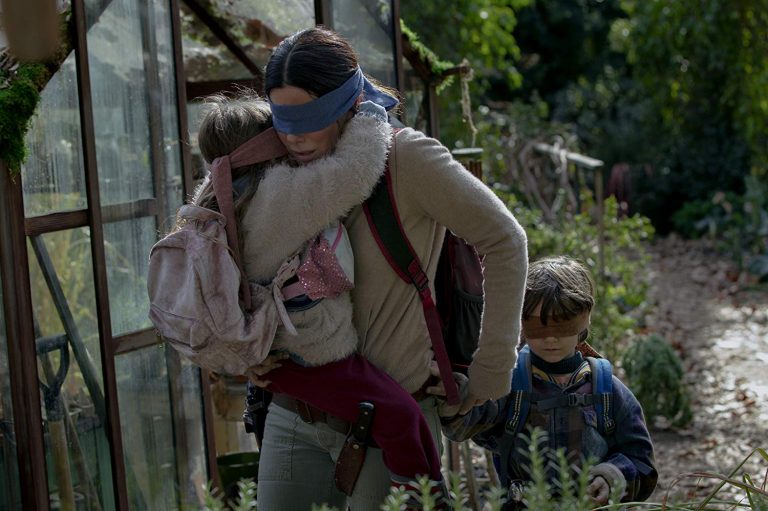
    Bird Box
    Trevante Rhodes and Sandra Bullock in Bird Box. Courtesy of Netflix.

    However, parts of the movie do work. Sprinkled throughout the film are flashforwards to a time further into the crisis in scenes that feel like they’re pulled from A Quiet Place. Malorie along with two young children named simply Girl (Vivien Lyra Blair) and Boy (Julian Edwards) take a boat down a river to some mythic sanctuary where they hope to be safe from the creatures. 

    Here, Bier and Heisserer take a simplistic approach. There’s little to see and little dialogue. These scenes are easily the best and most tense, so when the film completely reverts to these flashforwards for the third act it takes off. There’s something heightened and terrifying about not being able to see and Bird Box translates that feeling onto the screen as Malorie and kids encounter dangers down the river. If anything, the third act redeems the movie as a whole.

    The premise of Bird Box is so promising and its source material is some of the best horror fiction ever written. However, it often feels like both Bier and Heisserer don’t trust the audience enough to deliver a stripped-down story. Maybe that’s because Netflix was looking for a mainstream blockbuster type, which they certainly got—this movie is going to be a crowdpleaser, most likely. 

    The third act is where thematically the film comes together as Malorie struggles with motherhood in the face of a hopeless world. Bullock is solid as always in these scenes, but Rhodes is the steady hand here that elevates the material and delivers the thesis of the movie. It makes me wish this is what Bird Box was the entire time, but that would just be A Quiet Place wouldn’t it?

    Bird Box will be available to stream on Netflix on December 25th. You can get the book here.

    Karl’s rating:

  • 10 Best Movies of 2018

    10 Best Movies of 2018

    2018 has been a stellar year for movies. From the return of the romantic comedy to another golden year in horror, here are the 10 best movies of 2018.

    After what seemed to be an unbeatable year for movies in 2017, along came 2018 to challenge it. And unlike last year, 2018 gave us great movies from genres spanning from action like Mission: Impossible — Fallout and Black Panther and gut-busting comedies like Finnish heavy metal comedy Heavy Trip and Game Night to thrillers like Searching and Calibre.

    And 2018 also had its fair share of surprises. Paul Feig’s dark comedy soap A Simple Favor was an unexpected gem and Netflix’s To All the Boys I’ve Loved Before captured critics and audiences alike with its irresistible charm.

    Of course, there were a fair share of disappointments like the return of Michael Myers in Halloween and the Steven Spielberg’s Ready Player One, but more often than not, there were more pleasant surprises.

    As usual, it was nearly impossible to choose what, in my opinion, were the 10 best movies of 2018 (you can see my ranking of every movie I saw this year here). However, I went with my heart on these choice and I’m proud of the list I compiled.

    To start of, here are the movie that just missed my top 10.

    Honorable Mentions (#20-10) — Click here to skip to the top 10!

    20. Crazy Rich Asians: Without completely subverting the romantic comedy formula, Crazy Rich Asians is entertaining with a strong point-of-view, and is a compelling commentary Asian parenthood.

    19. Thoroughbreds: An incredibly assured debut feature character study about sociopathy and the nature versus nurture debate. However, what makes the movie great is its chilling final scene.

    18. Leave No Trace: Unexpectedly, Leave No Trace isn’t the survivalist drama that it looks to be. Instead, it’s a character study about a man whose fears and anxieties trap his daughter in a life of his choosing.

    Michelle Yeoh, Henry Golding, and Constance Wu in Crazy Rich Asians

    17. Incredibles 2: Picking up right where the original left off, this movie delves into even deeper themes of parenthood and challenging expectations while also remaining an entertaining superhero blockbuster.

    16. Suspiria: Disturbing, creepy, and upsetting, this remake of the classic 70s film of the same name has some of the best horror set pieces of the year and improves on the original’s plot.

    15. BlacKkKlansman: A funny and heartbreaking biopic that is a striking political piece that comments on the polarized political environment and the rise of white supremacists. 

    14. Bad Times at the El Royale: A sweeping, subversive homage to the 60s noir that is character-driven, thrilling, and keeps you guessing from beginning to end. It also features one of the best movie ensembles of the year.

    Regina Hall in Support the Girls

    13. First Man: A gorgeously shot, subversive biopic about Neil Armstrong and his obsession with making it to the moon. It’s a technical marvel and features one of the great “woman behind the man” performances from Claire Foy.

    12. Support the Girls: Regina Hall’s empathetic performance is what elevates this movie to greatness as does the beautiful mundanity of its day-in-the-life plot.

    11. The Favourite: Weird, absurd, and hilarious, this movie is the perfect intersection of period costume drama and Yorgos Lanthimos’ odd sensibilities to deliver an entertaining and surprisingly profound comedy of manners.

    NEXT PAGE: The Top Ten

    Pages: 1 2

  • ‘Gemini Man’ review — Geminis are the crazy ones

    ‘Gemini Man’ review — Geminis are the crazy ones

    Will Smith plays an assassin whose retirement is put on hold when the government sends his clone to take him out in Gemini Man

    One-sentence review: Gemini Man applies new filmmaking technology to action well, but a thin and boring story makes it not worth the price of admission.

    Details: ? Ang Lee // ?? U.S. // ⏳ 117 minutes

    The cast: Will Smith, Mary Elizabeth Winstead, Benedict Wong, Clive Owen

    Where to watch Gemini Man: Now playing in theaters.

    In recent years, Ang Lee has become obsessed with testing the limits of filmmaking technology. In particular, he’s been playing with 3D — Gemini Man and his two movies before it were all shot specifically for 3D — and high frame rates. Most movies are shot and shown in 24 frames per second, which delivers the cinematic quality we’re used to — everything doesn’t quite look real. That’s because you perceive the world without gaps in your vision. When something is filmed, you’re literally missed parts of the image. 

    However, Gemini Man was filmed in 120 fps. Most theaters don’t even have the ability to project movies in that format. I was fortunate (or unfortunate, depending how you look at it) was able to see the movie the way it was intended — 4K, 120 fps, and in 3D. Without it, though, I don’t know if I could even recommend seeing it in theaters. 

    An action-thriller we’ve seen before

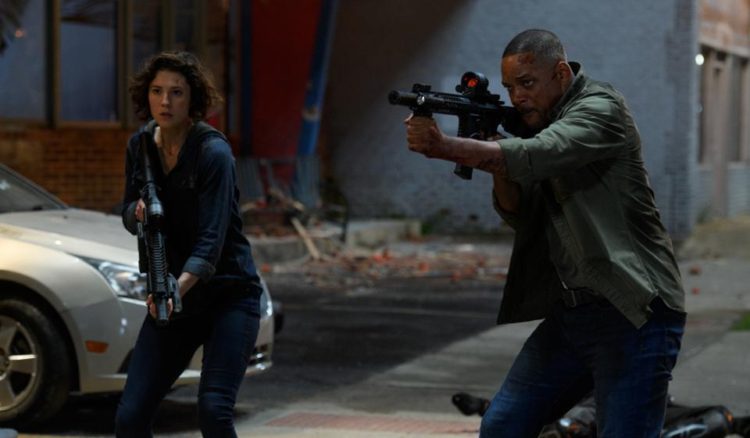
    Gemini Man
    Mary Elizabeth Winstead and Will Smith in Gemini Man. Credit: Paramount Pictures.

    The plot and story of Gemini Man are familiar that you can call every single beat before it happens. Not only that, but it feels like Lee isn’t interested in the story at all, only the tech that could be used to bring it to life. Ironically, it makes it all lifeless. 

    Henry Brogan (Will Smith) is not only an assassin, he is the assassin. He’s largely regarded as the best there ever was. However, he knows he’s not at the top of his game anymore. As he says in his opening kill, the smallest mistake could be the difference between killing his target and killing an innocent. That’s why he’s ready for retirement. However, Clay Varris (Clive Owen), head of the mysterious GEMINI project, isn’t so fast to let him go. 

    Brogan soon finds himself on the run with fellow agent Dani (Mary Elizabeth Winstead) and his friend and colleague Baron (Benedict Wong) as they uncover the secret of GEMINI. That secret is that 20 years ago, they made a clone of Henry who was raised by Clay to be the perfect assassin — and clearly the reason Lee was interested in the project. 

    Will Smith vs. Will Smith

    Smith also plays Junior using the same de-aging technology that was used on Robert De Niro and Joe Pesci in The Irishman. Here, Smith looks a little too smooth and a little too perfect for the effect to truly have a… well, effect. When both characters are on the screen, there is more impact. Deep in the tunnels of Budapest, the two have a brutal hand-to-hand brawl that is quite stunning to watch. Too bad the story is so thin that it feels more indulgent than anything else. 

    Truthfully, the high frame rate and 3D worked well to enhance the action. Without it, it would have felt so plain. It’s immersive cinema. Lee is on to something. The problem is that the time in between the action scenes is so boring that no amount of Will Smith on Will Smith action is enough to make up for it. 

    It’s a shame because the trio central trio — Smith, Winstead, and Wong — are all so charismatic and entertaining to watch on screen. However, they can’t save the corny dialogue and plot pulled straight out of a 90s spy thriller. The ending is so preposterous that my mouth was actually agape in the theater. It’s a movie that I think actually could have benefited from being longer.

    Ang Lee is so good at characters interacting. I mean, his greatest movies are essentially conversation-based — Sense and Sensibility, The Ice Storm, Brokeback Mountain. He was so interested in the human condition. Now, he’s more interested in the marvel of it all. Here’s to hoping he finds a way to balance the two.   

  • ‘Joker’ review — All clown, no bite

    ‘Joker’ review — All clown, no bite

    Joker reimagines the iconic Batman villain as a mentally ill, impoverished standup comedian.

    One-sentence review: Joker is well-made and full of interesting choices that all feel hollow when you consider what the movie is trying to say — the answer: not much.

    Details: ? Todd Phillips // ?? U.S. // ⏳ 122 minutes

    The cast: Joaquin Phoenix, Robert DeNiro, Zazie Beetz, Frances Conroy

    Where to watch Joker: Now playing in theaters.

    Joker is not a comic book movie. That’s not where it draws its inspirations from. Sure, The Joker is a comic book villain — maybe THE comic book villain — living in the fictional city of Gotham. However, director Todd Phillips is trying to emulate Martin Scorsese more than he is any version of a comic book movie we’ve seen before. Even Christopher Nolan’s darker and grittier Dark Knight series has nothing on Joker. But that’s part of the problem.

    Arthur Fleck (Joaquin Phoenix) can’t catch a break. He’s a clown for hire that has to deal with bullying everywhere he goes. In the opening scene, he’s jumped by a group of kids who beat him in an alleyway. Even in the locker room where he’s surrounded by other clowns he’s bullied. A lot of it comes from the fact that he’s mentally ill. Unfortunately, his actual condition is never discussed other than his inability to control his laughter, which often comes at inappropriate times.

    However, he has dreams of something greater than just being a clown. Arthur’s main goal is to be a standup comedian like his idol late-night talk show host Murray Franklin (Robert De Niro). De Niro’s inclusion here is a clear nod to Scorsese’s often overlooked 1983 film The King of Comedy, which also followed a celebrity-obsessed comedian trying to emulate his hero.

    One day, a co-worker gives Arthur a gun to protect himself from the people that bully him around. That’s how he ends up killing a trio of drunk wealthy wall street-types who jump him on the subway. The scene is masterful and full of tension as the lights of the subway flicker on and off as the men taunt Arthur. That killing sparks something in Arthur. Something darker. It also sparks anarchy in the city as the “poor” and “disenfranchised” use the man in clown makeup as their symbol of revolt.

    For all the discourse around Joker, I was expecting something truly abhorrent — for better or worse. What I was shocked to find is how little of a bite it has. All the moments of Joker’s infamous chaos feel so contrived that even if his actions are chaos for the sake of chaos, they have no impact. I don’t even think Phillips is completely sure why Arthur is the way he is. He’s not an incel or a misunderstood mentally ill person. He’s a character that someone thought would be cool.

    Joaquin Phoenix in Joker. Credit: Warner Bros. Pictures.

    It’s that juvenile perspective that really betrays Joker. What made Christopher Nolan’s take on the character so compelling — in addition to Heath Ledger’s stellar performance — is he was a mysterious force of evil. Not knowing his motivations made him all the more terrifying. In a way, Joker over explains the character’s reasons for being evil to the point that anything and everything he does is unsurprising.

    ⚠️ Slight spoiler alert.

    The great Zazie Beetz appears in the film as a young mother who lives a few doors down from Arthur. The two strike up a friendship despite Arthur’s clear oddities that carries throughout the film. In the end, it’s revealed that all his interactions with her were imagined. However, I think the movie would have been stronger if the friendship was real and the twist being Beetz’s character finding out that Arthur is a danger. It might not be as shocking or subversive, but it would at least ground the Joker in something rather than being a comic book villain in a gritty and realistic world.

    I’ve had such a hard time articulating what I thought about Joker, and that’s part of the problem. It’s a movie that thinks it’s more important, edgier, and more shocking than it is. It’s a shame because there are interesting ideas there. The movie needed a director more adept at thinking through those ides.

  • ‘It Chapter Two’ review — Once a loser, always a loser

    ‘It Chapter Two’ review — Once a loser, always a loser

    It Chapter Two finds the members of the “Loser Club” returning to their hometown to face Pennywise one last time

    30-second review: Rather than adding onto and complementing the first movie, It Chapter Two feels bogged down by it. Director Andy Muschietti and screenwriter Gary Dauberman try to make the movie funnier, scarier, more intense, and more emotional. As a result, it’s none of those things.

    The movie returns to the playbook that made many of the set pieces in the first work and doubles down on each of those elements, which seems instinctive, but instead, it just means each scene is predictable. That coupled with the overreliance on CGI, formless structure, and execssive plotiness makes It Chapter Two an uninspiring conclusion.

    Where to watch It Chapter Two: Now playing in theaters.

    There’s a recurring joke in It Chapter Two surrounding the grown-up Bill (played by James McAvoyJaeden Martell plays him as a teen). After leaving Derry, he went on to become an author, eventually adapting his books into films. However, he’s constantly teased about not knowing how to end his stories. Well, this movie, which completes the story arc started in 2017’s It, has a similar problem.

    Andy Muschietti returns to direct the film, which takes place 27 years after the original. As we see in the first 45 minutes, each member of the self-proclaimed “Losers Club” have gone on to achieve relatively normal lives despite the trauma they experienced in their youth. As Mike (Isaiah Mustafa as an adult and Chosen Jacobs as a teen), who never left the town of Derry, Maine, tells them, the further you get from the town the more the memories fade away. But he remembers what happened to them — and it’s happening again.


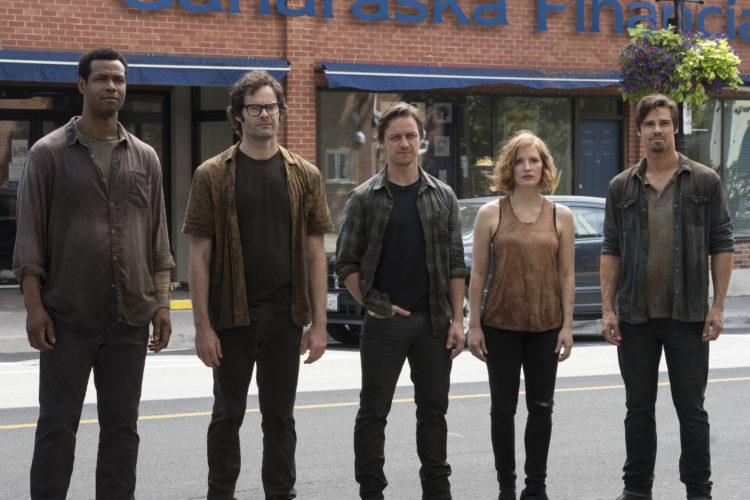
    The first part of the movie is dedicated to Mike getting the gang back together, which includes Bill, his love interest Beverly (Jessica Chastain and Sophia Lillis), fouled-mouth jokester Richie (Bill Hader and Finn Wolfhard), former fat kid (and now hot) Ben (Jay Ryan and Jeremy Ray Taylor), hypochondriac Eddie (James Ransone and Jack Dylan Grazer), and Andy Bean and Wyatt Oleff as Stanley.

    While it’s all fun and games at first, Pennywise (Bill Skarsgard) quickly starts up his old tricks to torment the gang as they try to figure out how to defeat him. Old memories are rehashed and wounds are reopened as each of the “Losers” face their pasts. Each of them gets their moment. However, the movie doesn’t really explain why each of them needs one. Yes, they all have chips on their shoulder, but each character vignette feels more like a way of letting the starry cast each have their turn in the spotlight. It feels more like filler than an actual plot — which explains the unnecessarily bloated 169-minute runtime.

    it chapter two
    Isaiah Mustafa, Bill Hader, James McAvoy, Jessica Chastain, and Jay Ryan in It Chapter Two. Credit: Warner Bros. Pictures.

    Rather than adding onto and complementing the first movie, Chapter Two feels bogged down by it. Muschietti and screenwriter Gary Dauberman try to make the movie funnier, scarier, more intense, and more emotional. As a result, it’s none of those things. I liked the first movie quite a bit. Though it isn’t perfect, the plot is more focused and intentional, which makes each scene (and scare) more effective.

    Chapter Two returns to the playbook that made many of the set pieces in the first work and doubles down on each of those elements, which seems instinctive, but instead, it just means each scene is predictable. That coupled with the overreliance on CGI makes the movie completely devoid of horror.

    Because the middle section drags so much, the plot is stuffed into the first and last 45 minutes. However, there is so much plot — and so much exposition — that we never get a chance to reform the emotional bond with the characters that makes the first so successful. The end of Chapter Two, which should feel triumphant and bittersweet instead feels hollow.

    Hader and Ransone do some of the best work of the cast and get chances to flesh out their characters a bit more, especially Hader, though there is some subtext that is a little too subtle to be notable. The rest of the cast, however, never really connect.

    If you haven’t noticed, I haven’t mentioned Pennywise, the eponymous “It” much yet. And that’s because he’s less than his already scant screentime in the first movie. Skarsgard is so good in the role, but Muschietti is more obsessed with action-based setpieces than he is actual horror, so he never gets a proper chance to shine.

    To be honest, there’s so much more I can criticize and tear apart in It Chapter Two, but I’ll spare you and say this. Clearly, Muschietti had a long list of things he wanted to do and tackle in this movie — and he did all of it. Unfortunately, the movie didn’t need most of it.


    ADVERTISEMENT


    More movies, less problems


    Hey! I’m Karl. You can find me on Twitter and Letterboxd. I’m also a Tomatometer-approved critic.

    💌 Sign up for our weekly email newsletter with movie recommendations available to stream.


    ADVERTISEMENT


  • ‘Atlantics’ NYFF review — Transatlanticism in a movie

    ‘Atlantics’ NYFF review — Transatlanticism in a movie

    Atlantics follows a group of workers in Dakar as they leave the country by boat looking for a better life.

    One-sentence review: Atlantics has an intriguing enough story and Mati Diop manages some fascinating scenes of tension and emotion, but it lacks the narrative momentum for it to really take off.

    Details: ? Mati Diop // ?????? Senegal, France, Belgium // ⏳ 104 minutes

    The cast: Mame Bineta Sane, Amadou Mbow, Ibrahima Traoré

    Where to watch Atlantics: Playing at the New York Film Festival October 9th & 10th. Tickets here.

    Atlantics is a meditative movie. Director Mati Diop — who became the first black woman to compete for the Palme d’Or at the Cannes Film Festival this year — wasn’t afraid to go slow or make the story relatively slight considering where it could have gone. The end product is better and worse for it. 

    Atlantics takes place in Dakar, on the Atlantic coast of Senegal in West Africa, where a group of workers argues with the management of the construction project they’re working on. They haven’t been paid in months and they’re fed up. One of those workers, Souleiman (Ibrahima Traoré) sneaks away to meet up with his girlfriend Ada (Mame Bineta Sane) to try and tell her something, but she brushes him off and tells him to save it for when they meet up later that night. However, that meeting never happens.

    Ada, who is engaged to a wealthy man named Omar (Babacar Sylla), sneaks out to meet Souleiman at a local haunt. When she gets there, all she finds are women from whom she learns that the workers set off to sea to find work overseas in Spain. She’s heartbroken that Souleiman has left her and that she must marry Omar. However, one night during a celebration for the couple, a fire breaks out. Though no one is hurt, several witnesses said that it was Souleiman who set the fire, which Ada knows is impossible. Still, the detective assigned to the case (Amadou Mbow) is convinced that it is him. 

    Ibrahima Traoré and Mame Bineta Sane in Atlantics. Credit: NYFF.

    The movie is based on Diop’s own short documentary about Senegalese migrants voyaging overseas in search of work, which is something I wish the movie explored a little more. Much of the focus of the first part of the movie is table-setting. Mostly, establishing Ada as the main character and her struggle following Souleiman’s departure. However, it’s hard to connect with her — or feel sympathy for her — because we don’t get to spend much time with the couple. Their relationship isn’t explored except for a brief scene. 

    That’s the main crux of the problem with Atlantics. There is a rich story about migrant workers, class, and female oppression waiting to be tapped. However, Diop instead takes a more cerebral and meditative approach. The result is a first half that drags a bit before the real narrative starts kicking in. The movie takes an unexpected turn to the supernatural, which breathes new life into it. In a way, it feels akin to Olivier Assayas’ Personal Shopper as it explores magical realism. Unfortunately, where that movie is an effective meditation on grief, the themes in Atlantics feel muddled. 

    That all being said, where the movie ends up is interesting. The final few scenes feel so impactful and even emotional — particularly one set in a graveyard and one set in a beachside bar. Or at least feel like they could have been impactful if the preceding hour were better plotted. However, they do point to some real talent that Diop has had they been applied to a stronger screenplay. You can never criticize a movie for being a slow burn. However, you can criticize what it does with that pace. Atlantics doesn’t do quite enough. 

  • ‘Hustlers’ review — Everyone is hustling someone

    ‘Hustlers’ review — Everyone is hustling someone

    Hustlers follows a group of strippers as they hatch a plan to swindle money from their wealthy clientele.

    30-second review: Hustlers is an incredibly complex movie. Not only is it hilarious and charming, it delivers commentary on complicated themes of female relationships, the power dynamic between men and women, and the struggle of the working class. And it doesn’t betray either side. It never becomes uncompelling or unentertaining.

    Much of the credit for its success lies in director and writer Lorene Scafaria‘s understanding of the characters. They’re hilarious and fun to hang out with, but also lived in and realistic. There’s so much to latch onto. It also helps that Jennifer Lopez is doing some of the best work of her career and is worth of Oscar attention.

    Details: ? Lorene Scafaria // ?? U.S. // ⏰ 110 minutes

    Where to watch Hustlers: In theaters now.

    Hustlers is a heist movie that also pulls off its own heist as it follows a group of strippers led by Jennifer Lopez in her greatest role since the 90s. While the movie is as glitzy and sleek as you’d expect with enough jokes and gags to keep you entertained from beginning to end, there’s also a complex framework of themes working in the screenplay from female empowerment and relationships to financial irresponsibility and the power dynamic between men and women.

    It’s quite impressive how much director and writer Lorene Scafaria packs into the breezy 110-minute runtime — including cameos from Cardi B, Lizzo, and Usher. Still, you never feel like you’re missing out on any element. The movie is framed by an interview Destiny (Constance Wu coming off Crazy Rich Asians) is doing with a journalist (Julia Stiles) about her time as a stripper from 2007 through the financial crisis and its aftermath.

    The beginning of the movie is surprisingly subdued. Scafaria takes care not to fall into the various traps that most directors would when tackling a movie set in a strip club. She doesn’t imbue the lifestyle with extra glitz and glam and instead lets the characters talk for themselves. During that time we get to know shy but tough Destiny who was left to be cared by her grandmother as a child in Queens who is taken under the caring wing of Ramona, a veteran at the club they work at.

    There, they deal with all kinds of men as a breezy montage shows us — mostly various levels of Wall Street figures looking to escape the mundanity of their lives or to simply feel powerful. For a time, they lived like queens able to buy themselves expensive jewelry, pay for beautiful apartments, and, at least for Ramona, take care of her daughter.

    Ramona is a fascinating character study in herself — and Lopez’s performance only elevates her. She’s a woman of dichotomies. She’s both caring and unforgiving, emotional and hardened. You can see those complexities in Lopez’s performance — in the way she carries herself and the way she moves. When she walks through the club, you believe she rules the world.

    Jennifer Lopez and Constance Wu star in Hustlers. Credit: STX Films.

    Like all good things, though, it had to all come crashing down. During the economic downturn of 2008, Destiny has a daughter and is forced to stop stripping. However, even if she kept at it she wouldn’t make nearly as much money as much of the club’s clientele also lost their jobs in the crisis.

    That’s when Ramona, with the help of Destiny and two other girls from the club — Annabelle (Lili Reinhart) and Mercedes (a delightful Keke Palmer) — hatch a plan to hustle wealthy Wall Street men out of their money by using their charm to gain their trust before drugging them and running up huge tabs on their credit cards.

    The brilliance of that plan is that the men are so embarrassed by what they’ve done and what was done to them that they keep quiet. Pride is one of the most powerful weapons to use against those in power. It’s one of the many complex themes that Scafaria explores in her wonderfully layered screenplay that uses several tricks to tell the story — flashbacks and forwards, montages, switching perspectives.

    However, it’s the way she brings that screenplay to the screen that’s the real wonder. Hustlers is both stripped down (pun intended) and larger-than-life. She allows the movie to be entertaining and funny and delightful while also delivering emotional beats between characters that are raw, especially between Ramona and Destiny.

    I feel like I’ve let this movie down. It’s so difficult to explain what makes it so great because there is so much not on the surface that does it. There’s so much joy exuding from the screen along with the pressing moments. The characters and the world feel heightened and lived in. The characters are complex and charming and relatable. It’s a circus act of a movie. A nearly impossible feat that somehow works. It’s one of the best movies of the year.

  • ‘Brittany Runs a Marathon’ review — The title says it all

    ‘Brittany Runs a Marathon’ review — The title says it all

    Brittany Runs a Marathon follows an overweight and lonely New Yorker as she sets out to turn her life around by training for a marathon.

    One-sentence review: Brittany Runs a Marathon has enough charm, laughs, and wonderfully eclectic characters — especially Jillian Bell‘s eponymous Brittany — to get it past its weaker moments.

    Details: ? Paul Downs Colaizzo // ⏳ 103 minutes // ?? U.S.

    Cast: Jillian Bell, Michaela Watkins, Utkarsh Ambudkar, Lil Rel Howery, Micah Stock

    Where to watch Brittany Runs a Marathon: Now playing in theaters.

    Brittany Runs a Marathon plays like a marathon. It begins light on its feet and breezy. It’s filled with sharp observational humor and a completely endearing performance by Jillian Bell in the titular role. Halfway through the pace slows before nearly crumbling in the final stretch. However, the movie, the first for playwright Paul Downs Colaizzo — he based the screenplay on a friend’s similar experience — eventually does cross the finish line. 

    In the vein of I Feel Pretty starring Amy Schumer a few years ago — a more broadly comedic take on the same concept — Brittany Runs a Marathon follows the titular character as she takes steps to better her life. After an appointment with the doctor points out she’s technically obese, Brittany begins to spiral out of her already obstacle-filled life. She’s 27, single, broke, and seems to always get to the subway just as the doors close. It doesn’t help that her roommate Gretchen (Alice Lee) is an influencer with a seemingly perfect life.

    Eventually, though, Brittany is able to muster up the motivation to go on a run donning two bras, sweatpants, and a pair of high top chucks. And she does it, igniting a spark that drives her to get her life together. Her first step is to join a running club recommended by her neighbor Catherine (Michaela Watkins). There she meets Seth (Micah Stock), a dad intent on showing his young son that he can be as athletic as his other dad. Side note: it’s so refreshing to see a happy gay married couple where their sexuality isn’t a plot point. 

    Micah Stock and Jillian Bell in Brittany Runs a Marathon. Credit: Amazon Studios.

    Brittany’s second step is to get another job which comes in the form of a house/dog sitting gig that she shares with perennial slacker Jern (Utkarsh Ambudkar — a standout). However, Brittany’s transformation doesn’t just come physically as she sheds the pounds. Her attitude begins to change. At the beginning of the movie, she’s a typical class clown type who is never able to say anything in earnest. Everything she says is either a sarcastic quip or delivered in some offbeat way — it’s the main reason the first part of the movie works. 

    As a former fat kid, it’s easy to see that Brittany uses humor as a defense mechanism. While coming off as agreeable and funny, she also keeps people — including friends and potential suitors — at an arm’s length. For a time, the movie balances that commentary with the laughs and fun romps with supporting characters. Eventually, though, it gets overtaken by its commentary and stops being fun. There’s a third act tonal shift that is abrupt and markedly difficult to get through. It feels as if Collaizzo starts to write and direct too much.

    Though, thanks to Bell’s great performance, the movie mostly stays on track even when the plot gets unwieldy with one too many digressions. However, when Brittany Runs a Marathon sticks to Brittany… well, running a marathon, it moves with plenty of laughs and relatable commentary. I mean, you can never go wrong with a movie with the line, “it’s New York City, of course I’ve slept on a rat.”


    ADVERTISEMENT


    More movies, less problems


    Hey! I’m Karl. You can find me on Twitter and Letterboxd. I’m also a Tomatometer-approved critic.

    💌 Sign up for our weekly email newsletter with movie recommendations available to stream.


    ADVERTISEMENT


  • ‘It’ (2017) review — More thrilling than scary, but certainly entertaining

    ‘It’ (2017) review — More thrilling than scary, but certainly entertaining

    Following the 1990 miniseries, It reimagines Stephen King’s classic novel as a frightening romp through the 1980s.

    30-second review: A key change was made from Stephen King’s classic novel It for its 2017 film adaptation directed by Andy Muschietti. The film’s timeline was moved from the 50s to 1988. That change brought some refreshing updates — raunchy humor and fun pop-culture callbacks — but also some issues.

    However, Muschietti focuses the movie on these set pieces pulled straight from the novel that makes you question the treatment of the child actors in the best way possible. The twisting creatures of the film, including a decomposing leper and a burned decapitated corpse, are fancifully realized and used to great effect. But it makes you think one thing: how messed up is Stephen King?

    It follows seven friends who make up the self-named Losers Club. Billy (Jaeden Lieberher), recently lost his little brother Georgie (Jackson Robert Scott) to the eponymous monster, though he relentlessly searches for him with help of his friends. However, when the same monster comes after the group, they must get over their fears and band together to defeat him.

    The set pieces at the center of the film are visually splendid and offer genuine thrills that will keep word of mouth churning for the film. However, after each of those scenes, the tension is drained usually after an awkward tonal shift. The film, which was adapted by Chase Palmer, Gary Dauberman, and Cary Fukunaga — who was attached to direct originally, feels a lot like Stranger Things.

    Whether it’s the 80s setting or Finn Wolfhard — he stars in Stranger Things — the humor, style, and even the scares feel more like the sci-fi drama than a real horror movie. Still, what stays with you are the set pieces. Each character has their fear realized when they are alone, and that’s where the film excels. One scene in particular, which takes place in a bathroom, was the closest the film got to terrifying. It was measured, tense, and paid off in a great way. Plus, the absolute drenching of blood gave of Carrie vibes that felt like a subtle nod, unlike a lot of the movie’s references.

    The character pieces in between, though, fall flat. Though the movie really feels from the point of view from adolescents, the story elements feel jammed in. A sexual abuse storyline is overtly alluded to, even though it seems like the movie thinks it’s being subtle. The history of the town and the potential source of It is crammed down our throats in clunky exposition scenes. Much of Billy’s storyline concerns his search for Georgie and his constant denial of his death, however even this is done in an unsubtle way.

    Jaeden Liberher in It

    However, three key performances save those sections from detracting too much from the film as a whole. First off, Sophia Lillis, who plays the only female member of the Losers Club, Bev, carries a lot of the emotional weight of the movie on her shoulders and does so naturally. But what stands out for me is her watershed moment in a bathroom with gallons of blood drenching her and her surroundings.

    For a movie about fear, she certainly knows how to portray it convincingly. Wolfhard, who plays Richie closely to his Stranger Things character, gets a lot of the one-liners and lands them every single time. He often walks away with every scene he’s in and, at points, he got the entire theater clapping. But the arguable lead of the film, Lieberher, gives the best performance of the Losers Club by fleshing out a character that isn’t given that much of a personality. He has a stutter, which he doesn’t let define the performance, and instead uses an intense love of Billy’s brother to drive the character’s motivations. It’s a sublime performance. Between this and Midnight Special, Lieberher may be the rising star among young actors.

    But still, the scares, all belong to Pennywise the Dancing Clown played masterfully by Bill Skarsgard. Skarsgard, who stunned in Atomic Blonde this year, builds on Curry’s classic 1990 performance as the character and infuses a physicality that Curry’s performance didn’t quite have. No scene displays the virtues of his performance more than the famous sewer scene that opens the movie. 

    He uses a similar throaty cartoon voice to Curry’s but adds menace with his delivery. More importantly, the amount of movement that he uses in his mouth area is a small but effective way to up the creep factor. Even when he’s not speaking he pinches and moves his lower jaw in a manner that I can only describe as deliciously creepy. All the nightmarish imagery aside, Skarsgard delivers the chills in the movie like no other monster can.

    It is frustratingly close to being a great movie. The 80s references — from Molly Ringwald to New Kids on The Block — are fun, but ultimately bog down the themes that make the novel a classic. The set pieces are scary but short-lived and the movie lacks the tension it needed to be an effective horror movie. You can count the number of changes that would make the movie a near-masterpiece on one hand, but it gets a lot right.

    It’s shot and designed beautifully — the creature design is phenomenal — and is cast superbly. Look at the movie as more of a sci-fi drama than an outright horror movie and you’ll definitely be more enthralled — this was one of the most fun times I had at the theater this year. Either way, when Pennywise tells you you can float too, you’ll feel a chill down your spine. Just like King intended.


    ADVERTISEMENT


    More movies, less problems


    Hey! I’m Karl. You can find me on Twitter and Letterboxd. I’m also a Tomatometer-approved critic.

    💌 Sign up for our weekly email newsletter with movie recommendations available to stream.


    ADVERTISEMENT


  • ‘Once Upon a Time in Hollywood’ movie review — Tarantino’s Summer of ’69

    ‘Once Upon a Time in Hollywood’ movie review — Tarantino’s Summer of ’69

    Once Upon a Time in Hollywood, Quentin Tarantino’s ninth film, is a romp through the Golden Age of Hollywood.

    30-second review: Once Upon a Time in Hollywood is as well-made, deliciously unhinged, and entertaining as any of Quentin Tarantino’s films. However, the impeccable recreation of 1969 Hollywood — from the sun-drenched cinematography to the lived-in costumes — is impeded by the thin story.

    The characters, both fictional and real, played by Brad PittLeonardo DiCaprio, and Margot Robbie are perfectly constructed — the performances are impeccable — but the narrative they’re thrown into feels shapeless and meandering for much of the runtime. Even when the ending tries to stitch it all together. Though, every scene sticks with you in some way. It’s that impact that has made Tarantino’s work endure. 

    Where to watch Once Upon a Time in Hollywood: In theaters now.

    Full review below ?


    If Quentin Tarantino knows how to do one thing it’s how to name characters. I mean, when you hear the name Rick Dalton you almost picture the washed-up TV cowboy that Leonardo DiCaprio plays. Though Dalton was a star burning bright for much of his career on the fictional show Bounty Law, Hollywood is a town that’s always on the move and it’s leaving him behind. 

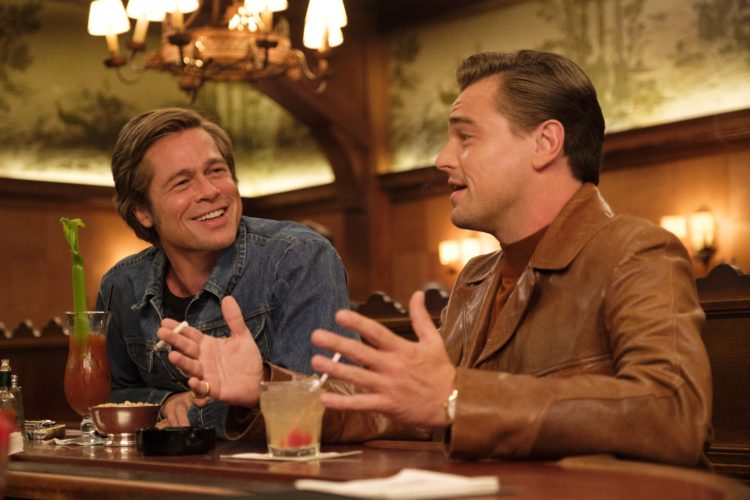
    Like many TV stars of the era, he tried to make the pivot to movies to lesser success. In one hilarious scene, he tells the story of how he once almost played Steve McQueen’s part in The Great Escape — complete with DiCaprio superimposed into clips of the film. He laments his career to his best friend, driver, and frequent stunt double Cliff Booth (played by a better than ever Brad Pitt) who has a dark reputation in town as the man who killed his wife and got away with it — which is seen in yet another vignette. 

    Much of the movie is spent hanging out with the duo both together and separately as Dalton films a guest role on another TV western and Booth has a friendly sparring match with Bruce Lee (Mike Moh) and encounters with a curious group of hippies (mainly Pussycat played by Margaret Qualley).

    All the while, we follow young upstart Sharon Tate (Margot Robbie), her husband Roman Polanski (Rafał Zawierucha), and ex Jay Sebring (Emile Hirsch). Yes, we follow Sharon Tate during the Summer of ’69 — a.k.a. the summer of the Manson murders. More on that later. 

    Every scene — all vignettes really — are infused with Tarantino’s trademark style and sharp writing. But as one of the few of his films that isn’t told in chapters, the narrative desperately needed a structure. I can’t quibble with any of the scenes. They’re all entertaining and some hilarious. DiCaprio is better than ever as a semi-high functioning alcoholic trying to prove to himself he can still act. But because his journey doesn’t clearly fit into the larger narrative, so much of it feels pointless. 

    Once upon a time in hollywood
    Brad Pitt and Leonardo DiCaprio star in ONCE UPON TIME IN HOLLYWOOD. Credit: Sony Pictures

    Despite the highly publicized spat between Tarantino and a reporter over the number of lines Robbie has in the film — apparently, more were added in later — Tate looms large in the film. If Dalton is a star fading, she is a star on the rise. She knows it and can’t believe it. Robbie is transfixing on the screen and any fan of Tarantino’s movies knows that following her for no discernible reason is going to pay off in some way — and it truly does. 

    The film’s ending is going to be a make or break moment for audiences. It’s classic Tarantino and theoretically ties the movie together. Whether or not it does is going to be subjective. Honestly, I’m not totally sure how I feel about it just yet. But ultimately, I land more positively on Once Upon a Time in Hollywood than I did his last film, The Hateful Eight, which I had a similar issue with. 

    Most of that is due to the fact that Tarantino is without a doubt a singular filmmaker. No one does what he does and those that try often fail — with the exception of Bad Times at the El Royale, which I loved. Each scene taken on its own is impeccably crafted and stick with you.

    In one scene, Sharon Tate sits in a theater and watches her own performance in The Wrecking Crew smiling as the audience react. In another, Dalton has a conversation with a precocious 8-year-old about his career and the wringer of the film industry. And in perhaps the best sequence of the movie, Dalton attempts to make it through a scene only to flub his lines after which he gives himself an alcohol-induced pep talk which reminds us why DiCaprio is a star. Each described sound uninteresting, but the reason Tarantino has endured is his ability to give each moment impact. Even without a solid story, Once Upon a Time in Hollywood certainly sticks with you.


    ADVERTISEMENT


    More movies, less problems


    Hey! I’m Karl. You can find me on Twitter and Letterboxd. I’m also a Tomatometer-approved critic.

    💌 Sign up for our weekly email newsletter with movie recommendations available to stream.


    ADVERTISEMENT