Category: Movies

  • Jane Fonda and Lily Tomlin kill in ‘Moving On’ | TIFF movie review

    Jane Fonda and Lily Tomlin kill in ‘Moving On’ | TIFF movie review

    Jane Fonda and Lily Tomlin play a pair of old friends in Moving On preparing to murder their third best friend’s husband following her death. It’s a comedy, by the way.

    If there was ever a duo readymade to murder a sexist, egotistical, lying, hypocritical bigot, it would be Lily Tomlin and Jane Fonda. (If I had to add a third to the mix, it would be Dolly Parton, but I digress.) The 9 to 5 co-stars—who have been friends for decades, helmed Netflix’s Emmy-nominated sitcom Grace and Frankie, and faced off against Megyn Kelly regarding plastic surgery—are back together on the big screen in Moving On. The comedy, which premiered at the 2022 Toronto International Film Festival last week, reunites director Paul Weitz with Tomlin, who received a Golden Globe nom for Grandma

    The movie follows Claire (Fonda) and Evvie (Tomlin), two parts of a trio of estranged college besties who reunite at the funeral of their third BFF, Joyce. Of course things immediately take a turn for the worse when Claire informs Joyce’s grieving husband Howard (Malcolm McDowell) that she has come to do more than mourn–she has come to murder him (DUN DUN DUN). When Evvie arrives (stumbling onto the stage from behind a curtain halfway through the eulogy), she agrees to assist Claire on her homicidal mission.


    ADVERTISEMENT


    From the initial premise (“two old brawds try to whack their bestie’s evil hubby”), a whole slew of Grace and Frankie-esque hijinks follow.

    They try to buy a gun. When that doesn’t work, they try to nab one from a semi-senile resident in Evvie’s assisted living facility. Claire accosts Howard about the reasons she has for murdering him. Evvie interrupts the wake to unveil a few secrets about Joyce’s life that the family has tried to forget. And with every tender moment, such as Claire reconnecting with her ex-husband Ralph (Richard Roundtree), there are ridiculous ones like Evvie, whose driver’s license has been revoked, causing mass havoc via automobile to Los Angelinos. 

    If you are thinking to yourself, “Well that just sounds like the movie version of Grace and Frankie” you would not be wrong. But tell me, who among us doesn’t want a 90-minute, large-screen version of that show? This is sort of like the Downton Abbey movie if they just changed the names of Lady Mary and the Dowager Countess to Lady Claudette and her grandmother Maude—charming, delightful, and a lovely way to spend the afternoon.


    ADVERTISEMENT


    While often light and frother, about halfway through the film reveals the pair’s motive for murder spins atop a much deeper and more serious issue.

    And while the duo still spend time bribing people with bacon and shouting at homophobic strangers, both Tomlin and Fonda are given the room to stretch their dramatic acting chops. With one Tony, two Oscars, and eight Emmys between them, Fonda and Tomlin can certainly deliver in a drama just as well as a comedy, and the balance here in Paul Weitz’s script is calibrated perfectly. 

    Ultimately Moving On is a tale of the friendship and nostalgia shared between two women whose memories of youth are too strong for time (and evil men) to keep them apart. While tragedies in their personal lives may have driven a wedge between them, the weight of their experiences in college and those formative post-grad years where we stumble about the real world like clutzy baby deer, cannot be dismissed.


    ADVERTISEMENT


    Tomlin and Fonda, who are 83 and 84 respectively, are certainly not as spry as they once were, and there is a certain melancholy attached to watching two formidable actors move more slowly and handle objects with less precision than they once did. And while the characters are embracing who they once were, they are also grappling with the fact that they are losing skills (driving, playing the violin) that they once took for granted. As a viewer, you can’t help but preemptively mourn the days when these two beacons are gone. Luckily they have left behind a treasure trove of—dare I use the word—content for us to savor. 

    Moving On is not groundbreaking cinema, but it doesn’t need to be. Honestly, it’s the better for it.

    Moving On feels like reconnecting with old friends to reminisce about your best, funniest memories. It’s spending 90 minutes with two living legends who can deliver quippy one-liners and dramatic monologues with ease. There’s no better way to enjoy an afternoon than at the theater with these two, and I can’t wait to do it again. 

    Moving On premiered at the 2022 Toronto International Film Festival. It is currently seeking distribution.


    Hey! I’m Matt. You can find me on Twitter here. I’m also a staff writer at Buzzfeed.


    ADVERTISEMENT

  • ‘Kimi’ is a techno-thriller for the pandemic era | review and analysis

    ‘Kimi’ is a techno-thriller for the pandemic era | review and analysis


    ADVERTISEMENT


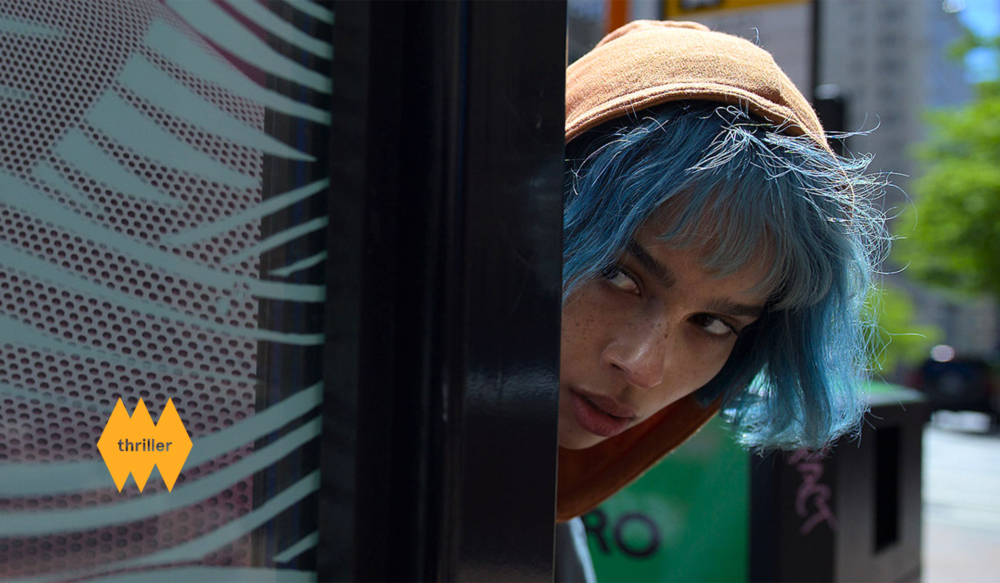
    Kimi follows a young tech worker is faced with a corporate conspiracy when she hears a crime through an Alexa-like smart speaker

    Where to watch Kimi:

    There’s a scene in Kimi, the newest movie from Oscar-winning director Steven Soderbergh, when protagonist Angela (Zoë Kravitz) puts her AirPods on to drown out the sounds of her Seattle loft. It mirrored me in my New York City apartment watching the movie with my headphones to drown out the noise coming from the street — and my radiator. When she put her right earbud in, my right headphone went quiet. When she put on the left, my left went silent. It’s a small detail, but one that was crucial to my viewing experience.

    That was the moment I knew that Kimi was something special.

    First of all, for its immersive quality. Like it was made for me to watch it in my apartment with my headphones on immersed in the world. Second, unlike many movies made in the pandemic era, Kimi doesn’t shy away from living in that world. Actually, the pandemic helps drive the plot — a twist on the classic Rear Window-esque psychological thriller. Angela already suffered from agoraphobia from a previous assault that left her riddled with anxiety. You could imagine that a global pandemic didn’t help her mental state.


    ADVERTISEMENT


    Angela sticks to a rigid schedule. She eats breakfast, rides on her Peloton, checks in with her cute neighbor (Byron Bowers) who lives across that street. Soderbergh — known best for directing the Ocean’s Trilogy — catches the action as methodically as Angela is. She’s just as regimented when it comes to her job as a sort of quality assurance engineer for Kimi, an Alexa or Apple HomePod analog. Angela’s job is to analyze snippets of failed requests and correct the mistakes. However, one recording doesn’t sit right with her. Something sounds off. Sinister even.

    In another wondrous scene of immersive sound design, Angela slowly toys with the audio file— reminiscent of Gene Hackman in The Conversation — until she is able to clearly hear a woman being attacked. The discovery finally gives her a reason to leave her apartment when her boss (Rita Wilson) invites her in to share her discovery. However, these case isn’t as simple as a trip to the corporate office.

    In Angela’s apartment the camera is rigid, steady, and ordered but when it’s outside it becomes frenetic and unsteady with unnatural angles mirroring Angela’s state of mind. The jarring soundscape juxtaposed against the peace of the apartment is anxiety-inducing. It’s what Soderbergh is best at. Evoking the specific feeling he wants you to experience.


    ADVERTISEMENT


    Kravitz gives one of the best performances of her career as she portrays the panicked feeling of anxiety that many of us felt in the face of the pandemic. Trying to muster up the courage to go outside and meet her crush for breakfast, she dons her mask, grabs a handful of hand sanitizer packets, and slowly unlocks her door only to be met with the crushing feeling of panic that is so familiar. Soderbergh makes it so easy to empathize with her, something that similar movies — *cough*The Girl on the Train *cough* — fail to do.

    After Angela ventures out into the world, Kimi makes the transition to a full-blown thriller for its second half filled with corporate intrigue, paranoia-filled thrills, and a stunning villain turn from Jane the Virgin actor Jamie Camil before pivoting to a third act conclusion that might be too tidy but is certainly satisfying. It tracks with Soderbergh’s “post-retirement” era — he announced a retirement from filmmaking in 2015 but apparently got bored. His filmmaking is still as lean, mean, and effective as before. But he’s not looking to push his craft or genre further. He’s simply having fun and you can tell.

    Kimi grapples with many of today’s issues — information security, big tech, trauma, homelessness, civil unrest, pandemic anxiety — but it never overstays its welcome and never overstates its purpose. Soderbergh knows that this is a popcorn movie and it’s all the best for it. As we move into the post-pandemic era, it’ll be interesting to see how filmmakers grapple with our collective trauma. If Kimi is any indication, there are stories just waiting to be heard.


    ADVERTISEMENT

    More movies, less problems


    Hey! I’m Karl. You can find me on Twitter and Letterboxd. I’m also a Tomatometer-approved critic.

    💌 Sign up for our weekly email newsletter with movie recommendations available to stream.


    ADVERTISEMENT


  • ‘Barbarian’ is for the camp horror girlies | review

    ‘Barbarian’ is for the camp horror girlies | review

    Barbarian follows a woman staying in an Airbnb in a rough neighborhood of Detroit who gets more than she bargains for when she finds a man already staying there.

    Barbarian is B-movie camp. It feels like it’s from the same grotesque weird wicked world that Sam Raimi is operating in. The twists are surprising, scares genuinely frightening, and comedy sharp. See it in a theater with a crowd.

    Don’t read this review. Barbarian is a movie that is best enjoyed unspoiled. And when I say unspoiled, I really mean it. That’s not to say it can’t be enjoyed entirely knowing what it’s about. But where’s the fun in that? It’s like a magic trick. The same way magicians use misdirection, distractions, and spectacles to hide how a trick is done, director Zach Cregger tricks you into thinking the movie is one thing. But while he’s showing you his left hand is empty, his right is getting ready to shock you. And unless you’re a boring cynic, you want to be tricked.

    It’s the same way I felt about James Wan’s Malignant, which feels like a spiritual sister to Barbarian. Both movies mine the tropes and imagery of Giallo flicks—a genre of movies popularized in Italy that combine elements of suspense, horror, and psychological erotic thrillers. The result is a maximalist horror that never fails to shock you with its devilishly fun twists and keep you entertained with delicious camp. At any given moment you’re not sure whether to laugh, cry, or just lose your damn mind. I, and the rest of my audience, seemed to be doing all three. Grab a bowl of popcorn, your closest horror-loving friend, and go for a ride. 

    For those who aren’t going to heed my warning, I’ll try to keep the rest of this review relatively spoiler-free.


    ADVERTISEMENT


    The first act of Barbarian will feel familiar to horror fans, whether it’s the camera movements reminiscent of Leigh Whannel or John Carpenter-esque score.

    It’s almost as if Cregger wanted to prove that he’s done his horror homework before completely flipping the genre on its head. There’s an almost cozy feeling when Tess (Georgina Campbell) drives up to the front of an unassuming single-family home at night… in the middle of a rainstorm. Yeah horror fans, your alarm should be going off. If it wasn’t already, it should be blaring when Tess finds the key in the lockbox already gone. Even worse, when she calls the phone number on the faux-Airbnb listing, it goes to the voicemail of a home management company. However, her luck sees a turn—for the worse or better we’re not sure—when a man answers the door.

    Keith is tall and handsome, but has a bit of a creepy edge to him. Bill Skarsgard, best known for his terrific turn as Pennywise the Clown in It, is perfectly cast. His look alone perfectly exudes a charmingly endearing energy that is alluring, but creepy at the same time—it would confuse any sensible person’s stranger danger senses. His apologetic and kind tone gets Tess to accept his invite to share the space while she sorts out her housing situation. Skarsgard’s performance continues to toe the line between genuinely charming and creepily rehearsed—but whether there is more to him is unclear.


    ADVERTISEMENT


    The movie actively ratchets up the tension even as Tess’ fears are assuaged in a perfectly calculated slow burn that keeps you searching for the twist—trust me, you won’t find it.

    When Tess steps out of the house the next morning to go to the job interview she’s in town for, she sees the state of the neighborhood. The house she’s staying in is lovingly renovated, but the rest of the neighborhood is a dilapidated ghost town. All this setup eventually leads to Tess returning to the home and finding a hidden corridor in the basement out of the house.

    From there, the movie takes pivots to the grotesque, absurd, and downright batshit. But what I love is that it doesn’t feel the need to explain itself or its lore further than needed. Some would call those plot holes—I’d call it strategic information withholding. Barbarian almost makes itself immune to story criticism because it only gives you enough to piece your own background story together. The same goes for its potential social commentary. It could follow It Follows and Don’t Breathe in the Detroit-horror subgenre that touches on race and class. However, it never fully forms those ideas—but it doesn’t spend valuable time on them either.

    There is a #MeToo subplot that takes the movie to a new place from the first half—Justin Long makes an appearance that I wish was hidden in the marketing. And while the message may be obvious, it helps tie the absurdity into a satisfying character journey. Barbarian isn’t going to be for everyone. It’s like Sam Raimi movies or Giallo films. If you know you know. Like Evil Dead 2 or Malignant, Barbarian feels like it’s from the same grotesque weird wicked world where twists are surprising, scares genuinely frightening, and comedy sharp. See it in a theater with a crowd.


    ADVERTISEMENT


    More movies, less problems


    Hey! I’m Karl. You can find me on Twitter and Letterboxd. I’m also a Tomatometer-approved critic.

    💌 Sign up for our weekly email newsletter with movie recommendations available to stream.


    ADVERTISEMENT


  • ‘Orphan: First Kill’ is the campy sequel we didn’t know we needed | movie review

    ‘Orphan: First Kill’ is the campy sequel we didn’t know we needed | movie review

    Esther, the titular Orphan from 2009’s cult classic, makes her triumphant return in Orphan: First Kill, an origin story prequel that you didn’t know you needed.

    Orphan: First Kill doubles down on the original’s wacky premise to deliver a deliciously campy prequel that will please fans of the first movie and convert a few new ones. With each passing twist, and a pair of perfectly tuned-in performances from Isabelle Fuhrman and Julia Stiles, the movie delights, terrifies, and entertains from beginning to end. A camp cult classic in the making.

    One of my favorite memories growing up is watching silly B-horror movies with my older sister—I Know What You Did Last Summer, Fear Island, the Final Destination series. But one of our favorites was 2009’s Orphan. It was kind of silly in a self-serious way but legitimately creepy and scary. The exact type of horror movie that we could come back to whenever we needed a comfort watch. Of course, we were excited when we heard that a sequel was forthcoming, with the original Esther.

    From the opening moments, we were giddily soaking in the creepy atmosphere. But then, our excitement waned. For the first half of Orphan: First Kill, what we loved about the first movie was dialed too high—the dramatics, Esther’s creepiness, the gore. It wasn’t the movie we loved. But then the twist happened—that glorious twist that completely changed the way we were watching the movie and turned it into a campy classic that I could see us enjoying for years to come.


    ADVERTISEMENT


    The first half was also campy fun, but the game of expectations made it feel like a betrayal of the original. In retrospect, it only made sense for the movie to open that way. We remeet Leena (played again by Isabelle Fuhrman who is made to look 10 years old with the help of movie magic) in a mental institution in Estonia before the events of the first movie. As her doctor explains, she suffers from proportional dwarfism, a disease that causes her to look the same age even as her mind grows and develops. You could imagine how that would make a person go mad—and mad she does go. After escaping the institution with manipulation and hilariously brutal kills for a “ten-year-old,” Leena hatches a plan to get to America.

    Finding a missing girl to whom she holds a passing resemblance, Leena assumes her identity and poses as Esther Albright, the daughter of wealthy artist Allen (Rossif Sutherland) and his philanthropist wife Tricia (Julia Stiles). She concocts a kidnapping backstory, which would explain how she found herself in Estonia… with an accent. Over the coming weeks, “Esther” tries to assimilate into the family by piecing together fragments of the actual Esther’s life.


    ADVERTISEMENT


    What made Fuhrman’s performance in the original so iconic and terrifying—part of the reason why a sequel would only work with her—was her ability to make Esther just odd enough to put you on edge but not enough to convince you she isn’t anything but a creepy, but normal, child. In First Kill, her performance is dialed up to 11, which doesn’t work—until it does. Remember that twist I mentioned a bit ago? Without spoiling, it doubles down on the wackiness of the premise to deliver some of the highest gay shriek-inducing camp that includes a deliciously devilish performance from Julia Stiles.


    ADVERTISEMENT


    More movies, less problems


    Hey! I’m Karl. You can find me on Twitter and Letterboxd. I’m also a Tomatometer-approved critic.

    💌 Sign up for our weekly email newsletter with movie recommendations available to stream.


    ADVERTISEMENT


  • ‘Beast’ roars for your attention | movie review

    ‘Beast’ roars for your attention | movie review

    In Beast, a doctor and his two young daughters find themselves at the wrong end of a lion’s taste for vengeance as they become trapped in the South African bush

    Over the running time of Beast, wildlife biologist and animal sanctuary protector Martin (Sharlto Copley) remarks a few times that what is happening isn’t normal. That being a lion on a path of vengeance through the South African grasslands after his pride is killed by a group of poachers. Most lions will kill to eat and generally avoid humans. This one is doing the exact opposite, leaving bodies behind in his wake. Why? The movie doesn’t exactly tell us. Rather than wrapping some wild exposition about the lion being infected by radioactive waste dumped by a nearby nuclear plant, Beast spares us from the unnecessary details and delivers what we want: Man vs animal. In that way, at its core, it’s a perfect B-movie.

    However, it’s more than that largely thanks to director Baltasar Kormákur and actor Idris Elba who elevate the schlocky script into a surprisingly effective survival thriller. The details we do get are that Elba’s Dr. Nate Samuels recently lost his wife who he had separated shortly before. In the wake of her death, he brings his young daughters, teenager Meredith (Iyana Halley) and preteen Norah (Leah Sava Jeffries), to her home village in South Africa where Martin still works. After a magical encounter with a pride of lions that Martin has worked with since their youth, they come upon an abandoned village that looks to be on the wrong end of a vicious lion attack. From there, the movie roars to life.


    ADVERTISEMENT


    Thanks to Kormákur’s sense for suspense, Beast rarely gives you a minute to breathe. Through a series of single-shot long takes, the movie builds suspense until inevitably the antagonistic lion roars onto the screen. And despite it being done in complete CGI, the titular beast feels dangerous. In the movie’s first long shot, the camera follows the group as they arrive at a nearby village. As we sweep around following different characters, the discovery of multiple dead bodies sets our senses ablaze. When Norah temporarily goes missing, we follow Nate through a labyrinth of branches that further disorients our senses. The shot finally cuts when we find Norah who has discovered another body. And the games begin.

    Each ensuing encounter with the lion feels as impactful as the last. Elba’s bonafide movie star glow holds every frame and makes you believe the stakes—even when the beast isn’t on screen. The movie is careful not to overuse its villain, but there’s always a sense that it’s lurking within reach. That’s what makes Beast worth its lean 93 minute runtime. Even if the material isn’t Oscar-worthy, every actor and filmmaker is performing like it is.


    ADVERTISEMENT


    More movies, less problems


    Hey! I’m Karl. You can find me on Twitter and Letterboxd. I’m also a Tomatometer-approved critic.

    💌 Sign up for our weekly email newsletter with movie recommendations available to stream.


    ADVERTISEMENT


  • ‘Prey’ gives The Predator new life | movie review

    ‘Prey’ gives The Predator new life | movie review

    A young Native American woman in the 1700s hunts down a vicious other-worldly predator terrorizing her tribe’s land. Or is it hunting her?

    Prey proves that bigger isn’t always better. Though the sequels to the original Predator each try to one-up the last — most hilariously with the aptly named Predators — director Dan Trachtenberg does the exact opposite with his stripped-down period coming-of-age. He still keeps the fun energetic action that the franchise is known for — the eponymous predator retains all of its ridiculous and ever-advancing powers — but by setting it in the 1700s, the movie has to find innovative ways to keep the audience entertained — and it certainly does. Wrapped up in a poignant tale of female empowerment, Prey is a perfect popcorn blockbuster to turn your brain off to for a lean 90 minutes.

    We’ve seen many long-running franchises return in the past few years with varying degrees of success. On one end of the spectrum, we had Scream, a celebration and satirization of the very thing that made the original film a classic. Then there was Texas Chain Saw Massacre where the only successful change in this modernized version was removing the word “the” from the title. The main problem with Massacre was the filmmakers’ — or studios — attempts to make the movie bigger and bloodier than its predecessors. Instead of the original’s relatively sparse plot and sending, it opted to bend itself to trendy sensibilities in horror resulting in a maximalist incoherent mess. Prey, a reboot of the long-running Predator franchise, does the exact opposite.

    Prey doubles down on the original’s simple plot and characters and strips away any attempts at modernization. On the contrary, it sets the movie back in more primitive times.


    ADVERTISEMENT


  • ‘Thor: Love and Thunder’ leans into weirdness and queerness | movie review

    ‘Thor: Love and Thunder’ leans into weirdness and queerness | movie review

    In his fourth solo outing, Thor: Love and Thunder finds Thor and Valkyrie align with an unlikely new hero to take down a villain with a taste for revenge.

    Thor: Love and Thunder makes up for what it lacks in structure and narrative in charming oddball energy, maximal laughs-per-minute, and a cast that is game for anything. Director Taika Waititi, returning after a very successful entry in Thor: Ragnorok, throws everything but the kitchen sink into the movie—for both better and worse. Sometimes the emotional beats are betrayed by the comedic tone and vice-versa, but when the movie gets it right—like in the riotous but stirring reveal of The Mighty Thor—it’s perfection.

    Thor: Love and Thunder might be more of a Taika Waititi movie than it is a Marvel Cinematic Universe movie. I mean, it’s colorful, gay, and has a running gag about screaming goats—it doesn’t get much more Waititi than that.

    While the most recent movies in Phase Four of the Marvel Cinematic Universe have to do much heavy-lifting in setting up the rest of the series, Thor: Love and Thunder stands on its own—even with the cameos.

    After all, the last time we saw Thor (Chris Hemsworth) was in Avengers: Endgame where he became one of the few main superhero holdovers from the original Avengers. Much time has passed and there is much to catch up on, which we see in a sleek and often-hilarious montage narrated by fan-favorite Korg (voiced by Waititi). Korg explains that Thor has been galavanting across the universe with the Guardians of the Galaxy “helping” various worlds with their problems. What the catch-up is meant to explain (other than how Thor dropped all his Endgame weight) is how Thor has become a bit more of a bohemian narcissist as he’s searched for meaning after helping defeat Thanos.


    ADVERTISEMENT


    Another thing Phase Four has had in common is the use of cameos to draw audiences in (I’m looking at your Spider-Man: No Way Home). And while the move can sometimes come off as cumbersome pandering, the Guardians’ (Chris Pratt, Pom Klementieff, Karen Gillan, Vin Diesel, Bradley Cooper, Sean Gunn, Dave Bautista) appearance feels slight enough to not detract from the movie. Were they completely necessary? Probably not. But they were a welcome sight.

    Eventually, following a distress message from Sif (Jamie Alexander reprising her role), Thor learns that Gorr the God Butcher (Christian Bale under heavy makeup) has been going from planet to planet murdering Gods. In the movie’s cold open, we see Gorr lose his daughter after he’s slighted by the God he worshipped spurring his journey of revenge. More importantly, Sif reveals that New Asgaard is next.

    The Sif scene is the perfect example of Waititi maintaining his comedic tone while still delivering on narrative. Sif asks Thor to let her die following a battle with Gorr so that she can go to Valhalla. An apologetic Thor informs her that she actually needs to die in the battle to go to Valhalla, but quips in the movie’s funniest one-liner that maybe her missing arm made it to Valhalla.

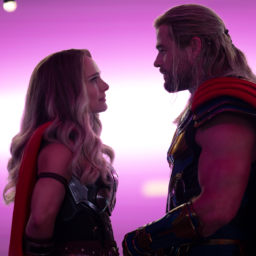
    Thor rushes back to the settlement of Asgardians where leader King Valkyrie (Tessa Thompson) is battling with the shadow creatures sent by Gorr. In yet another scene of Waititi’s ingenuity, we are treated to an epic battle, introduced to The Mighty Thor, and see a hilarious montage of how Thor and his one true love Jane Foster’s (Natalie Portman) relationship crumbled under the weight of both of their duties—Thor’s to the Avengers and Jane’s to her research.

    We learn that Jane, who is suffering from cancer, was called to Thor’s destroyed hammer Mjölnir. When she got to the hammer, it repaired and gifted itself to Jane in an attempt to save her. Now, as The Mighty Thor, she vows to help Thor and Valkyrie defeat Gorr who kidnaps New Asgard’s children to a mysterious land called the shadow realm.


    ADVERTISEMENT


    Thor and Jane’s relationship acts as the emotional anchor for the movie through all its absurdness. However, as often as the tonal balance between humor, thrills, and drama works—it doesn’t.

    The journey to the shadow realm takes our heroic quartet to Omnipotence City, a haven for the gods, where they hope to drum up support in their battle against Gorr. Specifically, they want to get the help of Zeus (Russell Crowe in a hilarious extended cameo). Unfortunately, Zeus is more interested in showing off with his lightning bolt for the other gods and, oh yeah, the orgy scheduled for later in the day.

    The riortous scene is comedy gold (pun intended) where we get to see just how far Marvel is willing to let Waititi go (we go as far as seeing Chris Hemsworth’s golden buns). We’re also treated to Valkyrie queering it up—and bopping to Mary J. Blige’s “Family Affair”—a gold-splashed action scene, and, of course, screaming goats. It’s a highlight scene.

    On the action side, a battle in the “shadow realm” is presented almost completely in black-and-white in one of the most thrilling creative decisions I’ve seen in a Marvel in quite some time. The scene is almost pure horror, but because of the tone up until that point it’s difficult to feel the stakes. While Bale is completely committed to the role of Gorr—and is often terrifying—you never truly feel he’s dangerous.

    That’s why when the movie works best when it focuses on just the characters.

    With Tessa Thompson’s Valkyrie, a history lesson on Korg’s people, and Chris Hemsworth’s peach, Love and Thunder is easily the queerest MCU movie yet.

    Still, it was a low bar. In the first three phases of the MCU, it seemed that LGBTQ+ people did not exist despite romance and sexuality being front and center. I mean, one of the first few scenes of Iron Man was Tony Stark sleeping with a female reporter. Queer representation in the MCU has only now started to settle in with characters like Phastos in Eternals and now Thompson’s Valkyrie and Waititi Korg in the Thor franchise wearing their queerness unapologetically. The result? A more colorful movie, both literally and figuratively.


    ADVERTISEMENT


    The dimension that it adds to a character like Valkyrie helps elevate the movie to a more profound plane in the same way that Thor and Jane’s past gives us an emotional investment in their narrative. Instead of being heroes of perfection, they themselves have trauma that drives them forward—or hold them back. Waititi’s grasp of tone and narrative in those scenes is perfection—much like his underrated gem Hunt for the Wilderpeople. It’s when he has to dig back into the MCU formula that the movie loses its color.

    It’s clear that the best way for the MCU to move forward is to give its directors full creative control over their movies from screenplay to direction.

    Much of Thor: Love and Thunder feels like MCU mastermind Kevin Feige handing Taika Waititi a blank check and a script and saying, “go,” much like Doctor Strange in the Multiverse of Madness felt like it had Sam Raimi’s DNA in it. However, these two movies in addition to Chloé Zhao’s Eternals show that unless Marvel truly allows these directors to completely run away with their movies—story and all—it’s difficult to meld the two visions. Of those three movies, I think Love and Thunder might be the least successful because Waititi had the more difficult balancing act. He was making a comedy. All the while, Disney needed him to deliver a popcorn blockbuster and Marvel needed him to deliver on storylines familiar to comic readers. He mostly succeeds. It’s clunky, the pacing is off, but I can’t deny that I laughed nearly every second of screentime.


    ADVERTISEMENT


    More movies, less problems


    Hey! I’m Karl. You can find me on Twitter and Letterboxd. I’m also a Tomatometer-approved critic.

    💌 Sign up for our weekly email newsletter with movie recommendations available to stream.


    ADVERTISEMENT


  • ‘EO’ and the donkey that enchanted Cannes | movie review

    ‘EO’ and the donkey that enchanted Cannes | movie review

    Eo follows life through the eyes of the eponymous donkey as he experiences life and conflict in the human world

    Eo doesn’t have a plot, little dialogue and, oh, the protagonist is a depressed donkey that wishes he was a horse, but this weird little movie is irresistible. Sure, its lead is a donkey, but it is as human as it gets. Constructed from our hero donkey’s journey away and back again, Eo meditates on loneliness, human nature, and empathy.

    Full review coming soon.


    ADVERTISEMENT


    More movies, less problems


    Hey! I’m Karl. You can find me on Twitter and Letterboxd. I’m also a Tomatometer-approved critic.

    💌 Sign up for our weekly email newsletter with movie recommendations available to stream.


    ADVERTISEMENT


  • ‘Doctor Strange in the Multiverse of Madness’ brings horror to the MCU | movie review

    ‘Doctor Strange in the Multiverse of Madness’ brings horror to the MCU | movie review

    Doctor Strange has to go up against his fellow Avenger Wanda Maximoff in order to save a young girl and the fabric of the multiverse

    Don’t worry, Sam Raimi fans. Doctor Strange in the Multiverse of Madness fully goes horror—jump scares, body horror, a smattering of diabolical kills and all. It’s a Marvel Cinematic Universe movie through and through but has Raimi’s creepy groovy campy deranged DNA all over it. It’s messy, uneven, and ridiculous but also may have made a play to be my favorite MCU movie of all time. Start the Elizabeth Olsen Oscar campaign.

    The Marvel Cinematic Universe is at its best when the powers that be allow the director’s DNA to weave its way into the tried and true formula. There was Taika Waititi’s slapstick-infused and witty Thor: Ragnarok, Chloé Zhao’s quiet existential musings in Eternals, and now the groovy creepy fun delights Sam Raimi’s Doctor Strange in the Multiverse of Madness.

    When Raimi, best known for creating the cult classic Evil Dead horror franchise, was first tapped to direct many speculated that the movie may go full horror after all before the universe where that version of the movie existed was quashed. However, if the jump scares, body horror, and smattering of downright devilish and diabolical kills are any indication, Doctor Strange in the Multiverse of Madness is a horror movie through and through. 


    ADVERTISEMENT


    Of course, though, it’s a Marvel movie first and begins with an action scene traversing through an ethereal low gravity universe where a different universe’s Doctor Strange is trying to reach The Book of Vishanti along with America Chavez (16-year-old newcomer Xochitl Gomez) while being pursued by a giant monster. Just as she is about to be caught, a portal to our universe suddenly opens giving her an escape. Of course, though, things are not that simple and a monster has followed her right in the middle of Christine Palmer’s (Rachel McAdams for the first time since appearing in the first Doctor Strange movie) wedding that a heartbroken Strange is attending. I mean, she is his ex-girlfriend.

    After dispatching the monster, he and Wong (Benedict Wong) learn that Chavez has the one-of-a-kind ability to travel the multiverse. Though, she’s not exactly sure how she does it. Clearly, some force wants that power. Wong takes her to the Masters of the Mystic Arts fortress Kamar-Taj for safekeeping while Strange seeks out Wanda (Elizabeth Olsen) for help. 

    However, in a surprisingly quick twist, we learn that Wanda herself is behind the attack in an effort to take America’s power and find a universe where she could be reunited with her sons who she lost in the Disney+ series WandaVision. She gives Strange until sunset to turn her in, which, of course, he does not do causing Wanda to take the fortress by force.

    What begins as a classic MCU action scene quickly turns into a clear announcement of Raimi as the creative force behind the movie as the horror elements he’s so known for start to creep in — whispered voices, tilting camera angles, quick-cut editing all reminiscent of The Evil Dead. That’s what’s most exciting about Multiverse of Madness. It’s not afraid to be scary. It stretches that PG-13 rating to its absolute limit.

    America again escapes with Strange to the multiverse leading to perhaps one of the most thrilling, deranged, terrifying, and twisted sequences in Marvel Cinematic Universe history that feels more akin to Prime Video’s The Boys than your classic superhero movie. Combined with some stellar and applause-inducing cameos, it propels the movie into a confident and assured second half that brings new (and ridiculous) ideas — a feat for a franchise with 27 movies and six television series.

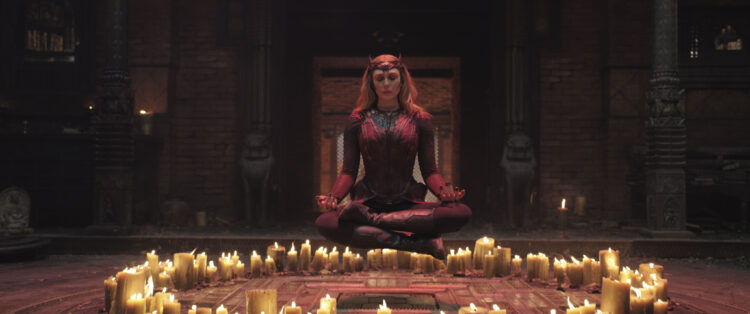
    Speaking of television series, Elizabeth Olsen continues to be a standout as her storyline continues from her Emmy-nominated turn in WandaVision. It almost makes more sense to call the movie Wanda’s Multiverse of Madness because she dominates every frame that she’s in. She chews the scenery with her villainous turn as a mother trying to be reunited with her kids to incredible and terrifying results. You feel the weight and danger of her presence — even when she isn’t on screen. While Benedict Cumberbatch, Benedict Wong, and Xochitl Gomez do great work, Elizabeth Olsen easily runs away with the entire movie. She’s even Oscar-worthy.


    ADVERTISEMENT


    Does the story have the same narrative implications as Spider-Man: No Way Home? No. It’s far from inconsequential, but the story does feel contained. That relative slightness is what allowed Raimi to chew into each action setpiece with his full might. Not a moment of the well-paced and lean 126-minute running time is wasted. The movie hits the gas from minute one and doesn’t let up until it crashes — in the best way possible.

    Doctor Strange in the Multiverse of Madness is messy, uneven, ridiculous, and at times confusing — and that’s why I loved it. In all the chaos and depravity is a future where the MCU is more than just a formula. It shows that auteurs with a singular vision can have the vision realized while still fitting into the grander scheme of the franchise. Sam Raimi swings for the outer reaches of the multiverse to absurd results — however, he’s in full control. Every campy unhinged decision is done with a wink and a nudge to the audience. Mileage may vary by viewer. For this critic, it went the distance. Creepy, campy, groovy, devilish fun from beginning to end. 


    ADVERTISEMENT


    More movies, less problems


    Hey! I’m Karl. You can find me on Twitter and Letterboxd. I’m also a Tomatometer-approved critic.

    💌 Sign up for our weekly email newsletter with movie recommendations available to stream.


    ADVERTISEMENT


  • Cold War gay romance ‘Firebird’ lacks spark | movie review

    Cold War gay romance ‘Firebird’ lacks spark | movie review

    Firebird tells the true story of a hidden romance between a private in the Cold War-era Soviet military and a star fighter pilot

    The best queer cinema lives in the silences and the subtext. In the looks and the touches. In the underlying messages. That’s because the lives of queer people are often lived in these spaces out in the world — in the present, but particularly the past. It is a defense mechanism for living in a society where safety is a privilege we aren’t often afforded. And it doesn’t get more dangerous than the Cold War-era Soviet Union.

    That’s where the love story at the center of Firebird, the feature debut of Estonian director Peeter Rebane, takes place. The film, based on Sergey Fetisov’s memoir The Story of Roman, focuses on young private Sergey (Tom Prior, who also co-wrote the screenplay) and fighter pilot Roman (Oleg Zagorodnii) as they strike up a secret romance in the shadows of their Air Force base.


    ADVERTISEMENT


    Matters are complicated by the base’s second-in-command Major Zverev’s (Margus Prangel) all-seeing eye and his secretary Luisa’s (Diana Pozharskaya) budding interest in both Roman and Sergey. That’s where much of the movie’s dramatic tension lies, largely because the central romance feels too easy. Unlike the great period-set queer romances — Portrait of a Lady on Fire, Call Me By Your Name, Maurice — Firebird doesn’t focus on the smoldering tension between Sergey and Roman. 

    There are moments when Rebane understands the needs of the story. At times he focuses on those passing touches, quick glances, and underlying meanings that underline so much of the communication between queer people. The problem is Firebird is afraid of living in the silence of those moments and fills them with often clunky dialogue — “I search for something deeper, but I can’t quite grasp it.” In that way, the directing far surpasses the screenplay, which feels overwrought and overwritten.


    ADVERTISEMENT


    However, the biggest failure of the movie is its inability to give reason to root for the central couple. It gets so distracted by its plot — and desire to be a war thriller — that it forgets to make its characters characters. In the final text epilogue, it’s hinted that Sergey lived a much more complex and rousing life than what is portrayed. It’s as if Rebane and Prior wrote their screenplay by connecting various plot points rather than journeying their characters through them.

    Sergey Fetisov has a story worth telling. One that I imagine is filled with emotional complexity and gives insight into the hardship of queer life in a specific time and place. The movie fails to mine any deeper than surface-level and opts for melodramatics rather than reality. The premise promises great love. But like any great love, it has to be earned. Unfortunately, Firebird doesn’t try to earn it.


    ADVERTISEMENT


    More movies, less problems


    Hey! I’m Karl. You can find me on Twitter and Letterboxd. I’m also a Tomatometer-approved critic.

    💌 Sign up for our weekly email newsletter with movie recommendations available to stream.


    ADVERTISEMENT


  • ‘Crush’ is a typical high school rom-com — and that’s a good thing | movie review

    ‘Crush’ is a typical high school rom-com — and that’s a good thing | movie review

    Crush follows an awkward queer high schooler as she tries clear her name as the school vandal while navigating a new crush

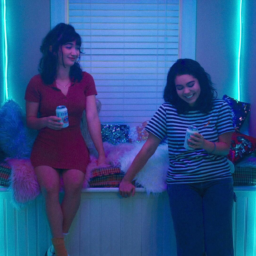
    In many ways, Crush is your typical high school coming-of-age romantic comedy that falls into all the genre trappings. An endearingly awkward lead, quirky side characters including a too-comfortable mom, a quick music-driven pace, melodramatic heart-to-hearts, and, of course, a third act public confession in front of the whole school — but that familiarity is a feature, not a bug. While Kirsten King and Casey Rackham‘s screenplay is often too adorkable and low stakes for its own good, it’s never less than charming — and queer kids deserve silly high school romantic comedies of their own. Rowan Blanchard and Auli’i Cravalho, best known as the voice of Moana, have enough charisma to power through the movie’s expected beats that it’s impossible not to fall for them.

    Crush will be available exclusively on Hulu on April 29.

    Paige (Rowan Blanchard) is your typical awkward high school junior with her dreams set on attending a summer program at The California Institute of the Arts. There’s just one problem: she has artist’s block. The prompt is to create a piece around her happiest moment. In the movie’s breezy intro, she considers the moment she came out to her mother (a delightful Megan Mullally), but that daydream is broken when her mother gifts her with glow-in-the-dark dental dams. Some parents are too supportive. The next she considers is when she told her straight best friend Dylan (Tyler Alvarez) she liked girls, but that option is kiboshed by his unremarkable reaction: “I like girls too.”

    Then, she considers a moment she has completely gotten over: when she first formed her crush on school it-girl Gabby (Isabella Ferreira). Crush immediately drew me in with the way it treated its queer themes — as if there’s nothing to see here. This isn’t a coming out movie like many other queer high school rom-coms. In one scene, Coach Murray (scene-stealing Aasif Mandvi), the school’s track coach, hands out keys for the hotel rooms for an away meet and quips: “do not go in each other’s rooms, even though I know 60% of you are queer.” It’s refreshing that this isn’t where the movie derives its plot and tension.


    ADVERTISEMENT


    Instead, the story surrounds the mystery of “King Pun,” a graffiti artist and social media star who has anonymously been vandalizing the school with their punny artwork. The problem is the school’s principal (Michelle Buteau) is convinced that Paige is King Pun and is threatening her with suspension threatening her CalArts hopes. However, Paige is able to strike a deal. If she can find the real identity of the vandal before the semester’s end she can avoid suspension. The catch is she has to join the school’s track team — yeah, it’s a bit of sweaty plot manuevering — that Gabby is co-captain of with her twin AJ (Auli’i Cravalho). Of course, hijinks ensue including a montage of Paige embarrassing herself at practice, which leads Coach Murray to assign AJ as her trainer.

    You could probably figure out the story from there.

    Through all the cute crushing back and forth between the triangle of girls, we get bits of their internal life — AJ feels pressure from her father and living up to her sister’s success, Gabby feels like people use her because she’s popular, Paige has never been kissed. But Crush isn’t precious about these issues and keeps much of its exploration surface-level — to both its benefit and detriment. Do you yearn to learn more about the characters? Or course. Is it refreshing for a movie not to be distracted by deeper themes in service of its simpler story? Yes.


    ADVERTISEMENT


    Blanchard and, in particular, Cravalho are irresistibly charming as the romance leads while the rest of the cast — Alvarez and Mandi, in particular — provides the much-needed goofs and laughs. There are some hilarious one-liners like “trigger warning, there will be a gunshot to start but it’s fake” and “you look like a serial killer, change your eyes,” that catch you off guard in such a sweet movie.

    There’s a sense that movies targeted at the LGBTQ+ community need to be about something whether our queerness or our trauma. For all its formulaic stereotypical corniness, Crush‘s normalization of its queer characters is what makes it a joy to watch. It doesn’t ignore it either, it just decenters it in the narrative allowing kids and teens to see that a queer life isn’t just darkness. They can have silly crushes too. And sometimes those crushes turn into something more. We need more movies like Crush.


    ADVERTISEMENT


    More movies, less problems


    Hey! I’m Karl. You can find me on Twitter and Letterboxd. I’m also a Tomatometer-approved critic.

    💌 Sign up for our weekly email newsletter with movie recommendations available to stream.


    ADVERTISEMENT


  • ‘The Northman’ goes south | movie review

    ‘The Northman’ goes south | movie review

    Years after witnessing his father’s murder, a Viking prince goes on a rampage across Scandinavia to avenge his death and save his mother.

    The Northman looks and sounds like it cost $90 million to make. Robert Eggers is a master at his craft perfectly melding every element — particularly Jarin Blaschke’s cinematography — to create his Viking-era world. Where the movie goes south is in its narrative and characters. Beneath the twisting Scandinavian folklore is a simple and familiar revenge story that never gives us real reason to care. The movie lacks the emotional impact to become fully immersed. Still, Eggers is a masterful director and holds your attention even if the movie isn’t as narratively compelling as The Witch nor as visceral as The Lighthouse.

    Full review coming soon.

  • ‘X’ is a Texas Boogie Nights Massacre | movie review

    ‘X’ is a Texas Boogie Nights Massacre | movie review

    X follows a young group of aspiring filmmakers who travel to an isolated farm to film a porn. It doesn’t go well.

    X is a detailed and well-studied recreation of 70s exploitation B-movies and the Golden Age of the slasher genre, right down to the film grain. However, director Ti West does more than homage. He adds his own darkly comedic tone to mine some real laughs in between the carnage as well as a surprisingly complex pair of villains — which is why a prequel film has already been shot. Nostalgic cinematography, a tense Carpenter-esque score, and deliciously camp performances — particularly from Brittany Snow, Mia Goth, and Martin Henderson — make X a gloriously bloody and entertaining throwback. Like Boogie Nights by way of The Texas Chainsaw Massacre.

    X is now playing in theaters.

    The most fascinating thing about X is how straightforward it is. There are no tricks, no twists, no sudden genre shifts or gotcha moments, but that’s exactly what director Ti West intends. He’s not looking to reinvent the slasher genre, he wants to celebrate every single gritty bloody detail right down to the film grain — although The Texas Chainsaw Massacre is clearly his biggest inspiration. But that’s not to say he doesn’t have some tricks up his sleeves.

    The glorious The Cabin in the Woods, perhaps the most meta meta-horror movie that lovingly skewers the genre for its repetitive tropes, posits that the victims of slashers are being punished for their youth. Not just being young, but taking advantage of that youth. However, movies from the genre’s heyday in the 70s and 80s personify that punishment as an inhumane mysterious force — Michael Myers, Leatherface, Jason Voorhees. West subverts that trope and instead finds humanity in the antagonists. If anything, X’s villains are devastatingly human.


    ADVERTISEMENT


    But first, let’s go back to 1979. You know the setup. A group of six young people travels to an isolated part of Texas for a weekend of fun. Though, in a Boogie Nights-like twist the group isn’t just doing it for their own pleasure. They’re shooting an adult film to take advantage of the newly formed home video market. Maxine Minx (Mia Goth), in particular, is obsessed with being a star. Something her boyfriend and film’s producer Wayne (Martin Henderson) is convinced she’s destined for.

    Maxine’s co-stars Bobby-Lynne (Brittany Snow) and Jackson Hole (Scott Mescudi aka musician Kid Cudi), on the other hand, are more seasoned porno actors. Rounding out the group are the film’s director RJ (Owen Campbell) and his girlfriend Lorraine (Jenna Ortega), who are more conservative compared to their companions, especially Lorraine who didn’t even know what the project was.

    In an effort to keep costs low the group is shooting the film in the farmhouse on the isolated property of elderly couple Howard (Stephen Ure) and his wife Pearl (Goth, playing double duty in impressive old age makeup). West makes it clear that something is amiss with his chilling bloody cold open, the foreboding music by composers Tyler Bates and Chelsea Wolfe, and classic horror shots framing the villains with menace. We don’t get a clear view of Wayne or Pearl’s faces for some time.


    ADVERTISEMENT


    After some brilliant slow-burn tension building where we begin to learn a bit more about our characters, hell breaks loose. Or should I say, Pearl breaks loose and X pivots to being a full-blown slasher with all the blood and gore you could hope for. Still, West finds depths in its narrative while maintaining its horror elements. Maxine and Pearl feel like parallel stories running in two different timelines. Pearl could’ve been Maxine in an earlier life and Maxine could become Pearl. X presupposes that the real horror here is time. It highlights the brilliance of casting Mia Goth in both roles and the decision to film a prequel in tandem.

    As straightforward of an homage to 70s and 80s horror X is, it mines the thematic depths of youth, time, regret, sex, and the horror genre itself. Horror and porn are often lumped together as gratuitous and deviant as they deal with the taboo topics of sex and gore. West questions asks why that is the case with his narrative. Why do we find two people having sex on camera so alluring yet unacceptable (the same for violence)? The answer is the movie itself.


    ADVERTISEMENT


    More movies, less problems


    Hey! I’m Karl. You can find me on Twitter and Letterboxd. I’m also a Tomatometer-approved critic.

    💌 Sign up for our weekly email newsletter with movie recommendations available to stream.


    ADVERTISEMENT


  • ‘Sissy’ directors and star Aisha Dee chat their new horror | Interview

    ‘Sissy’ directors and star Aisha Dee chat their new horror | Interview

    Hannah Barlow and Kane Senes chat their new horror-comedy Sissy, which premiered at SXSW, along with star Aisha Dee

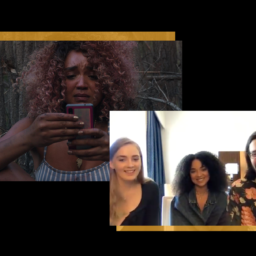
    Sissy, which opened the Midnighter section at the 2022 South by Southwest Film Festival, stunned audiences (you can read my review here) and was acquired by Shudder for release this year. Directors Hannah Barlow and Kane Senes chatted with me about the movie’s origins, why it needed to be a horror, and balancing the tricky tone between scares and laughs. Star Aisha Dee, best known for her role on The Bold Type, talks about how she empathized with her character, how the pandemic helped her prepare for the role, and what zodiac sign she thinks she’d be.


    ADVERTISEMENT


    More movies, less problems


    Hey! I’m Karl. You can find me on Twitter and Letterboxd. I’m also a Tomatometer-approved critic.

    💌 Sign up for our weekly email newsletter with movie recommendations available to stream.


    ADVERTISEMENT


  • ‘Bodies Bodies Bodies’ is a bloody game of Among Us | SXSW review

    ‘Bodies Bodies Bodies’ is a bloody game of Among Us | SXSW review

    Accusations fly between a group of friends after a stormy game night turns deadly in Bodies Bodies Bodies. Together they must find the killer among them.

    Bodies Bodies Bodies is like a dark, bloody slasher version of Clue with a hint of Mean Girls and Lord of the Flies that takes place over a single night where accusations fly between a group of friends after a body is discovered on a stormy night — like a sick game of Among Us. Its perfectly constructed mystery is punctuated by its slasher-like horror filmmaking and a flurry of terrific performances — particularly a hilarious Rachel Sennott — that feel so lived-in yet representative of the privileged Gen Z TikTok elite as a whole. The delicate balancing of tones, storylines, and relationships culminates in a hilariously satisfying ending that will make you want to watch the movie over and over again.

    Have you ever wondered how a real-life game of Among Us would play out? Or what the cult classic comedy Clue would be like as an actual horror movie? Well, Bodies Bodies Bodies may have answered that question and then some. Not that director Halina Reijn nor the screenwriters* intentionally took those properties as direct inspiration. It is unique in both narrative and execution even if you see shades of other movies in it — Scream and Mean Girls also come to mind. What it does have in common is it’s a complete blast, especially for genre fans. Though, it still even has a few tricks up its sleeves for them.

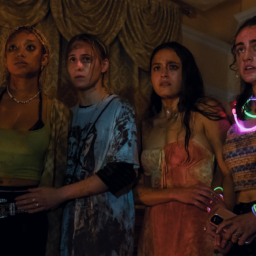
    Of course, like any good slasher (or slasher send-up), Bodies Bodies Bodies takes place in a remote family mansion where Sophie (Amandla Stenberg) is bringing her new girlfriend Bee (Maria Bakalova) to a hurricane party at her childhood friend David’s (Pete Davidson) parents’ house to brave a hurricane that is forecasted to hit that night. Immediately, there is tension within the group. It’s clear that past baggage is going to plague the night. David and his girlfriend Emma (Chase Sui Wonders) seem at odds for a variety of reasons but particularly because Alice (Rachel Sennott) brought her hot older boyfriend Greg (Lee Pace) along, causing David to feel threatened. Then there’s Jordan (Myha’la Herrold) who doesn’t seem all that happy that Sophie brought Bee uninvited.

    And with incredible comic timing, the storm starts barrelling down.


    ADVERTISEMENT


    Armed with drinks, glow sticks, enough cocaine to make a drug lord jealous, and a sprawling mansion to use as a playground, the friends hunker down for the longest night of their lives. In an attempt to break the tensions, the group decides to play the game Bodies Bodies Bodies where one player is secretly chosen as the killer and “kills” one of the other players by tapping them on the shoulder in the dark. Then, the remaining players must figure out who did it — like a game of Clue. All is well until the lights go out and the friends split up. Bad choice. A body is discovered and a real-life version of the game is now afoot.

    Throughout the night, more bodies are found, more people are killed, and suspects are cleared and uncleared. It’s like an entry in the Scream franchise that takes place in real-time over a single night.

    What I love about Bodies Bodies Bodies is how natural the relationships and interactions feel. Like you’re getting a glimpse into the deep tanglings of this friend group, which color the accusations. In one of the best and funniest scenes, the friends use Gen Z buzzwords to levy suspicion onto each other and remove it from themselves. “Stop gaslighting me,” one character says. “He’s a libra moon,” says another.


    ADVERTISEMENT


    Eventually, the group begins to play oppression Olympics. “Accuse the black girl,” “I had PTSD from that,” “I was poor.” In reality, none of these kids are completely oppressed. When one claims she’s poorer than the others she’s immediately slapped with, “your parents are professors at a University!” to which she replies, “it’s public.” It’s the kind of tongue-in-cheek skewering of Gen Z wokeness that makes the movie a delight to watch outside of its horror elements.

    However, the commentary doesn’t feel out-of-place. It feels so natural that the characters would use those defenses if they were accused of murder and their reactions, as ridiculous and hilarious as they are, never feel ingenuine. The way that the movie plays out is perfectly satisfying. Reijn paces the movie with precision so that not a single moment feels wasted and the momentum seemingly never stops.

    Bodies Bodies Bodies feels like a perfect example of what the horror genre is going to look like after its renaissance in the early part of the 2010s. Like Get Out or Ready or Not, it uses the tried and true horror staples to build tension and suspense while using the world we live in to color it in complex shades that reflect back the horror of our society. But who am I kidding? More than anything, this is a bloody, hilarious, slasher of a good time. Everything else, icing on the cake. Or, I guess, a line of coke on the dresser.

    * Kristen Roupenian, Sarah Delappe, Chloe Okuno, Joshua Sharp, Aaron Jackson


    ADVERTISEMENT


    More movies, less problems


    Hey! I’m Karl. You can find me on Twitter and Letterboxd. I’m also a Tomatometer-approved critic.

    💌 Sign up for our weekly email newsletter with movie recommendations available to stream.


    ADVERTISEMENT