Category: Theatre

  • Illinoise is Broadway’s best new musical | review

    Illinoise is Broadway’s best new musical | review

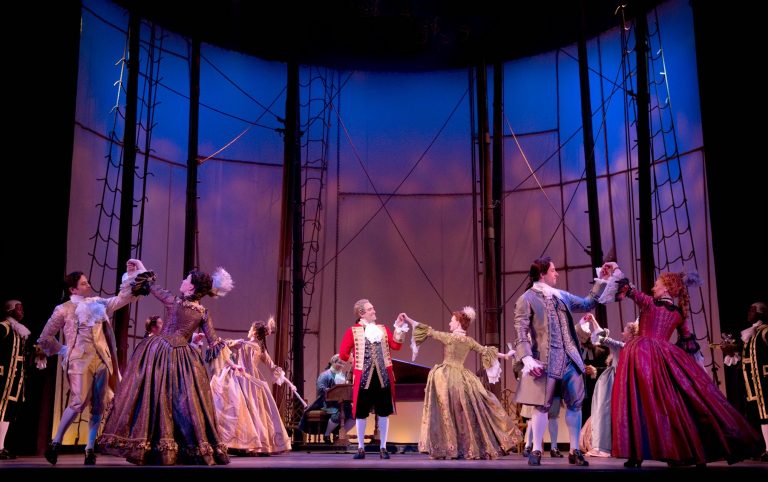
    Dance musical Illinoise takes the songs of Sufjan Stevens’s album of the same name and reimagines them as a series of stories told around a campfire culminating in an emotional queer coming-of-age

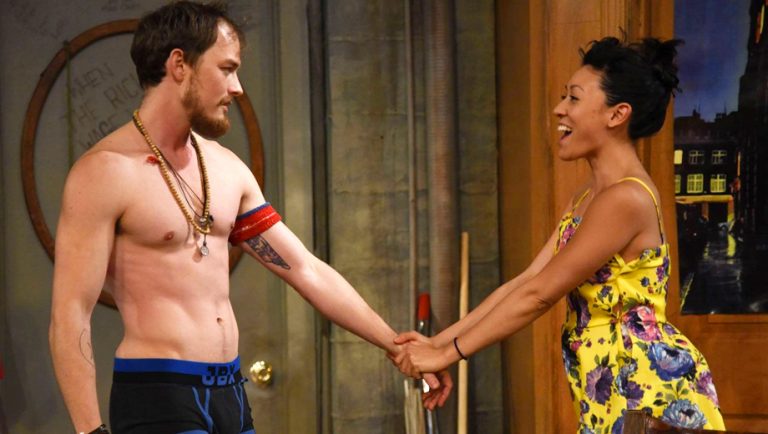
    Amongst Justin Peck‘s impressive and high energy choreography for Illinoise, the final new musical of the overstuffed and *insert RuPaul “meh” gif here* 2023-24 Broadway season, two men stand on stage hand-in-hand simply stepping to the side, forward, and back. Their hands are on their hearts and slowly their breathing comes in sync. We sit like this for nearly a minute. It’s a quiet moment, one of many in the musical, that catapults it past simply a “dance play”. It’s raw with meaning and drenched in queerness and love and anxiety and hope — a moment that had my inner gay child screaming.

    Illinoise has been a personal project for choreographer-turned-director Justin Peck, who held the prestigious title of Resident Choreographer for the New York City Ballet before transitioning to choreographing for theater and film (he most recently choreographed Steven Spielberg’s West Side Story remake). Like many millennials including yours truly, Sufjan Stevens and his concept album Illinois has been a nostalgic favorite — and regarded by many as one of the best albums of the 2000s. The twenty-two song magnum opus is a collection of stories inspired by people, places and events connected to the eponymous state. 


    ADVERTISEMENT


    That celebration of storytelling is what Peck brought to book writer Jackie Sibblies Drury.

    Together, they envisioned the songs as stories told by a group that found themselves together in an anonymous forest. But rather than using dialogue, the musical uses dance as its storytelling medium of choice.

    The show’s set is a mangle of scaffolding and trees with platforms housing the band and three vocalists above the stage donning butterfly wings (Elijah Lyons, Shara Nova, Tasha Viets-Vanlear) as if they’re a queer Greek chorus narrating what’s happening below (Legally Blonde the Musical, eat your heart out), crooning out Stevens’s music with gorgeous harmonies and orchestral orchestrations by Timo Andres. The twelve-dancer cast is a troop of hikers gathered around a campfire made of lanterns. Their introduction is bright, energetic and joyful as they greet each other (“Come On! Feel the Illnoise!”). The beauty of Peck’s choreography is its ease. Each dancer, though moving with the unit, feels like they’re in their own unique body imbuing their personality into the uniformity. Each of them holds a notebook.


    ADVERTISEMENT


    Ricky Ubeda in Illinoise on Broadway.

    Taking turns, they each tell a story from it set to one of Stevens’s songs, putting it down at the foot of the stage as if activating a new world.

    In “John Wayne Gacy, Jr.”, Alejandro Vargas puts a flashlight under his face like he’s about to tell a ghost story. The stage darkens and we watch as the story of the eponymous serial killer comes to life in front of our eyes before Vargas’s character relates the story to the skeletons in his own closet. When the emotion becomes too much, his fellow storytellers hold him as he calms down. In “Jacksonville”, Rachel Lockhart stomps out a hip-hop-tinged number that eventually adds Byran Tittle tap dancing his way across the stage. As the number goes on, Lockhart begins to mirror his moves. It is an energetic full company showstopper that feels like it has deeper meaning. Perhaps it’s about the lessons we pass down from generation to generation to find ourselves stronger — Jacksonville, Illinois was a stop on the underground railroad, so the choice to have two black dancers lead the number feels intentional. After all, the opening line of the song is:

    I’m not afraid of the black man running
    He’s got it right, he’s got a better life coming

    But the musical never tries too hard to imbue meaning on the numbers. Stevens has always been opaque about the meaning of his music. Peck, who also directs, adds enough context for you to find your own interpretation rather than telling you like many other dance musicals. 


    ADVERTISEMENT


    The dance numbers range from intimate interpretive pieces to full-blown production numbers that are as thrilling and entertaining as any big brassy Broadway musical.

    Lurking in the background, our protagonist Henry (Ricky Ubeda, the season 11 winner of So You Think You Can Dance?) is observing and shirking off the occasional goading to share what is in his notebook. Eventually, he gives in and for the final hour of the musical we see what led him to the campfire in the forest. On the back wall, a bit of graffiti tells us he’s in a small town in the middle of nowhere with his best friend Carl (Ben Cook) and Carl’s girlfriend Shelby (Gaby Diaz). There’s clearly a tension between the three of them as their bodies twist and spin into and out of each other (“Decatur”). After Past Lives, Challengers and Passages love triangle are clearly in. However, the tension between Henry and Carl is palpable.

    As any queer person can attest, in Henry’s mind there’s something potentially romantic between the men. A touch, playful wrestling, a near brush of the lips will send anyone into a spiral negotiating the potential queerness of their straight friend. During the endearing number “Chicago” the pair drive off to… well, Chicago in a swirl of flashlights that become the car and the city passing by before finding themselves in New York City where Henry meets Douglas (Ahmad Simmons). A gay man who sees Henry for who he is. Henry makes the choice to stay while Carl returns to their hometown (“To the Workers of the Rock River Valley Region”).


    ADVERTISEMENT


    Ricky Ubeda and Ben Cook in Illinoise on Broadway.

    The brilliance of Illinoise of using dance to tell this particular story is so much of the queer coming-of-age experience comes from body language.

    Something the choreography uses to great affect. Like each of the dancers are spinning objects intersecting with each other in time and space grasping for something — sometimes literally each other or a ghost that disappears in a bit of stagecraft that I’ll leave unspoiled. Brandon Stirling Baker‘s dynamic lighting design and Adam Rigg‘s minimalistic scenic design add to the ethereal effect. When life takes a turbulent turn, the stage uses the negative space to focus in on the details of the choreography. Not just the way bodies are moving, but how they’re moving together.

    In the end, Illinoise is about community and relationships. How those around us that we allow to understand our plights can figuratively and literally snap us out of our depressive psyches. Ubeda’s performance, worthy of a Tony nomination, is one of a traumatized man finding those moments of light — and the people he trusts. When he’s first introduced, Henry’s memories are literally represented by orbs held above Carl, Shelby and Douglas’s heads that swirl from Henry’s mind onto the stage (“Three Stars”). His expressiveness in his dance finds its way to his face grasping for empathy that he gets in the form of tears streaming down the faces of the audience (at the very least from a 30-year-old gay man in the second row understanding every emotion). What Illinoise presupposes is that speaking (no matter what the medium) is tantamount to healing. And over a beautiful, engrossing, heart-wrenching but ultimately uplifting 90 minutes, you feel it.


    ADVERTISEMENT


    More movies, less problems


    Hey! I’m Karl. You can find me on Twitter and Letterboxd. I’m also a Tomatometer-approved critic.

    💌 Sign up for our weekly email newsletter with movie recommendations available to stream.


    ADVERTISEMENT

  • Sweat Broadway Review — A timely play on our political and social climate

    Sweat Broadway Review — A timely play on our political and social climate

    Sweat tells a timely story that is made all the more effective from its strong perspective and sensational performances.

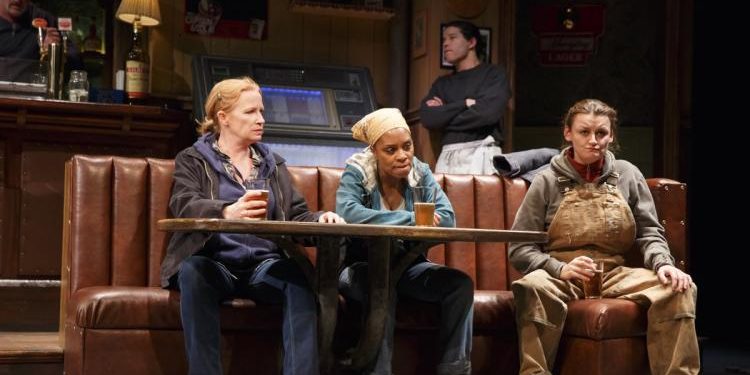
    Though Sweat, Lynn Nottage’s Pulitzer-Prize winning play that opened this Spring, takes place in the dawn and wake of the Bush presidency (2000 and 2008), its relevance to our current political climate is palpable. The play is set mostly in a bar in Reading, Pennsylvania where workers at the local steel mill gather to talk trash and let off steam from their long hours at work. And while this local haunt starts off as a place of refuge, it quickly becomes a battleground for the war to come.

    It was a brave choice to bring a very Middle America story to the liberal mecca of New York. However, more than anything, this play taps into the anger that has been sweeping the districts that put Donald Trump in the White House. At one point, a character proclaims that he has decided not to vote in the 2000 Presidential election because he’s choosing between the lesser of two evils — that line received an audible reaction from the audience. It’s at moments like those where Sweat justifies its existence.


    Nottage, who also won the Pulitzer in 2009 for her play Ruined, builds the relationship between the characters beautifully. At the center are long time friends Tracey (Johanna Day, who give a steely and passionate performance) and Cynthia (Michelle Wilson, who quickly wins over the audience with her sincerity) — both of whom were nominated for the Tony for Best Featured Actress in a Play — who work at the town’s steel factory alongside their friend Jessie (Allison Wright). The trio has been bonded by their experience at the factory where they have worked since high school. Each woman gets her moment to tell the audience their background with their “how I got here” monologue. While they’re heavy-handed, it is certainly a worthy way of getting the audience to understand what happens to inhabitants of these towns. They aspire for more, but in the end, they work for the factory like their parents and their grandparents.

    Tracey and Cynthia’s sons, Jason (Will Pullen, a real standout) and Chris (Khris Davis), respectively, also work at the factory, though Chris has aspirations outside of the town. The story is framed by their story 8 years later when the two are paroled for a crime that becomes the central mystery of the show. Before flashing back to 2000 where the main action of the story takes place, Chris describes seeing Jason — covered in tattoos including a swastika — for the first time on the street after all these years. He describes his body’s reaction as a violent one — teeth clenched, hands balled into fists — before saying that before he realizes what’s happening, they’re hugging. Sweat tells the story of a tight-knit community that becomes unraveled when empathy goes out the door. Over several months in 2000, Cynthia gets a promotion at the factory, which strains her relationship with Tracey — she eventually starts gossiping that Cynthia only received the promotion because she is black —, the factory begins layoffs, and the community is thrown into a racially charged turmoil.


    Nottage lets the show thrive in the emotionally charged arguments between the characters that eerily echo our current political climate. Everything from the outsourcing of manufacturing work, unions, the sweeping drug epidemic in our lowest-income communities are covered. Although the focus is on these characters, to both the advantage and detriment, that message is what hits home. Sweat shows us what can happen, especially in a community like Reading, when we refuse to see a situation from another’s perspective. And in the end, it’s a brilliant mix of conservative feelings told in a socially progressive way. Nottage has a clear message. In order to thrive, we have to acknowledge each other. If we don’t participate in that social contract our nation is going to fail.

    8/10

    Sweat is playing at the Studio 54 theater on Broadway!

  • Musical Review: “Amazing Grace”

    Musical Review: “Amazing Grace”

    Chuck Cooper and Josh Young in "Amazing Grace"
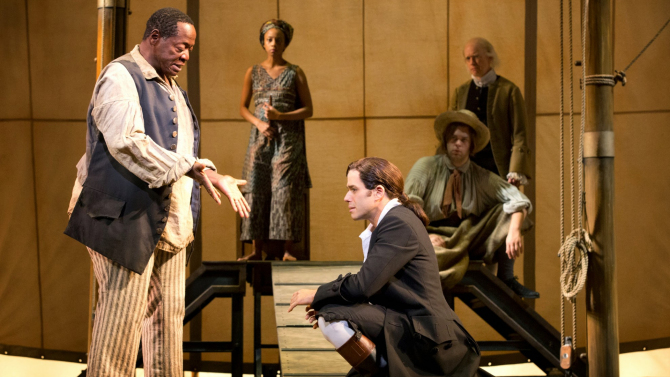
    Chuck Cooper and Josh Young in “Amazing Grace”

    When the lights go down at the Nederlander Theatre, Thomas (Chuck Cooper) takes the stage. Thomas, a former slave, tells the audience that they may be familiar with the song “Amazing Grace,” but they probably don’t know the story behind it’s creation. Not to worry: Thomas was there and he is going to tell us all about how John Newton came to write the lyrics to the famous anthem.

    I was quite intrigued at this point. How interesting to get a black slave’s perspective on a story often only told from a white man’s point of view! Unfortunately, Amazing Grace doesn’t live up to this potential. After the opening narration, the musical promptly switches back to the white perspective and is more concerned with telling a love story between the leads. John Newton (Josh Young, perpetually shirtless) works for his father (Tom Hewitt, giving his all to a mostly thankless role), auctioning slaves as soon as they arrive in Chatham, England. His would be love Mary Catlett (Erin Mackey) witnesses the horrors of the slave auction for herself. She takes up with abolitionists, putting herself in direct conflict with her well to do family, John Newton, and aggressive suitor Major Gray (Chris Hoch). In order to have Mary to himself, Major Gray sends John Newton and his servant Thomas into the Navy, on a ship bound for Africa.

    This continent and decade spanning story should be compelling, and some of the history is indeed revelatory. But composer Christopher Smith has broken a cardinal rule of musical theatre: the songs rarely ever move the plot forward or further character development. In any place where a song should be, there is instead a long (usually boring) book scene. Laiona Michelle’s Nana speaks at length to Mary on her horrifying capture at the hands of slavers and resulting loss of her daughter. It’s a powerful story, and one that should have been set to music as emotions reach their fever pitch (thankfully, the actress gets to show off her robust, passionate vocals later in the show). Much of the score consists of nondescript love ballads where the characters ruminate on the action that just took place. So not only does the show fail Musical Theatre 101, but putting the personal love lives of it’s white protagonists ahead of the plight facing its black characters is downright insulting. There’s a whole lot of “white savior” complex going on here.

    To further complicate matters, director Gabriel Barre appears to have coaxed his actors into embodying stereotypical archetypes. For much of the show John Newton is too broadly drawn to really care about, and even Mr. Young’s sterling tenor can’t save the character. Erin Mackey is able to utilize the full range of her impressive singing voice. She has a deep well of emotion to draw from, but most of the ballads she is saddled with have no dramatic oomph. Chuck Cooper provides the performance highlight of the evening with a stirring song “Nowhere Left to Run,” demanding a change of conscience from his master. Cooper’s rich baritone booms through the theatre and demands attention. If only the rest of the songs had this weight.

    On the design front, Toni-Leslie James has created vibrant period gowns and coats that pop off the stage. There are also some striking uses of lighting and silhouette throughout, though I’m unclear as to why so many scenes take place before an ugly, brown plank wall. Given how much of the musical takes place aboard a ship, I give the team credit for many of their stylistic choices (though the “action” scenes with ship battles and fights don’t fare well). There is also a crowd-pleasing underwater effect that closes act one quite impressively…even if we saw the exact same effect in The Little Mermaid.

    The musical does have one ace up it’s sleeve: the title song. The eponymous anthem closes the show and the choral arrangement is so astoundingly beautiful that it almost made me forget how bland the rest of the show was. Amazing Grace desperately wants to join the ranks of previous hit historical epics. But it has neither the sweeping grandness of Les Miserables or the musical complexity of 1776.

    John Newton’s journey from England to Africa and back, and the resulting change of heart towards slavery could make for a compelling tale (though I could really do without this musical’s preachy atheist: bad and Christian: good” conclusion). And there is certainly potential here to explore a complicated part of history from more than a typical white perspective. Unfortunately, this stage incarnation misses the mark as to why the story is compelling and ignores the basics of musical composition itself.

    Amazing Grace
    Nederlander Theatre
    208 West 41st St., Manhattan
    Music and Lyrics: Christopher Smith, Book: Christoper Smith and Arthur Giron
    Directed by: Gabriel Barre
    Choreographer: Christopher Gattelli
    Starring: Josh Young, Erin Mackey, and Chuck Cooper
    Run Time: 2 hours, 30 minutes (w/ 1 intermission)

  • Musical Review: “Something Rotten!”

    Musical Review: “Something Rotten!”

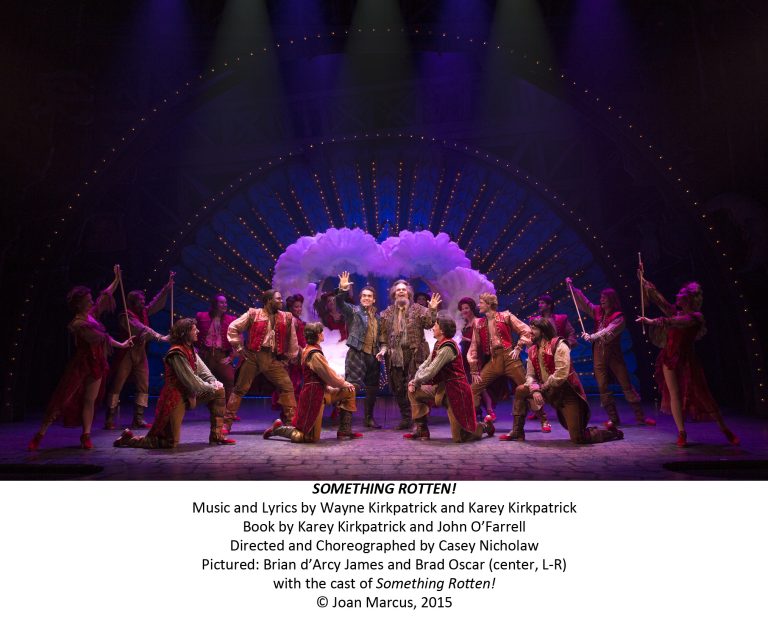
    Something Rotten!
    Hear Ye! Hear Ye! A joyous noise emanates from the St. James Theatre. It’s the sound of uncontrollable laughter and applause. A guaranteed side effect of the funniest Broadway musical in years.

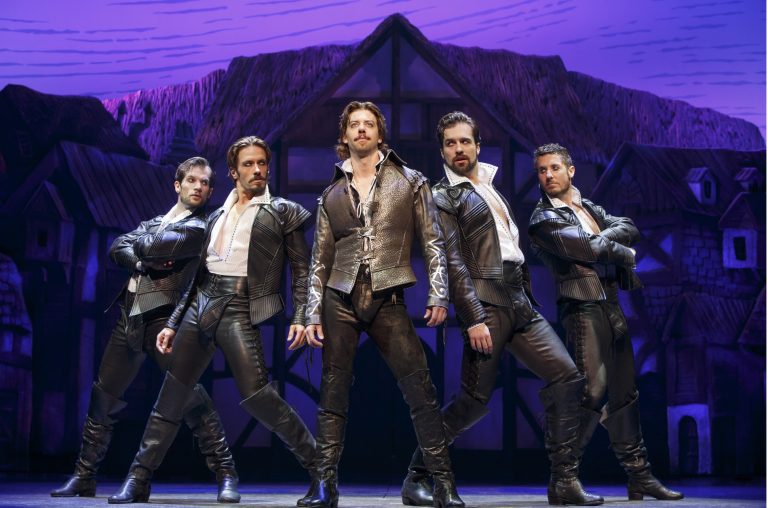
    It’s obvious one has stumbled across something special from the opening moment of Something Rotten!. A minstrel (Michael James Scott, in glorious voice) sings and dances through “Welcome to the Renaissance”. Accompanied by a superb sounding ensemble, the performers detail the new cultural and industrial advancements of the era.

    The setting might be old, but the music by Wayne and Karey Kirkpatrick contrasts with contemporary pop sensibilities, to comedic effect. The costume design from Gregg Barnes features elaborate splashes of color and pizzazz, and Scott Pask’s impressive set conjures signature scenic elements of past Broadway hits. The buoyant opening number ends with a thunderous wall of sound from the singers and the audience responds with rapturous applause. I was all smiles and I was completely hooked.

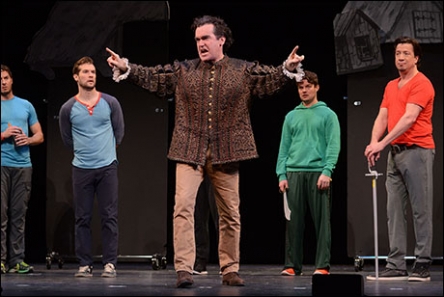
    The story centers on Nick Bottom (Brian d’Arcy James), a struggling London playwright who constantly feels overshadowed and outdone by Shakespeare (Christian Borle). Nick and his brother Nigel (John Cariani) are in the middle of staging their new show “Richard II” when word arrives that Shakespeare has beat them to the punch. The brothers’ wealthy patron pulls funding and shuts down the play. To make matters worse, Nick’s dutiful wife Bea (Heidi Blickenstaff) reveals she is pregnant. With no income and a family on the way, Nick panics and struggles to find a new idea for a play.

    Nick’s grand scheme involves paying a soothsayer to look into the future and find Shakespeare’s most successful play…and then write and produce it before the Bard gets the chance. The wonderfully zany Brad Oscar, as soothsayer Nostradamus, has been gifted with the showstopper of the season with “A Musical”. As he looks into theatre’s future, Nostradamus discovers an exciting new development: musicals.

    The Kirkpatrick brothers pull out all the stops with witty wordplay and an endless parade of Broadway references. The result is a hysterical, physical performance from Mr. Oscar as he lampoons landmark musicals across Broadway history. No tuner leaves unscathed, from the high-pitched Annie interlude (complete with buckets) to pondering the pointlessness of dance breaks (“Does it further the plot?” “No …it’s entertaining!”).

    Hamlet (Or “Omlette” as Nostradamus misinterprets) is the future hit that Nick chooses to put to song and finally top Shakespeare. And so the first musical is born. To detail the various ways in which he gets the famous story wrong would be to spoil the best jokes in the book. The Kirkpatrick brothers have taken a page out of Mel Brooks’ playbook and written a humorous, winking love letter to Broadway. The ending might feel a bit cliché, but the show is ultimately more about the fun journey than the destination.

    Director/Choreographer Casey Nicholaw has a lot of fun incorporating familiar pastiche into the energetic choreography. He also knows how to coax winning performances from the talented cast, as all the characters instantly pop off the stage from their first lines.

    Christian Borle is having a ball, evoking Tim Curry from his Rocky Horror days, with a preening and self-absorbed take on Shakespeare. Brooks Ashmanskas turns a thinly written Puritan character (Brother Jeremiah) into a meal of a part, transforming some of the book’s weaker jokes into satisfying one liners and fabulous stage exits. John Cariani displays a tender falsetto as Nigel Bottom. His neurotic physicality and sheer awkwardness around the woman he admires provide endless laughs.

    Speaking of women, they are criminally underutilized in this boys club. After hearing Heidi Blickenstaff’s soaring voice on “Right Hand Man”, I wanted more of this feisty woman (her only recurring plot involves her dressing in male drag to attain work). Kate Reindeers is also sublime as Nigel’s love interest (Portia, the Puritan’s daughter of course). It’s great fun watching her explore “sinful” readings of her favorite sonnets and plays. You shouldn’t get used to seeing either lady on stage much, but you’ll welcome their limited presence.

    The night really belongs to Brian d’Arcy James. The actor shows us why he is one of the best leading men of Broadway, with killer vocal chops and a grounded performance that holds up against the flashy characters surrounding him. And while he gets some fun showcases, I was really craving a big 11 o’clock “I want” number where James could truly let loose. Still, Nick Bottom is an engaging protagonist. I rooted for him during disastrous mistakes and through to eventual reconciliation.

    Even if you don’t recognize the various Shakespeare quotes or the subtle Pippin reference, this musical is a joy to behold. What’s most impressive is that we’ve seen this audacious, referential humor all before, but we’ve rarely seen it done so well. From the stellar cast to the dancing eggs (did I mention there are dancing eggs?), this is shameless, outrageous musical comedy at its best.

    Something Rotten!
    St. James Theatre
    246 West 44th Street, Manhattan
    Music and Lyrics: Wayne and Karey Kirkpatrick
    Book: Karey Kirkpatrick and John O’Farrell
    Directed and Choreographed by: Casey Nicholaw
    Starring: Brian d’Arcy James, Christian Borle, John Cariani, Heidi Blickenstaff, Brad Oscar,& Kate Reindeers
    Run Time: 2 Hours and 20 Minutes, including one intermission

  • Play Review: “The Curious Incident of the Dog in the Night-Time”

    Play Review: “The Curious Incident of the Dog in the Night-Time”


    the curious incident of the dog in the night-time

    Tony Nominations are still months away, but I will be extremely surprised if The Curious Incident of the Dog in the Night-Time is not cited a number of times on nomination morning. If even a small part of you is a theatre fan, this new play at the Barrymore Theatre is essential viewing this season.

    An Olivier winning production from the National Theatre in London, Curious Incident is based on the novel by Mark Haddon. The play, adapted by Simon Stephens, follows the same story about a young boy on the autism spectrum. The production opens with this boy, Christopher (Alex Sharp), happening upon a ghastly scene: the neighbor’s beloved dog has been murdered. Impaled by a gardening fork to be exact.  Things get more troubled when his father (Ian Barford) informs the boy his mother has died suddenly. Despite insistence that he stay out of other people’s business, Christopher sets out to find the dog’s killer himself.

    Christopher’s detective work unearths secrets from his parents and neighbors. The beauty of the story is how he is able to overcome any obstacle he faces with his frequent sensory overloads. Instead, he learns how to use his brilliant mind to not only solve the case, but deal with the harsher realities of the adult world.

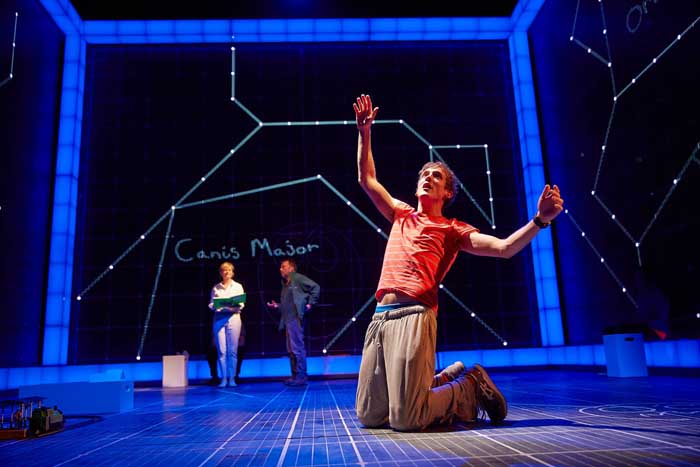
    In one of the most intriguing bits of stage presentation to hit Broadway in quite some time, the stage itself often represents that very brilliant mind. Scenic designer Bunny Christie has crafted a set consisting of four panels (three walls and a floor) each with a grid like design. The grid and walls constantly spring to life, mimicking the machinations of Christopher’s mind, with assistance by Paule Constable’s lighting design and Finn Ross’ brilliant video projection work. Sometimes, it’s a simple outline of houses as Christopher walks down his street. Other times he is surrounded by a cacophony of numbers or words as sights and sounds bombard him. Oftentimes the effect is at once both glorious and terrifying.

    The innovation in the production has director Marianne Elliott and choreographers Scott Graham and Steven Hoggett to thank. This creative team hurls the actors across the stage in an intensely physical production. The staging hovers somewhere between an experimental movement piece and full blown dance. The choreography plays with slowed time, patterns, and using people as props to climb on (and at one point has Christopher literally climbing the walls). It’s all in aide of showcasing how Christopher sees the world.

    Ms. Elliott directs each scene honestly and manages to find humor even in the darkest moments. Nothing feels forced here. It’s refreshing that in a production heavy with visual spectacle, the performances are so specific and honest.

    Most of the ensemble members get chances to shine as several different colorful characters. Enid Graham does beautiful work as Christopher’s mother. She displays a deep well of emotion and can play brutal and angelic all at once. Ian Barford is tremendous as a father doing his best to care for a child whom he continually struggles to connect with. His balancing act of rage and tenderness towards Christopher provides some of the emotional high points of the story.

    It is Alex Sharp who sells the whole thing. The recent Julliard graduate could not have asked for a better start to his career. His portrayal of someone on the spectrum never veers into caricature or imitation. He’s a math genius with a love of computers and space. He screams when anyone touches him. He rifles off lists of statistics and thoughts as we see his mind working one thousand miles per minute. Most importantly he grounds the spectacle in a brutally honest performance.

    If there is one aspect where the script falters it is in the second act narrative device. Francesca Faridany portrays a special needs teacher to Christopher. While the talented actress is a welcome addition to the cast, serving as a waypoint between the audience and her student, the second act takes it to a more meta level when she announces they are all just performing in a play based on Christopher’s writing. The shift in tone is too abrupt and sort of unnecessary given the slew of other narrative devices to keep the audience at safe distance.

    Minor gripes aside, The Curious Incident of the Dog in the Night-Time is an astounding achievement in storytelling. It’s a prime example of performance and stagecraft syncing up harmoniously for a gripping night at the theatre.

    The Curious Incident of the Dog in the Night-Time
    Ethel Barrymore Theatre
    243 West 47th Street, Manhattan
    Written by: Simon Stevens, based on the novel by: Mark Haddon
    Directed by: Marianne Elliott
    Starring: Alex Sharp, Francesca Faridany, Ian Barford, Enid Graham, and Helen Carey.
    Taylor Trensch plays Christopher on Wednesday evenings and Sunday matinees

  • Broadway Review: “Constellations”

    Broadway Review: “Constellations”

    Constellations broadway review

    Have you ever wondered about the paths in life you chose not to take? What would your life be like if you didn’t take that job, if you mustered the courage to flirt with the guy on the subway, if you moved to another state? In Nick Payne’s short but haunting “Constellations”, two actors bring all the possibilities of their relationship to life.

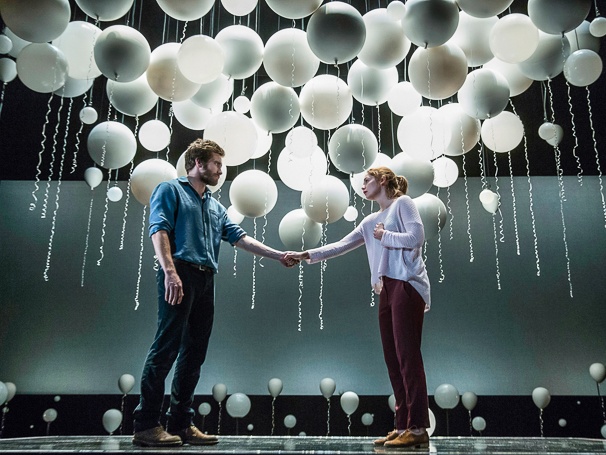
    Performed with no set, props, or costume changes, “Constellations” is the story (or should I say: stories) of Roland (Jake Gyllenhaal) and Marianne (Ruth Wilson). The play takes place across the multiverse, and flings the couple through space and time to explore the multitude of paths their lives could take. There is some scientific talk about the infinite universes that exist for every possible choice we make (Marianne is a physicist), but there’s no need to master high concepts to enjoy the play.

    We start with a scene at a party where the two first meet. The song and dance of their flirtations repeats several times with different outcomes. In one version of the scene, the seduction is unsuccessful and the story ends abruptly. Other replays show the pair getting to know one another, discussing their passions, and ultimately going home together. There are about six total scenes that get replayed to show the various routes the couple may take.

    I don’t mean to make you think you’ll be watching the same boring thing over and over again. Nick Payne has crafted some snappy and naturalistic dialogue for each variation. The script puts more weight on the journey than the destination of each scene. I sat fascinated as I watched how a single changed line or intonation altered a scene in dramatic fashion.

    This style certainly puts the focus on the actors, and Gyllenhaal and Wilson do not disappoint. Both of the catapult through emotions on a dime, as the variations switch from comical to heartbreaking. It is most impressive watching the pair find new tactics on each repeat. I could have watched Gyllenhaal’s marriage proposal attempts for hours, watching him with suave confidence one minute and paralyzing fear the next. Ruth Wilson is a brilliant physical performer, and displays comedic timing fans of hers from “The Affair” wouldn’t see otherwise. But it’s in a particularly brutal development at the plays end where she shines brightest. You won’t be able to take your eyes off her.

    Director Michael Longhurst succeeds at keeping all these realities clear in the minds of the audience. It’s an impressive feat considering the sometimes breakneck pacing. In a snap, actors change position and demeanor and hurl themselves into a new world. Some striking lighting work from Lee Curran, surrounding the playing space with illuminated balloons, helps to delineate the various universes.

    In just over one hour, you will watch the couple flirt, fight, dance, cheat, break up, and brave impossible struggles together. Payne allows Roland and Marianne to grow closer in each scene, and as a result, the audience grows closer to them as well. By the time the evening is over, I was completely enthralled and invested in both characters as if I knew them personally. Each and every version of them.

  • Play Review: “Skylight”

    Play Review: “Skylight”

    SkylightWhen David Hare’s Skylight premiered at the end of the Thatcher era in Britain, it surely struck a nerve with audiences. A play that intertwines politics and passion via two ex-lovers, the political ideology is still as sharp as ever even though the play has dated itself.

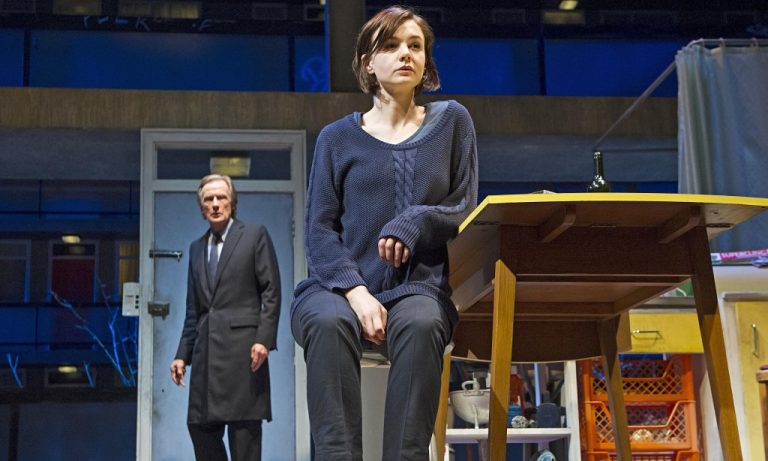
    In this first ever revival, Bill Nighy and Carey Mulligan portray Tom and Kyra. Set entirely in Kyra’s dingy flat (beautifully designed by Bob Crowley to feel cramped but homey), Tom bursts in one night after years of not speaking to his former flame. The two spend a long evening together excavating their past relationship and examining all the ways in which they have grown apart. Tom was married, Kyra his mistress of six years. Now that his wife has died, he realizes he wants Kyra back. If such a thing is even possible so many years and experiences later.

    Nighy expertly commands the stage, exploding through the front door with a sort of neurotic swagger. He patrols the apartment as if he owns the place while getting big laughs from the audience with his disbelief of Kyra’s unappealing new digs. He refuses to touch the kitchen chair with his bare hands and calls her out for living “in Siberia like conditions”.

    Mulligan’s character is less flamboyant, but has a fiery intensity that matches Nighy’s energy every step of the way. The two of them form a great bond on stage that actually feels like a lived-through relationship. I can’t say that I could see any sexual chemistry up there, but the deep care for each other was real. Even in moments of violent anger and silverware hurling. Matthew Beard also entertains in small but charming bookend part as Tom’s idealist son.

    The meat of the play is Hare’s peek into political ideology. Tom is an entrepreneur and successful restaurant owner. He values finer things, has money for meals and limousines, and chides Kyra for her choice to not reach her potential. Kyra obviously sees things differently, claiming she lives in a less than stellar apartment and teaches troubled kids to make a difference. If she doesn’t do it, who will? Issues of class, economics, and education are passionate topics of debate. Both characters realize they have shifted to opposite ends of the spectrum during their time apart, or perhaps they were set in this thinking all along. It’s a conversation that feels familiar with current arguments surrounding income inequality.

    I only wish Mr. Hare gave his characters more of an arc to match the enduring relevance of their arguments. Stephen Daldry is not a flashy director, and he brings out as much subtlety and nuance in his actors as possible. It’s a welcome change from the more bombastic styles usually seen on Broadway. And despite a mountain of words spewed back and forth, the play moves along at a clip (though his actors would do well to pause for laughter).  But as the play comes to a close I found myself thinking “what is the endgame here? What are they building to?”.

    It turns out not much. The actors do a brilliant job at taking us through the twists and reveals of their past life together, but they end up in essentially the same scenario in which they started. Beliefs are shared, some closure found. But I am stumped as to what they learned along their journey together or how it changed them. David Hare is always successful in building complex characters, but this piece doesn’t give those compelling characters anywhere to go.

    Skylight
    Golden Theatre
    Written by: David Hare
    Directed by: Stephen Daldry
    Starring: Bill Nighy, Carey Mulligan, and Matthew Beard
    Run Time: 2 Hours and 20 minutes, with one intermission

  • Musical Review: “Fun Home”

    Musical Review: “Fun Home”

    Fun HomeOne of the most satisfying experiences in musical theatre is when a composer taps into powerful and recognizable emotional moments, and against all odds, finds a way to set these revelations to music. The audience is left wondering: “how did they do that?”. Sometimes it’s a youth overwhelmed with love, as in ‘On the Street Where You Live’ in My Fair Lady. It may be something more impossible, like a demon barber realizing his blood-lust in Sweeney Todd‘s ‘Epiphany’. Well, I’m happy to report that Jeanine Tesori and Lisa Kron have achieved the impossible with Fun Home. I don’t know how they did it.

    On the surface, the story seems impossible to set to music. Based on Alison Bechdel’s autobiographical graphic novel, the show delves into the author’s coming out journey and her closeted father’s suicide. This isn’t a spoiler. As Allison tells us early on, “My Dad and I both grew up in the same small Pennsylvania town and he was gay and I was gay, and he killed himself, and I became a lesbian cartoonist”. The musical, like Allison herself, is less interested about what happened, and more interested in finding out why and how.

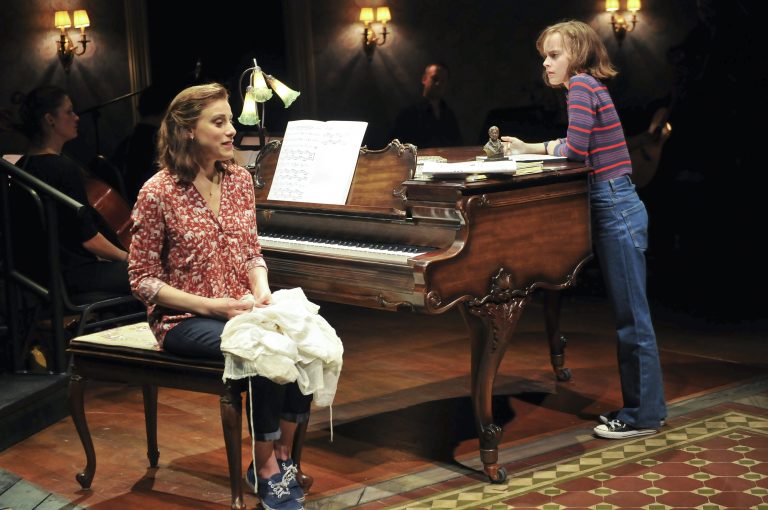
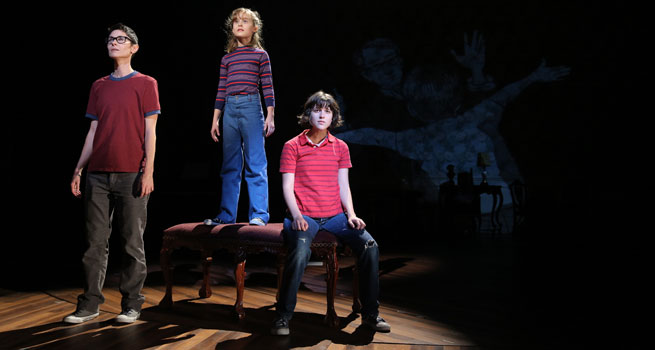
    An adult Alison (Beth Malone) is reliving old memories in order to write her novel. Two other actresses play Allison as a child (Syndey Lucas) and in her college years (Emily Skeggs). Malone is ever-present, hovering around the edges as the narrator of her life. All three Alison’s have a desperate desire to connect with their father Bruce (Michael Cerveris). Bruce has a wife Helen (Judy Kuhn) but is deeply in the closet and has affairs with several men (all played by Joel Perez). Bruce’s pressure to lead a perfect normal life, including running the family business (a funeral fun home), greatly wear on his wife and children. His daughter’s eventual coming out has shocking effects on him.

    Jeanine Tesori is one of the greatest working composers today. Her partnership with book writer and first time lyricist Lisa Kron proves a harmonious match. Together they expertly capture the humanity of each individual in the family with music and dialogue seamlessly woven together. The music also does a sublime job at capturing the frustrations, delights, and unreliability of memory.

    Each Alison does remarkable work. Emily Skeggs is delightful with a hysterical and touching number after her first sexual encounter with her college friend Joan (‘Changing My Major’). Her wild enthusiasm and bold declarations of admiration for her lover’s pillow drool gets the audience laughing with recognition. Malone’s adult Allison sings with desperation and poignancy in ‘Telephone Wire’, attempting to muster up the courage to speak up to her Father on a mostly silent car ride.

    It is the eleven year old Sydney Lucas who gets the best number of the show. ‘Ring of Keys’ describes the inner-workings of Allison’s mind when confronted with an out lesbian, before she even knows what that term means. Upon the sight of a butch delivery woman, Ms. Lucas brings us on a journey of confusion, admiration, and ultimately recognition as she tries to figure out her gravitation to this stranger. With a determined belt and heartbreaking head voice, this young actress successfully sings through the delicate act of processing one’s own sexuality for the first time. It’s not only the best song of the show, it’s one of the most magical stage moments I’ve had the pleasure to witness.

    Director Sam Gold has masterfully re-worked the show for the theatre-in-the-round setting of the Circle in the Square Theatre. Set pieces stealthily emerge and disappear through the floor, creating a seamless dreamlike sensation as Allison walks through her own memories. The lighting design and sparsely staged numbers created an intimate atmosphere where the audience can easily grab hold of the nuances in the actors’ work.

    Most importantly, Gold keeps the piece anchored in humanity and subtlety. All of the aforementioned songs are “showstoppers”, but none require a kick-line or jazz hands. The closest we get to a big ensemble dance number is when, oblivious to the morbidity and oddness of their lyrics, Young Alison and her brothers create a hilarious disco-themed funeral home commercial.

    Gold has directed his actors with a sense of naturalism. I was struck by how effortlessly the actors were able to give powerhouse performances without ever pushing or scene chewing (a refreshingly different take for Broadway). Judy Kuhn proves to be the master of this technique. In ‘Days and Days’ she paints a portrait of a woman quietly breaking as she recounts the sacrifices she made in her marriage.

    I’ve gotten this far and haven’t even mentioned the incomparable Michael Cerveris. His father figure is intensely troubled, scared, and filled with self loathing. Cerveris (a Tony winner for Assassins) nails the inner turmoil of a man who struggles daily to put on a facade, who unleashes his own self loathing on his daughter, and who somehow still enlists empathy from the audience. Though Allison Bechdel was on a long quest to form some connection with a father who remained a stranger,  the saddest part of this true tale is that the man was ultimately a stranger to himself. I can think of no better actor than Cerveris to telegraph these frustrations and fears.

    It has been quite some time since a Broadway show moved me as much as Fun Home. Yet, despite heavy seeming topics, it never ventured too far into depressing territory. This is thanks to Mr. Gold’s direction and Ms. Tesori’s career best music that finds humanity, humor, and pathos in every moment. Fun Home is an instant classic. This is storytelling at it’s best.

    Fun Home
    Circle in the Square Theatre
    Music by: Jeanine Tesori, Book and Lyrics by: Lisa Kron
    Directed by: Sam Gold
    Starring: Michael Cerveris, Beth Malone, Judy Kuhn, Emily Skeggs, and Sydney Lucas
    Runtime: 1 Hour, 45 minute, no intermission

  • Play Review: “Hand to God”

    Play Review: “Hand to God”

    Hand to God MCC at the LucilleLortel TheaterPlays as irreverent, profane, and wacky as Hand to God rarely make it to the big Broadway houses. So I raise a hallelujah to the theatre gods for giving us this outstanding play at the Booth Theatre. It’s one of the best shows this season.

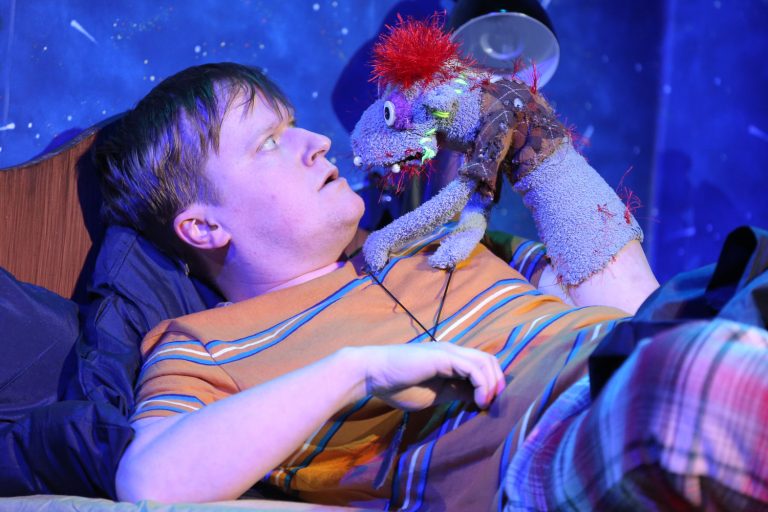
    Robert Askins has written an insanely funny dark comedy that you will want to attend over and over again. The play centers on Jason (Steven Boyer), a troubled young boy who is perfecting the art of hand-puppetry at his church’s puppet class. The class is led by his recently widowed mother Margery (Geneva Carr), determined to do something worthwhile and find meaning after her husband’s death. All hell (literally) breaks loose when we discover Jason’s hand puppet “Tyrone” has a mind of his own, and is quite possibly possessed by the Devil himself.

    If you were a fan of the Off-Broadway run concerned for the transfer into a larger house: have no fear. As directed by Moritz von Stuelpnagel, the production expertly balances outrageous humor and touching humanity. Beowulf Boritt has also provided an impressive set full of folding parts and loads of surprises.

    It is Steven Boyer in the dual roles of Jason/Tyronne who deserves the lion’s share of praise. Jason is an impossibly awkward young man with zero confidence to speak of. But as Tyronne takes over the boy’s arm, Boyer transforms his voice into an acidic, fiendish creature full of violent and lewd energy. The voice and mannerisms of Tyronne are so specific it’s often easy to forget the puppet is controlled by the actor. Watching the many scenes Stephen Boyer perform two character scenes by himself is mesmerizing. Though composed of a sock and some felt, Tyronne is absolutely the star of the show. It’s nearly impossible to describe the strange joy one feels watching Tyronne torment his small town victims.

    The cast is filled out by a wonderfully troupe of actors who match the zany energy of the devil puppet. Marc Kudisch portrays the church pastor who attempts (and fails) to disguise his sexual advances towards Jason’s mother as purely Christian intentions. Timothy (Michael Oberholtzer) is also inappropriately infatuated with Margery. Oberholtzer perfectly delivers teen angst and sexual frustration with a wildly physical performance. Sarah Stiles plays Jessica, the object of Jason’s pure affections and Tyronne’s sexual charged catcalls. Stiles is hilarious in her deadpan delivery, and collaborates with Boyer for the most outrageous puppet sex scene the world may ever know. Seriously, you won’t believe how many sex positions these puppets get into. Apologies to Avenue Q and Team America, this play has you beat.

    You can, and should, enjoy the play as a filthy hilarious escape. But while its odd to look for deeper meaning when puppet exorcism is a major plot point, there is more than shock and awe to the script. Tyronne in many ways represents the unfiltered Id, saying what Jason would say if no repercussions were involved. All of these characters are suffering from repressed urges and emotions.  Mr. Askins dares to ask the audience if there is any benefit to acting on our innermost desires.

    My one wish for the script is a stronger establishing moment between mother and son at the beginning of the play. Much of act two hinges upon Jason and Margery learning to forge ahead together and listen to each others needs instead of keeping them bottled up. But since the first act is so centered on establishing the play’s outrageous humor, the relationship is not immediately solidified and the eventual payoff isn’t as sweet or nuanced as it could be. This is not to speak ill of Geneva Carr, who commands the stage as Margery whenever she is present. A kind-hearted but lost woman, she can fly into a rage or a sexual fit at a moments notice. An angry sex scene of hers somehow rivals the puppet sex scene in outrageous hilarity.

    I honestly have not laughed this hard at a Broadway show in years. Whether it was from a sock puppet’s sermon on the origin of sin, or watching said puppet wrestle his owner while still on his arm, I couldn’t even attempt to suppress my cackling. The audience around me was certainly in agreement. This play is something special and to miss it would be a sin.

    Hand to God
    Booth Theatre
    222 West 45th Street, Manhattan
    Written by: Robert Askins
    Directed by: Moritz von Stuelpnagel
    Starring: Stephen Boyer, Geneva Carr, Michael Oberholtzer, Sarah Stiles, and Marc Kudisch
    Run Time: 2 hours, one intermission

  • Play Review: “The Pied Pipers of the Lower East Side”

    Play Review: “The Pied Pipers of the Lower East Side”

    1429906836-Pied-Pipers-of-the-Lower-East-Side-tickets

    It may be almost 40 years now since “The Age of Aquarius” dawned on Broadway, but the theatre’s love affair with all things alternative is still going strong. Its latest send up to the freedom and inhibition that comes with living “La Vie Bohéme” arrives in the form of The Pied Pipers of the Lower East Side, now rocking Los Angeles’ Matrix Theatre on Melrose with a radically ideological thrust that promises to challenge everything its audience members believe about love, devotion, and what can constitute a family.

    Written and directed by Derek Ahonen, founder and resident playwright of the Amoralists Theatre Company in New York City, The Pied Pipers of the Lower East Side tells the tale of four young adults operating a barter-style vegan restaurant and living in a polyamorous, new-age “tribe,” an unconventional family defined by free love, open sex, and — most importantly — loyalty and devotion to the group.

    Through the work of the show’s stunning ensemble cast, the Pipers spring to life onstage. Billy (Adam Brooks) is a drug-addicted revolutionary, constantly fretting over his sporadically published anarchist journal and the possibility of heading south to aid a bloody insurrection; Wyatt (Jordan Tisdale) struggles with a constant, existential fear of death and the unknown… when he’s not destroying Billy’s record collection over a few lost scratch-off lottery tickets; the teenage Dawn (Heather Mertens) escapes a household torn apart by abuse to sing obscure Rolling Stones songs on the city streets for money. Dear (Agatha Nowicki), a former lawyer, is unmistakably the tribe’s mother figure, extolling wisdom and encouraging free emotional expression in between running the vegan restaurant above which the Pipers make their home.

    The Pied Pipers functions simultaneously as both an unrelenting manifesto and a gripping character drama. Conflict arrives in the form of Billy’s younger brother Evan, a college-aged aspiring sports journalist and ideological conservative (played to frat-tastic perfection by a cocky Ben Reno) whom the Pipers attempt to convert to their way of thinking by staging an impromptu “bed-in” style interview. The Pipers seem to have all of the answers, matching each of their detractor’s skeptical dismissals with compelling arguments that favor a reliance on small self-sustaining tribes rather than larger apathetic global communities in which a starving child is nothing more than a statistic, all while explaining the complex inner workings of a four-way relationship that is both sexual and romantic.

    But for all of the Pipers’ faith in their ability to take care of each other, they are ultimately people that are individually falling apart. While Billy projects his own disappointment in himself onto his conservative family, Wyatt battles paralyzing panic attacks and Dawn dreads the possibility of the tribe one day coming to an end. Even the self-actualized Dear’s commitment to the tribe is tested by an eventual offer of an easier life. Furthermore, a controversial business decision by the group’s eccentric benefactor Donovan (a manic Patrick Scott Lewis) threatens the Pipers’ very existence as they know it. While the Pipers’ tribal lifestyle may be as virtuous as they claim it to be, there’s something a lot simpler at work here too: these are people that need each other.

    The Pied Pipers of the Lower East Side is a three-act thrill ride of visceral performances, twisting dialogue, and heart-wrenching emotional turns. Its irreverent onstage nudity may make you laugh, and the impossible decisions faced by its characters may make you cry; either way, the Pipers are guaranteed to be a hit with any theatre-lover looking to open their mind, challenge their preexisting ways of thinking, and change their life.

    The Pied Pipers of the Lower East Side is now playing as a limited engagement from April 16 to May 24, 2015 at the Matrix Theatre on Melrose Avenue in Los Angeles, California. Performances run Thursday, Friday, and Saturdays at 8 p.m. and Sundays at 7 p.m. The Matrix Theatre Company’s production of The Pied Pipers of the Lower East Side is presented by Alex Zoppa, Henry Reno, and Joseph Tuccio. Tickets are available now via Brown Paper Tickets.

  • Off-Broadway Review: “The Lion”

    Off-Broadway Review: “The Lion”

    the lion

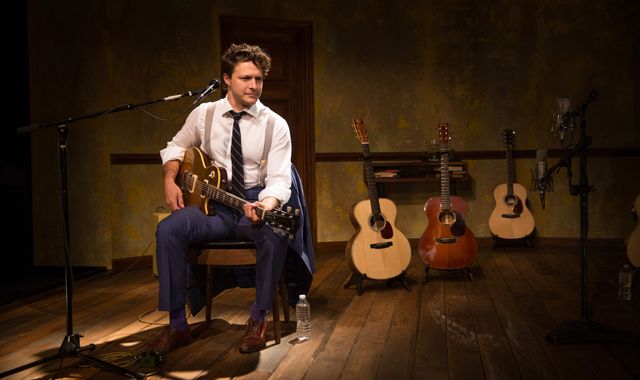
    The writer and star of The Lion, Benjamin Scheuer, enters the stage of the Lynn Redgrave Theatre with a mane of wild, tussled hair. He sits and sings a song about a toy banjo his father made for him. With his pleasant face and the intimate atmosphere, you may think you’re in for a sweet sort of folk music concert. But, you would only be about half right.

    Mr. Scheuer takes us on an autobiographical journey from his childhood to present day, with many demons lurking beneath the friendly surface. The innocence of his first experiences playing guitar with his Dad begin the story. Tensions between father and son set the narrative in motion. Music is their sole connection, and as hints of depression and rage enter the picture, this connection grows uneasy.

    To go into too many plot details would absolutely spoil the fun and heartbreak of experiencing the twists live. The less you know going in the better. But, safe to say that seemingly innocuous moments offer glimpses of a darker side to his family life. He asks one friend “What do you do when your Dad breaks one of your toys?” and the friend “looks at me like I’m insane”. The following tale of hostility, loss, love, sex, and illness carry the audience through depressing lows and triumphant highs. Though his father is not around for his adult life, his presence looms large over Ben and the way he matures.

    A solo performance dealing with heavy themes of the actor’s life has the potential to come off as self indulgent at every turn. Thankfully, Scheuer performs with an openness and gusto that allows the audience in, instead of keeping them at bay during private moments. He possesses a simplicity in style, devoid of pretensions. It allows you to root for him and cry for him.

    Seven different guitars serve as the only instruments of the evening. Each symbolizes a different period of his life, including a hilarious and touching segment on an electric guitar (during his teenage days as an “awesome” angst ridden rocker). Almost more powerful than his sweet and appealing singing voice, is his ability with each ax. The guitar solos in all of his self-penned songs appear to exist as an extension of the performer, with power and emotion rushing out of the guitars like waterfalls. Ben Stanton adds to the atmosphere, creating stunning stage pictures with evocative lighting design.

    “What makes a Lion a Lion” is the refrain asked several times during the musical, from youth to adulthood. As you may probably guess, it is essentially the same as asking “what’s in a man”? At times this theme is a bit too pointed, for the easy going type of storytelling at play. But I was willing to completely forgive it as Scheuer takes us through life’s devastating blows, one after another.

    Becoming a man. Becoming a lion. Whether you choose to look into the symbolism or not, watching Benjamin Scheuer learn how to roar makes for one of the most beautiful nights of theatre you could ask for.

    The Lion
    Lynn Redgrave Theater at Culture Project
    45 Bleecker Street, Manhattan
    Directed by: Sean Daniels
    Written and Performed by: Benjamin Scheuer
    Run Time: 70 minutes, no intermission 

  • Broadway Spring Preview

    Broadway Spring Preview

    broadway spring preview

    Spring is often the busiest time of year for Broadway. This spring sees a bevy of new musicals, Off-Broadway transfers, demonic puppets, and British royalty. Performers gracing New York’s stages include legends (Chita Rivera), newcomers (Vanessa Hudgens), and mainstays in classic roles (Kelli O’Hara).

    March also ushers in Tony Awards season. Every show wants to open right before the season ends so they can be fresh in the minds of Tony voters. A nomination for one of the top categories can spell a big boost in box office, and provides a new advertising angle. So, hold on to your seats (and money) because we are about to get flooded with more theatre than most people have time to see.

    MUSICALS 

    KingandIscene

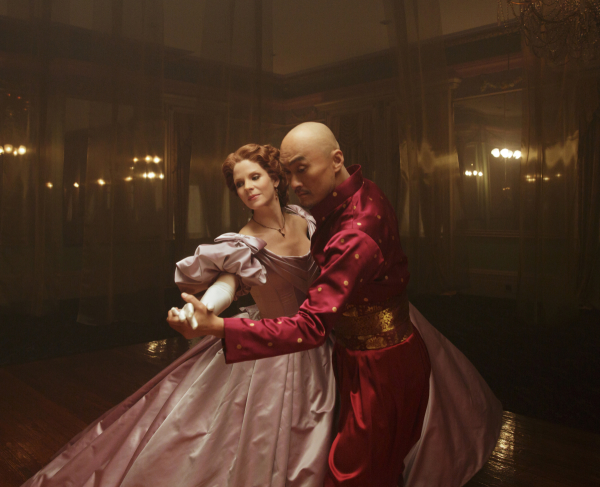
    The King and I
    Vivian Beaumont Theatre
    Previews: March 12, 2015
    Opening: April 16, 2015
    Music: Richard Rodgers, Lyrics: Oscar Hammerstein
    Director: Bartlett Sher
    Starring: Kelli O’Hara and Ken Watanabe
    Why You Should Get Excited: Kelli O’Hara singing Rodgers and Hammerstein? Do you really need more of a reason to go? OK fine. She reunites with “South Pacific” director Bartlett Sher. And they get Lincoln Center’s massive budget, with a cast of 50. Get your tickets.

    An American in Paris
    Palace Theatre
    Previews: March 13, 2015
    Opening: April 12, 2015
    Music and Lyrics: George and Ira Gershwin, Book: Craig Lucas
    Director: Christopher Wheeldon
    Starring: Robert Fairchild and Leanne Cope, with Veanne Cox, Jill Paice, and Max Von Essen
    Why You Should Get Excited: Head Choreographer of New York City Ballet, Christopher Wheeldon, was brought on board to give this classic love story life. If you are a fan of dance, this promises to be a special treat. Also: Max Von Essen. Google him.

    Finding Neverland
    Lunt-Fontanne Theatre
    Previews: March 15, 2015
    Opening: April 15, 2015
    Music & Lyrics: Gary Barlow and Eliot Kennedy, Book: James Graham
    Director: Diane Paulus
    Starring: Matthew Morrison and Laura Michelle Kelly, with Kelsey Grammer and Carolee Carmello
    Why You Should Get Excited: Dianne Paulus is on a role lately, with her past three Broadway outings taking home the Best Musical Revival Tony. This is her first time on Broadway with an original musical, and the Peter Pan story offers the opportunity for thrilling stagecraft.

    It Shoulda Been You 
    Brooks Atkinson Theatre
    Previews: March 17, 2015
    Opening: April 14, 2015
    Music: Barbra Anselmi, Book & Lyrics: Brian Hargrove
    Directed by: David Hyde Pierce
    Starring: Lisa Howard, Sierra Boggess, David Burtka, Tyne Daly, Edward Hibbert, and Harriet Harris
    Why You Should Get Excited: The plot of a wedding gone awry may not be totally original, but if anyone knows how to milk anything for laughs, it’s “Frasier” alum and first time Broadway director David Hyde Pierce. Lead by two great dames of Broadway (Daly, Harris), former Little Mermaid (Boggess) and Mr. Neil Patrick Harris (Burtka), how can it not be a fun time?

    Gigi 
    Neil Simon Theatre
    Previews: March 19, 2015
    Opening: April 8, 2015
    Music: Frederick Loewe, Book & Lyrics: Jay Alan Lerner
    Director: Eric Schaeffer
    Starring: Vanessa Hudgens, with Victoria Clark, Corey Cott, and Dee Hoty
    Why You Should Get Excited: Extensive changes have been made to the book to update the story and character for contemporary audiences. Vanessa Hudgens recently gave a very solid performance on Good Morning America. Gigi’s original Broadway bow was short-lived, but producers hope the updates to the script and their charming star give the show along life.

    Doctor Zhivago
    Broadway Theatre
    Previews: March 27, 2015
    Opening: April 21, 2015
    Music: Lucy Simon, Lyrics: Michael Korie & Amy Powers, Book: Michael Weller
    Director: Des McAnuff
    Starring: Tam Mutu with Kelli Barrett, Tom Hewitt, and Paul Nolan
    Why You Should Get Excited: This epic love story set in the fall of Czarist Russia has lived as a Nobel Prize winning book, and Oscar-winning movie, and now a Broadway musical. Not much is known about the show, which had its premiere in Australia. But the creative team’s credits include under-appreciated gems: “The Secret Garden”, “Grey Gardens”, and “Ragtime”. That’s good enough for me.

    FunHomeScene

    Fun Home
    Circle in the Square
    Previews: March 27, 2015
    Opening: April 19, 2015
    Music: Jeanine Tesori Book & Lyrics: Lisa Kron
    Director: Sam Gold
    Starring: Michael Cerveris and Sydney Lucas, with Judy Kuhn, Emily Skeggs and Beth Malone
    Why You Should Get Excited: Adapted from the graphic novel of the same name, Fun Home charts a young girl’s journey through adolescence and coming out. The Off-Broadway run at the Public Theater wowed audiences for its poignancy and humanity.

    somethingrottenscene

    Something Rotten! 
    St. James Theatre
    Previews: March 23
    Opening: April 22
    Music and Lyrics: Wayne Kirkpatrick and Karey Kirkpatrick, Book: Karey Kirkpatrick and John O’Farrell
    Director: Casey Nicholaw
    Starring: Christian Borle and Brian D’Arcy James with Heidi Blickenstaff and Brooks Ashmankas
    Why You should Get Excited: The story centers on a man writing “the first musical ever”…in order to compete with Shakespeare. This intentionally inaccurate tale has recruited some of the best musical comedy performers in the business.

    The Visit
    Lyceum Theatre
    Previews: March 26, 2015
    Opening: April 23, 2015
    Music and Lyrics: John Kander and Fred Ebb, Book: Terrence McNallly
    Director: John Doyle
    Starring: Chita Rivera and Roger Rees with Jason Danieley
    Why You Should Get Excited: Chita! This will reportedly be the legendary triple threat’s final Broadway show, and it’s a role she has been passionate about for a while. And should, heaven forbid Ms. Rivera fall ill, another legend is waiting in the wings as her standby: A Chorus Line Tony winner Donna Mckechnie. It is also the final collaboration between John Kander and the late Fred Ebb; the duo who gave us classics like Chicago and Cabaret.

    PLAYS

    Hand to God
    Booth Theatre
    Previews: March 12, 2015
    Opening: April 7, 2015
    Written by: Robert Askins
    Directed by: Moritz von Stuelpnagel
    Starring: Steven Boyer, with Geneva Carr, Marc Kudisch, and Sarah Stiles
    Why You Should Get Excited: An irreverent new comedy that played Off-Broadway last season. Who doesn’t want to watch a show about a foul-mouthed hand puppet who may or may not be possessed by the devil. They are also offering great inexpensive seats in advance.

    WolfHallScene

    Wolf Hall (Parts 1 and 2)
    Winter Garden Theatre
    Previews: March 20, 2015
    Opening: April 9, 2015
    Adapted by: Mike Poulton
    Directed by: Jeremy Herrin
    Starring: Ben Miles, Lydia Leonard, and Nathaniel Parker
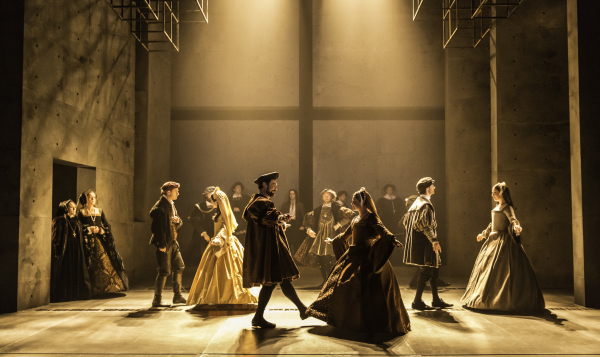
    Why You Should Get Excited: Hilary Mantel’s best-selling history novels about Henry VIII are getting a lavish Broadway treatment from the Royal Shakespeare Company. The two shows (played in repertory) were huge hits in London, and will be very competitive for that Best Play Tony.

    Living On Love 
    Longacre Theatre 
    Previews: April 1, 2015 
    Opening: April 20, 2015 
    Written by: Joe DiPietro 
    Director: Kathleen Marshall 
    Starring: Renee Fleming with Anna Chlumsky, Douglas Sills, and Jerry O’Connell
    Why You Should Get Excited: Celebrated opera diva Renee Fleming makes her Broadway debut. The new comedy features warring spouses, hiring pretty young things to make each other jealous. Fleming is also playing an opera diva in the show…so she should feel right at home.

    Airline Highway
    Samuel J. Friedman Theatre
    Previews: April 1, 2015
    Opening: April 23, 2015
    Written by: Lisa D’Amour
    Director: Joe Mantello
    Starring: Julia White, K. Todd Freeman, Caroline Neff, and Tim Edward Rhoze
    Why You Should Get Excited: Steppenwolf Theatre in Chicago consistently produces some of the best plays in the modern cannon (“August: Osage County” anyone?). Playwright Lisa D’Amour has often been cited for her riveting site-specific work, but she switches over to a proscenium for this tale about a colorful cast of characters in New Orleans.

    The Heidi Chronicles
    Music Box Theatre
    Previews: February 23, 2015
    Opening: March 19, 2015
    Written by: Wendy Wasserstein
    Director: Pam McKinnon
    Starring: Elizabeth Moss with Bryce Pinkham, Jason Biggs, and Tracee Chimo
    Why You Should Get Excited: Told in a series of vignettes, Wendy Wasserstein’s most celebrated play returns to Broadway with a more than capable star with Elizabeth Moss. The Pulitzer Prize winner details the morphing role of women and the rise of feminism by charting the life of Heidi over several years.

    Skylight
    Golden Theatre
    Previews: March 13, 2015
    Opening: April 2, 2015
    Written by: David Hare
    Director: Stephen Daldry
    Starring: Carey Mulligan and Bill Nighy, with Matthew Beard
    Why You Should Get Excited: This company of actors made a splash in the West End and it appears poised to be one of the most talked about revivals of the season. Playwright David Hare (now best known for scripting “The Hours”) always provides meaty roles for his actors to sink their teeth into.

  • Musical Review: “Honeymoon in Vegas”

    Musical Review: “Honeymoon in Vegas”

    honeymoon in vegas

    I recently took a vacation to Las Vegas only to discover it was not for me. Outside of Cirque du Soleil (which is the coolest thing I’ve ever seen); the smoke filled casinos, confusing slot machines, and overpriced everything wore me down. The trip to Vegas I took when I entered the Nederlander Theatre however, was a vastly different and pleasurable experience. I wish the real world locale entertained me as much as Honeymoon in Vegas.

    The charming and funny new tuner from Jason Robert Brown follows the cult comedy film of the same name.  Commitment-phobe Jack (Rob McClure) is in a loving relationship with his dream girl Betsy (Brynn O’Malley).  They adore their New York life together, except that Betsy is desperate for Jack to finally pop the question. Though he is haunted by his mother’s (Nancy Opel) dying wish for him to remain single, Jack finally musters up the courage and decides a spur of the moment trip to Las Vegas will be the perfect way to tie the knot.

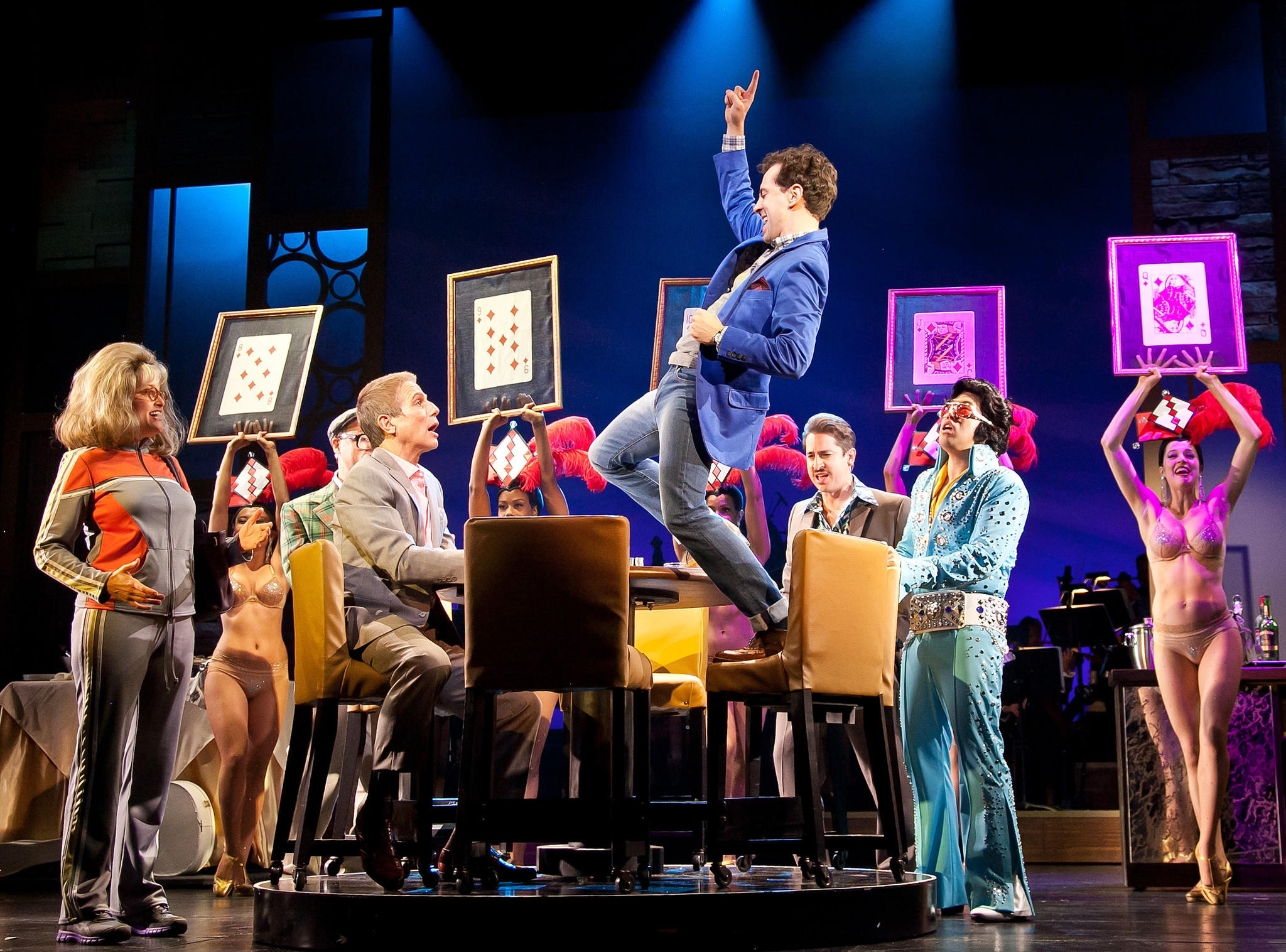
    When they arrive at their sin City hotel, a seedy gambler Tommy Korman (Tony Danza) falls instantly for Betty. Tommy rigs a poker game that forces Jack to lose $58,000. As Jack panics, Tommy pitches a deal: allow him a weekend alone with Betsy and the debt is paid. The plot mostly gets even more absurd from there. A trip to Hawaii, talking totems, and a chorus of Elvis impersonators stand in the way as Jack attempts to win back his fiancée.

    You may be worrying about how ridiculous that summary sounds. But, director Gary Griffin absolutely nails the madcap tone of the story. He quite refreshingly embraces the old fashioned musical comedy style of the piece. It isn’t afraid to go over the top and the book by Andrew Bergman (adapting his original screenplay) mostly serves that purpose, even if some of the jokes don’t land as they should.

    Jason Robert Brown contributes the musical’s score and it’s a complete about face from his previous work. Known for introspective scores about love and loss (The Last Five Years, Bridges of Madison County) Brown surprises with an upbeat song and dance collection. The numbers range from winking innuendo wordplay in “Friki Friki”, to toe tapping anthems like the high energy finale. The music is also spiritedly played by an onstage band that shows off their musicianship to some of the loudest applause of the evening.

    The best decision the creative team made was casting the impossibly likeable Rob McClure as their neurotic leading man. A Tony nominee for the short lived Chaplin, he oozes charm and sincerity. More importantly he knows how to make those qualities work for laughs. The moment he enters the stage in the opening “I Love Betsy” (with a superb singing voice), you’ll want to root for him the entire way through.

    Tony Danza is entertaining, if not outstanding, in his Broadway debut. The actor obviously lacks the vocal chops of a trained singer, which stands out when compared to the cast of talented belters. But Danza has charisma to spare and turns out to be a talented showman. He infuses Tommy with enough sympathy and generosity so as to avoid being a caricature villain. His crooning and ukulele playing on “You Made the Wait Worthwhile” is a tender highlight of the show.

    Elsewhere in the cast, Nancy Opel is predictably hysterical as Jack’s mother. As an apparition she pops out of counters, garbage cans and any other object they could fit her into. She’s a master of musical comedy and I only wish I got to see more of her. Similarly underutilized is the strong voiced Brynn O’Malley. She possesses killer comedic timing but doesn’t get much thrown her way in terms of solo numbers. David Josefsberg turns out to be the scene stealer of the supporting cast, pulling double duty as an omniscient lounge singer and showboating Elvis impersonator.

    Even though the director has united the team to successfully pull off the show’s tone, the staging can be a bit wonky. Not helping matters is the fairly generic set design by Anna Louizos. She seems to have tons of fun creating the absurd elements of the set, but the rest lacks any ingenuity. And if you begin to wonder how often a character or set piece will enter/exit from the same trap door in the stage, SPOILER ALERT: it’s every time.

    Honeymoon in Vegas may not be trying anything daring or new, but it is completely refreshing to see a well crafted musical comedy on Broadway.  It is loads of fun, it doesn’t take itself too seriously, and the bubbly score and charismatic characters are exactly what we need during the cold winter.

    Honeymoon in Vegas
    Nederlander Theatre
    208 West 41st Street, Manhattan
    Music & Lyrics: Jason Robert Brown, Book: Andrew Bergman
    Directed by: Gary Griffin
    Choreography: Denis Jones
    Starring: Rob McClure, Tony Danza, Brynn O’Malley, David Josefsberg, and Nancy Opel
    Run Time: 2 hours and 30 minutes, including 1 intermission

  • Play Review: “A Delicate Balance”

    Play Review: “A Delicate Balance”

    a delicate balance

    “I might very easily, as they say, lose my mind one day” purrs Glenn Close with casual conviction. It’s a humorous, but ultimately unsettling way to open a play. “A Delicate Balance” may not be Edward Albee’s most famous work, but it is likely the hardest to look in the eye.

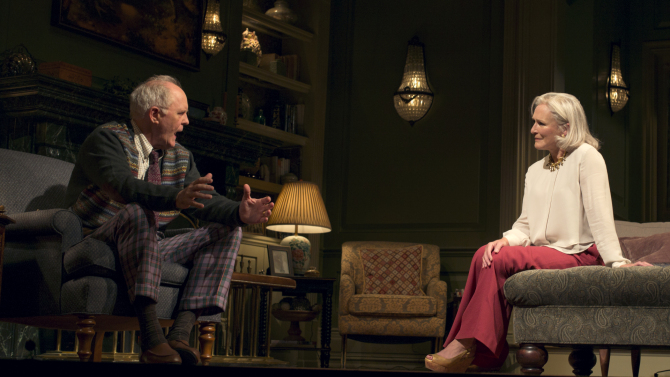
    Glenn Close and John Lithgow star as Agnes and Tobias, the heads of a WASP-ish upper class family. They live a comfortable life as they drink and lounge in their opulent living room (sumptuously designed by Santo Loquasto). A sort of existential crisis of fear has gripped the retirees however. Agnes’ alcoholic sister Claire (Lindsay Duncan) has crashed the party as a permanent guest. Soon the couple’s daughter Julia (Martha Plimpton) comes scurrying home from a fourth failed marriage. And more troubling, two best friends Harry and Edna (Bob Balaban and Clare Higgins) flee their house because of an unknown terror and seek shelter in under Tobias’ roof.

    Albee is a master of the domestic drama. Though you may be disappointed if you go in looking for a retread of “Who’s Afraid of Virginia Woolf”. Drinks and barbs are slung back and forth with wild abandon, sure. But there is something a bit more sinister amid the zingers. As Agnes points out, “It’s one of those days where everything is happening underneath”.

    Fear becomes a character looming over the entire proceedings. Director Pam McKinnon (who helmed Albees “Virginia Woolf” last season) has highlighted the most uncomfortable themes in the play. When keeping up appearances is all you have to live for, what happens when your composure crumbles or your authority undermined? Agnes refers to the “terror” Harry and Edna bring into their home as a plague. A fear that infects all of their minds and forces the characters to ponder if they will go mad, amount to nothing, or lose the comfort they worked so hard for. So while the play is full of funny bits, it can also be a tough pill to swallow as Agnes examines which people are a “cancer” to her family’s happiness and image.

    Glenn Close turns in a much more restrained performance than we are used to as the matriarch of the family. There were certain moments I felt she could have amped it up, but she retains her thrilling ability to command a room with a simple gesture. A sharp glare, furrowed brow, or single word can command or silence any of her family members.  Agnes orchestrates all of the proceedings and hardly moves a muscle.

    It’s Lindsay Duncan that gives Ms. Close a run for her money. As Claire, Duncan saunters about the room with zero sense of decorum or propriety, constantly on the sidelines offering hilarious commentary as her sister and brother-in-law attempt to keep their house together. Her comedic timing is perfect and any actor who must play drunk should watch Ms. Duncan for a master class. If you’re having trouble with the plays darker elements, you can at least find solace and humor in watching Claire chug martinis and fantasize about having her sister killed.

    The pacing suffers occasionally, mostly in scenes with Henry. Bob Balaban is playing up his characters awkwardness. Sometimes it works, but often it saps the energy out of the scene. And in a three act play (yes three!) it takes great effort to recover from lagging pace. Thankfully McKinnon keeps everything moving at a clip.

    Not everything comes fully into focus though. There is a side plot about a past affair that gets muddled. And Claire has several prophetic moments which are made too on the nose by an abrupt lighting shift or clumsy tableaux. And John Lithgow and Martha Plimpton are doing great work (they each get their own tremendous monologue to show off their chops), but one can’t help but feel the characters are sometimes more of an idea, and in service to the plays themes, rather than real people to root for.

    This is a dense play. I still feel like I need to go back for a second viewing to truly take in everything Albee presents. It also asks the audience (and more precisely: a theatre going, cultured, type of audience) to examine their own lives. As such, A Delicate Balance won’t be to everyone’s tastes. But, with the talented cast and brilliant playwright, you’re bound to find something on the menu to your liking. Even if you can’t quiet digest the whole thing.

    A Delicate Balance
    John Golden Theatre
    252 West 45th Street, Manhattan
    Written by: Edward Albee
    Directed by: Pam McKinnon
    Starring: Glenn Close, John Lithgow, Lindsay Duncan, Martha Plimpton, Bob Balaban, and Clare Higgins
    Run Time: 2 hours and 45 minutes, including 2 intermissions

  • Winter is Coming: A Guide to Broadway’s Dearly Departing

    Winter is Coming: A Guide to Broadway’s Dearly Departing

    broadway closingsTwas the week before Christmas, each show had a full house…and then January came and wiped them all out. Ok, so that rhyme scheme was rough. But the takeaway is that Broadway is currently enjoying what is usually its most profitable week of the year. Families flock to New York for the holidays, and in the spirit of overspending (budgets be damned! It’s Christmas!), purchase tremendous amounts of tickets with hopes of a few hours of fun in between shopping and relatives.

    After the Christmas extravaganza ends, a grim period on Broadway commences, commonly (though not affectionately) called the “January Slaughter”. January and February are tough for every shows’ bottom line. Not many theatergoers are willing to shell out hundreds more dollars after they examine their post-Christmas credit card balance.

    Thirteen productions are currently planning to shutter their doors between now and March. The struggling Love Letters didn’t even make it through December before cutting its run short (which completely ruined my plans of seeing Dame Diana “Olenna Tyrell” Rigg on Broadway). Some runs were scheduled to close during the winter, while others were forced due to low ticket sales.  With so many shows closing in such a small amount of time, I’ve compiled a list of which final hurrah’s you should make a point to catch, and the cheapest way to get tickets.

    What’s Closing? 

    Closing January 3th
    Cinderella

    Closing January 4th
    Pippin
    Once
    The Real Thing
    This is Our Youth
    The Illusionists
    Side Show

    Closing January 18th
    Rock of Ages
    Motown: the Musical

    Closing February 8th
    The River

    Closing February 15th
    The Elephant Man

    Closing February 22nd
    A Delicate Balance
    You Can’t Take it With You


    What to See?

    CINDERELLA
    If you’re a fan of spectacular design, then William Ivey Long’s Tony winning costumes alone are reason to book a trip. The production looks gorgeous from head to toe, and features an updated book thanks to Douglas Carter Beane (Cindy gets to be more than a damsel in distress this time). The cast currently features Keke Palmer (Cinderella), NeNe Leakes (Madame), and Judy Kaye (Fairy Godmother).

     Tickets on a budget: Students (…or those who still have student IDs) can take advantage of the Student Rush policy. You can purchase one ticket per ID for $32, when the Box Office opens on the day of the show. Tuesday – Thursday performances only.


    PIPPIN
    The 2013 Tony winner for Best Revival of a Musical is a great mix of story and spectacle thanks to Diane Paulus’ direction and high flying circus acts choreographed by Gypsy Snyder (of circus troupe Les 7 doigts de le main). The Voice winner Josh Kaufman recently took over the title role. The cast also features Carly Hughes (Leading Player), Charlotte D’Amboise (Fastrada), and Priscilla Lopez (Berthe).

    Tickets on a budget: This one offers a General Rush (no age restriction)! A limited number of $37 tickets are available at the Music box theatre, when the box office opens on the day of the show. One ticket per person.


    ONCE
    This Tony winner, and “little musical that could” is finally ending its very successful run at the Bernard B. Jacobs Theatre. A charming piece that is refreshingly intimate a stripped down compared to most other musicals on Broadway. Each actor plays their own instruments as they sing through a love story based on the hit indie film. You can read our own Karl Delossantos’ rave review here.

    Tickets on a budget: General Rush tickets are available when the box office opens on the day of the performance, 2 tickets per person. They will run you $35 Tuesday-Thursday, or $40 Friday-Sunday.


    SIDE SHOW
    This gorgeously produced revival has proved to be just as tough a sell as its original incarnation. But the story of conjoined Hilton sisters truly won me over, and you can read my take on it here. The best thing about it is its two stars, Erin Davie and Emily Padgett, who belt through the powerful score like two runaway trains. They’ll give you all the feels, and they will certainly be nominated for best actress come Tony Awards time.

    Tickets on a budget: General Rush is offered when the box office opens (10a.m.) on the day of the show, to patrons 30 and under. There’s a maximum of two $37 rush tickets per person.


    YOU CAN’T TAKE IT WITH YOU
    The classic comedy about the most dysfunctional of families holds up remarkably well. This is mostly thanks to the stellar ensemble headed by James Earl Jones, Kristine Nielsen, Rose Byrne, Elizabeth Ashley, and Annaleigh Ashford. For fans of HBO’s “Veep”, Anna Chlumsky will replace Rose Byrne who ends her tenure on January 4th. Comedies have been taking inspiration from this play for decades, so you owe it to yourself to see the original done right.

    Tickets on a budget: Student Rush is available when the Longacre box office opens on the day of the show (Monday-Saturday at 10am, Sunday at noon). Rush tickets are $30 each and limited to one ticket per student ID. Additionally $37 full priced seats are sold in the Balcony.


    More Discount Options!
    There are certainly other shows I would recommend (A Delicate Balance, The Elephant Man) that currently don’t have a discount program in place. But fear not broke Broadway fans! Here are a few other ways to score reasonably priced tickets.

    TKTS
    Sure, the lines can be long. But this half price booth can be the best place to score same day seats for a successful show like A Delicate Balance without going into triple digits. While not as cheap as rush or lottery seats, one can generally expect to pay approximately $60-90. TKTS now has an app you can download to see which shows are on sale at the booth, so you can know if the show you want is available before you go. Pro tip: Don’t forget the booths in downtown Brooklyn and the south Street Seaport which have shorter lines.


    HIPTIX
    Roundabout Theatre has an amazing (and easy to use) discount program for patrons 35 and under. Sign up online and you’ll then have access to $25 tickets for all of Roundabout’s shows, including The Real Thing, Cabaret, and On the 20th Century. You are granted up to two per production, and can even select your own seats online without being charged additional service fees. Sign up here: http://www.roundabouttheatre.org/Shows-Events/HipTix.aspx


    LINCTIX
    Lincoln Center has a similar program for patrons 35 and under. After signing up, you are eligible to purchase a $32 ticket to each of their productions (a small service fee applies online). This currently includes Disgraced, The Oldest Boy, and the upcoming revival of The King and I with Kelli O’Hara. Unfortunately you can only purchase one discounted ticket per person, but they allow you to coordinate with other friends in the program. Sign up here: http://www.lct.org/linctix/


    TODAYTIX
    Discount tickets in the palm of your hand! TodayTix is a new app that lets you browse Broadway and Off-Broadway shows and purchase discounted tickets from your phone. The one downside is that you can’t select your exact seat location, but I’ve found them to be pretty decent. Some shows, like On the Town, even allow you to enter their ticket lottery on the app. For many shows, you can meet a TodayTix concierge outside of the theatre to pick up your tickets (aka avoiding the long box office line). Use this code at checkout to save $20 on your first order with the app: XJQKU.