Category: Play Reviews

  • Play Review: “The Curious Incident of the Dog in the Night-Time”

    Play Review: “The Curious Incident of the Dog in the Night-Time”


    the curious incident of the dog in the night-time

    Tony Nominations are still months away, but I will be extremely surprised if The Curious Incident of the Dog in the Night-Time is not cited a number of times on nomination morning. If even a small part of you is a theatre fan, this new play at the Barrymore Theatre is essential viewing this season.

    An Olivier winning production from the National Theatre in London, Curious Incident is based on the novel by Mark Haddon. The play, adapted by Simon Stephens, follows the same story about a young boy on the autism spectrum. The production opens with this boy, Christopher (Alex Sharp), happening upon a ghastly scene: the neighbor’s beloved dog has been murdered. Impaled by a gardening fork to be exact.  Things get more troubled when his father (Ian Barford) informs the boy his mother has died suddenly. Despite insistence that he stay out of other people’s business, Christopher sets out to find the dog’s killer himself.

    Christopher’s detective work unearths secrets from his parents and neighbors. The beauty of the story is how he is able to overcome any obstacle he faces with his frequent sensory overloads. Instead, he learns how to use his brilliant mind to not only solve the case, but deal with the harsher realities of the adult world.

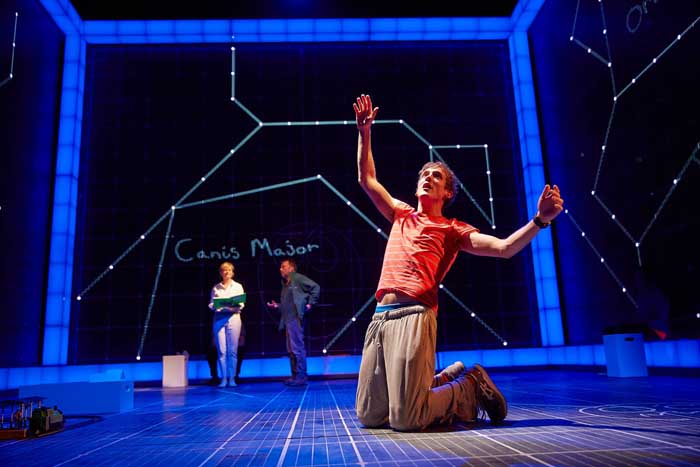
    In one of the most intriguing bits of stage presentation to hit Broadway in quite some time, the stage itself often represents that very brilliant mind. Scenic designer Bunny Christie has crafted a set consisting of four panels (three walls and a floor) each with a grid like design. The grid and walls constantly spring to life, mimicking the machinations of Christopher’s mind, with assistance by Paule Constable’s lighting design and Finn Ross’ brilliant video projection work. Sometimes, it’s a simple outline of houses as Christopher walks down his street. Other times he is surrounded by a cacophony of numbers or words as sights and sounds bombard him. Oftentimes the effect is at once both glorious and terrifying.

    The innovation in the production has director Marianne Elliott and choreographers Scott Graham and Steven Hoggett to thank. This creative team hurls the actors across the stage in an intensely physical production. The staging hovers somewhere between an experimental movement piece and full blown dance. The choreography plays with slowed time, patterns, and using people as props to climb on (and at one point has Christopher literally climbing the walls). It’s all in aide of showcasing how Christopher sees the world.

    Ms. Elliott directs each scene honestly and manages to find humor even in the darkest moments. Nothing feels forced here. It’s refreshing that in a production heavy with visual spectacle, the performances are so specific and honest.

    Most of the ensemble members get chances to shine as several different colorful characters. Enid Graham does beautiful work as Christopher’s mother. She displays a deep well of emotion and can play brutal and angelic all at once. Ian Barford is tremendous as a father doing his best to care for a child whom he continually struggles to connect with. His balancing act of rage and tenderness towards Christopher provides some of the emotional high points of the story.

    It is Alex Sharp who sells the whole thing. The recent Julliard graduate could not have asked for a better start to his career. His portrayal of someone on the spectrum never veers into caricature or imitation. He’s a math genius with a love of computers and space. He screams when anyone touches him. He rifles off lists of statistics and thoughts as we see his mind working one thousand miles per minute. Most importantly he grounds the spectacle in a brutally honest performance.

    If there is one aspect where the script falters it is in the second act narrative device. Francesca Faridany portrays a special needs teacher to Christopher. While the talented actress is a welcome addition to the cast, serving as a waypoint between the audience and her student, the second act takes it to a more meta level when she announces they are all just performing in a play based on Christopher’s writing. The shift in tone is too abrupt and sort of unnecessary given the slew of other narrative devices to keep the audience at safe distance.

    Minor gripes aside, The Curious Incident of the Dog in the Night-Time is an astounding achievement in storytelling. It’s a prime example of performance and stagecraft syncing up harmoniously for a gripping night at the theatre.

    The Curious Incident of the Dog in the Night-Time
    Ethel Barrymore Theatre
    243 West 47th Street, Manhattan
    Written by: Simon Stevens, based on the novel by: Mark Haddon
    Directed by: Marianne Elliott
    Starring: Alex Sharp, Francesca Faridany, Ian Barford, Enid Graham, and Helen Carey.
    Taylor Trensch plays Christopher on Wednesday evenings and Sunday matinees
  • Broadway Review: “Constellations”

    Broadway Review: “Constellations”

    Constellations broadway review

    Have you ever wondered about the paths in life you chose not to take? What would your life be like if you didn’t take that job, if you mustered the courage to flirt with the guy on the subway, if you moved to another state? In Nick Payne’s short but haunting “Constellations”, two actors bring all the possibilities of their relationship to life.

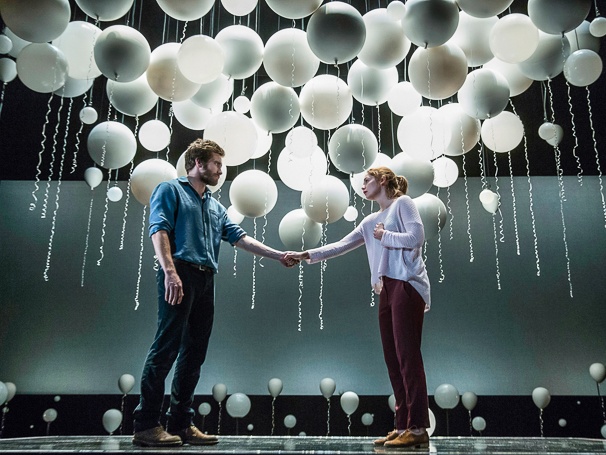
    Performed with no set, props, or costume changes, “Constellations” is the story (or should I say: stories) of Roland (Jake Gyllenhaal) and Marianne (Ruth Wilson). The play takes place across the multiverse, and flings the couple through space and time to explore the multitude of paths their lives could take. There is some scientific talk about the infinite universes that exist for every possible choice we make (Marianne is a physicist), but there’s no need to master high concepts to enjoy the play.

    We start with a scene at a party where the two first meet. The song and dance of their flirtations repeats several times with different outcomes. In one version of the scene, the seduction is unsuccessful and the story ends abruptly. Other replays show the pair getting to know one another, discussing their passions, and ultimately going home together. There are about six total scenes that get replayed to show the various routes the couple may take.

    I don’t mean to make you think you’ll be watching the same boring thing over and over again. Nick Payne has crafted some snappy and naturalistic dialogue for each variation. The script puts more weight on the journey than the destination of each scene. I sat fascinated as I watched how a single changed line or intonation altered a scene in dramatic fashion.

    This style certainly puts the focus on the actors, and Gyllenhaal and Wilson do not disappoint. Both of the catapult through emotions on a dime, as the variations switch from comical to heartbreaking. It is most impressive watching the pair find new tactics on each repeat. I could have watched Gyllenhaal’s marriage proposal attempts for hours, watching him with suave confidence one minute and paralyzing fear the next. Ruth Wilson is a brilliant physical performer, and displays comedic timing fans of hers from “The Affair” wouldn’t see otherwise. But it’s in a particularly brutal development at the plays end where she shines brightest. You won’t be able to take your eyes off her.

    Director Michael Longhurst succeeds at keeping all these realities clear in the minds of the audience. It’s an impressive feat considering the sometimes breakneck pacing. In a snap, actors change position and demeanor and hurl themselves into a new world. Some striking lighting work from Lee Curran, surrounding the playing space with illuminated balloons, helps to delineate the various universes.

    In just over one hour, you will watch the couple flirt, fight, dance, cheat, break up, and brave impossible struggles together. Payne allows Roland and Marianne to grow closer in each scene, and as a result, the audience grows closer to them as well. By the time the evening is over, I was completely enthralled and invested in both characters as if I knew them personally. Each and every version of them.

  • Play Review: “Skylight”

    Play Review: “Skylight”

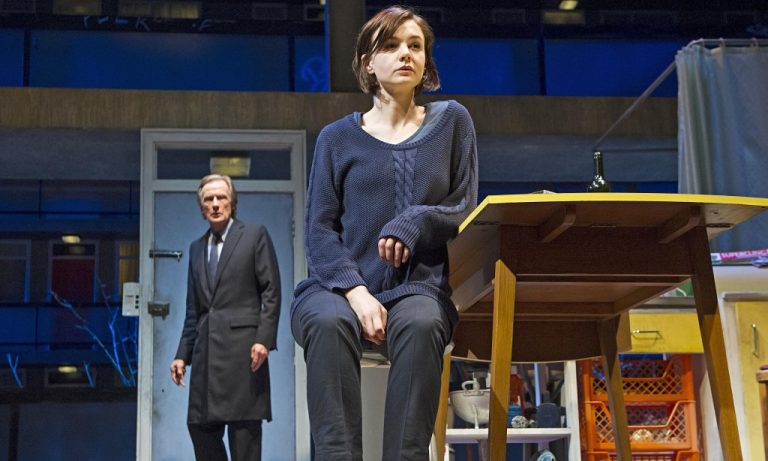
    SkylightWhen David Hare’s Skylight premiered at the end of the Thatcher era in Britain, it surely struck a nerve with audiences. A play that intertwines politics and passion via two ex-lovers, the political ideology is still as sharp as ever even though the play has dated itself.

    In this first ever revival, Bill Nighy and Carey Mulligan portray Tom and Kyra. Set entirely in Kyra’s dingy flat (beautifully designed by Bob Crowley to feel cramped but homey), Tom bursts in one night after years of not speaking to his former flame. The two spend a long evening together excavating their past relationship and examining all the ways in which they have grown apart. Tom was married, Kyra his mistress of six years. Now that his wife has died, he realizes he wants Kyra back. If such a thing is even possible so many years and experiences later.

    Nighy expertly commands the stage, exploding through the front door with a sort of neurotic swagger. He patrols the apartment as if he owns the place while getting big laughs from the audience with his disbelief of Kyra’s unappealing new digs. He refuses to touch the kitchen chair with his bare hands and calls her out for living “in Siberia like conditions”.

    Mulligan’s character is less flamboyant, but has a fiery intensity that matches Nighy’s energy every step of the way. The two of them form a great bond on stage that actually feels like a lived-through relationship. I can’t say that I could see any sexual chemistry up there, but the deep care for each other was real. Even in moments of violent anger and silverware hurling. Matthew Beard also entertains in small but charming bookend part as Tom’s idealist son.

    The meat of the play is Hare’s peek into political ideology. Tom is an entrepreneur and successful restaurant owner. He values finer things, has money for meals and limousines, and chides Kyra for her choice to not reach her potential. Kyra obviously sees things differently, claiming she lives in a less than stellar apartment and teaches troubled kids to make a difference. If she doesn’t do it, who will? Issues of class, economics, and education are passionate topics of debate. Both characters realize they have shifted to opposite ends of the spectrum during their time apart, or perhaps they were set in this thinking all along. It’s a conversation that feels familiar with current arguments surrounding income inequality.

    I only wish Mr. Hare gave his characters more of an arc to match the enduring relevance of their arguments. Stephen Daldry is not a flashy director, and he brings out as much subtlety and nuance in his actors as possible. It’s a welcome change from the more bombastic styles usually seen on Broadway. And despite a mountain of words spewed back and forth, the play moves along at a clip (though his actors would do well to pause for laughter).  But as the play comes to a close I found myself thinking “what is the endgame here? What are they building to?”.

    It turns out not much. The actors do a brilliant job at taking us through the twists and reveals of their past life together, but they end up in essentially the same scenario in which they started. Beliefs are shared, some closure found. But I am stumped as to what they learned along their journey together or how it changed them. David Hare is always successful in building complex characters, but this piece doesn’t give those compelling characters anywhere to go.

    Skylight
    Golden Theatre
    Written by: David Hare
    Directed by: Stephen Daldry
    Starring: Bill Nighy, Carey Mulligan, and Matthew Beard
    Run Time: 2 Hours and 20 minutes, with one intermission

  • Play Review: “Hand to God”

    Play Review: “Hand to God”

    Hand to God MCC at the LucilleLortel TheaterPlays as irreverent, profane, and wacky as Hand to God rarely make it to the big Broadway houses. So I raise a hallelujah to the theatre gods for giving us this outstanding play at the Booth Theatre. It’s one of the best shows this season.

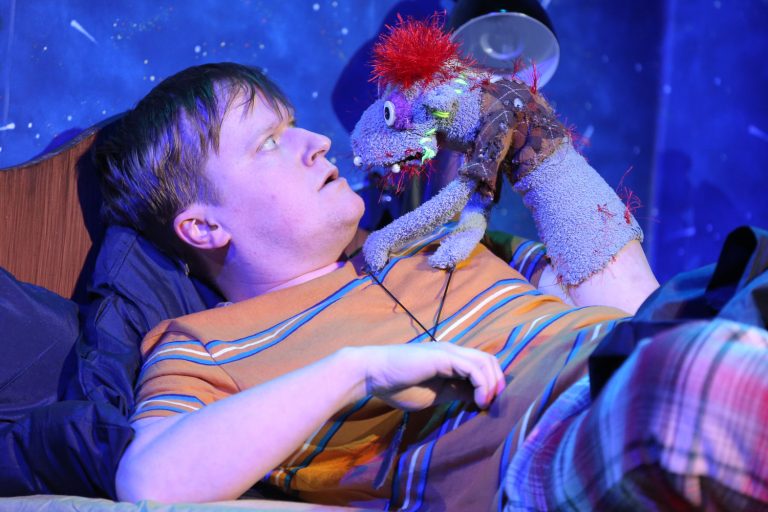
    Robert Askins has written an insanely funny dark comedy that you will want to attend over and over again. The play centers on Jason (Steven Boyer), a troubled young boy who is perfecting the art of hand-puppetry at his church’s puppet class. The class is led by his recently widowed mother Margery (Geneva Carr), determined to do something worthwhile and find meaning after her husband’s death. All hell (literally) breaks loose when we discover Jason’s hand puppet “Tyrone” has a mind of his own, and is quite possibly possessed by the Devil himself.

    If you were a fan of the Off-Broadway run concerned for the transfer into a larger house: have no fear. As directed by Moritz von Stuelpnagel, the production expertly balances outrageous humor and touching humanity. Beowulf Boritt has also provided an impressive set full of folding parts and loads of surprises.

    It is Steven Boyer in the dual roles of Jason/Tyronne who deserves the lion’s share of praise. Jason is an impossibly awkward young man with zero confidence to speak of. But as Tyronne takes over the boy’s arm, Boyer transforms his voice into an acidic, fiendish creature full of violent and lewd energy. The voice and mannerisms of Tyronne are so specific it’s often easy to forget the puppet is controlled by the actor. Watching the many scenes Stephen Boyer perform two character scenes by himself is mesmerizing. Though composed of a sock and some felt, Tyronne is absolutely the star of the show. It’s nearly impossible to describe the strange joy one feels watching Tyronne torment his small town victims.

    The cast is filled out by a wonderfully troupe of actors who match the zany energy of the devil puppet. Marc Kudisch portrays the church pastor who attempts (and fails) to disguise his sexual advances towards Jason’s mother as purely Christian intentions. Timothy (Michael Oberholtzer) is also inappropriately infatuated with Margery. Oberholtzer perfectly delivers teen angst and sexual frustration with a wildly physical performance. Sarah Stiles plays Jessica, the object of Jason’s pure affections and Tyronne’s sexual charged catcalls. Stiles is hilarious in her deadpan delivery, and collaborates with Boyer for the most outrageous puppet sex scene the world may ever know. Seriously, you won’t believe how many sex positions these puppets get into. Apologies to Avenue Q and Team America, this play has you beat.

    You can, and should, enjoy the play as a filthy hilarious escape. But while its odd to look for deeper meaning when puppet exorcism is a major plot point, there is more than shock and awe to the script. Tyronne in many ways represents the unfiltered Id, saying what Jason would say if no repercussions were involved. All of these characters are suffering from repressed urges and emotions.  Mr. Askins dares to ask the audience if there is any benefit to acting on our innermost desires.

    My one wish for the script is a stronger establishing moment between mother and son at the beginning of the play. Much of act two hinges upon Jason and Margery learning to forge ahead together and listen to each others needs instead of keeping them bottled up. But since the first act is so centered on establishing the play’s outrageous humor, the relationship is not immediately solidified and the eventual payoff isn’t as sweet or nuanced as it could be. This is not to speak ill of Geneva Carr, who commands the stage as Margery whenever she is present. A kind-hearted but lost woman, she can fly into a rage or a sexual fit at a moments notice. An angry sex scene of hers somehow rivals the puppet sex scene in outrageous hilarity.

    I honestly have not laughed this hard at a Broadway show in years. Whether it was from a sock puppet’s sermon on the origin of sin, or watching said puppet wrestle his owner while still on his arm, I couldn’t even attempt to suppress my cackling. The audience around me was certainly in agreement. This play is something special and to miss it would be a sin.

    Hand to God
    Booth Theatre
    222 West 45th Street, Manhattan
    Written by: Robert Askins
    Directed by: Moritz von Stuelpnagel
    Starring: Stephen Boyer, Geneva Carr, Michael Oberholtzer, Sarah Stiles, and Marc Kudisch
    Run Time: 2 hours, one intermission

  • Play Review: “The Pied Pipers of the Lower East Side”

    Play Review: “The Pied Pipers of the Lower East Side”

    1429906836-Pied-Pipers-of-the-Lower-East-Side-tickets

    It may be almost 40 years now since “The Age of Aquarius” dawned on Broadway, but the theatre’s love affair with all things alternative is still going strong. Its latest send up to the freedom and inhibition that comes with living “La Vie Bohéme” arrives in the form of The Pied Pipers of the Lower East Side, now rocking Los Angeles’ Matrix Theatre on Melrose with a radically ideological thrust that promises to challenge everything its audience members believe about love, devotion, and what can constitute a family.

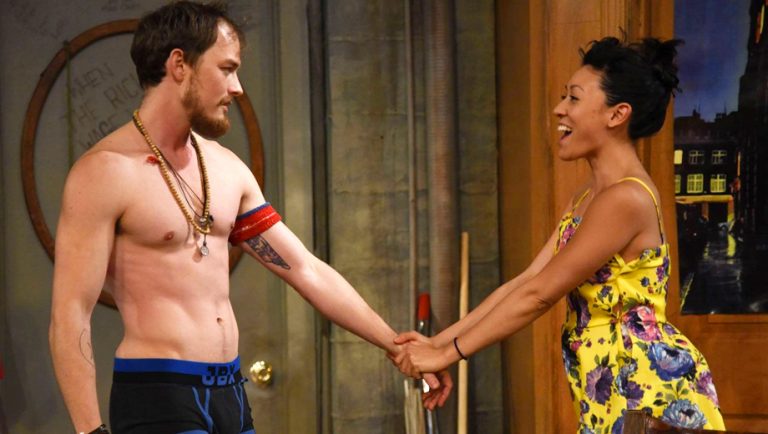
    Written and directed by Derek Ahonen, founder and resident playwright of the Amoralists Theatre Company in New York City, The Pied Pipers of the Lower East Side tells the tale of four young adults operating a barter-style vegan restaurant and living in a polyamorous, new-age “tribe,” an unconventional family defined by free love, open sex, and — most importantly — loyalty and devotion to the group.

    Through the work of the show’s stunning ensemble cast, the Pipers spring to life onstage. Billy (Adam Brooks) is a drug-addicted revolutionary, constantly fretting over his sporadically published anarchist journal and the possibility of heading south to aid a bloody insurrection; Wyatt (Jordan Tisdale) struggles with a constant, existential fear of death and the unknown… when he’s not destroying Billy’s record collection over a few lost scratch-off lottery tickets; the teenage Dawn (Heather Mertens) escapes a household torn apart by abuse to sing obscure Rolling Stones songs on the city streets for money. Dear (Agatha Nowicki), a former lawyer, is unmistakably the tribe’s mother figure, extolling wisdom and encouraging free emotional expression in between running the vegan restaurant above which the Pipers make their home.

    The Pied Pipers functions simultaneously as both an unrelenting manifesto and a gripping character drama. Conflict arrives in the form of Billy’s younger brother Evan, a college-aged aspiring sports journalist and ideological conservative (played to frat-tastic perfection by a cocky Ben Reno) whom the Pipers attempt to convert to their way of thinking by staging an impromptu “bed-in” style interview. The Pipers seem to have all of the answers, matching each of their detractor’s skeptical dismissals with compelling arguments that favor a reliance on small self-sustaining tribes rather than larger apathetic global communities in which a starving child is nothing more than a statistic, all while explaining the complex inner workings of a four-way relationship that is both sexual and romantic.

    But for all of the Pipers’ faith in their ability to take care of each other, they are ultimately people that are individually falling apart. While Billy projects his own disappointment in himself onto his conservative family, Wyatt battles paralyzing panic attacks and Dawn dreads the possibility of the tribe one day coming to an end. Even the self-actualized Dear’s commitment to the tribe is tested by an eventual offer of an easier life. Furthermore, a controversial business decision by the group’s eccentric benefactor Donovan (a manic Patrick Scott Lewis) threatens the Pipers’ very existence as they know it. While the Pipers’ tribal lifestyle may be as virtuous as they claim it to be, there’s something a lot simpler at work here too: these are people that need each other.

    The Pied Pipers of the Lower East Side is a three-act thrill ride of visceral performances, twisting dialogue, and heart-wrenching emotional turns. Its irreverent onstage nudity may make you laugh, and the impossible decisions faced by its characters may make you cry; either way, the Pipers are guaranteed to be a hit with any theatre-lover looking to open their mind, challenge their preexisting ways of thinking, and change their life.

    The Pied Pipers of the Lower East Side is now playing as a limited engagement from April 16 to May 24, 2015 at the Matrix Theatre on Melrose Avenue in Los Angeles, California. Performances run Thursday, Friday, and Saturdays at 8 p.m. and Sundays at 7 p.m. The Matrix Theatre Company’s production of The Pied Pipers of the Lower East Side is presented by Alex Zoppa, Henry Reno, and Joseph Tuccio. Tickets are available now via Brown Paper Tickets.

  • Play Review: “A Delicate Balance”

    Play Review: “A Delicate Balance”

    a delicate balance

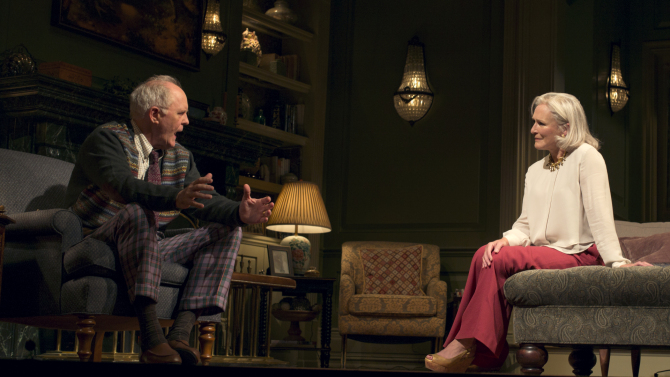
    “I might very easily, as they say, lose my mind one day” purrs Glenn Close with casual conviction. It’s a humorous, but ultimately unsettling way to open a play. “A Delicate Balance” may not be Edward Albee’s most famous work, but it is likely the hardest to look in the eye.

    Glenn Close and John Lithgow star as Agnes and Tobias, the heads of a WASP-ish upper class family. They live a comfortable life as they drink and lounge in their opulent living room (sumptuously designed by Santo Loquasto). A sort of existential crisis of fear has gripped the retirees however. Agnes’ alcoholic sister Claire (Lindsay Duncan) has crashed the party as a permanent guest. Soon the couple’s daughter Julia (Martha Plimpton) comes scurrying home from a fourth failed marriage. And more troubling, two best friends Harry and Edna (Bob Balaban and Clare Higgins) flee their house because of an unknown terror and seek shelter in under Tobias’ roof.

    Albee is a master of the domestic drama. Though you may be disappointed if you go in looking for a retread of “Who’s Afraid of Virginia Woolf”. Drinks and barbs are slung back and forth with wild abandon, sure. But there is something a bit more sinister amid the zingers. As Agnes points out, “It’s one of those days where everything is happening underneath”.

    Fear becomes a character looming over the entire proceedings. Director Pam McKinnon (who helmed Albees “Virginia Woolf” last season) has highlighted the most uncomfortable themes in the play. When keeping up appearances is all you have to live for, what happens when your composure crumbles or your authority undermined? Agnes refers to the “terror” Harry and Edna bring into their home as a plague. A fear that infects all of their minds and forces the characters to ponder if they will go mad, amount to nothing, or lose the comfort they worked so hard for. So while the play is full of funny bits, it can also be a tough pill to swallow as Agnes examines which people are a “cancer” to her family’s happiness and image.

    Glenn Close turns in a much more restrained performance than we are used to as the matriarch of the family. There were certain moments I felt she could have amped it up, but she retains her thrilling ability to command a room with a simple gesture. A sharp glare, furrowed brow, or single word can command or silence any of her family members.  Agnes orchestrates all of the proceedings and hardly moves a muscle.

    It’s Lindsay Duncan that gives Ms. Close a run for her money. As Claire, Duncan saunters about the room with zero sense of decorum or propriety, constantly on the sidelines offering hilarious commentary as her sister and brother-in-law attempt to keep their house together. Her comedic timing is perfect and any actor who must play drunk should watch Ms. Duncan for a master class. If you’re having trouble with the plays darker elements, you can at least find solace and humor in watching Claire chug martinis and fantasize about having her sister killed.

    The pacing suffers occasionally, mostly in scenes with Henry. Bob Balaban is playing up his characters awkwardness. Sometimes it works, but often it saps the energy out of the scene. And in a three act play (yes three!) it takes great effort to recover from lagging pace. Thankfully McKinnon keeps everything moving at a clip.

    Not everything comes fully into focus though. There is a side plot about a past affair that gets muddled. And Claire has several prophetic moments which are made too on the nose by an abrupt lighting shift or clumsy tableaux. And John Lithgow and Martha Plimpton are doing great work (they each get their own tremendous monologue to show off their chops), but one can’t help but feel the characters are sometimes more of an idea, and in service to the plays themes, rather than real people to root for.

    This is a dense play. I still feel like I need to go back for a second viewing to truly take in everything Albee presents. It also asks the audience (and more precisely: a theatre going, cultured, type of audience) to examine their own lives. As such, A Delicate Balance won’t be to everyone’s tastes. But, with the talented cast and brilliant playwright, you’re bound to find something on the menu to your liking. Even if you can’t quiet digest the whole thing.

    A Delicate Balance
    John Golden Theatre
    252 West 45th Street, Manhattan
    Written by: Edward Albee
    Directed by: Pam McKinnon
    Starring: Glenn Close, John Lithgow, Lindsay Duncan, Martha Plimpton, Bob Balaban, and Clare Higgins
    Run Time: 2 hours and 45 minutes, including 2 intermissions

  • “The Real Thing” Broadway Review

    “The Real Thing” Broadway Review

    the real thing broadway“I’m acting normal! You’re all acting strange”.

    For much of the beginning of Roundabout’s revival of “The Real Thing”, this quote by Maggie Gyllenhaal’s Annie holds very true. Director Sam Gold has crafted an uneven, sometimes frustrating, but ultimately rewarding revival of the Tom Stoppard classic.

    One of the playwright’s finest plays; “The Real Thing” is an exploration of commitment and how we define fidelity. The excavation of the relationships on display was quite ahead of its time in its initial bow.

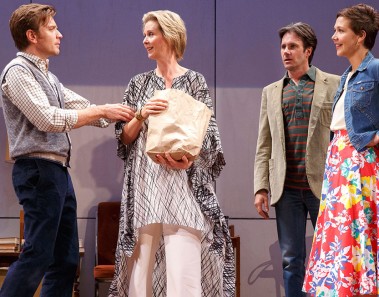
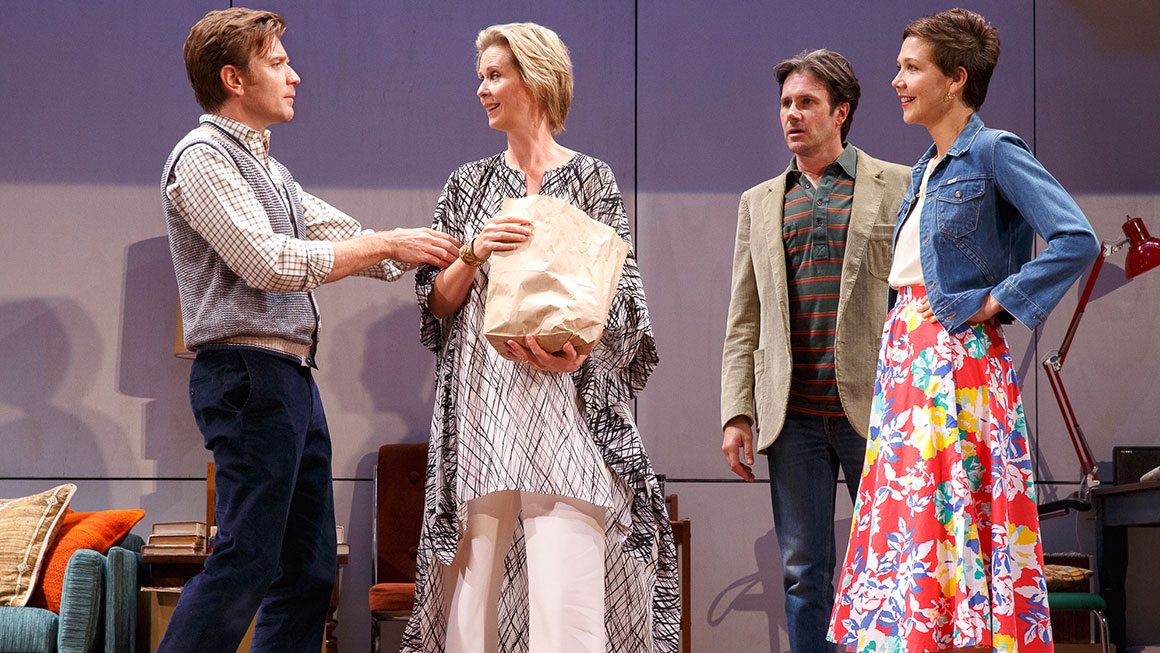
    We are introduced to two couples. Henry (Ewan McGregor) is a playwright, his wife Charlotte (Cynthia Nixon) the lead in his play. Annie (Gyllenhaal) is a free spirited actress married to Charlotte’s co-star Max (Josh Hamilton). An affair is quickly revealed between Henry and Annie, curiously mimicking the fiction their better halves portray in Henry’s play. The two lovebirds must find out if love born out of betrayal can work, and whether tradition thoughts on monogamy are practical.

    “The Real Thing” is arguably Tom Stoppard’s most accessible play. However, Mr. Gold has made a few frustrating choices with this production that do not help in that regard. As per most of Stoppard’s work, there are frequent time and location jumps. But, the decision to stage every scene in the same space makes realizing where and when the scene occurs more confusing than it ever needed to be. In the second act, there are a few simple furniture adjustments and a moving set piece that clearly delineate place. Why similar tactics weren’t used in act one is beyond me.

    The two acts truly feel as if two different people directed them. It unfortunately permeates the acting as well. In the confusing first act, the performers seem inclined to overdo everything. Hamilton pushes every line out. As a result I’ve already forgotten most of what he said. Even the mighty Cynthia Nixon is far too affected with each gesture and phrase, sabotaging many of the laughs she’s trying for. For most of the first half you are watching people ACT rather than getting a glimpse into fully nuanced characters.

    Fortunately, something magic clicks in act two. This is where Stoppard engages in his signature cerebral back and forth, and perhaps it’s the shift in tone that aids the troupe. Ewan McGegor really shines here. His Henry moves with gusto and surety as he confidently defends his worldviews to Annie, all the while revealing telling insecurities. Gyllenhaal matches him every step of the way, and is able to convey mountains physically, with a character that isn’t the verbal match of her writer sparring partner. Watching them negotiate their relationship is certainly the highlight of the play.

    Essentially they all stop acting in act two, as Stoppard moves away from banter and delves into meatier ideas, and begin embodying relatable people. Even Cynthia Nixon gets a scene to redeem herself when Henry comes back to wish their daughter (Madeline Weinstein, in a fun wiser-for her age cameo). The now divorced couple reveal battle scars underneath the pleasantries that should resonate with anyone who fought and lost for love.

    I almost forgot one other confusing directorial choice. They sing. For reasons beyond my comprehension, the actors come onto the stage as themselves to sing classic 80’s doo-wop before each act and in-between scenes. They move furniture around David Zinn’s sterile living room set, harmonizing as they prepare the next scene. It adds absolutely nothing to the show, unless you count the collective “Huh?” and hesitant clapping from the audience.

    Sam Gold is a smart director, known for taking risks. And we the audience are almost the better for it. Alas, what he threw against the wall this time simply hasn’t stuck. Despite two compelling leads, The Real Thing surrenders too much of its run time to artificiality.


    The Real Thing

    American Airlines Theatre
    Roundabout Theatre Company
    227 West 42nd Street, Manhattan
    Written by: Tom Stoppard
    Directed by: Sam Gold
    Starring: Ewan McGregor, Maggie Gyllenhaal, with Cynthia Nixon, Josh Hamilton, and Madeline Weinstein
    Run Time: 2 hours and 15 minutes, with one intermission