Blog

  • 2015 Emmy Predictions: Complete List

    2015 Emmy Predictions: Complete List

    2015 emmy predictions

    The Emmy season is in high gear as the best of the small screen competes for ratings and gold. This year, we’ve seen some unprecedented rule changes that’ll make this year one to remember. So, check out our 2015 Emmy Predictions!

    Best Drama Series

    Best Actor in a Drama Series

    Best Actress in a Drama Series

    Best Supporting Actor in Drama Series

    Best Supporting Actress in a Drama Series

    Best Comedy Series

    Best Actor in a Comedy Series

    Best Actress in a Comedy Series

    Best Supporting Actor in a Comedy Series

    Best Supporting Actress in a Comedy Series

  • 2015 Emmy Predictions: Supporting Actor in a Drama Series

    2015 Emmy Predictions: Supporting Actor in a Drama Series

    supporting actor in a drama series emmy predictions
    It seems that every year it’s becoming harder and harder to figure out who will win Supporting Actor in a Drama Series at the Emmys. However, this year we’re even having the problem or predicting who will be nominated. With 4-time winner Aaron Paul and The Good Wife favorite Josh Charles out of the race, we automatically have to open slots. However, you have to factor in surefire new nominee Jonathan Banks (Better Call Saul), who contends again after being nominated for Breaking Bad, to take up another spot.

    After Jonathan Banks, the rest of the category gets a little cloudy. It’s going to be hard to count out perennial nominee Peter Dinklage (Game of Thrones) who won for the first episode of the epic series. However, with a less prominent role this season, he could be pushed out for Kit Harrington whose performance and story arc was highly lauded this season.

    Mandy Patinkin (Homeland) has a strong chance of coming back after the series had creative resurgence, however it could be little too late for the Emmy winning series. A new nominee like Ben Mendohlson (Bloodline) or Michael Kelly (House of Cards) could make an appearance if an also ran nominee like Jim Carter (Downton Abbey) gets pushed out. However, there’s little room to add them in if Jon Voight (Ray Donovan) makes an appearance.

    If you couldn’t tell by this frantic article, I have little idea who’s going to be nominated. However, it’s time to make my final predictions. But be warned, I’m making no locks for this category. It’s truly anyone’s game.

    1. Jonathan Banks, Better Call Saul
    2. Peter Dinklage, Game of Thrones
    3. Ben Mendohlson, Bloodline
    4. Jon Voight, Ray Donovan
    5. Jim Carter, Downton Abbey
    6. Michael Kelly, House of Cards

    Check out our complete list of 2015 Emmy Predictions HERE!

  • Hannibal Review: “Aperitivo” (3×04)

    Hannibal Review: “Aperitivo” (3×04)

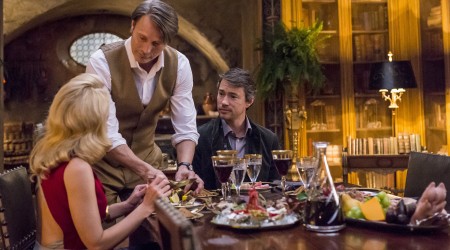
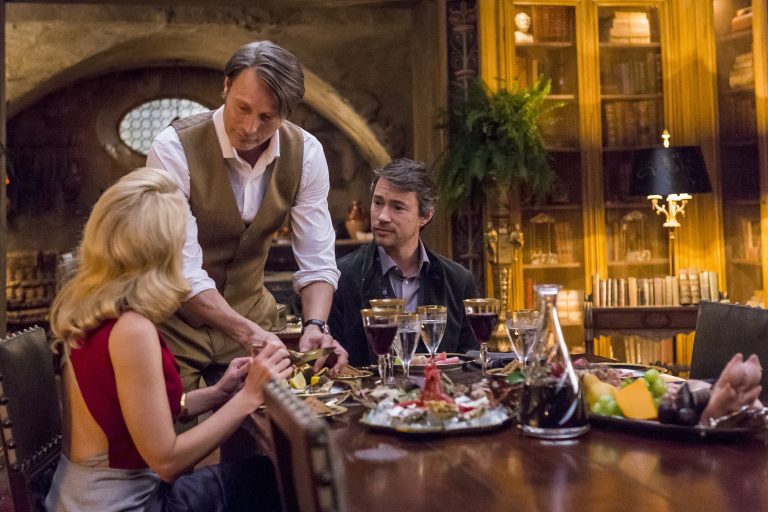
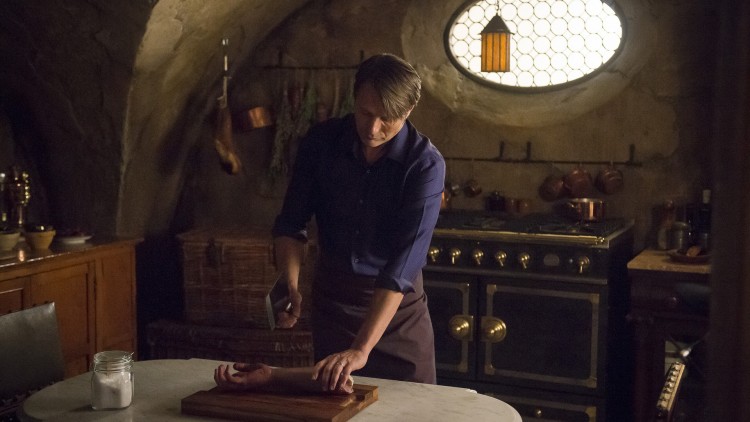
    hannibal aperIt’s a little odd yet fitting that “Aperitivo” is the fourth episode of the season. It’s odd because, in Italian dining, the aperitivo is the drink that precedes the meal; it’s meant to whet the appetite and to break the ice in social situations. It’s a precursor to not just to the main course, but the meal itself.

    Despite the fact that “Aperitivo” arrives three hours in to the meal that is Hannibal season three, it performs many of these functions. It (finally) connects the dots between the ending of season two and the events of the previous three episodes, and then it spends much of its time setting the table for the middle act of this season, which will bring us, one presumes, to the status quo of Red Dragon. With some minor deviations, of course.

    But for all of the (some might say overdue) explanations and resolutions “Aperitivo” offers, there’s no skating around the fact that it halts the momentum that Hannibal has so far achieved precisely by skipping past all that exposition. This episode is tracing its own steps for much of its running time, and, frankly, after three episodes, I’m more invested in what’s going on across the Atlantic.

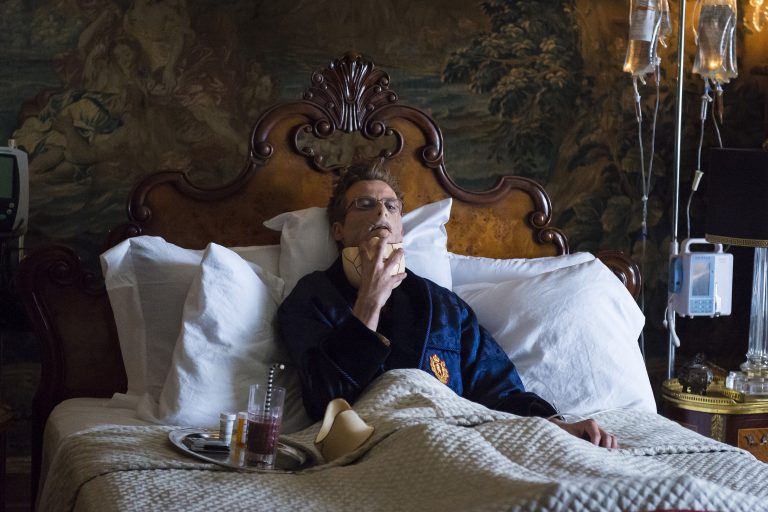
    Fortunately for us at home, even a somewhat disappointing episode of Hannibal is still better than most anything else on television, and “Aperitivo” is full of the little delights that we have come to expect. The opening scene between Chilton (who has cheated death again!) and Mason Verger is a master class in grotesquery, as they strip off their masks to reform the deformities with which Hannibal Lecter has left them. It’s one of the weirder scenes the show has done—which is saying something—that are full of weird sexual overtones that never quite resolve themselves.

    Weird sexual overtones persist into yet another reflection back on that night at Hannibal’s, though now we visit it in another new context, after Bedelia’s bombshell that, maybe, Hannibal is literally in love with Will. The constant flashing back may eventually become tiresome—maybe it already has—but I love that the show affords this sequence its proper weight. For all of these characters, this is the most fucked up night of their lives, bar none, and that impact is fully felt each time we revisit the scene from another perspective.

    It’s after these opening scenes that the episode begins to flag, if only a little. We see Will meet with Jack, prior to taking off to Europe to chase after Hannibal. He admits to Jack that he wanted Hannibal to run, and that he, in fact, wanted to go with him—so basically he almost found himself in exactly the same position in which Bedelia now finds herself. “Friendship with Hannibal is blackmail elevated to the level of love,” after all.

    We also catch up with Alana, who had her own flirtation with Hannibal in the previous season. Now, with a fancy new cane and an apparently murderous new attitude, she’s providing therapy to Mason Verger and also maybe convincing him to form a supervillain team with Chilton in order to get revenge on Hannibal. I don’t yet know what to make of this development in Alana’s character—she is so changed from the source material, where Alan Bloom is a minor character, and yet her development in the series so far has been so contingent on her relationship to the other characters that it’s hard to gauge how far she’s snapped, or if it’s even believable that she would. The jury is out here.

    Finally, we spend some actual quality time with Jack, as he finally decides to give Bella the peaceful death she desires. How much is his reasoning for this linked to his experience at Hannibal’s? It’s purposely vague. But Jack’s decision here is firmly entrenched in the context of the previous episodes this season. In the matter of Bella’s final days, is he observing or participating? (Hannibal sends him condolences because he is a giant prick.)

    The episode is slower than I’d like. It spends a lot of time connecting dots that the audience has already done intuitively, but it’s still necessary plot work. It’s understandable why Fuller and company waited until now to do it, too. If “Secondo” was a reflection on cause and effect, on the context for horror, then this hour is a reflection on grief, death, and on the aftermath of said horror. We see how Jack, Alana, and Will dealt with that immediate aftermath, and how they arrive at the point where Will is going at it alone in Lithuania. In the grand scheme of things, this episode is shoe leather, connective tissue between the ultra-arty thematic work that came before and the falling dominoes that are about to come. There’s nothing inherently wrong with that, but I’m glad to be past it nonetheless.


    Stray Observations

    • Outside of flashbacks and the note that Hannibal sends Jack, this is a Hannibal-free episode. This may or may not contribute to the perceived lack of momentum.
    • Also, how demented is that gorgeous dream sequence in which Will and Hannibal murder Jack at dinner? There is so much to unpack in that image, and I really hope that we revisit it as the season wears on.
    • Chilton copyrighted “Hannibal the Cannibal” because of course he did.
    • Hannibal may be taking over from Mad Men as the stealth funniest show on television. Lots of black humor in this episode.
    • “If my brother offers you chocolate? Politely refuse.”
    • “I’ve always enjoyed the word defenestration, and now I get to use it in casual conversation.”
    • Hannibal Revival Rumor Watch: Rumors all over the place this week. Hulu maybe wants the show but can’t have it because of Amazon’s contract, which Amazon may or may not make good on? And it might not matter at all because the show’s international backers might demand network involvement? Also, maybe A&E is interested? Look, if there’s more Hannibal to be had, I will watch it literally anywhere Bryan Fuller asks me to.
  • Hannibal Review: “Secondo” (3×03)

    Hannibal Review: “Secondo” (3×03)

    hannibal 3x03The secondo is the heaviest course of the Italian meal; it may include different sorts of meats or fish. Here’s the most interesting part: according to Wikipedia (I do a lot of hardcore research for these reviews, you know…) either the primo or the secondo may be considered more important, depending on the locality and the situation. Depending, in other words, on the context. “Secondo” is all about exploring that context. The question of which is more important in a continuing succession of pairs—cause and effect, Will and Hannibal, eater or eaten—is left to the viewer.

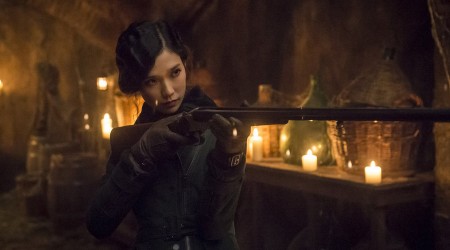
    Exploring the context of Hannibal Lecter means that we delve into Hannibal Rising, source material with which I am only glancingly familiar, by which I mean I am familiar with the fact that the source material blows and have therefore avoided it. Will visits the Lecter estate in Lithuania, which is a literal Dracula’s castle. The gothic nature of the setting is a perfect match for the visual aesthetic that Fuller has cultivated. Roughly the first half of Will’s time in Lithuania is extremely light on plot but heavy on creepy images and atmosphere, as he stalks Chiyoh, a mysterious woman hanging about the Lecter grounds who is keeping a prisoner.

    Meanwhile Hannibal and Bedelia continue their increasingly perverse game of house. They have Professor Sogliato over for dinner, and Hannibal casually murders him at the dinner table. Then he and Bedelia casually observe, trading barbs, as the man dies in a most darkly comic fashion, until Bedelia pulls the knife from his brain and spares him. . “That may have been impulsive” and “technically, you killed him” are both surprising laugh lines. In fact, throughout the episode, these two bicker with an unexpected humor.

    But the context is key. Bedelia is horrified by Hannibal’s actions, but only for a moment, until her horror is replaced by her fascination. “You are going to be caught,” she warns him. Later: “You’re drawing them to you, aren’t you?” She’s thoroughly chilling, and, moreover, she’s much more interested in understanding Hannibal than she should be—she’s fascinated by him. Consider context: what’s more important? Understanding the reason for Hannibal? Or understanding what he is and getting the hell out of dodge as quickly as your feet will carry you?

    The trap of understanding, of needing to find meaning, is one that Jack and Will and company have fallen into, and one into which Bedelia has more or less dived head first. In a way, Chiyoh is trapped, as well, though her trap is one of her own making. All roads, as always, lead to Hannibal, and soon the episode’s central question—the context it provides, the dichotomy it presents—is between Will and Hannibal. How alike are they? Who is crazy and who is sane? How should we even define the two extremes?

    It’s only fitting, then, that the writing and editing as the episode continues begins to interweave Hannibal and Will’s stories, showing us Will’s discovery of Hannibal’s past, as Hannibal shares a version of the same with Bedelia. The big reveal of the episode, insofar as Hannibal trades in big reveals, is that of Mischa, Hannibal’s young sister. But as Will says, “Mischa doesn’t explain Hannibal.” There is no easy explanation, no dot to connect. One or the other thing might be important; maybe cause, maybe effect. Maybe it doesn’t matter at all. “All sorrow can be borne, if you put them in a story.” Maybe the whole thing is trying to foist meaning onto a horror that has none; a man who kills and eats for the power it gives him over his victims. After all, we have Hannibal’s version of the same story: “Nothing happened to me. I happened.” Chiyoh’s version of the story is that her prisoner ate Mischa, which set Hannibal on his path. Bedelia catches on more quickly, as she asks Hannibal bluntly how Mischa tasted.

    It’s no accident that Bedelia sinks into that murky bath once again this week. This time as Hannibal shampoos her hair for her—he might as well be drowning her himself. But has Hannibal happened to Bedelia after all? Hasn’t she made, willingly, every decision that led her to this point? Is she not a participant after all?

    It seems that Will is. He frees Chiyoh’s prisoner, who summarily attempts to kill Chiyoh, forcing her to kill him instead. Chiyoh, at least, is sorry for what she has to do. Will isn’t. Hannibal was once curious whether Chiyoh would kill. Is Will equally curious? He strings up Chiyoh’s victim in a pose that would make Hannibal proud.

    I’ve filled this review with questions because the whole of “Secondo” is questions at its core. Even Jack gets in on the game, talking with the inspector about the nature of faith, understanding, and imagination. And yet Jack still has faith—still imagines—that Will understands Hannibal. That there is something there to be understood. That it isn’t all entropy, sliding slowly into pure chaos.

    “Secondo” is by far the best of this opening set of episodes. Visually, it is a fabulously murky episode. Everything in Lithuania is in dark blacks and blues. The very setting threatening to swallow Will and Chiyoh whole. Even the scenes in Hannibal’s stolen apartment are burnt orange, with none of the warmth that implies. The edits between scenes are slow dissolves, cross cuts, and fades in and out. Everything is of a piece; everything is of a design. Even if that design is a broken tea cup or a shattered bottle of wine. Narratively, the episode is the same; a fractured set of fairy tales and ponderings about the stories we tell ourselves and each other in order to bear the horrors we must live. It’s been a slow, purposeful start, but with the closing scenes of “Secondo,” the stage is set—sooner rather than later—for reckoning.


    Stray Observations:

    One of the episode’s neatest visual flourishes is the recurring, luxurious shots of snails. As Abel Gideon said so succinctly, “The snail doesn’t know it’s being eaten.” Hannibal sees everyone around him as snails, anyway, and maybe they are, for as susceptible to his machinations as they tend to be. Or maybe it’s that the knowledge of it doesn’t change their behavior.

    As an experiment, I am going to watch Hannibal Rising and see how it compares. (I expect the answer will be “not favorably,” but my expectations are nil anyway.)

    I try not to put too much weight on the previews, as the marketing monkeys responsible at NBC know how to twist and contort any episode beyond recognition. (RIP Parenthood.) But YO NEXT WEEK LOOKS SO GREAT.

    Well, as you all have learned by now, NBC has not renewed Hannibal for a fourth season. I’m not going to eulogize the show just yet because I’m pretty confident that some online streaming service or another will resurrect it for at least one more go. It remains to be seen whether that would even be worth it, given the difficulty with getting the rights for Silence of the Lambs and considering that the end of Red Dragon is a fine stopping point for the characters we’ve come to know. As much as I’ll miss Hannibal should this be the last season, you can’t really blame NBC for this one. They’ve given the show more than a chance against pretty much all reason.


  • Hannibal Review: “Primavera” (3×02)

    Hannibal Review: “Primavera” (3×02)

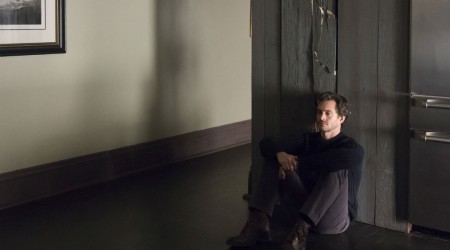
    hannibalAfter totally neglecting the cliffhanger ending of its second season, this week Hannibal brings us up to speed—at least somewhat—reacquainting us with Will Graham after what’s revealed to be a six month gap since that hellish night at Hannibal Lecter’s house. But first, “Primavera” takes us all the way back to that night, presenting the final moments of season two in the new context of this third season. At the time, it was a tragic crescendo, a cacophony of destruction raining down upon our heroes; now, the scene is framed as a tragic echo. Hannibal recalls the loss of the man who was his one, true friend. “Fate and circumstance have returned us to this moment,” Hannibal says, then and now. The stag lies dead, too. An ocean of blood spilling from it and drowning Will. The teacup shatters, again, only to reconstruct itself as Will awakens in hospital.

    Yes, the first several minutes of “Primavera” are composed of scenes we’ve already seen, but the new context they are afforded in following “Antipasto” is invaluable. They’re also no less gorgeous than they were the first time around—with a monochromatic grey that is shot through with deep, red blood, spurting in geysers and flooding the frame around the characters. The teacup, shattering is such a vital, recurring image throughout the previous season, reassembles itself here once more. This suggests something of Will’s mental state and sets up the dream logic that dictates much of the episode to follow.

    “Primavera” only slowly reveals its true nature. We should know better. After all, we are, by this point, more than familiar with Will Graham as an unreliable narrator. When a silhouette that might be Alana Bloom’s turns out instead to be that of Abigail Hobbs, it should be an obvious trick. And yet, somehow, it’s not. It helps that Abigail has cheated death on this show before; and the parallel of the relationship between Hannibal and Bedelia to that between Will and Abigail is intriguing enough to justify her giving death the slip one more time.

    But as the episode unfolds, much of Will’s reality comes into question. “Primavera” plays out like some sort of lurid fever dream, chiefly concerned with putting Hannibal and Will’s relationship in new relief (in light of what each views as the betrayal of the other) and exploring the past that Hannibal has attempted to abandon, whether it’s his crimes of the distant past (as the historical Il Mostro) or his more recent abuses toward Will and company.

    As with “Antipasto,” the very best thing about Hannibal this week is its utter indifference to the conventions of plot and narrative. In bucking what would be expected of the early season here, Hannibal presents an infinitely more exciting narrative instead. The show is doling out its familiar characters and rhythms only very slowly, and, for the most part, these have been abandoned or transformed beyond recognition. We are thrown one familiar bone, as Will investigates a murder committed by Hannibal Lecter, but rather than alongside Jack and Alana, he’s with Detective Pazzi and an imagined Abigail. We are robbed even of the pendulum swing that normally signals Will’s practiced use of his empathic abilities.

    And then there is the extended finale sequence, which is a master class in visual storytelling. It begins with Will’s study of the corpse Hannibal has left for him. Is it a gift? A trail of breadcrumbs? A warning? Or, perhaps, as is often the case, it is at once all and none of these. What it becomes for Will is a nightmare revisited, as the stag that was slain is reborn, in gloriously grotesque fashion, before his eyes, and in a church, of all places. The effects work here is excellent, and the way the corpse bends and breaks itself is a horrifying sight for Will and the audience alike.

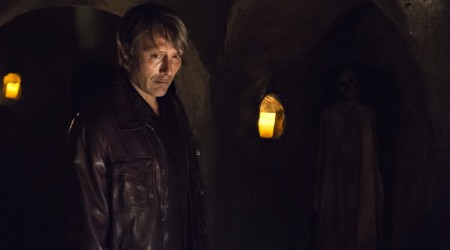
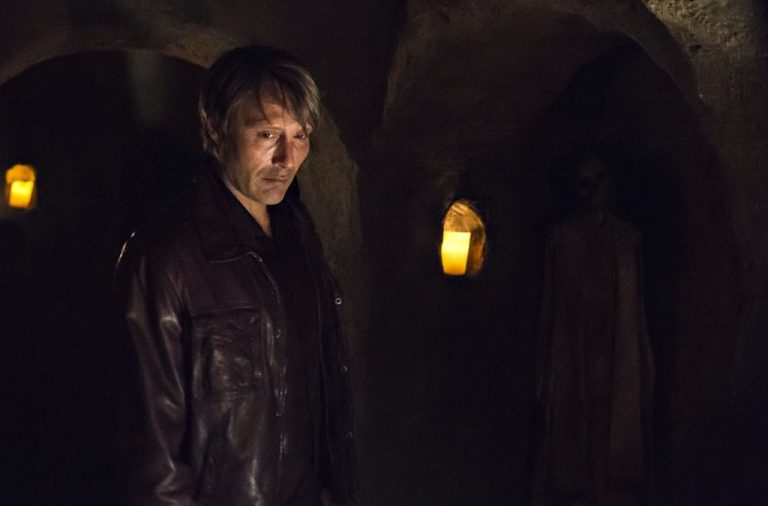
    And so, with Moby Dick newly revealed to his Ahab, Will hunts through the catacombs beneath the church, certain that he has caught a glimpse of Hannibal, and that he is somewhere here, lurking in wait. This is, of course, a gorgeous sequence, but is also delightfully tense, even as it serves the sole purpose of marking time as the surviving cast slowly assembles in Italy to finally bring Hannibal to justice. What excellent camerawork throughout. Hannibal is nowhere, yet he is around each corner. And then he is there, looking for all the world like Bela Lugosi or Christopher Lee. He and Will have several near misses. In fact, they may be nowhere near each other, as the episode never feels more dreamlike than it does in this sequence, and Hannibal and Will each fade in and out of the murky shadow in tandem. Will’s whispered, “I forgive you,” so reminiscent of Bedelia’s still-stunning “I believe you,” may be whispered to thin air—though it certainly seems as though Hannibal is there to hear him, after all.

    “Primavera” presents in may ways the first part of a long mystery narrative. The final manhunt for Hannibal Lecter, and it’s impossible, at this stage, to know what is real and what is not or who is real and who is not. Good and evil, like observation and participation, are obfuscated to the point of meaninglessness. In other words, we are right where Hannibal and Hannibal wants us to be.


    Stray Observations:

    • The show pretty unambiguously names Hannibal as the real-life serial killer Il Mostro, a tack that the novel and the film Hannibal  (in deleted scenes) hinted at, as well.
    • There is continued, overt discussion of religion in this episode. The idea of evil as the Devil-with-a-capital-D or, alternatively, of playing God, has always been on the fringes. Just last week, Abel Gideon called Hannibal the literal Devil.
    • What an awful last year of life Abigail Hobbs lived, when you think about it.
    • The title isn’t as structurally clever as “Antipasto”, which is disappointing—instead, it references Botticelli’s painting of the same name.


  • Album Review: “Grand Romantic” – Nate Ruess

    Album Review: “Grand Romantic” – Nate Ruess

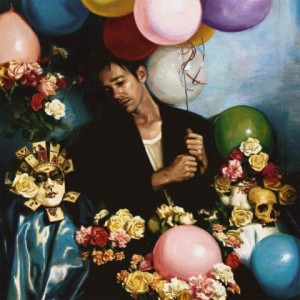
    nate ruess grand romantic

    There was a lot of anticipation leading up to the release of Nate Ruess’s first full-length solo album Grand Romantic. The singer/songwriter has been critically received for his work in both Fun (stylized fun) and The Format since the early 2000s. However, it was the mainstream success of Fun’s 2011 track “We Are Young” that launched Ruess into superstardom. He even accompanied P!nk in her 2012 hit “Just Give Me a Reason.” In fact, this year Ruess made appearances on The Voice (as a guest judge) and Brian Wilson’s Pier Pressure (as a guest vocalist). It is evident that Nate Ruess has rapidly and inconspicuously climbed the ladder of pop music success, and I have been there watching his ascent.

    The announcement of a solo Ruess album was coupled with a brand spanking new track called “Nothing Without Love.” This beast of a song blasted with a prideful roar, and my ears reveled in auditory bliss. It was climactic. It was self-exploratory. It was catchy. But, most importantly, it was fun, and I don’t mean Fun. Ruess aimed and ignited with an aural explosion that felt completely new. This was neither Fun nor Format. “Nothing Without Love” was Nate Ruess—a pure and distinctive sound that managed to bridge the gap between familiarity and novelty. “If a full album of this is what I can expect, then bring it on, baby!” I was hyped beyond belief.

    Ruess continued to drop three more singles leading up to the release of Grand Romantic (“AhHa,” “Great Big Storm,” and “What This World Is Coming To”). These three tracks definitely scored a lot of replays on my Spotify, but they couldn’t quite match the sheer glory of “Nothing Without Love.” I was concerned. Maybe this album won’t be as nuclear as I thought it would be. Sure enough, I was right.

    You know how they say movie previews are misleading because they only showcase the best parts? Previews are designed to make even Grown Ups 2 look like something that’s worth your time. Well, the four singles off Grand Romantic functioned very much like a misleading movie preview. They set the scene for a grandiose epic of an album but failed to address the forgettable tracks smacked in the middle. Coming right at the introduction of the album (the properly titled “Grand Romantic – Intro”), there’s an immediate sense of disappointment. Remember the intro to Some Nights? If you don’t, please give it a listen. It’s an operatic symphony of a track that immerses the listener right away. The Grand Romantic opener is nothing like that. It’s an incoherent 45 seconds of flat choral harmonies matched with strange filtered voices in the background. There is a theme of unfulfilled potential that is established here for the rest of the album.

    Oh, and speaking of themes, let’s have at it, eh? Grand Romantic does not try to hide its core subject matter here. It’s love. Love up and down, and all around. But more specifically, we’re looking into the heart and psyche of a hopeless fairytale lover boy, lost in a postmodern world of superficiality and disconnectedness. It’s written all over the lyrics in these songs. From “Take It Back” (“Well, we’re just two lost ships passing through the night / Two lost lonely people inside”) to “Moment” (“I need a moment / I’m alright here on the floor / Well, I’m fine / I just need a moment to cry”). The same ideas manifest themselves in almost every track.

    nate ruess grand romanticThe problem is that these lines find themselves trapped in a series of overproduced, forgettable ballads that more or less blend into one another. This is a shame because it is possible (and probable) that the lyrics in Grand Romantic are coming from a genuine place. After all, Ruess has never been one to waste words or lose sight of the power of language. But the sappy instrumentation on some of these tracks makes the lyrics lose whatever shine they may have had otherwise.

    I think about Fun’s song “The Gambler,” and how raw and evocative it was. It had minimalistic instrumentation because the song wanted the listener to focus full attention on the lyrics. They tell the story of a couple growing old together, fighting through sickness “’til they decide it’s [their] time.” It’s obvious that there is something profound and meaningful here. It’s poetry–pure and simple. The lyrics on Grand Romantic are more of a far cry from that. Plus, they aren’t even catchy to begin with. The vocals are ripe with strange inflections and sustained notes that make even Ruess’s poised and polished voice sound harsh and disjointed (see “It Only Gets Much Worse” and “You Light My Fire”). It almost sounds like Ruess is doing this to show off his vocal range rather than to communicate sincere emotion. The sound comes across as artificial–as if the words are coming from Ruess’s diaphragm and not his heart.

    That’s not to say we’re looking at a bad album here. We’re not. But there is certainly an expectation that goes into an album like this–a breakthrough solo record brought to you by the same man who gave us Fun and The Format. These two acts have delivered some of my favorite songs and albums of all time, so I was beyond pumped to hear what their frontman had to say solo. But, alas, Grand Romantic didn’t deliver the epic musical voyage I was half hoping (half-expecting) it to be. Grand Romantic is, first and foremost, an album of unfulfilled potential–from the intro moving forward.


    Oh well, at least there’s always “Nothing Without Love.”

  • Album Review: “Big People” – Max Gowan

    Album Review: “Big People” – Max Gowan

    album review max gown big people

    I’m not going to lie, I didn’t have the highest expectations for Max Gowan’”Big People.” He’s an 18-year-old singer-songwriter who recorded and produced the record mostly by himself in his room. However, after my first listen through, one thing is clear. Max Gowan has something going for him. From his gorgeous use of lo-fi to the innocence of youth in his ernest lyrics, it’s a record that sounds so much more mature than his age.

    There’s a charm to lo-fi when it’s used properly. Happyness perfected it with their debut “Weird Little Birthday,” and this is where I’m going to draw a lot of comparisons. Gowan isn’t wordy. He’s not trying to reach something terribly profound with his lyrics. He’s honest. Whether he’s drawing from his life experiences or is simply creating these emotions is lost on me, but what I do know is that his calming vocals compliment the often folk-influenced music and somewhat soft angst that run as a theme through the album.

    That lyrical theme is evident in album opener “Rare Thing,” which is one of the strongest songs on the record, when Gowan sings, “I thought I saw a tragic streak of luck and ingenuity / It flashed across your filtered screen / it’s gone again cause it’s a rare thing.”

    The album takes off in the second half with a slew of strong entries like “Big People,” “Here (Part 1),” and “Open Letter to Heaven.” “Snow,” which feels like a partner to the album closer, is a standout track. It has a light feeling that begets itself to both a song to chill or jam to.

    However, where the album shows Gowan’s true potential is in the album closer “Everything Is Cool.” It’s easily the best song on the record. The faint influence of surf rock with lyrics that really tap into the life of a teenager living in the suburbs feels a lot like early Real Estate, which is one of the greatest compliments a writer from New Jersey (ahem… me) can give. It’s basically the anthem of the album that ties it together. It’s the discontent of a teenager. It’s not overly contemptuous towards life—it’s real. That’s what takes the album out of the realm of “good for what it is” and moves it to just plain good.

    For me, the weakest part of the record is the production. Lo-fi is hard to get right. A few bands have in my opinion. There’s Brooklyn’s violent pop group Sharpless, chillwave band Bellows, and, of course, Happyness. With the fuzziness of the music and muffles of the guitars, I would have liked the vocals to be buried a little bit more to give it all a grittier sound. However, that’s just nitpicking at this point.

    It’s a very confident debut. Those two words aren’t often paired together. For a 12-track LP that didn’t have the support that a lot of albums have, it’s truly a remarkable achievement. Can he improve? Of course he can. Nonetheless, at this age with this talent Max Gowan is going to make a name for himself. You mark my words.

    You can purchase “Big People” for any price over on Bandcamp.

  • 2014 Emmy Predictions: Drama Series

    2014 Emmy Predictions: Drama Series

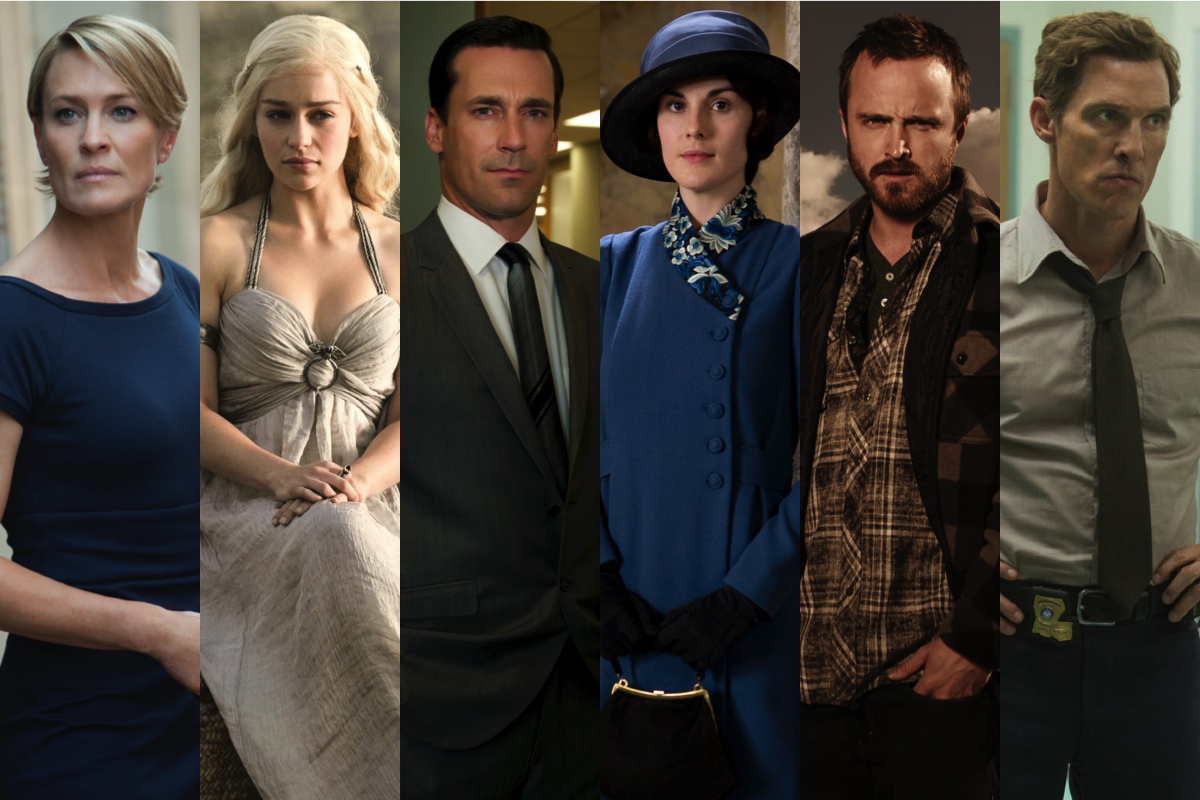
    Drama Series is pretty much done for me. A lot of people are going to say True Detective can win, Game of Thrones can win, House of Cards can win, but Breaking Bad will win.

    Although my confidence was a bit shaken when True Detective hauled in 4 awards at the Creative Arts Emmys, I still believe Breaking Bad is close to a lock. It hasn’t shown many signs of strength thus far, but it also hasn’t shown any signs of weakness. It again won Picture Editing as it did last year, but most pundits expected the show to win most of its awards at the main ceremony. With the powerful buzz around the final season, its increase in nominations, and nominations in key categories give Breaking Bad all it needs to pull off a win.

    If there was an alternative, it would be True Detective. Before the Creative Arts Emmys, I would have said that House of Cards was the alternate choice. It is probably one of the biggest cultural phenomenons since Breaking Bad went off air and it received surprise nominations in the guest and writing categories. However, following its already impressive success, True Detective is the clear alternative.

    [maxbutton id=”3″]

    1. Breaking Bad
    2. True Detective
    3. Game of Thrones
    4. House of Cards
    5. Mad Men
    6. Downton Abbey

  • Hannibal Review: “Antipasto” (3×01)

    Hannibal Review: “Antipasto” (3×01)

    antipasto hannibal review

    What I love best about the titling scheme Bryan Fuller has chosen for Hannibal—this season, each episode is named after an Italian course; the previous seasons were French and Japanese, respectively—is how it at once constitutes gimmickry and structural importance. Not every episode is perfectly aligned with its title, but many come pretty close. “Antipasto” is such an episode. It’s a peculiar episode. There is not even the remotest doubt that Will, Jack, and Alana survived the bloodshed of season two’s finale (not least, their names are in the credits), and so, assuming that its audience is not necessarily on pincushions waiting to find out what’s happened to them, “Antipasto” is instead thoroughly unconcerned in addressing the cliffhanger at all. This serves to generate considerably more suspense than the cliffhanger itself, such as it was, ever did. We are launched several months into the future, and our first glimpse of Will and company doesn’t come until the preview for next week. The question becomes not if they survived, but how on earth they managed it.

    Imagine an alternate premiere, a perfunctory episode of television that picks up right where we left off and doles out, piece by piece, the process that brought our maimed heroes back to life. It’s boring, and moreover, it’s uncharacteristic of Hannibal as a series. What a relief, then, to see in “Antipasto” that Bryan Fuller retains a full understanding of the sort of show he’s making, and how that sort of show works. Very little actually happens in “Antipasto”, and yet every second is engrossing; every shot, every frame, is dense with meaning. This is a show that begs to be savored.

    The episode wastes no time throwing us right back into the stylized glory that is Bryan Fuller’s vision of the Hannibal Lecter story. When we meet Hannibal in the season premiere, he is wandering around a party, floating adrift from frame to frame. He is newly unknown, freed not just from the weight of the Chesapeake Ripper, but freed from the reputation of Hannibal Lecter himself. Not that he doesn’t fall quickly into old habits. A new name and a new companion don’t change the fundamental aspects of his character.

    So Hannibal and Bedelia are trotting around the continent, stealing identities and living perfectly frivolous lives among the French, then Italian elite. One of their acquaintances happens upon in both countries, and twigs to their scheme. Suddenly Hannibal falls into the cat and mouse rhythm he developed so thoroughly with Will. Meanwhile, Bedelia du Maurier spends the episode becoming increasingly unraveled, despite her deceptively cool exterior. Gillian Anderson plays her as a reckless, curious woman, in way over her head (and she plays her brilliantly, at that. I have never been happier with opening credits than to see Gillian Anderson’s name added to this week’s).

    The episode climaxes (or perhaps, the antipasto cleared away, and the main course glimpsed) when, suddenly, Hannibal is bludgeoning his new friend to death, just as Bedelia tries to run away. Is she observing or participating? Hannibal asks this question of her implicitly throughout the episode, and explicitly here, as he calmly murders the poor man, and Bedelia looks down helplessly as he deconstructs her carefully considered rationalization. She has been participating all along; passivity is not an excuse. The game of cat and mouse has been with her all along.

    The relationship between Hannibal and Bedelia is fascinating, giving the episode a driving energy that more than serves in the absence of the show’s typical characters and rhythms. Her interest in him darts back and forth from intrigue to wariness. She discusses his murderous, cannibalistic habits frankly, not as scared of them as she should be—and that is what scares her most. There are many shots of blood flowing in “Antipasto”, being washed off the bodies of our intrepid Eurotrippers, or dripping off the corpse of a freshly killed rabbit hanging from a butcher shop. But there is no washing away the blood they’ve spilt. There’s no getting around the fact that Hannibal is, as Abel Gideon says tonight in flashback, truly the devil. He has an uncanny gift for brining out the worst in all around him, and Bedelia is no exception, as much as she’d like to think he is. The phrase “professional curiosity” comes about again; before this was the rationalization Alana used to justify her interest in Will Graham. Yet another parallel is drawn.

    The story, then, is excellent, a brilliant first course as we set the stage for, at last, the adaptation of Red Dragon proper. But as always the real main course here is the visual experience. The episode’s pace is deliberately languorous, as Fuller chooses instead to immerse us, slowly, in the new lives that Hannibal and Bedelia have established for themselves. As he does so, he lets us sink slowly back into the cinematography, the visual rules and motifs that govern Hannibal’s cinematic language. “Ethics become aesthetics,” Hannibal and Bedelia conclude in their philosophical exchange. No longer is the show interested, necessarily, in portraying Hannibal’s crimes as murders, as evil. That’s for granted now; now, the interest lies in portraying the nature of evil.

    There is of course the recurring visual of blood running, dripping, splashing, but there are a few other choice shots as well. For instance there is a striking contrast between the composed formality not just of Hannibal as a character, but of the settings and the framings that contains him, and the brutality with which he mains and murders. As the camera moves and wavers in the open sequence, it will be interesting to watch if the formal aspects of the show become increasingly unhinged as Hannibal does the same.

    There are also some black and white flashbacks with Abel Gideon, that serve to paint Hannibal’s previous life in a different, separate light. But the shot of the episode this week is the sequence of Bedelia, slowly sinking into the black murk of her bath, the depth of which for a moment becomes that of an ocean. What a stunning visual representation of her journey. Fuller describes this season in various interviews as a trashy ‘80s art film, and he’s not wrong; I just think his modesty oversells exactly what he’s managed to achieve. Hannibal is arguably one of the greatest dramas on the air, period, but it is inarguably the best-looking show on television right now.

    “Antipasto” is slow and atmospheric, setting the table for the rest of the season, and doing just enough to whet its audience’s collective appetite. In other words it does just what it’s meant to. Bring on the next course.

    Stray Observations:

    • “Antipasto” is also, for me, a bit of a palate cleanser. I’m thrilled to be writing about this amazing show, and I’m looking forward to being a sight more positive than I got to be about Scandal and American Horror Story. (I hope I haven’t jinxed it.)
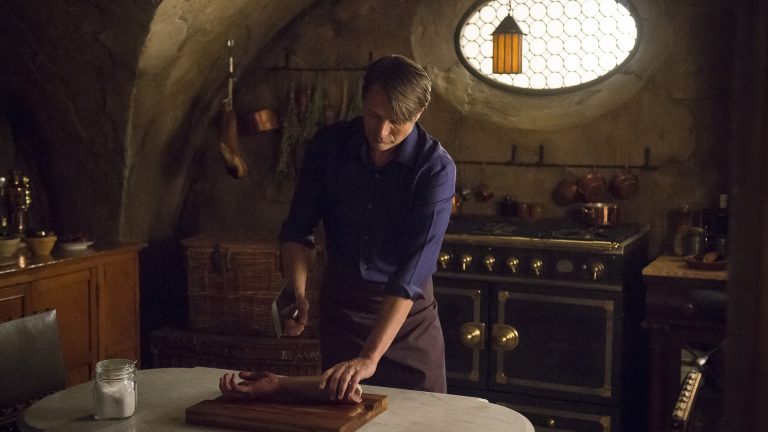
    • As always, the greatest guilty pleasure of Hannibal is THE FOOD. Every dish looks magnificently appetizing—even the dishes that we know for a fact are people. It is this show’s greatest trick.
    • Yo, how insane was season two of Hannibal? That previously on is just a mashup of crazy shit.
  • Musical Review: “Something Rotten!”

    Musical Review: “Something Rotten!”

    Something Rotten!
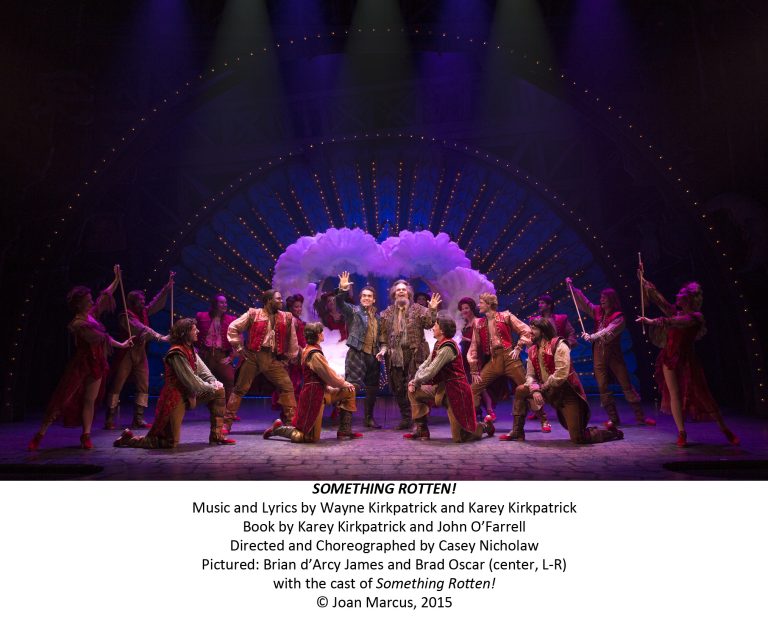
    Hear Ye! Hear Ye! A joyous noise emanates from the St. James Theatre. It’s the sound of uncontrollable laughter and applause. A guaranteed side effect of the funniest Broadway musical in years.

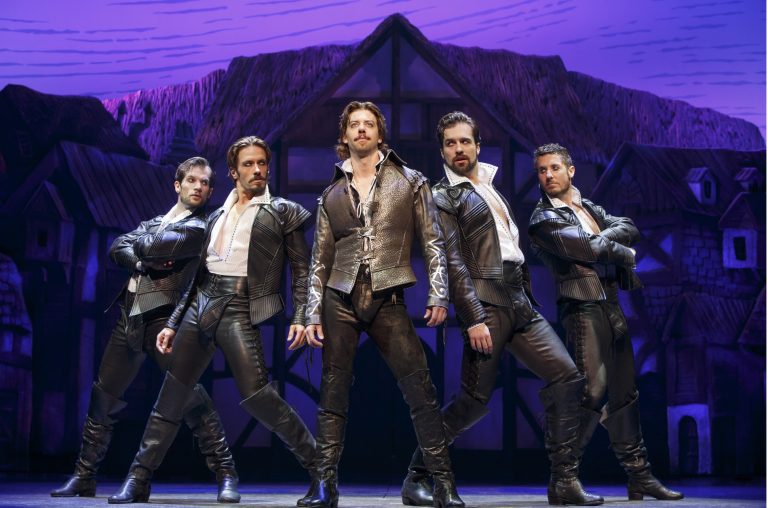
    It’s obvious one has stumbled across something special from the opening moment of Something Rotten!. A minstrel (Michael James Scott, in glorious voice) sings and dances through “Welcome to the Renaissance”. Accompanied by a superb sounding ensemble, the performers detail the new cultural and industrial advancements of the era.

    The setting might be old, but the music by Wayne and Karey Kirkpatrick contrasts with contemporary pop sensibilities, to comedic effect. The costume design from Gregg Barnes features elaborate splashes of color and pizzazz, and Scott Pask’s impressive set conjures signature scenic elements of past Broadway hits. The buoyant opening number ends with a thunderous wall of sound from the singers and the audience responds with rapturous applause. I was all smiles and I was completely hooked.

    The story centers on Nick Bottom (Brian d’Arcy James), a struggling London playwright who constantly feels overshadowed and outdone by Shakespeare (Christian Borle). Nick and his brother Nigel (John Cariani) are in the middle of staging their new show “Richard II” when word arrives that Shakespeare has beat them to the punch. The brothers’ wealthy patron pulls funding and shuts down the play. To make matters worse, Nick’s dutiful wife Bea (Heidi Blickenstaff) reveals she is pregnant. With no income and a family on the way, Nick panics and struggles to find a new idea for a play.

    Nick’s grand scheme involves paying a soothsayer to look into the future and find Shakespeare’s most successful play…and then write and produce it before the Bard gets the chance. The wonderfully zany Brad Oscar, as soothsayer Nostradamus, has been gifted with the showstopper of the season with “A Musical”. As he looks into theatre’s future, Nostradamus discovers an exciting new development: musicals.

    The Kirkpatrick brothers pull out all the stops with witty wordplay and an endless parade of Broadway references. The result is a hysterical, physical performance from Mr. Oscar as he lampoons landmark musicals across Broadway history. No tuner leaves unscathed, from the high-pitched Annie interlude (complete with buckets) to pondering the pointlessness of dance breaks (“Does it further the plot?” “No …it’s entertaining!”).

    Hamlet (Or “Omlette” as Nostradamus misinterprets) is the future hit that Nick chooses to put to song and finally top Shakespeare. And so the first musical is born. To detail the various ways in which he gets the famous story wrong would be to spoil the best jokes in the book. The Kirkpatrick brothers have taken a page out of Mel Brooks’ playbook and written a humorous, winking love letter to Broadway. The ending might feel a bit cliché, but the show is ultimately more about the fun journey than the destination.

    Director/Choreographer Casey Nicholaw has a lot of fun incorporating familiar pastiche into the energetic choreography. He also knows how to coax winning performances from the talented cast, as all the characters instantly pop off the stage from their first lines.

    Christian Borle is having a ball, evoking Tim Curry from his Rocky Horror days, with a preening and self-absorbed take on Shakespeare. Brooks Ashmanskas turns a thinly written Puritan character (Brother Jeremiah) into a meal of a part, transforming some of the book’s weaker jokes into satisfying one liners and fabulous stage exits. John Cariani displays a tender falsetto as Nigel Bottom. His neurotic physicality and sheer awkwardness around the woman he admires provide endless laughs.

    Speaking of women, they are criminally underutilized in this boys club. After hearing Heidi Blickenstaff’s soaring voice on “Right Hand Man”, I wanted more of this feisty woman (her only recurring plot involves her dressing in male drag to attain work). Kate Reindeers is also sublime as Nigel’s love interest (Portia, the Puritan’s daughter of course). It’s great fun watching her explore “sinful” readings of her favorite sonnets and plays. You shouldn’t get used to seeing either lady on stage much, but you’ll welcome their limited presence.

    The night really belongs to Brian d’Arcy James. The actor shows us why he is one of the best leading men of Broadway, with killer vocal chops and a grounded performance that holds up against the flashy characters surrounding him. And while he gets some fun showcases, I was really craving a big 11 o’clock “I want” number where James could truly let loose. Still, Nick Bottom is an engaging protagonist. I rooted for him during disastrous mistakes and through to eventual reconciliation.

    Even if you don’t recognize the various Shakespeare quotes or the subtle Pippin reference, this musical is a joy to behold. What’s most impressive is that we’ve seen this audacious, referential humor all before, but we’ve rarely seen it done so well. From the stellar cast to the dancing eggs (did I mention there are dancing eggs?), this is shameless, outrageous musical comedy at its best.

    Something Rotten!
    St. James Theatre
    246 West 44th Street, Manhattan
    Music and Lyrics: Wayne and Karey Kirkpatrick
    Book: Karey Kirkpatrick and John O’Farrell
    Directed and Choreographed by: Casey Nicholaw
    Starring: Brian d’Arcy James, Christian Borle, John Cariani, Heidi Blickenstaff, Brad Oscar,& Kate Reindeers
    Run Time: 2 Hours and 20 Minutes, including one intermission

  • Play Review: “The Curious Incident of the Dog in the Night-Time”

    Play Review: “The Curious Incident of the Dog in the Night-Time”


    the curious incident of the dog in the night-time

    Tony Nominations are still months away, but I will be extremely surprised if The Curious Incident of the Dog in the Night-Time is not cited a number of times on nomination morning. If even a small part of you is a theatre fan, this new play at the Barrymore Theatre is essential viewing this season.

    An Olivier winning production from the National Theatre in London, Curious Incident is based on the novel by Mark Haddon. The play, adapted by Simon Stephens, follows the same story about a young boy on the autism spectrum. The production opens with this boy, Christopher (Alex Sharp), happening upon a ghastly scene: the neighbor’s beloved dog has been murdered. Impaled by a gardening fork to be exact.  Things get more troubled when his father (Ian Barford) informs the boy his mother has died suddenly. Despite insistence that he stay out of other people’s business, Christopher sets out to find the dog’s killer himself.

    Christopher’s detective work unearths secrets from his parents and neighbors. The beauty of the story is how he is able to overcome any obstacle he faces with his frequent sensory overloads. Instead, he learns how to use his brilliant mind to not only solve the case, but deal with the harsher realities of the adult world.

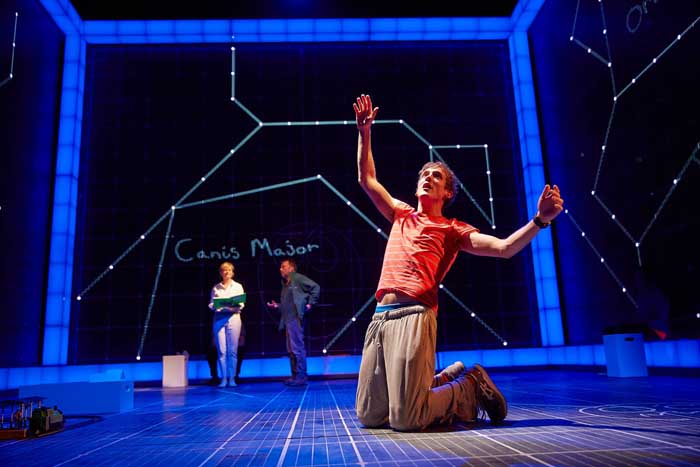
    In one of the most intriguing bits of stage presentation to hit Broadway in quite some time, the stage itself often represents that very brilliant mind. Scenic designer Bunny Christie has crafted a set consisting of four panels (three walls and a floor) each with a grid like design. The grid and walls constantly spring to life, mimicking the machinations of Christopher’s mind, with assistance by Paule Constable’s lighting design and Finn Ross’ brilliant video projection work. Sometimes, it’s a simple outline of houses as Christopher walks down his street. Other times he is surrounded by a cacophony of numbers or words as sights and sounds bombard him. Oftentimes the effect is at once both glorious and terrifying.

    The innovation in the production has director Marianne Elliott and choreographers Scott Graham and Steven Hoggett to thank. This creative team hurls the actors across the stage in an intensely physical production. The staging hovers somewhere between an experimental movement piece and full blown dance. The choreography plays with slowed time, patterns, and using people as props to climb on (and at one point has Christopher literally climbing the walls). It’s all in aide of showcasing how Christopher sees the world.

    Ms. Elliott directs each scene honestly and manages to find humor even in the darkest moments. Nothing feels forced here. It’s refreshing that in a production heavy with visual spectacle, the performances are so specific and honest.

    Most of the ensemble members get chances to shine as several different colorful characters. Enid Graham does beautiful work as Christopher’s mother. She displays a deep well of emotion and can play brutal and angelic all at once. Ian Barford is tremendous as a father doing his best to care for a child whom he continually struggles to connect with. His balancing act of rage and tenderness towards Christopher provides some of the emotional high points of the story.

    It is Alex Sharp who sells the whole thing. The recent Julliard graduate could not have asked for a better start to his career. His portrayal of someone on the spectrum never veers into caricature or imitation. He’s a math genius with a love of computers and space. He screams when anyone touches him. He rifles off lists of statistics and thoughts as we see his mind working one thousand miles per minute. Most importantly he grounds the spectacle in a brutally honest performance.

    If there is one aspect where the script falters it is in the second act narrative device. Francesca Faridany portrays a special needs teacher to Christopher. While the talented actress is a welcome addition to the cast, serving as a waypoint between the audience and her student, the second act takes it to a more meta level when she announces they are all just performing in a play based on Christopher’s writing. The shift in tone is too abrupt and sort of unnecessary given the slew of other narrative devices to keep the audience at safe distance.

    Minor gripes aside, The Curious Incident of the Dog in the Night-Time is an astounding achievement in storytelling. It’s a prime example of performance and stagecraft syncing up harmoniously for a gripping night at the theatre.

    The Curious Incident of the Dog in the Night-Time
    Ethel Barrymore Theatre
    243 West 47th Street, Manhattan
    Written by: Simon Stevens, based on the novel by: Mark Haddon
    Directed by: Marianne Elliott
    Starring: Alex Sharp, Francesca Faridany, Ian Barford, Enid Graham, and Helen Carey.
    Taylor Trensch plays Christopher on Wednesday evenings and Sunday matinees

  • Broadway Review: “Constellations”

    Broadway Review: “Constellations”

    Constellations broadway review

    Have you ever wondered about the paths in life you chose not to take? What would your life be like if you didn’t take that job, if you mustered the courage to flirt with the guy on the subway, if you moved to another state? In Nick Payne’s short but haunting “Constellations”, two actors bring all the possibilities of their relationship to life.

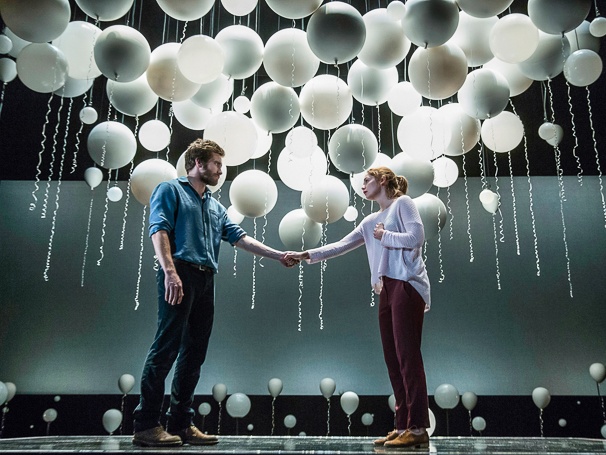
    Performed with no set, props, or costume changes, “Constellations” is the story (or should I say: stories) of Roland (Jake Gyllenhaal) and Marianne (Ruth Wilson). The play takes place across the multiverse, and flings the couple through space and time to explore the multitude of paths their lives could take. There is some scientific talk about the infinite universes that exist for every possible choice we make (Marianne is a physicist), but there’s no need to master high concepts to enjoy the play.

    We start with a scene at a party where the two first meet. The song and dance of their flirtations repeats several times with different outcomes. In one version of the scene, the seduction is unsuccessful and the story ends abruptly. Other replays show the pair getting to know one another, discussing their passions, and ultimately going home together. There are about six total scenes that get replayed to show the various routes the couple may take.

    I don’t mean to make you think you’ll be watching the same boring thing over and over again. Nick Payne has crafted some snappy and naturalistic dialogue for each variation. The script puts more weight on the journey than the destination of each scene. I sat fascinated as I watched how a single changed line or intonation altered a scene in dramatic fashion.

    This style certainly puts the focus on the actors, and Gyllenhaal and Wilson do not disappoint. Both of the catapult through emotions on a dime, as the variations switch from comical to heartbreaking. It is most impressive watching the pair find new tactics on each repeat. I could have watched Gyllenhaal’s marriage proposal attempts for hours, watching him with suave confidence one minute and paralyzing fear the next. Ruth Wilson is a brilliant physical performer, and displays comedic timing fans of hers from “The Affair” wouldn’t see otherwise. But it’s in a particularly brutal development at the plays end where she shines brightest. You won’t be able to take your eyes off her.

    Director Michael Longhurst succeeds at keeping all these realities clear in the minds of the audience. It’s an impressive feat considering the sometimes breakneck pacing. In a snap, actors change position and demeanor and hurl themselves into a new world. Some striking lighting work from Lee Curran, surrounding the playing space with illuminated balloons, helps to delineate the various universes.

    In just over one hour, you will watch the couple flirt, fight, dance, cheat, break up, and brave impossible struggles together. Payne allows Roland and Marianne to grow closer in each scene, and as a result, the audience grows closer to them as well. By the time the evening is over, I was completely enthralled and invested in both characters as if I knew them personally. Each and every version of them.

  • Play Review: “Skylight”

    Play Review: “Skylight”

    SkylightWhen David Hare’s Skylight premiered at the end of the Thatcher era in Britain, it surely struck a nerve with audiences. A play that intertwines politics and passion via two ex-lovers, the political ideology is still as sharp as ever even though the play has dated itself.

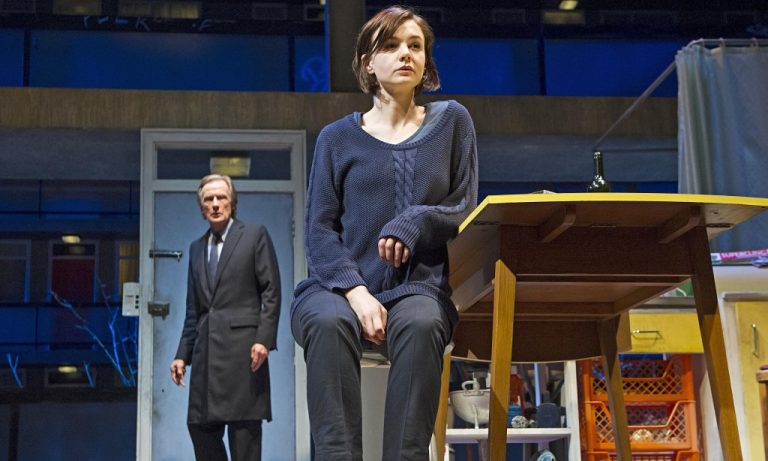
    In this first ever revival, Bill Nighy and Carey Mulligan portray Tom and Kyra. Set entirely in Kyra’s dingy flat (beautifully designed by Bob Crowley to feel cramped but homey), Tom bursts in one night after years of not speaking to his former flame. The two spend a long evening together excavating their past relationship and examining all the ways in which they have grown apart. Tom was married, Kyra his mistress of six years. Now that his wife has died, he realizes he wants Kyra back. If such a thing is even possible so many years and experiences later.

    Nighy expertly commands the stage, exploding through the front door with a sort of neurotic swagger. He patrols the apartment as if he owns the place while getting big laughs from the audience with his disbelief of Kyra’s unappealing new digs. He refuses to touch the kitchen chair with his bare hands and calls her out for living “in Siberia like conditions”.

    Mulligan’s character is less flamboyant, but has a fiery intensity that matches Nighy’s energy every step of the way. The two of them form a great bond on stage that actually feels like a lived-through relationship. I can’t say that I could see any sexual chemistry up there, but the deep care for each other was real. Even in moments of violent anger and silverware hurling. Matthew Beard also entertains in small but charming bookend part as Tom’s idealist son.

    The meat of the play is Hare’s peek into political ideology. Tom is an entrepreneur and successful restaurant owner. He values finer things, has money for meals and limousines, and chides Kyra for her choice to not reach her potential. Kyra obviously sees things differently, claiming she lives in a less than stellar apartment and teaches troubled kids to make a difference. If she doesn’t do it, who will? Issues of class, economics, and education are passionate topics of debate. Both characters realize they have shifted to opposite ends of the spectrum during their time apart, or perhaps they were set in this thinking all along. It’s a conversation that feels familiar with current arguments surrounding income inequality.

    I only wish Mr. Hare gave his characters more of an arc to match the enduring relevance of their arguments. Stephen Daldry is not a flashy director, and he brings out as much subtlety and nuance in his actors as possible. It’s a welcome change from the more bombastic styles usually seen on Broadway. And despite a mountain of words spewed back and forth, the play moves along at a clip (though his actors would do well to pause for laughter).  But as the play comes to a close I found myself thinking “what is the endgame here? What are they building to?”.

    It turns out not much. The actors do a brilliant job at taking us through the twists and reveals of their past life together, but they end up in essentially the same scenario in which they started. Beliefs are shared, some closure found. But I am stumped as to what they learned along their journey together or how it changed them. David Hare is always successful in building complex characters, but this piece doesn’t give those compelling characters anywhere to go.

    Skylight
    Golden Theatre
    Written by: David Hare
    Directed by: Stephen Daldry
    Starring: Bill Nighy, Carey Mulligan, and Matthew Beard
    Run Time: 2 Hours and 20 minutes, with one intermission

  • Musical Review: “Fun Home”

    Musical Review: “Fun Home”

    Fun HomeOne of the most satisfying experiences in musical theatre is when a composer taps into powerful and recognizable emotional moments, and against all odds, finds a way to set these revelations to music. The audience is left wondering: “how did they do that?”. Sometimes it’s a youth overwhelmed with love, as in ‘On the Street Where You Live’ in My Fair Lady. It may be something more impossible, like a demon barber realizing his blood-lust in Sweeney Todd‘s ‘Epiphany’. Well, I’m happy to report that Jeanine Tesori and Lisa Kron have achieved the impossible with Fun Home. I don’t know how they did it.

    On the surface, the story seems impossible to set to music. Based on Alison Bechdel’s autobiographical graphic novel, the show delves into the author’s coming out journey and her closeted father’s suicide. This isn’t a spoiler. As Allison tells us early on, “My Dad and I both grew up in the same small Pennsylvania town and he was gay and I was gay, and he killed himself, and I became a lesbian cartoonist”. The musical, like Allison herself, is less interested about what happened, and more interested in finding out why and how.

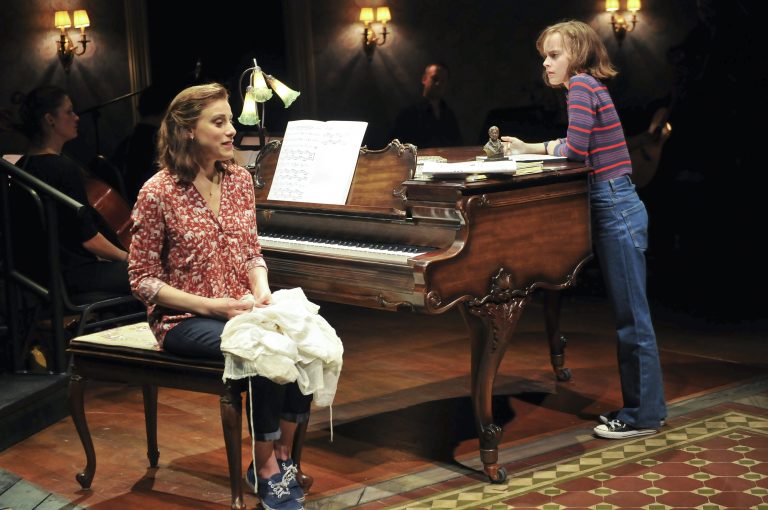
    An adult Alison (Beth Malone) is reliving old memories in order to write her novel. Two other actresses play Allison as a child (Syndey Lucas) and in her college years (Emily Skeggs). Malone is ever-present, hovering around the edges as the narrator of her life. All three Alison’s have a desperate desire to connect with their father Bruce (Michael Cerveris). Bruce has a wife Helen (Judy Kuhn) but is deeply in the closet and has affairs with several men (all played by Joel Perez). Bruce’s pressure to lead a perfect normal life, including running the family business (a funeral fun home), greatly wear on his wife and children. His daughter’s eventual coming out has shocking effects on him.

    Jeanine Tesori is one of the greatest working composers today. Her partnership with book writer and first time lyricist Lisa Kron proves a harmonious match. Together they expertly capture the humanity of each individual in the family with music and dialogue seamlessly woven together. The music also does a sublime job at capturing the frustrations, delights, and unreliability of memory.

    Each Alison does remarkable work. Emily Skeggs is delightful with a hysterical and touching number after her first sexual encounter with her college friend Joan (‘Changing My Major’). Her wild enthusiasm and bold declarations of admiration for her lover’s pillow drool gets the audience laughing with recognition. Malone’s adult Allison sings with desperation and poignancy in ‘Telephone Wire’, attempting to muster up the courage to speak up to her Father on a mostly silent car ride.

    It is the eleven year old Sydney Lucas who gets the best number of the show. ‘Ring of Keys’ describes the inner-workings of Allison’s mind when confronted with an out lesbian, before she even knows what that term means. Upon the sight of a butch delivery woman, Ms. Lucas brings us on a journey of confusion, admiration, and ultimately recognition as she tries to figure out her gravitation to this stranger. With a determined belt and heartbreaking head voice, this young actress successfully sings through the delicate act of processing one’s own sexuality for the first time. It’s not only the best song of the show, it’s one of the most magical stage moments I’ve had the pleasure to witness.

    Director Sam Gold has masterfully re-worked the show for the theatre-in-the-round setting of the Circle in the Square Theatre. Set pieces stealthily emerge and disappear through the floor, creating a seamless dreamlike sensation as Allison walks through her own memories. The lighting design and sparsely staged numbers created an intimate atmosphere where the audience can easily grab hold of the nuances in the actors’ work.

    Most importantly, Gold keeps the piece anchored in humanity and subtlety. All of the aforementioned songs are “showstoppers”, but none require a kick-line or jazz hands. The closest we get to a big ensemble dance number is when, oblivious to the morbidity and oddness of their lyrics, Young Alison and her brothers create a hilarious disco-themed funeral home commercial.

    Gold has directed his actors with a sense of naturalism. I was struck by how effortlessly the actors were able to give powerhouse performances without ever pushing or scene chewing (a refreshingly different take for Broadway). Judy Kuhn proves to be the master of this technique. In ‘Days and Days’ she paints a portrait of a woman quietly breaking as she recounts the sacrifices she made in her marriage.

    I’ve gotten this far and haven’t even mentioned the incomparable Michael Cerveris. His father figure is intensely troubled, scared, and filled with self loathing. Cerveris (a Tony winner for Assassins) nails the inner turmoil of a man who struggles daily to put on a facade, who unleashes his own self loathing on his daughter, and who somehow still enlists empathy from the audience. Though Allison Bechdel was on a long quest to form some connection with a father who remained a stranger,  the saddest part of this true tale is that the man was ultimately a stranger to himself. I can think of no better actor than Cerveris to telegraph these frustrations and fears.

    It has been quite some time since a Broadway show moved me as much as Fun Home. Yet, despite heavy seeming topics, it never ventured too far into depressing territory. This is thanks to Mr. Gold’s direction and Ms. Tesori’s career best music that finds humanity, humor, and pathos in every moment. Fun Home is an instant classic. This is storytelling at it’s best.

    Fun Home
    Circle in the Square Theatre
    Music by: Jeanine Tesori, Book and Lyrics by: Lisa Kron
    Directed by: Sam Gold
    Starring: Michael Cerveris, Beth Malone, Judy Kuhn, Emily Skeggs, and Sydney Lucas
    Runtime: 1 Hour, 45 minute, no intermission

  • Play Review: “Hand to God”

    Play Review: “Hand to God”

    Hand to God MCC at the LucilleLortel TheaterPlays as irreverent, profane, and wacky as Hand to God rarely make it to the big Broadway houses. So I raise a hallelujah to the theatre gods for giving us this outstanding play at the Booth Theatre. It’s one of the best shows this season.

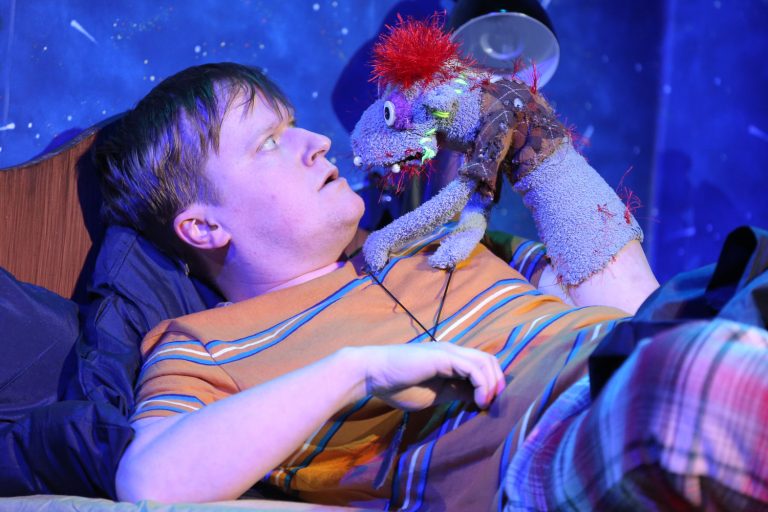
    Robert Askins has written an insanely funny dark comedy that you will want to attend over and over again. The play centers on Jason (Steven Boyer), a troubled young boy who is perfecting the art of hand-puppetry at his church’s puppet class. The class is led by his recently widowed mother Margery (Geneva Carr), determined to do something worthwhile and find meaning after her husband’s death. All hell (literally) breaks loose when we discover Jason’s hand puppet “Tyrone” has a mind of his own, and is quite possibly possessed by the Devil himself.

    If you were a fan of the Off-Broadway run concerned for the transfer into a larger house: have no fear. As directed by Moritz von Stuelpnagel, the production expertly balances outrageous humor and touching humanity. Beowulf Boritt has also provided an impressive set full of folding parts and loads of surprises.

    It is Steven Boyer in the dual roles of Jason/Tyronne who deserves the lion’s share of praise. Jason is an impossibly awkward young man with zero confidence to speak of. But as Tyronne takes over the boy’s arm, Boyer transforms his voice into an acidic, fiendish creature full of violent and lewd energy. The voice and mannerisms of Tyronne are so specific it’s often easy to forget the puppet is controlled by the actor. Watching the many scenes Stephen Boyer perform two character scenes by himself is mesmerizing. Though composed of a sock and some felt, Tyronne is absolutely the star of the show. It’s nearly impossible to describe the strange joy one feels watching Tyronne torment his small town victims.

    The cast is filled out by a wonderfully troupe of actors who match the zany energy of the devil puppet. Marc Kudisch portrays the church pastor who attempts (and fails) to disguise his sexual advances towards Jason’s mother as purely Christian intentions. Timothy (Michael Oberholtzer) is also inappropriately infatuated with Margery. Oberholtzer perfectly delivers teen angst and sexual frustration with a wildly physical performance. Sarah Stiles plays Jessica, the object of Jason’s pure affections and Tyronne’s sexual charged catcalls. Stiles is hilarious in her deadpan delivery, and collaborates with Boyer for the most outrageous puppet sex scene the world may ever know. Seriously, you won’t believe how many sex positions these puppets get into. Apologies to Avenue Q and Team America, this play has you beat.

    You can, and should, enjoy the play as a filthy hilarious escape. But while its odd to look for deeper meaning when puppet exorcism is a major plot point, there is more than shock and awe to the script. Tyronne in many ways represents the unfiltered Id, saying what Jason would say if no repercussions were involved. All of these characters are suffering from repressed urges and emotions.  Mr. Askins dares to ask the audience if there is any benefit to acting on our innermost desires.

    My one wish for the script is a stronger establishing moment between mother and son at the beginning of the play. Much of act two hinges upon Jason and Margery learning to forge ahead together and listen to each others needs instead of keeping them bottled up. But since the first act is so centered on establishing the play’s outrageous humor, the relationship is not immediately solidified and the eventual payoff isn’t as sweet or nuanced as it could be. This is not to speak ill of Geneva Carr, who commands the stage as Margery whenever she is present. A kind-hearted but lost woman, she can fly into a rage or a sexual fit at a moments notice. An angry sex scene of hers somehow rivals the puppet sex scene in outrageous hilarity.

    I honestly have not laughed this hard at a Broadway show in years. Whether it was from a sock puppet’s sermon on the origin of sin, or watching said puppet wrestle his owner while still on his arm, I couldn’t even attempt to suppress my cackling. The audience around me was certainly in agreement. This play is something special and to miss it would be a sin.

    Hand to God
    Booth Theatre
    222 West 45th Street, Manhattan
    Written by: Robert Askins
    Directed by: Moritz von Stuelpnagel
    Starring: Stephen Boyer, Geneva Carr, Michael Oberholtzer, Sarah Stiles, and Marc Kudisch
    Run Time: 2 hours, one intermission