Tag: Jack Lowden

  • ‘Dunkirk’ is Christopher Nolan at his best | review

    ‘Dunkirk’ is Christopher Nolan at his best | review

    Dunkirk is a thrilling and emotional war movie that is singular in its form and a high-point in Christopher Nolan’s already impressive career

    Quick cut: Though it is infused with the cinematic innovation that’s synonymous with Christopher Nolan, Dunkirk also finds him at his most human. The action, visuals, and disorienting story make it a cinematic achievement, but the surprising emotion is what makes it one of Nolan’s best.

    Tick. Tick. Tick. That’s the sound that underscores almost all of Christopher Nolan’s film about the evacuations at Dunkirk during the height of World War II. However, what we’re counting down to exactly is never truly apparent. Is it to the end of the evacuation? Or perhaps to when the German troops — who are never truly seen — finally make their final push into Dunkirk? Nolan plays with time by tracking the story in three vignettes. “The Mole” takes place over one week, “The Sea” over one day, and “The Air” over one hour. The three storylines are interwoven into each other before crashing together. However, no matter if you’re watching the speeding story of The Mole or the slow burn one of The Sea, the tension never truly abates until that clock stops ticking.

    With barely any dialogue or even context for where the movie takes place in World War II, it’s disorienting to orient yourself into the story. Still, from the haunting opening shot of five soldiers scavenging through the empty streets of Dunkirk, you are immersed into the narrative. Eventually, Tommy (Fionn Whitehead) emerges as our general point of view for “The Mole.” However, he is certainly not a typical war movie protagonist. There really isn’t anything typical about Dunkirk. There are no incredible heroics or selfless acts of bravery. Nolan portrays the desperation that soldiers felt unflinching. For the soldiers shown in “The Mole,” the only goal is to get off the beach.

    💌 Sign up for our weekly email newsletter with movie recommendations available to stream.


    ADVERTISEMENT
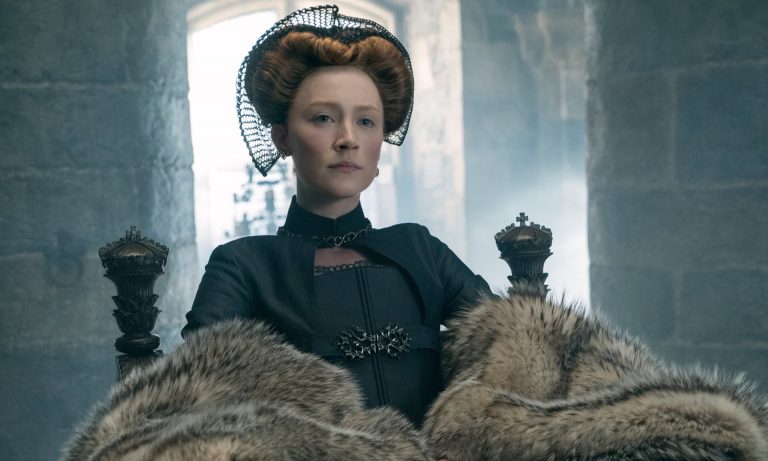

    “The Sea,” which is anchored down by recent Oscar winner Mark Rylance, — he has a good chance of being back in the Oscar race with this role — is a slower build, but no less tense. However, this is also where we get to know our characters a bit more. Specifically, when a soldier (Nolan regular Cillian Murphy) is brought onto Mr. Dawson’s (Rylance) boat — the Navy commissioned the vessel to help with the evacuation — after the ship he was on was struck by a torpedo, his strong PTSD begins to endanger those on board. PTSD is misunderstood, but Nolan handles the plot line here with grace. For a director that is often criticized for forgetting humanity in a situation, Dunkirk is made up almost exclusively of human moments. Even scenes of action have a feeling of dread or our fragility.

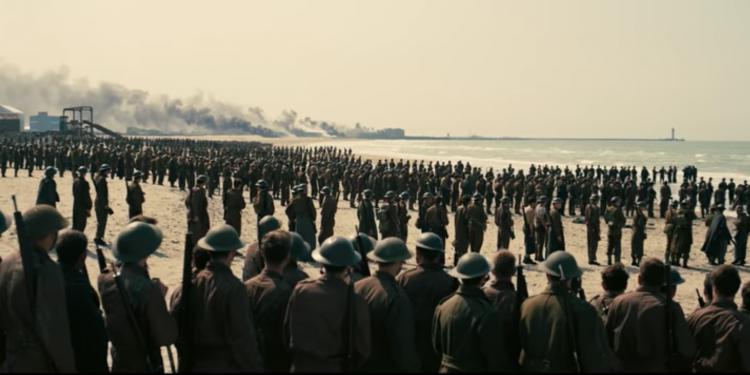
    To call Dunkirk singular would be an understatement. Among war movies, it is an outlier. It’s more poetic than it is brutal. It can even be described as an arthouse version of war. Cinematographer Hoyte van Hoytema finds the beauty in the chaos and helps Nolan look past the carnage of war and instead look at the desolation. This isn’t a battle. The battle is over. This is a race for survival. A lesser filmmaker would intercut the war scenes with scenes in Berlin strategizing the final assault into Dunkirk or London with Churchill. Instead, it keeps its attention on the beach, the sea, and the air. It’s that focus that makes you unable to rest during its lean 90-minute running time.

    There’s been a recent discussion over Netflix and its place in the film industry. Is it okay to watch movies in their unintended setting? In the case of Dunkirk, watching it in any place other than a movie theater — ideally an IMAX — would be a disservice. This movie will immerse you. The wide hellish landscape portrayed on-screen engulfs you to the point that hearing a plane roaring overhead will make you flinch much like the soldiers on the beach. At times, you hear the noise, but don’t see the plane and instead watch the reactions of the soldiers screen. A huddled line of soldiers standing on a pier waiting to board the next evacuation boat suddenly turn their faces to the sky to see the unseen enemy before being bombarded the next moment. In those moments, your breath is taken away. It’s filmmaking at its finest.

    💌 Sign up for our weekly email newsletter with movie recommendations available to stream.


    ADVERTISEMENT


    At one point, Tommy, who has teamed up with Alex (Harry Styles, who does good work here) and another unnamed soldier (Aneurin Barnard) are aboard a ship that is hit by a torpedo. As the water rushes in, we are caught up in the swell and are soon consumed by darkness. The terror of the moment seeps into you. Even though you’re watching it on a two-dimensional screen, the scene surrounds you.

    All the while, in the sky, Farrier (Tom Hardy), a Royal Air Force Pilot, is in a dogfight protecting the beach during the evacuation. Hardy is sublime in the nearly silent performance. However, the storyline is more than an action sequence. Dunkirk is about heroes. The actual evacuation was seen as a military disaster that has been largely ignored until now. Well, Nolan has found that heroes in war movies don’t have to be the brave soldiers going out in a blaze of glory. Instead, it’s the ones that save one person. It’s the ones that show their humanity for a brief moment. It’s the ones that see the mass of soldiers huddled on the beach as individuals, instead of one collective mass. Dunkirk is as much about the evacuation as it is the men and women who experienced it.

    Christopher Nolan is the biggest director to rise to prominence in the 21st Century, without qualification. However, it’s only recently that he has learned how to balance his incredible style with substance — check out our review of Interstellar. Well, if Dunkirk is any indication, he’s found that balance. Dunkirk is nothing short of a masterpiece. No other director would attempt a war movie like this. From the artful cinematography to Hans Zimmer’s disorienting score, and the non-linear narrative to the dialogue-less emotion, Dunkirk is a practice in the bursting through the boundaries of filmmaking. But it’s more than the craft. It has heart. Through the entire movie, every character has an ultimate goal that is right there but is never within reach: home.


    ADVERTISEMENT


    More movies, less problems


    Hey! I’m Karl. You can find me on Twitter and Letterboxd. I’m also a Tomatometer-approved critic.

    💌 Sign up for our weekly email newsletter with movie recommendations available to stream.


    ADVERTISEMENT

    💌 Sign up for our weekly email newsletter with movie recommendations available to stream.


    ADVERTISEMENT

  • ‘Mary Queen of Scots’ review — Saoirse Ronan and Margot Robbie are dueling queens

    ‘Mary Queen of Scots’ review — Saoirse Ronan and Margot Robbie are dueling queens

    Mary Queen of Scots is a solid well-made historical drama with powerhouse performances by Saoirse Ronan and Margot Robbie

    Mary Queen of Scots is an exemplary example of how a historical drama can feel modern and have modern themes without sacrificing the story its based on. Saoirse Ronan—following up her career-high performance in Lady Bird—is a powerhouse as the titular famed young queen with high ambitions.

    So much of the power of the film comes from the performances, specifically Ronan and Margot Robbie, who plays Mary’s rival Queen Elizabeth of England, and Jack Lowden—most recently seen in the underrated Calibre or 2017’s Dunkirk—who is a revelation as Mary’s second husband Lord Darnley.

    When Mary Queen of Scots focuses on the interactions between these players it soars. It’s no wonder considering the film’s director Josie Rourke has a decade and a half of experience directing stage plays, which is what the movie often feels like—a stage play.

    It’s also apparent in the striking staging of many of the scenes. The film’s opening introduction to the two queens at the center of the film is so powerful. As Mary—introduced as she’s being walked to her execution—and Elizabeth appear on screen, we watch them walk from behind through a sea of men separating as they pass. It’s marvelous.

    Mary Queen of Scots
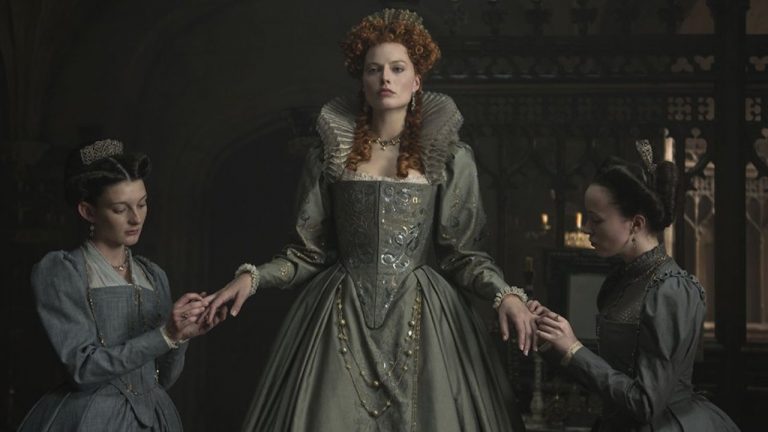
    Margot Robbie in Mary Queen of Scots. Courtesy of Focus Features.

    The film begins with Mary returning to Scotland after her husband King Francis II of France dies leaving her widowed. With a claim to both the thrones of Scotland and England, she quickly begins maneuvers to strengthen her position in Scotland and secure her place as the successor to Queen Elizabeth.

    Mary has the council of her illegitimate half-brother James, Earl of Moray (James McArdle) and the Earl of Bothwell (Martin Compston) guiding her through the politics, however, Mary clearly wants to be the one making the decisions. A main theme through the film is the two queens struggling to get men to look past their gender and allow them to rule as if they were kings. Queen Elizabeth even says at one point, “I choose to be a man.”

    As the political intrigue continues, Queen Elizabeth—represented by her ambassador played by Adrian Lester and counseled by her lover Robert Dudley (Joe Alwyn)—slowly begins to become jealous of Mary’s youth, beauty, intelligence, and ability to produce an heir.

    The slow descent that Queen Elizabeth experience is incredibly captured by Robbie who is especially convincing as someone who is developing an inferiority complex to a seemingly invincible rival. On the other hand, Ronan’s steely confidence as Mary—her motivation is sometimes terrifying—is juxtaposed with moments where she is losing a handle of it all, particularly when Lord Darnley comes into the picture.

    The political intrigue is what makes the movie enjoyable to watch like an episode of Game of Thrones. Though, since it has less than two hours to tell an epic of a story House of Cards creator Beau Willimon‘s screenplay sometimes feels overstuffed. It also doesn’t give room for the audience to discover the character’s motivations or inner workings. Rather it dictates them.

    Mary Queen of Scots
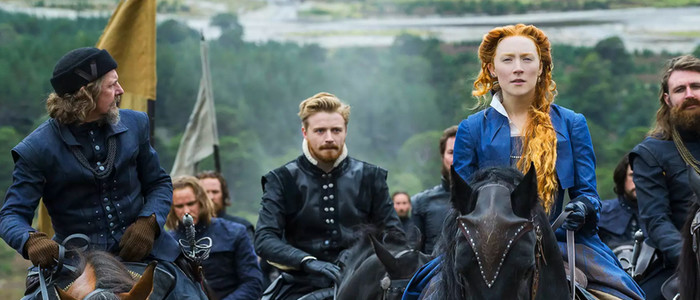
    Jack Lowden and Saoirse Ronan in Mary Queen of Scots. Courtesy of Focus Features.

    Still, there are some stunning sequences that are captivating to watch thanks to Rourke’s strong direction and John Mathieson’s naturally lit cinematography. A battle sequence midway through the film—we watch as Mary on a cliff high above her rivals looks down knowing the physically and metaphorically has the higher ground—is chilling as is Mary’s execution scene—spoiler alert for history.

    Though Mary Queen of Scots is obviously a historical drama it feels updated. Many of the characters and background actors are actors of color and one character is even updated to being a queer character—Mary’s confidant David Rizzio (Ismael Cruz Córdova). It proves that there is no excuse to not have diversity in a film.

    Oddly though, Mary Queen of Scots feels less than the sum of its parts. There are rousing scenes mostly thanks to Rourke’s direction and Ronan and Robbie’s powerhouse performances—Lowden, Alwyn, and Lester deserve some credit on this front, as well. And the costume design by Oscar-winner Alexandra Byrne deserves to be in the Oscar conversation. However, the movie sometimes feels cold and disconnected.

    Still, its feminist themes around women trying to succeed in a world stacked against them and dominated by men is particularly poignant and one of its successes. Mary Queen of Scots may not be perfect, but it has so many elements that make it a solid historical drama. The meeting scene between Mary and Elizabeth is worth the price of admission alone.

    Mary Queen of Scots will be released in theaters on December 12th.

    Karl’s rating:


  • ‘Calibre’ review — Netflix’s suspenseful Scottish Highlands thriller

    ‘Calibre’ review — Netflix’s suspenseful Scottish Highlands thriller

    Calibre is a lean and oppressively dark thriller set in the Scottish Highlands that announces Matt Palmer as an exciting new filmmaker and Jack Lowden as a star

    Calibre at the beginning is interspersed with sweeping, silent shots of the Scottish Highlands. The shots are beautiful but foreboding and isolating. Slowly the film closes in. The shots get tighter and lighting gets darker. The movie is literally closing in on the main characters.

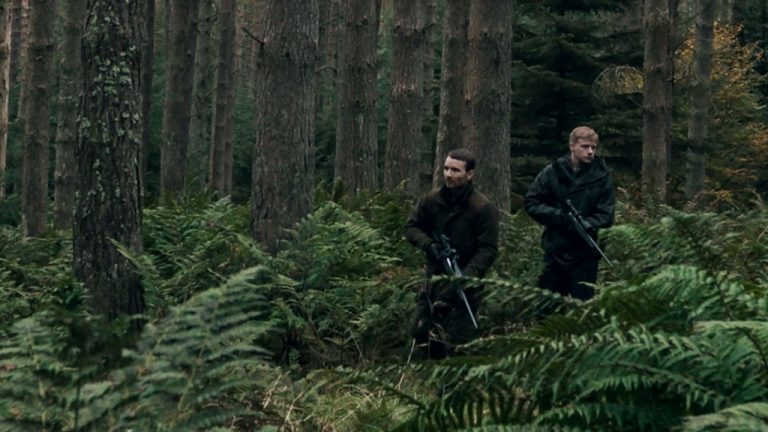
    The film, which is director Matt Palmer’s feature debut, is methodical and precise in its plot as two friends, Vaughn (Jack Lowden—last seen in Christopher Nolan’s Dunkirk—is brilliant here) and Marcus (Martin McCann), go on a hunting trip far into the Scottish Highlands.

    Palmer’s screenplay deftly sets up the relationship of the pair in the breezy first act of the film. Vaughn, who has fiance and baby on the way, and Marcus, a businessman with a cocaine habit, are old boarding schoolmates that have the air of friends that can pick up where they left off even after time apart.

    Their hunting trip takes them to a small village on troubled times held up and led by Logan (Tony Curran in a great performance). Though their drunken night on the town is light and fun despite some tension with the locals, the trip is anything but a relaxing reunion between schoolmates.

    Jack Louden in Calibre

    Something remarkable happens about 20 minutes into the film. In short, the hunting trip goes awry and someone ends up dead. From that point on, it’s nearly impossible to look away from the screen for most of the running time. Continually Calibre wounds tighter and tighter as new information and increasingly distressing events hammer at the pair before a bracing but inevitable finale closes out the taut thriller.

    Even more impressively, the most suspenseful scenes are the ones where it’s just characters talking. However, Palmer’s sharp writing and tight directing keep you at arm’s length so you’re constantly at the edge of your seat trying to decipher who knows what.

    Calibre flirts with folk horror like Kill List and, in an odd way, The Texas Chainsaw Massacre. They all follow polished city folk as they go up against rural counterparts. However, the more important similarity is the main characters’ series of decisions that lead them to their fates.

    Truly though, the story isn’t something we haven’t seen before. However, when a movie is told this effectively with a Hitchcockian flair—credit has to be given to Chris Wyatt’s masterful editing and composer Anne Nikitin simple but oppressive score—it’s hard not to be engrossed in Calibre.

    Calibre is now streaming on Netflix!

    Karl’s rating: