Tag: Kirsten Dunst

  • Civil War is a thriller at war with itself | review

    Civil War is a thriller at war with itself | review

    A group of journalists and war photographers trek from New York to Washington, D.C. while the United States is in the throes of a civil war


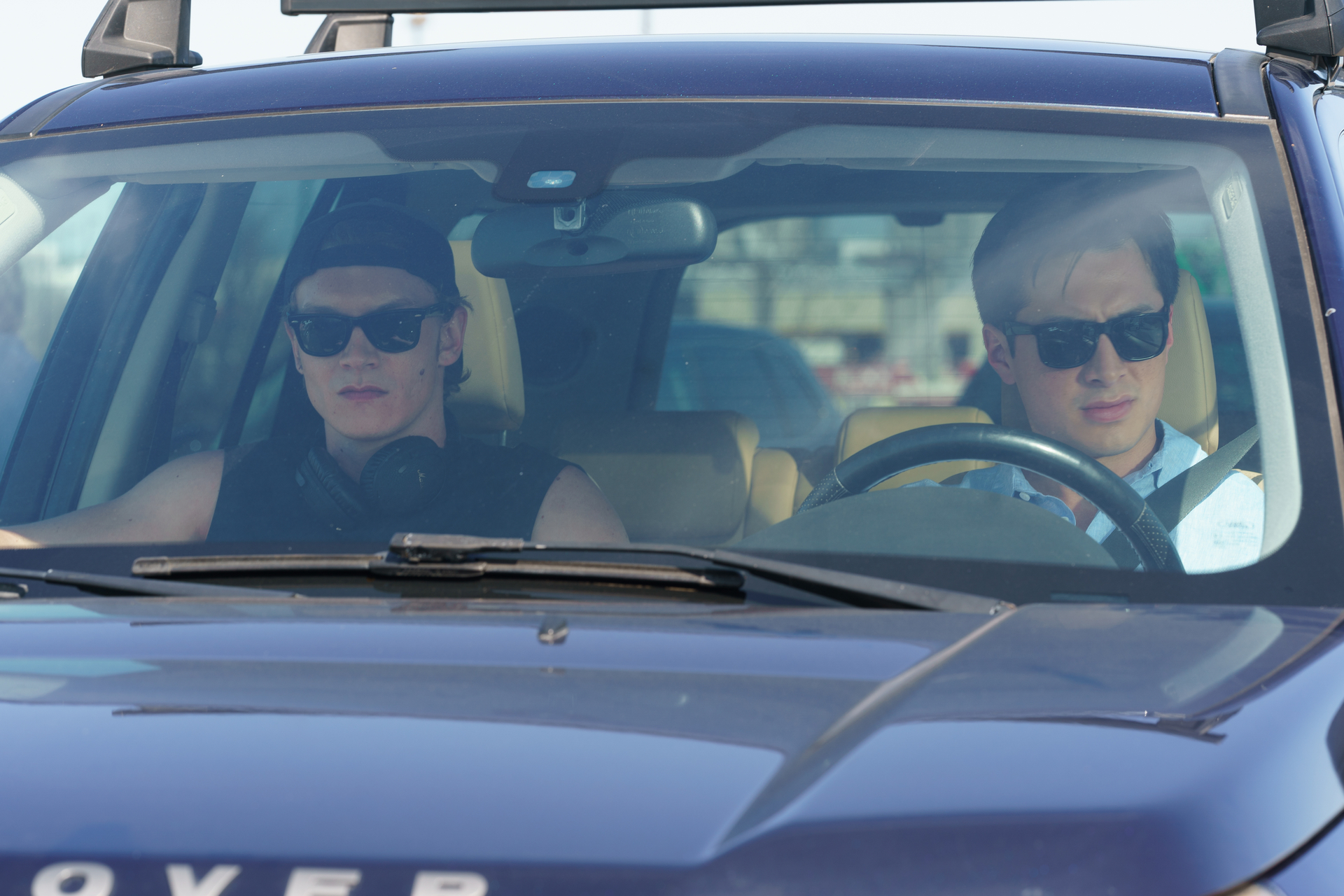
    Writer-director Alex Garland’s Civil War is an all-out assault on the senses that immerses you in a war zone that isn’t just close to home, it is home. When it focuses on the sheer terror and brutality of war — graphic images mixed with the worst of human tendencies — and the emotional and moral complexities of being a war photographer, the movie is nothing short of engrossing. However, whenever it deigns to say anything specific about the current state of society and culture in the United States it feels misguided. Mixed with opaque characters and uneven writing, Civil War feels at war with itself.

    Civil War is in theaters now.

    The first shot of Alex Garland’s Civil War is of the President of the United States, played by Nick Offerman, in extreme closeup. He says, “We are closer than ever to,” then pauses. You assume he’s going to say “civil war.” Instead, he says, “to victory.” It’s perhaps Garland’s cheeky way of quickly setting up the movie as a cautionary tale. The United States is closer than it ever has been to civil war, especially when he wrote this film four years ago. And it’s clear that Garland came up with this story as a response to what he was seeing around him in this country, even if the movie itself takes place in a somewhat fictional dystopia.


    ADVERTISEMENT


    While he keeps many of the specifics of what led to the war and how we got to the point that rebellion forces are on the precipice of toppling Washington, D.C. we get a vague understanding of the state of play. The Western Forces are a coalition of states allied with California and Texas that have seceded from the nation and presumably were fed up with a president that dismantled the FBI, sought and won a third term and used drones on American civilians. I’m sure you can imagine who he’s referring to.

    It’s part of the fallacy of Civil War. While Garland avoids specifics as a means to focus in on the general themes, he includes enough for us to understand that the story misunderstands what it’s saying.

    It’s the trouble of setting an allegory like this in a real-life environment. The benefit is that it adds a layer of relatability and terror at the prospect of an event like this hitting so close to home. Graphic images of war and violence on the streets of New York City or Washington, D.C. are a chilling reminder of what is going on in the day-to-day lives of some around the world. When the movie hones in on the unabashed brutality of war and the complexity of being a war correspondent, the movie’s transparency enhances all of those feelings. But whenever it attempts to bring in real-world artifacts — a line that mentions a fictional “antifa massacre” is particularly jarring — it immediately takes you out of the movie.

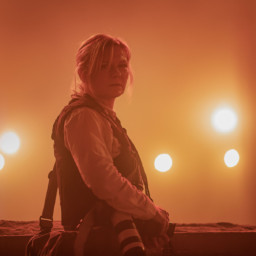
    But if the mechanics of its world take you out, the story pulls you in and doesn’t let go. Kirsten Dunst plays Lee Smith, a renowned war photographer on the hunt for the holy grail: a photo of the president. Along with her journalist colleague Joe (Wagner Moura), her mentor Sammy (Lady Bird‘s Stephen McKinley Henderson) and aspiring young photographer Jessie (Priscilla‘s Cailee Spaeny) she makes the long, dangerous trek through war-torn land and raging battles from New York City to the nation’s capital.

    Along the way, they encounter the monstrosities of war including a suicide bombing that nearly takes both Lee and Jessie out — of course, a second after getting her bearings Lee is up taking photos of the carnage — and a shootout between rebel forces and the U.S. military.

    Both scenes are violent, graphic and immersive. Like you’re being surrounded on all sides by gunfire, smoke and the smell of death. Interestingly, Garland doesn’t sensationalize these images. Even when we watch people dying, the image is objective — just as Lee sees them. That isn’t to say she doesn’t care, she believes that the work is a necessity.

    As they continue to make their way through the country, encountering people fighting for both sides and those caught in the middle, we learn what drives each of the characters. However, the screenplay never allows us too close. Almost like we’re just seeing them in a still photograph without the context of what come before or what is happening around them. Perhaps it’s an intentional choice. However, it left me unable to become emotionally invested in their journeys.

    When barnburner scenes come along like an encounter with a group of soldiers that goes awry — led by Jesse Plemmons in yet another role that proves he’s one of the great character actors working today — there’s suspense because of the situation, but not because we’re afraid for our characters. As Plemmons’s unnamed soldier goes down the line of our hero journalists asking what state they’re from, there’s a palpable amount of tension. It’s moments like it when Civil War fully meets expectations. But then it immediately fades away because we’re not emotionally connected to the characters enough to have actually cared about the outcome.

    When Civil War is great, it is magnificent. Especially the climactic final assault on the White House by rebel forces that could’ve been a short film in itself. Though it’s chaotic, Garland guides us through the carnage to tell us a nearly wordless story about the pursuit of the truth, the melancholic thrill of destruction and even the out-of-touch way that our leaders see the country — like their actions have no consequences. It is one of the best action scenes in a war movie in recent memory and shows he trusts the audience enough to understand what he’s trying to tell us. However, when it starts to tell instead of show, Civil War feels at war with itself.


    ADVERTISEMENT


    More movies, less problems


    Hey! I’m Karl. You can find me on Twitter and Letterboxd. I’m also a Tomatometer-approved critic.

    💌 Sign up for our weekly email newsletter with movie recommendations available to stream.


    ADVERTISEMENT

  • The Beguiled review — A darkly funny southern gothic tale

    The Beguiled review — A darkly funny southern gothic tale

    The 1971 southern gothic tale The Beguiled has been reimagined with a sharp, witty tone that delivers some darkly funny laughs.

    Some of the greatest facets of a southern gothic tale — equivocal gender roles, a decaying setting, social alienation — all appear in both adaptations of Thomas P. Cullinan’s novel A Painted Devil, renamed The Beguiled. However, unlike the clear male gaze of the original 1971 version, which was directed by Don Siegel and starred Clint Eastwood, Sofia Coppola’s The Beguiled is set firmly from the female point of view. But, it’s not just a single view. Instead, she looks at female desire from four different viewpoints. That change elevates this new version of The Beguiled to surprising new heights while also streamlining the narrative to be more deep and effective than before.

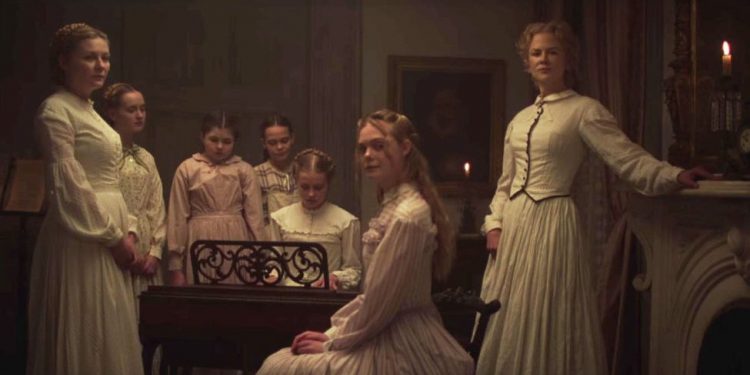
    In 1864 Virginia, a few students and teachers remain in the Farnsworth Seminary run by Martha Farnsworth (Nicole Kidman). From the school, you can see smoke and hear canon fire as a reminder that the Civil War still rages on.


    While searching for mushrooms in the woods in deep Virginia, Amy (a delightful Oona Laurence) stumbles upon a Union soldier Corporal John McBurney (Colin Farrell), who injured his leg. Amy helps him back to the school where he passes out. Martha decides to take him in and nurse him back to health before handing him over to Confederate troops. However, there’s a noticeable shift in the air when Corporal John McBurney arrives. Teacher Edwina Morrow (Kirsten Dunst), teenage student Alicia (Elle Fanning), Martha, and the other students begin fighting for McBurney’s attention often slipping into his room, which he is locked in, to even just steal a glance of him. However, they all have different motives.

    Coppola smartly strips the movie of any obvious subtext and instead allows us to derive meaning from each characters’ actions. It’s less about the possible threat of McBurney and more about each woman’s reaction to his presence. And all of their reactions can be summed up in desire. Martha sees John as a companion. Unlike her complicated backstory in the original adaptation, it’s simply hinted at that Martha lost her husband at some point during the war. She sees John as a way to fill that void. Edwina, on the other hand, wants John as an escape. It’s clear that she’s unhappy with the way her life has gone, but she never had the means to leave it. To her, John is her chance to be free. Alicia, the eldest of the girls at the school, lusts after John. Her repressed sexuality suddenly has an outlet when John appears. And lastly, Amy, who doesn’t quite fit in with the other girls, want John to be a friend or even brother.

    What is most surprising about The Beguiled, though, is that it is a delight to watch. Not that I didn’t think it was going to be enjoyable. But it’s surprisingly funny in its own dark way. In one scene, the girls, particularly dressed up for their first dinner with McBurney, slyly fight over the apple pie that McBurney just complimented. The polite, but pointed, banter is a hilarious reminder that none of these women have felt the attention of a man in quite some time.

    However, there is a noticeable hole in terms of race. There has been a lengthy discussion about a black female slave character being cut from film — she appeared in both the book and the 1971 version. For a movie so closely tied to the Civil War, it was disappointing to not have that commentary. Especially considering this is a movie about desires. A woman in that position would have a very interesting perspective on the situation. It is addressed with a throwaway line early in the movie. Still, for such a lean narrative, one would wonder why they couldn’t fit in such an important conversation.


    The Beguiled is a practice minimalistic storytelling. We rarely leave the overgrown grounds of the school — the growing weeds are a small reminder of the absence of slaves — the characters don’t say more than is needed, and the plot doesn’t stray far from the main thread. However, it is still a charming and engrossing, albeit quiet, movie. Though she certainly has Farrell, who delivers a constantly shifting performance that keeps you guessing, and Kidman, who is powerful in her otherwise reserved role, to thank for that. The Beguiled isn’t your typical summer thriller. However, one of the best things on a hot summer day is a dose of melodrama. And that, like revenge, is served up ice cold.

    ★★★½ out of 5


    Watch The Beguiled on Amazon!

  • Midnight Special Movie Review — A pitch-perfect 80’s sci-fi throwback

    Midnight Special Movie Review — A pitch-perfect 80’s sci-fi throwback

    Midnight Special proves that you don’t need huge explosions, action set pieces, or over-the-top special effects to make a great sci-fi movie

    The 80s are back in style. From Carly Rae Jepsen’s EMOTION to Stranger Things to Everybody Wants Some, it seems like Hollywood had a board meeting and decided that this is the decade we’re going to be homaging this year. However, unlike the clear homages that these were, Director Jeff Nichols’ Midnight Special feels more influenced by the decade. And specifically by E.T., It’s influenced by its character-driven plot that overshadows the sci-fi one and it inherits the decade’s anxiety about the extent of the government’s control.

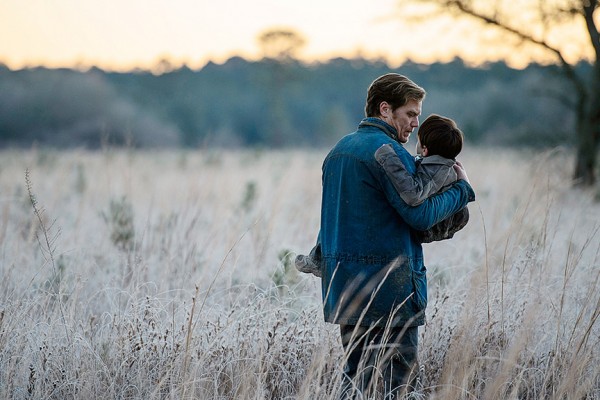
    However, the story is much small than that. Boiled down, it’s a story about a father and the lengths he will go to protect his son, Alton (Jaeden Lieberher). However, Alton isn’t just any 8-year old kid. He possesses incredible powers that are not of this world (which seem to be influenced again by E.T.). This has made him a hugely sought after property by two groups in particular: The Ranch and the government. The Ranch is a cult that sees Alton as a Jesus figure while the government sees him as a weapon. Both groups will go to extraordinary lengths to retrieve him, which Roy (Michael Shannon), Lucas (Joel Edgerton), and Sarah (Kirsten Dunst), won’t let happen.


    The entire movie begins en media res. From there, Nichols builds a compelling narrative that doesn’t concern itself with huge ideas (though the ending betrays this, but I’ll leave that for you to decide). All we know at the beginning is that there is an amber alert for a 9-year old boy. The government is orchestrating a cross-country chase for Alton, Roy, Lucas, and Sarah which is being led by Paul Sevier (Adam Driver), a surprisingly amicable NSA agent. As the group makes a run for it, we learn what exactly they’re running to and why so many people are interested in a 9-year old that wears giant headphones and swimming goggles.

    One of the most amazing things about Midnight Special is its incredible trust in its audience. It is a true exercise in showing, not telling. The most obvious example (although the movie is strewn with subtle ones) comes from the character of Lucas. Nichols is so careful with his framing of Lucas. He never shares the frame with the full family, and when he does he’s relegated to the far background. To me, Lucas’ storyline is the most intriguing. He has no reason to help Roy and Alton. However, with smart cinematography and Edgerton’s career-high performance we are able to attain that he is looking to be a part of a family. Just some lingering looks he gives is all we need to know that he cares.


    Overall, the movie has wealth of phenomenal performances. There’s Michael Shannon whose struggle to be strong for his son is outlined by his clear fear of losing him. He tells him at one point: “I’ll always worry about you, Alton. That’s the deal.” Kirsten Dunst;s perpetually worried Sarah, who is Alton’s mother, offers more outward emotion compared to Shannon’s intrinsic approach and becomes the emotional center of the film. However, Joel Edgerton is the true standout for me. His understated performance is a pitch-perfect complement to the film’s naturalistic style.

    Midnight Special isn’t going to be a movie that everyone loves. While the pretty simple, linear narrative is the set-up for most crowd-pleasers the focus on the family unit and their motivations may cause some people to ask, “what’s the point?” Government conspiracies, cults, and even the sci-fi elements take a back seat to the family drama surrounding Alton Meyer. While the entire movie is exciting with incredibly realized set pieces, the love that the principle characters show for each other is what makes it a great movie.

    7/10

    Midnight Special is available on DVD, Blu-Ray, and digital on Amazon!

  • Hidden Figures review — One of the most enjoyable biopics in years

    Hidden Figures review — One of the most enjoyable biopics in years

    Hidden Figures delicately balances a racial drama with a biopic while also telling the story of the space race. The result is one of the most delightful movies of the year.

    It takes the right kind of movie to get a Thursday night crowd actually cheering in the theater. Well, Hidden Figures is that kind of movie. Crowdpleasers aren’t hard to find in our current cinematic environment. It seems that Hollywood lives off of them. Financially, they do. However, good crowd pleasers are a rarity. Last year saw The Martian was the perfect example. You rooted for the success of the main characters and wallowed in their defeats. But in the end, you were up off your seat cheering at the photo finish. However, Hidden Figures is a more complex story than The Martian. In addition to being a true story, director Theodore Melfi had to carefully balance a biopic with a race drama, all the while telling the story of the space race with Russia.

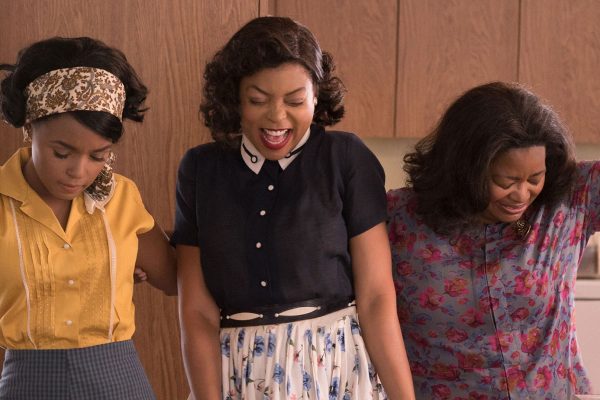
    Hidden Figures tells the story of three unsung heroes of NASA. Dorothy Vaughan (Octavia Spencer) is the informal supervisor of the West Area Computers Division, which is a group of thirty black women doing the calculations for the spacecrafts. Two of those women are Mary Jackson (Janelle Monáe), an aspiring engineer, and mathematician Katherine Goble (Taraji P. Henson), who is the center of our story.


    The movie opens with the three ladies stranded on the side of the road after Dorothy’s car breaks down. A cop comes to investigate and becomes distracted by the fact that the ladies work for NASA. This scene makes two things clear. First, it reminds us of the racial tensions of our society at the time. Second, it reveals that no matter what, the space race is at the front of everyone’s mind. Katherine is reassigned to the Space Task Group, which does the calculations for the all the shuttle missions. However, she finds that she is the only female and only person of color working in the division. This leads to animosity between her and her coworkers. They bring in a coffee pot for colored people in a heartbreaking instance. More subtly, Katherine’s bright patterned dresses clash against the uniform white button downs and black ties worn by everyone else in the department.

    However, this animosity is demonstrated beautifully and heartbreakingly in a single scene. The building that contains the Space Task Group doesn’t have a colored bathroom. So, she has to run in her heels and skirt half a mile to the West Area Computers division with her work in hand. She works while she uses the bathroom, then runs back to her office. This is played for laughs the first few times. It is even set to Pharrell’s song “Runnin’.” However, on a rainy day, this simple injustice causes Katherine to snap. Taraji P. Henson is an actress with a lot of power behind her, and she lets it go in this scene. But what makes it so effective is that Melfi builds up to it. He earns that scene and Henson knocks it out of the park. It may be emotionally manipulative filmmaking, but to the movie’s credit, it essentially asks you to buy into it emotionally and you allow it.

    More than anything, these women just want to work and do what they love. They want to have the opportunity to prove themselves. Allison Schroeder and Melfi’s screenplay, which they adapted from the book of the same name, does just that. It places the lens of the movie squarely on these ladies. It filters our society through their experiences. It’s one thing for a biopic to tell a story. Hidden Figures is the rare biopic to show me a real person.


    The movie tells the story of unsung heroes and it makes it a point to remind you of the impact of both their work and the work. It has a reverence for its subjects that is so vital. Part of that is thanks to the incredible performances from the cast. Kevin Costner does great work as Al Harrison, the director of the Space Task Group. He is a champion for Katherine and often helps her break the barriers that are systematically set in place. Jim Parsons is also great outside his typical mold as the head engineer Paul Stafford. Kirsten Dunst and Mahershala Ali, who is destined for an Oscar for Moonlight, also give great performances. Glen Powell gives a charming performance as John Glenn, the first American to orbit the Earth.

    However, it’s the three leading ladies who carry the movie on their shoulders. Octavia Spencer does her usual great work as the forward-thinking and motivated Dorothy Vaughn. Breakout Janelle Monáe is a scene stealer for much of the movie and has two scenes that would have made excellent Oscar clips. But Taraji Henson gives one of the best performances of the year as Katherine Johnson. She gorgeously emotes in two incredible scenes that are high points for the movie. Though, what I most appreciate about her performance is her internal struggle of suffering from injustices while trying to just do her the best work she can do.

    Is Hidden Figures one of the best written or directed movies of 2016? No. But is it one of the most satisfying and enjoyable movies? Yes! Hidden Figures will hook you from the very first time you see Taraji Henson, Janelle Monáe, and Octavia Spencer grace the screen and not let go until the last credit rolls. Watching Hidden Figures is perhaps one of the best times I had in the theater recently. It doesn’t just emulate a crowd pleaser, it’s the definition of a crowd pleaser.

    ★★★★ out of 5


  • 2016 Emmy Predictions: Lead Actress in a Limited Series or TV Movie

    2016 Emmy Predictions: Lead Actress in a Limited Series or TV Movie

    Lead Actress in a Limited Series or TV Movie is all but won. But I guess we can still predict nominees.

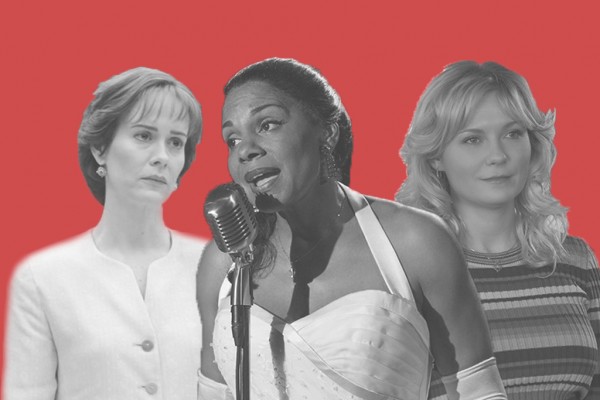
    Lead Actress in a Limited Series or TV Movie is already won. So, predicting the nominations is probably a little boring. Sarah Paulson (The People v. O.J. Simpson) has had such high notices for her performances that she would already naturally be the frontrunner. But add in the fact that she is in one of the most buzzed about shows of the last few years and that she can submit her tour de force episode “Marcia, Marcia, Marcia” and you have a winner.

    The only actress I can see giving her any competition is Kirsten Dunst (Fargo). Her show is looking to be the bridesmaid to O.J.’s bride and it’s no different in this category. Before O.J. premiered Dunst was the easy winner and that buzz can still push her over, but it’s unlikely.

    Another lock for a nomination is Kerry Washington (Confirmation). She lucked out because if this category was as competitive as the lead actor category she would have not been a lock by any means. Her movie wasn’t as well-received as the other contenders in this category, however the role is an important high-profile historical figure whose story is unfortunately timely.

    Both ladies from American Crime, Lilli Taylor and Felicity Huffman, should be good for nominations. Taylor more so than Huffman simply because she has the more baity role. However, Huffman had a nomination last year, which keeps her in contention.

    The last spot is going to be tricky. Nearly every pundit has Audra McDonald (Lady’s Day at Emerson’s Bar and Grill) in for her repeat performance in her Tony-winning role. However, I just don’t see her being that big of a lock. Her name just doesn’t seem enough to push her over and the movie isn’t enough for it to help her much. Plus, when she was predicted for The Sound of Music, it didn’t work out. However, what she does have working for her is the fact that the category this year is relatively weak. That’s why I’m keeping her in.

    The one contender outside of these six we have to look out for is Lady Gaga (American Horror Story: Hotel). This installment of Horror Story doesn’t seem like it’s going to make as big of a splash at the Emmys as the ones in the past. However, they’ve never missed a nomination in this category. Whether or not that’s because the only contenders have been Jessica Lange and Paulson is yet to be seen. But coming off a strong year, I can see voters going with her.

    Doesn’t matter though since Paulson winning, right?

    Check out my 2016 Emmy Predictions!

    My Predictions:

    Kirsten Dunst (Fargo)
    Felicity Huffman (American Crime)
    Audra McDonald (Lady’s Day at Emerson’s Bar and Grill)
    Sarah Paulson (The People v. O..J. Simpson)
    Lilli Taylor (American Crime)
    Kerry Washington (Confirmation)