Tag: Mahershala Ali

  • ‘Spider-Man: Into the Spider-Verse’ review — One of the best superhero movie in years

    ‘Spider-Man: Into the Spider-Verse’ review — One of the best superhero movie in years

    Spider-Man: Into the Spider-Verse is a bright and bold loving critique of the superhero genre and a much needed hard reset.

    30-second review: Spider-Man: Into the Spider-Verse is so keenly aware of what it wants to be even though what it wants to be has never existed before. It’s a bright and bold loving critique of the superhero genre and a much needed hard reset. It doesn’t shy away from the usual tropes, but it tackles them in a way that is innovative, visually jaw-dropping, and laced with real emotion. With great power comes great responsibility, and the responsibility was in the right hands with Into the Spider-Verse.

    Where to watch Spider-Man: Into the Spider-Verse: Available to stream on Netflix. You can also buy or rent it on Prime Video.

    With great power comes… oh, you get it. Full review below ?


    Spider-Man: Into the Spider-Verse leans into the ridiculousness of superhero movies but respects how empowering they can be. In an odd way, Into the Spider-Verse feels akin to The Cabin in the Woods. The 2012 horror film directed by Drew Goddard was a loving hate letter to the genre in played in. Into the Spider-Verse seems to be interested in the same thing. 

    It’s a meta-commentary on the oversaturation of superhero origin stories told over and over again—each hitting the same beats as the last. Hilariously, the movie begins with an origin story montage that pokes fun of previous movie incarnations of the superhero. Specifically, the Sam Raimi trilogy—even the infamous Spider-Man 3 street walk-dance.

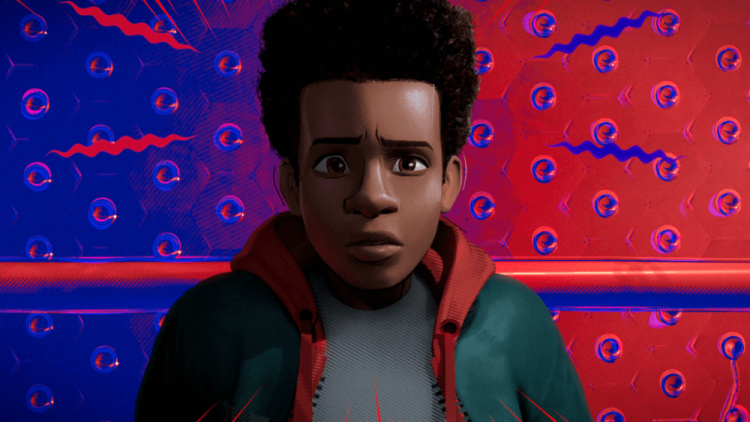
    In Into the Spider-Verse, we watch the origin story of 13-year-old Miles Morales (Shameik Moore), a half-black/half Puerto Rican teen who is unexpectedly thrust into the position of Spider-Man.

    However, this is not your typical origin story. Yes, we hit the familiar beats of the Spider-Man story we all know—bit by a radioactive spider, unexpectedly discovers powers and doesn’t know how to control them—but there’s the added layer of Miles existing in a world where Spider-Man (Chris Pine) is already a fixture.

    So, when that Spider-Man is taken down by baddie Kingpin (Liev Schreiber), Miles is inspired to take over. At first, he’s overwhelmed by his powers and the responsibility. However, he’s not alone.

    Fisk’s evil plan is to open up a multiverse underneath Brooklyn for reasons I will keep unspoiled. However, in doing so, a Spider-Man from another dimension is brought into Miles’. This Spider-Man goes by the name Peter B. Parker (Jake Johnson). In his world, he’s been Spider-Man for a lot longer than the one in Miles’ world and has become jaded—and overweight—by the job.
    Spider-Man: Into the Spider-Verse
    Shameik Moore voices Miles Morales in Spider-Man: Into the Spider-Verse.

    The movie is upbeat, colorful, and hyper-stylized in a way that comic fans will appreciate. Into the Spider-Verse is, perhaps, the best film interpretation of a comic book’s sensibility—it includes on-screen sound effects and the classic comic book text box without feeling gimmicky.

    The filmmakers even went as far as slowing down the frame rate to 12 frames per second—the standard is 24—to make the action look like a moving image. This is best used in a hilarious action scene where Peter B. Parker and Miles first meet.

    As they bounce through the streets of Brooklyn—hilariously attached by their own webs—chased by the police, there is a keen cartoon sensibility to the comedy and comic book veneer to the way the action is rendered. That carries throughout the movie and delivers some of the best action and comedic set pieces of the year. 

    At first, Peter B. Parker, who feels inferior compared his dimensional counterpart, is hesitant to take Miles under his wing. But when he finds out that Miles holds the key to getting him back home he finally accepts. 

    Now that the pair teamed up, they begin to form a mentor/mentee relationship that drives part of the emotional crux of the movie. The other emotional crux is Miles’ relationship with his police officer father Jefferson (Brian Tyree Henry) and with his Uncle Aaron (Moonlight‘s Mahershala Ali)—Miles often feels overwhelmed by his parents’ high expectations of him and goes to his uncle for a reprieve. 

    After a hilarious visit Aunt May (Lily Tomlin)—a badass assistant to this universes Spider-Man—Miles and Peter B. Parker realize that the multiverse has brought in even more Spider-People.

    Spider-Man: Into the Spider-Verse
    Hailee Steinfeld voices Gwen Stacey in Spider-Man: Into the Spider-Verse.

    There’s the dark and gritty—to hilarious levels—film-noir Spider-Man (a terrific Nicolas Cage) who is rendered in high contrast black and white and talks in exactly how you’d expect a noir detective to speak. There’s the anime rendered Penni Parker (Kimiko Glenn) who fights with a spider-like robot she controls with her mind. And there’s Spider-Woman who turns out to be Gwen Stacey (Hailee Steinfeld), a young and energetic Spider-Person.

    Together they work to take down Kingpin and return each Spider-Person to their own universe. Of course, there’s a time crunch. If they aren’t returned soon, their cells will degenerate. Along the way, they battle Kingpin’s goons in fan-service references, callbacks, and homages.

    And what is so refreshing—especially with the MCU being the template for most superhero movies—is that there are real stakes and danger in the action. I found myself tensing at the light and funny action because it feels often like any character could be hurt or killed.

    All the elements I’ve mentioned above make Into the Spider-Verse the boldest superhero movie in years and most innovative animated movies ever made. It’s so keenly aware of what it wants to be even though what it wants to be has never been done before. 

    Audiences have become desensitized by the at least three MCU movies, a cadre of DC movies, and a Sony Marvel movie coming out each year. Into the Spider-Verse is a refreshing reset to the genre. In a world where we know superheroes can do anything—with the help of CGI—how do you keep things interesting? Into the Spider-Verse solves this by playing with—and criticizing—the formula.

    It’s bold, funny, sentimental, and one of the best movies of the year.


    ADVERTISEMENT


    More movies, less problems


    Hey! I’m Karl. You can find me on Twitter and Letterboxd. I’m also a Tomatometer-approved critic.

    💌 Sign up for our weekly email newsletter with movie recommendations available to stream.


    ADVERTISEMENT


  • 2019 Oscar Predictions: Best Supporting Actor

    2019 Oscar Predictions: Best Supporting Actor

    Best Supporting Actor at the 2019 Oscars is stacked with industry veterans and newcomers looking for their shot at Oscar glory.

    Best Supporting Actor seems to be the most locked acting categories as Mahershala Ali has swept every televised acting prize including the Golden Globe, Screen Actors Guild, and Critics Choice. However, I think there is room for an upset.

    Here are my current rankings:

    1. Mahershala Ali, Green Book
    2. Richard E. Grant, Can You Ever Forgive Me?
    3. Sam Elliott, A Star is Born
    4. Adam Driver, BlacKkKlansman
    5. Sam Rockwell, Vice

    Check out all our 2019 Oscar Predictions: Best Picture | Best Actor | Best ActressBest Supporting Actor | Best Supporting Actress

    Even though Green Book has been marred by controversy, the one person involved with the film that seems to have gotten out unscathed is Ali. After waltzing through the precursors, he is the clear favorite to win even though he won just two years ago for Moonlight in this category. Plus, it’s a place where voters who liked Green Book can honor it without any of the people involved in the controversies.

    However, I think Ali winning so recently is going to hurt his chances more than people think. Whether people   don’t vote for him because of it or they vote for someone else thinking he has this on lock, there might be a block of voters who go elsewhere.

    Best Supporting Actor
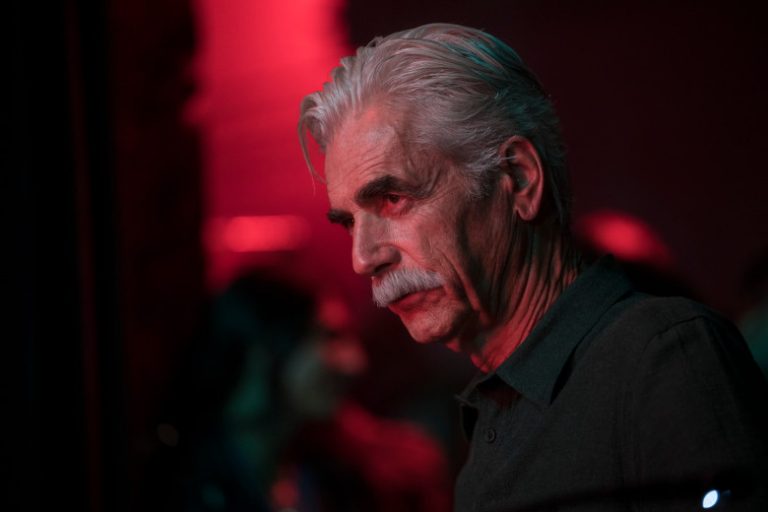
    Legendary veteran actor Sam Elliott got his first acting nomination in Best Supporting Actor for A Star is Born.

    The smart money would be on Sam Elliott for his small, but impactful performance in A Star is Born. After snubs in Best Director and Best Film Editing, the film has been on the ropes for its Best Picture chances — it could go home with just one award for Best Original Song. Voters looking for an above-the-line place to honor could easily go to Elliott. He’s an industry legend on his first nomination and a win could be seen as a lifetime achievement award.

    Sam Rockwell’s performance as George W. Bush is an impressive imitation in Viceand Adam Driver is BlacKkKlansman’s sole acting nomination. However, my money for an upset is on Richard E. Grant for Can You Every Forgive Me?.

    He swept the critics awards and has launched a homegrown social media campaign that will charm the socks off just about anyone. Although his movie only received two other nominations — Best Actress for Melissa McCarthy and Best Adapted Screenplay — I could see there being passionate support for his performance.

    He has the same industry veteran narrative as Elliott and has a good chance at upsetting Ali at the BAFTAs. If he does, the Oscar could be next.

  • ‘Alita: Battle Angel’ review — A messy, but fun cyberpunk sci-fi adventure

    ‘Alita: Battle Angel’ review — A messy, but fun cyberpunk sci-fi adventure

    Alita: Battle Angel boasts exhilarating action scenes and a breakout performance by Rosa Salazar, but buckles under the weight of its complex plot.

    Alita: Battle Angel gets one very important thing right: robots fighting. Director Robert Rodriguez — best known for the Spy Kids and Sin City franchises — knows how to direct an action scene. Even though they’re hyper-stylized with seemingly endless slow-motion CG shots, all of the setpieces have forward momentum, grounding in character, and are easy to follow — no Bourne Identity shaky camera to be found.

    That’s why he was the perfect fit to tackle the long-gestating adaptation of Yukito Kishiro’s classic manga Battle Angel Alita. Taking place in the 26th Century as the cheeky opening logos set, Alita: Battle Angel follows a disembodied core — think of it as a brain and heart in one — who is found and given a new body by Dr. Ido (Christoph Waltz). With no memory of the post-apocalyptic world she wakes up in or her name, Dr. Ido names her Alita.

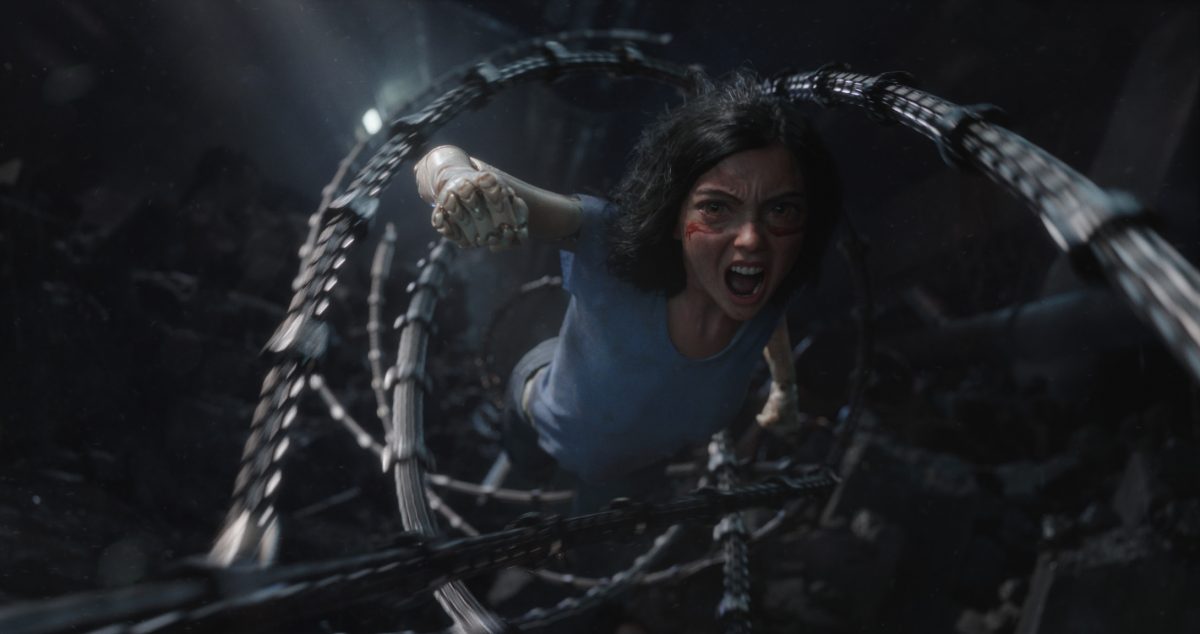
    Rosa Salazar plays the cyborg heroine through a surprisingly strong motion-capture performance that translates her facial expressions and emotions vividly. Much of the first 30 minutes is dedicated to world building. We’re introduced to a cyberpunk version of Earth where many people have been fused with machinery and dream to make it to Zalem — a utopia floating above their crumbling city.

    The world is fantastically realized. From the costumes to the production design to the character design, every detail feels perfectly drawn out.

    However, for all the great directing and visuals on display, Alita has one very obvious flaw — and it’s a flaw one of the movie’s contributor brings to all his movies. That contributor is James Cameron and the flaw is the screenplay. As is evident in every screenplay he’s written — Avatar and Titanic being the most notable — Cameron completely overthinks every aspect of the story. That’s why Alita is inundated with clunky exposition throughout the entire running time.

    ALITA: BATTLE ANGEL
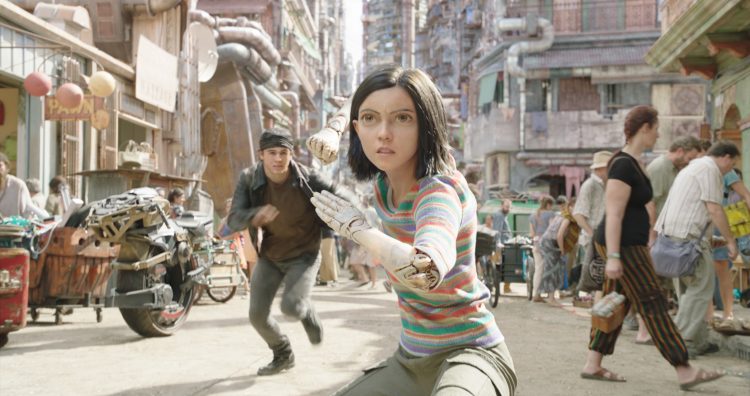
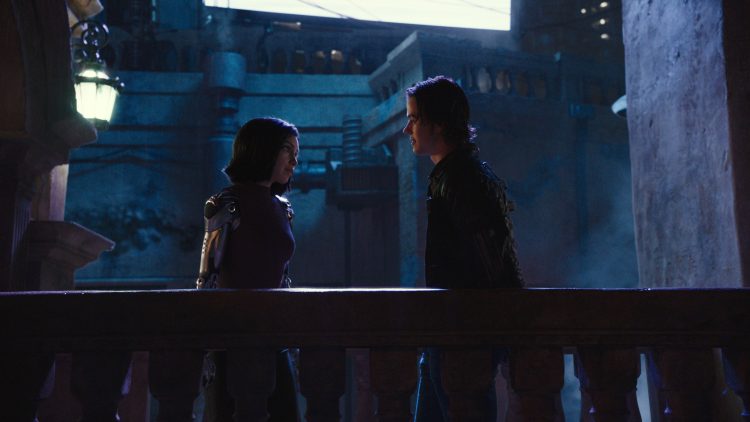
    Keean Johnson (left) and Rosa Salazar (center) in Twentieth Century Fox’s ALITA: BATTLE ANGEL. Photo Credit: Courtesy Twentieth Century Fox.

    It’s a delight to watch Alita play the role of the girl in an alien world discovering new things — she takes a bite of an Orange peel! And she’s never had chocolate! But the attempt to also introduce the main characters and get the plot of the ground end up derailing any of the goodwill being built up from Salazar’s stellar performance.

    Eventually, Alita meets Hugo (Keean Johnson), a fully human boy who teaches her the ropes of Earth. He also helps her piece together the mystery of her past. But it’s not all fun and games.

    Alita learns that Dr. Ido is also a hunter-warrior — a league of dangerous bounty hunters who will do anything to collect their payment. After following him out one night, Alita and Ido are attacked by a group of cyborgs who almost kill Ido. However, out of nowhere, Alita fights (and destroys) them using an incredible fighting technique and astonishing strength.

    It catches the eye of Vector (Mahershala Ali) — a man who rigs Motorball combat matches (think of it as roller derby with robots) — who is being used a vessel for Nova — the man who controls Zalem and keeps a close eye on Earth. He takes notice of Alita and wants her dead, to which he tasks the massive cyborg Grewishka (Jackie Earle Haley) with.

    There are multiple intersecting storylines including one involving another hunter-warrior cyborg called Zapan (If Beale Street Could Talk’s Ed Skrein — quite good here) and Ido’s ex-wife Dr. Chiren (Jennifer Connelly — the best of the supporting cast), but it all ends up being incredibly muddled as the screenplay switches and loses focus constantly.

    ALITA: BATTLE ANGEL
    Rosa Salazar (Alita) and Keean Johnson (Hugo) star in Twentieth Century Fox’s ALITA: BATTLE ANGEL. Photo Credit: Courtesy Twentieth Century Fox.

    When the movie is focused on Alita and her journey of self-discovery in the face of real danger from Nova and Grewishka, it works. Unfortunately, that journey is often cast to the side.

    A lot of the emotional core of the movie falls to the relationship between Hugo and Alita. Salazar does her best with the material — a lot of which feels forced. Johnson, on the other hand, stumbles often and doesn’t make a compelling romantic or heroic lead. Because of that, there’s a lack of chemistry between the pair that sucks the life out of any character development — we’re being told they care for each other instead of being shown.

    If Alita: Battle Angel stopped thinking and just delivered great robot fighting action with a simple, but compelling, plot, it would be a fantastic exercise in sci-fi instead of an over-complicated mess. I appreciate so much of what Rodriguez is doing. He should have been allowed to let his imagination run wild. Instead, it felt like he kept getting dragged back down to Earth by the screenplay.

    Alita: Battle Angel comes out a little bit better than the similarly high-concept sci-fi action-adventure Valerian and the City of a Thousand Planets mostly thanks to Salazar’s performance and Rodriguez’s masterful handling of the action sequences. I think it bodes well for a sequel that won’t be burdened with world building. This is a great story. It’s just not told the way it deserves.

    Alita: Battle Angel will be in theaters on February 14th.

  • Moonlight Movie Review — An instant classic and landmark in film history

    Moonlight Movie Review — An instant classic and landmark in film history

    Moonlight is gorgeously crafted, masterfully acted, surprisingly timely, and demands to be watched and respected

    It wasn’t until I got into my twenties that I became aware of what identity is. Identity is as much how you view yourself as what the world views you as. You may be a minority or gay or poor, but that doesn’t mean you have to identify as those things. It’s truly your experience that shapes your identity. Any LGBTQ+ person knows what it is to struggle with identity. Hell, anyone that is anything different from what society views as normal has struggled with identity. It’s a process that is as emotionally taxing as it is satisfying. Learning who you truly are and who you see yourself to be is one of the most liberating — sometimes heartbreaking — experiences. That’s what Moonlight really is about: identity. Not only the concept of identity, but the process of discovering, struggling, and ultimately accepting who you are.

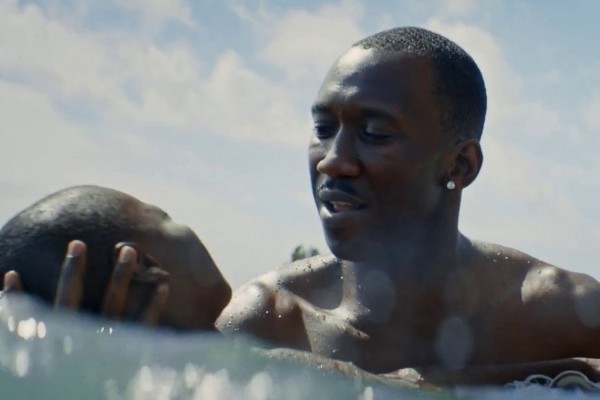
    Moonlight is split up into three parts that are named after the nicknames that our main character is called: Little, Chiron, and Black. In little, we meet young Chiron (Alex Hibbert) as he is running away from a group of taunting classmates. Eventually, he finds shelter in a crack house and is soon discovered by Juan (Mahershala Ali), who takes him under his wing. Juan is an interesting character. He is the only character whose perspective we see outside of Chiron’s. This is an important choice because Juan is a character whose identity as a drug dealer directly contradicts his caring personality.


    Eventually, Juan takes him under his wing along with his girlfriend Teresa (Janelle Monae). They become Chiron’s figurative parents while his real mother, Paula (Naomie Harris), is on drugs or with random men. This part is about Chiron discovering his identity. Juan is there to assure him that there are other people out there like Chiron.

    The second part of the film follows Chiron as a teenager as he struggles with his identity. At this point in his journey, he’s as confused and vulnerable as ever. He must deal with his mother falling further into drug addiction, his place as a punching bag for the school’s bullies, and his deepening confusion about his sexuality. However, maintaining a close eye on his subjects, Jenkins portrays Chiron’s struggle with a chilling intimacy that culminates in a chilling final shot.

    In the final act, Chiron has transformed into Juan both physically, professionally, and mentally. There is even a scene where he gives a pep talk to a younger associate. However, this act is outlined by his acceptance of who he is. Ultimately, he must face his past ghosts and find a way to embrace it as part of his identity.

    moonlight movie review

    Jenkins and cinematographer James Laxton were careful to shoot nearly the entire film in close-up. It’s a deeply personal story. However, Jenkins also doesn’t shy away from cinematic flair. In particular, composer Nicholas Brittell’s score mixes old school rap and hip hop with classical music to outline the beauty and savagery of growing up. The most surprising element though is the sound. It comes in and drops out in the perfect places. However, the most effective part of its design is when we hear dialogue, but all we see is a look in the actors’ faces.

    I need to take a moment to talk about this incredible cast. First, the three actors that portray Chiron are revelations and bring entirely different perspectives on the role that come together to create this dynamic character. Alex Hibbert, who portrays the young Chiron, has this knowing look that captures his attempt to understand something that is just out of grasp. Teen Chiron, portrayed by Ashton Sanders, instead uses his physicality to show his inner battle to embrace who he truly is or what society wants him to be. Finally, Trevante Rhodes’ performance as the adult Chiron shows the character at his most emotionally vulnerable.


    However, they are joined by a supporting cast that use their limited screentime to make huge impacts. Naomie Harris, who plays Chiron’s mother in all three parts of the film, is phenomenal throughout the film. But her third act monologue is one of the best-acted scenes of the year. Jharelle Jerome, who plays Chiron’s love interest Kevin as a teenager, is a surprisingly naturalistic performer. Mahershala Ali, though, towers in the film. Though his screen time is short, his impact is felt throughout the movie. It’s truly a masterclass in acting. Then there is Andre Holland who plays Kevin as an adult. His performance is perhaps one of the best of the year. Along with Rhodes, he created scenes that felt so natural and real that I was floored that this was actually a movie. 

    LGBTQ+ characters are marginalized in film. However, black gay characters are completely in the periphery. Moonlight bravely brings them into the forefront. It is easily a turning point for queer cinema and black cinema alike. In the end, though, Moonlight is a love letter to the people that struggle with their identity and sometimes feel isolated. It works as both a comfort and a glimmer of hope. But that’s not to take away from the craft of the film. The only way to describe Moonlight is as art. It’s pure, unadulterated art. It’s storytelling at it’s best. It’s filmmaking at it’s best. It’s romantic, emotional, and, most importantly, a film that needs to be seen. 

    10/10

    Preorder Moonlight on DVD, Blu-Ray, or digital on Amazon!

  • Hidden Figures review — One of the most enjoyable biopics in years

    Hidden Figures review — One of the most enjoyable biopics in years

    Hidden Figures delicately balances a racial drama with a biopic while also telling the story of the space race. The result is one of the most delightful movies of the year.

    It takes the right kind of movie to get a Thursday night crowd actually cheering in the theater. Well, Hidden Figures is that kind of movie. Crowdpleasers aren’t hard to find in our current cinematic environment. It seems that Hollywood lives off of them. Financially, they do. However, good crowd pleasers are a rarity. Last year saw The Martian was the perfect example. You rooted for the success of the main characters and wallowed in their defeats. But in the end, you were up off your seat cheering at the photo finish. However, Hidden Figures is a more complex story than The Martian. In addition to being a true story, director Theodore Melfi had to carefully balance a biopic with a race drama, all the while telling the story of the space race with Russia.

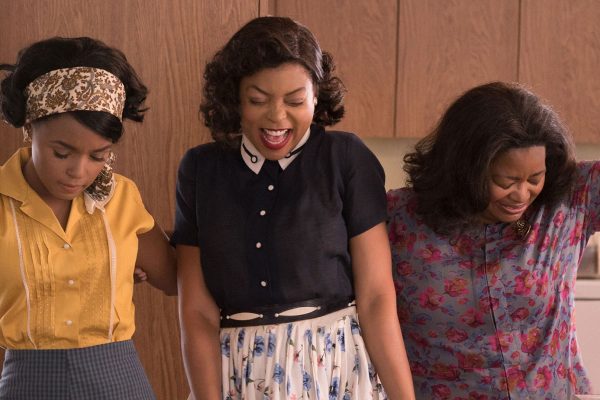
    Hidden Figures tells the story of three unsung heroes of NASA. Dorothy Vaughan (Octavia Spencer) is the informal supervisor of the West Area Computers Division, which is a group of thirty black women doing the calculations for the spacecrafts. Two of those women are Mary Jackson (Janelle Monáe), an aspiring engineer, and mathematician Katherine Goble (Taraji P. Henson), who is the center of our story.


    The movie opens with the three ladies stranded on the side of the road after Dorothy’s car breaks down. A cop comes to investigate and becomes distracted by the fact that the ladies work for NASA. This scene makes two things clear. First, it reminds us of the racial tensions of our society at the time. Second, it reveals that no matter what, the space race is at the front of everyone’s mind. Katherine is reassigned to the Space Task Group, which does the calculations for the all the shuttle missions. However, she finds that she is the only female and only person of color working in the division. This leads to animosity between her and her coworkers. They bring in a coffee pot for colored people in a heartbreaking instance. More subtly, Katherine’s bright patterned dresses clash against the uniform white button downs and black ties worn by everyone else in the department.

    However, this animosity is demonstrated beautifully and heartbreakingly in a single scene. The building that contains the Space Task Group doesn’t have a colored bathroom. So, she has to run in her heels and skirt half a mile to the West Area Computers division with her work in hand. She works while she uses the bathroom, then runs back to her office. This is played for laughs the first few times. It is even set to Pharrell’s song “Runnin’.” However, on a rainy day, this simple injustice causes Katherine to snap. Taraji P. Henson is an actress with a lot of power behind her, and she lets it go in this scene. But what makes it so effective is that Melfi builds up to it. He earns that scene and Henson knocks it out of the park. It may be emotionally manipulative filmmaking, but to the movie’s credit, it essentially asks you to buy into it emotionally and you allow it.

    More than anything, these women just want to work and do what they love. They want to have the opportunity to prove themselves. Allison Schroeder and Melfi’s screenplay, which they adapted from the book of the same name, does just that. It places the lens of the movie squarely on these ladies. It filters our society through their experiences. It’s one thing for a biopic to tell a story. Hidden Figures is the rare biopic to show me a real person.


    The movie tells the story of unsung heroes and it makes it a point to remind you of the impact of both their work and the work. It has a reverence for its subjects that is so vital. Part of that is thanks to the incredible performances from the cast. Kevin Costner does great work as Al Harrison, the director of the Space Task Group. He is a champion for Katherine and often helps her break the barriers that are systematically set in place. Jim Parsons is also great outside his typical mold as the head engineer Paul Stafford. Kirsten Dunst and Mahershala Ali, who is destined for an Oscar for Moonlight, also give great performances. Glen Powell gives a charming performance as John Glenn, the first American to orbit the Earth.

    However, it’s the three leading ladies who carry the movie on their shoulders. Octavia Spencer does her usual great work as the forward-thinking and motivated Dorothy Vaughn. Breakout Janelle Monáe is a scene stealer for much of the movie and has two scenes that would have made excellent Oscar clips. But Taraji Henson gives one of the best performances of the year as Katherine Johnson. She gorgeously emotes in two incredible scenes that are high points for the movie. Though, what I most appreciate about her performance is her internal struggle of suffering from injustices while trying to just do her the best work she can do.

    Is Hidden Figures one of the best written or directed movies of 2016? No. But is it one of the most satisfying and enjoyable movies? Yes! Hidden Figures will hook you from the very first time you see Taraji Henson, Janelle Monáe, and Octavia Spencer grace the screen and not let go until the last credit rolls. Watching Hidden Figures is perhaps one of the best times I had in the theater recently. It doesn’t just emulate a crowd pleaser, it’s the definition of a crowd pleaser.

    ★★★★ out of 5


  • 2017 Oscar Predictions: It’s Mahershala Ali vs. Dev Patel for Best Supporting Actor

    2017 Oscar Predictions: It’s Mahershala Ali vs. Dev Patel for Best Supporting Actor

    Best Supporting Actor is looking like it’s going to go to Mahershala Ali for Moonlight. However, there is certainly room for an upset.

    While it took a while for the race for Best Supporting Actor to take shape, a clear frontrunner has emerged in Mahershala Ali (Moonlight). His towering performance was a favorite among the early critic awards (and in my review for the movie) and he will certainly be swept along with the buzz for the movie. Plus, the Best Picture frontrunners tend to win an acting award. So, if Moonlight remains popular, then Ali could be taken along. His loss at the Globes and BAFTA is telling, though. It shows that he isn’t infallible like Viola Davis (Fences) over in supporting actress. 

    Starting with the actor with the smallest chance of upsetting is Michael Shannon (Nocturnal Animals). He was probably the most critically-acclaimed actor in the film despite the odd Aaron Taylor-Johnson win at the Golden Globes. However, no acting award winner has won the Oscar after being snubbed by the Globes and SAG — Marcia Gay Harden is the only actor to pull this off. Plus, his film was shut out from all the other categories. So, Shannon probably doesn’t need to worry about preparing a speech.

    oscars mahershala ali best supporting actorCheck Out: Will Moonlight, La La Land, or Manchester by the Sea win Best Picture?


    Lucas Hedges (Manchester by the Sea) has the benefit of pretty much being a co-lead to Casey Affleck. Though the supporting actor category is a lot less prone to category fraud as the actress counterpart, when it does happen, it seems like it's more of a pro than a con. However, there is a bigger statistic going against him. The Academy tends to award older and more veteran actors. In fact, supporting actor has become a sort of lifetime achievement award — Christopher Plummer, Alan Arkin, Morgan Freeman. And at the ripe age of 20, Hedges is the youngest nominee this year in any category. Unless there is a sudden and unexpected Manchester sweep, it's safe to say he probably won't win. Who I do think has a chance at upsetting Ali is Jeff Bridges (Hell or High Water). His grizzled police officer role is a popular type for the older and whiter Academy. Plus, Bridges is a very popular actor. In thus Trump era we're in, he would be the alternative for voters that skew towards that demographic. The nominee with the best chance at beating Ali is Dev Patel (Lion). With the great Harvey Weinstein behind him fueling his campaign, Patel will have a strong narrative behind him. He's been in the industry for a while and was snubbed for his main role in the Best Picture winning Slumdog Millionaire. He has a lot of screentime in a really meaty role. Plus, I think Lion is the dark horse contender in a lot of categories. It's a feel-good movie with a lot of substance. The biggest indication that he could be the more likely contender than Bridges is his win at BAFTA. While BAFTA isn't exactly the best indicator. It does help with where the momentum is going. While there is no perfect contender to take Ali down, Patel is certainly the closest. Either way, I think Mahershala should be getting a space set up on his mantel! Check out the rest of our 2017 Oscar Predictions! Will Win: Mahershala Ali, Moonlight Could Win: Dev Patel, Lion Dark Horse: Jeff Bridges, Hell or High Water Should Win: Mahershala Ali, Moonlight