Tag: Margot Robbie

  • ‘Barbie’ is hot pink-splashed post-modern meta romp | review and analysis

    ‘Barbie’ is hot pink-splashed post-modern meta romp | review and analysis

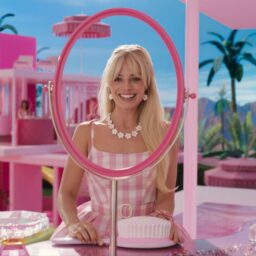
    Barbie leads a perfect life, until something goes horribly wrong. To save herself, she needs to leave her pink utopia Barbieland and venture into the real world. Ken’s there too.


    Barbie looks camp right in the eye and turns it into a hot pink-splashed post-modern meta exploration of existentialism, feminism, the patriarchy and masculinity packaged in a satirical surreal musical comedy homage to classic. It isn’t just a movie of our time. It is the movie of our time.

    Barbie is in theaters now.

    Before I begin: I want to vocalize by full support of the Writers Guild of America and the Screen Actors Guild as they fight for a fair deal. 

    I’m so happy I live in a world where a major studio gave a female filmmaker a $145 million dollar budget to make a post-modern meta-exploration of existentialism, feminism, the patriarchy and masculinity packaged as a satirical surreal musical comedy homage to classic cinema based on a children’s toy. They’d probably faint if I tried to explain this to a Victorian child. Barbie is a movie of today. Or, more aptly, Barbie is *the* movie of today. 

    Writer-director Greta Gerwig (Lady Bird, Little Women)—she co-wrote the movie with her husband Noah Baumbach—captures our current societal, political, and cultural moment with confident hot pink-splashed ease as she double winks at the audience with the surreal absurdity of Barbieland. That is the most remarkable achievement of the movie. Barbie knows that we know that they know that we know exactly what they’re doing. It’s like a movie of a dream sequence in a movie in a dream. Things don’t quite make sense, but it adds up. In the case of Barbie, it adds up to a sharp, incisive, and profound reflection of our world—that also happens to be a hilarious summer romp that we’ve been craving.


    ADVERTISEMENT


    We begin in Barbieland, a picturesque bright idealistic world made of plastic. It’s basically the “how society would look if” meme if it was pink. Every morning the “Barbies” wake up, brush their teeth with comically-sized toothbrushes, “shower” with no water, and float down from their roofs to begin their day of… well, being perfect. Barbie is president (Issa Rae in a charming supporting role). She also holds every seat on the Supreme Court. She’s a doctor. A lawyer. Barbie is everything. As narrator Helen Mirren puts it in a cheeky voiceover, “all problems of feminism and equal rights have been solved” in the real world because of Barbie… or so the Barbies in Barbieland are led to believe—more on that later.

    All the visual gags and well-publicized hyper-stylized quirks are as delightful as you’d imagined (Her heels don’t hit the ground! They drink from cups with nothing in them! Gravity is more of a concept than reality!). The specificity and absolute absurdity of the world-building is joyous, as is the “giant blowout party with all the Barbies, and planned choreography, and a bespoke song.” Margot Robbie as our protagonist Stereotypical Barbie (her words not mine)—aka the Barbie you think of when someone tells you to think of a Barbie—is perhaps the most charismatic and perfect of them all (if that’s even possible). 

    But then at the end of their perfect Disco-inspired musical number to Dua Lipa’s “Dance the Night” a though creeps into Barbie’s head: “Do you guys ever think about dying?” Cue the record scratch.

    The next day, Barbie’s perfect morning isn’t quite perfect. Her “shower” is cold, waffles burnt, and, most alarmingly, her feet are flat (*gay gasp*)! She laments, “I would never wear heels if my feet were shaped this way.” There are countless of those precise observational quips. This leads her to Weird Barbie (Kate McKinnon)—a Barbie who was played with too hard and can’t seem to keep herself out of the splits—who explains that someone playing with her in the real world is making her this way (she even starts to get *gulps* cellulite on her thigh). Weird Barbie offers her a red pill and a blue pill. Well, in the world of Barbie it’s a pink sparkly pump and a Birkenstock. Go to the real world and fix the problem or stay here and suffer—she chooses the pump. Weird Barbie makes clear it wasn’t an option to begin with. So Barbie takes a car to a bike to a rocket to an RV to a boat into the real world… oh, and Ken (Ryan Gosling) is there too.


    ADVERTISEMENT


    Like Singin’ in the Rain—a clear inspiration for the movie—delightfully wrestled with the change from silent movies to sound, Barbie wrestles with the change from Barbie’s ignorant utopic existence in Barbieland to the bleak reality of the real world where she’s ogled on by men in a world ruled by them. Ken, on the other hand, is like a teenage boy discovering the Joe Rogan podcast. His eyes are “opened” to the possibilities of being a man and a world ruled by the patriarchy—and learns its limits. His world shifts from only have a good day if Barbie looks at him to seeing he can have that power all to himself—what could possibly go wrong?

    Gerwig bakes the themes of the movie into the world and story seamlessly. She makes the concept of Barbie inseparable from gender and gender roles—her very existence is rooted in the experience of being a woman. In a climactic scene, Gloria (America Ferrara), a Mattel employee in the real world, lists the all the reasons why being a woman is so frustrating (you have to be skinny, but you can’t say you’re skinny you have to say you’re “healthy”; you have to strive to be successful, but you can’t be mean). It calls into question Barbie’s place in the real world—is she there to just make women feel bad that they can never achieve that level of success? Though Mattel is directly involved in the movie, they are just as much of a target of the movie’s dismantling of the paradoxes that make up our society—represented here by a bumbling CEO played by Will Ferrell and low-level intern Aaron (Connor Swindells).

    Like any hero’s journey, Barbie’s adventure leads her back to Barbieland where things are looking different—and with more horses. From there, Barbie evolves to a battle of philosophies that call into question the foundations of our society.


    ADVERTISEMENT


    While Robbie’s performance is pitch-perfect playing up the plastic perfection (and realistic ignorance) of Barbie as she discovers what it is to be human (it’s giving Tyra Banks in Life Size), it’s Ryan Gosling’s performance as Ken that perhaps best encapsulates the high wire act that Gerwig accomplishes between the energetic larger-than-life tone and complex societal themes. In a scene that is destined to be his Oscar clip, Gosling portrays a devastated Ken experiencing real emotion for the first time while throwing himself around the Barbie dream house in what can only be described as a slapstick tantrum over the nearly impossible balancing act of existing not for something but yourself.

    It’s difficult to watch Barbie and not be enamored by the sheer audacity of it all. It looks camp right in the eye and turns it into an artful, wildly entertaining, sharply funny deconstruction of the very fabric of our existence and the existence of our society. That isn’t even a hyperbolic statement. The intro parody of 2001: A Space Odyssey isn’t only brilliantly hilarious, it’s the perfect cinematic comparison. Barbie exists in a different meta-plane than other movies. By the time an Avengers: Endgame-level battle is levied between Gosling’s Ken and Simu Liu‘s Ken using sports equipment that eventually devolves into a “Greased Lightning”-inspired musical number it feels like you’ve seen the bounds of cinema expanded. As Billie Eilish’s “What Was I Made For?” underscores and an emotional montage on screen you can help but be moved by this movie about a doll.

    So take the sparkly pink pump and step into Barbieland.


    ADVERTISEMENT


    More movies, less problems


    Hey! I’m Karl. You can find me on Twitter and Letterboxd. I’m also a Tomatometer-approved critic.

    💌 Sign up for our weekly email newsletter with movie recommendations available to stream.


    ADVERTISEMENT

  • ‘Babylon’ review: Pure magic and bad taste

    ‘Babylon’ review: Pure magic and bad taste

    Babylon follows the rise and fall of several figures during the 1920s Hollywood silent film era. But sound (and change) are on the horizon.

    Babylon is “a confluence of bad taste and pure magic,” as Jean Smart’s character describes star-on-the-rise Nellie LaRoy. In the mess of its unfocused plot and spectacle is a rousing story of evolution, fame, and, yes, the power of movies that’s greater than the sum of its parts.

    Diego Calva and Margot Robbie’s storylines are the most successful as two Hollywood dreamers on parallel paths to success. However, the movie gets distracted by its own flash and their character development gets stunted. Still, the movie manages to land on its feet, just barely.

    It is a huge swing. If it’s a hit or miss I’m not entirely sure. What I do know is it didn’t lose me for its three-plus hour runtime and the ending left me reeling. Did it earn it? Not quite. But Chazelle knows how to put a movie together, even if he’s not fully mastered the storytelling part.

    Babylon is now streaming on Parmount+. Get one week free here.

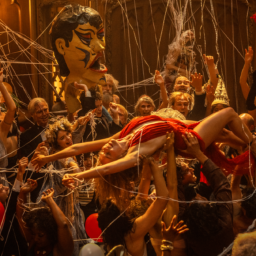
    By the time the title card for Babylon roars onto screen we’ve seen every bodily fluid imaginable—blood, sweat, tears, cum, bile, spit, shit (both human and animal). There’s song, dance, contortion, acrobatics, and an elephant. Welcome to Hollywood circa the late 1920s. The film industry is hitting its stride and dreamers from all over converge to have their hopes crushed and realized. But that’s what all of the films in director Damien Chazelle’s short but prolific filmography are about—people fighting to realize their dreams. In Babylon, our dreamers are New Jersey-born aspiring actress Nellie LaRoy (Margot Robbie) and Mexican-American film assistant Manny Torres (Diego Calva). For them, unlike the pair at the center of La La Land, the dream is very real. They shoot for the moon and actually get there. Unfortunately for them, there’s also this thing called gravity. 


    However, before the crash, Babylon is a cocaine-fueled, debaucherous love letter to excess and the people who dare to dream. Nellie and Manny meet for the first time at a… party. Let’s just say that this makes The Hangover look quaint. In classic Chazelle style the camera whips around the hilltop mansion catching glimpses of people dancing, drinking, fucking, and doing every illicit substance imaginable—it’s pure heartracing movie magic. In the chaos we also meet our cast of characters. There’s Nellie and Manny, of course. Then there’s silent film star Jack Conrad (Brad Pitt), the man everyone wants to meet and with one glance can send you to stardom. On stage playing the sax is trumpeter Sidney Palmer (Jovan Adepo) who along with his band support a song from Lady Fay Zhu (Li Jun Li), a sort of composite between screen legends Anna May Wong and Marlene Dietrich. Lastly we have Elinor St. John (Jean Smart), a journalist covering the industry with kink for sensationalism. 

    Over the next decade or so we follow each character as they grow in the industry. After the party, Manny is tapped to be Jack’s assistant while Nellie is asked to fill in on a film for an actress that… had a little too much fun. Just when you thought Babylon couldn’t get any more impressive, Chazelle treats us to another quick-cutting romp through the silent movie era as we watch multiple projects being filmed at the same time on the same studio lot. There’s Nellie’s prostitute in a bar movie where the director (Olivia Hamilton), in awe, watches as she’s able to cry on command in a hundred different ways. Then there’s Jack’s Grecian war epic, hilariously directed by Spike Jonze playing a very angry German director, complete with real explosions causing real injury to the extras. Meanwhile, Manny is tasked with retrieving a specific camera before the sun goes down and they lose their light. After that day, Nellie and Manny are hooked and on the up and up. 

    The kinetic energy of the first hour of the movie is equal parts overwhelming and enthralling. There’s isn’t a minute when something, whether in the foreground or background, keeps you hooked on the screen. And there’s of course Margot Robbie whose expressive face, spot on New Jersey accent, and full commitment to the off-the-wall but genuinely talented Nellie keep you rooting for her and Diego Calva whose charm, leading man good looks, and earnest, if not, naïve demeanor keep you hooked on him whenever he’s on screen. It’s always satisfying to watch people succeed (the same way it’s so satisfying to watch Sebastian and Mia fall in love in La La Land).

    But then, along comes sound. 


    ADVERTISEMENT


    And just like Singin’ In The Rain before it, nobody is ready for change as evidenced by perhaps one of the funniest scenes of the year where an entire studio can’t get on the same page to film a scene with sound—it ends with someone dying (if you know, you know). However, the fall is nowhere near as graceful as the rise. The movie begins to fall apart when it loses focus on its main characters. With asides to Adepo’s Sidney, whose storyline involving race is stunted by his screen time, and Lady Fay, who we never really get to know, we start to lose track of the development of our main protagonists. Even Jack’s climactic final scene, which is impactful regardless because of Chazelle’s sensitive direction, loses some impact because we don’t get to experience his journey there as deeply. It’s like the studio asked Chazelle who the main character was and he just said, “yes.”

    As Elinor writes a story about Nellie’s latest film, she calls it “a confluence of pure magic and trash.” That is exactly what Babylon is. When it is great, it lands among the stars. But when it misses, it crashes back down to earth—albeit in spectacular fashion. The third act, which takes us back to the lunacy of the first with a delicious appearance by Tobey Maguire, recaptures some of the magic and brings the movie to a roaring crescendo that leaves us buzzing. It helps the movie become greater than the sum of its parts. Even with a disappointing middle hour, Babylon is worth its three-hour runtime. The greatest litmus test for an ensemble movie like this is whether I’ll miss hanging out with its characters—and I will. Unhinged Nellie, steadfast Manny, enigmatic Lady Fay, they all left something of an impact. And that is all they ever wanted.


    ADVERTISEMENT


    More movies, less problems


    Hey! I’m Karl. You can find me on Twitter and Letterboxd. I’m also a Tomatometer-approved critic.

    💌 Sign up for our weekly email newsletter with movie recommendations available to stream.


    ADVERTISEMENT


  • ‘Birds of Prey’ is the best DCEU movie yet — movie review

    ‘Birds of Prey’ is the best DCEU movie yet — movie review

    After splitting with the Joker, Harley Quinn joins superheroes Black Canary, Huntress and Renee Montoya to save a young girl in Birds of Prey

    Quick review: Birds of Prey has all of the chaotic energy that a movie about Harley Quinn should have packaged in a frenetic action-filled romp that’s impossible to resist.

    Where to watch Birds of Prey: In theaters now

    Birds of Prey (and the Fantabulous Emancipation of One Harley Quinn) has all of the chaotic energy that a movie about Harley Quinn should have. It’s often messy, sometimes over-the-top, confusing, laugh out loud funny, cringy, endearing, and somewhere beneath it all is the best DC extended universe movie thus far.

    Harley Quinn (a pale, manic pixie dream girl Margot Robbie) was done largely wrong in the abysmal Suicide Squad where we were introduced to this universe’s version of the Joker. Not only was her character terribly one-note, but she also played nothing more than a second fiddle to other characters’ storylines — if you could even give the movie credit for having those. However, Birds of Prey is her movie. She even tells us that at the start.

    Mercifully, at the beginning of the film Mr. J and Harley break up — she’s not taking it well. Her debaucherous and boozy relationship mourning ends with a colorful decimation of the chemical plant where she first jumped into a vat of acid to prove her devotion to Mr. J and took on the persona of the excitable Harley Quinn — affected New York accent and all.

    And while she may find some closure in it, it also notifies all of Gotham City that she’s no longer under the Joker’s protection. That means everyone — and I mean everyone — is after her. That includes Roman Sionis (a deliciously camp Ewan McGregor), a crime lord whose trip for power went right through Helena Bertinelli’s (Mary Elizabeth Winstead) family — eventually, we learned she gave herself the name Huntress. She, trained as a master assassin, now seeks vengeance for her family’s deaths. But I, like the movie, am getting ahead of myself.

    💌 Sign up for our weekly email newsletter with movie recommendations available to stream.


    ADVERTISEMENT


    Birds of Prey poster

    Just like Harley, the movie’s plot, structure, and style is playful and erratic. We jump back and forth in time getting to know the women that will eventually form the eponymous Birds of Prey and how they’ll eventually come to work together. However, I’m reluctant to call this a team-up movie. There aren’t scenes where the women take a break to see that they’re not so different after all. The team-up is really a product of necessity, adding to this clever subversion of the superhero story.

    The other two members of the birds are Renee Montoya (Rosie Perez), an underappreciated but talented detective in the Gotham City Police Department, and Dinah Laurel Lance or Black Canary (Jussie Smollett-Bell), a singer in Roman’s club who eventually is recruited as his driver. Through thoroughly entertaining sequences, we learn of each woman’s abilities and their reason’s for seeking emancipation from the men in their lives.

    The more comic book movies stop being comic movies and start being about something else the better. Birds of Prey locks in on a feminist thematic consistency where women are underappreciated and often taken advantage of by men. Without being completely overt — looking at you Joker — it allows its characters to break free of those confines and eventually find each of the women peace.

    Along the way, we are treated to a delightfully whacky performance by Robbie that keeps you locked in on the movie’s energetic pace and tone. Without her, it’s clear that Birds of Prey would not work. However, director Cathy Yan has to be credited with keeping the movie largely on the rails. It could have easily become unwieldy, instead, the plotting feels tight, even when the actual visuals on the screen go berzerk.

    Not only that, the movie has some of the best action in a superhero movie in years. Easy to follow, but brutally beautiful to watch. It feels reminiscent of John Wick or Atomic Blonde. It’s impossible to not feel filled with adrenaline after watching the birds fight. Of course, they need to be fighting for something. In this case, they’re fighting for a teenage girl’s emancipation too. Cassandra Cain (newcomer Ella Jay Basco) has a bounty on her head after she pickpockets a diamond from Roman. And while that diamond might be a McGuffin, the journey that it inspires is full of purpose.

    As crazy as Harley is, Robbie plays her with a shread of humanity that was once there. Birds of Prey is keenly aware that although it’s a superhero movie, it needs to be grounded in something. And because of that, it soars.

  • ‘Bombshell’ fizzles out despite strong performances — movie review

    ‘Bombshell’ fizzles out despite strong performances — movie review

    Bombshell tells the story of how the women of Fox News banded together to take down one of the most powerful predators in media

    Quick review: Bombshell has a terrific performance by Charlize Theron as Megyn Kelly and an interesting story worth telling. However, the muddled tone, hollow characters, and awkward pacing make it a forgettable watch.

    There’s been a trend in the film industry of tackling serious topics and difficult people — that’s being kind — with a heavy dose of comedy and satire. In particular, Adam McKay seems to have cracked the code with the 2008 financial crisis movie The Big Short — which is good — and the Dick Cheney biopic Vice — which is bad. Then there was Craig Gillespie’s Tonya Harding biopic I, Tonya. Other than a shared style, these three movies had tremendous Oscar success. Keep that in mind when watching Bombshell — a new movie by Jay Roach following the demise of Fox News CEO Roger Ailes at the hands of several women at the network. 

    Truthfully, it feels like Bombshell is the worst version of this kind of movie because it feels like the story doesn’t justify the style — characters talking to the camera, punchy graphics popping up on the screen. Though, maybe it does. The Big Short’s Oscar-winning screenwriter Charles Randolph penned the script, so maybe it’s Roach that went wrong with the equation. The uneven tone shows just how much control someone like McKay had over his movies. 

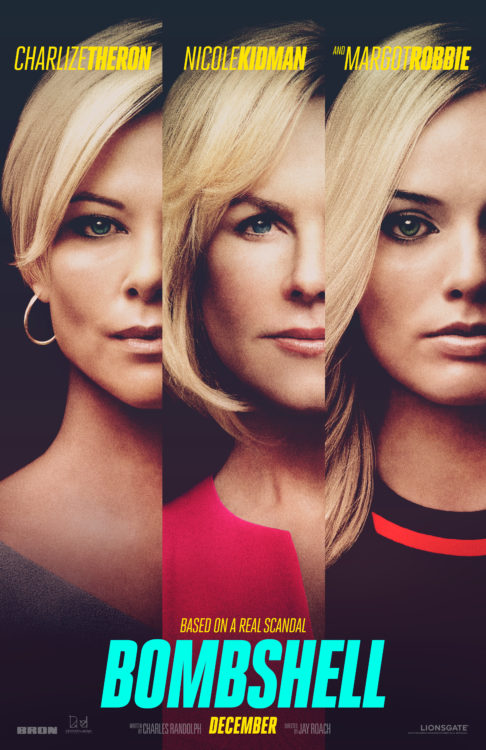
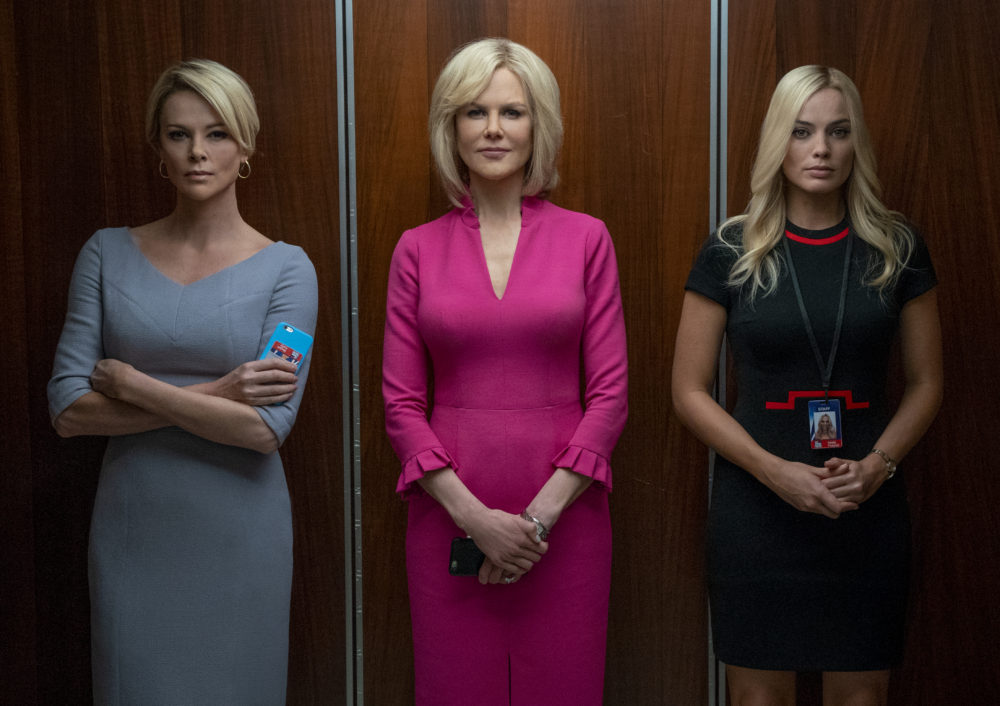
    We follow three women working at Fox News. An eerily transformed Charlize Theron as Megyn Kelly, Nicole Kidman as Gretchen Carlson, and Margot Robbie as the fictional Kayla Pospisil — an upstart keen on greatness at the network. The movie starts with a promising look into the fallout following the first Republican Primary Debate in 2016 where she confronted Donald Trump about his long history of harassment of women and misogyny.

    💌 Sign up for our weekly email newsletter with movie recommendations available to stream.


    ADVERTISEMENT

    After the brush-up, she gives us a to the camera tour of the Fox News offices where we learn about the setup of the organization. Ailes and the VPs that serve him are on the second floor while the owners of the network, the Murdochs, are on the eighth. While she’s dealing with harassment from angry Trump voters, the media, and even people within the network, Carlson is preparing for war. 

    After showing her lawyers a reel of misogynistic comments and moments on-air — she assures them that worse happened behind-the-scenes — she gets ready to be fired and subsequently sue Roger Ailes for sexual harassment. Meanwhile, Kayla, who was recently promoted to working on The O’Reilly Factor, maneuvers her way into meeting Ailes to be considered for on-air work explaining that Fox News is like a religion to her conservative family. However, during an uncomfortable meeting with Ailes, he asks her to slowly lift her dress as he “assesses” whether she’s fit to be in front of the camera.

    Bombshell poster

    Theron is pure electricity as Megyn Kelly — and it’s not just the makeup job like some recent Oscar winner. While the physical transformation helps, it’s the physicality that she imbues her with that makes it remarkable. There are subtle ways she captures Kelly — the way she carries herself, the cadence and deliberateness when she talks, her almost slow-motion movements. Without that central performance, the movie would fall apart. 

    The other woman are solid too. Kidman is a seasoned pro and does the best that she could with Carlson. However, the character is shamefully underwritten, which is a key problem with the movie. Because we split our time between Kelly, Carlson, and Kayla, we never get time to understand them outside of this particular situation. They’re reduced to vessels rather than actual people — maybe it’s because the actual people aren’t that great either. As for Robbie, she does great work, but her character feels like a construction for the story.

    That shouldn’t detract from the message. It seems to have been made with good intentions. Powerful men can be stopped when we support victims and when victims support each other. However, I don’t think Roach was equipped to tell that story. Rather than one about the victims, he focused on the intrigue. Instead of coalescing around Carlson’s crusade and the other woman around her, he’s more interested in Kelly’s journey to speaking out, as well. The issue there is that that journey isn’t entirely compelling either. 

    There are more layers to Bombshell than I am equipped to go into. So, I’ll leave you with this. More than being bad, it’s forgettable. Other than the scenes where Theron is giving room to flex her characterization, the rest of the movie feels is awkwardly paced, unevenly toned, and, to be frank, a slog. For a movie called Bombshell, it really has no impact. The news might even be more interesting. 

  • ‘Once Upon a Time in Hollywood’ movie review — Tarantino’s Summer of ’69

    ‘Once Upon a Time in Hollywood’ movie review — Tarantino’s Summer of ’69

    Once Upon a Time in Hollywood, Quentin Tarantino’s ninth film, is a romp through the Golden Age of Hollywood.

    30-second review: Once Upon a Time in Hollywood is as well-made, deliciously unhinged, and entertaining as any of Quentin Tarantino’s films. However, the impeccable recreation of 1969 Hollywood — from the sun-drenched cinematography to the lived-in costumes — is impeded by the thin story.

    The characters, both fictional and real, played by Brad PittLeonardo DiCaprio, and Margot Robbie are perfectly constructed — the performances are impeccable — but the narrative they’re thrown into feels shapeless and meandering for much of the runtime. Even when the ending tries to stitch it all together. Though, every scene sticks with you in some way. It’s that impact that has made Tarantino’s work endure. 

    Where to watch Once Upon a Time in Hollywood: In theaters now.

    Full review below ?


    If Quentin Tarantino knows how to do one thing it’s how to name characters. I mean, when you hear the name Rick Dalton you almost picture the washed-up TV cowboy that Leonardo DiCaprio plays. Though Dalton was a star burning bright for much of his career on the fictional show Bounty Law, Hollywood is a town that’s always on the move and it’s leaving him behind. 

    Like many TV stars of the era, he tried to make the pivot to movies to lesser success. In one hilarious scene, he tells the story of how he once almost played Steve McQueen’s part in The Great Escape — complete with DiCaprio superimposed into clips of the film. He laments his career to his best friend, driver, and frequent stunt double Cliff Booth (played by a better than ever Brad Pitt) who has a dark reputation in town as the man who killed his wife and got away with it — which is seen in yet another vignette. 

    Much of the movie is spent hanging out with the duo both together and separately as Dalton films a guest role on another TV western and Booth has a friendly sparring match with Bruce Lee (Mike Moh) and encounters with a curious group of hippies (mainly Pussycat played by Margaret Qualley).

    All the while, we follow young upstart Sharon Tate (Margot Robbie), her husband Roman Polanski (Rafał Zawierucha), and ex Jay Sebring (Emile Hirsch). Yes, we follow Sharon Tate during the Summer of ’69 — a.k.a. the summer of the Manson murders. More on that later. 

    Every scene — all vignettes really — are infused with Tarantino’s trademark style and sharp writing. But as one of the few of his films that isn’t told in chapters, the narrative desperately needed a structure. I can’t quibble with any of the scenes. They’re all entertaining and some hilarious. DiCaprio is better than ever as a semi-high functioning alcoholic trying to prove to himself he can still act. But because his journey doesn’t clearly fit into the larger narrative, so much of it feels pointless. 

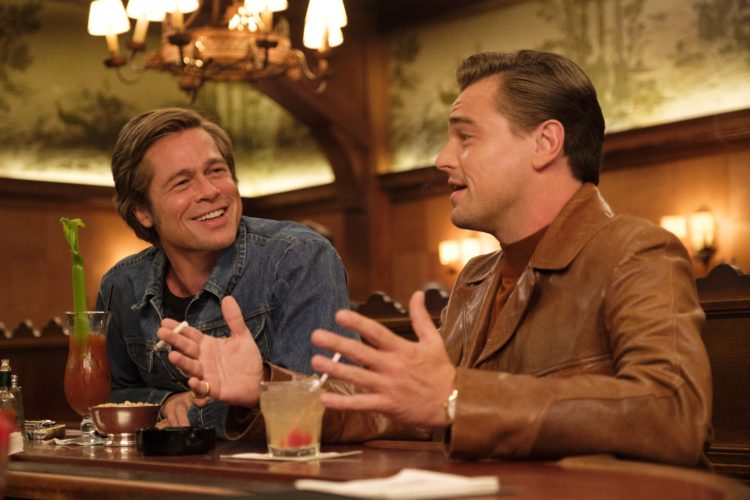
    Once upon a time in hollywood
    Brad Pitt and Leonardo DiCaprio star in ONCE UPON TIME IN HOLLYWOOD. Credit: Sony Pictures

    Despite the highly publicized spat between Tarantino and a reporter over the number of lines Robbie has in the film — apparently, more were added in later — Tate looms large in the film. If Dalton is a star fading, she is a star on the rise. She knows it and can’t believe it. Robbie is transfixing on the screen and any fan of Tarantino’s movies knows that following her for no discernible reason is going to pay off in some way — and it truly does. 

    The film’s ending is going to be a make or break moment for audiences. It’s classic Tarantino and theoretically ties the movie together. Whether or not it does is going to be subjective. Honestly, I’m not totally sure how I feel about it just yet. But ultimately, I land more positively on Once Upon a Time in Hollywood than I did his last film, The Hateful Eight, which I had a similar issue with. 

    Most of that is due to the fact that Tarantino is without a doubt a singular filmmaker. No one does what he does and those that try often fail — with the exception of Bad Times at the El Royale, which I loved. Each scene taken on its own is impeccably crafted and stick with you.

    In one scene, Sharon Tate sits in a theater and watches her own performance in The Wrecking Crew smiling as the audience react. In another, Dalton has a conversation with a precocious 8-year-old about his career and the wringer of the film industry. And in perhaps the best sequence of the movie, Dalton attempts to make it through a scene only to flub his lines after which he gives himself an alcohol-induced pep talk which reminds us why DiCaprio is a star. Each described sound uninteresting, but the reason Tarantino has endured is his ability to give each moment impact. Even without a solid story, Once Upon a Time in Hollywood certainly sticks with you.


    ADVERTISEMENT


    More movies, less problems


    Hey! I’m Karl. You can find me on Twitter and Letterboxd. I’m also a Tomatometer-approved critic.

    💌 Sign up for our weekly email newsletter with movie recommendations available to stream.


    ADVERTISEMENT

  • ‘Mary Queen of Scots’ review — Saoirse Ronan and Margot Robbie are dueling queens

    ‘Mary Queen of Scots’ review — Saoirse Ronan and Margot Robbie are dueling queens

    Mary Queen of Scots is a solid well-made historical drama with powerhouse performances by Saoirse Ronan and Margot Robbie

    Mary Queen of Scots is an exemplary example of how a historical drama can feel modern and have modern themes without sacrificing the story its based on. Saoirse Ronan—following up her career-high performance in Lady Bird—is a powerhouse as the titular famed young queen with high ambitions.

    So much of the power of the film comes from the performances, specifically Ronan and Margot Robbie, who plays Mary’s rival Queen Elizabeth of England, and Jack Lowden—most recently seen in the underrated Calibre or 2017’s Dunkirk—who is a revelation as Mary’s second husband Lord Darnley.

    When Mary Queen of Scots focuses on the interactions between these players it soars. It’s no wonder considering the film’s director Josie Rourke has a decade and a half of experience directing stage plays, which is what the movie often feels like—a stage play.

    It’s also apparent in the striking staging of many of the scenes. The film’s opening introduction to the two queens at the center of the film is so powerful. As Mary—introduced as she’s being walked to her execution—and Elizabeth appear on screen, we watch them walk from behind through a sea of men separating as they pass. It’s marvelous.

    Mary Queen of Scots
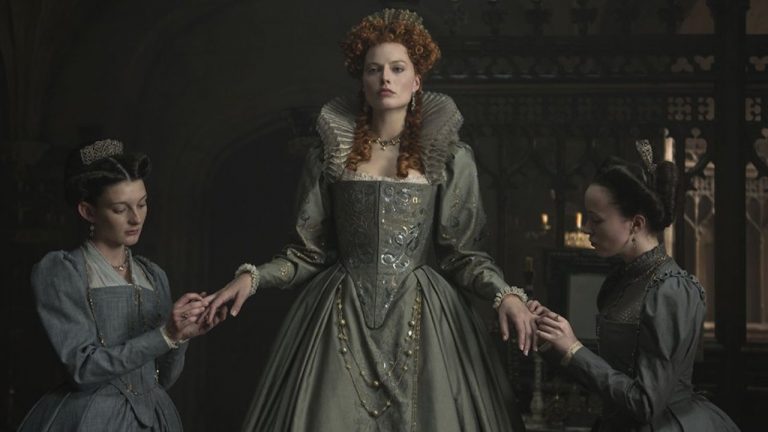
    Margot Robbie in Mary Queen of Scots. Courtesy of Focus Features.

    The film begins with Mary returning to Scotland after her husband King Francis II of France dies leaving her widowed. With a claim to both the thrones of Scotland and England, she quickly begins maneuvers to strengthen her position in Scotland and secure her place as the successor to Queen Elizabeth.

    Mary has the council of her illegitimate half-brother James, Earl of Moray (James McArdle) and the Earl of Bothwell (Martin Compston) guiding her through the politics, however, Mary clearly wants to be the one making the decisions. A main theme through the film is the two queens struggling to get men to look past their gender and allow them to rule as if they were kings. Queen Elizabeth even says at one point, “I choose to be a man.”

    As the political intrigue continues, Queen Elizabeth—represented by her ambassador played by Adrian Lester and counseled by her lover Robert Dudley (Joe Alwyn)—slowly begins to become jealous of Mary’s youth, beauty, intelligence, and ability to produce an heir.

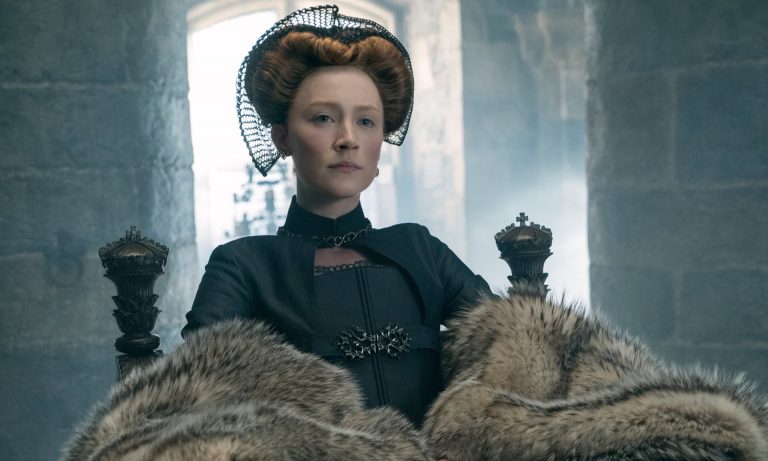
    The slow descent that Queen Elizabeth experience is incredibly captured by Robbie who is especially convincing as someone who is developing an inferiority complex to a seemingly invincible rival. On the other hand, Ronan’s steely confidence as Mary—her motivation is sometimes terrifying—is juxtaposed with moments where she is losing a handle of it all, particularly when Lord Darnley comes into the picture.

    The political intrigue is what makes the movie enjoyable to watch like an episode of Game of Thrones. Though, since it has less than two hours to tell an epic of a story House of Cards creator Beau Willimon‘s screenplay sometimes feels overstuffed. It also doesn’t give room for the audience to discover the character’s motivations or inner workings. Rather it dictates them.

    Mary Queen of Scots
    Jack Lowden and Saoirse Ronan in Mary Queen of Scots. Courtesy of Focus Features.

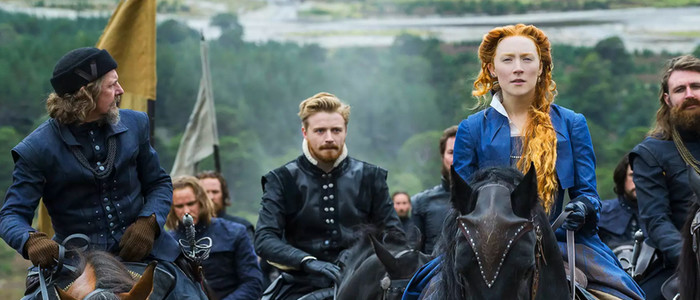
    Still, there are some stunning sequences that are captivating to watch thanks to Rourke’s strong direction and John Mathieson’s naturally lit cinematography. A battle sequence midway through the film—we watch as Mary on a cliff high above her rivals looks down knowing the physically and metaphorically has the higher ground—is chilling as is Mary’s execution scene—spoiler alert for history.

    Though Mary Queen of Scots is obviously a historical drama it feels updated. Many of the characters and background actors are actors of color and one character is even updated to being a queer character—Mary’s confidant David Rizzio (Ismael Cruz Córdova). It proves that there is no excuse to not have diversity in a film.

    Oddly though, Mary Queen of Scots feels less than the sum of its parts. There are rousing scenes mostly thanks to Rourke’s direction and Ronan and Robbie’s powerhouse performances—Lowden, Alwyn, and Lester deserve some credit on this front, as well. And the costume design by Oscar-winner Alexandra Byrne deserves to be in the Oscar conversation. However, the movie sometimes feels cold and disconnected.

    Still, its feminist themes around women trying to succeed in a world stacked against them and dominated by men is particularly poignant and one of its successes. Mary Queen of Scots may not be perfect, but it has so many elements that make it a solid historical drama. The meeting scene between Mary and Elizabeth is worth the price of admission alone.

    Mary Queen of Scots will be released in theaters on December 12th.

    Karl’s rating: