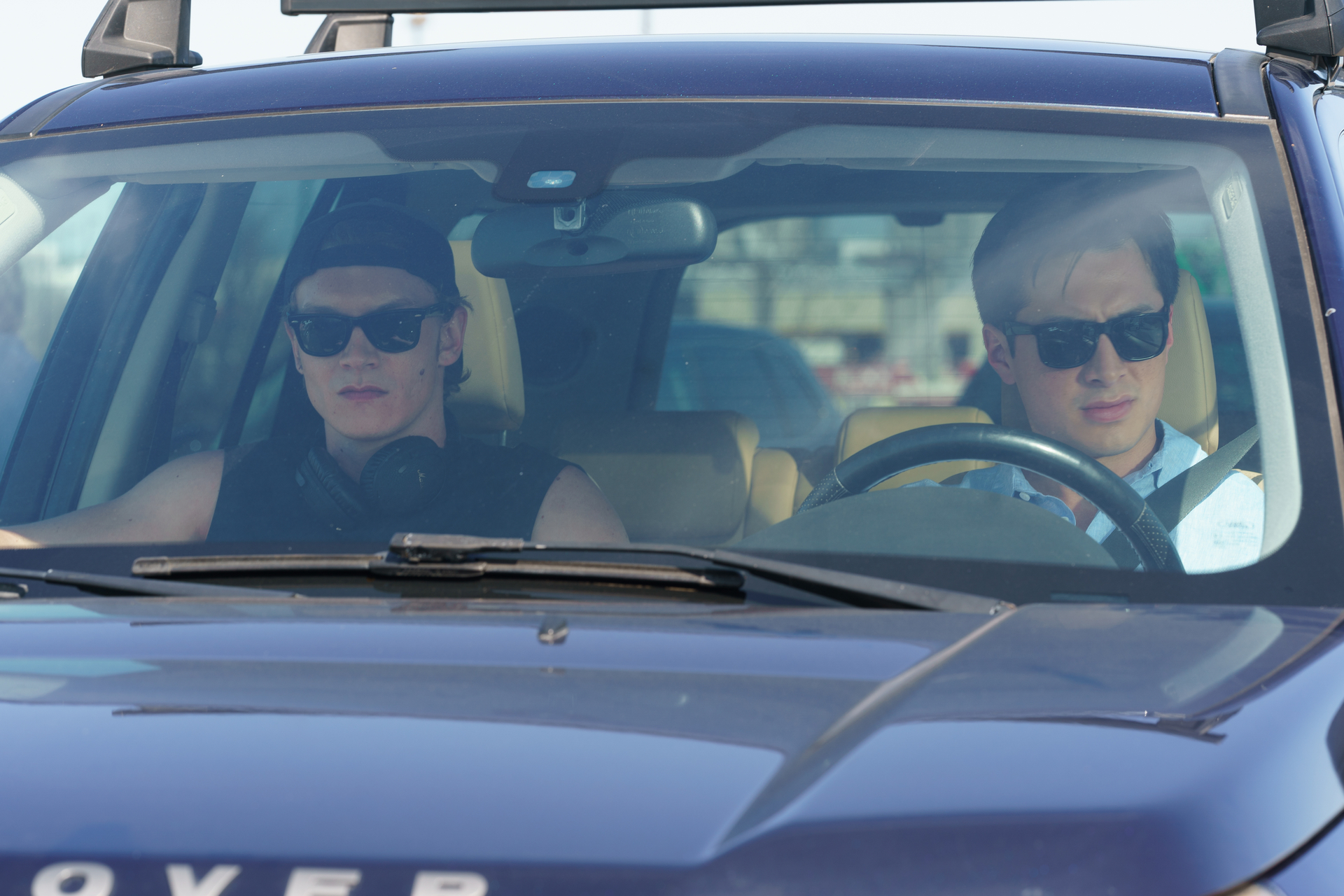
Category: Movies

  • ‘Bacurau’ NYFF review — The weird western Tarantino never made

    ‘Bacurau’ NYFF review — The weird western Tarantino never made

    Set in a Brazillian village in the near future, Bacurau follows the inhabitants as they become the victims to a sinister set of events.

    One-sentence review: Bacurau is a wonderfully weird western that is as funny as it is hard hitting and thrilling.

    Details: ? Kleber Mendonça Filho & Juliano Dornelles // ?? Brazil // ⏳ 130 minutes

    The cast: Sônia Braga, Udo Kier, Bárbara Colen

    Where to watch Bacurau: Playing at the New York Film Festival October 1st & 2nd. Tickets here.

    The inhabitants of the small remote fictional Brazilian village Bacurau don’t know it yet, but they’re at the center of a sinister act of greed, racism, and privilege. There are signs of the impending events. One night dozens of horses stampede through the center of the town. Another night the truck that supplies the village with water arrives with bullet holes in its side. When one of the village’s leaders and teacher (Wilson Rabelo) goes to show his students where Bacurau is on a map, it’s missing. Oh, and there’s a UFO-shaped drone stalking people. 

    All the oddball energy extends to the cast of characters that call the village home. There’s the boozed-up doctor unafraid to speak her mind (Sônia Braga), an outlaw who can never turn his machismo off (Thomas Aquino), and a DJ who doesn’t have a radio station and instead just broadcasts on giant speakers for anyone to hear.

    The tone of Bacurau, which had its North American premiere at the 57th New York Film Festival, is so unexpectedly delightful. It’s like the weird western that Quentin Tarantino never made — perhaps even lighter and sillier than even Tarantino. There are so many subtle quips and observations from characters that make you want to delve even deeper into their inner lives and history — the movie might have taken inspiration from Bong Joon-ho’s work including his most recent work Parasite, also playing at the fest. It makes the ensuing events even more difficult to stomach.

    The community is tight-knit. Almost alarmingly so. They’re so wary of outsiders that even when the skeevy mayor (Thardelly Lima) pays a visit they all disperse as he tries to buy their affection with less than stellar gifts — books dropped off by garbage trucks, illegal prescription medicine, expired food. It’s a less-than-subtle indictment of Brazil’s current powers-that-be. However, directors Kleber Mendonça Filho & Juliano Dornelles make it a point to center the movie of the community. The inhabitants of Bacurau are the strong beating heart at its center.

    bacurau
    The cast of Bacurau.

    It would be extremely difficult to review Bacurau without revealing at least in some part where the movie leads. However, that’s also part of the fun. So, I will say this before diving further into details. This movie is a genre-bender. It’s a western, a satire, a comedy, an action movie, a mystery all rolled up into beautifully packaged — and wild — narrative. And it ends up nowhere you think it would.


    ADVERTISEMENT


    ⚠️ Light spoiler warning.

    Eventually, the villagers realize that something is amiss. Along with all the weird events happening, they discover some inhabitants murdered. It’s revealed that the village is about to be besieged by a group of heavily armed American tourists in a twist of The Most Dangerous Game or The Purge. Another inspiration, as evidenced by the score and opening credits, is John Carpenter’s Assault on Precinct 13.

    We get to know this group and their motivations as well as the villagers. And it’s laid out pretty bluntly that this is an allegory for colonialization, class warfare, and the current political climate in Brazil and throughout the world. Exploring those themes as a sendup of 70s westerns and exploitation movies is a brilliant decision.

    While a lot of the movie’s themes and its portrayal of the community and its lore, which in some parts nearly veer into fantasy, are so specific to Brazil. There are so many threads connecting it to what’s happening in the United States. In fact, the white tourists, who are clearly parodies of rural Americans, feel entitled to their “hunt” of the villagers. For them, it only makes sense.

    If I have one complaint about Bacurau it’s that, whether intentional or not, the filmmakers clearly outline — almost too clearly — the message they’re trying to get across. It’s almost propagandist. However, that is forgivable because they go so hard on the quirkiness and camp of it all. Bacurau is a pure, hilarious, violent, and surprising delight.


    ADVERTISEMENT


    More movies, less problems


    Hey! I’m Karl. You can find me on Twitter and Letterboxd. I’m also a Tomatometer-approved critic.

    💌 Sign up for our weekly email newsletter with movie recommendations available to stream.


    ADVERTISEMENT


  • ‘Barbie’ is hot pink-splashed post-modern meta romp | review and analysis

    ‘Barbie’ is hot pink-splashed post-modern meta romp | review and analysis

    Barbie leads a perfect life, until something goes horribly wrong. To save herself, she needs to leave her pink utopia Barbieland and venture into the real world. Ken’s there too.

    Barbie looks camp right in the eye and turns it into a hot pink-splashed post-modern meta exploration of existentialism, feminism, the patriarchy and masculinity packaged in a satirical surreal musical comedy homage to classic. It isn’t just a movie of our time. It is the movie of our time.

    Barbie is in theaters now.

    Before I begin: I want to vocalize by full support of the Writers Guild of America and the Screen Actors Guild as they fight for a fair deal. 

    I’m so happy I live in a world where a major studio gave a female filmmaker a $145 million dollar budget to make a post-modern meta-exploration of existentialism, feminism, the patriarchy and masculinity packaged as a satirical surreal musical comedy homage to classic cinema based on a children’s toy. They’d probably faint if I tried to explain this to a Victorian child. Barbie is a movie of today. Or, more aptly, Barbie is *the* movie of today. 

    Writer-director Greta Gerwig (Lady Bird, Little Women)—she co-wrote the movie with her husband Noah Baumbach—captures our current societal, political, and cultural moment with confident hot pink-splashed ease as she double winks at the audience with the surreal absurdity of Barbieland. That is the most remarkable achievement of the movie. Barbie knows that we know that they know that we know exactly what they’re doing. It’s like a movie of a dream sequence in a movie in a dream. Things don’t quite make sense, but it adds up. In the case of Barbie, it adds up to a sharp, incisive, and profound reflection of our world—that also happens to be a hilarious summer romp that we’ve been craving.


    ADVERTISEMENT


    We begin in Barbieland, a picturesque bright idealistic world made of plastic. It’s basically the “how society would look if” meme if it was pink. Every morning the “Barbies” wake up, brush their teeth with comically-sized toothbrushes, “shower” with no water, and float down from their roofs to begin their day of… well, being perfect. Barbie is president (Issa Rae in a charming supporting role). She also holds every seat on the Supreme Court. She’s a doctor. A lawyer. Barbie is everything. As narrator Helen Mirren puts it in a cheeky voiceover, “all problems of feminism and equal rights have been solved” in the real world because of Barbie… or so the Barbies in Barbieland are led to believe—more on that later.

    All the visual gags and well-publicized hyper-stylized quirks are as delightful as you’d imagined (Her heels don’t hit the ground! They drink from cups with nothing in them! Gravity is more of a concept than reality!). The specificity and absolute absurdity of the world-building is joyous, as is the “giant blowout party with all the Barbies, and planned choreography, and a bespoke song.” Margot Robbie as our protagonist Stereotypical Barbie (her words not mine)—aka the Barbie you think of when someone tells you to think of a Barbie—is perhaps the most charismatic and perfect of them all (if that’s even possible). 

    But then at the end of their perfect Disco-inspired musical number to Dua Lipa’s “Dance the Night” a though creeps into Barbie’s head: “Do you guys ever think about dying?” Cue the record scratch.

    The next day, Barbie’s perfect morning isn’t quite perfect. Her “shower” is cold, waffles burnt, and, most alarmingly, her feet are flat (*gay gasp*)! She laments, “I would never wear heels if my feet were shaped this way.” There are countless of those precise observational quips. This leads her to Weird Barbie (Kate McKinnon)—a Barbie who was played with too hard and can’t seem to keep herself out of the splits—who explains that someone playing with her in the real world is making her this way (she even starts to get *gulps* cellulite on her thigh). Weird Barbie offers her a red pill and a blue pill. Well, in the world of Barbie it’s a pink sparkly pump and a Birkenstock. Go to the real world and fix the problem or stay here and suffer—she chooses the pump. Weird Barbie makes clear it wasn’t an option to begin with. So Barbie takes a car to a bike to a rocket to an RV to a boat into the real world… oh, and Ken (Ryan Gosling) is there too.


    ADVERTISEMENT


    Like Singin’ in the Rain—a clear inspiration for the movie—delightfully wrestled with the change from silent movies to sound, Barbie wrestles with the change from Barbie’s ignorant utopic existence in Barbieland to the bleak reality of the real world where she’s ogled on by men in a world ruled by them. Ken, on the other hand, is like a teenage boy discovering the Joe Rogan podcast. His eyes are “opened” to the possibilities of being a man and a world ruled by the patriarchy—and learns its limits. His world shifts from only have a good day if Barbie looks at him to seeing he can have that power all to himself—what could possibly go wrong?

    Gerwig bakes the themes of the movie into the world and story seamlessly. She makes the concept of Barbie inseparable from gender and gender roles—her very existence is rooted in the experience of being a woman. In a climactic scene, Gloria (America Ferrara), a Mattel employee in the real world, lists the all the reasons why being a woman is so frustrating (you have to be skinny, but you can’t say you’re skinny you have to say you’re “healthy”; you have to strive to be successful, but you can’t be mean). It calls into question Barbie’s place in the real world—is she there to just make women feel bad that they can never achieve that level of success? Though Mattel is directly involved in the movie, they are just as much of a target of the movie’s dismantling of the paradoxes that make up our society—represented here by a bumbling CEO played by Will Ferrell and low-level intern Aaron (Connor Swindells).

    Like any hero’s journey, Barbie’s adventure leads her back to Barbieland where things are looking different—and with more horses. From there, Barbie evolves to a battle of philosophies that call into question the foundations of our society.


    ADVERTISEMENT


    While Robbie’s performance is pitch-perfect playing up the plastic perfection (and realistic ignorance) of Barbie as she discovers what it is to be human (it’s giving Tyra Banks in Life Size), it’s Ryan Gosling’s performance as Ken that perhaps best encapsulates the high wire act that Gerwig accomplishes between the energetic larger-than-life tone and complex societal themes. In a scene that is destined to be his Oscar clip, Gosling portrays a devastated Ken experiencing real emotion for the first time while throwing himself around the Barbie dream house in what can only be described as a slapstick tantrum over the nearly impossible balancing act of existing not for something but yourself.

    It’s difficult to watch Barbie and not be enamored by the sheer audacity of it all. It looks camp right in the eye and turns it into an artful, wildly entertaining, sharply funny deconstruction of the very fabric of our existence and the existence of our society. That isn’t even a hyperbolic statement. The intro parody of 2001: A Space Odyssey isn’t only brilliantly hilarious, it’s the perfect cinematic comparison. Barbie exists in a different meta-plane than other movies. By the time an Avengers: Endgame-level battle is levied between Gosling’s Ken and Simu Liu‘s Ken using sports equipment that eventually devolves into a “Greased Lightning”-inspired musical number it feels like you’ve seen the bounds of cinema expanded. As Billie Eilish’s “What Was I Made For?” underscores and an emotional montage on screen you can help but be moved by this movie about a doll.

    So take the sparkly pink pump and step into Barbieland.


    ADVERTISEMENT


    More movies, less problems


    Hey! I’m Karl. You can find me on Twitter and Letterboxd. I’m also a Tomatometer-approved critic.

    💌 Sign up for our weekly email newsletter with movie recommendations available to stream.


    ADVERTISEMENT


  • ‘The Little Mermaid’ review: Halle Bailey swims to stardom

    ‘The Little Mermaid’ review: Halle Bailey swims to stardom

    Disney’s 1989 classic The Little Mermaid makes a splashy return to the screen with a refresh that finally bucks Disney’s live-action adaptation losing streak

    The Little Mermaid is largely successful off the back of recreating the original film — but how wonderful it looks in live-action. Bolstered by a star-is-born turn from Halle Bailey as Ariel, this is the Disney live-action to finally capture some of the magic from our childhood for the new generation.

    The Little Mermaid is in theaters May 26.

    “Welcome back, ladies and gentlemen. Before we continue I’d like to apologize to anyone who might be upset or offended by what you saw before the break. It’s not every day you see a demonic possession on live television.” That’s how host Jack Delroy (David Dastmalchian)follows up a segment of the Halloween episode of his late-night talk show where he interviews suspected possession victim young teen Lilly (Ingrid Torelli). While it might seem bizarre for a 1977 late-night show, it’s by design. Night Owls with Jack Delroy is lagging in ratings behind a little program known as The Tonight Show starring Johnny Carson and it’s sweeps week — the time of the month when Nielsen comes up with its ratings for what Americans are watching on TV. If you were desperate enough you’d commune with the devil too. 

    After enduring expressionless hyperrealistic animals in The Lion King and an eerily artificial genie in a surprisingly dull Aladdin, Disney has finally broken their live-action losing streak with Rob Marshall’s adaptation of the 1989 classic The Little Mermaid. And there were two clear reasons for the movie’s success. 

    There’s Marshall himself, who has become the go-to movie musical adapter since winning Best Picture for Chicago in 2002 — though The Little Mermaid is easily his best film since. And, of course, there’s Halle Bailey who makes the jump from musician to actor with the ease of Lady Gaga in A Star is Born, Janelle Monae in Moonlight and Hidden Figures, and Rina Sawayama in John Wick: Chapter Four (What? Like it’s hard?). If anyone keeps the movie afloat, it’s her Ariel.


    ADVERTISEMENT


    This version of The Little Mermaid largely follows the story of the original. Ariel, a young mermaid who longs to live in the surface world, gets the chance to live her dream when sea witch Ursula (a deliciously camp Melissa McCarthy) strikes a deal to make her into a human in exchange for her siren call. Of course, there’s a catch. If she doesn’t get the swoon-worthy Prince Eric (Jonah Hauer-King) to give her true love’s kiss by the third sunset, she will revert to a mermaid and find herself pledged to Ursuala.

    Her journey to the surface world is aided by her father King Triton’s (Javier Bardem) trusted advisor Sebastian (voiced by Hamilton’s Daveed Diggs), her (terrifying looking) fish friend Flounder (Jacob Tremblay), and squirrely seagull Scuttle (Awkwafina). And while the surface world brings its own kind of magic, it is ahem… under the sea that is the most impressive.

    Where Jon Favreau strived for realism in The Jungle Book or The Lion King (because a lion version of Shakespeare’s “Hamlet” just begs for realism), Marshall was unafraid to infuse surrealism into the world — it is a movie about mermaids after all. There’s no better example than the colorful musicality of “Under the Sea”, which largely errs to the original sequence. As Diggs joyously laments on the wonders of their ocean world, colorful sea creatures dance around the coral reef — whether sea turtles marching to the beat or sea fans mimicking burlesque fans. It’s the kind of energized musical number that was lost to the uncanny valley of The Lion King


    ADVERTISEMENT


    “Kiss the Girl” is formed by the sounds of the environment — wind through the trees, bird fluttering their wings — bringing the impossible magic of the cartoon into the real world. McCarthy, taking note from Ursula’s original inspiration Divine, brings us a deliciously camp “Poor Unfortunate Souls” that teems with the spellbinding antics of the original number while bringing a new sense of danger with the live-action elements. The movie’s sense of stakes was a welcome surprise. 

    And while the classic numbers certainly do the heavy lifting, the movie charts new territory. Screenwriter David Magee (Life of Pi, Finding Neverland) expanded the lore in ways that help the movie reach new depths (though others leave it shipwrecked). Moving the story to an unspecified Caribbean island adds a fresh perspective to the well-worn Disney Princess genre — and adds an island musicality that keeps the scenes between musical numbers light and airy.

    New numbers like “For the First Time” fall into step with the classic score, while still feeling like it fits within the tone and possibilities of this adaptation. The island kingdom itself has a new life (and music) to it — adding a new complexity to the themes of the original.

    At the core of the movie’s success, however, is Hauer-King’s Prince Eric, who feels more than just a love interest thanks to added character development — and a new musical number that plays suspiciously like “Edgar’s Prayer” from Barb and Star Go To Vista Del Mar — and, of course, Bailey’s singular Ariel who teems with charisma, uniqueness, nerve, and talent. Her version of “Part of Your World” (and its subsequent reprises) have bore themselves into my psyche since seeing the movie — and likely the rest of the audience if judging by the applause break after her final ethereal riff.


    ADVERTISEMENT


    Bailey’s take on “Part of Your World” is perhaps the greatest characterization of the movie’s success. Her rendition has a deep reverence for Jodi Benson’s iconic original but finds ways to push the song in new directions to feel one with herself. As much as she is the lead of the movie, the movie is her. From her palpable chemistry with Hauer-King to her doe-eyed wonder at the surface world to her teenage angst of where she came from, her performance drives (sails?) The Little Mermaid to its peak.

    Does The Little Mermaid change my mind about Disney’s commitment to producing films off of existing IP? No. I’d rather they focus on creating new stories for this generation to fall in love with. Still the movie, for all its imperfections and missteps — I will never forgive Lin Manuel Miranda for subjecting me to “The Scuttlebutt” rap — finds heart within material that already had one beating strong in it. And that heart is Halley Bailey, the Disney princess a new generation needs and deserves.

  • ‘Mafia Mamma’ review: Toni Collette’s mob comedy needs to get whacked

    ‘Mafia Mamma’ review: Toni Collette’s mob comedy needs to get whacked

    Mafia Mamma follows a down-on-her-luck California woman who unwittingly becomes the head of her family’s crime operation in Italy

    Mafia Mamma tries to be Under the Tuscan Sun, Goodfellas and a raunchy 2000s comedy yet fails at all three. The jokes are so low-brow (and vaguely offensive) to even laugh at let alone with. Sloppily made. Frustratingly repetitive. Toni, I’m so sorry.

    Mafia Mamma may have been the greatest comedy of all time… back in 2008. Today, not so much. It’s not fault of the actors, who are doing their absolute best with material that reads like it was written by a screenwriter that has since been canceled. Toni Collette is such a master at comedic line delivery that she could make War and Peace funny. The problem here is that the jokes are so broadly-written that even good line-delivery make the punchline land—it’s what happens when jokes are only punchlines.

    It’s a shame that a concept ripe for laughs (and camp) goes to waster (sleeping with the fishes, if you will). Kristin, a California wife and mother, is surrounded by men who think her job is to kowtow to their will—worst of all is her man-child husband Paul (Tim Daish) who, of course, is in a band. So when she gets a call from her late grandfather’s no-nonsense Italian “assistant” Bianca (Monica Bellucci) asking her to come to Italy to help settle his affairs, Kristin is hesitant… that is until she catches her husband in a compromising position in their basement.


    ADVERTISEMENT


    Seeing an opportunity to get herself out her rut—and with some encouragement from her friend Jenny (Sophia Nomvete) who insists she have an “Eat, Pray, Fuck” vacation—Kristin travels to Italy. However, at the funeral the mourning is quickly interrupted by gunfire (and maybe one of the worst “walking away from an explosion” shots I’ve ever seen—Angela, show them how it’s done). Turns out, Kristin’s grandfather was the boss for one of the most powerful crime families in Italy, The Balbanos, and he wanted her to be his successor much to the chagrin of his nephew Fabrizio (Eduardo Scarpetta).

    Kristin ambles her way through the crime org including negotiating peace between crime families, managing their sh-tty wine cover operation, and trying to get d-ck. That last part is what makes Mafia Mamma nearly unbearable to watch. While Collette is completely immersed in Kristin’s naïve doe-eyed persona, that one-note doesn’t often change even when the movie takes a turn towards female empowerment. In many cases, it’s her dopiness that saves her rather than her own skill. Throw in Super Mario Bros.-levels of Italian stereotypes, unnecessary levels of gross-out gore, and a plot that doesn’t actually go anywhere despite it going everywhere and you have a crime-comedy that’s dead-on-arrival.


    ADVERTISEMENT


    More movies, less problems


    Hey! I’m Karl. You can find me on Twitter and Letterboxd. I’m also a Tomatometer-approved critic.

    💌 Sign up for our weekly email newsletter with movie recommendations available to stream.


    ADVERTISEMENT


  • ‘Babylon’ review: Pure magic and bad taste

    ‘Babylon’ review: Pure magic and bad taste

    Babylon follows the rise and fall of several figures during the 1920s Hollywood silent film era. But sound (and change) are on the horizon.

    Babylon is “a confluence of bad taste and pure magic,” as Jean Smart’s character describes star-on-the-rise Nellie LaRoy. In the mess of its unfocused plot and spectacle is a rousing story of evolution, fame, and, yes, the power of movies that’s greater than the sum of its parts.

    Diego Calva and Margot Robbie’s storylines are the most successful as two Hollywood dreamers on parallel paths to success. However, the movie gets distracted by its own flash and their character development gets stunted. Still, the movie manages to land on its feet, just barely.

    It is a huge swing. If it’s a hit or miss I’m not entirely sure. What I do know is it didn’t lose me for its three-plus hour runtime and the ending left me reeling. Did it earn it? Not quite. But Chazelle knows how to put a movie together, even if he’s not fully mastered the storytelling part.

    Babylon is now streaming on Parmount+. Get one week free here.

    By the time the title card for Babylon roars onto screen we’ve seen every bodily fluid imaginable—blood, sweat, tears, cum, bile, spit, shit (both human and animal). There’s song, dance, contortion, acrobatics, and an elephant. Welcome to Hollywood circa the late 1920s. The film industry is hitting its stride and dreamers from all over converge to have their hopes crushed and realized. But that’s what all of the films in director Damien Chazelle’s short but prolific filmography are about—people fighting to realize their dreams. In Babylon, our dreamers are New Jersey-born aspiring actress Nellie LaRoy (Margot Robbie) and Mexican-American film assistant Manny Torres (Diego Calva). For them, unlike the pair at the center of La La Land, the dream is very real. They shoot for the moon and actually get there. Unfortunately for them, there’s also this thing called gravity. 


    However, before the crash, Babylon is a cocaine-fueled, debaucherous love letter to excess and the people who dare to dream. Nellie and Manny meet for the first time at a… party. Let’s just say that this makes The Hangover look quaint. In classic Chazelle style the camera whips around the hilltop mansion catching glimpses of people dancing, drinking, fucking, and doing every illicit substance imaginable—it’s pure heartracing movie magic. In the chaos we also meet our cast of characters. There’s Nellie and Manny, of course. Then there’s silent film star Jack Conrad (Brad Pitt), the man everyone wants to meet and with one glance can send you to stardom. On stage playing the sax is trumpeter Sidney Palmer (Jovan Adepo) who along with his band support a song from Lady Fay Zhu (Li Jun Li), a sort of composite between screen legends Anna May Wong and Marlene Dietrich. Lastly we have Elinor St. John (Jean Smart), a journalist covering the industry with kink for sensationalism. 

    Over the next decade or so we follow each character as they grow in the industry. After the party, Manny is tapped to be Jack’s assistant while Nellie is asked to fill in on a film for an actress that… had a little too much fun. Just when you thought Babylon couldn’t get any more impressive, Chazelle treats us to another quick-cutting romp through the silent movie era as we watch multiple projects being filmed at the same time on the same studio lot. There’s Nellie’s prostitute in a bar movie where the director (Olivia Hamilton), in awe, watches as she’s able to cry on command in a hundred different ways. Then there’s Jack’s Grecian war epic, hilariously directed by Spike Jonze playing a very angry German director, complete with real explosions causing real injury to the extras. Meanwhile, Manny is tasked with retrieving a specific camera before the sun goes down and they lose their light. After that day, Nellie and Manny are hooked and on the up and up. 

    The kinetic energy of the first hour of the movie is equal parts overwhelming and enthralling. There’s isn’t a minute when something, whether in the foreground or background, keeps you hooked on the screen. And there’s of course Margot Robbie whose expressive face, spot on New Jersey accent, and full commitment to the off-the-wall but genuinely talented Nellie keep you rooting for her and Diego Calva whose charm, leading man good looks, and earnest, if not, naïve demeanor keep you hooked on him whenever he’s on screen. It’s always satisfying to watch people succeed (the same way it’s so satisfying to watch Sebastian and Mia fall in love in La La Land).

    But then, along comes sound. 


    ADVERTISEMENT


    And just like Singin’ In The Rain before it, nobody is ready for change as evidenced by perhaps one of the funniest scenes of the year where an entire studio can’t get on the same page to film a scene with sound—it ends with someone dying (if you know, you know). However, the fall is nowhere near as graceful as the rise. The movie begins to fall apart when it loses focus on its main characters. With asides to Adepo’s Sidney, whose storyline involving race is stunted by his screen time, and Lady Fay, who we never really get to know, we start to lose track of the development of our main protagonists. Even Jack’s climactic final scene, which is impactful regardless because of Chazelle’s sensitive direction, loses some impact because we don’t get to experience his journey there as deeply. It’s like the studio asked Chazelle who the main character was and he just said, “yes.”

    As Elinor writes a story about Nellie’s latest film, she calls it “a confluence of pure magic and trash.” That is exactly what Babylon is. When it is great, it lands among the stars. But when it misses, it crashes back down to earth—albeit in spectacular fashion. The third act, which takes us back to the lunacy of the first with a delicious appearance by Tobey Maguire, recaptures some of the magic and brings the movie to a roaring crescendo that leaves us buzzing. It helps the movie become greater than the sum of its parts. Even with a disappointing middle hour, Babylon is worth its three-hour runtime. The greatest litmus test for an ensemble movie like this is whether I’ll miss hanging out with its characters—and I will. Unhinged Nellie, steadfast Manny, enigmatic Lady Fay, they all left something of an impact. And that is all they ever wanted.


    ADVERTISEMENT


    More movies, less problems


    Hey! I’m Karl. You can find me on Twitter and Letterboxd. I’m also a Tomatometer-approved critic.

    💌 Sign up for our weekly email newsletter with movie recommendations available to stream.


    ADVERTISEMENT


  • ‘Black Bear’ is Aubrey Plaza’s best performance to date | movie review

    ‘Black Bear’ is Aubrey Plaza’s best performance to date | movie review


    ADVERTISEMENT


    A young couple’s relationship is thrown into turmoil when an enigmatic filmmaker moves in with them to try and complete her latest film in Black Bear.

    With its sharp script, interesting structure, and a watershed performance by Aubrey Plaza, Black Bear is a deliciously entertaining and satirical quasi-thriller romp about what it is to be a creative.

    Black Bear is streaming on Paramount+. You can subscribe here.

    Black Bear, which premiered in the NEXT section of the 2020 Sundance Film Festival, invokes feelings of a cross between a relationship drama like Before Midnight and a meta satire like One Cut of the Dead. And if that combination sounds crazy, it kind of is. Black Bear could have easily felt like a party trick of a film where a mid-movie shift changes everything you know about the film. Still, it manages to be more than a clever gimmick. 

    While Lawrence Michael Levine’s careful direction and sharp screenplay help, it is Aubrey Plaza’s dynamite performance as protagonist Allison that does a lot of the work to pull the movie off. Allison at first comes off like an alternate version of Plaza herself. She is a writer, director, and actress who escapes to the mountain home of a friend of a friend to get over a bout of writer’s block—and she maintains the same dry deadpan wit that is patently Plaza. 


    ADVERTISEMENT


    💌 Sign up for our weekly email newsletter with movie recommendations available to stream.


    ADVERTISEMENT


    The homeowners who are hosting Allison, Gabe (Christopher Abbott—also in Possessor at the festival) and Blair (Enemy’s Sarah Gadon), are a long-term couple—important to note that they’re not married—who are expecting a child. They’ve been offering their isolated lake home to creatives hoping to help inspire them, as they are with Allison, a filmmaker trying to complete writing her latest film.

    From the start, it’s clear that there is some simmering tension between the trio. Blair and Gabe seem to constantly contradict each other and take subtle jabs that they know sting. At the same time, it’s clear that Gabe is attracted to Allison, which Blair picks up on. It leaves her in the odd position of hosting Allison while trying to steer her boyfriend in the right direction. 

    The tension that Levine derives is palpable, though something seems off. Things seem maybe a touch too perfect. Or maybe too dramatic? Perhaps it’s that the dialogue is hyper stylized? Or maybe too natural. Eventually the movie answers at least part of the question of what’s going on, but I will spare you the detail because the reveal is all a part of the trick that makes the movie work. 


    ADVERTISEMENT


    Black Bear is about everything and nothing. Not that it doesn’t have a clear purpose, but because of its experimental structure its allegiances are unclear. There are threads for and against the creative process, relationships, and gender dynamics that could have all easily become overwrought. But because of the way the movie twists to a sharp, satirical tone that is at times uproariously funny you’re never left too deep in dramatic waters. Until the climax. 

    The only proper way to end this review is with a full paragraph of praise for Aubrey Plaza’s performance which I’ll begin with ARE YOU F#CKING KIDDING ME!? Plaza’s performance is mind-blowing in its complexity. Allison herself is a character that code switches depending on who she’s talking to, but at the same time seems susceptible to manipulation. Or is she? Her thoughts are opaque and oh so transparent at the same time to the point that you can at times see her thinking through how she should come off at any given moment. But when that scene happens, and you’ll know it when you see it, you know exactly what she’s thinking. Give her the damn Oscar. 


    ADVERTISEMENT


    More movies, less problems


    Hey! I’m Karl. You can find me on Twitter and Letterboxd. I’m also a Tomatometer-approved critic.

    💌 Sign up for our weekly email newsletter with movie recommendations available to stream.


    ADVERTISEMENT


    💌 Sign up for our weekly email newsletter with movie recommendations available to stream.


    ADVERTISEMENT


  • ‘Air’ balls hard | movie review

    ‘Air’ balls hard | movie review

    Ben Affleck’s Air tells the story of how Nike struck the biggest partnership in sports history with Michael Jordan and the Air Jordan

    Air is a sturdy crowd-pleasing “based on a true story” dramedy that leverages every aspect of the biopic genre to a precision level.

    There’s always that one scene in movies about inventors or companies where the main character gets up and gives an impassioned speech about why what they’re doing is important or matters. Ben Affleck’s Air is no exception. However, when Sonny Vaccaro (Matt Damon) gives a speech to convince a young Michael Jordan (Damian Young) to partner with Nike on what will eventually become the Air Jordan, Affleck cuts the scene with archival footage from the real Jordan’s life. News clips covering his highest highs and lowest lows. In one cut we see an archival news report about his father’s murder before cutting back to the film’s version of James Jordan (Julius Tennon). The effect is nothing short of show-stopping, especially since the film takes care to never let us get a full look at the young Michael. 

    That emotional impact was particularly surprising to me considering I don’t have much of an attachment to the subject matter at all. 


    ADVERTISEMENT


    The movie begins with a breezy montage of 1984. Everything from Princess Diana to Tetris is displayed setting the backdrop. Further adding to the background is perhaps the most shocking true fact the movie exposes: “Nike… 17%.” That’s the share of the athletic shoe market that Nike commands (today it’s over 40%). And while the upstart company had a fast start, their biggest competitors Adidas and Converse continue to cover the majority of the feet in the nation. Air has such a distinct sense of its time and place that it makes it hard to fathom the colossus it eventually becomes. 

    That’s thanks in part to the performances by the ensemble — and Affleck in particular as Nike founder and CEO Phil Knight — that perfectly captures the energy of a startup that is finding its footing as it finds wider success. The movie is even interspersed with title cards the ten principles of Nike’s mission statement — their inclusion, as someone who has worked in many start-ups, felt facetious. In direct opposition to Knight, who has become somewhat of a corporate shill (despite still traversing the office barefoot), is Sonny. Hilariously, and like many companies, Sonny’s role is obscure and a bit undefined with the goal of “making things better.” However, he can be boiled down to a talent scout.

    With Nike’s back against the wall and the NBA draft behind them, it’s Sonny’s job to find three basketball players to split a $250k partnership with Nike to save their failing basketball shoe brand — wild to think about. After going through all the potentials from the top draft picks, Sonny sets his sights on young upstart Michael Jordan. He could just see the spark of greatness, even when others doubt him. So sets off his campaign to lock down MJ, even if it means betting his entire career — and Nike’s entire budget — on it. Even Sonny’s greatest supporter in the office, Howard White (Chris Tucker — doing scene-stealing comedic character work) is skeptical of their chances. Still, Sonny fights for it. 


    ADVERTISEMENT


    Like Ford v. Ferrari or Moneyball, as two recent hall of fame examples, Air is the epitome of a dad movie. As in, dads will watch it and nod along like they too are an expert in athlete-brand partnerships at a major shoe corporation. There’s something about process movies — or movies about people just passionately and effectively doing their job well (i.e. every Tom Hanks movie) — that gets dads going. Well, call me a daddy because I was nodding along with them. 

    Affleck breezily moves between scenes of Sonny analyzing game tape, working with wacky designer Pete Moore (Matthew Maher), or strategizing around their pitch meeting — “Phil, you have to walk in seven minutes late.” It’s the kind of technical fodder that we see more often in journalism movies, here it’s a little more fun. And further tying into the theme of startup culture, more than once a character references the scramble to create the pitch feeling like “the old Nike days” — that glorious period of a startup’s life where you have nothing and everything to lose, but you’re having fun scrappily surviving.


    ADVERTISEMENT


    Even with that momentum, Air takes a few moments to breathe (pun intended) thanks to two key players. First is George Raveling (Marlon Wayans), Jordan’s coach for the 1984 Olympic Games, who in a barnburner biopic inspirational one-scene special recounts how Martin Luther King, Jr. gifted him his “I Have a Dream” speech. Second is Viola Davis as Michael’s mother Deloris Jordan who, for lack of a better phrase, is the heart of the movie in both of her expertly-acted scenes (she’s not an EGOT winner for nothing). In particular, a negotiation scene late in the movie, performed with steady confidence only an actress Davis’ stature can muster, evokes the strongest emotional response of the movie. 

    Air is as sturdy of a crowd-pleasing “based on a true story” dramedy as they come — this coming from someone who thinks Argo, Affleck’s last directorial effort, is one of the worst Best Picture winners in recent memory. However, where Argo’s emotional manipulation feels like… well, manipulation, Air feels genuine. It never overstates its stakes or forces you to care about its characters. Even a mid-movie soliloquy where marketer Rob Strasser (Jason Bateman) tells Sonny about his divorce and estranged relationship with his daughter only mines the smallest of eye rolls. Does Air do anything to reinvent the biopic? Far from it. Does it leverage every aspect of it to a precision level? Absolutely. It’s the equivalent of watching Michael Jordan fly through the air to dunk. An athlete performing to his highest technical level, but with extra magic that only he could assemble. 


    ADVERTISEMENT


    More movies, less problems


    Hey! I’m Karl. You can find me on Twitter and Letterboxd. I’m also a Tomatometer-approved critic.

    💌 Sign up for our weekly email newsletter with movie recommendations available to stream.


    ADVERTISEMENT


  • ‘How To Blow Up a Pipeline’ review: An explosive eco-thriller

    ‘How To Blow Up a Pipeline’ review: An explosive eco-thriller

    A group of strangers hatch a plan to blow up a pipeline in West Texas as an act of climate protest in Neon’s thrilling How To Blow Up a Pipeline

    How To Blow Up a Pipeline is a non-stop tension-filled eco-thriller that plays more like a sleek heist movie than one about climate activism. Flowing with terrific performances and complex moral quandaries, it’s one of the finest movies about the climate crisis to date.

    How To Blow Up a Pipeline is in theaters April 6th.

    How to Blow Up a Pipeline, which was contructed using ideas from Andreas Malm’s book of the same name, is structured like a classic heist movie. Act one: we’re introduced to each member of our ragtag group of protagonists trying to pull off an impossible feat. Act two: we watch as they lay the groundwork for the plan — taking care to emphasize how much can — and probably will — go wrong. Act three: we watch the heist play out with brute skillfulness, of course with more than one unplanned bump along the way. But this is no heist movie. 


    ADVERTISEMENT


    Throughout the movie, we learn through pointed but impactful flashbacks how each member of our motley crew has come to find themselves in West Texas attempting to blow up an oil pipeline. More importantly, though, we learn why. The central idea of Malm’s book is that traditional protesting tactics regarding the climate crisis are little too late and drastic measures — like blowing up an oil pipeline to spike the price of fuel — are necessary to get the attention of those that can enact actual change. 

    The swift efficiency of Ariela Barer, Jordan Sjol, and Daniel Goldhaber’s screenplay (Goldhaber also directs) allows us to get to know how each character fits into the cog of their plan while we watch how it unfolds. At the helm are Xochitl (Barer) and Shawn (Marcus Scribner), two climate activist college students who are tired of the endless and fruitless protests that seemingly shout into a void. Together they recruit aloof Native American amateur bomb-builder Michael (Forrest Goodluck), local landowner veteran Dwayne (Jake Weary), vandal anarchist couple Logan (Lukas Gage) and Rowan (Kristine Froseth), Xochitl’s childhood friend Theo (Sasha Lane) and her girlfriend Alicia (Jayme Lawson).


    ADVERTISEMENT


    While each character’s motivation is outlined clearly — and perhaps a bit too tidily — How to Blow Up a Pipeline flows through its runtime like… well, oil in a pipeline. Despite the dusty West Texas landscape, the movie moves like any sleek heist movie — picture a western Ocean’s Eleven. Still, Goldhaber allows for moments of overwhelming tension like Michael’s careful preparation of the bombs — that have the equivalent power of ten sticks of dynamite — where one wrong move could cause an explosion. While the forward propulsion of the gang’s mission provides plenty of moments of suspense, there are more surprises in store as we explore more how this group is woven together. 

    How to Blow Up a Pipeline’s greatest feature, however, is that it doesn’t sanctify its protagonists. It never presupposes that they’re heroes or that what they’re doing is right — even if their cause is just. They argue about what the public will call them. How will history remember them? After throwing a few names around, they settle on terrorists. Whether or not they believe themselves to be classified as such depends on which character you ask. Some of them seem more understanding of the gravity of their crime than others. By the time it’s revealed whether or not they were successful, we’ve found ourselves rooting for their success, even if it’s just because we’ve gotten to know their motivations. But then the movie itself questions them, or in some cases misleads us. The unraveling mystery is what make How to Blow Up a Pipeline more than just  a call to action, but a call to explore your own position. 


    ADVERTISEMENT


    More movies, less problems


    Hey! I’m Karl. You can find me on Twitter and Letterboxd. I’m also a Tomatometer-approved critic.

    💌 Sign up for our weekly email newsletter with movie recommendations available to stream.


    ADVERTISEMENT


  • ‘Peak Season’ is a late twentysomething anti-rom-com | movie review

    ‘Peak Season’ is a late twentysomething anti-rom-com | movie review

    Peak Season follows a burnt-out young professional who escapes to Wyoming where she strikes up a friendship with a local fishing guide

    On its surface, Peak Season is a light, charming big city girl meets small town boy romantic-comedy that we’ve seen countless times. But as it goes on it surprises you with its surprisingly complex philosophical musings about life, what we want, and what we think want. Where Peak Season ends up is more emotional but life-affirming than you can imagine for a romantic-comedy. If anything, it’s a late twentysomething dramedy that is as deeply introspective and life-affirming as it is charming and funny.

    Peak Season premiered at the SXSW 2023 Film Festival.

    Peak Season has all the makings of a Hallmark movie. The stressed out New Yorker escaping to a small town, her workaholic hotshot fiancé, and the charming mountain man who believes in his solitude. But this is no Hallmark movie and this is not a romantic comedy. While it may initially seem that way on the surface and its commentary on the millennial experience of success, burnout, and life choices derivative, Peak Season surprises you with its depth and understanding. While it remains charming and funny throughout, it begs complex questions about our own lives. 


    ADVERTISEMENT


    Amy (Claudia Restrepo) is a burnt out former consultant who escapes to Jackson Hole, Wyoming for peace and quiet with her fiance Max (Ben Coleman) before their upcoming nuptials. Much like Britney Spears in that one movie, she’s at a crossroads. Staring down marriage and an open career path are terrifying things. Loren (Derrick Joseph DeBlasis), on the other hand, is a laid back mountain man who makes ends meet by picking up odd jobs around town — whether a shift washing dishes at a local restaurant, landscaping, or giving the rich out-of-towners fishing lessons. 

    When we first meet Loren, he’s counseling one of his clients who’s beginning to see the possibilities of living the rural life. Loren genuinely loves it and enthusiastically urges him to take the jump. But, of course, there’s his wife and kids. It’s a pipe dream. The story of every one passing through the town. That’s until he meets Amy. She doesn’t quite fit in with the influx of affluent vacationers voyeuristically observing “the other side of the country” but unable to even consider leaving their lives for it. 


    ADVERTISEMENT


    When she first arrives at the mountain mansion that Max has found for them through a mutual friend she quickly makes friends with the housekeeper — speaking to her in Spanish — and has genuine interest in exploring the natural beauty of Grand Teton National Park. That’s in comparison to Fiona (​​Caroline Kwan), Max’s acquaintance they run into, who seems more interested in taking sexy pictures with cows (in her cowboy cowprint getup, of course) and attending a trendy CrossFit class than actually taking in the landscape around her.

    After their dryly humorous first fishing journey complete with tobacco chewing and fishing bibs, Amy and Loren constantly run into each other. Matters are complicated when Max is called back to the city for a work crisis and Amy is left to her devices. Whether it’s her curiosity that keeps her coming back to Loren or genuine interest is unclear. But each time they hang out, their conversations, while romantic and charmingly witty (the movie’s humor is dry but hilarious), are loaded with subtext from their life decisions. Should Amy leave it all (her wedding, her career) for the simple life? Does Loren regret leaving his? You may come to the movie for light comedy, but it’ll surprise you with its complex understanding of the journey so many thirtysomethings face. 


    ADVERTISEMENT


    Over the course of the movie I found myself frustrated. I knew (or at least thought I knew) where the story was going. I’ve seen it a thousand times before. Then, it doesn’t go there. Writer-directors Steven Kanter and Henry Loevner instead explore a more realistic path. One that confronts the human battle between what we want, what we think we want and what is possible. Amy and Loren remind me of Jesse and Celine from Richard Linklater’s Before series or Harry and Sally from Rob Reiner’s When Harry Met Sally. While there is certainly a romantic spark, it’s their philosophical discussions about their views (or lack thereof) of life that fuel their time together. 

    Where Peak Season ends up is more emotional but life-affirming than you can imagine for a romantic-comedy. I don’t even know if it could be categorized as one. It’s a charming thirtysomething dramedy about settling — whether settling down or just settling for something. You’ll even find yourself questioning your own decisions. But the beauty of Kanter and Loevner’s screenplay is that it never judges any of its characters. They make the decisions that are best for them, as scary as that commitment is. What you can commit to is that Peak Season is a quaint indie gem.


    ADVERTISEMENT


    More movies, less problems


    Hey! I’m Karl. You can find me on Twitter and Letterboxd. I’m also a Tomatometer-approved critic.

    💌 Sign up for our weekly email newsletter with movie recommendations available to stream.


    ADVERTISEMENT

  • ‘The Woman King’ redefines the historical epic | TIFF review

    ‘The Woman King’ redefines the historical epic | TIFF review

    Set in 1820s West Africa, The Woman King follows an all-female group of warriors as they prepare to face the rising threat from a rival kingdom.

    In some ways, The Woman King is a quintessential historical action epic—think Ben-Hur or Glory. It’s immersive with its impeccable sets and costumes recreating 1820s Africa, engrossing with its storytelling, and captivating with its action. It’s the kind of big studio blockbuster we don’t often see anymore. But in other ways, it’s unlike anything else in the genre—and a watershed moment for action movies—because of how its story centers on the experience and plights of black women without focusing on their relation to whiteness and men—Top Gun: Maverick, eat your heart out. Of course, those elements are there. But director Gina Prince-Bythewood moves them to the periphery. Instead, her heroines, led by General Nanisca (Viola Davis who disappears into the role), are front and center. 

    At the same time, Prince-Bythewood directs The Woman King as a full-throated historical action epic that is simply weightier because her protagonists aren’t the typical ones you’d see in a studio blockbuster.

    However, she doesn’t treat them any differently in the same way she didn’t treat the queer characters in her underrated fantasy action The Old Guard any differently than straight heroes—#JoeandNicky4Ever. There’s no better example than the movie’s sensational opening scene. In the dead of night, a group of male soldiers is relaxing around a campfire when the Agojie, a group of sword-wielding female warriors from the West African kingdom of Dahomey, rise from the brush—and oiled for the gods—with Nanisca at the center. It’s the kind of cheer-worthy entrance that heroes of their caliber deserve and Prince-Bythewood knows it. 

    What follows is one of the most impressive action setpieces of the year as the Agojie tear through the group of men viciously but gracefully. And just like the warriors, it is captured on camera with the same grace—there’s a sense of space and geography that makes the scene almost feel like a choreographed dance. The women are there to save women taken from their kingdom by the Oyo Empire, who intends to sell their captives to white colonialists. General Nanisca, along with her two closest comrades Izogie (Lashana Lynch) and Amenza (Shelia Atim), returns to the kingdom as revered as warriors should be. While their enemies chide King Ghezo (John Boyega) for using women as his main line of defense, he knows what they are capable of. 

    The movie then transforms into a classic hero’s journey as we’re introduced to Nawi (Thuso Mbedu), an orphan whose adoptive parents gift her to the king after her disobedience becomes too much to handle. But instead of being forced into grueling training with the Agojie, she willingly accepts the opportunity to become a warrior—igniting a running theme of finding one’s agency. The movie spends much of its second act as a Shakespearean drama as tensions continue to rise between Dahomey and the Oyo, Nawi struggles through training, and Nanisca faces a trauma from her past as the king prepares to make her his successor. However, the movie doesn’t become any less thrilling. The stakes are never lessened, if anything the introduction of each character’s arc raises them. 

    Prince-Bythewood knows the key to good action is good character development. Each member of the Agojie is etched in such beautiful detail that you can clearly see how their past—and the world they live in—informs their present.

    Take for example Amenza’s careful counseling of Nansica as various threads from her past come back to haunt her. Her measured response—and consultation with mystical nuts—never feels false because the relationship between the pair is well-defined. You can easily understand why they’ve been confidants for so long. The same goes for the way they fight—it feels in control. Like they’re listening to each other’s bodies only in the way that sisters forged in battle can. 

    Multiple story threads involving slavery, colonialization, and sexual assault weave themselves together into an ignition wire that is ignited into a stellar third act that works because of all the groundwork set in place—and in one case, literally. The brutal action feels dangerous because we are made to care deeply for these women. Every single one of them. Even those whose names we don’t get to learn. That is The Woman King’s most impressive achievement among its many technical and social achievements. 

    Don’t get me wrong, though. The Woman King is exactly what moviegoers are expecting of it.

    Nail-biting action, engrossing political intrigue, awe-inspiring heroics, even a muscled-in romantic subplot—the folly of many of its predecessors. But because of the simple fact that it takes place in a location, time, and with faces we don’t often get to see as heroes, it feels completely fresh. The same way it felt when Black Panther broke the glass ceiling for superhero movies or Crazy Rich Asians for romantic comedies. The beats we know and love are there. But Prince-Bythewood gives them a new rhythm. The Agojie deserve to have their stories told as epically as Maximus Gladiator or Achilles in Troy. And Viola Davis, Lashana Lynch, Sheila Atim, and Thuso Mbedu are up to the task—and then some.


    ADVERTISEMENT


    More movies, less problems


    Hey! I’m Karl. You can find me on Twitter and Letterboxd. I’m also a Tomatometer-approved critic.

    💌 Sign up for our weekly email newsletter with movie recommendations available to stream.


    ADVERTISEMENT

  • ‘Scream VI’ is the series’ best sequel | Non-spoiler review

    ‘Scream VI’ is the series’ best sequel | Non-spoiler review

    The survivors of the latest Ghostface killings try to escape their pasts in New York City in Scream VI. Unfortunately for them, Ghostface follows them to the Big Apple.

    Making perfect use of its New York City setting, Scream VI is bigger, bolder, and scarier than any of its predecessors. While it sticks to the tried and true tropes and references that film fans will love, it pushes the boundaries of its story and, most importantly, kills to exciting new territory. Ghostface takes Manhattan and I couldn’t be happier.

    Scream VI, a sequel to the 2022 requel of Wes Craven’s original 1993 slasher classic, is bigger, bolder, and scarier than any of its predecessors. That’s in large part because of its New York City setting. While the city has always been ripe for horror, I mean it’s a claustrophobic concrete maze filled with 8 million highly stressed individuals (I’m a New Yorker, I’m allowed to say this), making one that captures its full potential has largely alluded us (I’m looking at your Jason Takes Manhattan). Scream VI  uses the city’s potential to magnify almost every element of the franchise — the lore, the kills, and, of course, the potential identities of Ghostface.

    After a requel that knowingly remakes the original film while also moving the story forward, Scream VI catapults in an entirely new direction as we focus in on the “core four” as Mason Gooding’s Chad puts it. ​​The movie picks up months after the latest Ghostface killings centered around sisters Sam (Melissa Barerra) and Tara (Jenna Ortega). They along with Chad and his twin sister Mindy (Jasmin Savoy Brown) have gone off to start a new life in New York City. However, it wouldn’t be Scream if the world wasn’t obsessed with the recent string of murders perpetrated by horror-obsessed serial killers—and why wouldn’t they? This is the world of the internet, though, and as with any news story the dark corners create a conspiracy.

    The most horrifying thing in the world, a subreddit, is convinced that Sam perpetrated the latest Woodsboro killings complicating the sisters’ lives in the Big Apple. Thankfully, something comfy and familiar pops up to remind them of home — a Ghostface killer! But this is the sixth movie in a franchise of movies that know they’re movies in a franchise. Horror movie geek Mindy breaks it down for us. Now that they’re deep in the franchise the rulebook is out the window. That means that no one is safe, even legacy characters.

    From the classic cold open that plays with our expectations to the final reveal, Scream VI constantly surprises with its ability to be more brutal and menacing (Ghostface with a shotgun? Horrifying.) while maintaining its winky film nerd charm (complete with a shoutout to Letterboxd). This time, the movie takes aim at how franchises slowly lose reverence for the source material in an effort to keep the themselves relevant. Its criticism of the genre isn’t nearly as incisive as previous installments, even last year’s less successful Scream “requel” had more to say about current state of horror. Instead directors Matt Bettinelli-Olpin and Tyler Gillett lean into the iconic horror elements that make up the series — i.e. the kills.

    Often horror movies portray New York City as long concrete blocks of shadowy corners and urban emptiness. Scream VI does the opposite and uses its crowdedness to its advantage — the two most impressive set pieces take place in public on a bodega and the subway. In a city of millions, no one can hear you scream. It’s that expansion outside of suburban interiors that make this installment so exciting. Classic elements like the chase scene and horrors lurking behind closed doors remain, but new elements bring new life screeching back into the series.

    The mystery is perhaps the most twisted — for better and worse — while legacy characters like Courtney Cox‘s Gale Weathers and Hayden Panettiere‘s Kirby Reed add to the movie’s plethora of easter eggs.


    ADVERTISEMENT


    More movies, less problems


    Hey! I’m Karl. You can find me on Twitter and Letterboxd. I’m also a Tomatometer-approved critic.

    💌 Sign up for our weekly email newsletter with movie recommendations available to stream.


    ADVERTISEMENT


  • ‘Infinity Pool’ review: Hedonistic holiday hell

    ‘Infinity Pool’ review: Hedonistic holiday hell

    Infinity Pool

    Infinity Pool plays like a campier version of Michael Haneke’s psychological thriller Funny Games crossed with an upper class Spring Breakers all wrapped up in Brandon Cronenberg’s infamous visceral body horror style. It’s weird, grotesque, bleakly funny, and, most surprisingly, entertaining. People are going to detest it, but we can’t all have taste for hedonism.

    By the time Gabi (Mia Goth) is riding on the hood of a convertible drinking straight out of a bottle of wine with a bucket of fried chicken and a gun, you’re probably wholly enamored by the frenzy of Infinity Pool or absolutely detest it. It seems “like father, like son” very much applies to the Cronenberg dynasty. Like his father, writer-director Brandon Cronenberg (who last directed the sensational Possessor) has settled into a niche of body horror meant to unsettle, unnerve, and upset. However, similar to his father’s most recent film Crimes of the Future, Cronenberg found entertainment and even humor in his madness. Even though nearly every bodily fluid imaginable is present—blood, sweat, tears, bile, spit, c-m—in another world Infinity Pool would be a mainstream horror.


    ADVERTISEMENT


    It’s no wonder it has conjured up comparisons to the series The White Lotus, which has collectively captured the consciousness of the broad public for its satirical takedown of the rich and marriages.

    Infinity Pool doesn’t have quite the same societal commentary, but it’s impossible not to draw comparisons at least in premise. When we’re first introduced to married couple James (Alexander Skarsgård) and Em (Cleopatra Coleman) Foster—vacationing at a beautiful luxury seaside resort in the fictional country of La Tolqa—we instantly know who they are. They’re both conventionally attractive, but clearly mismatched—and bored with each other. It’s giving Harper and Ethan.

    It is perhaps why James, a failed writer, is so quick to accept Gabi’s invitation to dinner when he learns she’s a fan of his work despite it not selling well and her flirtatious demeanor. We learn during dinner with Gabi and Alban (Jalil Lespert) that Em is the wealthy daughter of a book publisher—whose one piece of advice to his daughter was not to marry a writer. What does she do? Marry the first sad sap with a pen that she could find. She further explains that she essentially supports the couple—“I’m practically a charitable organization,” she quips. James doesn’t look pleased but also doesn’t fight. Skarsgård, typically a hulking (and very handsome) figure, portrays James diminutively literally hunched over for much of the movie—a physical manifestation of his repression and shrunken masculinity.

    Gabi and Alban invite them outside the resort’s walls to visit a secret beach—forbidden as La Tolqa is “uncivilized” as Gabi puts it. Still, the Fosters oblige. On their way back to the resort with James at the wheel after a day of sun, boozing, and um… hand jobs—in which Gabi jacks James to a very graphic conclusion—they strike and kill a local farmer with the car. Instead of risking their chances with the local authorities—who will beat, torture, and rape them according to Gabi—they flee the scene back behind the barbed wire fences of the resort.


    ADVERTISEMENT


    Then, Detective Thresh (Thomas Kretschmann) comes knocking. When he takes the couple into the police station, James is clearly anxious, but only weakly questions and protests their detainment—more evidence of his feebleness. The police are completely sure of his guilt—thanks to Gabi and Alban’s testimonies. However, not all is lost. The police chief explains that is La Tolqa tradition to execute offenders by having the family members of the victims maim them. But, with tourism being a booming part of the economy, the country has a deal to clone offenders and instead kill the double as a symbolic punishment—for a fee, of course.

    The way that this procedure is summarized is so matter-of-fact as if it is a normal everyday occurrence—the station even has an ATM for their convenience.

    That dry-pointed humor is what makes Infinity Pool surprisingly accessible. Despite the sinister depravity that is about to ensue, the tone is continually light. After his clone is created, James watches in horror as the farmer’s son brutally stabs his double multiple times. Em shudders and looks away. James, after the bloodbath, almost looks pleased. Like he’s gotten a shot of adrenaline. Still, the events have the couple fleeing the country—or at least trying to. James seems to have misplaced his passport leading him to stumble upon Gabi and Alban again inviting him to dinner with a group of vacationers.

    James discovers that the members of the group are essentially hedonist tourists chasing thrills in a country where they are essentially immortal—they’ve all committed crimes for which their doppelgängers have paid the price. Cronenberg is a visceral filmmaker and captures these indiscretions by assaulting your senses with the coked-out images and sounds of drug trips, hallucinations, f-cking, and killing. His horror is less of danger and more of our innate discomfort with our bodies—inside and out. Even a drug-fueled orgy leaves you feeling dirty as we watch bodies touching, sliding, and penetrating in graphic detail.


    ADVERTISEMENT


    Eventually, these pleasure trips—whether sexual, physical, or criminal—reach a point of no return and James realizes he must escape.

    Is it too late? Perhaps there’s still a chance to physically escape. Mental escape is another story. Cronenberg’s intentions with the story are perhaps sometimes drowned out by the devilish uncomfortable horror or the high-camp shenanigans of Mia Goth’s Gabi—another incredible entry in her pantheon of horror characters. Still, the tale of masculinity and emotional escape emerge in tact—themes movies like The Hunt or The Purge try and fail to mine. If anything, Infinity Pool has more in common with Michael Haneke’s sadistic home invasion satire Funny Games or Harmony Korine’s bikini-clad crime caper Spring Breakers—replace bikinis with disturbing ritual masks and two bored young men with a group of bored affluent married couples. It’s about the primal instinct to purge and society’s instinct to quash those urges—and the nightmares that come with it. Infinity Pool may bring you nightmares, but it’s worth the pleasure trip.

    If you enjoyed Infinity Pool, you might also like:


    ADVERTISEMENT


    More movies, less problems


    Hey! I’m Karl. You can find me on Twitter and Letterboxd. I’m also a Tomatometer-approved critic.

    💌 Sign up for our weekly email newsletter with movie recommendations available to stream.


    ADVERTISEMENT


  • ‘Sometimes I Think About Dying’ review: Daisy Ridley fights loneliness | Sundance 2023

    ‘Sometimes I Think About Dying’ review: Daisy Ridley fights loneliness | Sundance 2023

    Sometimes I Think About Dying follows a socially awkward office worker finds her lonely days interrupted by a new co-worker who piques her interest—and interest in herself.

    Sometimes I Think About Dying is an observational meditation on loneliness, connection and life that’s surprisingly moving and life-affirming despite its pointed dry humor at the start. Daisy Ridley’s performance as chronic wallflower Fran is frustrating, charming, and above all complex in its portrayal of introversion in a world built for extroverts.

    Fran (Daisy Ridley) is a wallflower observing life going on around her but never participating in it. You might too if you worked from her drab office in a tiny waterside town in Oregon. As the hours tick on and she voyeuristically listens to her co-worker’s mundane conversations—“look at that cruise ship!”—her mind slips away… to her death. The way Fran (Daisy Ridley) imagines her death comes in spurts of visions—her feet lifting off the ground as she watches a crane lift outside her office window, her body dumped in the woods. Sometimes I Think About Dying is a cheeky title, but refers to the very real—and shockingly relatable—phenomenon. One that is a part of the very lonely human experience.


    ADVERTISEMENT


    The movie’s portrayal of this loneliness is perhaps an extreme example, but not completely unrelatable. When Carol (Marcia Debonis), a beloved employee at Fran’s company, Fran finds herself clinging to the edge of the party. She reads over Carol’s farewell card filled with personal messages and inside jokes before writing, “Happy retirement, Fran.” However, it’s not as if the people around her are shunning her. Fran simply doesn’t know how to insert herself in the seemingly effortless whirl of socialization around her. That’s until Robert (Dave Merheje) starts working there.

    After a hilariously painful ice-breaking exercise where Fran sharply exclaims her love for cottage cheese, she does something life-changing. She makes Robert laugh over slack. “Cottage cheese is not a cheese. I googled it,” she says. His small chuckle over her non-joke piques her interest—gives her something to be interested in—especially considering she can’t seem to become interested in herself.

    Fran says maybe a handful of words in the movie’s opening act, which makes it difficult to even empathize with her plight. It’s almost frustrating to watch how sheepish she is. Even when she meets up with Robert for a movie and dinner after work, he drives the conversation. However, the brilliance of the screenplay by Kevin Armento, Stefanie Abel Horowitz, and Katy Wright-Mead is that it never vocalizes or outlines Fran’s affliction. Instead, it allows us to unpack her for ourselves—perhaps by seeing ourselves in her or in Robert.


    ADVERTISEMENT


    As the pair continue to hang out, we see that Fran’s shyness isn’t impenetrable as Robert gets her to say more than a few words at a time. Like Before Sunset if Jesse was a sweet divorcee and Celine was and introvert. The content of their conversations on the surface dredges some charm, though the subtext is where the richness—or lack thereof—of Fran’s existence… well, exists. Her isolation is self-imposed. Like she’s put herself into a mental prison as an act of protection. If no one gets to know her, you can’t be rejected. The movie highlights how introverted people are often thrown into loneliness solely because they live in a world unsuited to their needs. 

    Sometimes I Think About Dying is a small movie. It deals in the moments between the moments of life. What it explores is what happens when you live a lowercase ‘L’ life instead of a Life. Its most impressive feat, though, is its ability to make you understand how Fran’s past has informed her present and perceived future. While the first act feels like a retread of the dry humor of Office Space, it’s all in service of a story exploring what is the point of all this. This being life, work, love. Being human. In the emotional final minutes of the movie Fran encounters a character we’ve met who says, “whatever I imagine in my head is not as real as what I do have.” The thoughts she’s referring to are those that are good or bad, positive or negative. It’s a plea to live in the moment. Sometimes I Think About Dying says all that in few words.


    ADVERTISEMENT


    More movies, less problems


    Hey! I’m Karl. You can find me on Twitter and Letterboxd. I’m also a Tomatometer-approved critic.

    💌 Sign up for our weekly email newsletter with movie recommendations available to stream.


    ADVERTISEMENT

  • ‘M3GAN’ slays her way into our hearts | movie review

    ‘M3GAN’ slays her way into our hearts | movie review

    A toy inventor and roboticist creates a lifelike AI doll to keep her recently orphaned to protect and befriend her niece. M3GAN takes her job deadly seriously.

    M3GAN slays (and dances) her way into camp slasher movie villain canon one spicy comeback at a time. Whenever she isn’t on screen, including during the movie’s setup, things don’t operate quite as well. But the second that M3GAN walks through the door dressed in a satin brown peacoat and enormous “here for the drama” sunglasses, the movie runs like a well-oiled robotic machine in a blonde lace front.

    By the time M3GAN, a lifelike AI doll programmed to be a child’s greatest companion, sings her 9-year-old charge Cady (Violet McGraw) an acapella lullaby version of Sia’s “Titanium” (after swearing she didn’t kill anyone on Cady’s behalf) you’re either completely locked into the movie’s specific brand of black comedy camp or you’re boring. Just kidding. Kind of. But M3GAN, already a viral sensation, does beget a certain brand of weird to appreciate a sassy doll with a penchant for spicy comebacks, breaking into song and… well, murder. Like Child’s Play for the AI era.


    ADVERTISEMENT


    And just like Chucky (M3GAN vs Chucky movie when?), M3GAN gets plenty of mileage simply on the audaciousness of a child’s toy (albeit a toy that looks like Charlize Theron as Megyn Kelly) doing things a toy very much shouldn’t—like the aforementioned murder. Unlike Child’s Play—and it’s failed remake that attempts to update the story for the 21st century—M3GAN has an added layer of relevancy by exploring the ethics (and pure creepiness) of artificial intelligence and our overreliance on it. While Chucky (or Annabelle from The Conjuring franchise) are cursed dolls, M3GAN is created by us—specifically Gemma (Allison Williams), a roboticist and toy inventor. It creates a lore where our audacity is almost as unbelievable as M3GAN’s. We contributed to our own downfall.

    It’s even more hilarious when you consider that Gemma, who has been toddling in her development of M3GAN (short for Model 3 Generative Android), was only able to finally finish building her when she became overwhelmed caring for her recently orphaned niece Cady (Violet McGraw). Trying to find a way out of actually parenting—and to impress her boss (Ronny Chieng) at the toy company she works at—she programs M3GAN to not only continually learn behaviors and evolve to help Cady, but also do anything to protect her physically and emotionally. Emotionally protecting a child who just witnessed her parents being killed in a car crash? What could possibly go wrong!?


    ADVERTISEMENT


    Once M3GAN starts disobeying Gemma’s commands (with sass!)—“Are you sure you want me to shut down?”—the scene for slasher history is set. Though there is a general lack of inventive kills that is a bit disappointing, the movie’s horror is more derived from an AI becoming uncontrollable rather than the actual physical danger she poses. If anything, M3GAN’s greatest shortcoming is that the human characters aren’t nearly as entertaining as she is—ironic if you think about it. Whenever she isn’t on screen, including during the movie’s setup, things don’t operate quite as well. But the second that M3GAN walks through the door of Gemma’s home dressed in her satin brown peacoat, the movie runs like a well-oiled robotic machine in a blonde lace front.

    M3GAN became an instant gay twitter phenomenon for two reasons: gays love powerful women (human or otherwise) and gays love camp. The second we saw a ridiculous-looking lifelike doll doing a tight 8-count before going to murder someone we were hooked. However, the key to camp that few people acknowledge is intention. For camp to work, a movie’s tone has to be somewhat sincere. And what is more sincere than a deadpan AI fulfilling its programming—even if its methods are a bit uncouth? I guess what I’m trying to say is *in my best Roxie voice* the name on everybody’s lips is gonna be… M3GAN!


    ADVERTISEMENT


    More movies, less problems


    Hey! I’m Karl. You can find me on Twitter and Letterboxd. I’m also a Tomatometer-approved critic.

    💌 Sign up for our weekly email newsletter with movie recommendations available to stream.


    ADVERTISEMENT

  • ‘Avatar: The Way of Water’ review: Post-Pandora depression is real

    ‘Avatar: The Way of Water’ review: Post-Pandora depression is real

    Avatar: The Way of Water returns us to the world of Pandora where the Navi’s struggle against human colonizers takes them to the water

    Avatar: The Way of Water reminds us that the possibilities of film are endless as it expands the world of Pandora to an impossibly stunning underwater landscape. Coupled with James Cameron’s inability to direct a bad action scene, it’s an immersive sci-fi epic that keeps you engaged from start to finish. That’s despite a derivative plot and underdeveloped characters. While other movies might feel empty by relying on its visuals, The Way of Water emotes through them. Did I care for any of the characters (or know their names)? Nope. Do I care what happens in the sequels? Absolutely not. But it’s an enjoyable 3-hour visual magnum opus.

    After the release of Avatar in 2009, there was a spate of news stories about people feeling depressed after seeing the movie. They couldn’t live with the fact that they didn’t live in a world as beautiful as Pandora apparently. I had a similar experience when I went to the bathroom during the long three-hour runtime of the movie’s sequel Avatar: The Way of Water. As I sprinted out of the theater, the dull colors of the AMC Empire (if you know you know) and the quiet of the halls felt deafening. As I came back into the theater, feeling encompassed by the world felt comforting. But do I now remember the names of any of the characters on the screen? Absolutely not.


    ADVERTISEMENT


    That was always the clap back from the original’s detractors, especially those defending The Hurt Locker’s Best Picture win at the Oscars. The challenge was to name three characters or one iconic line to prove the movie’s cultural impact and staying power (typically the challenge would end at “Jake Sully”). It was always interesting considering the sheer scale of the movie. Director James Cameron created an entire world, culture, and famously, language for the movie similar to George Lucas with Star Wars. But unlike that long-running franchise, nothing from the Avatar world has seemed to stick. I mean, you don’t walk around saying “I see you” to people, which would have been the answer to that earlier question. 

    But as I was sitting watching Avatar: The Way of Water I wondered if that was not a bug, but a feature. 

    What better way to make people focus on some of the most incredible and impressive CGI visuals created for film than to make every other element fade into the background to simply support it. Do I need to know the name of Jake Sully (Sam Worthington) and Neytiri’s (Zoe Saldaña) second son? No. (It’s Lo’ak if you’re wondering). But did I tear up while he was comforting his whale-like companion? Absolutely. It’s what James Cameron does best. He emotes through his visuals. Of course there are countless iconic lines in Titanic, but the images of Jack and Rose standing on the bow of the ship or getting steamy in a car are what really sell the romance. The Way of Water does the same. Instead of romance, however, Cameron emphasizes family. 


    ADVERTISEMENT


    We’re reintroduced to Jake and Neytiri more than a decade after the events of the original movie through sweaty expositional voiceovers. Despite pushing out the “sky people” aka colonizing humans aka the Resource Development Administration (I know…) from Pandora, they’ve returned more aggressively than ever destroying the clan’s home and driving them into hiding. The humans, led by General Frances Ardmore (Edie Falco), are bent on taking over the planet as a recolonization effort for humanity. However, the Navi are fighting back and slowly cutting off the RDA’s supplies which is why Ardmore brings in reinforcements in the form of Colonel Miles Quaritch (Stephen Lang) who returns after being killed by Neytiri during the events of the first film as an Avatar with the memories of his human form.

    The Sullys fly off to a distant island chain where the Metkayina clan is settled. Though they’re wary of the family at first, leader Tonowari (Cliff Curtis) and his wife Ronal (Kate Winslet) allow them to stay granted they assimilate with the people. And while it treads similar ground to the original, the way the Metkayina expand the lore of the Avatar world is nothing short of awe-inspiring. Unlike the forest-dwelling Omaticaya clan where the family is from, the Metkayina live off of the water. Because of that, their tails and arms have fish-like fins while their skin is a lighter shade of blue. 

    The Metkayina’s trepidation toward the outsiders mirrors Neytiri and her clan’s reaction to Jake’s arrival in the first movie. Here, however, it’s their children—Neteyam (Jamie Flatters), Lo’ak (Britain Dalton), Tuktirey (Trinity Jo-Li Bliss), and adopted Kiri (Sigourney Weaver returning to play the daughter of her original character)—that bear the brunt of the assimilation as Tonowari and Ronal’s kids Reya (Bailey Bass) and Aonung (Filip Geljo) train them in the “way of water.” In the same way that their home tribe relies on and is connected to the forest, they are connected to the ocean and its creatures. This is where Avatar: The Way of Water soars (swims?). Like the first movie (or any other of Cameron’s movies), the world-building is unmatched. For an hour, we’re treated to some of the most impressive visuals I have ever seen on screen as the world of Pandora is expanded into the water.


    ADVERTISEMENT


    After more than a decade of muddy CGI-gobblygook where the worlds have no weight or permanence (*head slowly turns to Marvel and DC*), seeing what the VFX artists were able to create has raised the bar. And it’s not even the sweeping landscapes that are the most impressive like in the first movie—though those are impressive, as well. It’s the close-ups. In some scenes, I would just stare at the texture of the skin of the Navi. There are imperfections, just like in life, in every frame that make you feel immersed in this new world. Unlike Black Panther: Wakanda Forever, where there was much to be desired from the underwater kingdom of Talokan, The Way of Water takes its time to explore every facet of this new foreign land.

    And sure, a lot of the plot beats that it hits are derivative like Reya and Lo’ak’s burgeoning romance or a confrontation with a group of boys who don’t take to the outsiders. But setting it in this detailed tapestry of a world negates any quibbles I could have with the plot. Like in one of the most impressive sequences of the movie, Lo’ak is attacked by a shark-like beast after being left in the deep water by some nefarious teens from the village. He is saved by a whale-like creature called a Tulkun, a spiritual partner to the clan, and begins to bond with it. While the “two outcasts bonding over being outcasts” story is familiar, the sheer visual of “man” and beast together is enough to draw you in.


    ADVERTISEMENT


    However, whenever we spend time with the human characters, particularly Colonel Quaritch and his biological son Spider (Jack Champion), who has lived with the Navi since the events of the first movie before being kidnapped by his newly resurrected Avatar father (I know this plot is convoluted), the movie loses a lot of the awe that distracts us in other scenes. The humans are drawn so black-and-white that they’re almost evil for the sake of being evil. Although Quartritch does have possibly the most defined arc of any of the characters and when both storylines crash together it leads to a satisfying (and thrilling) conclusion that is possibly one of the best large-scale action scenes I’ve seen in years.

    Avatar and now Avatar: The Way of Water will always be fascinating entries in James Cameron’s filmography. From Aliens to Terminator 2 to Titanic, he has been able to weave together compelling stories with pure spectacle. Avatar excels incredibly in the latter and just barely passes on the former. However, the way it excels makes it almost impossible not to enjoy yourself for its surprisingly spry three-hour runtime.


    ADVERTISEMENT


    More movies, less problems


    Hey! I’m Karl. You can find me on Twitter and Letterboxd. I’m also a Tomatometer-approved critic.

    💌 Sign up for our weekly email newsletter with movie recommendations available to stream.


    ADVERTISEMENT