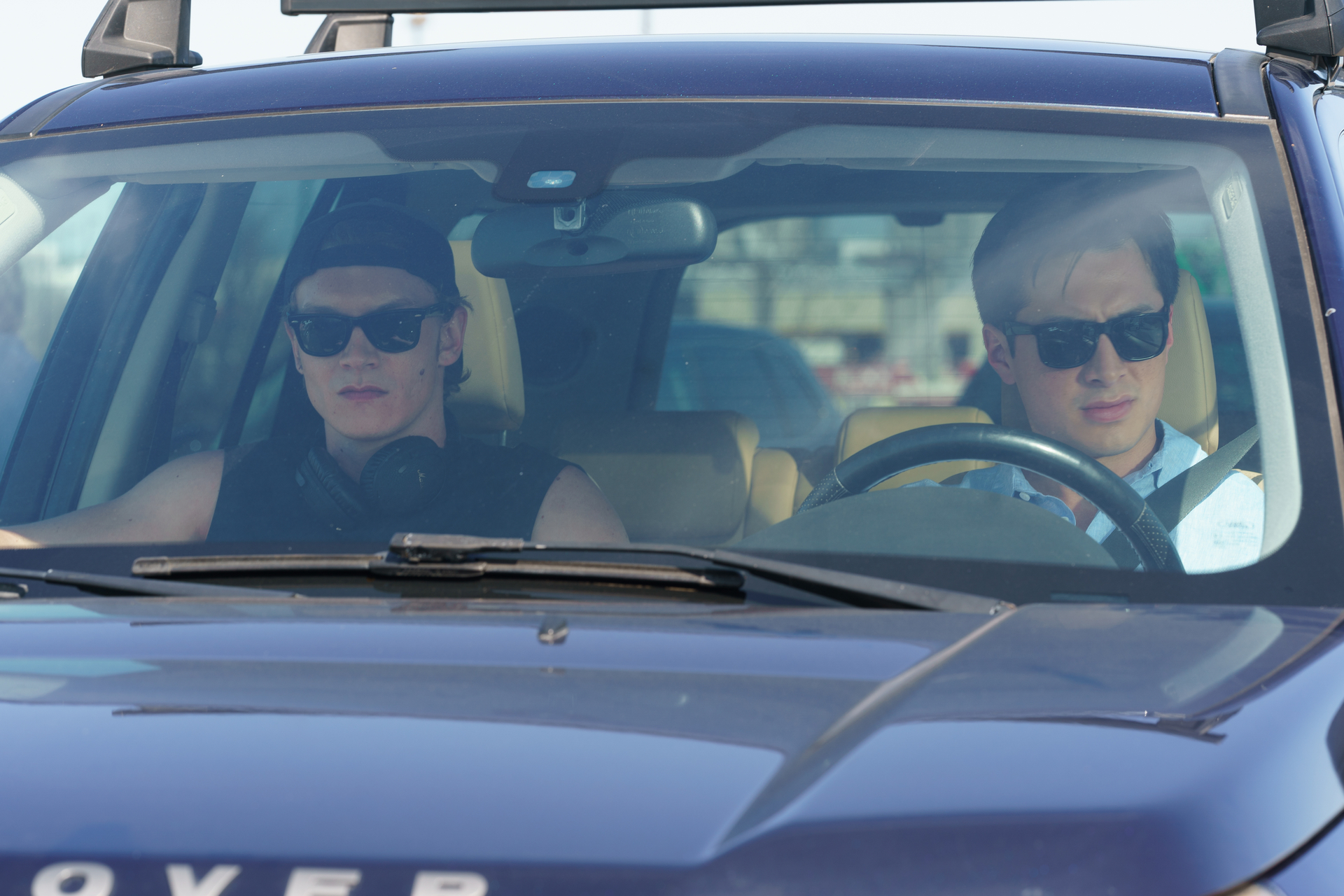
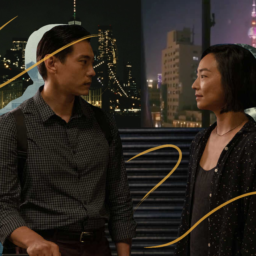
Amidst the First World War, The Girl with the Needle follows a young Danish woman forced to make difficult decisions when she discovers she’s pregnant unaware of the dark secrets that lurk.
The Girl with the Needle is a bleak, dread-filled film that blends psychological horror with real horror, highlighted by disturbing imagery and an ominous discordant score.
The narrative follows Karoline, a young impoverished woman in WWI-era Copenhagen, as she makes difficult decisions after discovering she’s pregnant.
Directed by Magnus von Horn with a style reminiscent of Andrei Tarkovsky, the film transforms from a period drama to a psychological thriller, presenting its dark true-crime story with visceral, emotional impact and even flashes of macabre humor.
The Girl with the Needlepremieredin competition at the 2024 Cannes Film Festival.
There’s a reveal in The Girl with the Needle so heinous and disturbing you’d think you were watching a horror—and at times it feels like it is. With its ominous discordant score and disturbing imagery—like the extended opening sequence where we watch a face (perhaps multiple) distorting and blending into one another—director Magnus von Horn treats the story of one of Denmark’s most infamous crimes with the bleakness and dread it deserves. The movie’s descent into psychological horror (and real horror) isn’t linear though, it takes time to build its narrative in a slow burn that never disengages so that when you’re sucked in, it’s too late.
ADVERTISEMENT
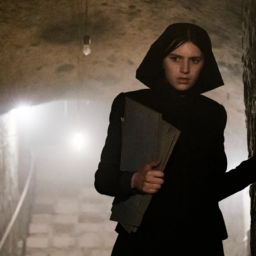
The eponymous “girl with the needle” is Karoline (Vic Carmen Sonne), a young woman living in Copenhagen during the First World War. With her soldier husband missing in action, she’s fallen behind in rent, which she pays for with a factory job sewing uniforms. When her landlord brings a mother and her young daughter as prospective tenants, Karoline does her best to deter them by talking about the smokey stove and rats that crawl in her bed at night. The daughter throws a fear-fueled tantrum at the prospect which causes her mother to slap her, without abandon. The sudden shock of violence isn’t the last instance of mother-inflicted trauma.
After finding a shabby one-windowed attic covered in bird feces to live in, she falls into an affair with Jørgen (Joachim Fjelstrup) the aristocratic owner of the factory who sympathizes with her plight. The swirling romance is cut short when Karoline realizes she’s pregnant, which forces his mother to threaten his inheritance causing a breakup (and Karoline to lose her job). Now with child and nowhere to turn, she turns to desperate measures. She brings one of her knitting needles to the local bathhouse to give herself an abortion. Director and co-writer Magnus von Horn captures the act without sensationalizing it, but it doesn’t make it less effective. He presents it as a visceral bit of body horror that only adds to the dread-filled atmosphere—and eventually his ultimate message.
ADVERTISEMENT
There’s a constant sense of impending doom driven by Frederikke Hoffmeier’s discordant score—like a baseball bat smashing into a piano—even as Karoline is unaware of the plots happening in the background. Even when jovial Dagmar (Trine Dyrholm), an older woman at the bathhouse with her curiously young toddler daughter Erena (Avo Knox Martin), helps Karoline after her failed attempt the darkness remains.
Dagmar offers her a service she provides out of the back of her candy shop. She allows would-be mothers to drop off their unwanted children for her to find them a home with a family unable to have their own—or looking to help an orphan. The mission, though illegal, is so admirable to Karoline that she asks Dagmar to take her in as her apprentice and help care for Erena. From there, The Girl with the Needle takes twists and turns that are better left unspoiled but are made even more impactful when the final title card labeling the story as based on true events drops onto the screen.
ADVERTISEMENT
Von Horn’s direction evokes Tarkovsky’s expressionist style, particularly Persona, with striking crisp black-and-white that suggests horror rather than showing it outright—though it certainly has its moments. As the slow-burn marches towards each of its reveals, it transforms itself from period drama to psychological thriller in a way that is as satisfying as it is shocking. It helps that Vic Carmen Sonne and Trine Dyrholm are giving perfectly pitched performances that transform with the movie.
For a story as dark as The Girl with the Needle, there’s something so enticing about how it presents itself—a storyline involving Karoline’s ex-husband is grotesque in a macabre way but captures you like a sideshow. There are even flashes of the pitchest black humor as Karoline navigates her new situation. Whether you’d consider it a part of the true crime genre is up to you, but if it is then von Horn is pushing the genre to new limits. It is visceral, emotional and relevant without guiding its audience’s hand. Shocking without malice and engrossing without insincerity, it is a highlight of the 2024 Cannes Film Festival.
Dance musical Illinoise takes the songs of Sufjan Stevens’s album of the same name and reimagines them as a series of stories told around a campfire culminating in an emotional queer coming-of-age
Amongst Justin Peck‘s impressive and high energy choreography for Illinoise, the final new musical of the overstuffed and *insert RuPaul “meh” gif here* 2023-24 Broadway season, two men stand on stage hand-in-hand simply stepping to the side, forward, and back. Their hands are on their hearts and slowly their breathing comes in sync. We sit like this for nearly a minute. It’s a quiet moment, one of many in the musical, that catapults it past simply a “dance play”. It’s raw with meaning and drenched in queerness and love and anxiety and hope — a moment that had my inner gay child screaming.
Illinoise has been a personal project for choreographer-turned-director Justin Peck, who held the prestigious title of Resident Choreographer for the New York City Ballet before transitioning to choreographing for theater and film (he most recently choreographed Steven Spielberg’s West Side Story remake). Like many millennials including yours truly, Sufjan Stevens and his concept album Illinois has been a nostalgic favorite — and regarded by many as one of the best albums of the 2000s. The twenty-two song magnum opus is a collection of stories inspired by people, places and events connected to the eponymous state.
ADVERTISEMENT
That celebration of storytelling is what Peck brought to book writer Jackie Sibblies Drury.
Together, they envisioned the songs as stories told by a group that found themselves together in an anonymous forest. But rather than using dialogue, the musical uses dance as its storytelling medium of choice.
The show’s set is a mangle of scaffolding and trees with platforms housing the band and three vocalists above the stage donning butterfly wings (Elijah Lyons, Shara Nova, Tasha Viets-Vanlear) as if they’re a queer Greek chorus narrating what’s happening below (Legally Blonde the Musical, eat your heart out), crooning out Stevens’s music with gorgeous harmonies and orchestral orchestrations by Timo Andres. The twelve-dancer cast is a troop of hikers gathered around a campfire made of lanterns. Their introduction is bright, energetic and joyful as they greet each other (“Come On! Feel the Illnoise!”). The beauty of Peck’s choreography is its ease. Each dancer, though moving with the unit, feels like they’re in their own unique body imbuing their personality into the uniformity. Each of them holds a notebook.
ADVERTISEMENT
Ricky Ubeda in Illinoise on Broadway.
Taking turns, they each tell a story from it set to one of Stevens’s songs, putting it down at the foot of the stage as if activating a new world.
In “John Wayne Gacy, Jr.”, Alejandro Vargas puts a flashlight under his face like he’s about to tell a ghost story. The stage darkens and we watch as the story of the eponymous serial killer comes to life in front of our eyes before Vargas’s character relates the story to the skeletons in his own closet. When the emotion becomes too much, his fellow storytellers hold him as he calms down. In “Jacksonville”, Rachel Lockhart stomps out a hip-hop-tinged number that eventually adds Byran Tittle tap dancing his way across the stage. As the number goes on, Lockhart begins to mirror his moves. It is an energetic full company showstopper that feels like it has deeper meaning. Perhaps it’s about the lessons we pass down from generation to generation to find ourselves stronger — Jacksonville, Illinois was a stop on the underground railroad, so the choice to have two black dancers lead the number feels intentional. After all, the opening line of the song is:
I’m not afraid of the black man running He’s got it right, he’s got a better life coming
But the musical never tries too hard to imbue meaning on the numbers. Stevens has always been opaque about the meaning of his music. Peck, who also directs, adds enough context for you to find your own interpretation rather than telling you like many other dance musicals.
ADVERTISEMENT
The dance numbers range from intimate interpretive pieces to full-blown production numbers that are as thrilling and entertaining as any big brassy Broadway musical.
Lurking in the background, our protagonist Henry (Ricky Ubeda, the season 11 winner of So You Think You Can Dance?) is observing and shirking off the occasional goading to share what is in his notebook. Eventually, he gives in and for the final hour of the musical we see what led him to the campfire in the forest. On the back wall, a bit of graffiti tells us he’s in a small town in the middle of nowhere with his best friend Carl (Ben Cook) and Carl’s girlfriend Shelby (Gaby Diaz). There’s clearly a tension between the three of them as their bodies twist and spin into and out of each other (“Decatur”). After Past Lives, Challengers and Passageslove triangle are clearly in. However, the tension between Henry and Carl is palpable.
As any queer person can attest, in Henry’s mind there’s something potentially romantic between the men. A touch, playful wrestling, a near brush of the lips will send anyone into a spiral negotiating the potential queerness of their straight friend. During the endearing number “Chicago” the pair drive off to… well, Chicago in a swirl of flashlights that become the car and the city passing by before finding themselves in New York City where Henry meets Douglas (Ahmad Simmons). A gay man who sees Henry for who he is. Henry makes the choice to stay while Carl returns to their hometown (“To the Workers of the Rock River Valley Region”).
ADVERTISEMENT
Ricky Ubeda and Ben Cook in Illinoise on Broadway.
The brilliance of Illinoise of using dance to tell this particular story is so much of the queer coming-of-age experience comes from body language.
Something the choreography uses to great affect. Like each of the dancers are spinning objects intersecting with each other in time and space grasping for something — sometimes literally each other or a ghost that disappears in a bit of stagecraft that I’ll leave unspoiled. Brandon Stirling Baker‘s dynamic lighting design and Adam Rigg‘s minimalistic scenic design add to the ethereal effect. When life takes a turbulent turn, the stage uses the negative space to focus in on the details of the choreography. Not just the way bodies are moving, but how they’re moving together.
In the end, Illinoise is about community and relationships. How those around us that we allow to understand our plights can figuratively and literally snap us out of our depressive psyches. Ubeda’s performance, worthy of a Tony nomination, is one of a traumatized man finding those moments of light — and the people he trusts. When he’s first introduced, Henry’s memories are literally represented by orbs held above Carl, Shelby and Douglas’s heads that swirl from Henry’s mind onto the stage (“Three Stars”). His expressiveness in his dance finds its way to his face grasping for empathy that he gets in the form of tears streaming down the faces of the audience (at the very least from a 30-year-old gay man in the second row understanding every emotion). What Illinoise presupposes is that speaking (no matter what the medium) is tantamount to healing. And over a beautiful, engrossing, heart-wrenching but ultimately uplifting 90 minutes, you feel it.
Challengers follows a decade-long love triangle between three would-be tennis stars that culminates in a match nearly as intense as their entanglement.
Challengers tells the story of a decade-long deliciously messy love triangle that is as quick and thrilling as a tennis match and crazy, sexy, cool as the best erotic thrillers. Rapidly volleying between the past and present, director Luca Guadagnino keeps a light and fun tone thanks to a stellar heart-pumping score and clever editing even as the competition (both tennis and for the heart) gets heated. With a trio of perfectly-matched performances with Zendaya further cementing her start status and Josh O’Connor and Mike Faist building on their already impressive work, Challengers is as engrossing, entertaining and delightful as they come. A crowd-pleaser that’ll have you on your feet asking for more.
To call Challengers a romance would be both apt — it is about love and relationships after all — and underplaying just how deliciously messy the love triangle at its center becomes. The plot isn’t particularly shocking, unless you consider a well-placed drop shot a twist. But the increasingly debauched ways that each of the three corners of the triangle tangle, using their pasts and understanding of their psychologies against each other, are constantly satisfying even if you know what’s coming.
ADVERTISEMENT
That’s because Challengers builds to every moment with incredible precision knowing exactly where to hit and how hard for maximum effect.
So when Zendaya’s tennis prodigy Tashi Duncan turns a three-way make-out with best friends and tennis partners Art Donaldson (Mike Faist) and Patrick Zweig (Josh O’Connor) in a dingy motel room during the 2006 Junior U.S. Open Championships into a two-way make-out between the two boys, it’s not only devilishly sweet, it’s exactly where we wanted them to end up.
It all comes back to Justin Kuritzkes’s ingenious screenplay that frames the rocky history between the three would-be tennis stars with what should be a low-stakes match between Art and Patrick that instead becomes a metaphor for their volatile friendship. Each time a point is scored during the match or there’s a particularly intense volley, the movie flashes back to a moment in the entanglement that has the exact same result. Except rather than a point they win Tashi.
ADVERTISEMENT
It’s not pedantic as it sounds, but the feeling it evokes has all the intensity and suspense of any tennis match.
When we first meet Tashi and Art they are married. He a tennis pro in a rut and Tashi his scrupulous coach. To help him gain his confidence back, she enters him into a U.S. Open Qualifier hilariously sponsored by Phil’s Tire Town in the very unglamorous town of New Rochelle, New York. It should be a walk in the park for Art, that is until he realizes that Patrick is also in the challenger.
In flashbacks, Art is portrayed as the more serious of the two. He sees tennis as a serious sport. Something to be mastered. Patrick, on the other hand, with a sly grin often laying back with manspreading as wide as possible, believes you either have it or you don’t. It’s that kind of teenaged dirtbag posturing (the he never really shakes even as an adult) that pushes him to unabashedly pursue Tashi at a post-tournament party at the 2006 Junior Opens. However, Tashi, as tactical and strategic in love as she is on the court, can immediately pick up on the dynamic between the pair — and exploits that by pitting them against each other. Both psychologically and literally when she says she’ll give her number to whoever wins the Men’s Singles Final during the tournament.
ADVERTISEMENT
Zendaya plays Tashi with an easy confidence that captures you as much as it it captures the boys. Her charisma mixed a knowing wit is irresistible.
Her performance is as much of a technical marvel as the well-captured tennis matches. From the start of the triangle, she is in complete control. Not because she wants to be, but because she knows she can. It’s what’s fascinating aboutthe underlying fascination Challengers has with relationships. Like last year’s Fair Play, the movie presupposes that relationships are as much about power as they are emotion. Whether or not there is actually love between Tashi, Art and Patrick isn’t the question. It’s how the tension — both sexual and psychological — drives their decisions.
In the present, Art is on the precipice of retiring at a low point in his career. An emasculating decision that puts strain on his relationship with Tashi as both wife and coach. With so much of their relationship tied up in tennis, how can they go on without it? The subtext: how can she love him without it? On the other hand, Patrick’s unpredictability, that makes him less malleable for Tashi’s uses, also makes him more attractive. It’s those opposing and attracting forces that make the movie drives the movie’s tension through the roof. Even without sex scenes — most end before or pick up after — the eroticism is palpable.
ADVERTISEMENT
However, Guadagnino brilliantly uses the visceral and immersive tennis scenes as the movie’s proxy for sex.
He captures sweat falling, muscles flexing and strained grunting in glorious high definition slow motion that is as captivating as it is gorgeous to look at — for more reasons than one. Guadagnino wrings out the proverbial cinematic rag and switches from player POVs to slow-motion to quick cuts to a stunning tennis ball POV that has the audience literally volleyed between the two players. All the while, Trent Reznor and Atticus Ross‘s thumping electronic score — their best since The Social Network — keeps the momentum going. Along with the crispest ball hitting racket sounds, Challengers is an immersive cinematic experience worthy of seeing on the biggest screen possible (find your local IMAX or Dolby Theater immediately).
However, every single shot is charged. Even though Art and Patrick’s relationship is platonic, there’s something so romantic and even erotic about the way they taunt and chide each other — and of course hit balls.
Challengers feels like a movie we haven’t seen before, or at least in recent memory. One that doesn’t feel bogged down by its self-importance nor trying so hard to be shocking or camp (I’m looking at you, Saltburn). Guadagnino simply has fun with Justin Kuritzkes’s brilliant screenplay and uses each of his three actors exactly as they should. Zendaya is the movie star of a generation. Mike Faist is the steady straight man. Josh O’Connor is a scene-stealer with one of the most complex storylines of all. And at the very least, it’s a blast.
A group of journalists and war photographers trek from New York to Washington, D.C. while the United States is in the throes of a civil war
Writer-director Alex Garland’s Civil War is an all-out assault on the senses that immerses you in a war zone that isn’t just close to home, it is home. When it focuses on the sheer terror and brutality of war — graphic images mixed with the worst of human tendencies — and the emotional and moral complexities of being a war photographer, the movie is nothing short of engrossing. However, whenever it deigns to say anything specific about the current state of society and culture in the United States it feels misguided. Mixed with opaque characters and uneven writing, Civil War feels at war with itself.
Civil War is in theaters now.
The first shot of Alex Garland’s Civil War is of the President of the United States, played by Nick Offerman, in extreme closeup. He says, “We are closer than ever to,” then pauses. You assume he’s going to say “civil war.” Instead, he says, “to victory.” It’s perhaps Garland’s cheeky way of quickly setting up the movie as a cautionary tale. The United States is closer than it ever has been to civil war, especially when he wrote this film four years ago. And it’s clear that Garland came up with this story as a response to what he was seeing around him in this country, even if the movie itself takes place in a somewhat fictional dystopia.
ADVERTISEMENT
While he keeps many of the specifics of what led to the war and how we got to the point that rebellion forces are on the precipice of toppling Washington, D.C. we get a vague understanding of the state of play. The Western Forces are a coalition of states allied with California and Texas that have seceded from the nation and presumably were fed up with a president that dismantled the FBI, sought and won a third term and used drones on American civilians. I’m sure you can imagine who he’s referring to.
It’s part of the fallacy of Civil War. While Garland avoids specifics as a means to focus in on the general themes, he includes enough for us to understand that the story misunderstands what it’s saying.
It’s the trouble of setting an allegory like this in a real-life environment. The benefit is that it adds a layer of relatability and terror at the prospect of an event like this hitting so close to home. Graphic images of war and violence on the streets of New York City or Washington, D.C. are a chilling reminder of what is going on in the day-to-day lives of some around the world. When the movie hones in on the unabashed brutality of war and the complexity of being a war correspondent, the movie’s transparency enhances all of those feelings. But whenever it attempts to bring in real-world artifacts — a line that mentions a fictional “antifa massacre” is particularly jarring — it immediately takes you out of the movie.
But if the mechanics of its world take you out, the story pulls you in and doesn’t let go. Kirsten Dunst plays Lee Smith, a renowned war photographer on the hunt for the holy grail: a photo of the president. Along with her journalist colleague Joe (Wagner Moura), her mentor Sammy (Lady Bird‘s Stephen McKinley Henderson) and aspiring young photographer Jessie (Priscilla‘s Cailee Spaeny) she makes the long, dangerous trek through war-torn land and raging battles from New York City to the nation’s capital.
Along the way, they encounter the monstrosities of war including a suicide bombing that nearly takes both Lee and Jessie out — of course, a second after getting her bearings Lee is up taking photos of the carnage — and a shootout between rebel forces and the U.S. military.
Both scenes are violent, graphic and immersive. Like you’re being surrounded on all sides by gunfire, smoke and the smell of death. Interestingly, Garland doesn’t sensationalize these images. Even when we watch people dying, the image is objective — just as Lee sees them. That isn’t to say she doesn’t care, she believes that the work is a necessity.
As they continue to make their way through the country, encountering people fighting for both sides and those caught in the middle, we learn what drives each of the characters. However, the screenplay never allows us too close. Almost like we’re just seeing them in a still photograph without the context of what come before or what is happening around them. Perhaps it’s an intentional choice. However, it left me unable to become emotionally invested in their journeys.
When barnburner scenes come along like an encounter with a group of soldiers that goes awry — led by Jesse Plemmons in yet another role that proves he’s one of the great character actors working today — there’s suspense because of the situation, but not because we’re afraid for our characters. As Plemmons’s unnamed soldier goes down the line of our hero journalists asking what state they’re from, there’s a palpable amount of tension. It’s moments like it when Civil War fully meets expectations. But then it immediately fades away because we’re not emotionally connected to the characters enough to have actually cared about the outcome.
When Civil War is great, it is magnificent. Especially the climactic final assault on the White House by rebel forces that could’ve been a short film in itself. Though it’s chaotic, Garland guides us through the carnage to tell us a nearly wordless story about the pursuit of the truth, the melancholic thrill of destruction and even the out-of-touch way that our leaders see the country — like their actions have no consequences. It is one of the best action scenes in a war movie in recent memory and shows he trusts the audience enough to understand what he’s trying to tell us. However, when it starts to tell instead of show, Civil War feels at war with itself.
Preceding the 1976 classic, The First Omen follows a young nun-to-be who discovers an insidious plot to bring about the antichrist
Unlike other recent “requels” that are simply retreads of their originals, The First Omen mostly stands on its own as an homage to the original — and the Giallo horrors of the 70s — while feeling fresh and modern. With devilishly delectable imagery as beautiful as it is horrifying, it trades cheap jumpscares for dread-filled tension that gets under your skin and delivers a diabolical thrill that lasts after the credits roll.
The First Omenis in theaters now.
Some horror movies bill themselves as cheap thrills. A fun ride that gives you a temporary rush that ends the second it’s over. Other movies are slower. They methodically sink into your skin. Biding their time so that when you realize how far they’ve sunken in it’s too late. That’s how The First Omen feels. A true blasphemous religious horror that may not feel immediately scary, but the way it presents its story of possession is so deeply disturbing that the walk home from the theater is just as terrifying as the movie itself. It’s the kind of horror that makes you feel dirty after watching it. Like you just saw something you shouldn’t. And that’s real horror.
ADVERTISEMENT
It’s a surprise considering the recent spell of so-called horror “requels” — sequels or prequels to classic movies that are both a continuation and retread of the original — have felt like cheap gags or clear money grabs that rely on fan service ranging from great (Luca Guadagnino’s Supiria) to fine (David Gordon Green’s Halloween) to downright detestable (David Blue Garcia’s Texas Chainsaw Massacre). The First Omen manages to be an homage to the original — and the Giallo horrors of the 70s — while feeling fresh and modern. It stands without any knowledge of the original 1976 The Omen. In some ways, it weaponizes your knowledge of the original against you.
The movie also begins in Rome where Father Brennan (Ralph Ineson) presses Father Harris (Game of Thrones’s Charles Dance) on an ominous photo of a child with the name “Scianna” scrawled on the back. Harris is visibly disturbed by the question but says, “It was an unnatural birth.” Right then, in slow motion stained glass begins falling around the men. Cinematographer Aaron Morton’s naturalistic lighting and grainy compositions are as beautiful as it is eerie. While disaster seems to be averted, when Father Harris turns to leave Brennan realizes a chunk of his skull is missing.
ADVERTISEMENT
It’s the kind of quiet visceral terror that sets The First Omen apart from most modern horror. It’s not the surprise of the scare. It’s the unholiness of the image.
American nun-to-be Margaret Daino (Nell Tiger Free) arrives at Vizzardeli Orphanage to take her vows. She’s bright-eyed and optimistic about her new future but quickly realizes that things might not be as idyllic as she originally thought. Especially when she realizes that one of the children Carlita (Nicole Sorace) is not only ostracized by the other children but feared and mistreated by the nuns who often lock her in the ominously named “bad room” for her erratic behavior like when she inexplicably licks Margaret’s face. Director Arkasha Stevenson maintains a dread-filled atmosphere rather than continually hitting us with unnecessary jump scares. Scenes like Margaret witnessing childbirth rely on what we don’t see as much as on what we see — blood, a dilated pupil, and… is that a demon hand coming out of her?!
In another sequence where Margaret’s roommate and fellow nun-to-be Luz (Maria Caballero) convinces her to go out for one last night of debauchery where she meets Paolo (Andrea Arcangeli). When she follows him onto the dance floor, the strobe lights begin to obscure the image alternating between light and dark. But in those split seconds that we can see small gestures like Paolo pulling her hair back or a hand reaching for flesh feel disturbing until it culminates with Margaret licking his face just as Carlita did to her. The horror is in the image and in the parallel even if it isn’t shocking.
ADVERTISEMENT
Margaret’s journey will take her down a dark path that involves mutilations, freak accidents and, of course, a public suicide just like in the original. However, none of it feels cheap even when the story at times feels like it’s trying too hard to shock you. When it leans in on its dark atmosphere The First Omen fully pulls you in. Even as an atheist, my Catholic upbringing had me reeling at some of the imagery that felt nothing short of evil. The kind of thrill I chase in my horror.
The First Omen is one of the great horror movies of the year against all odds. Sit back and bask in the sinful delight.
Dev Patel’s directorial debut Monkey Man follows an Indian man on a mission for revenge against the people and politics that wronged him
Dev Patel plays triple duty as action hero star and writer-director of his ultraviolent revenge fable Monkey Man. With action sensibilities akin to John Wick and a politically charged narrative deeply embedded in Indian culture and society, the movie is a roaring crowd-pleaser that is as thrilling as it is emotionally resonant. Though its ambitious plot can feel overstuffed at times, Patel’s magnetic screen presence and assured vision keep you hooked from beginning to end.
Monkey Man is in theaters on Friday, April 5.
When the eponymous “Monkey Man” — simply billed as “Kid” and played by Dev Patel — goes to a black market weapons dealer to buy a small concealable weapon the man jokes he’s like John Wick. It’s an apt comparison in many ways. Both The Kid and Wick spend their movies seeking revenge on people who wronged them in stunning, brutal, and neon-lit fashion. However, that’s where the comparisons end. Where John Wick opted for simplicity in its story and complexity in its world, Monkey Man takes place in our world using themes that feel familiar to us while telling a story that we may not be privy to but can relate to.
ADVERTISEMENT
The first time we meet The Kid he’s donning a monkey mask much like the Hindu legend Hanuman, a monkey whose strength and courage helps him rescue the wife of the deity Rama. He learned the story as a child (Jatin Malik) from his mother (Adithi Kalkunte). However, The Kid is no Hanuman. Instead of a battlefield, he’s waging his war in an underground fight club run by a greedy MC (Sharlto Copley) where his skinny frame is no match for the hulking figures he’s meant to fight who more often than not defeat him in the ring. It doesn’t matter to The Kid though, he’s just doing this and various odd jobs to gather money.
For nearly the first hour, exactly what The Kid’s mission is or why he’s on it is unclear. All we know is that the next step is to get a job at a VIP club run by Queenie (Ashwini Kalsekar), a sharp-tongued businesswoman in stilettos. He finds his way in by orchestrating the stealing of her purse in a kinetic sequence that puts Patel’s directorial skills at the forefront. The purse goes from hand to hand across the fictional Indian city Yatana until it reaches Patel where he uses “finding” it to leverage a job at the club. The sequence drives home that the city is split between the upper echelon and the streets — a theme that continues throughout the film.
ADVERTISEMENT
The club’s clientele is exactly who The Kid is targeting, particularly police chief Rana (Sikandar Kher) who we learn through a series of flashbacks murdered his mother and destroyed the community he called home in favor of further development of the sprawling city. We breezily move between the past and the present with little to slow the narrative down even with diversions to The Kid’s unwitting accomplice Alphonso (Pitobash) and an escort called Sita (Sobhita Dhulipala) who works in the club. When he finally hatches his plan, the movie erupts into a flurry of violence that is captured with the kind of singular Bollywood maximalism that Patel said he was inspired by.
Much of the DNA of Monkey Man feels rooted in Patel’s desire to explore his homeland (he was raised in the U.K. by Kenyan-born Indian parents). That extends to the background of The Kid’s mission and the political corruption that is plaguing the country, represented by faux-spiritual figure Baba Shakti (Makarand Deshpande) who uses his benevolent demeanor to hide his oppression of the poor — including the order to remove The Kid’s community that ended with his mother’s death. There’s almost too much on Patel’s mind to get to everything he wants. Another storyline that involves a group of hirja, a tribe of third-gender people, led by Alpha (Vipin Sharma) displaced by Shakti’s policies feels shirked based on its importance in the movie’s final act.
ADVERTISEMENT
However, Patel’s heart is certainly in the right place. As transgender people worldwide fight for their place, it’s encouraging to see this storyline featured. That can be said for much of what Patel is doing with Monkey Man. While it has the mistakes we often see with first-time directors, and especially actors-turned-directors, the sheer ambition is admirable. It’s best on display in the movie’s stunning final act where we get to see the fruits of The Kid’s journey and Patel’s.
The result is the rip-roaring, white-knuckling action filmmaking that is impossible not to be taken by. With kinetic fight choreography and kinetic cinematography from Sharon Meir, it’s a great omen for Dev Patel’s future as a filmmaker.
After a homophobic attack, a gay man sets out for revenge on his assailant when he discovers he is closeted in Femme
Anchored by stellar performances by Nathan Stewart-Jarrett and George MacKay, Femme is a tense, sexy and engrossing queer revenge thriller that feels for us and by us. Subverting the classic “femme fatale” erotic thriller trope and archetype, directors Sam H. Freeman and Ng Choon Ping create a morally ambiguous face-off between two queer men that blurs the line between good and evil and right and wrong. One of the best movies of the year so far.
While the inciting incident of first-time directors Sam H. Freeman and Ng Choon Ping’s Femme is a brutal outburst of homophobic violence, I felt an unexpected feeling of relief after it was over. Erotic thrillers like Brian de Palma’s Dressed to Kill or Paul Verhoven’s Basic Instinct and Elle can at times feel exploitative in their use of violence, sex and sexuality as a plot device. And like those films, as the title implies, Femme centers on a “femme fatale” whose sexuality is front and center. However, instead of feeling like the movie is admonishing our fatale or punishing them for the indiscretions it empowers them. The incident while visceral and vicious doesn’t feel lingered on.
ADVERTISEMENT
It’s helpful that unlike the de Palma or Verhoven movies, Freeman and Ping have the utmost respect for their protagonist, drag queen Aphrodite Banks (Nathan Stewart-Jarrett).
When we first meet her, they’re performing a surprisingly high production number for a drag club. After her number, Aphrodite notices tattooed and toned Preston (George MacKay) outside the venue watching intently. Jules catches his gaze that she returns with a charismatic smile — he sulks off. Later in the night, Aphrodite is at a bodega when Preston and his friends enter, posturing as men do.
When they start verbally harassing Aphrodite, there’s a moment where it seems she’s going to try to ignore it and shrink back. But like a switch ticked off in her brain, she decides to take space up as any queer person would and reads them down. Especially Preston who she calls out for checking her out at the club. It’s what leads to Preston’s assault that leaves Aphrodite beaten and naked on the street.
ADVERTISEMENT
Three months later, the incident has left Jules, who has given up his Aphrodite drag persona much to the chagrin of his roommates Alicia (Asha Reid) and Toby (John McCrea), completely withdrawn from the world. That’s until one day he finds himself in a gay bathhouse where he once again encounters Preston who is cruising. For our straight friends, cruising is when you go to a public space looking for someone to have sex with. It’s not helpful that he lashes out at any forward man with a hearty f-slur. “We’re all faggots here,” someone cheekily responds.
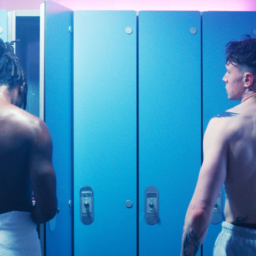
Both horrified and intrigued, Jules follows Preston to the locker room. Unaware of who Jules is, Preston invites him back to his apartment for sex. Behind Jules’ eyes — and a testament to Stewart-Jarrett’s quietly powerful and emotive performance — is panic, interest and, horrifyingly to himself and the us, lust. Preston is dominant and very clearly knows what he wants to which Jules obliges, but right as they’re about to have sex, his rowdy and drunk roommates return. Panicked and left alone in the room, Jules makes a last minute decision to don the hoodie that Preston wore when he assaulted him and leave the room.
The risky move pays off when Jules is able to pass himself off as an old friend of Preston’s and is able to slip out. Angered yet impressed by the move, Preston asks to see Jules again saying he’ll text him when he needs him.
ADVERTISEMENT
Fueled by his performance in the apartment, Jules hatches a plan to get revenge on Preston by weaponizing his sexuality against him and secretly recording a revenge sex tape to out him to the world.
This is where Femme takes a hard firm turn towards a dark and brooding erotic thriller. Jules sets out to lure Preston — like a queer femme fatale — before enacting his revenge. The cat-and-mouse game, that is unbeknownst to Preston, occurs as a series of encounters between the pair that challenge our assumptions of what we know of them. To Jules’ surprise, their first meeting after the bathhouse and apartment incident is an intimate dinner where Preston takes care to make Jules comfortable — like a real date. And while the conversation begins to unwrap the mystery, it eventually devolves into a rough sex scene in the woods where Preston leaves Jules to get home on his own.
There’s a distinct queerness to the entire story and the way each of the characters functions in Femme.
It feels like it’s derived from lived experience. Something that the erotic thrillers of the 90s that it sends up doesn’t have with its female characters — those movies are by and large written and directed by men. There isn’t good or evil. The rights are as morally ambiguous as the wrongs. While our sympathies at first lie with Jules, the more we learn about Preston gives us an understanding — albeit opaque — of his own queer trauma that he’s experiencing. While we never fully dive into his backstory, MacKay’s bombastic performance that oscillates between a put on machismo and tender longing tells us everything we need to know about the character — like his tatted skin is a literal armor for his sexuality.
ADVERTISEMENT
Then there’s Jules, who in the pursuit of much-deserved vengeance, has to grapple with the vulnerability and intimacy that he begins to feel towards Preston as he carries out his plan. While the movie never loses its sense of danger and Preston is always presented as a violent figure that could lash out at any moment — especially in an incident when Jules is caught trying to film one of their backseat rendezvous — the focus is very much on a study of the characters. It makes Stewart-Jarrett’s performance all the more impressive as he has to communicate Jules’ thought process with few words rather furtive glances and body language.
And while Femme has empathy for its characters, it doesn’t ask us to forgive them for their sins. That moral ambiguity is what makes the character dynamics as engrossing as the suspense.
As the movie careens to its conclusion, there’s a sense of romance. A sense that perhaps a lesser movie would give into. Instead, Femme understands its characters but isn’t afraid to leave them as imperfect beings. Perhaps they’re capable of change, but that isn’t the story that Freeman and Ping are telling. Instead, they’re interested in what it is to be unapologetically queer in a space that isn’t made for us, how masculinity is a prison that even we sometimes can’t escape and how our feelings, as powerful and magnetic as they are, are messy and can lead us down paths we shouldn’t follow.
Femme is as messy and beautiful and complicated as we are. It’s the kind of queer thriller we deserve.
Dune: Part Two finds would-be messiah Paul Atreides on a revenge mission that may take him to the dark side of Arrakis
Dune: Part Two is a visceral masterpiece and one of the best science fiction movies ever made. Besides delivering a visually impressive assault on all the senses, it’s also a riveting political thriller and character study that struggles with morality, religion and power. Director Denis Villeneuve guides every facet of the movie—costumes, production design, visual effects, sound—to the very top of its craft.
Dune: Part Two is a The Empire Strikes Back or The Return of the King-level event. A science fiction classic in the making that’ll inspire the next generation of science fiction and fantasy films. Denis Villeneuve continues his unblemished filmography.
Dune: Part Two is in theaters March 1.
From the opening throngs of Hans Zimmer‘s score and saturated rust-colored first shot of the desert planet Arrakis, it’s impossible not to feel immediately transported. Like you were shot out of a rocket straight into a sand dune—ironic because we first encounter our protagonist (?) buried hiding in the sand. That’s partially thanks to director Denis Villeneuve‘s skillful world-building in the first half of the story that brings a detailed view of the future set out in Frank Herbert’s novel of the same name. But what sets Dune: Part Two apart is its absolute audacity of vision that often has your heart skipping a beat.
ADVERTISEMENT
Like the moment when a group of Harkonnen soldiers leap and gracefully float from a sand dune to a rocky plateau to escape an incoming sandworm. Villeneuve makes the moment one of effortless wonder. Like what is happening in front of us is completely normal and the most incredible feat we’ve ever seen before us—partially because it is.
There are countless moments like that throughout Dune: Part Two. There is the breathless battle sequence where suspected messiah Paul Atreides (Timothée Chalamet) and Chani (Zendaya) along with the desert-born Freman people take down a Harkonnen-held spice mining operation or Paul’s jaw-dropping and anxiety-inducing wormriding rite of passage that involves… well, riding a giant sandworm. Both sequences feel like an assault on every one of your senses. It’s like you can feel the grains of sand whipping by your face when an army of Fremen-ridden sandworms blast through a sandstorm to the apparently inaccessible southern hemisphere of the planet.
ADVERTISEMENT
It’s almost impossible not to overstate Villeneuve’s absolute cinematic achievement. It is perhaps the most visually impressive movie I’ve ever seen—a visual and auditory spectacle that is at times difficult to comprehend in the same way that I imagine audiences felt when seeing Star Wars or 2001: A Space Odyssey for the first time.
And just when you didn’t think it could surprise you any more, it introduces you to the black-and-white Harkonnen world as it explore the sadistic but intoxicating villain Feyd-Rautha Harkonnen (Austin Butler is a terrifying scene stealer in a role that proves that Elvis wasn’t a fluke).
Admittedly, I’ve never read Frank Herbert’s book nor seen David Lynch’s much-maligned 1984 adaptation. And after watching the first part of Villeneuve’s adaptation I was confused why this story had to be retold. The story of Paul, an aristocracy-born and bred white man, tapped to lead an oppressed people against his own enemies wasn’t only formulaic but reductive. Hadn’t we advanced past the white savior narrative? So when Dune: Part Two takes a turn to the morally grey area I wasn’t just enthralled, I was impressed.
ADVERTISEMENT
Throughout the movie, Paul is resistant to the label messiah. Not because of some internal imposter syndrome, but because he is prescient of the potential outcome if he embraces the label. That isn’t a new concept. What does feel fresh is the social and political implications of a messiah—or at the very least a leader that people see as the only way out. Dune: Part Two tackles the moral-quandary from many different angles.
There’s the one of Paul who sees it as both a strategic blessing in his mission of revenge against the people that betrayed his family—mainly the Emperor (Christopher Walken) and Vladimir Harkonnen (Stellan Skarsgård)—and a curse that would betray his closest confidant Chani. There’s his mother Lady Jessica (Rebecca Ferguson who continues her enthralling complex performance) who works on behalf of the Bene Gesserit, a group that aligns itself with those that could best help their pursuit of power. There’s the aristocratic elite, the Emperor and his daughter Princess Irulan (Florence Pugh), who are playing for their own relentless pursuit. And then there’s the Fremen, split into two groups. One that is seeing the messiah as their way out of struggle—particularly Stilgar (Javier Bardem)—and the other that see him as a threat to their pursuit of freedom.
In the middle is Chani, who wants to believe in the good she sees in Paul but worries that her infatuation is clouding her better judgement for her people. Zendaya has for years been bubbling to the surface as one of the great new talents of her generation. Dune: Part Two cements her movie star status.
ADVERTISEMENT
With interwoven plots that involve a meddling mastermind fetus, intergenerational feuds and a social and political game of colonization and power, it could have been easy for Dune: Part Two to buckle under the weight of its ambitions—it’s the reason Lynch’s movie and John Harrison’s miniseries adaptations failed. Instead, Villenueve finds a balance between engrossing political thriller and epic science fiction action that grabs for heart and mind and doesn’t let up through its entire surprisingly breezy runtime.
Dune: Part Two in many ways is the classic blockbuster spectacle with its intense battle sequences, ever unfolding world and characters that are held up as heroes. But the way it subverts the hero’s journey, in a way that angered many in The Last Jedi, is what makes it a classic-in-the-making that feels like it has the gravitas of The Empire Strikes Back or The Return of the King. Like those movies, I could see Dune: Part Two inspiring the next generation of great science fiction and fantasy stories. It is that singular. It is that impressive. It is that awe-inspiring.
Dune: Part Two is a once-in-a-generation cinematic event that you do not want to miss. Will you follow the call?
This week, we analyze romantic drama Past Lives and discuss how it explores race, the immigrant experience and challenges the concept of a soulmate
Hey! We’re Karl and Ana. Best friends, writers and movie obsessives that love to analyze (overanalyze?) movies. In Movie Therapy, we take a movie that we love and explore its story and themes to understand what it means to us (and maybe you). This week we analyze Past Lives. Spoilers are abound so proceed with caution.
For the best experience, we recommend you read on desktop. This conversation has been edited and condensed.
Karl Delossantos Hello! 👋 Welcome to the first edition of Movie Therapy, a series where my co-movie over-analyzer Ana Toro and I discuss a movie to understand what it means to us (and maybe you). Today, we’re analyzing the meaning behind Celine Song’s Oscar-nominated drama Past Lives. Shameless plug: you can read my review here.
Hello, Ana! Ready to overthink?
Ana Toro Yes! Our specialty!
Karl I want to start this discussion at the very end of the movie. We watch Nora (Greta Lee) and Hae Sung’s (Teo Yoo) emotional goodbye. As she walks back towards her home and husband Arthur (John Magaro) in the East Village (in my home neighborhood!) Nora begins to cry. How do you interpret that moment?
Ana I think she’s mourning the past – what could have been. In that moment she witnesses a chapter closing. And though it’s the rational thing to want closure, it tends to bring an unexpected amount of pain.
Karl It’s interesting because it feels like she spends a lot of the movie only looking forward. Even when she does look back in the second act when they reconnect over Skype she quickly realizes that it’s something that’s “holding her back” even if it’s not necessarily the case. But I think because she never allowed herself to confront where she’s come from, she’s never had to close the chapter… until that scene.
But at the same time, she’s where she’s always wanted to be. And if you ask me, where she belongs. Something we might disagree about.
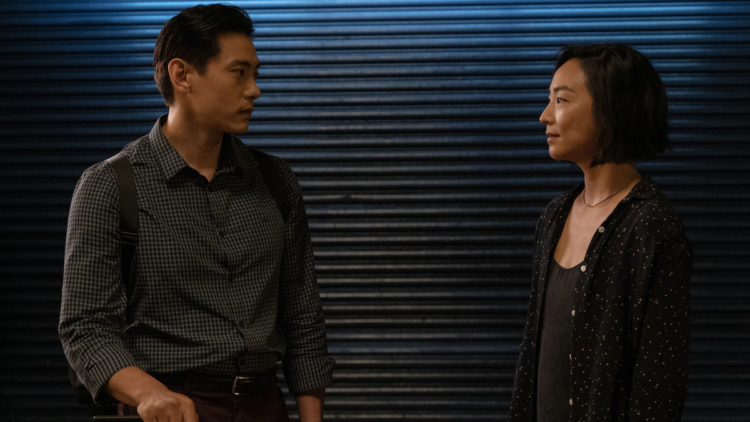
Teo Yoo and Greta Lee in Past Lives. Courtesy of A24.
Ana Haha yes! I mean, the brilliance of this movie is that it is so subtle and nuanced that it really does reflect back at you whatever your current beliefs, or point of views are. When I watched it the first time with you, I was very much in a place in my life where I was looking back to the past, and towards someone from the past specifically. I’m pretty nostalgic by nature, so this wasn’t out of character for me, and I definitely sympathized the most with Hae Sung’s character… to the point where you’ll remember that I was pretty accusatory towards Arthur’s character, believing him to not be right for Nora, and insisting that she should look towards the past to move forward, and be the version of herself that she had left behind.
Karl Projecting, essentially.
ADVERTISEMENT
Ana Exactly. When I watched it a second time I was definitely in a more calm place in my life, having had a bit more closure and feeling a lot more present in my day to day life. So of course, I was more neutral while watching the narrative play out, and I realized that the end wasn’t a tragedy, but rather something beautiful, an acceptance of the past and the present. Nora’s outburst was a catharsis, not necessarily something bad, or more meaningful than it was.
Karl Yeah when we first watched it we were the closest we’ve ever been to arguing in our friendship over whether Hae Sung or Arthur was her soulmate. And perhaps the answer is that soulmates don’t actually exist. At least in the very black-and-white sense that most people think about them.
“Which is interesting because the movie constantly brings up the concept of soulmates, and it’s a recurring motif / theme of the movie so it’s almost like a red herring.“
Ana Which is interesting because the movie constantly brings up the concept of soulmates, and it’s a recurring motif (if not the outright theme!) of the movie. It keeps the viewer guessing as to who she’s going to choose – who is the actual soulmate. For such a quiet movie this is the biggest source of tension that drives the film forward. It almost feels like holding your breath, until the very end when they say goodbye.
Karl Yeah. I mean, the movie is structured like a romance. The direct comparison a lot of people have been making is to the Before trilogy. A series of movies that we love. And in a lot of ways, they are similar in that they talk about the seeming randomness of romance that is actually clouded in fate.
ADVERTISEMENT
Ana It’s like the Before trilogy but happening all at once!
Karl 💯
This might be the time to note too that the writer-director Celine Song based the character of Nora in some part on herself and is currently married to the equivalent of Arthur. Her husband Justin Kuritzkes is a white writer that she lives with in New York. And ironically wrote Challengerswhich is another movie about a love triangle. Maybe they’re dropping hints.
Ana That absolutely changed everything for me. I almost couldn’t believe that in some ways we were given the answer to such an open ended mystery in Past Lives. To me it means that she chooses Arthur in the end! Because he represented her present, and her future. How did you feel when you found that out? Did it change the movie at all for you, or am I reading too much into fiction and its likeness to reality?
Karl I think you can’t not think it’s connected in some way. But unlike you I was always on the side that Arthur is who she should be with. Right now, at least. I think hearing that just affirmed that for me. I went through a pretty big breakup a few years ago and since then I’ve felt very much how Nora felt. Looking forward. Working on my career. Moving myself up and out of my current circumstances.
But I did have times where I thought, “what is this all for?”
Ana I think that’s the thing that we’re meant to be feeling at the end of the movie though – we aren’t ever going to be sure if something is the right choice or not. There are ways to justify any decision or relationship – Arthur and Nora could have in-yun, but so could Hae Sung and Nora. This concept is even poked at by Hae Sung and Arthur during their conversation at the bar: maybe they’re the ones that have the multiple layers of in-yun! There’s truly no way to know, so we just have to accept whatever choice is made.
Karl It makes me wonder whether Past Lives is almost an exercise to assuage the uncertainty of whether you made the right decision.
Ana That makes me wonder a lot about her intentions for making this film, and how much of it she admits to being autobiographical. It’s a beautiful film regardless, but I think it does bring up questions as to how much art resembles life, and if the film’s narrative should stand alone regardless of what she has revealed during the press circuit.
“Nora and Hae Sung are in many ways in opposition to each other. He stayed in Korea, she moved to Canada and then New York. He followed his head to a technical career. She followed her heart to the arts. He’s living in the culture he grew up in and she’s grounding herself in a new one.“
ADVERTISEMENT
Karl As a viewer the first time without that background I think we still picked up what Song was struggling with. Nora and Hae Sung are in many ways in opposition to each other. He stayed in Korea, she moved to Canada and then New York. He followed his head to a technical career. She followed her heart to the arts. He’s living in the culture he grew up in and she’s grounding herself in a new one.
Which is funny when we learn that Arthur is learning Korean to understand her better. Oddly, I think I also related to Arthur, as well.
Ana I know I’m being superficial and too focused on aesthetics and a simplistic romantic worldview, but I just have to say: it is so unfair that Greta Lee and Teo Yoo are the most beautiful people in the world, with chemistry in this movie that is off the charts, inhabiting a film that comes across as aesthetic visual ASMR, and we don’t actually get to see them profess their love to each other. It’s inevitable to root for the beautiful couple with perfect bone structure, that are also childhood sweethearts, separated by fate. But I guess that’s the expectation we’re meant to be pushing up against.
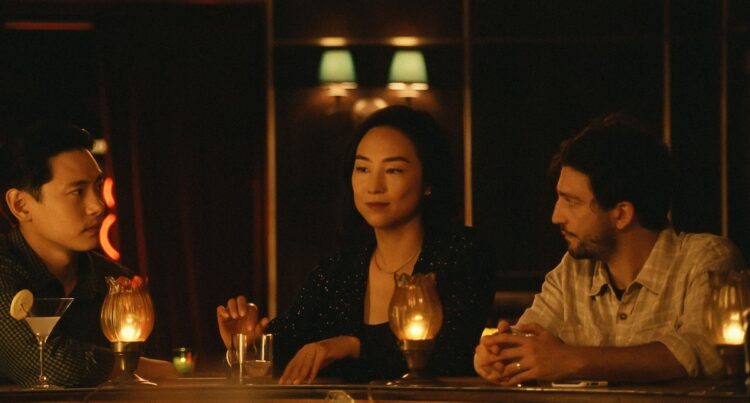
Teo Yoo, Greta Lee and John Magaro in Past Lives. Courtesy of A24.
Karl The bone structure!! Cut from marble both of them.
Ana No like, they were made to be on camera.
Karl But I think this was an intentional decision. We get all these very superficial indications that Arthur is just some average white guy. The book he authored in the movie is called “Boner” for God’s sake!
ADVERTISEMENT
Ana WITH A JEFF KOONS BALLOON SCULPTURE ON THE COVER. Nothing screams out more “mediocre white man” that fumbled his way to the top more than that. I’m sorry, I’ll relax, but my art history minor clocked that immediately and I am of the belief that every single choice in a film is intentional. So why add that? This would be my question to Celine Song if I were to ever attend a Q&A with her.
Karl #Arthur4Lyfe <3
Ana Rethinking our friendship as we speak. I’d leave the conversation if I wasn’t digitally chained to this chat.
Karl I just knew this would end in an argument. But then we see his relationship with Nora and I think there’s a real love there. That scene in the bedroom before they’re about to go to sleep is oddly the centerpiece of the movie.
Ana Karl. No it is not. It is a movie full of beautiful set pieces, and him trying to say fried chicken in Korean is not the one.
“They never express their full feelings. Which is, as an Asian-American, a very real thing. Whereas Arthur is so willing to vocalize the way he feels in that moment. And he delivers for me the most potent line of the movie: ‘You make my life so much bigger. I’m just wondering if I do the same.’”
ADVERTISEMENT
Karl I think I find that scene so refreshing because Hae Sung and Nora often talk around each other. They never express their full feelings. Which is, as an Asian-American, a very real thing. Whereas Arthur is so willing to vocalize the way he feels in that moment. And he delivers for me the most potent line of the movie: “You make my life so much bigger. I’m just wondering if I do the same.”
For Nora, Arthur does make her life bigger. For Hae Sung, Nora makes his life bigger. But I’m not sure he does the inverse. And that’s why Past Lives feels as much about the transient experience (I’m intentionally not saying immigrant here) as it is this specific romance.
Arthur even calls out in a different story he’d be the villain. Though, you certainly think he is. But he’s not. He’s the third protagonist, if anything.
Ana I’m curious as to why you won’t say immigrant! To me this movie really does encapsulate the immigrant experience. Immigrating is all about that central theme, captured by that same line you just mentioned: what makes your world bigger? Does staying in Korea make your world bigger, or smaller? If you feel like you’ve outgrown a place, and like you can grow so much more outside of it, that’s why you immigrate. So you don’t live an entire life unsatisfied, feeling stuck, and wondering “what if”. Just like you would with a past lover – places can encapsulate the same feeling of lost potential, and wanting more. Nora’s parents, even though her dad was successful filmmaker, knew they could have bigger lives for themselves and their daughters abroad, and so they did.
Hae Sung goes to China for the same reason, it’ll expand his work opportunities. After visiting New York, temporarily making his world that much bigger — literally, does he then seek job options abroad? Maybe! Maybe that’s his smile at the end of the movie — he sees a bigger world for himself thanks to Nora. Maybe not a life with her, but his own future, which he can now literally visualize since Nora paved the way, but he’s also free to pursue, without any attachments (at least romantic) in Korea, or New York.
Karl While I do think it definitely touches on the immigrant experiences and uses it to explore about the sensation you’re describing it feels like with a lot the movie it paints in broader strokes as to allow as many people as possible to relate to it. So what you were about outgrowing a place. That doesn’t necessarily have to tie to leaving your specific country. I left New Jersey to move to New York City and that small of a move still felt like my world was expanding. But I think it could be as simple as just leaving the path that is predestined for you. Hae Sung follows the very pragmatic Korean expectation of living with your parents until you’re married, going to school so you can find a stable job. Even going to China was in service of that mission. But that isn’t specifically the immigrant experience, which is why I used the word transient. Maybe transplant might even be more appropriate.
I think if Past Lives was about the immigrant experience then that first section when they were kids wouldn’t have jumped to 12 years later right when she was about to start her life in Canada.
Ana Fair! Totally understand what you mean, and agree that transplant is a better word. Though in an interview with Deadline, Celine Song does say that while the movie is objectively true to her immigrant experience, she does want people to relate to her story even if their experience is moving from St. Louis to L.A., for example. But this is getting into the weeds of how we define immigrants and transplants.
Karl To wrap this up, because this chat is now over 2000 words, I have one last question: which character (or combination of) do you relate to most and why?
I’ll start with my favorite character… Arthur. Muahaha 😈.
Ana Is he really your favorite?
Karl I love them all for different reasons. I think part of it is my affinity for John Magaro who I’ve loved since First Cow. A movie you have to watch since I know your affinity for cows. And I think he has the dialogue that felt most potent to me in a lot of cases.
I guess I feel like I’m a mix of all three of them in a way. I have the good boy aversion to risk like Hae Sung, the headstrong ambition of Nora and the insecurities of Arthur. And perhaps I’ve felt more Arthur recently than Hae Sung or Nora.
ADVERTISEMENT
Ana I agree, I mean I think the beauty of this movie is that it is up to interpretation, and you could see yourself as any of them depending on your current circumstance, or play out a different reality where you, as Nora, does get into the car with Hae Sung at the end. In my first watch with you, pining for an ex-love, I was fully in Hae Sung’s shoes, living in the past, remembering everything and not moving forward. Now I feel a bit more self-assured about the present and my future, like Nora. But through this conversation I’ve actually had a pretty potent realization —
Karl Ahhh a movie therapy breakthrough!
“The reason I was so put off by Nora and Arthur’s relationship (and why I reactively took Hae Sung’s side at first) was that it reminded me of my own relationships and the insecurities I’ve had in them…”
Ana The reason I was so put off by Nora and Arthur’s relationship (and why I reactively took Hae Sung’s side at first) was that it reminded me of my own relationships and the insecurities I’ve had in them, especially regarding having a white partner as a Colombian that I was afraid would never understand my native language, or my immigrant experience.
Karl Yeah I completely get where you’re coming from. It’s something you become so aware of too as you get older and our understanding of race evolves.
Ana In my early twenties and the immaturity that comes with that time of my life, I definitely felt misunderstood and didn’t have the tools or mental stability to have those conversations about my culture, without feeling…
Karl Without feeling immediately defensive about your feelings.
Ana Exactly! It’s a shame, because I do think that relationship could have had a future if we had met later on in life, when I had actually come to terms with my own immigrant experience and that it doesn’t mean I had to explicitly date someone that came from where I came from — they simply had to love me in spite of our differences, and make a true, honest effort, like Arthur does with Nora.
Seung Min Yim and Seung Ah Moon in Past Lives. Courtesy of A24.
Karl And granted we went to a predominantly white college, which I think made all those differences all the more obvious. Same with how Nora found herself in a place so different and foreign from what she knew.
I also had a white boyfriend around that time.
Ana Oh, I remember!
Karl Haha it was a time!! But something he did that I appreciated was take the time to understand where I was coming from in our relationship. We had a lot of conversations about how we could come off as an interracial Asian/White couple. Like cue the colonizer jokes (often from me…). And it angered him that we would be seen that way but I think he eventually understood is that’s a fact of my life. And that understanding was enough. He didn’t have to solve it. But just know about it.
Maybe that’s why I appreciated Nora and Arthur’s relationship. Particularly the discussion they have mid-way through the movie. All Arthur wanted to do is understand where she comes from — even if she was resistant to look back at her own life.
ADVERTISEMENT
Ana That’s lovely! Yeah I definitely was so insecure during that time, that I became a victim and my own worst enemy when it came to having those conversations. But you live and you learn. Which is funny, this is that same relationship I was wondering about right as we watched Past Lives together, and I was thinking, what if things had been different? What if it all took place now?
I remember that day so distinctly: we were having a reflective day, one of those very beautiful fall days where the city and the light is perfect, and it’s unseasonably warm, but you can still pull off a nice fall outfit. The first of our college friend group turned 30 that day, and we met up with her at a cafe. And I remember thinking that we all felt content about where we were in life at that moment. Naturally, that day fell apart in spectacular fashion for me, but we met up again at the end of it.
Karl And while we were walking I think I remember saying we should watch Past Lives because (1) it’s the kind of movie we love. Melancholic. Introspective. Poetic. And (2) it’s so meditative and poetic that I figured it’d calm you down.
Ana It both calmed me down and sent me spiraling, thank you.
Karl The Karl special.
Ana So we were primed to think about our past, present, and futures that day, and me particularly, to imagine a different reality of a life that could have been. It was the perfect film to watch and it highlighted exactly where I was in that moment in my life.
Karl And it helped us both look at our lives at that moment as this long journey. We both separately post-pandemic went on these journeys that took us away from our comfort zones. The movie looks back and explores the many decisions we make to get to a certain point. But it also emphasizes that it is a necessary exercise to move forward and understand you are in the right place. To bring it back to the movie, Nora and Hae Sung on the street with Arthur waiting for her at their apartment was the right place.
And perhaps that place for us was on my couch in the East Village eating a sweet treat watching a movie.
Ana And that place is also here right now with you. I feel like we unearthed some pretty vital and new realizations despite having talked about this movie non stop since we first watched it, and you talking around the plot for months while I gathered up the will to watch it with you. This has been surprisingly cathartic, but I guess that was the point! Thank you, as always, for these conversations. ❤️
How to Have Sex follows a trio of friends on a drunken debauched island holiday that leads to trouble
How to Have Sex subverts the 2000s-era raunchy sex comedy to deliver a sobering holiday drama with a melancholic realistic edge. Despite being set in the present, it has a nostalgic quality as it mines the many complicated feelings we experience as we come of age. Isolation, joy, anxiety, hope, fear, longing. As the movie takes its dark turn, it becomes even more piercing in its exploration of girlhood. With Mia McKenna-Bruce‘s heartbreaking performance as its strong beating heart it is much more than another teen movie.
How to Have Sex is now playing in limited release.
The plot and structure of Molly Manning-Walker’s How to Have Sex closely resembles a 2000s-era raunchy sex comedy where the goal is to get laid — think Superbad or The Hangover (or more recently Bottoms, which subverts the genre). But this is no off-the-wall broad comedy — though there are certainly hijinks, jokes, and drinking. Lots and lots of drinking. Manning-Walker grounds the movie in realism to the point that it’s essentially a mumblecore drama where you’re slipping in and out of very specific moments in the character’s lives. The effect is dizzying, entertaining, terrifying and in equal parts uplifting and heartbreaking — the best movie of the year so far.
ADVERTISEMENT
When we first meet our trio of friends Tara (Mia McKenna-Bruce), Skye (Lara Peake) and Em (Enva Lewis) they are the picture-perfect Essex messes — think Love Island: High School Edition. They’re boisterous, brash and have a weekend away with no parents in the Greek party town of Malia. Tara seems like the firebrand of the group and never shirks an opportunity to “woo” at the slightest luxury of the trip. However, we quickly learn that behind their bravado the girls are just insecure teens.
Manning-Walker captures their debaucherous nights out like any good party movie with thumping bass and flashing neon lights giving way to the girls throwing up after drinking from a comically large fishbowl. But what it quickly sets up is the caring dynamic between the trio — something that we’ll see tested through the movie. As much as our first impression portrays the girls as wildly carefree to a fault, we’re able to empathize with their youthful joy. It’s something that Manning-Walker captures so vividly.
ADVERTISEMENT
It’s something that Tara particularly exudes. Behind all her surface confidence is her insecurity around being a virgin, something Skye and Em are working to change. Which is why when they meet their balcony neighbors Badger (Shaun Thomas) and Paddy (Samuel Bottomley) they see the opportunity for Tara. It’s what careens the story from joyful friendship dramedy to something darker. However, How to HaveSex keeps much of its comedic edge. “Romeo, Romeo, for where is you?” Skye says when they first spot Badger on the balcony neighboring theirs.
Where she felt like an assured woman at the start of the movie, Tara becomes a shy girl when she meets the new group. It doesn’t help either that Skye clearly likes Badger and is jealous of the sweet attention he gives to Tara — who would have thought a man with his name tattooed across his chest would be so swoon-worthy! Meanwhile, Em hits it off with their queer friend Amber (Laura Ambler) adding to Tara’s isolation. The dynamic feels so familiar and relatable. Like being at a party you don’t want to be at. Manning-Walker so deftly captures the feeling with the bright dance music making way to a drowning high-pitched buzzing and the bright neon lights becoming blinding. It’s an assault on the senses. Like a cinematic anxiety attack.
ADVERTISEMENT
It puts us firmly in Tara’s point-of-view so when things turn from uncomfortable to downright trouble we’re right there with her. We feel what she’s feeling. At the center of the story are Tara’s relationship dynamics, particularly with Skye, Badger and Paddy. And they all represent different facets of the coming-of-age trope. Though Skye is her best friend, she tends to project her own insecurities onto Tara. In a drunken slip-up, she embarrassingly reveals to the group that Tara is still a virgin. While she shrugs it off as an accident, it’s clearly a sleight. Paddy is a classic f-boy — who hilariously gets an unfetching tattoo on the trip (I don’t want to know how) — who constantly negs Tara but sees himself as a hero. In opposition, Badger makes her feel nothing but comfortable. It’s that dichotomy of gender dynamics that makes How to Have Sex profound.
How to Have Sex feels like a coming-of-age classic-in-the-making. Despite being set in the present, it has a nostalgic quality as it mines the many complicated feelings we experience as we come of age. Isolation, joy, anxiety, hope, fear, longing. As the movie takes its dark turn, it becomes even more piercing in its exploration of girlhood. Anchored by Mia McKenna-Bruce‘s masterful heartbreaking performance, the movie finds a strong beating heart making it so much more than another teen movie. While it’s not a message movie, it reflects hard truths in the world — and the beautiful things we find to combat them — to remind us we are not alone at the party.
Modern classic Mean Girls returns in musical form to the big screen after a hit Broadway run. So fetch.
Mean Girls, the movie based on the musical based on the movie, doesn’t do much to convince us why it exists. While it does its best to update the story for a chronically online Gen Z audience, it never feels much more than a fresh coat of paint on a perfectly good wall. While the musical numbers are fetch (yes, it’s happening!) and show stopping performances, particularly by Auliʻi Cravalho and JacquelSpivey as Janis and Damian, keep the movie a fun time it isn’t the instant classic of the original plastics. You can’t sit with us.
Mean Girls is in theaters now. It will premiere on Paramount+ later this year.
To talk about Mean Girls, the new movie based on the Broadway stage musical based on the 2004 movie of the same name, we have to talk about the Great White Way’s recent obsession with movie-to-musical adaptations. We’ve been moving towards a world where billionaire studio executives see existing intellectual property as an untapped goldmine. And while movie remakes / reboots / requels (looking at your Halloween and Scream) are typically hit-or-miss with varying excuses for their existence, stage musicals haven’t quite come to the same realization – speaking exclusively of non-musical movies becoming stage musicals. There are past exceptions, of course, like Legally Blonde or Grey Gardens, but the modern state of the genre — Back to the Future, New York, New York — is grim.
ADVERTISEMENT
Mean Girls the musical is a perfect example. It takes a beloved property that is already nearly as stylized as a musical and simply overlays songs on top of its key moments.
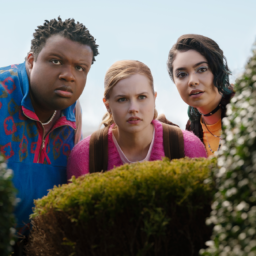
If you’ve somehow missed out on the original, the story follows Cady Heron (Angourie Rice), North Shore High School’s newest student who has returned to the States after being homeschooled in South Africa. What she discovers is high school is perhaps wilder than the savanna. Art freaks / “too gay to function” dynamic duo Janis (Auli’i Cravalho) and Damien (Jacquel Spivey) take Cady under their wing just for her to catch the eye of the school’s popular clique “The Plastics” consisting of aloof Gretchen (Bebe Wood), airhead Karen (Avantika) and queen bee Regina George (Renee Rapp).
But when Cady’s crush on Regina’s ex-boyfriend Aaron Samuels (Christopher Briney) gets out, a war of gossip, crushes and buses ensues.
To justify the existence of songs in the universe, directors Samantha Jayne and Arturo Perez Jr. stage many as fantasy sequences taking place in the mind of characters. Some of these sequences are incredibly effective. Janis (Auli’i Cravalho) and Damien’s (Jacquel Spivey) “Revenge Party” is staged as a pastel-splashed revenge montage and Regina George’s “Someone Gets Hurt” is turned into a dark, twisted party anthem that feel true to the nature of a movie musical. Others like “Stupid with Love” feel more contrived.
ADVERTISEMENT
In adapting the movie to a musical and back into a movie, Tina Fey, who penned all three versions of the story, had to sacrifice some of the impact of the original’s best moments to fit in the musical moments.
For example, Regina’s iconic “get in loser” line comes as the button of a song feels like an afterthought and Damien’s “you go, Glen Coco” gets lost in the shuffle of a musical montage. Other lines like “stop trying to make fetch happen” don’t feel as natural in the brighter more positive movie musical than the original. In adding music to Mean Girls, it also loses some of its bite.
While the original movie wasn’t exactly complex, the characters felt like lived in specimens with a life before the we pick up the story and one that continues after. Perhaps it’s the innate dissonance you get when translating something for the stage onto screen, but I think there’s something more afoot. Mean Girls the movie the musical the movie feels more like a list of plot points rather than a full story. It leans too heavily on your prior knowledge of the plot and the characters. It’s no wonder that the most rewarding moments are the ones where we get to see characters like Cravalho’s Janis, Spivey’s Damien or Wood’s Gretchen step outside the bounds of the original story.
ADVERTISEMENT
On the other hand, characters like Cady and Regina feel like they are too closely chained to the original while striving to become something new — a tension that results in an uneven performances.
While a skilled musical tactician like Rapp is able to find her moments — her performance of Regina’s soliloquy “Watch the World Burn” is standing ovation worthy — Rice gets lost.
Is there a way to bring Mean Girls to a new generation? Perhaps. Social media, TikTok, viral trends and Gen Z lingo are abound in the movie. But it never feels more than a whole lot of unnecessary business piled on top of a perfectly good story. Even the brightest moments feel fleeting. The original was subversive and ahead-of-its-time. This already feels dated. If you’re looking for the Mean Girls for a new generation, just watch Bottoms.
From Beyoncé and Bernstein to Godzilla and Frankenstein, here are the best movies of 2023 that made us, as Nicole Kidman said, laugh, cry and care.
After watching over a hundred new movies in 2023, I’ve narrowed down the list to the 10 best movies of 2023. Well, perhaps not the best movies, but the ones that have stayed with me in one way or another. This year found a comfortable place in the uncomfortable, where filmmakers felt that they were able to tackle themes and stories that were once taboo in ways that are increasingly tailored to our ever-evolving hunger for unique perspectives and bizarre storytelling. My list reflects that.
To see every movie I watched in 2023 racked, go over to Letterboxd.
To explain Bottoms, I need to spoil it just a tiny bit. The final shot of the movie, a baroque painting if I’ve ever seen one, pulls from a classic 90s / early aughts high school comedy trope. The school football team triumphantly raises the school’s quarterback. Students rush the field dancing with joy. Our best friend protagonists make up and hold each other. However, a few added details make this unlike any high school comedy we’ve seen. The field is littered with incapacitated (and possibly dead) players and our ragtag group of protagonists are covered in blood (both their own and others’). In the background, a tree burns after recently being blown up with a homemade device. Welcome to the wonderfully weird and wacky world of writer/director Emma Seligman‘s Bottoms.
Seligman’s vision of high school in Bottoms is equal parts satiric and surreal. Like if Luis Buñel directed The Breakfast Club or Andrei Tarkovsky directed Clueless. It’s a tricky tone that Rachel Sennottand Ayo Edebiri nail with perfectly pitched performances as woefully lame high schoolers PJ and Josie. All they need is a mission. And like any good high school raunchy comedy, this mission involves getting laid: “Do you want to be the only girl virgin at Sarah Lawrence?” Best friends that stick together get laid together. At least that’s their prerogative. The absolute absurdity never relents, yet Bottoms manages to pull at the heart strings. That’s what makes it the best comedy of the year and one of the best movies of 2023.
A clip from Godzilla Minus One. Courtesy of Toho Studios.
Hey, Hollywood? This is how you do a blockbuster. Just when we thought the action blockbuster was dead in 2023, Godzilla Minus One came roaring in at the final moment to save the genre. And while the spectacular giant monster destruction in the forefront has you leaning forward in your seat with bated breath — like a remix of Jaws where our ragtag group of heroes is dealing with a much much larger shark — the character drama grabs for your heart and makes the action all the more tense.
Though it’s a prequel to Shin Godzilla, the first film in Toho Studios’ reboot of the franchise, Minus One is more like a drama that happens to have a giant monster than a full-blown Kaiju movie as it follows failed Kamikaze pilot Kōichi (Ryunosuke Kamiki) coping with the fallout of the war. While some deal with the grief and trauma by looking to the future — like young suddenly-single mother Kimiko (Minami Hamabe) — Kōichi constantly looks to the past with regret. He gets the chance to right his perceived wrongs when Godzilla takes aim at the already battered country. Part-war epic, part-classic Kaiju, part-found family drama, Minus One is the perfect crowd-pleasing action movie we were craving this year.
Writer-director Yorgos Lanthimos has always played in magical realism, but with his first foray into full fantasy he is able to flex his world-building like never before — and the result is as magnificent and deeply weird as we hoped.Cribbing the tale of Frankenstein, Poor Things takes place in our world (with familiar locations like Victorian-era London and Portugal), but Lanthimos imagines it as a colorful storybook full of childlike wonder that mirrors protagonist Bella’s (Emma Stone) state of mind as she comes of age after being created by Dr. Godwin Baxter (Willem Dafoe) whom she affectionally calls “God.” In classic Lanthimos fashion, Bella’s creation is deeply disturbing as Dr. Baxter uses the brain of an infant to reanimate the corpse of an adult woman. Of course, that disturbing premise isn’t without reason.
Poor Things spins up a tale of discovery both of the self and the world. As Bella comes into herself and into her sexuality, the movie doesn’t shy away from the ugliness of the patriarchal world — represented by a devilishly delightful villain turn by Mark Ruffalo — but also the pure joy it can bring to live a life unburdened by societal norms. The result is a wonderfully batshit epic that is as heartbreaking as it is uplifting.
ADVERTISEMENT
Passages
Franz Rogowski and Adèle Exarchopoulos appear in Passages by Ira Sachs, an official selection of the Premieres program at the 2023 Sundance Film Festival. Courtesy of Sundance Institute | photo by Guy Ferrandis / SBS PRODUCTIONS
When we first meet German filmmaker Tomas (Franz Rogowski), he is directing the final scene of his latest movie. We watch him as he instructs an actor to enter the scene down a flight of stairs. Then he makes him do it again… and again. Each time he notices something else wrong with the way he enters the scene. We’ll see Tomas do something similar throughout Passages, except this time to the people in his life — specifically his long-suffering husband (Ben Whishaw) and new lover (Adèle Exarchopoulos). That is expecting them to act one way— the way that is best for him and his wants — and getting frustrated when they don’t follow the script he’s written for them in his head.
Eventually, the magnetism that draws people to Tomas begins to repulse them and the gravity that kept them in orbit becomes weaker. Essentially, his life goes off script and he’s not good at improv. While Passages could have easily relied to melodramatics, Sachs keeps each character and interaction grounded. Writer-director Ira Sachs introduces us to the characters of Passages when their lives intersect and tangle into a mess of complications. By the end, Whishaw, whose remarkable portrayal of a gay man finding his strength and independence, untangles the knot and leaves us (and Tomas) flooded with emotion.
In recent years, Japanese writer-director Hirokazu Kore-eda has been interested in stories about misunderstood people from the found families of Shopliftersand Brokeror the complicated parents of The Truth or After the Storm. He continues that trend with the three points-of-view that make up his latest feature Monster as he plays with our expectations of each of the characters. The core story seems straightforward. We start from the perspective of a single mother (Sakura Ando) concerned about her son’s (Sōya Kurokawa) increasingly erratic behavior who goes on a warpath when she discovers his teacher (Eita Nagayama) may be responsible.
Kore-eda is so skilled at presenting his characters with so much depth that it’s almost impossible not to see the story from their point-of-view and think their actions are justified. In the mother’s chapter, for example, seethe with the same anger that she feels when the school brushes off her initial complaints — in a surprising bit of dark humor. But then, when we discover more through the next chapter, the seemingly uncaring school administration becomes human. Through each chapter of the triptych, our own allegiances shift, but especially in the final perspective that is as heartwarming as it is heartbreaking. Taken as three individual stories, Monster is already impressive. As a whole, it’s a gorgeous tapestry of mystery, suspense, drama and romance that begs to be rewatched.
ADVERTISEMENT
Renaissance: A Film by Beyoncé
A clip from Renaissance: A Film by Beyoncé
The brilliance of Renaissance: A Flim by Beyoncé, a nearly three-hour epic concert documentary, becomes clear just 25 minutes in. And despite the reputation (say hey) Ms. Carter has made for herself as a perfectionist, a moment of imperfection stands out. As we catapult from “Cozy” into Beyhive-favorite “Alien Superstar” the audio suddenly cuts out — and no, it’s not yet time for the mute challenge. We see as the crew, donned in shimmering silver jumpsuits jump into action. Beyoncé is unphased and even decides to gag the crowd by changing her outfit during the short three-minute interruption.
However, because we watched a vignette of the crew putting the stage together with a voiceover by Bey herself explaining the complexity of the show, we know exactly the stakes involved and the people that ultimately save the day. It’s this structure where we’re treated to some background about the tour, the album or Beyoncé herself followed by a part of the show that is directly inspired or impacted by it that makes Renaissance such a satisfying documentary. Oh yeah, and Beyoncé is the performer of our generation. There’s that too.
Sandra Hüller and Milo Machado-Graner in Anatomy of a Fall.
Don’t blink. You’re not going to want to miss a thing in Justine Triet’s Anatomy of a Fall. While the movie sets itself up as an episode of Law & Order: French Edition as we unravel the case of the mysterious fall of a husband and father. Was it an accident? Or did his wife Sandra (Sandra Hüller) or young son Daniel (Milo Machado-Graner) have something to do with it? As we sweep from investigation to trial, Triet gives us nearly all the clues to solve the case. However, it is still up to the audience to decide who to believe. Hüller’s remarkable performance will sway you in either direction with the smallest inflection or glance.
While structured like a standard procedural, Anatomy of a Fall pays attention to every detail. There is never a shot or line that doesn’t have a purpose, which makes the robust runtime fly by. More impressively, though, Triet is also able to throw in astute observations about marriage, parenthood and even the French judicial system — which if you don’t know is messy messy — that add to the richness of the movie. While the movie has a definitive end, rewatches can uncover something you missed that might change your interpretation of the case. It’s that staying power that makes it one of the best movies of 2023.
ADVERTISEMENT
Perfect Days
Koji Yakusho and Arisa Nakano in Wim Wenders’ Perfect Days | Courtesy of TIFF
The subgenre of day-in-the-life movies where nothing really happens yet everything is happening will get me every time — and Wim Wenders’ Perfect Days is… well, a perfect example. The way Wenders shows us Hirayama’s (Kōji Yakusho) daily routine is so comforting — the cinematic equivalent of a weighted blanket. Each morning, he wakes up in his modest apartment, makes his bed, carefully waters his plants, steps out donning blue coveralls with “The Tokyo Toilet” scrawled on the back, grabs his morning coffee and sets out on his job cleaning the city’s vast network of public toilets.
However, the magic of Perfect Days comes in the little diversions from his routine like when Mama (revered enka singer Sayuri Ishikawa) trills out a Japanese rendition of “House of the Rising Sun” or his niece arriving at his tiny apartment unannounced. These detours give us a small insight into Hirayama’s interior life, which he seems to have locked away behind his quiet contentment. We may not know much more about his world by the movie’s stunning ending, but we do learn his philosophy. And that may be the greater gift.
Natalie Portman and Julianne Moore in Todd Haynes’ May December. Courtesy of Netflix.
From the second Julianne Moore’s Gracie opens a refrigerator and dramatically says over a discordant chord, “I don’t think we have enough hot dogs” you understand exactly what kind of movie May December is. However, while it is a 70s melodrama on its surface filled with darkly comedic verbal and psychological sparring between Natalie Portman’s B-list actress Elizabethand Moore’s notorious tabloid subject, it never shies away from the darkness of its story.
On the surface, May December shouldn’t work with its contrasting tones of dark comedy mixed with near-parody satirical elements and sentimental dramatics that deal with trauma, grooming and sensationalism. Still it manages to find balance in a way that allows you to enjoy it without letting you get too comfortable with the sensitive situation.
Like with all of his movies, writer-director Todd Haynes allows his characters to show you their character rather than telling you. While there are emotionally resonant moments of insight like Charles Melton’s performance as a young father having a heart to hear with his own son, something as small as the way Melton carries himself that is just as affecting.
Greta Lee and Teo Yoo in Past Lives. Courtesy of A24.
Celine Song’s Past Lives has held the top spot on my best movies of 2023 list since seeing it back in January at the Sundance Film Festival — and that’s partially the movie’s own intention. Though the movie is rich in its story and characters as it follows old childhood crushes that reconnect twelve and then twenty-four years later, it’s the memories of it that linger.
While Nora and Hae Sung’s story, brought to life with stellar performances by Greta Lee and Teo Yoo, is presented as a decades-long “will-they-won’t-they” romance — complete with swoon-worthy conversations and charmingly comical banter, it’s really a story about one person stubbornly chasing a future she’s decided for herself and another avoiding a future by constantly looking back. And while the dialogue Song uses to communicate their feelings is poetic (she is a playwright after all), it’s the visual language that is the most impressive.
Song doesn’t present any easy answers, which is why the movie stays with you long after its stunning heart-wrenching but cathartic final scene. Is looking to the past avoiding the future? Is staying resolute on your future ignoring your inner child? The answer is perhaps hidden in a line from the third member of the trio Arthur (John Magaro), “You make my life so much bigger. I’m just wondering if I do the same.” Past Lives somehow achieves the same effect on its audience and that’s why it is the best movie of 2023.
Renaissance: A Film by Beyoncé takes us onstage and behind the scenes of her record-breaking tour with intimate vignettes that uncover how the show and album came together.
The nearly three-hour concert documentary epic weaves personal narratives and impressive concert footage to give us an intimate glimpse into the literal blood, sweat and tears that go into creating a show of this magnitude and the love, joy and respect that go into creating an artist like Beyoncé. Renaissance: A Film by Beyoncé isn’t just a record of a concert, it’s a complete story of one of the greatest artists of our generation. And it is completely befitting of a woman of her stature.
Renaissance: A Film by Beyoncé is in theaters now.
The brilliance of Renaissance: A Flim by Beyoncé, a nearly three-hour epic concert documentary, becomes clear just 25 minutes in. And despite the reputation (say hey) Ms. Carter has made for herself as a perfectionist, a moment of imperfection stands out. As we catapult from “Cozy” into Beyhive-favorite “Alien Superstar” the audio suddenly cuts out — and no, it’s not yet time for the mute challenge. Ironic considering the song starts with, “Please do not be alarmed, remain calm / Do not attempt to leave the dance floor.” We are unmoved. If anything we’re stunned. We see as the crew, donned in shimmering silver jumpsuits jump into action. Beyoncé is unphased and even decides to gag the crowd by changing her outfit during the short three-minute interruption.
ADVERTISEMENT
She rises again from the stage in a new silver stunner and the number continues, perhaps even stronger than before. The scene is preceded by the first of several interludes that dive into a facet of the tour, the Renaissance album, or Beyoncé herself. In this vignette, she explains the logistics of putting together a concert of this scale. She emphasizes the sheer magnitude of the staff from the dancers to the lighting technicians to the army of workers putting the stage together by hand — and points out that she didn’t want them to be hidden hence the silver jumpsuits. The explanation gives the audio mishap more dimension and complexity because we understand how close to failure the show could be at any moment.
Unlike other concert documentaries like Talking Heads’s Stop Making Sense or Taylor Swift’s recent The Eras Tour, Renaissance doesn’t aim to immerse you into the live show. Though it certainly does.
We’ll get to that. Instead, it aims to add meaning to it. It weaves together the personal narratives behind its various moving parts and the literal blood, sweat and tears that went into producing it. It makes the highly impressive performance numbers all the more impactful.
In another vignette, we spend time with Blue Ivy Carter. At just 11 years old she asks her parents to perform on stage. It’s already a scary enough prospect for any tween, let alone the offspring of Beyoncé and Jay-Z. Despite initial pushback, especially from Beyoncé herself who experienced first-hand the stage at such a young age (albeit at a much smaller scale), they agree. Much has been made on social media of Blue’s appearance and dance break set to “My Power” off of The Gift. It’s something that she talks candidly to the camera about. After her first appearance, the internet wasn’t entirely kind. Instead of letting it get to her, she talks about how it empowered her to continue on and to improve herself. It connects perfectly to the song itself:
“Keep it locked in a safe Don’t make me get back to my ways My power, they’ll never take”
It’s that profound mirroring that makes the structure of Renaissance so satisfying.
ADVERTISEMENT
And while all of this documentary filmmaking is impressive, you come to Renaissance for a show. And a show you will see.
For any souls lucky enough to experience it in person know that Beyoncé performs like no other. The kinetic choreography feels like it plays with the camera as much as it plays with the crowd. There are even moments when dancers will flourish directly to the camera making the audience feel like they’re seeing something unique to the film. The songs of Renaissance are propulsive as is. Still, the way the show mixes each into the next creates an unstoppable momentum that is some of the most impressive concert documentary filmmaking ever.
To add even more to the elegant chaos, each number showcases the various looks that Beyoncé and her dancers donned across the fifty-six shows of the tour with quick match cuts that mirror this iconic bit of editing magic from Homecoming. The effect is overwhelming and doesn’t just communicate the audacity of having different costumes for each show, it makes the musical numbers more than just a capturing of the show rather a time-jumping montage of the sheer epicness of the tour.
ADVERTISEMENT
The interstitial vignettes cover themes as small as Beyoncé’s connection with her hometown Houston — including a trip to Frenchy’s — and Blue Ivy’s crusade to have the song “Diva” included in full — a hilarious cut from her rant to the performance in the concert is a highlight — to larger societal themes like being a working mother or how vogue and ballroom impacted the creation of the album and show. However, one stands out. Before “Heated” (get your fans out), Beyoncé and her mother Tina Knowles talk about the real-life Uncle Johnny who inspired the now-iconic line, “Uncle Johnny made my dress, the cheap spandex she looks a mess.”
Johnathan “Johnny” Williams was Beyoncé’s uncle. An openly gay black man living with HIV. Tina opens up about their time as young adults partying and designing clothes, laying rhinestones down on fabric one by one. The emotional story adds color to what exactly Renaissance is. It’s a celebration of queer Black joy inspired by her Uncle Johnny. However, it more broadly speaks to who Beyoncé has become as an artist.
She is so often revered as larger-than-life, and in many ways she is. With this film, she tells us that while she’s able to communicate these concepts epically, they all originate from completely human experiences.
And the tour, despite its perceived perfection, was born out of real human blood, sweat and tears. But also love, joy and respect for those who came before. Renaissance is a love letter. It’s a three-hour sweat-your-ass-off-until-you-forget-your-troubles-romp that will go down as one of the greatest concert documentaries of all time.
Newfest 2023 | In Netflix’s new biopic, Colman Domingo plays civil rights activist Bayard Rustin as he plans the March on Washington in just eight weeks
Thanks to a focused storyline and sensational theatrical performance by Colman Domingo, Rustin largely transcends the typical biopic formula to deliver a satisfying account of Bayard Rustin’s formation of the March on Washington. While George C. Wolfe’s kinetic direction keeps you engrossed in the story, a light screenplay doesn’t allow us to explore the complexities of a Black queer man at the forefront of the civil rights movement.
Rustin had its New York City premiere at the 2023 New York LGBTQ+ Film Festival.
Bayard Rustin, the unsung hero of the civil rights movement, is finally given his flowers in Netflix’s new biopic directed by George C. Wolfe (Ma Rainey’s Black Bottom) as it hones in on the eight week dash to plan the now historic March on Washington for Jobs and Freedom. It’s not surprising if you didn’t know who Rustin was before. His involvement in the civil rights movement was often relegated to the background since he was one of the few gay men to be out in the 1960s. However, Rustin doesn’t shy away from it.
There’s something about a biopic that just works that is so satisfying. It’s the perfect combination of an interesting but unsung subject and a specific story told with enough of a singular vision to transcend past conventional biopic trappings — and Rustin, for the most part, finds the right formula. By focusing in on the planning for the March on Washington and Rustin’s impulses to live life as an out and proud gay man with the spotlight encroaching on him gives the movie focus where other biopics feel unnecessarily packed.
George C. Wolfe’s deft direction fueled by saxophonist and composer Branford Marsalis‘s kinetic score keeps you engrossed in the story while constantly introducing new characters that weave the tapestry of the near-impossible feat of organizing the largest peaceful protest in history. To carve out storylines for a figure as massive as Rev. Dr. Martin Luther King, Jr. (Aml Ameen) as well as an invisible figure of the movement like Rustin’s lover Tom (Gus Halper in an impressive supporting turn) and mine sympathy for both is nearly as impressive. However, if those supporting performances are the blood of the movie, Colman Domingo‘s performance as Bayard Rustin is the strong beating heart.
Domingo is nothing short of sensational. A theatrical rendering of a man that in many ways was larger than life living in a world that sought to dull his shine — both from those against him and on his side. Despite his preference for collaboration, as seen in a charming scene where he begins the seeds of the march with a good ol’ fashioned brainstorm, he seems to be fighting for his voice to be heard constantly. Partially because his panache was itself seen as a sort of protest, but also because with any movement egos can quickly get in the way. With politicians, the NAACP and activists, there was as much division in the movement as there was outside. What Julian Breece and Oscar winner Dustin Lance Black‘s screenplay attempts to explore is how Rustin was able to coalesce those ideas into what is now seared into our country’s consciousness.
ADVERTISEMENT
Rustin‘s greatest flaw is that it tends to shy away from his flaws to begin with. There are moments where it begins to probe Rustin’s penchant for distraction (often of the male variety) and rigidity in vision, but it never goes as far as to criticize him. Rustin’s inner turmoil will bubble its way to the surface in fits and starts, but often the movie will cut away just before it gives us any sort of real insight. It’s why the stakes never feel great.
While that makes the movie less successful as a portrait of Bayard Rustin, as an account of his involvement in the planning of the March on Washington it is a satisfying jaunt. It feels like a lost peace of history finally brought to the surface as it doesn’t shy away from Rustin’s queerness. In fact, it centers it in a way we don’t often see in mainstream biopics (*couch*Bohemian Rhapsody*cough*). Coupled with Colman Domingo’s charismatic performance, Rustin is an easy biopic — for both better and worse — that is easy to find yourself lost in.
NYFF 2023 | A Tokyo toilet cleaner enjoys his routine-driven simple life. But unexpected detours force him to face what is simple and what is safe.
Perfect Days is a slight but entertaining and profound day-in-the-life romp through Tokyo that meditates on the dignity of making a living, protecting your peace, and both the beauty and trappings of routine. With an impressive watershed performance by Kōji Hashimoto and Wim Wenders’ sensitive direction, Perfect Days is a simple near-masterpiece.
There’s something about the way Wim Wenders’ Perfect Days shows us a day in the life of the its middle-aged hero Hirayama (Kōji Hashimoto) that is so comforting — the cinematic equivalent of a weighted blanket. Each morning, he wakes up in his modest apartment, makes his bed, carefully waters his plants, steps out donning blue coveralls with “The Tokyo Toilet” scrawled on the back, grabs his morning coffee and sets out on his job cleaning the city’s vast network of public toilets — something the people of Tokyo have always taken pride in. His work is also something Hirayama takes pride in. His coworker Takashi (Emoto Tokio) even marvels that he brings his own equipment to work. “How can you put so much in a job like this?” he asks. Like most of their exchanges, Hirayama is quiet.
ADVERTISEMENT
But that doesn’t mean that he’s silent. There are moments of pure bliss. Like when he steps out of his apartment and looks at the clear sky or teaches a British woman how to use the high tech bathroom — the glass opaques when you lock the door! — a soft smile finds his way to his face. Even when things aren’t great he seems content — a drunk business man knocking over the “Wet Floor” sign or an angry mother snubbing him when he finds her lost son. And the movie continues on that way for a large portion of its runtime introducing new elements to his daily routine that slowly unlock the mystery of Hirayama’s past.
But it’s never boring. The same way that Kelly Reichardt finds texture in the slow burn of her movies — particularly First Cow — Wenders finds small moments of magic in Hirayama’s days. One of the most impactful is his nightly drink at a local bar run by a woman affectionately known as Mama (revered enka singer Sayuri Ishikawa) trills out a Japanese rendition of “House of the Rising Sun” that punctuates the melancholic tone to the movie.
It’s in these diversions from his routine where Perfect Days fully captures you. One day, Takashi’s “girlfriend” (Aoi Yamada) comes to visit him at work (“A real ten out of ten”) as he would say. But after his motorcycle fails to start he convinces Hirayama to let them drive his van to the bar… with Hirayama in the van. The two young would-be lovers are fascinated by him and his collection of American cassettes ranging from Van Morrison to Lou Reed, which provide a perfect vibey soundtrack. But it’s when Takashi lets slip “being alone at your age” before trailing off. Hirayama doesn’t take much from it, but we do.
However, the movie takes its biggest turn when Hirayama’s precocious teen niece (Arisa Nakano) shows up at his door step. It’s a bit of a shock for us as he comes off a detached loner. To learn he has family just adds to his depth. We’ll learn a bit more about why he chose this life of protected peace. His niece, a mirror to himself in some ways, forces him to look at his life and choices from a birds eye view and allows us to do the same. But it also gives us insight to his philosophy as he tells her, “Next time is next time. Now is now.”
The final shot is a marvel — and puts Hashitomo’s performance in contention for one of the best of the year. Like the rest of the movie everything and nothing is happening at the same time. Wenders captures the feeling of walking or driving through your city at golden hour. Everything is the same but looks different. It feels nostalgic, melancholic but — and maybe this is Wenders’ point — meaningful. As Nina Simone croons out “Feeling Good” over an unbroken long shot of Hirayama’s face illuminated by the sun a sense of satisfaction creeps over us — like when you reach the final perfect line of a simple poem. Perfect Days is a well-constructed meditation. Simple, relatable but will follow you for the rest of your day.